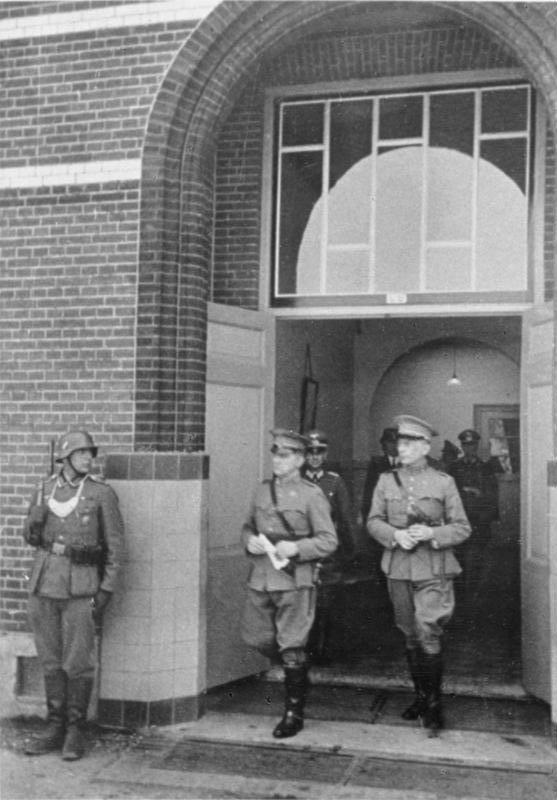
The Netherlands surrendered to Germany at 10:15 AM. After the shattering Luftwaffe destruction of Rotterdam, the Dutch fighting spirit (at least among the leadership) dies on 15 May 1940. Dutch General Henri Winkelman capitulates at 10:15 in a formal signing at Rijsoord, a suburb of Rotterdam. The Dutch army is out of the fight except in Zeeland and isolated spots such as Walcheren Island and Beveland, where there are some holdouts. The Wehrmacht’s 18th Army occupies “Fortress Holland,” including Amsterdam, The Hague, and Rotterdam. There are some members of the Dutch Fascist Party on hand to greet them.
The German 18th Army occupies Amsterdam and The Hague. The conquering German Army marched into The Hague in peaceful fashion today, while fighting against the Nazis apparently was continuing in remote districts of the Netherlands despite an order to the troops to lay down their arms except in the Zeeland area.
The spirit of the Netherlands is unbroken because its conscience is clear and the Netherlanders will never give up their faith in the pause of freedom and justice, Queen Wilhelmina declared tonight from London.
The Battle of Sedan ended in German victory. All the bridges across the Meuse were captured, allowing the Wehrmacht to pour across the river and advance toward the English Channel unimpeded.
General Gamelin informs Defense Minister Daladier that the front is broken.
General Bilotte, commanding the French 1st Army Group, decides to abandon the Dyle line in the face of Reichenau’s attacks. His superior, General Georges, concurs with the decision and is now in fact beginning to lose his nerve.
At 0730 hours, French Premier Paul Reynaud phoned British Prime Minister Winston Churchill and told him, “We have been defeated; we have lost the battle… The front is broken near Sedan.” Churchill, attempting to offer some comfort to Reynaud, reminded the Prime Minister of all the times the Germans had broken through the Allied lines in World War I only to be stopped. Reynaud was, however, inconsolable. Reynaud would later call Churchill asking for all the troops and planes he could send. Later on the same day in Paris, France, a reported German breakthrough at Sedan caused panic, with fleeing civilians jamming roads and blocking military traffic south and west of the city.
Churchill later recounts the call to the War Cabinet: “I doubted the mighty French Army could be beaten so easily, but Reynaud seemed near-hysterical.” The invasions are only five days old, but already they all are having outlandish success against proud countries that have spent heavily on their own defense for many years.
The Wehrmacht penetration across the Meuse gains force. General Guderian reaches Montcornet near Laon to lever open the gap between French 2d and 9th Armies. He is ordered to halt, and once again demands and receives permission to advance another day. General Rommel continues pushing southwestward toward Philippeville and passes through the Maginot Line extension at Sivry on his way into the French interior. Rommel faces little opposition and covers 40 km to Cerfontaine.
The French are off-balance, both in the field and at General Gamelin’s headquarters. General Gamelin informs Defense Minister Daladier that the front is shattered. He replaces French 9th Army commander General Corap with General Giraud after the army collapses.
In Holland, Army Group B under General Fedor von Bock is performing its diversionary role brilliantly. In fact, Army Group B’s stumbles only enhance the illusion that the battle so far is not going terribly for the Allies and thus they have more time than they really do, aiding the real thrust to the south.
The Battle of Gembloux ended with the German offensive checked. However, the breakthrough by the Wehrmacht at Sedan means the entire Dyle Line has become a huge trap. The Battle of Gembloux in Belgium ended with the Germans losing about 250 tanks, which was the equivalent of an entire armored division; the weakened French forces, however, were unable to hold the line despite their effective 75mm artillery and 25mm anti-tank guns; they fell back toward the Belgian-French border.
The German 6th Army is attacking toward Antwerp and Brussels. German 6th Army under General Reichenau continues rushing westward (partly due to faulty military intelligence) and slams into the Allies’ well-prepared Dyle Line. General Billotte commands the French 1st Army Group. Fliegerkorps VIII clears the way for an assault at 08:00. The assault by 3rd and 4th Panzer Divisions stalls in the teeth of fierce French artillery (French 75mm artillery and Hotchkiss 25mm anti-tank guns). The Germans take huge tank losses (some estimates say 250 tanks lost) and decide to wait a day before mounting a concentrated attack. It is a clear French defensive victory, but the French retreat during the night to the French border.
Charles de Gaulle was promoted to Brigadier General and named French undersecretary of war. Colonel Charles de Gaulle, an advocate of innovative strategies for the use of armor, is promoted to Brigadier General and given command of the improvised 4e Division cuirassée (4th Armoured). It is a new unit, formed on 10 May 1940, comprised mainly of tank battalions. This command complements de Gaulle’s talents and serves as a good way to test his theories, which are similar to those of the panzer Generals. His first job is to set up a front at Laon.
General Heinz Guderian’s panzers reached Montcornet less than 15 miles from Laon. Guderian was ordered to halt there but after vigorous complaints he was allowed another day’s march. His motorized infantry dispersed the reinforcements of the newly formed French 6th Army in their assembly area west of Sedan, undercutting the southern flank of the French 9th Army. The 9th Army collapsed and surrendered en masse. The 102nd Fortress Division, its flanks unsupported, was surrounded and destroyed on 15 May at the Monthermé bridgehead by the 6th and 8th Panzer Divisions acting without air support. The French 2nd Army had also been seriously mauled and rendered impotent, and the 9th Army was giving way because they did not have time to fortify their lines. Erwin Rommel had breached its defenses within 24 hours of its conception. This allowed Rommel to break free with his 7th Panzer Division, refusing to allow his division rest and advancing both by day and night. The “Ghost” division advanced 30 miles (48 km) in just 24 hours.
The German 4th Army is pushing west from Philippeville.
General Corap relieved of command of French 9th Army.
Panzer Group Kleist is flooding westward through the gap between French 9th Army and 2nd Army.
Paul von Kleist was awarded the Knight’s Cross of the Iron Cross medal.
Civilians and government departments begin to flee Paris. The refugee crisis hits Paris, as news of the Wehrmacht breakout at Sedan is spread. Government offices begin burning sensitive documents and refugees flee south.
The Communist Party of the Netherlands held a meeting to organize underground resistance during German occupation. Dutch underground newspaper Geuzenactie is published, the first of many resistance publications.
RAF Bomber Command dispatches 24 aircraft to attack communication targets and bridges.
Allied bombing attacks against the Meuse River crossings are completely ineffective, and the Allies lose over 50% of the planes committed.
The Luftwaffe attacks Brussels and bombs Radio Brussels.
Bullets were fired on refugee cars miles north of Paris, it was learned today. Drivers and occupants all told the same story: German bombers repeatedly flew over roads and disdaining cars outside the villages proceeded to bomb hamlets further along.
James Wood Johnson, head of the American Volunteer Ambulance Corps in France, said last night he had been informed that four of its ambulances on the Western Front had been partially destroyed by gunfire “directed” by a German airplane in a “deliberate attempt to destroy them.”
Destroyers HMS Valentine, HMS Winchester, and HMS Whitley were operating off Flushing during the night of 14/15 May. At 1300, destroyers Valentine and Whitley were ordered to cover the Terneusen – Brosele (Beveland) Ferry. Destroyer Valentine (Cdr H.J. Buchanan RAN), at the mouth of the River Scheldt within a mile of Terneusen, was bombed and badly damaged by German Ju.88 bomber. Struck by two bombs, destroyer Valentine’s boiler blew up and she was run aground and abandoned a total loss. Thirty one ratings were killed and twenty one crew, including Probationary Temporary Surgeon Lt N. F. E. Burrows RMCS, LRCP, MD, BCH RNVR, Temporary Lt R. M. MacFie RNVR, Acting Gunner S. F. Burrow were wounded. Destroyer Whitley was bombed, but was not damaged. Destroyer Whitley blew up destroyer Valentine. Destroyer Whitley remained at Flushing during the afternoon and evening.
Destroyer HMS Winchester, en route from Flushing, was near missed by German bombing early on the 15th off Hook of Holland and was badly damaged. Destroyer Winchester arrived at Dover. She departed Dover at 1900/15th under tow for Portsmouth where she was beached temporarily. The destroyer was taken on to Liverpool for repairs completed in mid-June.
Minesweeper HMS Hussar off Orfordness was struck by a glancing German bomb. The bomb itself did little damage, but it set off a depth charge on the minesweeper. Temporary Lt F. F. Wheeler RNR, two ratings were killed in the minesweeper. Despite the damage, the minesweeper was able to return to Harwich under her own power. The minesweeper was repaired at North Shields, completing on 21 June.
French auxiliary minesweepers Duquesne II (189grt) and Henri Guegan (251grt) were sunk by mines at the entrance to the Scheldt River, five hundred yards southeast of the Wielingen Whistle Buoy.
The Royal Netherlands Navy Hydra-class minelayer HNLMS Hydra was beached on the coast of Zeeland following damage by German anti-tank gunfire. She was subsequently scuttled.
Greek steamer Evgenia (5839grt) was badly damaged by German bombing in 51-23N, 03-07E, in the Scheldt at Knokke, West Flanders, Belgium, off red Buoy, outside Zeebrugge. All the crew was saved. The steamer was abandoned on the 16th and sank as a result of this bombing on the 18th.
Italian steamer Foscolo (3059grt) was badly damaged by German bombing six miles northeast of Zeebrugge. The steamer was abandoned and the survivors were landed at Zeebrugge. The steamer sank on the 18th.
The Dutch pilot vessel Loodsboot No.1 struck a mine and sank in the Westerscheldt.
Belgian steamer Brabo (3699grt) was damaged by German bombing in the River Scheldt.
Dutch steamer Prinses Irene (400grt) was damaged by German bombing in 51 24N, 0l 18E.
Dutch steamer Texelstroom (1617grt) arrived at Dover with 268 German prisoners of war, the Dutch guard, thirty one refugees.
Dutch steamer Inspector General Twent arrived at Dover with fifty of the Ijmuiden XD demolition party.
Luftwaffe transports drop 22 troops of 1st Fallschirmjaeger Regiment to reinforce German forces around Narvik.
At 0030, HMS Ark Royal received word that Polish troop transport SS Chrobry had been bombed. At 0445, with Ark in position 71.10 N, 16.00 E, Flag Officer Narvik requested air cover for the ships returning Chrobry’s survivors to Harstad. At 0512 a trio of 801 Squadron Skuas departed on the task. At 0710, Ark dispatched six Swordfish of 810 Squadron, led by Captain N. R. M. Skene, RM, each carrying 2 x 250 lb. and 8 x 20 lb. Cooper bombs to bomb the railway and trucks between Hundallen and the Swedish border. Two Skuas of 803 Squadron (Lieutenant L. A. Harris, RM) escorted the “Stringbags”. They intercepted two He-111s and a single Ju-88, all of which escaped at high speed. However return fire hit 8L was hit in the canopy section, and splinters from the Skuas non-bulletproof glass slightly wounded both aircrew, Petty Officer Airman A. G. Johnson, RN (P) and Leading Airman F. Coston, RN (AG). All aircraft did return safely however.
French destroyer Foudroyant sank two German seaplanes at their moorings at Hemnes and Sund.
Destroyer HMS Somali and French destroyer Foudroyant, returning from Mo, received the report of troopship Chrobry’s bombing and heavy damage. En route to assist at 0243, these destroyers were heavily bombed by German Ju.87 bombers and Somali was badly damaged by a near miss. Destroyer Somali had fore compartments flooded. Destroyer Somali was escorted to Scapa Flow by destroyer Foudroyant, screened by anti-aircraft cruiser HMS Curlew. Tug HMS Brigand departed Lerwick at 1930/15th, but she was ordered to return at 2150 when it was found she was not needed. Anti-aircraft cruiser Curlew arrived and Scapa Flow at 1339/17th and the two destroyers arrived at Scapa Flow at 0400/18th. Destroyer Somali then went on her own to Liverpool arriving at 1245/19th. The destroyer was under repair until 1 September 1940.
Nine Skuas of 806 Squadron and three Blenheims of 254 Squadron departed Hatston to raid Bergen, but were forced to return owing to fog.
From 1045 to 1455, submarine HMS Porpoise laid minefield FD.11 in 61 44N, 04 54E.
Swedish steamer Rosenholm (1736grt) was seized by German forces at Bergen. The Swedish steamer was renamed Oxhoft for German use.
At a meeting of the Chiefs of Staff Committee and the War Cabinet in London, attended by Winston Churchill, Archibald Sinclair, Lord Beaverbrook, and Cyril Newall, Air Chief Marshal Hugh Dowding strongly argued the case for expanding the strength of RAF Fighter Command to 52 squadrons for the immediate air defense of Britain. Dowding, who has remained in office only due to the crisis, argues against reinforcing the RAF fighter presence in France. The French, of course, want “clouds of planes,” but the British War Cabinet agrees with him. Despite his insistence that no more squadrons should be sent to France orders were still given to send four more squadrons to France. However, none of these squadrons would be Spitfire squadrons.
There is a massive civilian response to the broadcast of the previous evening calling for volunteers for the Local Defence Volunteers.” Unfortunately, the police have received no uniforms or equipment for the volunteers yet.
Britain’s sugar ration will be reduced from twelve ounces a week for each person to eight ounces, beginning May 27, and the butter ration will be cut June 3 from eight ounces a week to four ounces, the Food Ministry announced today. The bacon ration also will be reduced in the near future.
Greece rushed troop reinforcements to her frontier with Italian-occupied Albania shortly after midnight this morning. It was understood precautionary measures had been ordered along the frontier regions. Colonel Papademas, undersecretary of war, arrived in the frontier region of Yanina to take personal charge of preparedness operations. He is virtual head of Greece’s armed forces since the war secretary is Premier John Metaxas. The Yanina district borders the island of Corfu at the mouth of the Adriatic, an object of Italian ambitions for many years because of its position dominating Otranto strait. Italy occupied the island in 1923, but later vacated it.
The Voclkischer Beobachter, official organ of the Nazi party, today charged that the German minority in Yugoslavia was being mistreated and that German schoolboys had been “arrested and beaten by police.” The dispatch was headed: “Singular police measures against the German minority in Yugoslavia.”
David Ben-Gurion meets with Colonial Secretary Lord Lloyd in London about the future of Palestine.
As a response to the Rotterdam Blitz on the previous day, the first large-scale strategic bombing of World War II targets Gelsenkirchen, followed by Hamburg, Bremen, Cologne, Essen, Duisburg, Düsseldorf and Hanover during the next days. RAF Bomber Command was authorized to attack German targets east of the Rhine. The Air Ministry authorized Air Marshal Charles Portal to attack targets in the Ruhr, including oil plants and other civilian industrial targets which aided the German war effort, such as blast furnaces. The first attack took place on the night of May15/16, with 96 Wellington medium bombers, Whitley medium bombers, and Hampden medium bombers setting off to attack targets east of the Rhine, 78 of which were against oil targets. Of these, only 24 claimed to have found their targets. Only one plane was lost. This action was in response to the Luftwaffe raid on Rotterdam the previous day and was the beginning of Bomber Command’s strategic bombing campaign on Germany.
The Royal Navy dredger HMS M A West sank in the North Sea off Great Yarmouth, Norfolk.
Australian light cruiser HMAS Hobart covered the disembarkation of the 2nd King’s African Rifles at Berbera from 15 to 17 May.
Convoy FN.172 departed Southend, escorted by destroyers HMS Wallace, HMS Vimy, and HMS Windsor. Minelayers HMS Teviotbank and HMS Plover traveled in this convoy. On arrival off the Tyne, destroyers HMS Vivien and HMS Valorous escorted the minelayers to Rosyth. The convoy arrived at the Tyne on the 17th.
Convoy FS.171 departed the Tyne, escorted by sloop HMS Hastings. The convoy arrived at Southend on the 17th.
Convoy HG.30 of twenty seven ships departed Gibraltar escorted by destroyer HMS Keppel which escorted the convoy from 15 to 17 May. The ocean escort for the convoy was Sloop HMS Deptford from 15 to 25 May. Destroyer HMS Whitehall escorted the convoy in Home Waters from 22 to 25 May. The convoy arrived at Liverpool on the 25th.
The War at Sea, Wednesday, 15 May 1940 (naval-history.net)
Anti-aircraft ship CARLISLE departed Scapa Flow for Devonport.
French destroyer FOUDROYANT sank two German seaplanes at their moorings at Hemnes and Sund.
Destroyer SOMALI and French destroyer FOUDROYANT, returning from Mo, received the report of troopship CHROBRY’s bombing and heavy damage. En route to assist at 0243, these destroyers were heavily bombed by German Ju.87 bombers and SOMALI was badly damaged by a near miss.
Destroyer SOMALI had fore compartments flooded.
Destroyer SOMALI was escorted to Scapa Flow by destroyer FOUDROYANT, screened by anti-aircraft cruiser CURLEW.
Tug BRIGAND departed Lerwick at 1930/15th, but she was ordered to return at 2150 when it was found she was not needed.
Anti-aircraft cruiser CURLEW arrived and Scapa Flow at 1339/17th and the two destroyers arrived at Scapa Flow at 0400/18th.
Destroyer SOMALI then went on her own to Liverpool arriving at 1245/19th.
The destroyer was under repair until 1 September 1940.
French destroyer FOUDROYANT arrived at Scapa Flow at 0400/18th. She took on fuel and ammunition before departing at 2130/18th for the Clyde.
Destroyer FOUDROYANT escorted French tanker TARN to the Clyde arriving at 0400/20th.
Destroyer FURY, after destroyer KELLY escort, departed the Tyne for Leith to escort troopship ORION (23,456grt) to Pentland Firth.
Destroyer FURY and the troopship departed Leith at 1600/15th.
Destroyer MASHONA departed Scapa Flow at 0330/16th to escort ORION.
Destroyer MASHONA arrived at Greenock at 1530/17th after escorting ORION to 13W.
Destroyer ZULU, which had evacuated 150 allied troops from Mo, arrived in the Clyde at 1930 after having been relieved by destroyer ACASTA in the light cruiser PENELOPE screen.
At 2102, destroyer ZULU received orders to remain at Greenock for escort duties.
Destroyer BEDOUIN departed Scapa Flow at 1030/14th for repairs in the Clyde, arriving at 0930/15th.
A Swordfish of 816 Squadron ditched in Ofotfjord after receiving damage on an attack on German aircraft at Lake Hartvig, near Bjervik. S/Lt J. W. Ball, Lt A. S. Marshall, Naval Airman R. Pike were picked up by destroyer ZULU.
Nine Skuas of 806 Squadron and three Blenheims of 254 Squadron departed Hatston to raid Bergen, but were forced to return owing to fog.
British Leading Airman J. Rees of 7 SFTS Peterborough was killed when his Hart dived into the sea during dive bombing exercises off West Freugh.
From 1045 to 1455, submarine PORPOISE laid minefield FD.11 in 61 44N, 04 54E.
Anti-submarine trawlers CAPE WARWICK and CAPE PORTLAND departed Scapa Flow escorting oiler British GENERAL for Liverpool and Norwegian oiler EGERO for Trinidad as far as Cape Wrath.
French troopships DEGRASSE (18435grt) and COLOMBIE (13390grt) departed the Clyde for Brest.
Swedish steamer ROSENHOLM (1736grt) was seized by German forces at Bergen.
The Swedish steamer was renamed OXHOFT for German use.
Destroyer MALCOLM departed Dover at 1310 for docking at Blackwall to repair propellers damaged at Hook of Holland.
Destroyer WINCHESTER, en route from Flushing, was near missed by German bombing early on the 15th off Hook of Holland and was badly damaged.
Destroyer WINCHESTER arrived at Dover. She departed Dover at 1900/15th under tow for Portsmouth where she was beached temporarily. The destroyer was taken on to Liverpool for repairs completed in mid-June.
Destroyers VALENTINE, WINCHESTER, and WHITLEY were operating off Flushing during the night of 14/15 May.
At 1300, destroyers VALENTINE and WHITLEY were ordered to cover the Terneusen – Brosele (Beveland) Ferry.
Destroyer VALENTINE (Cdr H.J. Buchanan RAN), at the mouth of the River Scheldt within a mile of Terneusen, was bombed and badly damaged by German Ju.88 bomber.
Struck by two bombs, destroyer VALENTINE’s boiler blew up and she was run aground and abandoned a total loss.
Thirty-one ratings were killed and twenty-one crew, including Probationary Temporary Surgeon Lt N. F. E. Burrows RMCS, LRCP, MD, BCH RNVR, Temporary Lt R. M. MacFie RNVR, Acting Gunner S. F. Burrow were wounded.
Destroyer WHITLEY was bombed, but was not damaged. Destroyer WHITLEY blew up destroyer VALENTINE.
Destroyer WHITLEY remained at Flushing during the afternoon and evening.
Minesweeper HUSSAR off Orfordness was struck by a glancing German bomb. The bomb itself did little damage, but it set off a depth charge on the minesweeper.
Temporary Lt F. F. Wheeler RNR, two ratings were killed in the minesweeper.
Despite the damage, the minesweeper was able to return to Harwich under her own power.
The minesweeper was repaired at North Shields, completing on 21 June.
Destroyer WESSEX departed Dover at 0600 for the Humber.
Destroyers WESTMINSTER and VIMIERA arrived at Dover from the Hook of Holland.
After refueled and taking on ammunition, they departed that evening for Dunkirk.
Destroyer WOLSEY departed Dover at 1600 for Dunkirk and Flushing.
Destroyer VESPER departed Dover at 0010 for Sheerness.
Five Destroyers departed Harwich for Plymouth.
Destroyer HYPERION departed Sheerness at 0800 for Plymouth. The destroyer arrived at 2130 to prepare to depart for duty in the Mediterranean Fleet.
Destroyers JUNO and JANUS departed Harwich for Plymouth for duty with the Mediterranean Fleet.
Destroyer HOSTILE departed Humber for Plymouth for duty with the Mediterranean Fleet.
Destroyer MOHAWK arrived at Plymouth from Sheerness for duty with the Mediterranean Fleet.
Destroyers KHARTOUM and KINGSTON, after refitting at Falmouth, arrived at Plymouth for duty with the Mediterranean Fleet.
Destroyer ILEX, which had departed Narvik on the 10th, was ordered at 1815 to proceed directly to Plymouth.
Submarine SEAWOLF sighted enemy minesweepers off the Texel.
These minesweepers were thought to be preceding merchant ships. The allied submarines in these areas were told to remain to the east of their patrol zones.
Submarine SUNFISH arrived at Harwich after patrol.
Submarines depot ship CYCLOPS of the 3rd Submarine Flotilla and French submarine depot ship JULES VERNE of the 10th Submarine Flotilla departed Harwich for Rosyth.
Depot ship CYCLOPS was escorted by destroyers CODRINGTON, GRIFFIN, GRAFTON, and GALLANT. When the Humber was reached, destroyers CODRINGTON and GRIFFIN were detached. The group safely arrived at Rosyth on the 18th, escorted by destroyers GRAFTON and GALLANT.
On 25 May, depot ship JULES VERNE and submarines CIRCE and THETIS departed Rosyth for Dundee. They were joined at sea by submarine CALYPSO and safely arrived at Dundee later the same day.
On 16 May, submarines H.49 and H.50 departed Dover with British trawler WARRIOR II for Portsmouth.
On 18 May, after being delayed by fog, submarines H.28 and H.44 departed Dover escorted by British trawler WARRIOR II for Portsmouth, where they arrived on the 19th.
At Harwich after the departure of the 3rd Submarine Flotilla, five H.class submarines were brought from Portland for anti-invasion duties.
These submarines were H.31 and H.32, which were refitting at Sheerness, H.33, H.34, H.43. In addition, L. 27 was also attached to the Flotilla pending the completion of a refit at Portsmouth.
Destroyers IVANHOE, ESK, and EXPRESS of the 20th Destroyer Flotilla departed Immingham at 1525/15th and laid mines off Hook of Holland in Operation CBX 3.
On 26 July, three German minesweepers were lost on this minefield.
Destroyer INTREPID, to be escorted by destroyer IMPULSIVE, departed Immingham to lay mines off Egmond in Operation CBX 2, an extension of the CBX minefield.
However, destroyer IMPULSIVE was forced to return to Immingham with boiler defects and destroyer INTREPID proceeded alone.
Destroyer WESTMINSTER (Lt Cdr A. A. C. Ouvry) arrived at Dover at 1100/15th to reprovision. The destroyer departed at 2100 for Dunkirk.
At 2325, the destroyer struck a wreck in the Dunkirk west channel approaches. She was considerably damaged, but sustained no casualties. WESTMINSTER was towed into Dunkirk and drydocked at 0520/16th.
On 20 May, tug LADY BRASSEY towed WESTMINSTER to Dover escorted by destroyer WOLSEY.
Off Dover, destroyer WESTMINSTER was able to proceed on her own at nine knots to Portsmouth escorted by destroyer WOLSEY as far as Nab Tower.
Destroyer WESTMINSTER was repaired at Portsmouth on 7 July.
Minesweeper ELGIN was damaged in a collision with the Grimsby Royal Dock.
The minesweeper was repaired at Hull completing on 8 June.
French auxiliary minesweepers DUQUESNE II (189grt) and HENRI GUEGAN (251grt) were sunk by mines at the entrance to the Scheldt River, five hundred yards southeast of the Wielingen Whistle Buoy.
Italian steamer FOSCOLO (3059grt) was badly damaged by German bombing six miles northeast of Zeebrugge.
The steamer was abandoned and the survivors were landed at Zeebrugge. The steamer sank on the 18th.
Greek steamer EVGENIA (5839grt) was badly damaged by German bombing in 51-23N, 03-07E, off red Buoy, outside Zeebrugge.
All the crew was saved.
The steamer was abandoned on the 16th and sank as a result of this bombing on the 18th.
Belgian steamer BRABO (3699grt) was damaged by German bombing in the River Scheldt.
Dutch steamer PRINSES IRENE (400grt) was damaged by German bombing in 51 24N, 0l 18E.
Dutch steamer TEXELSTROOM (1617grt) arrived at Dover with 268 German prisoners of war, the Dutch guard, thirty-one refugees.
Dutch steamer INSPECTOR GENERAL TWENT arrived at Dover with fifty of the Ijmuiden XD demolition party.
Convoy FN.172 departed Southend, escorted by destroyers WALLACE, VIMY, and WINDSOR. Minelayers TEVIOTBANK and PLOVER traveled in this convoy. On arrival off the Tyne, destroyers VIVIEN and VALOROUS escorted the minelayers to Rosyth. The convoy arrived at the Tyne on the 17th.
Convoy FS.171 departed the Tyne, escorted by sloop HASTINGS. The convoy arrived at Southend on the 17th.
Convoy HG.30 of twenty-seven ships departed Gibraltar escorted by destroyer KEPPEL which escorted the convoy from 15 to 17 May.
The ocean escort for the convoy was Sloop DEPTFORD from 15 to 25 May.
Destroyer WHITEHALL escorted the convoy in Home Waters from 22 to 25 May. The convoy arrived at Liverpool on the 25th.
Australian light cruiser HMAS HOBART covered the disembarkation of the 2nd King’s African Rifles at Berbera from 15 to 17 May.
Submarine RORQUAL, following repairs at Singapore, departed Singapore on 28 April, Colombo on the 3rd, Aden on the 10th arriving at Suez on the 15th.
Submarine RORQUAL arrived at Alexandria on the 16th, departing on the 20th, arrived at Malta on the 22nd for duty with the Mediterranean Fleet.
French destroyers VERDUN, VALMY, GUÉPARD, ALBATROS, and VAUTOUR, which departed Brest on the 13th, passed Gibraltar en route to Toulon, arriving on the 17th.
Today in Washington, President Roosevelt worked on the defense message he intends to send to Congress tomorrow, conferred with Paul Van Zeeland, former Premier of Belgium, and Gerard Swope, and was host to disabled veterans of the World War at a garden party in the White House grounds.
The Senate considered the army promotion bill, heard debate on national defense, received the Naval Affairs Committee report urging passage of the naval expansion bill and recessed at 5:42 PM until noon tomorrow.
The House returned to conference the Agriculture Department appropriation bill, received the $1,111,754,916 relief bill for the 1941 fiscal year and adjourned at 5:40 PM until 11 AM tomorrow. The Immigration Committee reported the bill to deport Harry Bridges.
British Prime Minister Winston S. Churchill (“Former Naval Person”) pleaded for U.S. aid in a personal message to U.S. President Franklin D. Roosevelt. Churchill’s request was six-fold. First, he requested the loan of 40 or 50 “older destroyers” to bridge the gap between what the Royal Navy has on hand and what was under construction; second, he asked for “several hundred” of the latest planes; third, he asked for antiaircraft “equipment and ammunition”; fourth, he asked that the U.S. continue to provide Britain with steel; fifth, he asked that a U.S. squadron visit Irish ports; and sixth, he intimated that the U.S. “keep that Japanese dog quiet in the Pacific, using Singapore in any way convenient.”
President Roosevelt decided tonight to deliver his special defense message to congress in person. He will speak at 1 p.m. (10 a.m. P.S.T.) tomorrow. The address will be broadcast nationally and perhaps internationally over the N.B.C., C.B.S. and M.B.S. radio. Stephen Early, the president’s press secretary, said the action was taken on the advice and recommendation of congressional leaders. House and senate members will be in attendance. Arrangements for the address were started as soon as the president made known his decision shortly before 10 p.m. Legislators expressed belief that the president was using this method to demonstrate the importance of his message. Special details of policemen will be assigned to the capitol, and congressional leaders will put through a resolution for a joint session as soon as the senate and house convene.
The President, according to reports, will ask Congress for an appropriation of practically $1,000,000,000 to make possible the swift mobilization of a fully equipped army of 750,000 in case of need and to speed the naval preparedness program. Subject to last-minute modifications the President will ask Congress to appropriate $732,000,000 for the army and $250,000,000 for the navy. This amount will be in addition to regular military and naval appropriations of about $2,000,000,000, making total defense provisions of about $3,000,000,000 for the next fiscal year, the largest in peacetime history and the greatest since the World War.
The additional appropriation to be asked by the President for the army is intended to provide, through modernization and equipment with weapons essential for warfare today, for an amplified military force; the training of 7,000 instead of 2,400 air pilots annually and a stronger air force, as well as to place key industries on an approach to a war production footing. Officials said the intention was to “speed up” defense preparations all along the line.
The expenditure of an additional $106,000,000 is included in the new program for training a body of military pilots on a scale similar to that used in Germany. With part of the fund between 2,200 and 2,400 new training planes would be acquired. The United States now has fewer than 150 anti-aircraft guns, most of them antiquated. For acquiring the latest type of anti-aircraft batteries: $47,383,000 will be requested and for ammunition for them $16,770,000. The President is represented as favoring the immediate building of more than 200 flying fortresses in addition to the 400 the War Department has requested, and $80,000,000 will be asked for these four-motored long-range bombers.
About $30,000,000 will be requested for speeding up production in existing airplane factories. The program calls for placing an additional shift on duty in plants producing fighting craft and essential parts for them. Other major items to be included in the request for further funds are $262,000,000 for equipment needed by the “initial protective force” in event of mobilization; $64,000,000 for parachutes, blankets, clothing, and personal equipment for National Guard and regular troops; $44,000,000 for the building of ammunition works; $4,000,000 for coastal defense other than anti-aircraft defense, and $7,740,000 for industrial mobilization.
All Americans have been warned to get out of Europe, the State Department disclosed tonight, indicating its fears the war will spread soon. For the first time since the war broke out, the Americans are being advised to return home by way of Spain, Portugal or Bordeaux, France, the department revealed. The significance of this is that heretofore they have been instructed to make their way overland to Italy for embarkation from Italian ports. The new routing, therefore, was regarded as indicating the department has reason to believe that Italy soon will align with her axis partner, Germany, against the allies.
In the midst of planning for strengthening the nation’s defenses, President Roosevelt paused long enough today to speak a word of cheer to the disabled veterans of the World War. With Mrs. Roosevelt at his side, the President acted as host at the annual garden party for the veterans on the South lawn of the Executive Mansion.
The regular army and the National Guard are “woefully inadequate,” Major Gen. William N. Haskell, commanding officer of the New York National Guard, declares in an article written for the New York National Guardsman for June. An advance copy of the article was made public yesterday.
Stressing the military unpreparedness of this country to meet any emergency that might arise as a consequence of the war in Europe, Lieutenant General Hugh A. Drum, commander of the Second Corps Area, outlined yesterday a five-point program which he said was essential for the defense of the United States. The general said it might not prevent a war, but should prevent us from losing it.
Allegations of financial fraud, evasion of regulations, administrative inefficiency and subversive activities among project workers were contained in a report of WPA operations in New York City submitted to Congress today.
Amid charges that the WPA program had been marked by waste, politics, private gain and benefit to Communists, with widespread abuses alleged to have existed in the New York City projects, the House Appropriations Committee today reported a relief bill sanctioning a fund of $975,650,000 for the Work Projects Administration for the next fiscal year and authorizing the President to spend the entire amount in eight months, if necessагу.
For the second time in twenty-five years Herbert Hoover has agreed to head a Belgian Relief Commission.
Richard and Maurice McDonald open the first McDonald’s restaurant. The fast food chain McDonalds opened its first restaurant at San Bernardino, California.
The first nylon stockings appeared in stores in New York and on the first day, 780,000 pairs were sold.
A 12-foot clamshell dredge arrived at Johnston Atoll to dredge the lagoon to widen and deepen the entrance channel.
Major League Baseball:
The Reds beat the Dodgers today, 5–2. A five-run blast off John Whitlow Wyatt in the first inning at Ebbets Field yesterday was sufficient to tumble the Dodgers out of first place and again put the champion Reds at the top of the National League.
Larry French’s two-hit pitching gave the Chicago Cubs a 2-0 edge in a tight hurling duel with rookie Nick Strincevich of the Boston Bees today before a slim crowd of 1,919.
In the Pirates 5–2 loss to the Giants, only 3 Bucs bat in the 2nd, but all reach base. Maurice Van Roblys singles and is picked off; Vince DiMaggio walks and is forced at second base by Frankie Gustine, who is caught stealing.
The unpredictable Phillies gained a tighter hold on the top of the National League’s second division today, trouncing the Cardinals, 6–3, in a one-inning spree of singles. Having climbed over the Cards to fifth place yesterday, the Phils made it two in a row by routing Gene Lillard in the second frame with a six-hit barrage that produced as many runs.
First baseman Art Mahan and second baseman Herman Schulte establish themselves as regulars at their positions with the Phillies. Fewer than a dozen players have been 120–or-more-game regulars in their only season in the Major League, and the Phillies, again locked in last place, have 2 of them in one season. Neither Phillie will hit .250, but Schulte will top second basemen in fielding.
Cincinnati Reds 5, Brooklyn Dodgers 2
Chicago Cubs 2, Boston Bees 0
Pittsburgh Pirates 2, New York Giants 5
St. Louis Cardinals 3, Philadelphia Phillies 6
Canada’s nineteenth Parliament will meet at noon tomorrow with a government majority unprecedented in Canadian history.
U.S. Minister in Uruguay Edwin C. Wilson reported to US Secretary of State Cordell Hull that there had been an increase in German activities in Uruguay. Although Uruguayan police had been moving against the Germans to a certain degree, the general indifference by the government was beginning to worry him. He noted “indifference and apathy…and in certain cases, something worse, evidenced by the Uruguayan government.” The situation, Wilson warned, “Has serious possibilities.”
In the Indian Ocean, troop convoy US 3 from Australia diverted to Cape of Good Hope
Japanese Army and Navy air offensive against Chungking and Chengtu begins approximately this date and continues through August
The Netherlands East Indies declares a state of war and arrests 2,400 German residents and 500 members of Dutch National Socialist movement.
Dow Jones Industrial Average: 129.08 (+0.81)
Born:
Lainie Kazan [Levine], American stage and screen singer and actress (“Lust in the Dust”; “Beaches”; “My Big Fat Greek Wedding”), in Brooklyn, New York, New York.
Don Nelson, NBA small forward and power forward (NBA Champions-Celtics, 1966, 1968, 1969, 1974, 1976; Boston Celtics) and coach (Hall of Fame, inducted 2012), in Muskegon, Michigan.
Álvaro Mejía, Colombian athlete (Boston Marathon, 1971, in 2:18:45), in Medellín, Colombia (d. 2021).
Roger Ailes, American TV executive and CEO of Fox News (1996-2016), in Warren, Ohio (d. 2017).
Paul Ryan Rudd, American stage and screen actor, in Boston, Massachusetts (d. 2010).
Died:
Menno ter Braak, 38, Dutch author (suicide).
Naval Construction:
HMCS Prince Henry (ex-North Star, ex-Prince Henry) purchased from Clarke Steamship Company for $606,740, and preparations were begun to convert her to an Armed Merchant Cruiser (AMC). The Washington and London Naval Treaties placed limits on the number of cruisers that could be built by the participating nations. Canada was governed by the limits placed on the Royal Navy. An important role of heavy cruisers was service on distant stations and as the ‘patrolman on the beat,’ keeping watch over the trade routes of the world. Smaller, more maneuverable light cruisers served as scouts for the battle fleet and as leaders for destroyer flotillas since they did not have the endurance for the trade protection role, except in home waters where short-range corvettes and armed trawlers sufficed. To meet the requirement for greater numbers of cruisers for mercantile protection, a survey of all small to medium sized passenger ships was undertaken to determine which were suitable for service as auxiliary cruisers. During the Second World War, a large amount of effort, time, and expense was dedicated to converting commercial ships to AMC’s to defend against a threat that did not really exist any longer. Although both the German and Japanese navies did employ disguised merchant raiders, they were targeted against independently routed ships, as they did not have the capacity to withstand even a small conventional warship serving as a convoy escort. The use of heavy warships and submarines against convoys exposed the weakness of the AMC’s. Their large size, low maneuverability, rudimentary armament, and lack of armor made them particularly vulnerable. Their large crews also made their manning and loss difficult to bear. By late ’42 to early ’43, the AMC’s were being withdrawn from escort service and converted to troopships, a vastly less costly and complicated process as well as a more important role.
The Kriegsmarine (German Navy) Type VIIC U-boat U-82 is laid down by
The Kriegsmarine (German Navy) Type VIIC U-boat U-119 is laid down by .
The Royal Navy Hunt-class (Type I) escort destroyer HMS Badsworth is laid down by . She will be transferred to the Royal Norwegain Navy in 1944, becoming the HNoMS Arendal.
The U.S. Navy Atlanta-class light cruiser USS San Juan (CL-54) is laid down by the .
The Regia Marina (Royal Italian Navy) Marconi-class submarine Luigi Torelli is commissioned.
The U.S. Navy Sargo-class submarine USS Sailfish (SS-192), formerly the ill-fated USS Squalus (SS-192), is recommissioned. Her first commanding officer as Sailfish is Lieutenant Commander Morton C. Mumma Jr., USN.
The U.S. Navy Sims-class destroyer USS Buck (DD-420) is commissioned. Her first commander is Lieutenant Commander Horace C. Robison.
 History Diaries