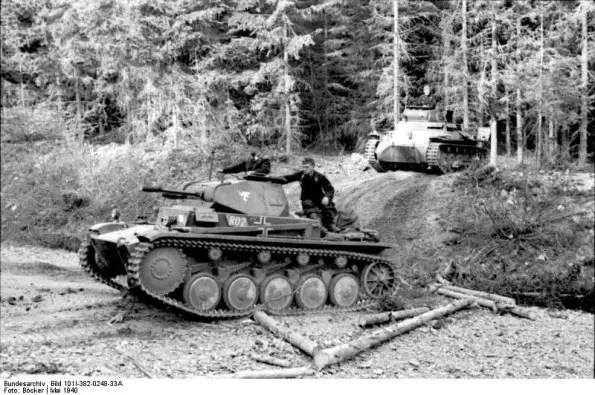
The French 7th Army advancing into Holland is engaged with the German advance near Tilburg and is thrown back. In their main armored thrust the Germans enter Sedan without a fight. The French forces in the area retire to the left bank of the Meuse River where they have substantial artillery support deployed to deny the crossing to the Germans. During the night, French artillery shells Sedan. Meanwhile, other German armored forces reach the Meuse farther north.
The Battle of Sedan began. In this key battle the Germans attempted to capture the important strategic point of Sedan, which would enable them to cross the Meuse and advance into the undefended French countryside.
As the German Army advanced through southern Belgium on 12 May, General Ewald von Kleist and Guderian clashed over where the main point of effort should fall. Kleist was Guderian’s immediate superior, commanding Panzergruppe von Kleist, consisting of XLI Panzer Corps and XIX Panzer Corps (under Guderian). Kleist pressed for the main point to come at Flize, further west than Sedan. Kleist argued that the blow would avoid a double river crossing at the Meuse (at Sedan) and Ardennes canal (to the west of Sedan). Moreover, the blow would strike at the dividing line between the French Ninth Army and the French Second Army. Guderian saw things differently, and pointed out that a thrust along the lines of Kleist’s plan would put the flank of the advance within range of the fortress artillery at Charleville-Mézières, some 25 kilometres (16 mi) north west of Sedan. The shift of operations further north would also disperse concentration (or Schwerpunkt) and disrupt the intense planning of the German tactical units, who had been in training for the Sedan attack and an advance north-west, for months. He also felt that a regrouping period in front of Sedan would delay the assault for 24 hours and allow the French to bring up reinforcements. Kleist agreed that such a delay was unacceptable, so he agreed to Guderian’s plan.
German Panzer Group Kleist reaches the Meuse River at Sedan. The German advance forces reached the Meuse line late in the afternoon of 12 May. To allow each of the three armies of Army Group A to cross, three major bridgeheads were to be established: at Sedan in the south, Monthermé to the northwest and Dinant further to the north. The first German units to arrive hardly had local numerical superiority; their already insufficient artillery support was further limited by an average supply of just 12 rounds per gun. Fortunately for the German divisions, the French artillery was also limited to a daily combat supply rate of 30 rounds per “tube” (gun). German armored units entered Sedan without a fight. The French forces in the area retired to the left bank of the Meuse River where they had substantial artillery support deployed to deny the crossing to the Germans. During the night, French artillery shelled Sedan.
By nightfall on 12 May, Guderian’s XIX. Panzerkorps rolled into Sedan. Guderian reported there was no sign of the enemy. With the city itself secured, Guderian would now have to strike south, across the defended rear behind Sedan, which in turn was protected by a large bunker complex located on Marfee ridge, a piece of high ground covering the Sedan-Meuse river to the south. But there were three fundamental choices. He could obey tactical necessity and protect the bridgeheads against a French counter-attack from the south; he could strike west-south-west towards Paris with his Corps; or he could carry out the dash to the Channel. Remembering the Chief of Operations, 1st Panzer Division, Walther Wenck’s saying, “Hit with your fists, don’t feel with your fingers!”, Guderian decided on the last option.
Rommel’s 7th Panzer Division of German 4th Army reaches the Meuse River at Dinant.
The importance of Sedan is not the city itself, but the entry it provides to the heart of France. Its capture in 1870 essentially decided the Franco-Prussian war.
An Allied conference is held near Mons with French Defense Minister Daladier, General Georges, General Billotte, British General Pownall, and Belgian King Leopold.
Although no official announcement to that effect has been made, it was confirmed today that the operations of the French, British, Netherland and Belgian forces are being directed by General Maurice Gustave Gamelin, Allied Commander in Chief. From the moment the Germans entered the Low Countries close liaison was established between the separate national commands and the French Generalissimo.
General Gamelin has his headquarters at Vincennes on 12 May 1940. He has no radio and notes that he does not even have a radio — so he has “no idea” where the front lies.
The Battle of the Afsluitdijk began in the Netherlands. The Germans send a three-man scouting part to see if Fort Kornwerderzand at the Afsluitdijk is defended. The fort opens fire and kills two of the three men. The Germans decide to take the fort, beginning with Luftwaffe strikes.
The German 6th Army crosses Albert Canal and pushes toward Gembloux.
In the Netherlands, German 9th Panzer Division reached Moerdijk bridges 10 miles south of Rotterdam, relieving the paratroopers who had been holding the bridges since 10 May. After evaluating the situation, Dutch Crown Princess Juliana and Prince Bernhard departed for Harwich, England, United Kingdom aboard HMS Codrington.
At Grebbeberg, the German 207th Infantry Division, supported by the SS Brigade Der Fuhrer, directly attacks the hill that dominates the defense. After an artillery barrage of several hours, the SS Brigade attacks. The SS men take an 18th Century fort, the Hoornwerk. This provides a wedge into the Dutch battle line, whose other guns cannot fire sideways. Dutch counterattacks fail. Obersturmbannführer (Lieutenant Colonel) Hilmar Wäckerle, contrary to orders, moves his battalion forward, penetrates the Dutch line, and gets surrounded – but holds on. The Dutch bring up reinforcements and plan a flank attack on the Germans. It is a confusing situation, but the Germans have the initiative – if they can rescue the impetuous Wäckerle.
Dutch army attempts to withdraw into Fortress Holland positions.
The German 18th Army captures Eindhoven and pushes toward the mouth of the Maas River.
The French 7th Army advanced into Holland and engaged with the German advance near Tilburg but was repulsed.
The Battle of Hannut began in Belgium. The first tank battle of the campaign erupts between General René Prioux’s 2d French armored divisions (confusingly, Corps de Cavalerie) and the 3d and 4th Panzer Divisions at the Gembloux Gap. The 4th Panzer Division assaults toward Hannut, which protects the 6th Army’s flank. They engage 25 French tanks and destroy 7 of them for no losses. The Germans probe toward Tirlemont, drawing Allied forces there while continuing toward Hannut. The French attempt a flank attack, which fails, and the German panzers run into a French strongpoint at Crehen.
The French are forced to retreat to Medorp after breaking out of an encirclement. They also abandon Hannut. In the evening, the Germans renew the attack and force the French strongpoint at Wansin to withdraw, but the rest of the French line holds. The outcome is a tentative French victory for having stopped the German advance, even if only temporarily. The French Somua S35 and Hotchkiss H35 tanks are good equipment, though they have their faults. They outclass the German Panzer Is and IIs, though the Panzer IIIs are more of a match.
The Allies have occupied the Dyle Line with the French 1st Army, 7th Army, 9th Army, and the British Expeditionary Force. The BEF is in position in Belgium. In position to be cut off, unfortunately.
A French pilot, Capt. René Gavoille, reports miles-long Wehrmacht columns in the Ardennes. His superiors are dismissive, calling them “night phantoms.” He has spotted Panzer Group Kleist and its 41,140 vehicles on narrow two-lane roads. When he takes off again and takes pictures, they call them “obvious fake tanks.”
In the air over Belgium, five Fairey Battle aircraft of No. 12 Squadron RAF flown by volunteer crews attacked the vital road bridges over the Albert Canal in the face of extremely heavy ground fire; the attack was pressed home with considerable gallantry and one bridge was seriously damaged, but at the cost of all five aircraft. The squadron was met with fierce anti-aircraft fire and the bridge was hit but not put out of commission. Flying Officer Donald E. Garland, who was leading the attack, and his navigator, Sergeant Thomas Gray were killed during the raid. Garland and Gray were later posthumously awarded the first air Victorian Crosses of the War.
The RAF sends 38 bombers over Hannut to support the defense of that town, losing 22, and the Arme de l’air sends over 18 new Breguet 693 bombers, losing 8. The Luftwaffe supports the ground operation there with 85 Bf 109s of JG 26, flying 340 sorties during the day. They claim 26 Allied planes for 4 of their own numbers. German anti-aircraft there also claims 25 planes.
RAF Bomber Command dispatches aircraft to attack bridges and roads by day and night.
The Allies send every available light bomber – some called from Hannut, which thereby loses air support – to attack the Meuse bridges at Sedan. They fail to make any hits and lose 44 percent of their number.
There are Luftwaffe air raids on Rotterdam, including incendiary bombs.
Luftwaffe aircraft conduct minelaying operations in Dutch waters overnight.
Luftwaffe aircraft conduct minelaying operations in Belgian waters overnight.
Luftwaffe fighter pilot Adolf Galland scores his first victories of the war, downing three RAF Hurricanes with his Bf-109 near Liège, Beligum.
The Royal Netherlands Navy Gruno-class gunboat HNMS Friso was bombed and sunk in the IJsselmeer off Enkhuizen, North Holland by Luftwaffe aircraft.
The Dutch passenger ship Prinses Juliana was bombed and sunk in the North Sea off Hoek van Holland, South Holland by Luftwaffe aircraft. The survivors were rescued by the Royal Navy destroyers HMS Havock and HMS Wild Swan.
The Dutch passenger ship Van Rensselaer struck a mine at IJmuiden, Noord Holland and was beached.
The Dutch coaster Henrica collided with another vessel and sank.
The Swiss tanker Jura struck a mine and sank in the North Sea off Zeebrugge, West Flanders, Belgium with the loss of two lives.
The German cargo schooner Käthe Jürgensen struck a mine and sank in the Bay of Lübeck, Germany.
The British coaster Roek struck a mine and sank in the Nieuwe Waterweg Rotterdam, South Holland, Netherlands (51°54’N 4°21’E). All 51 people aboard were rescued.
The British cargo ship St Denis struck a mine and sank in the Nieuwe Waterweg between Hoek van Holland and Rotterdam.
British motor torpedo boats MTB.22, MTB.24, MTB.25 arrived at Ijmuiden at 2130/12th. The boats operated from Ijmuiden on reconnaissance duties until 14 May.
The Dutch Crown Princess, her two daughters Irene and Beatrice, and Prince Bernhard departs for the UK aboard destroyer HMS Codrington.
King George received today the “heartfelt thanks” of Queen Wilhelmina of the Netherlands for the message he sent to her yesterday decrying the “brutal and wholly unwarranted attack” upon her country.
The British Scots Guards battalion arrives at Mo, Norway, by sea from Harstad. The British reinforce Mo i Rana with the British Scots Guards battalion from Harstad. The Germans have troops near Hamnesberget brought in by the seized Norwegian vessel Nord Norge, which the British have sunk (while empty).
The Norwegian coaster Ranheim was shelled and sunk at Hemnesberget, Nordland by HMS Carlisle and HMS Zulu (both Royal Navy).
Swedish steamer Bothnia (1488grt) was damaged by German bombing in the Kattegat.
Swedish steamer Indus (729grt) was seized by German forces at Bergen. On 28 May, she was renamed Metz for German service.
Swedish steamer Eros (2151grt) after the crew left the ship was seized by German forces at Bergen. On 28 May, she was renamed Illkirch for German service.
The United Kingdom began the internment of German civilians. Alarmed by the success of Germany’s “Trojan Horse” and parachute troop tactics and guarding against the possibility of a Nazi invasion from the air the British Government started interning all adult male Germans and Austrians in East and Southeast Britain today and imposed an eight o’clock curfew in the same area for all other aliens, including Americans.
Winston Churchill appointed the newly created Viscount Simon (former Sir John Simon) to the post of Lord High Chancellor, the Chief Law Officer to the Government, succeeding the Viscount Caldecote. Sir Kingsley Wood became Chancellor of the Exchequer. Winston Churchill, the New Prime Minister, announced today the selection of seven more members of the reconstructed British Government, after the members of his inner War Cabinet and the new service Ministers. had been sworn in and received their seals of office at a session of the Privy Council in Buckingham Palace before King George VI. Only three of those who held office under the retired Prime Minister, Neville Chamberlain, retain their old posts. They are Viscount Halifax, the Foreign Secretary; Sir Andrew Duncan, President of the Board of Trade, and Sir John Anderson, Home Secretary and Minister of Home Security.
Announcement of the new selections to the Cabinet disclosed that Sir John Simon, who held the important office of Chancellor of the Exchequer under Mr. Chamberlain, had been made Lord Chancellor, which means that he will soon be named to the peerage and become a government spokesman in the House of Lords, instead of in the House of Commons, which has still to conclude debate on his latest budget proposals. During the World War, Sir John Simon refused the peerage at the age of 42 because he wished to continue his political career in the House of Commons.
In all parts of France and especially in those districts of Lorraine, the Rhone Valley and near the German border that have suffered air attacks there is growing indignation at German bombings of civilians in France, Belgium, the Netherlands and Luxembourg. The demand from all sides is for Allied reprisals.
The Italian attitude toward Britain and France following publication of the official Italian report on the Allied blockade caused considerable surprise here, the more so since the French claim that from the beginning every possible efort has been made to take into account the needs of Italian industries and economy.
The game of defying the Allies continued today with thousands more anti-British posters all over Rome and many little incidents to show that the young Fascisti have been told to go out and bait the British. Even more pointed was a communique issued this afternoon.
Spanish government reiterates its neutrality. Spain’s policy of neutrality was reaffirmed today in a communique issued by the Foreign Ministry.
Reports that German troops in Norway had moved toward the Swedish frontier in many places were confirmed today, and the fact has caused alarm in Sweden. It was said that as many as five Nazi divisions—that is, about 100,000 menwere concentrating on the Swedish frontier.
Rose Philippine Duchesne was beatified by Pope Pius XII.
At 1100 HMS Furious departed the Clyde to embark aircraft. The Fleet Air Arm pilots of both 802 and 804 Squadrons flew the RAF Gladiator IIs of 263 Squadron aboard. That done, she then brought aboard the nine Swordfish of 818 Squadron to join the six Sea Gladiators of 804 Squadron detachment. At 1300 HMS Glorious, now carrying the 18 RAF Hurricanes, puts to sea to bring aboard the six Walrus amphibians of the newly established 701 Squadron, which are also bound for Norway. These join her modest air group consisting of five Sea Gladiators of 802 Squadron and six Swordfish of 823 Squadron. At 1415, both ships return to Greenock.
Spanish cruisers Canarias, Almirante Cervera, Navarra and destroyers Almirante Antequera, Ciscar, Ulloa, Gravina passed Gibraltar en route from Cadiz for Malaga.
Convoy OA.147 departed Southend escorted by destroyer HMS Wessex and corvette HMS Arabis. The corvette was later detached to convoy HX.40.
Convoy OB.147 departed Liverpool escorted by destroyer HMS Saladin from 12 to 14 May.
Convoy FN.169 departed Southend, escorted by sloop HMS Weston. The convoy arrived at the Tyne on the 14th.
Convoy MT.67 departed Methil, escorted by escort ship HMS Vascama and subsequently by sloop HMS Grimsby. Sloop Grimsby was then relieved by sloop HMS Auckland and HMS Grimsby returned to Rosyth. The convoy arrived later that day.
Convoy FS.169 departed the Tyne, escorted by sloop HMS Auckland. . The convoy arrived at Southend on the 14th.
Convoy OG.29 was formed from convoys OA.145G, which departed Southend on the 10th escorted by destroyers HMS Whitehall and HMS Winchelsea, OB.145G, which departed Liverpool on the 10th, of fifty ships. The convoy was escorted by destroyer Whitehall and Winchelsea from 12 May. Destroyer Whitehall was detached on the 12th and destroyer Winchelsea on the 13th. The convoy was escorted by French sloop La Curieuse and patrol vessel HMS Jutland from 13 to 18 May. Anti-submarine trawler HMS Snakefly escorted the convoy near Gibraltar. The convoy arrived at Gibraltar on the 18th.
Convoy HG.30F departed Gibraltar with forty two ships. The convoy was escorted by French destroyer Jaguar and auxiliary patrol vessel Minerve from 12 to 18 May. The destroyer arrived at Brest on the 18th and the patrol vessel at Lorient on the 19th. Sloops HMS Enchantress and HMS Leith from convoy OGF 30 escorted the convoy from 18 to 21 May. The convoy arrived at Liverpool on the 21st.
Convoy HX.42 departed Halifax at 0900 escorted by Canadian destroyers HMCS Restigouche and HMCS Skeena, which were detached on the 13th. The destroyers turned over the convoy to ocean escort armed merchant cruiser HMS Laconia at 1814/13th. The armed merchant cruiser was detached on the 24th. On 24 May, sloop HMS Rochester and corvette HMS Gladiolus joined the convoy. The sloop Rochester was detached on the 27th. The corvette remained with the convoy until its arrival at Liverpool on the 28th.
The War at Sea, Sunday, 12 May 1940 (naval-history.net)
At 0500/12th, destroyers MOHAWK and JANUS were ordered to patrol Brown Ridge.
Destroyer VERSATILE grounded at Sheerness at 0940/12th. Destroyer WALPOLE pulled her off and was later relieved by a tug.
Destroyer VERSATILE proceeded to Sheerness and was repaired in one day.
At 1830, destroyers HYPERION and WILD SWAN departed the Hook of Holland to patrol off the coast. Destroyer HAVOCK had arrived there shortly before.
Destroyer HAVOCK then departed to bombard German troops reported near Hook of Holland. None were found and after dusk, destroyer HAVOCK returned to Harwich.
In Operation J, with Destroyers HYPERION and WINDSOR in company, destroyer CODRINGTON arrived at Ijmuiden at about 2100/12th. Destroyer CODRINGTON embarked Dutch Princess Juliana and her family and evacuated them to Harwich.
Destroyer CODRINGTON was escorted back to Harwich by destroyers VIVACIOUS and VENETIA. They arrived at 0800/13th.
Destroyer HEREWARD arrived at Holland at 2400.
Destroyers HYPERION and WINDSOR departed Ijmuiden at 0100/13th escorting British steamer DOTTEREL (1385grt) carrying British refugees.
Destroyer KIMBERLEY arrived at Flushing during the forenoon of 12 May. She embarked the military mission at Flushing and then proceeded to Ijmuiden.
Destroyer KIMBERLEY departed Ijmuiden that evening.
British motor torpedo boats MTB.22, MTB.24, MTB.25 arrived at Ijmuiden at 2130/12th. The boats operated from Ijmuiden on reconnaissance duties until 14 May.
Destroyers KEITH and BOREAS arrived at Dover after escort duty with the 2nd Cruiser Squadron.
Light cruisers ARETHUSA and GALATEA arrived at Sheerness.
Destroyer WHITSHED departed Dover for Dunkirk with ammunition for the FA force destroyers.
Destroyer MALCOLM departed North Goodwins patrol for Hook of Holland to relieve destroyer WILD SWAN as Senior Naval Officer.
Destroyer VENOMOUS, returning from Hook of Holland, relieved destroyer WIVERN on North Goodwins patrol.
Destroyer WIVERN returned to Dover.
Destroyer WHITLEY departed Sheerness on the 11th to meet Dutch steamer PERSEUS (1307grt) at Ijmuiden. She arrived at 0015/12th also to embark the Dutch Crown Princess, her family, 100 British refugees.
At Ijmuiden, she was not able to locate the PERSEUS or the Dutch Royal Family. Destroyer WHITLEY departed Ijmuiden at 0330/12th and returned to Sheerness.
Destroyers VIMY and WINDSOR departed Dover at 0500 to meet destroyers VIVACIOUS and VENETIA from Harwich off Maas Light Vessel to operate off the Dutch coast.
Destroyers KEITH, BOREAS, WIVERN, and WOLSEY departed Dover at 2000 for Hook of Holland with British steamers CANTERBURY (2910grt) and MAID OF ORLEANS (2386grt) with a composite battalion of guards for the port.
British steamer ROEK (1041grt) was sunk on a mine in 51 54N, 04 21E in the Nieuwe Waterweg west of Rotterdam.
Twenty crew and thirty-one refugees were rescued.
Dutch steamer VAN RENSSELAER (4241grt) with 150 refugees on board was badly damaged on a mine near the south pier at Ijmuiden. She was beached to prevent sinking.
Forty-two survivors were landed at Ramsgate from Dutch steamer JOHAN DE WITT (10,474grt) on the 14th.
British steamer ST DENIS (2435grt) was sunk by a mine in the river between Hook and Rotterdam partially blocking the channel.
Dutch steamer PRINSES JULIANA (2908grt), carrying troops from Flushing to Ijmuiden, was sunk by German bombing off Hook of Holland.
Destroyers WILD SWAN and HAVOCK rescued her survivors
Destroyers MASHONA and JAGUAR arrived at Scapa Flow at 2100 from Narvik.
Destroyers ACHERON and ANTELOPE arrived at Greenock at 0700.
Destroyer ACHERON commenced repairs to minor defects and boiler cleaning.
Lt (A) A. S. Downes and Lt R. W. Little in a Swordfish of 815 Squadron, operating from Bircham Newton, shot down in a raid on Wallhaven aerodrome. Both were returned unhurt on the 14th.
Convoy OA.147 departed Southend escorted by destroyer WESSEX and corvette ARABIS. The corvette was later detached to convoy HX.40.
Convoy OB.147 departed Liverpool escorted by destroyer SALADIN from 12 to 14 May.
Convoy FN.169 departed Southend, escorted by sloop WESTON. The convoy arrived at the Tyne on the 14th.
Convoy MT.67 departed Methil, escorted by escort ship VASCAMA and subsequently by sloop GRIMSBY. Sloop GRIMSBY was then relieved by sloop AUCKLAND and GRIMSBY returned to Rosyth. The convoy arrived later that day.
Convoy FS.169 departed the Tyne, escorted by sloop AUCKLAND. The convoy arrived at Southend on the 14th.
French Legionnaires were embarked on British assault landing craft landing craft at Ballangen for the assault on Bjervik in Herjangsfjord. The remainder of the 1500 troops involved were embarked on the Light cruisers EFFINGHAM and AURORA.
Four tanks and two mechanized landing craft landing craft to take the tanks ashore were carried on battleship RESOLUTION. A fifth tank in a more modern LC went under its own power.
This landing craft had arrived at Harstad on 27 April on British steamer EMPIRE ABILITY (7603grt).
In addition, repair ship VINDICTIVE, net layer PROTECTOR, destroyers HAVELOCK (Captain E. B. K. Stevens, D.9), which carried a French mortar battery on her forecastle, SOMALI, FAME, BASILISK, and WREN accompanied the force.
Aircraft carrier ARK ROYAL provided air support for this operation.
This force departed Ballangen late on the 12th and the troops were landed on the 13th and Bjervik was captured.
The naval ships were dispersed at 0600/13th. Light cruiser EFFINGHAM proceeded to Harstad.
Aircraft carrier FURIOUS escorted by destroyers IMPERIAL and VISCOUNT departed the Clyde at 1100 for flying on of aircraft.
Two hours later, Aircraft carrier GLORIOUS escorted by destroyers DELIGHT and DIANA departed the Clyde, but both groups were recalled at 1415 to the Clyde.
Submarine TRIBUNE departed the Clyde on patrol escorted by anti-submarine trawler NORWICH CITY (541grt).
Submarines SPEARFISH departed Blyth and PORPOISE and TETRARCH departed Rosyth on patrol. PORPOISE conducted minelaying operation FD.11 on the 16th.
Swedish steamer BOTHNIA (1488grt) was damaged by German bombing in the Kattegat.
Swedish steamer INDUS (729grt) was seized by German forces at Bergen.
On 28 May, she was renamed METZ for German service.
Swedish steamer EROS (2151grt) after the crew left the ship was seized by German forces at Bergen.
On 28 May, she was renamed ILLKIRCH for German service.
German trawler KATHE JURGENSEN (346grt) was sunk on a mine near Lubeck.
Convoy OG.29 was formed from convoys OA.145G, which departed Southend on the 10th escorted by destroyers WHITEHALL and WINCHELSEA, OB.145G, which departed Liverpool on the 10th, of fifty ships. The convoy was escorted by destroyer WHITEHALL and WINCHELSEA from 12 May. Destroyer WHITEHALL was detached on the 12th and destroyer WINCHELSEA on the 13th. The convoy was escorted by French sloop LA CURIEUSE and patrol vessel JUTLAND from 13 to 18 May.
Anti-submarine trawler SNAKEFLY escorted the convoy near Gibraltar. The convoy arrived at Gibraltar on the 18th.
Convoy HG.30F departed Gibraltar with forty-two ships. The convoy was escorted by French destroyer JAGUAR and auxiliary patrol vessel MINERVE from 12 to 18 May. The destroyer arrived at Brest on the 18th and the patrol vessel at Lorient on the 19th.
Sloops ENCHANTRESS and LEITH from convoy OGF 30 escorted the convoy from 18 to 21 May. The convoy arrived at Liverpool on the 21st.
Sloop FOLKESTONE, formerly with convoy OG.28F, departed Gibraltar for Liverpool.
Spanish cruisers CANARIAS, ALMIRANTE CERVERA, and NAVARRA and destroyers ALMIRANTE ANTEQUERA, CISCAR, ULLOA, and GRAVINA passed Gibraltar en route from Cadiz for Malaga.
Convoy HX.42 departed Halifax at 0900 escorted by Canadian destroyers HMCS RESTIGOUCHE and HMCS SKEENA, which were detached on the 13th.
The destroyers turned over the convoy to ocean escort Armed merchant cruiser LACONIA at 1814/13th. The armed merchant cruiser was detached on the 24th.
On 24 May, sloop ROCHESTER and corvette GLADIOLUS joined the convoy. The sloop ROCHESTER was detached on the 27th. The corvette remained with the convoy until its arrival at Liverpool on the 28th.
Canadian troop convoy TC.4A departed Halifax at 1400 escorted by Canadian destroyers HMCS ST LAURENT and HMCS SAGUENAY. The convoy was composed of troopships ANTONIA (13,867grt) and DUCHESS OF BEDFORD (20,123grt) which carried 932 and 1559 troops, respectively.
Battleship REVENGE was the ocean escort.
Battleship REVENGE accidently collided with and sank Canadian Gate Vessel No. 1 (trawler YPRES, 440grt, Lt A. H. Cassivi RCNR) at Halifax as REVENGE was setting out to escort Canadian troop convoy TC 4 A.
Three ratings were slightly injured in the vessel; no lives were lost from the eighteen-man crew.
A storm of U.S. congressional opposition tonight hit proposals that the United States throw open her treasure chest to finance the allied war effort. The suggestion was made last light by Chairman Andrew J. May, Kentucky Democrat, of the house military affairs committee, who urged relaxation of the Johnson act which bans American credits or loans to nations which have defaulted on their World war debts to this country. He contended that we ought to do everything we can to help the allies. Senator Hiram Johnson, California Republican, author of the law and one of the nation’s outstanding isolationists, vigorously rejected his contention. “Any attempt to repeal or modify the act which bears my name will be vigorously contested, he said. Experience in the last, war taught us that the surest way to get into war is to let our money precede us.” Many in Congress felt that the country should express its full sympathy with the allies, but did not know whether this expression should go to the length of modifying the Johnson Act. Senate Majority Leader Alben W. Barkley, Kentucky Democrat, would not comment.
“They don’t need our money,” said Senator Burton K. Wheeler, Montana Democrat, candidate for the Democratic presidential nomination. “I am unalterably opposed to any repeal or modification of the law at this time.” Senate Whip Sherman Minton, Indiana Democrat, said he saw no objection to repealing the Johnson act, but admitted that such a step probably could not succeed in an election year because of the political dynamite attached to the war debts. He and his colleagues generally were opposed to any far-reaching modifications of the neutrality law which might involve this nation in the war. Congressional sentiment generally favored President Roosevelt’s acts; his denunciation of the invasion in a speech Friday, his invocation of the neutrality act against the Netherlands, Belgium and Luxembourg and his message to King Leopold of the Belgians hoping that the Nazis would be repulsed.
Speculation is increasing as to whether Congress will remain in session continuously as the result of the Nazi invasion of the Netherlands, Belgium and Luxembourg. Representative Drewry of Virginia expressed the belief that the legislators would not be willing to adjourn while the European war continued. He thought they would merely recess for the national political conventions, instead of quitting in advance of them, as originally planned. Republicans have proposed that there be no adjournment this year, but other Democratic leaders have been cool to the idea for fear it would be construed as evidence of a lack of faith in the ability of President Roosevelt and Secretary Hull to conduct foreign affairs alone.
Army and navy requests for multimillion-dollar increases in next year’s budgets led some members of Congress to demand today that the services give an accounting of the billions spent for military and naval purposes in the last few years. Senator La Follette of Wisconsin, told reporters that taxpayers were entitled to “a comprehensive and exhaustive survey” of national defense machinery. He said that when Congress adjourned it should leave behind a committee to delve into defense deficiencies and make recommendations for action at the next session.”
He asserted that he was “perfectly willing to support any appropriation that is demonstrated as necessary for our national defenses,” but ho added that Congress and the country should receive “an explanation for the sudden claims of deficiency by both the army and navy despite the huge appropriations that have been granted.” He said that he referred to recent testimony by War Department officials that the army was woefully lacking in such equipment as anti-aircraft batteries, anti-tank guns, and other supplies for its initial protective force.
Faced with demands for several hundred million dollars additional for national defense, Congress this week will be called upon to decide whether it will add further to the fiscal burdens of the nation by voting additional pensions for the World War group and by increasing the budget-requested amount for relief.
Two of ten special trains carrying employes of the International Business Machines Corporation from the vicinity of Endicott, New York, to the World’s Fair for the celebration of I.B.M. Day this afternoon collided at the Port Jervis (New York) station at 8:44 o’clock yesterday morning, injuring at least 250 persons.
The new World’s Fair of the “plain people,” favored by bright, sunny weather and visited by friendly crowds, offered a simple, unostentatious program on the second day of its 1940 season yesterday, and got off to an encouraging start on attendance.
Child star Shirley Temple, through her mother Gertrude Temple, canceled her movie contract with 20th Century Fox and retired from film acting at age 11. Age finally caught up with old movie star Shirley Temple, and she retired from the screen with a fortune estimated at $3,000,000. She was 11 years old last April 23 and nothing the studio experts could do in the way of trick shoes, low-crowned hats and sloping-shouldered dresses could make her look any younger. So Shirley, through her mother, Mrs. Gertrude Temple, cancelled her contract with the Twentieth Century-Fox and settled down to enjoy her old age in the sixth grade of grammar school.
Major League Baseball:
Behind the six-hit pitching of Red Ruffing, the Yankees beat the Bosox, 4–0, and stop New York’s 8–game losing streak. New York (7–14) is still in last place while Boston (16–6) sits atop the American League. Ruffing strikes out eight in his best outing so far this season.
Ted Lyons, 39 years old, had enough on the hall today to score his second victory of the season and lead the White Sox to a 4–3 triumph over the Tigers. He yielded eight hits, including homers by Pinky Higgins and Dick Bartell that accounted for all the Detroit runs, but kept them scattered as the Sox took the rubber game of the series.
Elden Auker, right-handed submarine pitcher, jinxed the Indians again today and gave the Browns a 5-2 victory. Auker went the route, allowing nine hits, walking only two men and collecting three of the Browns’ twelve hits.
Johnny Babich, Athletics’ righthander, baffled the Senators with two-hit pitching for seven innings today and then was touched for only four more safeties as the A’s triumphed, 4–2.
The Reds (15–4) follow up yesterday’s win over St. Louis, with a doubleheader sweep, winning 7–1 and 13–4. Ival Goodman has a homer in the openers and three Reds — Frank McCormack, Lonnie Frey, and Harry Craft — come through with circuit clouts in the second game. The Cards help with seven errors in the two games.
Dizzy Dean was knocked out of the box in the second inning today, but the Cubs went on to win from the Pirates, 7 to 5 on Bill Herman’s three-run homer in the eighth frame.
The Dodgers snapped their recent tailspin and beat the Phillies, 5–3. Although he handed 14,505 Flatbush fans a scare in the ninth inning and required relief from Forest (Tot) Pressnell, the veteran Freddy Fitzsimmons notched his second victory of the campaign and the 194th of his major league career.
An eighth inning relief effort by Walter Brown enables the New York Giants to edge the Boston Bees, 3–2. Mel Ott contributes two hits and an RBI for the Giants.
Philadelphia Phillies 3, Brooklyn Dodgers 5
New York Giants 3, Boston Bees 2
Pittsburgh Pirates 5, Chicago Cubs 7
St. Louis Browns 5, Cleveland Indians 2
Chicago White Sox 4, Detroit Tigers 3
Boston Red Sox 0, New York Yankees 4
Washington Senators 2, Philadelphia Athletics 4
Cincinnati Reds 7, St. Louis Cardinals 1
Cincinnati Reds 13, St. Louis Cardinals 4
Canadian troop convoy TC.4A departed Halifax at 1400 escorted by Canadian destroyers HMCS St Laurent and HMCS Saguenay. The convoy was composed of troopships Antonia (13,867grt) and Duchess Of Bedford (20,123grt) which carried 932 and 1559 troops, respectively. Battleship HMS Revenge was the ocean escort. Battleship Revenge accidently collided with and sank Canadian Gate Vessel No. 1 (trawler Ypres, 440grt, Lt A. H.Cassivi RCNR) at Halifax as Revenge was setting out to escort Canadian troop convoy TC 4 A. Three ratings were slightly injured in the vessel; no lives were lost from the eighteen man crew.
French marines occupy the Dutch possession of St. Maarten in the Caribbean.
Argentina invites the 21 American republics to adopt an attitude of “non-belligerency” instead of neutrality in war. Declaring neutrality in present circumstances of the world a “fiction” and a “dead conception,” Foreign Minister Jose Maria Cantilo proposed tonight that the Americas adopt a “non-belligerent” attitude instead.
The Chinese claimed today that they had inflicted heavy losses on Japanese forces in Northern Hupeh and Southern Honan Provinces. Japanese troops estimated at 60,000 to 150,000 launched a drive two weeks ago in those regions, evidently designed to encircle and smash the Chinese armies there. The invaders are now withdrawing to bases and counter-attacking Chinese, who claim they evaded the Japanese drive, are reported to be decimating the enemy by means of flank attacks and stabs in the rear. Japanese supply lines are said to have been cut and many units isolated and wiped out with many prisoners taken and much equipment seized, including fifty-four tanks, fifty-two artillery pieces and 100 trucks. The casualty estimates run as high as 50,000 for the last two days.
Usually reliable Chinese sources indicated today that a Japanese push from Canton was expected in the near future, presumably in compliance with the desire of the Wang Ching-wei regime to extend the area occupied in Kwangtung Province. Reports that detachments of Japanese guards, in addition to two Japanese divisions, are massed on the outskirts of Canton and to the northeast and also that Japanese contingents have been stationed eastward and westward of the Canton-Hankow Railway, lend color to these expectations. The total Japanese force ready to move is thought to be at least 30,000 men. Small units have engaged lately in brisk skirmishes with Chinese forces in the Sunkat district. It is stated that General Chang Fah-wei, former leader of the “Ironsides,” has gone to Kweilin to direct the Chinese Kwangsi operations, while General Yu Hanmou remains in Kwangtung preparing to meet the expected Japanese thrust.
Japanese newspapers warned the Netherlands today that any move to place the Dutch East Indies under allied “protection” would be followed by immediate action by Japan. The landing of allied troops at Aruba, Dutch West Indies, caused grave concern here where it was seen as possibly presaging a similar move in the East Indies. Allied protection of the West Indies, it was recalled, was for the nominal purpose of protecting the big oil refineries at Aruba.
The Japanese press was greatly excited today over the French landing at Curaçao, Netherland West Indies, which, it is alleged, shows that the Netherland guarantees of the status quo of Netherland colonies are unreliable. It is stated that the Netherland Minister to Tokyo informed the Foreign Office on Saturday that the West Indies, as well as the East Indies or Netherlands Indies, would refuse external assistance, Although Japan does not pretend to have any interest whatever in the West Indies, the Netherland action in permitting a French landing is considered by Japanese officials as “betraying the Netherland Government’s pledge” and making it impossible for Japan to rely on the Netherland statement alone.
These views were expressed at a conference of Foreign Office officials that met hurriedly yesterday, according to the newspaper Asahi. Nationalist opinion has already leaped to the conclusion that the time has come when Japan must act. “The Japanese Government’s policy regarding the Netherlands Indies no longer remains within the sphere of mere expressions of will but requires actual measures,” says the newspaper Kokumin. “Full counter-steps are being considered.”
Born:
Norman Whitfield, American songwriter and producer for Motown (“I Heard It Through the Grapevine”; “Just My Imagination”; “Papa Was A Rollin’ Stone”), in New York, New York (d. 2008).
Tom Timmermann, MLB pitcher (Detroit Tigers, Cleveland Indians), in Breese, Illinois.
Died:
Andrew McPherson, 22, RAF bomber pilot (killed in action near Lanaken, Belgium).
 History Diaries