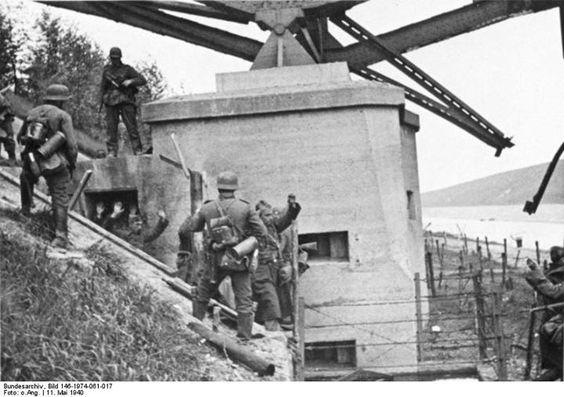
The German offensive continues. The advance in Holland is very rapid and even more of the Dutch army is put out of action. In Belgium the Germans are approaching the British and French positions which are now strongly held. Eben Emael falls to German attacks after some fruitless resistance. Rundstedt’s forces advance nearer to the Meuse.
The Battle of Fort Eben-Emael ended with the German capture of the fort. The Belgian Fort Eben-Emael surrendered to German airborne infantry of the 7th Flieger Division. With the fortress’s guns silenced, the German paratroopers wasted no time in securing the entire garrison of Fort Eben-Emael. The Belgian defenders, unprepared for an attack from the sky, were taken by surprise and overwhelmed by the speed and ferocity of the assault. The audacity of this glider-borne operation left the defenders disoriented and unable to mount a coordinated response. What was expected to be a prolonged siege lasting days was accomplished in a matter of hours. About 1,000 prisoners were taken. Simultaneously, German forces crossed the Albert Canal, securing key bridges and paving the way for the advancing Panzer divisions. Fort Eben-Emael’s guns were neutralized, and the Germans continued their lightning-fast advance into France and the Low Countries.
German tanks of the 6th Army crossed Albert Canal bridges in an attempt to move behind Belgian defensive lines.
The Belgian roads are clogged with refugees fleeing westward and southward. Most are on foot or on their bicycles. The Mayor of Bouillon, in a classic “business, is business” reaction to the war, refuses to quarter troops in hotels: “This is a resort town! Hotels are reserved for tourists.”
German 18th Army pushes into the Netherlands.
The Battle of the Grebbeberg began in the central Netherlands. This is the main defense line forward of “Fortress Holland” in the west. The Grebbeberg is a hill near Rhenen which offers panoramic views. In order to mount a direct assault on the Grebbeberg, the Germans had to breach the line of outposts (voorpostenlijn) which covered a 3 km (1.9 mi) wide area directly in front of the Grebbeberg, which had not been flooded. The line was manned by two companies of the third battalion of the 8th Infantry Regiment (III-8 RI), which was part of the 4th Division and the 2nd Corps. In the early hours of 11 May, German artillery opened fire on the line of outposts, disabling the telephone system of the Dutch defenders. Now that communication with the other defensive lines had become impossible, the Dutch were deprived of artillery support. At dawn, the SS brigade launched a direct assault on the outposts. The defensive positions at the outposts were mostly improvised and consisted of sandbags and wooden obstacles. The field of fire of the Dutch defensive positions did not overlap. German forces were able to neutralize them one by one by sending two teams of machine gunners to attack a single position. One team would provide covering fire while the other would use the blind spots to launch a flanking attack.
In the northern part of the line, on the edge of the inundated area, the Germans ran into a section of the Dutch 19th Infantry Regiment (19 RI), which — because it was part of a different unit — had trouble co-ordinating its actions with the other Dutch positions. This section broke after a short skirmish and retreated westward, thereby creating an open flank which the Germans exploited by encircling the more southern Dutch sections. Near the Rhine the Germans used a dike to approach defending forces from the rear unhindered. Dutch supporting fire from the Frontline was largely ineffective because the area between the frontline and the line of outposts was carpeted in orchards, which kept the Germans out of sight. Now that the SS forces had succeeded in approaching the Dutch forces from the rear, the line of outposts could be neutralized. At 18:00, the last Dutch section surrendered and the voorpostenlijn fell into German hands.
In the evening, German armored cars tried to attack the hill itself but were repelled by a 47 mm (1.85 in) anti-tank gun. That evening, Chris Meijer — an artillery sergeant who had been arrested for abandoning his post — was brought in and subjected to a court-martial and executed by firing squad. After the war, this court-martial would become controversial because of possible undue influence by the commander of 2nd Corps, General Harberts. This incident — and unfounded rumors of a massive rout in the line of outposts — incited Harberts into setting an example for other Dutch forces. At 21:00, he ordered the second battalion of 19 RI to initiate a counterattack under the cover of darkness against the outposts. Harberts estimated that about a hundred Germans were in the line of outposts, but in reality II-19 RI faced 3,000 SS troops. At the stopline, which was situated directly on the Grebbeberg, II-19 RI was fired upon by other Dutch troops who had not been informed of the impending counterattack. The confusion that followed caused the attack to lose momentum before it had made contact with the enemy and by the time order had been restored, dawn had broken and the counterattack was called off. One positive side-effect of the counterattack had been that Dutch artillery support forced the Germans to abandon their own planned night attack.
Troops of the German 9th Panzer Division crossed the Meuse River; at 1200 hours, they found an undefended bridge over the Zuid-Willemsvaart canal 50 miles from Rotterdam, where airborne troops of the German 22nd Flieger Division held on to bridges along the Nieuwe Maas River, awaiting the arrival of ground troops.
The Fallschirmjäger (paratroops) operation at The Hague is one of the few blemishes on the Fall Gelb offensive. Generalleutnant Hans Graf von Sponeck’s paratroops are scattered across dunes and do not control any of the airports they were dropped to capture. With his objective now impossible, von Sponeck receives orders to aid the assault on Rotterdam. In reality, he and his men now are hunted fugitives behind enemy lines, with hundreds of wounded and missing troops.
The paratroopers at Rotterdam are doing somewhat better. The 22nd Flieger Division holds bridges over the Niewe Maas River. The Dutch Marines launch furious attacks, but the paratroopers have nowhere to retreat to anyway, so a stalemate develops – which is to the Germans’ benefit.
Tremendous fires blazed in the beleaguered city of Rotterdam tonight as the Dutch defenders strove to dislodge attacking Germans from the right bank of the Maas river. The Germans were reported to be making no progress, but apparently they wore holding their position. The Rotterdam water tower was blazing and huge fires were visible elsewhere in the city, which was without drinking water.
Former Kaiser Wilhelm, living in exile in Holland, has had a somewhat dismissive opinion of Hitler. However, he refuses Winston Churchill’s offer of sanctuary in the UK.
The British air ministry early today denied a German allegation that allied planes had bombed the open German town of Freiburg-am-Breisgau and killed 24 civilians. “That is a further example of German mendacity,” the air ministry said. The attack on Freiburg, far from the western front, occurred late today, it was said, and was carried out by three planes. “Freiburg,” it was said, “lies outside the actual operations area and contains no military objectives.”
The Luxembourg Parliament protests invasion and pledges loyalty to the Grand Duchess in exile.
William Shirer, a US journalist, notes that there are “Great headlines today in Berlin papers over ‘shameful’ protests of the Low Countries against being invaded.”
Gamelin ordered reserve divisions to begin reinforcing the Meuse sector facing the Ardennes. Because of the danger the Luftwaffe posed, movement over the rail network was limited to nighttime, slowing the reinforcement, but the French felt no sense of urgency as they believed the build-up of German divisions would be correspondingly slow. The French Army did not conduct river crossings unless assured of heavy artillery support. While they were aware that the German tank and infantry formations were strong, they were confident in their strong fortifications and artillery superiority. However, the capabilities of the French units in the area were dubious; in particular, their artillery was designed for fighting infantry, and they were short of both antiaircraft and antitank guns.
Seven German armored divisions began to spearhead into the Ardennes Forest, brushing aside the few French cavalry units guarding this route into France. The German columns pushing through the Ardennes face logistical issues on the forest roads, but no significant defenders. General Erwin Rommel’s 7th Panzer “Ghost” Division is in the lead of Army Group A and disperses a French Cavalry Unit guarding the road. Allied bombers are noticeably absent, partly due to Luftwaffe air superiority.
Following the First World War, the French General Staff had ruled out the idea of a future German thrust through the Ardennes–Sedan sector. The French were certain such terrain could not be crossed by tanks. Marshal Philippe Pétain described them as “impenetrable”. Maurice Gamelin described the geographical feature as “Europe’s best tank obstacle”. The “barrier” of the Meuse and Ardennes appeared to be a sound strategic defence feature that a future enemy could not get through or go around. The French concluded that, at best, a German assault through the Ardennes towards Sedan would not reach the Meuse for two weeks after the start of any German offensive, and would take between five and nine days to penetrate the Ardennes alone.
The French assessments were less credible in the light of military exercises carried out in 1938. That year, General André-Gaston Prételat took command of maneuvers which created a scenario whereby the German Army launched an assault with seven divisions, including four motorized infantry divisions and two tank brigades (the type of the remaining three are not given). The “French” side’s defences collapsed. “The result was a defeat of so comprehensive a nature that the wisdom of publishing it was questioned lest morale be damaged.” As late as March 1940, a French report to Gamelin named the defences at Sedan, the last “fortified” position on the Meuse, and the last before the open country of France, as “entirely inadequate.” Prételat had correctly identified the landscape as relatively easy terrain for armour to cross. At most, he concluded, the Germans would take 60 hours to reach the Meuse and take one day to cross it. This estimate was to prove inaccurate by just three hours; the Germans achieved the Meuse crossing after just 57 hours.
The French Army authorized fresh attempts to increase the strength of the fortifications in the autumn of 1939, but severe winter weather prevented the pouring of concrete and the delivery of the necessary materials. On 11 April 1940, General Charles Huntziger asked for another four divisions to work on the defences but was refused. The French defences at Sedan were weak and neglected. The French had long believed that the German Army would not attack through the Sedan sector as part of their concentrated effort, and only Brigadier General Henri Lafontaine’s French 55th Infantry Division, a category B division, was allocated to this sector.
French reconnaissance aircrews had reported German armoured convoys by the night of 10/11 May but this was assumed to be secondary to the main attack in Belgium. On the next night, a reconnaissance pilot reported that he had seen long vehicle columns moving without lights; another pilot sent to check reported the same and that many of the vehicles were tanks. Later that day, photographic reconnaissance and pilot reports were of tanks and bridging equipment.
The French 1st Army, 7th Army, 9th Army, and British Expeditionary Force execute the “Dyle Plan,” advancing to take up defensive positions on the Dyle River line. The German main assault does not lie there. Retreating Belgian troops join them. Hitler, when informed of his classic decoy move producing the desired results, says “I could weep for joy!”
The Allied troops are marching into a gigantic trap.
The Luftwaffe is concentrating on ground support missions – a key element of “Blitzkrieg.” The Allies are hampered by few airbases close to the scene of the battles and, quite frankly, often inferior equipment.
In terms of that equipment, the Fairey Battle light bomber is struggling. The RAF sends eight of them to attack German troops in Luxembourg and only one returns.
The Luftwaffe also is aggressively targeting Allied airfields. They make a low-level attack on the field of No. 114 Squadron and destroy its Bristol Blenheim bombers on the ground.
RAF Bomber Command dispatches 37 aircraft to attack Monchengladbach overnight in its first strike against a German town.
RAF Bomber Command dispatches 23 aircraft to attack bridges around Maastricht.
The unescorted Estonian steam merchant Viiu was torpedoed and sunk at 0049 hours by the U-9, commanded by Oberleutnant zur See Wolfgang Lüth, off the Westhinder Buoy at the mouth of the Scheldt River off the coast of the Netherlands (51°21’N 2°25’E). The Viiu was hit near the bridge by one G7e torpedo from U-9 and sank within one minute off the Westhinder Buoy. The five survivors were picked up by HMS Arctic Hunter (FY 1614) (T/Skr G.W. Moore, RNR) ten miles east of Noss Head. On 10 May, the Viiu had picked up survivors from the British steam merchant Henry Woodall (625 grt), which had been mined and sunk that day three miles east of Withernsea. The 1,908 ton Viiu was bound for Miami, Florida.
The unescorted British steam merchant Tringa was torpedoed and sunk at 1400 hours by the U-9 one and a half miles from the West Hinder buoy at the mouth of the Scheldt River off the coast of the Netherlands in the North Sea (51° 21’N, 2° 55’E). Tringa (Master Hugh Conway) was hit aft by one torpedo from U-9 and sank immediately one and a half miles from the West Hinder buoy at the mouth of the Scheldt. The master, 15 crew members and the Belgian pilot were lost. Six crew members were picked up by HMS Malcolm (D 19) (Capt T.E. Halsey, RN) and landed at Ramsgate on 13 May. The 1,930 ton Tringa was carrying potash and iron ore and was bound for Glasgow, Scotland.
The Dutch ocean liner Statendam was sunk at Rotterdam, South Holland in a Luftwaffe air raid.
The Dutch cargo ship Stella was bombed and sunk in the North Sea off Vlissingen, Zeeland by Luftwaffe aircraft.
The Dutch ocean liner Veendam was sunk at Rotterdam in a Luftwaffe air raid.
Dutch steamer Prins Willem Van Oranje (1304grt) was badly damaged by German bombing in 51 26N, 03 36E.
On 11 May, light cruisers HMS Arethusa, HMS Galatea, and HMS Birmingham and destroyers HMS Codrington, HMS Brilliant, HMS Vimy, HMS Valorous, HMS Griffin, HMS Hereward, HMS Hyperion, HMS Havock, HMS Mohawk, HMS Venetia, HMS Vivacious, HMS Windsor, HMS Verity, HMS Venomous, HMS Wivern, and HMS Wild Swan were actively working off the Dutch coast.
British General Claude Auchinleck arrives to command Allied North Western Expeditionary Force in Norway. Auchinleck is in command of the British-French ground forces of what has become a classic sideshow campaign. Even that is not going well for the Allies.
The two Independent Companies and accompanying British light anti-aircraft detachments (who have to abandon their equipment) at Mosjøen evacuate during the early morning hours on Norwegian vessel Erling Jarl. Lt. Col. Gubbins pays the owners 5000 kroner for their assistance. The accompanying Norwegians are forced to retreat by road after the Germans occupied Hemnesberget on the 10th by using the commandeered vessel Nordnorge.
British troops guarding Mosjøen (brought there on the 2nd by destroyer HMS Janus) were cut off German troops. The troops embarked on a Norwegian coastal steamer and headed down Vefsenfjord to Sandessjoen where destroyers HMS Javelin and HMS Jackal, which departed Tjelsndet at 0700/11th for Scapa Flow, met them. The army commander Colonel Gubbins and 100 troops were embarked on Jackal while the rest of the troops remained on the steamer which was escorted to Bodø by destroyers Jackal and Javelin. Destroyer Jackal bombarded the German headquarters at Sund, above Hemnes. The troops with provisions and ammunition were landed at Bodø at 1000/12th. Destroyers Jackal and Javelin arrived at Scapa Flow at 1750/13th. After this duty, destroyers Jackal and Javelin arrived at Rosyth on the 15th en route to the Humber.
Elements of German 2nd Mountain Division enter Mosjøen, Norway.
Elements of German 2nd Mountain Division are attacking toward Mo, Norway.
The HMS Seal, which was captured off the Norwegian coast, arrived in tow by German “UJ 128” (Unterseebootsjäger 128) at the German naval base at Frederikshavn, Denmark. The HMS Seal would be repaired but had limited value for the Kriegsmarine except for training and propaganda uses.
The Finnish cargo ship Sally struck a mine and sank in the Kattegat.
Submarine HMS Narwhal laid minefield FD.10 off Haugesand in 62 58N, 06 48E. On 29 May, German auxiliary patrol boat Vp 1109 (trawler Antares, 291grt) was lost on this minefield.
At 0540 HMS Ark Royal, in company with the anti-aircraft cruiser HMS Curlew and destroyers HMS Inglefield, HMS Mashona, HMS Jaguar, and HMS Encounter at position 71.02N, 15.25 E, received a signal from Flag Officer Narvik requesting fighter patrols over HMS Penelope and convoy, HMS Aurora off Narvik, and HMS Enterprise and convoy bringing the Scots Guards to Mo. Determining that the distance involved precluded performing all three missions simultaneously, Ark Royal endeavored to cover the two convoys.
Six Skuas of 806 Squadron departed Hatston escorted by three Blenheims of 254 Squadron to attack fuel tanks near Bergen. No aircraft were lost. The raid was repeated the next day by six Skuas of 806 Squadron, again escorted by three Blenheims of 254 Squadron. They were to attack an enemy transport, escorted by torpedo boats. The target was located in 65-05N, 5-20E, but no damage was done. No aircraft were lost.
With characteristic speed, Winston Churchill tonight formed a new British all-party government and set up a new streamlined, five-man war cabinet while allied forces raced for vantage points in the, low countries and swapped blows from the air with German war-planes. The war cabinet, replacing the old eight-man board of strategy of Neville Chamberlain, includes Chamberlain, Lord Halifax, foreign secretary under the resigned prime minister, and the labor party leaders, Clement R. Attlee and Arthur Greenwood. Churchill named Lord Beaverbrook the head of the Ministry of Aircraft Production. This ministry reported to the War Cabinet, and was responsible for setting aircraft production priorities. Churchill appointed Anthony Eden as Secretary of State for War.
The Manchester Guardian publishes an editorial stating that new Prime Minister Churchill “takes office with greater goodwill than any of our modern history.”
King George VI of the United Kingdom signed the proclamation canceling the Whitsun holiday.
The British spy film “Contraband” starring Conrad Veidt and Valerie Hobson was released. Veidt is a Lutheran German World War I veteran who fled Germany in 1933 due to the specter of Hitler’s persecution of his Jewish wife.
Swedish delegation meets with Göring again about allowing transit of German supply trains to Norway.
Switzerland mobilized its military forces in response to the German invasion of the neutral Low Countries on the previous day. Civilians in towns near the German-Swiss border fled south.
A strong report — so strong as to constitute a genuine challenge to the Allies — has just been made by the Italian Foreign Office to Premier Mussolini on the workings of the Allied blockade.
Thousands of posters deriding England were tacked up during the night in Rome’s principal squares by Italian blackshirts. Headed “England’s failure,” the posters warned against British aid. They consisted almost entirely of former Prime Minister Chamberlain’s speeches, with a few from other British leaders.
Amid mounting Fascist feeling against Great Britain, marked by anti-British posters and an incident in which two British diplomats were roughed up by a crowd of angry blackshirts, Pope Pius XII sent his blessing from the Vatican today to Germany’s newest enemies, with prayers for their victory. Messages to the Catholic rulers of Belgium and Luxembourg and to Protestant Queen Wilhelmina of Holland, whose countries had been attacked “against their will and right,” told of the pope’s prayers for their liberation.
The Rumanian Government of Premier George Tatarescu has been reconstructed and those Ministers who were known to be pro-German have been replaced in the Cabinet by well-known Francophiles.
The Greek Government’s intention to preserve neutrality at nearly any price during the European conflict is made doubly clear and its present policy is designed to keep the people even from mental participation and to foster an attitude in which, as far as this country is concerned, peace is taken for granted.
RAF Fighter Command flying offensive patrols over North Sea.
The British Air Ministry made the decision to attack purely civilian targets in Western Germany. This marked a departure from the rule that hostilities are to be limited to operations against enemy military forces alone.
The German cargo ship Makis struck a mine and sank in the Mediterranean Sea off Pantelleria, Italy.
At 2359, French submarine Amazone fired two torpedoes at Submarine HMS Shark in 52-55N, 4-28E. The French submarine had mistaken submarine Shark for German. Both torpedoes missed.
Convoy OA.146 departed Southend. No escorts were listed.
Convoy OB.146 departed Liverpool escorted by destroyer HMS Vanquisher from 11 to 13 May
Convoy BC.36 of steamers Atlantic Coast, Baron Nairn (Commodore), Cameo, City Of Lancaster, and Dorset Coast departed Loire with no escort. The convoy arrived safely in Bristol Channel on the 13th.
Convoy FS.168 departed the Tyne, escorted by sloop HMS Flamingo. The convoy arrived at Southend on the 13th.
Destroyers HMS Active and HMS Wishart arrived at Gibraltar, escorting troopship Oronsay from Cherbourg with troops for the Gibraltar garrison.
The War at Sea, 11 May, Saturday 1940 (naval-history.net)
British troops guarding Mosjoen (brought there on the 2nd by destroyer JANUS) were cut off German troops.
The troops embarked on a Norwegian coastal steamer and headed down Vefsenfjord to Sandessjoen where destroyers JAVELIN and JACKAL, which departed Tjelsndet at 0700/11th for Scapa Flow, met them.
The army commander Colonel Gubbins and 100 troops were embarked on JACKAL while the rest of the troops remained on the steamer which was escorted to Bodø by destroyers JACKAL and JAVELIN.
Destroyer JACKAL bombarded the German headquarters at Sund, above Hemnes.
The troops with provisions and ammunition were landed at Bodø at 1000/12th.
Destroyers JACKAL and JAVELIN arrived at Scapa Flow at 1750/13th.
After this duty, destroyers JACKAL and JAVELIN arrived at Rosyth on the 15th en route to the Humber.
Destroyer JUNO arrived at Scapa Flow at 1130.
Destroyer BEDOUIN was ordered at 2004 to sail from Narvik at her best possible speed. She later departed Narvik for Scapa Flow where she arrived at 1130/13th.
Destroyer BEDOUIN departed Scapa Flow at 1030/14th for boiler cleaning and repairs in the Clyde where she arrived at 0930/15th.
Convoy NS.2 with base ship MASHOBRA and steamer CALUMET (7268grt) was escorted by light cruiser ENTERPRISE, anti-aircraft cruiser CAIRO, destroyer HESPERUS, and sloop FLEETWOOD.
British steamer META (1578grt) joined the convoy en route escorted by destroyers WOLVERINE and WITHERINGTON.
Destroyer WITHERINGTON was detached en route and arrived at Liverpool at 2130/11th. The convoy, another of the SCISSORS landings, safely arrived at Narvik during the morning of 11 May.
Steamer META and destroyer WOLVERINE arrived independently due to the steamer’s slow speed.
Light cruiser ENTERPRISE, anti-aircraft cruiser CAIRO, destroyer HESPERUS, sloop FLEETWOOD with storeship MARGOT (4545grt), which carried four field guns and a light anti-aircraft battery, departed Narvik at 1130 to land 320 troops at Mo during the night of 11/12 May.
Light cruiser ENTERPRISE landed troops and supported others ashore.
At Mo on the 12th, destroyer HESPERUS, escorting store ship MARGOT (4545grt), was damaged by two near misses of air bombs.
Destroyer HESPERUS left Narvik with a convoy, consisting of steamers MARGOT (4545grt), SEPIA (6214grt), ULSTER MONARCH (3791grt), CHARLBURY (4836grt), French steamers CHATEAU PAVIE (2047grt) and BRESTOIS (3094grt), and Norwegian SADO (925grt), on the 15th for Dundee escorted by destroyers BASILISK, WOLVERINE, and HESPERUS and minesweeper HEBE.
Sloop FLEETWOOD gave anti-aircraft support until the convoy was seventy miles clear of the coast.
Destroyer VANOC after escorting submarine depot ship MAIDSTONE departed the Clyde at 0500/21st to join the convoy.
On 21 May, HESPERUS was relieved by destroyer VANOC and arrived on the 22nd for repairs at Dundee completed in late June.
Destroyer HESPERUS arrived at Plymouth on 1 July for operations. The convoy arrived in the Clyde at 1800/22nd with destroyers BASILISK, VANOC, and WOLVERINE and steamers MARGOT, SEPIA, ULSTER MONARCH, BRESTOIS, CHARLBURY, and CHATEAU PAVIE.
Six Skuas of 806 Squadron departed Hatston escorted by three Blenheims of 254 Squadron to attack fuel tanks near Bergen. No aircraft were lost.
The raid was repeated the next day by six Skuas of 806 Squadron, again escorted by three Blenheims of 254 Squadron. They were to attack an enemy transport, escorted by torpedo boats. The target was located in 65-05N, 5-20E, but no damage was done. No aircraft were lost.
Heavy cruiser YORK and light cruisers MANCHESTER and SHEFFIELD at Rosyth were placed at the disposal of the Commander in Chief Nore for operations in the southern North Sea should German cruisers appear to support the German invasion.
Destroyer FIREDRAKE arrived at Scapa Flow at 2210 from Bodø.
Destroyers WALKER and BEAGLE departed Liverpool at 0900 after boiler cleaning. They arrived in the Clyde at 1730.
Anti-submarine trawlers DANEMAN, WELLARD, and BLACKFLY departed Scapa Flow for Grimsby.
Steam drifters STRATHDEVON, STHRATHDERRY, ELDORADO, NEWHAVEN, and SANDWICK under the command of Lt Cdr R. D. Fell arrived at Scapa Flow for onward passage to Norway.
On arrival in Norway, the drifters were found to be too large for the purpose intended. They were laid up and Lt Cdr Fell requisitioned ten Norwegian “puffers. “
Submarine SWORDFISH departed Blyth on patrol.
Submarine STURGEON arrived at Blyth after patrol.
Polish submarine ORP ORZEŁ arrived at Rosyth after patrol.
On 11 May, light cruisers ARETHUSA, GALATEA, and BIRMINGHAM and destroyers CODRINGTON, BRILLIANT, VIMY, VALOROUS, GRIFFIN, HEREWARD, HYPERION, HAVOCK, MOHAWK, VENETIA, VIVACIOUS, WINDSOR, VERITY, VENOMOUS, WIVERN, and WILD SWAN were actively working off the Dutch coast.
Destroyer VENOMOUS departed Dover for Dunkirk with the Dutch military missions for Belgium and France.
These missions had been brought from Ijmuiden on light cruiser GALATEA of the 2nd Cruiser Squadron.
At Ijmuiden, light cruiser ARETHUSA and destroyer BOREAS met Dutch steamer IRIS (909grt), carrying gold from Ijmuiden, destroyer KEITH met incomplete Dutch cruiser HEEMSKERCK and Dutch steamer TITUS (1712grt), carrying Dutch gold from Ijmuiden.
Patrol yacht WARRIOR II later on the 11th relieved destroyer KEITH of escorting the Dutch cruiser.
They arrived in the Thames that evening and the next morning, IRIS went into Southend and ARETHUSA and BOREAS to Sheerness.
Light cruiser BIRMINGHAM and destroyers MOHAWK and JANUS arrived in the Humber.
Destroyers HYPERION and WILD SWAN remained in the Hook of Holland overnight.
Destroyer HAVOCK departed the Hook of Holland at 1330/11th and patrolled outside between the Hook and Ijmuiden to deal with landings at Scheveningen from German aircraft.
Destroyer WIVERN departed Dover at 0415/11th with a British miliary mission, which included Major General Heywood and the British Military Mission which had missed passage on destroyer WILD SWAN, for Hook of Holland.
The passage was covered by destroyers HYPERION and HAVOCK.
After her arrival, she was diverted to Flushing where the mission was landed. The destroyer arrived at Flushing at 1200 and departed after disembarkation at 1600.
Destroyer WIVERN then returned to Dover. After refueling, she joined destroyer MALCOLM off the North Goodwins.
Destroyers VALENTINE and WINCHESTER joined by French destroyers SIROCCO and CYCLONE departed Dunkirk with French steamer COTE D’ARGENT (3047grt) at 1030 and arrived at Flushing at 1323.
The Destroyers remained underway until dusk to give protection to the Breskens – Flushing ferry.
Destroyers WESTMINSTER and VIMIERA departed Dunkirk with destroyers FOUGUEUX, FRONDEUR, INCOMPRISE and sloop DLIGENTE at 1300 with French storeships PAVON (4128grt) and NEWHAVEN (1888grt). Off Wandelar Light Vessel, the destroyers were detached to patrol off Nieuport. Destroyers VALENTINE and WINCHESTER supported the store ships that evening.
On the evening of 12 May, destroyers VALENTINE and WINCHESTER departed Flushing to replenish at Dunkirk. Destroyers WESTMINSTER and VIMIERA proceeded from their Nieuport patrol to relieve them off Flushing.
Destroyers MOHAWK and VERSATILE, after departing the Humber on the 11th, embarked British diplomatic personnel at Hook of Holland.
Dutch liners VEENDAM (15,450grt) and STATENDAM (28,291grt) were sunk by German bombing at Rotterdam.
Dutch steamer STELLA (2818grt) was sunk by German bombing at Flushing Roads.
Dutch steamer PRINS WILLEM VAN ORANJE (1304grt) was badly damaged by German bombing in 51 26N, 03 36E.
U- 9 sank Estonian steamer VIIU (1908grt), which was carrying the survivors of British steamer HENRY WOODALL, off Westhinder Buoy and British steamer TRINGA (1930grt) in 51 21N, 02 25E.
There were five survivors from the steamer VIIU. They were picked up by anti-submarine trawler ARCTIC HUNTER ten miles east of Noss Head.
Sixteen crew and the pilot were lost on the steamer TRINGA. Destroyer MALCOLM rescued six survivors.
Finnish steamer SALLY (2533grt) was sunk on a mine in the Fairway north of Helsingor.
Departing Dover at 2345/11th, destroyers VERITY and VENOMOUS arrived at Hook of Holland at 0515/12th on Operation HARPOON with a 200-man guard for the protection of the demolition party brought there by destroyer WILD SWAN.
Also arriving on the 12th at Hook of Holland were minesweeping trawlers ARCTIC HUNTER (356grt) and ST MELANTE (358grt).
Submarine NARWHAL laid minefield FD.10 off Haugesand in 62 58N, 06 48E.
On 29 May, German auxiliary patrol boat Vp 1109 (trawler ANTARES, 291grt) was lost on this minefield.
At 2359, French submarine AMAZONE fired two torpedoes at Submarine SHARK in 52-55N, 4-28E.
The French submarine had mistaken submarine SHARK for German. Both torpedoes missed.
Convoy OA.146 departed Southend. No escorts were listed.
Convoy OB.146 departed Liverpool escorted by destroyer VANQUISHER from 11 to 13 May 1940 (naval-history.net)
Convoy BC.36 of steamers ATLANTIC COAST, BARON NAIRN (Commodore), CAMEO, CITY OF LANCASTER, and DORSET COAST departed Loire with no escort. The convoy arrived safely in Bristol Channel on the 13th.
Convoy FS.168 departed the Tyne, escorted by sloop FLAMINGO. The convoy arrived at Southend on the 13th.
Destroyers ACTIVE and WISHART arrived at Gibraltar, escorting troopship ORONSAY from Cherbourg with troops for the Gibraltar garrison.
After the invasion of Holland, French troops on French light cruiser PRIMAUGUET landed at Aruba to safeguard the oil facilities.
Light cruiser CARADOC and Canadian destroyer HMCS FRASER departed Kingston at 1230/11th with two companies of infantry and British steamer JAMAICA PLANTER (4098grt) with motor transport to be landed at Willemstad. Light cruiser DESPATCH was already off Willemstad on patrol.
No landing took place at the request of the Dutch Governor.
President Roosevelt added the newly belligerent countries to the list of states whose submarines were prohibited from entering American ports and territorial waters.
President Roosevelt replied in a most friendly vein tonight to an appeal from the king of the Belgians he support little Belgium’s fight against the Nazi invaders with all of his “moral authority.” In his message to Leopold III, the soldier-monarch, Mr. Roosevelt denounced the “cruel invasion” of Belgium, the Netherlands and Luxembourg. “The people of the United States hope, as I do, that policies which seek to dominate peaceful and in dependent peoples through force and military aggression may be arrested,” he said, “and that the government and people of Belgium may preserve their integrity and their freedom. “As an old personal friend I send you my warm personal regards.” At the same time, the president issued a proclamation applying the neutrality act to the low countries in the same manner he had invoked It previously against Germany, France, and England. The principal practical effect of this action was to forbid American credit to the Dutch government. Regardless of the neutrality act, the Belgian government is barred from borrowing in this country by the Johnson act. The latter statute forbids extension of credit to governments which have defaulted on previous war debts to the United States. Even before Mr. Roosevelt extended application of the neutrality law to the newest belligerents, Chairman May, Kentucky Democrat, of the House Military Committee came out in favor of repealing the Johnson act and revising the Neutrality Act to permit granting some aid to Belgium and her allies. When he broached the idea, however, the general reaction was the suggestion was premature.
Many members of both houses praised the address in which Mr. Roosevelt predicted last night the 21 American republics would act together, if necessary, to protect and defend their freedom and civilization. But Senator Reed, Kansas Republican, told newsmen he had “a reluctant fear the president is heading in the direction of participation in the war in Europe.” Stephen Early, Mr. Roosevelt’s press secretary, said that 9 of every 10 of several thousand telegrams received at the White House in regard to the speech applauded it. The remaining 10 percent, he added, were from persons who favored “peace at any price.”
After a conference at the Navy Department today, Chairman Vinson of the House Naval Committee told reporters that a “comprehensive program” for expansion of the navy’s air force would be presented. to the committee Thursday. He declined to divulge its details, but said it would be broad enough to insure all the aircraft and pilots the enlarged fleet would need. Mr. Vinson stated that while. pending legislation would authorize a maximum of 4,500 planes for the navy, its top limit of trained reserve pilots was only 6,000. Indications were that the new program would materially augment the pilot training program and possibly provide for admission of student pilots to the navy from civilian schools. and colleges as well as from the Naval Academy and the naval air training stations at Pensacola, Florida.
Completing the largest and fastest mass movement of armed troops ever witnessed in this country during peacetime, 41,000 khaki-clad soldiers and officers of the Fourth Corps finished the first phase of the Third Army maneuvers when they arrived in Louisiana yesterday after a forced overland march covering more than 600 miles in less than six days. Long columns of army trucks, rumbling tanks, armored cars and official staff cars were still pouring westward along the nation’s highways yesterday morning. The long route of march took them from Georgia across Alabama and Mississippi to converge at Alexandria, Louisiana, for a big ten-day “battle” — an unprecedented peacetime maneuver against the Ninth Corps, based on San Antonio, Texas.
Taking notice of the invasion of the Netherlands and Belgium by Germany, Thomas E. Dewey charged tonight that the Roosevelt Administration had wasted billions of the taxpayers’ money but had failed to prepare adequately for national defense.
Thomas E. Dewey would run an extremely close race for the Presidency against either Cordell Hull, Secretary of State, or President Roosevelt, if the contest were staged now, a survey just completed by the American Institute of Public Opinion indicates, according to Dr. George Gallup, its director.
The New Deal has provided the nation with a “decade of decadence,” Wendell L. Wilkie, president of the Commonwealth and Southern Corporation, declared in St. Paul, Minnesota tonight. Introduced by Governor Harold E. Stassen at a pre-convention dinner of Republican leaders from all sections of the State, Mr. Wilkie condemned the New Deal as a centralized government run by non-elected commissioners.
Instruction of Iowa’s twenty-two votes in the Democratic National Convention for President Roosevelt, if he decides to run, and otherwise for Secretary Wallace, a favorite son, was voted in Des Moines today as the party held its State convention.
President Roosevelt “made the pro-war speech he has long wanted to make,” Norman Thomas, Socialist candidate for President, declared in a statement issued in Philadelphia today.
The Chicago Daily News declared in a two-column page-one editorial today that the German invasion of Holland struck “the hour of decision for the United States,” warned that the greatest danger possible to this country was that of “a combined attack from a Germany victorious in Europe and a Japan victorious in Asia,” and demanded that the country “hasten the tempo” of arms production and armament. The editorial, entitled “The United States in a World of Force,” followed one of a few days ago, titled “Time to Face the Truth,” which urged the United States “to help in every way, short of war itself, those who are now fighting the bestial monster that is making a shambles of Europe.”
The Daily News is owned and published by Colonel Frank Knox, Republican Vice Presidential candidate in 1936, who sided with President Roosevelt in demanding the lifting of the arms embargo, and was subsequently reported to have received the offer of a post in the Cabinet. Today’s editorial, which is understood to have been written by the publisher himself, set forth the “danger of a combined attack” by Germany and Japan.
American Federation of Labor officials said today that labor resentment against the New Deal was mounting because of Justice Department prosecutions of building trades unions and leaders for alleged violations of anti-trust laws.
The New York World’s Fair reopens for the 1940 season. Rededicated to a New World of peace and freedom, while the Old World is being racked by war and bondage, the New York World’s Fair reopened yesterday for its second season as the greatest and most magnificent exposition in history. For 170 days and 170 nights, until the end of October, it will continue as a symbol of the culture and progress of democratic civilization, and of individual rights to the pursuit of life and happiness under free government, in contrast to the new dark age and human wretchedness brought upon mankind by dictatorship. President Roosevelt, who opened the 1939 Fair in person with an invitation to all the world to attend, sent a message that was read at the dedication ceremonies in the Court of Peace and Freedom, hailing the “Forty Fair” as “a symbol of international common sense” that “deserves to have every success.”
65th Preakness: Fred A. Smith aboard Bimelech wins in 1:58.6. Colonel E. R. Bradley’s Bimelech led from start to finish in winning the fiftieth running of the Preakness Stakes before a record-breaking crowd of 50,000 at the Pimlico track. Favored at 9 to 10 in the betting, Bimelech triumphed by two lengths over Mioland, with third going to the Kentucky Derby winner, Gallahadion. The victor’s share of the $73,365 purse was $53,230, this being the third Preakness success for Colonel Bradley, whose colt was second to Gallahadion in the Derby the preceding Saturday.
Major League Baseball:
The Red Sox top the Yankees 9–8 with 2 runs in the top of the 11th. Tommy Henrich hits his 2nd homer of the game in the bottom of the 11th as New York falls short. Light-hitting Lou Finney has a grand slam for the Bosox. Manager Joe McCarthy benches Frankie Crosetti, hitting .150, but New York (6–8) still loses their 8th in a row at home to drop into last place. Meanwhile, first-place Boston takes their 6th straight. With Crosetti’s benching, he ends his consecutive games played at 420, the longest current streak in the majors.
Michigan celebrated “Gehringer Day” today on the thirty-seventh birthday of the Tigers’ second baseman but the Chicago White Sox wouldn’t cooperate and took a 1–0 decision over Detroit.
With the bases loaded, Rollie Hemsley connected for a ninth-inning single today to give Cleveland a 1–0 victory over the St. Louis Browns.
Rookie Sid Hudson, up from the Florida State League, scored the second triumph of his major league career today, hurling the Washington Senators to a 9–6 victory over the Athletics to even the series before 7,500 at Shibe Park.
At Ebbets Field the Brooklyn Dodgers were downed by the Phillies, 5–4. The setback, coupled with the Reds’ victory over the Cardinals in St. Louis, dropped the Dodgers to second place in the National League and put the Reds on top.
The Reds are back where they left off last year — in first place in the National League. After trailing Brooklyn since the start of the season, the champion Cincinnatians spurted to the front today by defeating the Cardinals with a devastating seventeen-hit attack, 12–5, while the Dodgers were losing at home to Philadelphia. Junior Thompson had an easy time scoring his fourth victory against one defeat, holding the Cardinals to eight hits and helping his cause by driving in three runs. He pitched Cincinnati’s eleventh complete game. In contrast, St. Louis, a pre-season favorite, has had nine-inning performances by only two pitchers.
The New York Giants banged out 13 hits and routed the Boston Bees, 10–2. Bill Lohrman went the distance and allowed the Bees just five hits. Mel Ott contributed three of the Giants’ hits, two of them doubles.
Glen Russell’s sixth-inning double with the bases loaded gave the Chicago Cubs a 7–5 victory over Pittsburgh today in the second game of their series.
Syracuse shortstop Ace Parker, the International League’s (AAA) leading hitter, breaks his leg sliding home in a win over Toronto. Parker will miss the rest of the baseball season but he will be the 1940 MVP in the National Football League. At the end of the year he will announce that he is giving up baseball for football.
Philadelphia Phillies 5, Brooklyn Dodgers 4
New York Giants 10, Boston Bees 2
Pittsburgh Pirates 5, Chicago Cubs 7
St. Louis Browns 0, Cleveland Indians 1
Chicago White Sox 1, Detroit Tigers 0
Boston Red Sox 9, New York Yankees 8
Washington Senators 9, Philadelphia Athletics 6
Cincinnati Reds 12, St. Louis Cardinals 5
British and French troops occupied the Dutch Caribbean possessions of Curaçao and Aruba. President Roosevelt announced that these actions were not contrary to the Monroe Doctrine and allowed them.
The German cargo ship Antilla was scuttled in the Caribbean Sea off Aruba, Netherlands Antilles to avoid capture by the Dutch.
Battle of Tsaoyang-Ichang: Chinese 5th War Area is attacking the Japanese 11th Army around Tsaoyang, Tungpo, and Mingkang. The Japanese 11th Army breaking out of encirclement and withdrawing to the east.
The Chinese High Command announced today that “overwhelming numbers” of Chinese had smashed a Japanese campaign west of the Peiping-Hangow railroad between the Yellow and Yangtze Rivers and that the Japanese were falling back on Hankow after losing 15,000 men since May 9. Last week Chungking military quarters said the Chinese had fallen back in some sectors northwest of Hankow in the face of three Japanese divisions heavily supported by aircraft, armored vehicles, and artillery engaged in what Chinese spokesmen said was the most powerful Japanese drive since that which resulted in their capture of Hankow in October, 1938. Chinese quarters said the Japanese drive apparently was planned to crush Chinese resistance between Hankow and the Yellow River and thus enable the Japanese to link their economic and military control in North and Central China.
In spite of the drain the war in Europe is imposing upon French financial and military resources, there has been no curtailment of the costly schemes for making French Indo-China secure from outside attack.
Whatever may be the outcome of the European war Japan will not permit the Netherlands Indies to change hands, Foreign Minister Hachiro Arita, who twice previously has announced this policy, today officially told the diplomatic representatives of the Netherlands, Germany. Britain, France, the United States and Italy.
Secretary of State Cordell Hull reiterated today the intention of the United States to see that the status quo is maintained with regard to the Netherlands Indies, now isolated from the invaded mother country.
More than 700 Germans and 100 Hollanders suspected of pro-Nazi sympathies were interned by Dutch authorities tonight on a concentration camp island off Batavia in the Dutch East Indies. Arrested Germans, whose property was confiscated throughout the Dutch East Indies, included the former consul general in Batavia. German ships in East Indies ports were seized and one was sunk, presumably scuttled by its crew. At Bandoeng irate Dutch patriots raided the German club, tore down the German flag and hoisted the Dutch flag in its place and destroyed a portrait of Adolf Hitler.
Dow Jones Industrial Average: 144.85 (+0.08)
Born:
Ron Pellegrino, American electronic music composer, in Kenosha, Wisconsin.
Juan Downey, video artist, in Santiago, Chile (d. 1993).
Harry Fanok, MLB pitcher (St. Louis Cardinals), in Whippany, New Jersey.
Died:
Ralph Paget, 75, British diplomat.
Naval Construction:
The Kriegsmarine (German Navy) Type VIIC U-boat U-81 is laid down by Bremer Vulkan-Vegesacker Werft, Bremen-Vegesack (werk 9).
The Kriegsmarine (German Navy) Type VIIC U-boat U-356 is laid down by Flensburger Schiffsbau-Ges, Flensburg (werk 475).
 History Diaries