The Actions in Nordland began. When the Germans achieved victory in the Campaigns in Central Norway, they began advancing north through Nordland to relieve the German forces isolated in Narvik. To prevent the Germans either relieving Narvik or capturing airfields within easy range, some small British and French units were deployed to the southern part of Nordland county early in May to reinforce retreating Norwegian units. A more powerful force (mainly British, but with some Norwegian units) was detached from the expeditionary force besieging Narvik to northern and central Nordland in the middle of May. This force’s arrival was disrupted by German air attacks on the ships carrying its units. The Germans began advancing north from Grong on 5 May. To oppose them were a Norwegian battalion (numbering about 400), which was falling back to Mosjøen while carrying out ineffective demolitions, and another weak Norwegian reserve battalion. Nos. 4 and 5 Independent Companies landed at Mosjøen on the night of 8/9 May, replacing the small French detachment. No. 1 Independent Company meanwhile secured Mo i Rana and No. 3 Independent Company went to Bodø.
A UK-Polish (Government in exile) military agreement is signed.
The Polish Podhale Brigade is deploying south of Narvik.
British No. 4 and No. 5 Independent Companies under command of Colin Gubbins occupy Mosjoen, north of Namsos.
The Danish cargo ship Gerda struck a mine in the North Sea off Bergen, Hordaland, Norway and sank.
The Royal Norwegian Navy 1st-class torpedo boat HNoMS Skrei was scuttled off Aspøya, Møre og Romsdal, Norway to prevent capture by German forces.
At 1736 Submarine HMS Taku (Lt Cdr V. J. Van Der Byl) attacked German steamers Palime (2863grt) and Pelikan (3264grt) escorted by torpedo boats Moewe and Kondor in the North Sea, sixty miles off Tyboroen in 56-45N, 06-12E. The steamers were undamaged and later arrived at Stavanger on the 9th, but torpedo boat Moewe was severely damaged in the stern. Torpedo boat Moewe was towed by torpedo boat Kondor to Wilhelmshaven and was repairing until April 1941. After the ten hour counterattack, Taku was forced to return to Rosyth arriving on the 15th.
To forestall anticipated German landings on Iceland, armed merchant cruiser HMS California and armed boarding vessels HMS Kingston Peridot (356grt), HMS Kingston Jacinth (356grt), and HMS Northern Duke (655grt) operated off the Icelandic coast. Armed boarding vessels HMS Kingston Onyx (357grt) and HMS Kingston Turquoise (356grt) joined armed merchant cruiser California on the 13th off Iceland and armed boarding vessel HMS Discovery II (1062grt) arrived off the east coast of Iceland on the 22nd. In Operation FORK, heavy cruiser HMS Berwick and light cruiser HMS Glasgow with destroyers HMS Fortune and HMS Fearless departed Greenock at 0430 for Reykavik where they arrived on the 10th to land a detachment of Royal Marines. The troops landing was completed at 0700/10th and the FORK ships departed Reykavik at 1900/10th. The cruisers searched for eastern fjord for German activity and took on board all German nationals for transport to England. The destroyers were detached at 1500/11th and arrived at Scapa Flow at 1010/12th. Cruisers Berwick and Glasgow arrived at Liverpool on the 12th.
German raider Widder departs Bergen.
Swedish steamers Albert (1745grt) and Tyra Bratt (1301grt) were seized by German forces at Stavanger. Steamer Tyra Bratt was detained at Haugesand and her crew was returned to Gotenburg. The steamer was renamed Nogat for German service.
HMS Ark Royal is operating off Narvik, in position 70.30 N, 17.00 E, covering the Allied forces at Harstad and the surrounding areas. The intent is to maintain a standing fighter patrol throughout the day.
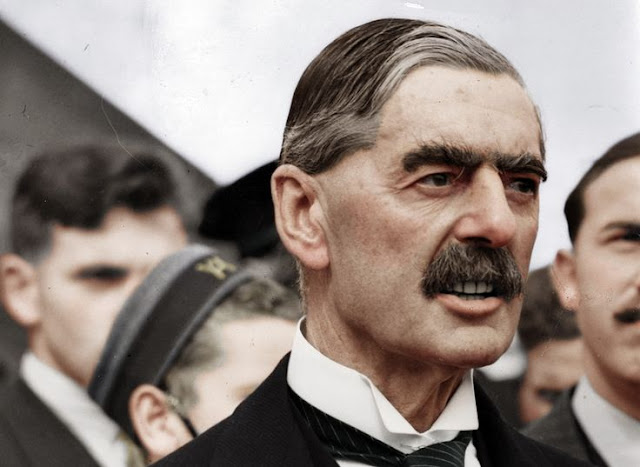
Chamberlain survived a motion of no confidence by a vote of 281 to 200, but the number of absentions from within his own Conservative Party caused the level of support for his government to appear very weak.
The Norway Debate continued in Parliament. David Lloyd George said that since Chamberlain had asked the nation for sacrifice, “I say solemnly that the Prime Minister should give an example of sacrifice, because there is nothing which can contribute more to victory in this war than that he should sacrifice the seals of office.”
During the continuing debate on the conduct of the war and especially of the Norwegian campaign, British Prime Minister Neville Chamberlain’s government was sustained by a test vote of 281 to 200 in the House of Commons. Neville Chamberlain retained control of the British war machine by a narrow, 81-vote margin of confidence won in the House of Commons but attacks for failure in Norway may bring about a reconstructed, all-party government. The prime minister’s Tory backers, alarmed by the swing of public opinion against the Chamberlain leadership, urged him quickly to rebuild his cabinet before he is compelled to yield to the clamor for his resignation. The climax of the debate was reached in a vote on a motion of adjournment which Chamberlain had made a question of confidence when Laborites demanded a division. There were 281 Tory votes to 200 for the combined opposition. The Conservatives’ position was clouded, however, by 134 absentees or abstentions, who, with those voting in opposition, make a majority of the 615 members. The British Press association said 130 members of these were absentees. Moreover, an estimated 40 members who normally support the government voted opposition. Some political observers speculated whether the 71-year-old prime minister might follow the example of former Premier Edouard Daladier of France and resign. There was nothing, however, to confirm such intention, yet. Meanwhile, former Prime Minister David Lloyd George called for Chamberlain to step down for the good of the country. As First Lord of the Admiralty, Winston Churchill stoutly declared that he took the fullest share of responsibility for the Norwegian campaign.
Chamberlain loses 33 conservative members and the vote total is less than previous votes of support. It is an insufficient level of support for a Prime Minister. Accordingly, Chamberlain decides to resign after anguished late-night talks with First Lord of the Admiralty Winston Churchill, who has been conspicuously absent as a target during the debate.
For a while it seems that Lord Halifax will be the next prime minister. Most of the Conservative majority in Parliament would prefer to have Halifax, and the Labour minority are also ready to support him. The problem is that as a peer he sits in the House of Lords and this is not ideal for a national leader. At the meeting of senior Conservatives Halifax’s own worries about this leave Winston Churchill as the only alternative.
Influential Netherlands commentators advanced the suggestion tonight the elaborate army and navy precautionary steps of the last 24 hours were a test of the nation’s defenses. The widely-read Amsterdam newspaper De Telegraaf declared although the international situation was dangerous the sensation caused by the government’s measures was “not justified.” The Dutch army, the newspaper pointed out, is more fully mobilized than at any time in history. It is only logical the high command should test their readiness, “There is no reason for disquiet,” De Telegraaf continued.
French Premier Reynoud tonight called two cabinet meetings for tomorrow one in his office and another with President Lebrun at the Elysee palace as the government kept a careful watch on developments in Holland. Although a war ministry spokesman asserted renewed rumors of a possible German invasion of Holland were only a Nazi propaganda move to keep neutral nations stirred up, other French sources expressed belief something was afoot serious enough to cause the Netherlands to take unusual precautions.
The Belgian government is warned by its embassy in Berlin of impending attack.
The Germans claim that Dutch mobilization on 7 May 1940 is proof that the Allies intend to invade Holland.
William Shirer in Berlin has some advice for Associated Press on whether to transfer their Amsterdam correspondent to Norway: “The war will come to him, soon enough.”
Adolf Hitler again pushes the decision date for the invasion of France to the following day.
Fear that the war would spread to other nations was expressed by Pope Pius this morning in a gloomy and rather bitter address to 4,000 Catholics assembled in the Hall of Benedictions for the customary Wednesday public audience.
Irish Republican Army “terrorists” who continue their lawless campaign against the Irish Government will receive no quarter from now on, Premier Eamon de Valera asserted in a broadcast to the country tonight.
General Wavell and General Weygand meet in Beirut to discuss French plans regarding Crete and Milos in the event of an Italian declaration of War.
Marshal Semyon Timoshenko is appointed the Soviet Commissar of Defense. Training programs are soon introduced to correct some of the defects which have appeared during the Winter War.
Jews in German-occupied territory are now banned from restaurants, parks, museums, trains, owning land. They have a 5 pm curfew and must wear the Yellow Star of David, the “badge of shame.” Chaim Kaplan comments, “My own eyes saw a `badge of shame’: a yellow patch saying ‘Jew.’ I advise everyone add, next to ‘Jew,’ the words: My Pride.”
French Admiral Jean Abrial was lent six Destroyers of Convoy C for the defense of Belgium. This force was designated “FA” and was dispatched in four sections. At 1600/10th, destroyers HMS Valentine and HMS Winchester departed Dover for operations under Abrial’s command. Destroyer Valentine had arrived at Dover on the 9th after escorting convoy FS.66. On 11 May at 0600, destroyers HMS Vimiera and HMS Westminster departed Dover. Destroyers HMS Whitley and HMS Wolsey arrived at Dover from the north on the 12th. Destroyer Whitley departed Dover for FA operations at 0445/13th, followed by Wolsey on the 15th at 1600. However, heavy losses cut short the life of this unit. On 19 May at 1815 “FA” was disbanded with Valentine and Whitley lost, Westminster and Winchester badly damaged. Only Wolsey and Vimiera remained fit for further operations and were ordered to the Dover Command.
Convoy OA.141 departed Southend escorted by destroyer HMS Vivacious.
Convoy OB.141 departed Liverpool escorted by destroyer HMS Versatile from 8 to 10 May. The convoy was dispersed on the 12th.
Convoy FN.166 departed Southend, escorted by armed patrol yacht HMS Breda. The convoy arrived in the Tyne on the 10th.
Convoy FS.166 departed the Tyne, escorted by destroyer HMS Valentine and sloop HMS Weston. The convoy arrived at Southend on the 10th. French large destroyers Albatros and Vautour departed Brest escorting liner Pasteur to St Nazaire, where the liner arrived that day. The destroyers returned to Brest, arriving 1340/10th after spending six hours in Quiberon Bay.
Convoy HX.41 departed Halifax at 0900 escorted by Canadian destroyers HMCS Restigouche and HMCS St Laurent, which were detached on the 9th. The destroyers turned the convoy over to ocean escort, armed merchant cruiser HMS Ranpura and French submarine Ajax at 1800/8th. The armed merchant cruiser and submarine were detached on the 20th. Destroyer HMS Mackay and sloop HMS Aberdeen joined on the 19th and corvette HMS Clarkia on the 20th. The escort was detached on the 23rd when the convoy arrived at Liverpool.
The War at Sea, Wednesday, 8 May 1940 (naval-history.net)
At 1736 Submarine TAKU (Lt Cdr V. J. Van Der Byl) attacked German steamers PALIME (2863grt) and PELIKAN (3264grt) escorted by torpedo boats MOEWE and KONDOR in the North Sea, sixty miles off Tyboroen in 56-45N, 06-12E.
The steamers were undamaged and later arrived at Stavanger on the 9th, but torpedo boat MOEWE was severely damaged in the stern.
Torpedo boat MOEWE was towed by torpedo boat KONDOR to Wilhelmshaven and was repairing until April 1941.
After the ten-hour counterattack, TAKU was forced to return to Rosyth arriving on the 15th.
Destroyers HYPERION, HEREWARD, and JANUS departed Scapa Flow at 0500 with light cruiser BIRMINGHAM for Rosyth.
Destroyers KELLY (D.5) and KIMBERLEY departed Greenock at 0845 with all dispatch for Rosyth to join a force of eight destroyers on duty on the East Coast.
To forestall anticipated German landings on Iceland, armed merchant cruiser CALIFORNIA and armed boarding vessels KINGSTON PERIDOT (356grt), KINGSTON JACINTH (356grt), and NORTHERN DUKE (655grt) operated off the Icelandic coast.
Armed boarding vessels KINGSTON ONYX (357grt) and KINGSTON TURQUOISE (356grt) joined armed merchant cruiser CALIFORNIA on the 13th off Iceland and armed boarding vessel DISCOVERY II (1062grt) arrived off the east coast of Iceland on the 22nd.
In Operation FORK, heavy cruiser BERWICK and light cruiser GLASGOW with destroyers FORTUNE and FEARLESS departed Greenock at 0430 for Reykavik where they arrived on the 10th to land a detachment of Royal Marines.
The troops landing was completed at 0700/10th and the FORK ships departed Reykavik at 1900/10th.
The cruisers searched for eastern fjord for German activity and took on board all German nationals for transport to England.
The destroyers were detached at 1500/11th and arrived at Scapa Flow at 1010/12th.
Cruisers BERWICK and GLASGOW arrived at Liverpool on the 12th.
Heavy cruiser BERWICK was refitting at Liverpool until the beginning of August.
Cruiser GLASGOW was refitting from 14 May to 1 July 1940.
Light cruiser GLASGOW departed Liverpool on 7 July.
Heavy cruiser DEVONSHIRE departed Scapa Flow at 1400 to return to Northern Norway.
Destroyers WESTCOTT and VOLUNTEER met the heavy cruiser at 2045/10th. They arrived at Tromsø at 2255.
Destroyer WESTCOTT refueled from the heavy cruiser at Tromsø that night.
The destroyers were involved in anti-submarine duties around Tromsø from 10 to 14 May. On 14 May, the destroyers were detached to Vice Admiral Air to escort the aircraft carriers operating off northern Norway.
Destroyer ISIS struck wreckage in Balangen Fjord and was badly damaged. Her propellers were wrecked and her tiller flat was damaged. She was towed to Skelfjord by destroyer ILEX.
Destroyer ISIS departed Skelfjord under tow for England on the 10th.
At 2200, destroyer SOMALI met a Norwegian fishing vessel, en route to the Faroes with twelve Norwegian Air Force officers. The boat was given a boat’s compass and directed to the Shetlands.
A Swordfish aircraft of 810 Squadron from aircraft carrier ARK ROYAL crashed into the sea on landing. S/Lt W. G. Adams, S/Lt H.E. H. Pain, Leading Airman H.G. Edwards were picked up by destroyer MAORI.
Adams died of injuries incurred in the crash on 5 October 1940. Edwards was injured, but not seriously.
French Amiral Jean Abrial was lent six Destroyers of Convoy C for the defense of Belgium. This force was designated “FA” and was dispatched in four sections.
At 1600/10th, destroyers VALENTINE and WINCHESTER departed Dover for operations under Abrial’s command.
Destroyer VALENTINE had arrived at Dover on the 9th after escorting convoy FS.66.
On 11 May at 0600, destroyers VIMIERA and WESTMINSTER departed Dover.
Destroyers WHITLEY and WOLSEY arrived at Dover from the north on the 12th. Destroyer WHITLEY departed Dover for FA operations at 0445/13th, followed by WOLSEY on the 15th at 1600.
However, heavy losses cut short the life of this unit. On 19 May at 1815 “FA” was disbanded with VALENTINE and WHITLEY lost, WESTMINSTER and WINCHESTER badly damaged. Only WOLSEY and VIMIERA remained fit for further operations and were ordered to the Dover Command.
French destroyers carried out a twenty-four-hour sweep within twenty miles of the Belgian and Dutch coast as far north as Egmond.
No contact was made.
Light cruiser SOUTHAMPTON was docked at Rosyth for repairs from 8 to 20 May.
Swedish steamers ALBERT (1745grt) and TYRA BRATT (1301grt) were seized by German forces at Stavanger.
Steamer TYRA BRATT was detained at Haugesand and her crew was returned to Gotenburg. The steamer was renamed NOGAT for German service.
Convoy OA.141 departed Southend escorted by destroyer VIVACIOUS.
Convoy OB.141 departed Liverpool escorted by destroyer VERSATILE from 8 to 10 May. The convoy was dispersed on the 12th.
Convoy FN.166 departed Southend, escorted by armed patrol yacht BREDA. The convoy arrived in the Tyne on the 10th.
Convoy FS.166 departed the Tyne, escorted by destroyer VALENTINE and sloop WESTON. The convoy arrived at Southend on the 10th.
French large destroyers ALBATROS and VAUTOUR departed Brest escorting liner PASTEUR to St Nazaire, where the liner arrived that day.
The destroyers returned to Brest, arriving 1340/10th after spending six hours in Quiberon Bay.
Convoy HX.41 departed Halifax at 0900 escorted by Canadian destroyers HMCS RESTIGOUCHE and HMCS ST LAURENT, which were detached on the 9th.
The destroyers turned the convoy over to ocean escort, armed merchant cruiser RANPURA and French submarine AJAX at 1800/8th.
The armed merchant cruiser and submarine were detached on the 20th.
Destroyer MACKAY and sloop ABERDEEN joined on the 19th and corvette CLARKIA on the 20th. The escort was detached on the 23rd when the convoy arrived at Liverpool.
French destroyers INDOMPTABLE and MALIN passed Gibraltar en route from Brest for Oran, where they arrived on the 9th.
Today in Washington, President Roosevelt discussed the Iowa political situation with Senators Herring and Gillette and Representatives Harrington and Jacobsen, the Georgia political situation with Governor Rivers of that State, Clark Howell, Atlanta editor, and James Gillis, chairman of the Georgia Democratic State Central Committee, and transacted other executive business.
The Senate completed Congressional action on the bill to return 116 vessels of the laid-up merchant marine fleet to service, confirmed the reappointments of W. A. Ayres to the Federal Trade Commission and Clyde L. Seavey to the Federal Power Commission, considered the Townsend Bill to repeal the foreign purchase provisions of the Silver Purchase Act and recessed at 4:26 PM until noon tomorrow. The Reorganization Committee agreed to hold hearings on the resolution to disapprove the fourth reorganization order and the Civil Liberties Committee heard further testimony on the problem of migrant workers.
The House voted by 232 to 153 to disapprove the Fourth Reorganization Order, considered the conference report on the $922,911,213 Agriculture Appropriation Bill and adjourned at 5:37 PM until 11 AM tomorrow. The Dies committee heard Mervyn Rathborne and Michael Quill on charges of Communist activity.
Official secrecy tonight continued to shroud President Roosevelt’s diplomatic maneuvering in connection with the European war, but veteran observers were convinced he is charting a sensational course. He appeared to be moving on at least two fronts in the Pacific where the U. S. fleet has been ordered to remain indefinitely, and through Rome, probably in conjunction with the Vatican, in the hope of keeping Italy out of the war.
The White House, on authority of President Roosevelt, denied tonight a report from Rome that Mr. Roosevelt had made a peace offer to Premier Mussolini through Ambassador William Phillips in the nature of a feeler suggesting mediation and that it had been rejected.
The House today rejected, by a vote of 232 to 153, President Roosevelt’s Fourth Governmental Reorganization Order by which he proposed to transfer the Civil Aeronautics authority to the Commerce Department and abolish the Air Safety Board. The resolution of rejection, by Representative Lea of California, went to the Senate and Senator McCarran, author of a similar resolution, stated that he would move tomorrow to take up the question despite the decision of the Senate Reorganization Committee to start hearings on it tomorrow.
There was no debate today in the House on the Lea resolution of disapproval, that having been completed yesterday. The vote showed that seventy-seven Democrats, 153 Republicans and two Progressives supported the resolution. Against it were 151 Democrats, one American Laborite and one Farmer Laborite, and no Republicans. Representative Culkin of New York, had a general pair and he was the only Republican to have his name listed as against rejection of the reorganization order, although the pair prevented his name from being included in the record vote.
If the Senate should adopt the Lea resolution, it would veto the Reorganization Order. But Senate rejection of the McCarran resolution would mean that the order would go into effect June 11. The situation there leaves both the ultimate result and the immediate procedure in doubt. A special committee on reorganization orders headed by Senator Byrnes prepared to begin tomorrow morning a two-day series of hearings on the plan, in the face of Senator McCarran’s threats to move to discharge this committee. Under the law governing Congressional handling of these orders a motion to discharge is “highly privileged,” may be debated only for one hour, and is subject to final vote on the first ballot as it may not be reconsidered.
The House was told today by Representative Woodrum of Virginia, as it took up Senate amendments aggregating $343,000,000 to the Agriculture Department appropriation bill, that the nation for all effective purposes already has exceeded the national debt limit of $45,000,000,000.
The Senate Judiciary Committee completed its plan today to force a Senate vote on the Logan-Walter bill by agreeing upon a series of relatively minor amendments to the measure, already passed by the House.
The House Appropriations Subcommittee handling the 1941 Relief Bill was reported today to have “tentatively” adopted President Roosevelt’s suggestion that the budget-requested sum of $985,000,000 be appropriated in a manner that would permit its use in the first eight months of the new fiscal year instead of having it cover the full fiscal year.
The National Labor Relations Board struck again today at the labor policy of the Ford Motor Company and ordered the company’s Buffalo assembly plant to reinstate thirty-eight discharged C.I.O.-United Automobile Workers Union members, with back pay since 1937.
Michael J. Quill, president of the C.I.O.’s United Transport Workers Union of America, was forcibly removed from the Dies committee hearing today at a turbulent session in which he accused the committee of “war mongering” and denied that he was a Communist.
An affidavit charging that high officials of the German-American Bund had virtually abandoned Fritz Kuhn and “misled” the general membership into believing that their donations would make possible a prompt appeal for the imprisoned bund führer has been filed in Bronx Supreme Court, it was learned yesterday. Kuhn is serving a prison term for embezzling bund funds.
Captain John T. Prout Jr. of the 165th Infantry, New York National Guard, and William Gerald Bishop, mystery man of the alleged plot to overthrow the United States Government, both admitted to agents of the Federal Bureau of Investigation the theft of government ammunition from the 165th Regiment armory, it was disclosed yesterday.
Authorization was voted and support pledged for a special Red Cross drive for funds for European war relief, if necessary, at today’s closing session of the American National Red Cross convention.
Peace groups united yesterday to adopt a “peace platform” at the final session of their two-day National Peace Conference at International House in New York.
Major League Baseball:
Stuart Martin hit two home runs today, giving the St. Louis Cardinals nine round-trippers in two days, as the revived Redbirds defeated Philadelphia, 7–4. He hit one of the Cardinals’ seven homers against Brooklyn yesterday.
Getting to Paul Derringer for four runs in the opening stanza, the Bees shelled him from the mound in a five-run fifth inning and went on today to a 10–4 rout of the Reds.
The Waner brothers, Lloyd and Paul, lose their places in the Pittsburgh outfield when new manager Frank Frisch acquires Vince DiMaggio for Johnny Rizzo, who hit 23 home runs as a rookie in 1938 with Cincinnati. Vince takes over centerfield, flanked by Maurice Van Robays and Bob Elliott, each playing their first full season. Yesterday the Bucs sold outfielder Fern Bell to Toronto.
The struggling New York Giants come alive with 17 hits and pummel the Pirates today, 10–6. Babe Young had four singles; Frank Demaree hit two triples and a double.
The stouthearted relief pitching of Jack Wilson enabled the Red Sox to increase their American League lead today by defeating the Tigers, 5–4.
The Yankees find themselves in unaccustomed territory — alone in last place in the American League. Today another lefthander, Al Smith of the Indians, stops them, 10–4.
Pounding four pitchers for thirteen hits, four of them by Benny McCoy, second baseman, the Athletics outlasted the Browns in a highscoring game today, 10–8.
The White Sox climbed out of the American League cellar today by beating the Senators, 6–3, and left the world champion Yankees in sole possession of last place. Edgar Smith and Clint Brown hurled five-hit ball for the Chicago victory.
Detroit Tigers 4, Boston Red Sox 5
Boston Bees 10, Cincinnati Reds 4
Cleveland Indians 10, New York Yankees 4
St. Louis Browns 8, Philadelphia Athletics 10
New York Giants 10, Pittsburgh Pirates 6
Philadelphia Phillies 4, St. Louis Cardinals 7
Chicago White Sox 6, Washington Senators 3
Rafael Ángel Calderón Guardia became the 19th President of Costa Rica.
The United States Navy Wake-class river gunboat USS Tutuila (PR-4) was damaged when she ran aground on a reef and becomes stranded as she shifted her anchorage at Chungking, China. She will be refloated on May 13, repaired and returned to service.
Chinese Communist Brigadier General Chen Yi recommended his superiors to launch an offensive against Nationalist positions in Jiangsu Province, China.
Battle of Tsaoyang-Ichang: Counterattack by 31st Army Group of Chinese 5th War Area recaptures Tangho.
The Chinese today admitted Japanese troops have broken through Chinese lines on the northern flank of the Hupeh-Honan front at Miyang, thirty miles east of Tangho. Meanwhile the southern wing of the attacking Japanese forces has driven northward to a point on the Siangyang-Tsaoyang highway about twenty miles east of the former city, which is believed one of the main objectives of the whole Hupeh-Honan offensive.
Battle of Tsaoyang-Ichang: Japanese 11th Army captures Hsinyeh and Tsaoyang.
Japanese Navy Rear Admiral Maso Kanazawa, naval spokesman, said today that retention of the United States battle fleet in Hawaiian waters “constitutes another indication of America’s anti-Japanese feeling.” Japanese newspapes uniformly charged today that the stationing of the United States fleet in the Honolulu area is aimed against Japan.
Dow Jones Industrial Average: 147.96 (+0.22)
Born:
Toni Tennille, American singer-songwriter, keyboardist and one-half of the musical duo Captain & Tennille (“Love Will Keep Us Together”), in Montgomery, Alabama.
Ricky Nelson, American actor (“The Adventures of Ozzie and Harriet”), singer (“Garden Party”) and songwriter, in Teaneck, New Jersey (d. 1985, in a plane crash).
Emilio Delgado, American actor (“Sesame Street”), singer and activist, in Calexico, California (d. 2022).
Peter Benchley, American author (“Jaws”), in Princeton, New Jersey (d. 2006).
Naval Construction:
The Kriegsmarine (German Navy) Type IXC U-boat U-163 is laid down by Deutsche Schiff und Maschinenbau AG, Bremen (werk 702).
The Royal Navy Flower-class corvette HMS Godetia (K 72) is launched by the Smiths Dock Co., Ltd. (South Bank-on-Tees, U.K.).
The Royal Navy Flower-class corvette HMS Primrose (K 91) is launched by William Simons & Co. Ltd. (Renfrew, Scotland).
 History Diaries