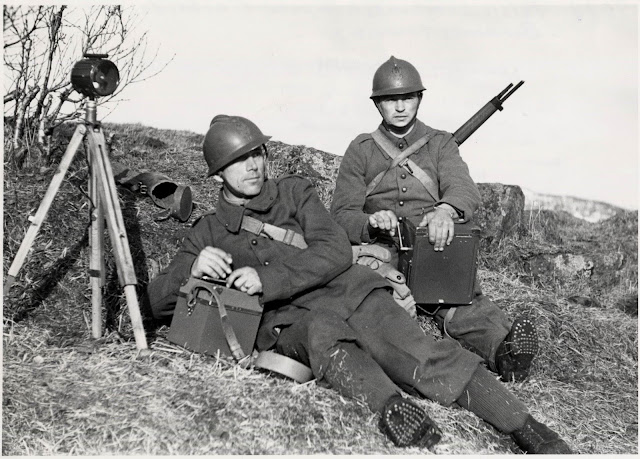
At Narvik, the Allies tightened the noose around Colonel General Eduard Dietl’s Regiment. The South Wales Borderers (part of British 24th Brigade) were in position 5 miles west of Narvik, while French Chasseurs Alpins and Colonial artillery troops continued to press their attack on Labergdal Pass to the north, across the fjord. Both positions were held by German perimeter forces. Getting into position on the opposite shore would provide prime artillery positioning for the Allies, so the pass must be held if the Germans are to hold the town.
Colonel-General Dietl in Narvik is sitting tight in Narvik. It is a small port whose only value is the rail line to Swedish ore mines. While easily defensible due to the towering mountain ranges on all sides, Dietl’s regiment does not have the manpower to hold off a determined assault from all directions.
The Wehrmacht high command (particularly Hitler) is well aware that General Dietl’s regiment is in trouble.
German mountain troops of the 2nd Gebirgsjäger Division continued their slow march north from Trondheim, Norway to Narvik, to aid Dietl’s Regiment. It remains far away. Sea transport is out of the question due to British naval dominance.
While the British control the sea around Narvik, the Germans increasingly control the skies.
Off Narvik, British cruiser HMS Enterprise was slightly damaged by a near miss by an aerial bomb, killing one Royal Marine.
Allied supply convoy arrives at Harstad and Tromsø.
French 13th Demi-Brigade Legion Etrangere arrives at Harstad.
The Norwegian gold reserves — £33,000,000 — arrived in London, England, United Kingdom.
The German cargo ship Vogesen struck a mine and sank in the Kattegat (57°33’N 11°35’E).
British submarine HMS Sealion attacked German transports Moltkefels and Neidenfels in the Skagerrak at 1400 hours. All 6 torpedoes missed.
HMS Ark Royal, now in position 69.00 N, 11.50 W, flies off a Walrus at 1651 carrying Staff Officer Operations to Harstad to confer on the impending operations. These are immediately followed by two sections of Skuas (six aircraft) to fly fighter patrols over Harstad. At 2145, three Swordfish were dispatched to attack a surfaced U-boat that had been reported by the returning Skuas, but it was not sighted.
Light cruiser HMS Enterprise was near missed by German bombing at Narvik. The ship sustained splinter damage. Cdr M. F. L. Henstock was wounded.
The general expectation was that British Prime Minister Chamberlain would survive attacks during debate starting tomorrow afternoon and continuing Wednesday, but not without seeing his government badly shaken. If he fares badly, it was reported, the 71-year-old prime minister may seek a way out by announcing a plan to bring about immediate and effective coordination of the fighting forces with Churchill in the role of supreme defense leader. The bitterness of impending attacks on the floor of commons by the Laborite opposition was evidenced tonight when it was demanded that Chamberlain resign and permit a “war against Hitler under new management.”
Fall Gelb, the German invasion of France, was once again postponed by Hitler. Meanwhile, Pope Pius XII shared the intelligence gathered by Vatican agents that Germany was planning on invading the Low Countries with the Princess of Piedmont Marie José, who was the sister of King Leopold III of Belgium and wife of Italian Crown Prince Umberto. Unfortunately, there have been several false alarms that have greatly embarrassed the Belgians and cost some highly placed officials their jobs, so one more alarm does not create as much excitement as it otherwise might.
On the same day, a massive German armored motorized column many miles long was spotted driving west through the Ardennes forest but the Belgian Army did not respond.
Hitler’s Wehrmacht is silently moving over 90 divisions into launching points for the invasion of the Low Countries and France. Meanwhile, the Allies are focused on the sideshow in Narvik. The Germans, incidentally, are preparing more divisions for combat operations than the United States fielded at any point in World War II.
Two companies of German troops stormed French outposts in the wake of violent artillery fire in the Saar sector early today, military dispatches from the Western Front reported. Military sources were silent on the outcome, although they admitted. fighting still was going on well after daylight. The attack was well organized, available information indicated. Big guns laid down a heavy “box fire” in advance, encasing the point to be attacked and making difficult the bringing up of reinforcements. French sources said the Germans in all three attacks were highly mobile detachments specially trained for such tactics. Military observers believed the repeated attacks in the one sector were designed by the Germans to test the caliber of their troops. The enemy appeared to be training its front-line men in storming tactics. At the same time it was pointed out that the German soldier cannot get his stripes without distinguishing himself in the course of some action. Aviation activity consisted of desultory French raids over the German lines and a German flight over Eastern France, military sources reported.
Unemployment in the United Kingdom fell below 1 million people for the first time in 20 years.
Steps were taken today in Britain to curb Communist anti-war activities and the party’s influence in the trade union movement.
The International Olympic Committee formally canceled the 1940 Summer Olympics.
Horia Sima, a young Rumanian Legionary (Iron Guard) leader leaves Berlin with a group of comrades and secretly enters Rumania.
In an editorial in today’s Giornale d’Italia, Virginio Gayda states that Italy has taken “a few precautions in the territories nearer to the Balkans.”
Another report on German atrocities in Poland has recently been made by August Cardinal Hlond, Polish Primate, to the Pope, it was announced by the Polish Embassy today. From details which have been given out, this report, like the similar one made in January, is a tale of unmitigated horrors. The Pope is understood to have been so shocked that he is contemplating making a speech soon referring to Poland.
The 1919 military class has been called up for training in Yugoslavia and recruits are still marching to their barracks tonight. Some 70,000 men are affected by the order.
RAF Bomber Command dispatches 12 aircraft on minelaying operations overnight.
The Royal Navy minesweeping trawler HMS Loch Naver collided with another vessel off Hartlepool, County Durham and sank. The survivors were rescued by the yacht Breda (United Kingdom).
The Kriegsmarine vorpostenboot V-101 sank in the Kattegat.
The Kriegsmarine vorpostenboot V-811 struck a mine in the Ems estuary and sank.
The German cargo ship Brage struck a mine in the North Sea off the Kiel Lightship (Germany) and sank.
The British tanker Brighton struck a mine and sank in the North Sea off Dunkerque, Nord, France (51°03’N 2°09’E). All 34 crew were rescued.
German armed merchant cruiser Widder departed Kiel to operate in the Central Atlantic, via the Denmark Strait. At 1525 armed merchant cruiser Widder was attacked by submarine HMS Snapper, which fired two torpedoes in the North Sea in 55-35N, 07-16E. The German ship was not damaged and her escorts of S.boats drove submarine Snapper off.
French netlayer Gladiateur arrived at Beirut to prepare the port for wartime operations.
Convoy OA.143GF departs Southend.
Convoy OB.143 departs Liverpool.
Convoy NS.2 departed the Clyde at 0230 for Narvik. It was composed of base ship Mashobra and British steamers Balzac (5372grt), Calumet (7268grt), Coxwold (1124grt) escorted by destroyers HMS Javelin and HMS Jackal and French destroyers Brestois and Boulonnais. On the 7th at 0230, steamers Balzac and Coxwold ran aground south of Neist Light in Little Minch. Steamer Balzac was escorted by destroyer Brestois to Stornoway, arriving at 1330. Destroyer Brestois continued on to Scapa Flow. Destroyer Brestois made an attack on a submarine contact at 0130/8th in 58-43N, 03-50W. Later considered non sub. Steamer Coxwold was taken by Boulonnais and Brestois to Scapa Flow, arriving 0630/8th after being delayed by fog in Pentland Firth. Destroyers HMS Witherington and HMS Wolverine departed Scapa Flow at 0500/7th with steamer Meta (1578grt) to rendezvous with the convoy at 1500/7th. On joining, destroyer Witherington was sent to Stornoway to provide anti-submarine protection for steamer Balzac. She was later relieved by anti-submarine trawler St Cathan (565grt). Destroyer Witherington arrived at Scapa Flow at 1300/9th. The fuel stores on Coxwold were embarked on British steamer Ulster Monarch (3791grt) which departed Scapa Flow at 2130/10th unescorted for Narvik. On the convoy’s arrival in the Narvik area, destroyers Javelin and Jackal were ordered to return to Scapa Flow immediately. Destroyers Javelin and Jackal departed Tjelandet at 0700/11th.
Convoy FN.164 departed Southend, escorted by destroyers HMS Vivien and HMS Vimiera. The convoy arrived at the Tyne on the 8th.
Convoy FS.164 departed the Tyne, escorted by destroyer HMS Winchester and sloop HMS Londonderry. The convoy arrived at Southend on the 8th.
The War at Sea, Monday, 6 May 1940 (naval-history.net)
Light cruiser ENTERPRISE was near missed by German bombing at Narvik.
The ship sustained splinter damage. Cdr M. F. L. Henstock was wounded.
Light cruiser SOUTHAMPTON departed Scapa Flow at 2240 for Rosyth.
Anti-aircraft ship CALCUTTA departed Scapa Flow at 1941 for the Narvik area.
Destroyers WOLVERINE and WITHERINGTON arrived at Scapa Flow at 1430 with British boom defense vessel META (1578grt) from Leith.
Convoy NS.2 departed the Clyde at 0230 for Narvik. It was composed of base ship MASHOBRA and British steamers BALZAC (5372grt), CALUMET (7268grt), and COXWOLD (1124grt) escorted by destroyers JAVELIN and JACKAL and French destroyers BRESTOIS and BOULONNAIS.
On the 7th at 0230, steamers BALZAC and COXWOLD ran aground south of Neist Light in Little Minch.
Steamer BALZAC was escorted by destroyer BRESTOIS to Stornoway, arriving at 1330. Destroyer BRESTOIS continued on to Scapa Flow.
Destroyer BRESTOIS made an attack on a submarine contact at 0130/8th in 58-43N, 03-50W. Later considered non sub.
Steamer COXWOLD was taken by BOULONNAIS and BRESTOIS to Scapa Flow, arriving 0630/8th after being delayed by fog in Pentland Firth.
Destroyers WITHERINGTON and WOLVERINE departed Scapa Flow at 0500/7th with steamer META (1578grt) to rendezvous with the convoy at 1500/7th.
On joining, destroyer WITHERINGTON was sent to Stornoway to provide anti-submarine protection for steamer BALZAC. She was later relieved by anti-submarine trawler ST CATHAN (565grt).
Destroyer WITHERINGTON arrived at Scapa Flow at 1300/9th.
The fuel stores on COXWOLD were embarked on British steamer ULSTER MONARCH (3791grt) which departed Scapa Flow at 2130/10th unescorted for Narvik.
On the convoy’s arrival in the Narvik area, destroyers JAVELIN and JACKAL were ordered to return to Scapa Flow immediately.
Destroyers JAVELIN and JACKAL departed Tjelandet at 0700/11th.
Destroyer ESCAPADE departed Rosyth at 0900 for Invergordon to escort British tanker INVERADER to Scapa Flow.
The ships departed Invergordon at 2030/7th and arrived at Scapa Flow at 0700/8th.
Destroyer ESCAPADE went on to Liverpool for repairs. She arrived at 0740/9th.
Destroyer CODRINGTON (D.1) departed Invergordon with British tanker WAR BHARATA for Scapa Flow arriving at 1700.
Destroyers ESK, EXPRESS, and INTREPID arrived Scapa Flow with mines for operation DZ, a minelay in Norwegian waters.
However, this operation was later cancelled.
Destroyers HERO and FOXHOUND departed Scapa Flow at 1230 for boiler cleaning at Rosyth.
Destroyers IVANHOE, ICARUS, and IMPULSIVE departed Scapa Flow at 2130 for Immingham to boiler clean and embark mines.
At 1400, submarine SEALION attacked escorted German transports MOLTKEFELS (7863grt) and NEIDENFELS (7838grt) 19 miles 240° from Vaderobod Light in 58 30N, 10 30E.
The submarine fired six torpedoes and claimed three hits, but no damage was done.
Submarine TRIAD of the 2nd Flotilla, SEAWOLF, SHARK, and SNAPPER of the 3rd Submarine Flotilla, STURGEON of the 6th Submarine Flotilla and French submarines AMAZONE, ANTIOPE, CALYPSO, CIRCE, DORIS ORPHEE, SYBILLE, and THETIS of the 10th Submarine Flotilla began patrols in the southern North Sea and blockade of Texel in anticipation of the German invasion of the Low Countries.
Submarine TRIAD departed Rosyth on patrol on the 6th, SEAWOLF departed Harwich on the 6th, SHARK departed Harwich on the 7th, STURGEON was already at sea having departed Blyth on 30 April and continued patrol until returning on the 11th, SNAPPER was also already at sea having departing Harwich on 28 April and continued patrol until arriving back at Blyth on the 11th.
Submarine ANTIOPE was already at sea having departed Harwich on 28 April and arrived back on the 8th, CALYPSO, which had departed Harwich on 29 April to relieve AMAZON off Texel, arrived back for refueling on the 11th, CIRCE arrived at Harwich with defects from patrol on the 6th and set off again on the 12th, DORIS and AMAZONE departed Harwich on patrol on the 6th ORPHEE departed Harwich on patrol on the 3rd, LA SIBYLLE already at sea having departed Harwich on 27 April completed her patrol on the 8th when she arrived back at Harwich, THETIS arrived at Harwich from patrol on the 7th and departed again on patrol on the 10th.
Reassignments on patrol areas were made on 10/11 May. French submarines THETIS and ANTIOPE were moved to patrol areas off Lowestoft and Yarmouth. French submarine AMAZONE was moved to forty miles west off Texel and French submarine DORIS was ordered to a parallel patrol line fifty miles west of Rotterdam. However, submarine DORIS had already been lost by that time.
Destroyer WILD SWAN and minesweeper SKIPJACK began boiler cleaning at Dover.
Destroyer WILD SWAN returned to service on the 9th.
Convoy FN.164 departed Southend, escorted by destroyers VIVIEN and VIMIERA. The convoy arrived at the Tyne on the 8th.
Convoy FS.164 departed the Tyne, escorted by destroyer WINCHESTER and sloop LONDONDERRY. The convoy arrived at Southend on the 8th.
German armed merchant cruiser WIDDER departed Kiel to operate in the Central Atlantic, via the Denmark Strait.
At 1525, armed merchant cruiser WIDDER was attacked by submarine SNAPPER, which fired two torpedoes in the North Sea in 55-35N, 07-16E. The German ship was not damaged and her escorts of S-boats drove submarine SNAPPER off.
British steamer BRIGHTON (5359grt) was sunk on a mine in 51 03N, 02 09E.
The entire crew was saved.
Minesweeping trawler LOCH NAVER (278grt, Skipper G. R. Burwood RNR) of Minesweeping Group 22 was lost off Hartlepool in a collision with an unknown vessel.
The survivors of the trawler were rescued by British yacht BREDA (1431grt).
German steamer BRAGE (5954grt) was sunk on a mine near Kiel Light Ship.
French netlayer GLADIATEUR arrived at Beirut to prepare the port for wartime operations.
The U.S. Senate in Washington confirmed the nomination of Senator Schwellenbach to be a United States District Judge for the Eastern District of Washington, completed Congressional action on the conference report on the Rivers and Harbors Authorization Bill, received the Wagner bill to extend to disabled workers the benefits of the Social Security Act, received the President’s veto of the bill extending Federal crop insurance to cotton, debated the bill for the repeal of the Silver Purchase Act and recessed at 5:20 PM until noon tomorrow.
The Senate Judiciary Committee voted to recommend consideration of the Logan-Walter bill at this session and the Civil Liberties Committee heard Secretary Perkins on the problem of migratory workers.
The House passed a bill authorizing the Maritime Commission to sell or charter idle ships of the Merchant Marine fleet, approved the conference report on the Rivers and Harbors Bill, heard pleas for action on the Hatch bill, heard Representative Short criticize Mexico for its stand on the oil controversy, considered calendar bills and adjourned at 4:13 PM until noon tomorrow.
The Supreme Court upheld the conviction of twelve corporations and five individuals in the Madison Oil case.
President Roosevelt today gave his unqualified endorsement to legislation extending the Hatch Act’s restrictions on political activities by federal employees to state employees who are paid wholly or in part from federal funds. Thereby, the President assumed personal leadership of the fight to dislodge the new legislation from the House Judiciary Committee, which pigeonholed it last week. Mr. Roosevelt volunteered his statement at a press conference. He said he hoped the amendments could be extracted from the House Judiciary Committee, brought before the House and passed. He left no doubt of his willingness to sign the bill into law if given the opportunity.
Coming at a time when backers of the legislation are trying to get the necessary 218 signatures to a petition discharging the committee from further consideration of the measure and thus bring it automatically before the House for a vote, it was obvious to observers that the President sought to place members of both legislative branches on record regarding the issue. One view was that Mr. Roosevelt was expecting ultimate approval of the amendments and wanted to be on record, himself, as having given them his endorsement. Another was that he pictured the measure in an uphill fight and sought through his statement to supply the impetus for bringing it to a vote, and final passage.
Whatever the case, the statement came as a surprise to those who had heard his first unenthusiastic reaction to the legislation a short time after it was introduced. He had signed the original Hatch Act with several reservations, and said of the amendments extending its restrictions to state employees that it was probably a good thing to include them, since federal workers below the policy-making status already were subject to the law. Mr. Roosevelt made no mention of the 14-to-10 vote by which the House committee tabled the extending amendments, nor of assertions by Representative Dempsey, sponsor of the measure in the House, that sixteen committeemen had told him they voted to report the bill out of committee.
President Roosevelt vetoed today a bill to extend to cotton the system of Federal crop insurance now applied only to wheat.
An attempt by Administration leaders in the Senate to sidetrack the Logan-Walter bill, designed to open Federal administrative actions to court review, met an emphatic rejection today at the hands of the Senate Judiciary Committee. Soon after Senator Barkley, the majority leader, appeared before the committee to request that the committee defer action on this bill, recently adopted by the House, and in effect kill it, the committee voted unanimously that the measure should go to the floor. Fourteen members, including all except Senators Chandler and Neely, who were absent, joined with Senator Ashurst, the chairman. Not all necessarily support the bill, it was explained afterward, but both proponents and opponents favored an open test in the Senate rather than to pigeonhole the measure.
The House of Representatives voted 194 to 15 today to free 116 government-owned ships of World war vintage from the maritime commission’s laid-up fleet and permit their operation in the inter-coastal, coastal or foreign trades. Under the parliamentary procedure under which the house was operating, a two-thirds majority was necessary for action on legislation proposed by Representative Buck, California Democrat. House passage sends the legislation to the senate, where a similar resolution, by Senator Johnson, California Republican, has been approved by the senate commerce committee.
An involved four-way factional fight for California’s 44 votes in the Democratic national convention is expected to bring out a record number of Democrats tomorrow in a new test of strength between President Roosevelt and Vice-President Garner. Two unpledged slates based on principles and the switches of delegates between slates were counted on to draw more of the record registration cf 2,172,853 Democrats to the polls. The Democratic free-for-all was the only state-wide issue on the California ballot. The 1,308,211 Republicans have only a single unpledged delegation for which to vote. Minor parties have no candidates at all. Makeup of the Democratic tickets will give the first clear picture of the voting strength of various party factions in California.
Thomas E. Dewey picked up a couple dozen more Republican national convention delegates today in primary voting in Maryland and a state convention in Idaho. Voters in the Maryland Republican primary had a choice between Dewey and an uninstructed delegation. With the count from about half of the polling places completed, the Free state’s Republicans had voted more than 7 to 1 for Dewey, assuring him of the 16 Maryland delegates. In Idaho, a state convention voted 133 to 68 to instruct the eight delegates to cast their ballots for Dewey “so long as in the judgment of the delegates, Mr. Dewey shall have a reasonable chance” for the presidential nomination.
The Supreme Court by five to two sustained today the conviction of twelve Midwest oil corporations and five individuals for conspiracy to violate the 1890 Sherman act.
Secretary of Labor Frances Perkins stirred up a hornets’ nest today by recommending that the Social Security Act and the Wage-Hour Act be extended to cover workers on industrialized farms, that being exactly what the operators of those farms have opposed.
Another witness before the House Committee to Investigate Unamerican Activities described Harry Bridges as a Communist today, and testified further that the C.I.O. labor leader and Edwin S. Smith of the National Labor Relations Board had conferred privately in 1936 on East Coast labor matters. The witness was Peter J. Innes Jr. of Bridgeport, Connecticut, who said he had once been national purchasing agent for the C.I.O.’s National Maritime Union.
John Steinbeck won the Pulitzer Prize for his novel “The Grapes of Wrath.”
Major League Baseball:
Forget yesterday’s mark. Two Major League records are set as Pittsburgh uses 24 players and both clubs use 40 as the Boston Bees win in 12 innings, 10–7. The Bucs have lost 6 in a row.
The red-hot Brooklyn Dodgers win again, beating the Cardinals in St. Louis, 6–2, behind the pitching of Luke “Hot Potato” Hamlin. Dolf Camili hit his third home run of the year in the 6th to pace Brooklyn.
The Phillies knocked out Dizzy Dean in the fifth inning today, but all they got for their efforts was an overtime game that Billy Herman won for the Cubs, 5–4 with an eleventh-inning homer off Lloyd Brown, relief pitcher.
After a earlier rain delay, the Reds score 7 runs in the sixth to crush the New York Giants, 9–1. Ernie Lombardi’s double and Harry Craft’s home run were the big blows for Cincinnati.
Hank Greenberg and Billy Sullivan hit home runs, sparking a Detroit comeback that ends with the Tigers beating the Yankees, 6–4. Greenberg added a ninth-inning double that brought home the winning runs.
The Red Sox put on a six-run barrage in the fourth inning today to score an 8–5 triumph over the Indians and climb back into the lead in the American League, supplanting the Tribe by half a game.
Nelson Potter of Philadelphia and Johnny Rigney of the White Sox each yielded nine hits today, but extra-base blows helped the Athletics win, 3–2, and even the current three-game series at 1-all.
Cleveland Indians 5, Boston Red Sox 8
Philadelphia Phillies 4, Chicago Cubs 5
New York Giants 1, Cincinnati Reds 9
Detroit Tigers 6, New York Yankees 4
Chicago White Sox 2, Philadelphia Athletics 3
Boston Bees 10, Pittsburgh Pirates 7
Brooklyn Dodgers 6, St. Louis Cardinals 2
St. Louis Browns 11, Washington Senators 9
Fire in Colombia caused the death of 103 and injuries to 125 persons, celebrating the hundredth anniversary of the death of the Colombian hero, General Francisco de Paula Santander, at Sandona in the State of Narino near the Ecuadorian border. Sixty-seven of the dead are children. A short circuit electric wiring started the fire, which destroyed the Municipal Palace.
Battle of Tsaoyang-Ichang: Japanese 11th Army captures Fengyao and Changchiachi.
Continuing its policy of extending trade connections with Latin America, the Japanese Government today announced ratification of a treaty of trade and navigation with Uruguay.
Closing his visit to Tokyo tonight, Francis B. Sayre, United States High Commissioner to the Philippines, again emphasized the informal and purely informative nature of his conversations with Foreign Minister Hachiro Arita. A brief statement released by the United States Embassy said that “the informal talks that Mr. Sayre has had with Mr. Arita have consisted wholly of efforts to clarify certain aspects of American-Japanese relations and have been, as intended, purely of an informative nature.” The last of Mr. Sayre’s talks with Mr. Arita was held today in the informal atmosphere of a luncheon party. It was attended, however, by such key men as Ambassador Joseph C. Grew, Eugene H. Dooman, counselor of the United States Embassy; Masayuki Tani, Vice Foreign Minister; Seijiro Yoshizawa, director of the American Bureau of the Foreign Office, and Yakichiro Suma, the Foreign Office spokesman.
Dow Jones Industrial Average: 147.33 (-0.22)
Born:
Bill Hands, MLB pitcher (San Francisco Giants, Chicago Cubs, Minnesota Twins, Texas Rangers), in Hackensack, New Jersey (d. 2017).
Murry Sidlin, American conductor (National Symphony, 1973-77; Long Beach Symphony, 1980-88), arranger (“Defiant Requiem”), and educator, in Baltimore, Maryland.
Died:
Jonah Kumalae, 65, Hawaiian politician, businessman and ukulele manufacturer.
Naval Construction:
The U.S. Navy 70-foot Elco patrol motor torpedo boat USS PT-15 is laid down by the Electric Boat Company Ltd. (Elco Works), (Bayonne, New Jersey, U.S.A.).
The Royal Navy Tree-class minesweeping trawler HMS Ash (T 39) is commissioned. Her first commander is T/Skipper George Alfred Harrison, RNR.
The U.S. Navy prototype (110-foot wooden hull) submarine chaser USS SC-450 is commissioned.
The Royal Canadian Navy patrol vessel (armed yacht) HMCS Ambler (Q 11; later Z 32) is commissioned.
The Royal Canadian Navy patrol vessel (armed yacht) HMCS Beaver (S 10; later Z 10) is commissioned.
The Royal Navy Flower-class corvette HMS Calendula (K 28) is commissioned. Her first commander is Lieutenant Commander Alan Douglas Bruford, RNVR. In 1942 she will be transferred to the U.S. Navy under reverse lend-lease and renamed the USS Ready (PG-67).
The Italian Royal Navy (Regia Marina) Littorio-class battleship RN Littorio (later renamed Italia) is commissioned.
 History Diaries