The New York Times reports today, May 5, 1940:
“A natural substance found abundantly in many parts of the earth, now separated for the first time in pure form, has been found in pioneer experiments at the Physics Department of Columbia University to be capable of yielding such energy that one pound of it is equal in power output to 5,000,000 pounds of coal or 3,000,000 pounds of gasoline, it became known yesterday.
“The discovery was announced in the current issue of The Physical Review, official publication of American physicists and one of the leading scientific journals of its kind in the world.
“Professor John R. Dunning, Columbia physicist, who headed the scientific team whose research led to the experimental proof of the vast power in the newly isolated substance, told a colleague, it was learned, that improvement in the methods of extraction of the substance was the only step that remained to be solved for its introduction as a new source of power. Other leading physicists agreed with him.
“A chunk of five to ten pounds of the new substance, a close relative of uranium and known as U-235, would drive an ocean liner or an ocean-going submarine for an indefinite period around the oceans. of the world without refueling, it was said, for such a chunk would possess the power-output of 25,000,000 to 50,000,000 pounds of coal, or of 15,000,000 to 30,000,000 pounds of gasoline.
“Uranium ore, in which the U-235 also is present, is found in the Belgian Congo, Canada, Colorado, England and Germany, in relatively large amounts. It is 1,000,000 times more abundant than radium, with which it is associated in pitchblende ores.
“Until about two months ago not even an infinitesimal drop of the substance had been isolated in pure form and the task of doing so appeared hopeless from a practical point of view. Toward the end of February a minute fraction of a gram was isolated at the University of Minnesota Physics Department, under the direction of Professor Alfred O. Nier. The sample was rushed at once to Columbia University, where Professor Dunning, in collaboration with Dr. E. T. Booth and Dr. Aristid V. Grosse, submitted it to tests with the Columbia 150-ton cyclotron (atom smasher).
“The sample, however, was so small that the results, while striking, served merely to stimulate the scientists at Columbia and Minnesota to further efforts. So fast has the work progressed since the beginning of March, the report in the Physical Review says, that the yield has been increased 200-fold.
“Such an increase in two months has given new hope that a process for isolating the substance in larger quantities, in grams and pounds instead of millionths of a gram, will be found in the not too distant future. While scientists refuse to make predictions, it is not impossible that a few months or a year hence may see the realization of this quest.”
The Times added the following day:
“Dr. Nier said his experiments had proved a theory advanced by Neils Bohr, Danish scientist, that the explosive tendency of uranium lay in U-235.
” ‘The isolation of the isotope has little commercial or military value at present,’ he asserted.
” ‘U-235 is present in uranium in only minutely small quantities, the bulk of the metal being U-238, another isotope of uranium which does not possess the explosive quality of U-235.’
“So far, he said, laboratory experiments had produced an infinitely small amount — “hardly enough to spring a mousetrap.”
“There is no possibility, he added, that U-235 could be developed for use in the present war.
Central and southern Norway are now solidly German-occupied, but the northernmost third of the country is still up for grabs. It is rugged, largely devoid of roads, and subject to fierce weather, with military supply dependent upon naval or aerial sources – at which the British and French can rightly claim an advantage. The prize is more desirable because, aside from general geographic convenience for U-boat operations and air bases, the only value of Norway to anyone lies in that northern third – the port of Narvik. It is the source of the iron ore which makes the tanks and ships and guns which the German war machine requires.
The Battle of Hegra Fortress ended when the fortress capitulated. The Germans had now achieved complete victory on Norway’s southern front. Hegra Fortress surrendered following the Allied evacuation around Trondheim and the surrender of southern Norway. The fortress had been under siege since April 12, 1940 resisting infantry and artillery attacks plus Luftwaffe bombings. 190 volunteer soldiers and civilian nurse Anne Margrethe Bang became POWs. 150-200 Germans were killed or wounded attacking the Fortress while 6 Norwegians died and 14 were wounded.
A Norwegian government in exile was established in London with British support. Norwegian Foreign Minister Professor Koht, and Minister of Defence Colonel Ljungberg arrive in London for consultations with British ministers. A Norwegian Government-in-exile is established in London, though the seat of government remains under British/French protection in northern Norway.
German 2nd Mountain Division advancing north from Namsos toward Mosjoen.
French Foreign Legionnaires and Polish troops land at Harstad and Tromsø, preparing the way for a pincer movement on Narvik. They also can help block any relief attempts.
Norwegian 6th Infantry Brigade and 7th Infantry Brigade and French 27th Demi-Brigade de Chasseurs capture Elvenes north of Narvik.
Reports from Oslo today say that the three prison camps, where about 10,000 Norwegians are held, are insufficient and that new ones are being created at Gargemoen, at Baerum, at Lillehammer and in the west of Norway.
Thousands of starving war refugees descended upon the hilly regions around Namsos Friday and Saturday and helped themselves to large stores of food left by the British and French before the hasty allied withdrawal. Upon learning that the allies were gone, these civilian victims of the war made a Roman holiday of it, eating and drinking as much as they could and then carting away as big a load as they could carry to their homes. It was a strange procession of vehicles of every description imaginable, stacked high with everything from bully beef to the equivalent of hard tack.
German aircraft from Norwegian bases fly support missions for General Dietl’s troops at Narvik for the first time.
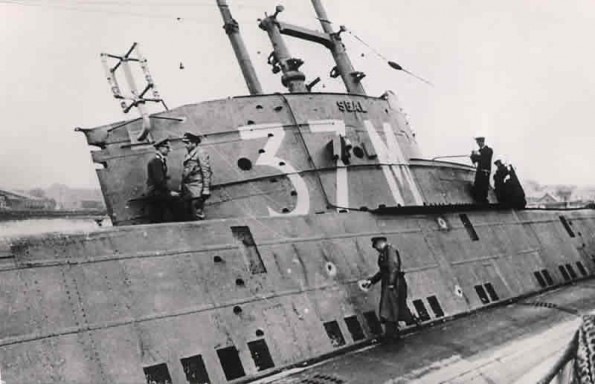
The British submarine Seal was captured by the Germans in the Kattegat. The mine-laying submarine HMS Seal which had been damaged the previous day was refloated by her crew and was attempting to reach Swedish waters. Lt Gunther Mehrens, piloting an Ar 196A-3 from Ku.Fl.Gr.706, spotted HMS Seal. Mehrens attacked with his cannon and bombs, forcing the submarine’s surrender. The British submarine surrendered with a white table cloth. The crew of 60 was captured at around 0530 hours after failing to scuttle the ship.
British submarine HMS Seal begins the day on the ocean floor in the Skagerrak after a mine explodes nearby. The Captain reads the Lord’s Prayer to the crew. While damaged, it is intact enough for the men to somehow re-float it (using their very last, unexpected source of air) at 01:30. They head for Swedish waters to be interned, but the submarine can only go in reverse, and then the engine seizes up completely from mud collected on the sea bottom. A Luftwaffe Heinkel He 115 seaplane and two Arado 196s spot her dead in the water at 02:30. The crew surrenders using a white table cloth.
The captain of the Seal, Rupert Lonsdale, swims to the Heinkel to surrender. The crew is saved and HMS Seal (expected by its crew to sink) is taken in tow by the German “UJ 128” (Unterseebootsjäger 128) and brought to the German naval base at Frederikshavn, Denmark. It is about as near-death as a submarine crew can get and still survive – they truly looked death in the face -and one of the epic survival stories of submarine history.
The damaged Norwegian cargo ship Eldrid was scuttled at Narvik, Nordland by German forces.
The Royal Norwegian Navy 1st-class torpedo boat HNoMS Sild was scuttled in the Norwegian Sea off Harøya, Møre og Romsdal to prevent capture by German forces.
The Norwegian cargo liner Richard With was attacked and damaged off Sørreisa, Tromsø by Luftwaffe aircraft and was beached. Later refloated, repaired and returned to service.
German raider Widder sails from Kiel for Bergen.
Citing the Norwegian campaign as an “irreparable blow” to allied prestige in a war in which everything depends on the attitude of the neutrals, David Lloyd George, World War premier, today demanded an immediate reconstruction of the war’s direction to avoid disaster. Writing in the Sunday Pictorial, Lloyd George, a constant critic of the Chamberlain government, added his powerful voice to the storm of criticism in England over the allied withdrawal from central Norway. In a bitter attack, Lloyd George said the Norwegian campaign was not one blunder but “one series of incredible botcheries.” His article asserted that the democratic leaders have “muddled their case” since Germany started to rearm. He listed blunders as: “Our failure to take effective measures to create a powerful air force when Germany was spending thousands of millions on creating powerful offensive armaments. “Abandoning Czecho-Slovakia and backing Russia, then rushing into a crazy guarantee to Poland without first, ascertaining where Russia stood. Sending a third class foreign office clerk to negotiate an arrangement with the prime minister of a powerful country like Russia, “Encouraging Poland to fight without first ascertaining the condition of her defenses and not sending airplanes to aid her when she was being mangled to death.”
Adolf Hitler pushed the decision date for the invasion of France to the following day.
There is a report that, during the night, German patrols launched exploratory attacks on three Allied outposts supported by artillery fire, but were driven off. Whatever it may portend, the Germans seem to have adopted new tactics on the French front. Again last night, after intense artillery preparation, they simultaneously attacked several contiguous outposts. The action lasted several hours and was of a very determined nature; at one time the outposts were surrounded. The French defense was stubborn and machine guns were used to good effect until the arrival of supporting units. The enemy was then driven off with casualties. As was the case on Friday night, this attack occurred in the region of the Saar River. Details now available of the engagement on Friday indicate the new process. Soon after nightfall German artillery began pounding several outposts at the edge of a wood on a front of about a mile and a half. This lasted several hours. The infantry, estimated at three companies at least, advanced to the attack.
Warned by the artillery preparation, the French gunners were ready; as soon as the advance was reported, they vigorously shelled the raiders, who fell back in disorder. The French losses are described as “very slight.” At daybreak a quantity of blood-stained German equipment was discovered in front of the outposts. It has been observed that frequently, after an unsuccessful attempt, the Germans return to the charge in the same sector as soon as possible in stronger force and with greater determination. Such was the case with the action last night, which is reported as follows in a General Headquarters communiqué: “During last night, in the region of the Saar, the enemy, supported by heavy artillery fire, attacked three of our outposts in force. These outposts, although surrounded, resisted victoriously until our counter-attack, led by light units, drove the enemy away.” Hitherto German attacks have involved only one post at a time.
Journalist William Shirer in Berlin, unlike the Allied intelligence services, notices something unusual going on: “More bans on private cars. Why is Germany saving oil? Do they need it for some big military plan?”
Giovanni Ansaldo, Italian editor who speaks for Foreign Minister Count Galeazzo Ciano, today predicted in a nation-wide radio broadcast that Germany will invade the British Isles and said such an invasion would have the blessing of Italy. Ansaldo, editor of Ciano’s Leghorn newspaper Tclegrafo, said that “the coup dreamed by Napoleon would finally be realized through the enormously improved technical means now at the disposal of the Germans.”
A German Abwehr agent lands by parachute near Dublin. Ireland is defiantly neutral, but a large body of opinion sees the distraction of war against Germany as a handy way to pry the British out of the country. Taking advantage of this, the German military intelligence service sends Kapitän Hermann Goertz to Dublin by parachute. He is there to establish contacts with the IRA and sympathetic Irish Army Officers.
Pope Pius XII issues a public anti-war prayer: “Christ, please stop the whirlwind of death which is crushing humanity.”
As viewed from Belgrade, Yugoslavia, which is probably the most sensitive listening post in Southeastern Europe, a new type of uneasiness has pervaded the area. Recently there was a short-range fear that war would spread here any day. This has now gone. There is a tendency to feel that Italy has calmed down for the moment and that Germany still has no interest in invading the Danube Valley. While the Allies have strengthened their naval positions in the Eastern Mediterranean, there is yet no thought that they will seek to provoke an incident, because of ensuing complications, such as the probability of Italy’s belligerency. The long-range worry now is that Germany may win the war. Such an event would really relegate the entire region into either a colonial or fully dependent puppet status. The events in Norway have had deep repercussions. Governmental and army circles, while not yet convinced of the eventual dominance of the Reich, are far more worried than they have been at any time since Denmark and Norway were invaded.
RC Paris defeated Olympique de Marseille 2-1 in the Coupe de France Final.
Damaged Royal Navy heavy cruiser HMS Suffolk, troopships El Kantara (5079grt), El D’jezair (5818grt), El Mansour (5818grt), Djenne (8790grt), President Doumer (11,898grt), Duchess Of Atholl (20,119grt), Reina Del Pacifico (17,707grt), escorted by destroyers HMS Kelly (D.5), HMS Tartu, HMS Griffin, HMS Grenade, and HMS Imperial, and French destroyers Chevalier Paul, and Milan departed Scapa Flow at 1800 for the Clyde, arriving on the 6th.
British auxiliary minelayer HMS Hampton laid mines in minefield DML 9 in 51-01N, 2-16E escorted by destroyers HMS Keith, HMS Boreas, HMS Brilliant, and HMS Verity. An extension of minefield DML 9 was cancelled on the 10th.
Destroyers HMS Keppel and HMS Vortigern departed Gibraltar to meet arriving battleship HMS Warspite, escorted by destroyers HMS Douglas and HMS Wrestler. Destroyer HMS Velox later departed the joined destroyers Keppel and Vortigern. Destroyers Douglas and Wrestler were relieved in the vicinty of Alboran Island and arrived at Gibraltar on the 6th. On the 11th, destroyers Keppel, Velox, Vortigern arrived at Gibraltar from Malta after this escort duty.
River gunboat HMS Cockchafer lost a propeller after a fracture of her port propeller shaft. The gunboat was towed to Basra by Indian sloop HMS Hindustan.
Convoy OG.28 was formed at sea from convoys OA.140G, which departed Southend on the 2nd escorted by destroyer HMS Whitehall, OB.140G, which departed Liverpool on the 2nd escorted by sloop HMS Rochester, with forty four ships. Sloop Rochester and destroyer Whitehall escorted the convoy from 5 May and then were detached to convoy HG.28. French destroyer Jaguar escorted the convoy from 5 to 10 May and French patrol vessel Minerve joined near Gibraltar. The convoy arrived at Gibraltar on the 10th.
Convoy FN.163 departed Southend, escorted by destroyer HMS Valentine and sloop HMS Weston. The convoy arrived at the Tyne on the 7th.
Convoy MT.64 departed Methil, escorted by destroyer HMS Wolsey, sloop HMS Weston, armed patrol yacht HMS Breda. The convoy arrived in the Tyne later that day.
Convoy FS.163 departed the Tyne, escorted by destroyer HMS Wolsey, sloop HMS Weston, armed patrol yacht HMS Breda. Early on the 6th, destroyer Wolsey was detached to proceed independently to Devonport. The convoy arrived at Southend on the 7th.
Troop convoy US 3 departs Victoria for Egypt with Australian 18th Infantry Brigade.
The War at Sea, Sunday, 5 May 1940 (naval-history.net)
Heavy cruiser BERWICK departed Scapa Flow at 1630 for the Clyde.
Damaged Heavy cruiser SUFFOLK, troopships EL KANTARA (5079grt), EL D’JEZAIR (5818grt), EL MANSOUR (5818grt), DJENNE (8790grt), PRESIDENT DOUMER (11,898grt), DUCHESS OF ATHOLL (20,119grt), and REINA DEL PACIFICO (17,707grt), escorted by destroyers KELLY (D.5), TARTU, GRIFFIN, GRENADE, IMPERIAL, CHEVALIER PAUL, and MILAN departed Scapa Flow at 1800 for the Clyde, arriving on the 6th.
Destroyer FAULKNOR operating in Rombaksfjord near Straumein Point struck a submerged wreck.
Destroyer FAULKNOR sustained damage to her anti-submarine dome and the directing gear. She left with a convoy on the 7th to return to England for repairs.
Destroyers VETERAN, VISCOUNT, and FIREDRAKE departed the Clyde at 0900 with British troopships ULSTER PRINCE (3791grt) for Mosjoen and ROYAL SCOTSMAN (3244grt) for Bodø.
Destroyers NUBIAN and JUNO departed Scapa Flow at 0400 on 6 June to relieve destroyers VISCOUNT at 1030.
Destroyer VISCOUNT arrived at Scapa Flow at 1400/6th.
The Mosjoen and Bodø groups parted company at 1540/8th.
Destroyers JUNO and VETERAN with ULSTER PRINCE proceeded to Mosjoen and destroyers NUBIAN and FIREDRAKE with ROYAL SCOTSMAN proceeded to Bodø.
British tanker WAR NIZAM, escorted by anti-submarine trawlers WHITETHORN and LE TIGER departed Scapa Flow for Sullom Voe.
British motor torpedo boats MTB.22, MTB.24, and MTB.25 arrived at Dover from Portsmouth.
Submarine NARWHAL arrived in the Humber after patrol.
Submarine TRITON arrived at Rosyth after patrol.
After a German cruiser was reported sighted off Nordeney and a large merchant ship in Nordeney Harbour, all the Nore motor torpedo boats and patrol sloops were brought to one half-hour’s notice.
Submarine patrols off the Dutch coast were reinforced.
British auxiliary minelayer HAMPTON laid mines in minefield DML 9 in 51-01N, 2-16E escorted by destroyers KEITH, BOREAS, BRILLIANT, and VERITY.
An extension of minefield DML 9 was cancelled on the 10th.
Convoy OG.28 was formed from convoys OA.140G, which departed Southend on the 2nd escorted by destroyer WHITEHALL, OB.140G, which departed Liverpool on the 2nd escorted by sloop ROCHESTER, with forty four ships.
Sloop ROCHESTER and destroyer WHITEHALL escorted the convoy from 5 May and then were detached to convoy HG.28.
French destroyer JAGUAR escorted the convoy from 5 to 10 May and French patrol vessel MINERVE joined near Gibraltar. The convoy arrived at Gibraltar on the 10th.
Convoy FN.163 departed Southend, escorted by destroyer VALENTINE and sloop WESTON. The convoy arrived at the Tyne on the 7th.
Convoy MT.64 departed Methil, escorted by destroyer WOLSEY, sloop WESTON, and armed patrol yacht BREDA. The convoy arrived in the Tyne later that day.
Convoy FS.163 departed the Tyne, escorted by destroyer WOLSEY, sloop WESTON, and armed patrol yacht BREDA.
Early on the 6th, destroyer WOLSEY was detached to proceed independently to Devonport. The convoy arrived at Southend on the 7th.
Destroyers KEPPEL and VORTIGERN departed Gibraltar to meet arriving battleship WARSPITE, escorted by destroyers DOUGLAS and WRESTLER. Destroyer VELOX later departed the joined destroyers KEPPEL and VORTIGERN.
Destroyers DOUGLAS and WRESTLER were relieved in the vicinity of Alboran Island and arrived at Gibraltar on the 6th.
On the 11th, destroyers KEPPEL, VELOX, and VORTIGERN arrived at Gibraltar from Malta after this escort duty.
River gunboat COCKCHAFER lost a propeller after a fracture of her port propeller shaft.
The gunboat was towed to Basra by Indian sloop HINDUSTAN.
The fate of the proposals involving farm payments, the Wheeler-Lea transportation bill and President Roosevelt’s last two reorganization orders placing the Civil Aeronautics Authority under the Commerce Department, may be decided this week as Congress enters what its leaders hope will be the “home stretch” to adjournment. Two sideshows that may become main Congressional attractions before the week closes are fights to force the Hatch “clean politics” bill out of the House Judiciary Committee, where it was tabled, and to force Senate consideration of the House-approved Logan-Walter bill to subject rules and decisions of administrative agencies to court review. The first battle in the House will be over Senate amendments increasing the Agriculture Supply Bill by a net of $208,968,584 above the House-approved figure. The conferees were unable to agree, forcing the Senate amendments back to the House floor, where action is tantamount to further instructions to the conferees. The amendment forming the real basis for the fight is that for $212,000,000 for farm parity payments.
The most significant of the six presidential primary elections in the nation this week is to decide if California desires a third term for President Roosevelt, but it probably will not draw more than half of the registered voters in the state because a Republican contest is lacking, it was indicated tonight. A sizzling battle between four Democratic delegations was offset ‘by almost complete disinterest in the unopposed and unpledged Republican slate. Other elections this week in Maryland, Florida, Indiana, South Dakota, and Alabama do not have as much third term interest as in California. The third term issue got hotter last night when former United States Senator William Gibbs McAdoo reaffirmed his support of the California governor Olson pro-Roosevelt “harmony” delegation from which he withdrew several weeks ago. McAdoo, in a radio broadcast, urged reelection of President Roosevelt as an “apostle of peace” to a third term. Governor Olson, who heads the third term ticket, faced possible recall action because of opposition to his liberal administration policies The anti-third term vote for Vice- President Garner was expected to include many opponents of the ‘Democratic Olson administration.’ The extreme left-wingers are on the ticket of Lieut.-Gov. Ellis E Patterson, Olson’s former running mate who now accuses the governor of being a “phony and red-baiter.” Patterson supports a $60 federal old age pension for persons over 60, attacks President Roosevelt for his foreign policies, and courts the votes of Ham and Eggers, C.I.O unions and ultra-liberal groups.
President Roosevelt spent a quiet Sunday, sleeping late and leaving the house only to drive about the estate. There were no war reports today to disturb him and the direct telephone connecting his home with the White House and the State Department was quiet throughout the day. The President had tentatively planned to start for Washington late tomorrow night but there were suggestions here that he might prolong his stay at Hyde Park if the weather continued favorable.
Delegates pledged to President Roosevelt threaten the control of Vice President Garner over the 254 county conventions of Texas Democrats on Tuesday.
Thomas E. Dewey left Chicago this afternoon for New York City, where he will arrive early tomorrow morning, ending a twenty-four-day campaign tour which has taken him from coast to coast with stops in sixteen States. Although Mr. Dewey himself would not comment on the political aspects of the tour, members of his party expressed confidence that the Presidential candidate had considerably consolidated his delegate strength on the trip and was now “way out in front” among the Republican aspirants for the nomination. The candidate and his party have been wary of claiming any specific number of delegates, but it is known that the Dewey forces are counting at present on entering the Philadelphia convention with at least 400 delegates and are beginning to believe there is a strong possibility that Mr. Dewey will get more than 501 delegates, the number necessary to obtain the nomination, on the first ballot.
Launching their first blitzkrieg in a major traffic war, Los Angeles authorities early today made 2,899 arrests including 72 drunk drivers in a four-hour attack on 36 fronts throughout the county. From midnight to 4 a.m., 500 city, county and state officers checked 43,838 cars, scrutinizing drivers’ licenses, their registration certificates and the condition of their machines, in addition to examining their degree of sobriety. Official results of the blitzkrieg, sprung without warning to the tune of swinging red lanterns, searching flashlights and police whistles, listed the following arrest totals, according to Frank C. Lynch, secretary-manager of the Greater Los Angeles Safety council, who coordinated the drive: Drunk driving, 72. Driving without operator’s license, 758. Driving without registration certificate, 526. 1939 registration plates, 21. Wrong address on operator’s or registration license, 654. One or both headlights out, 235. Tail light out or in bad condition, 302. Defective muffler, 107. Reckless driving, 3. Stolen cars, 3. Miscellaneous, 218.
The immediate need for funds to provide emergency relief and rehabilitation in war areas and other European countries was stressed by New York Governor Lehman in a nationwide radio broadcast yesterday afternoon.
Actress Mary Martin (26) weds producer Richard Halliday (35).
Major League Baseball:
The visiting Dodgers use 22 players and the Cards use 17 for a Major League record 39 players in a nine-inning game. The two teams use 6 catchers, four by the Dodgers and both are records. The Dodgers score four runs in the 9th to win, 9–6.
The Bees hit when it counted today, bunching eight blows and capitalizing on three errors to trim the Pirates, 5–1, for the Buccaneers’ fifth successive loss.
The Phillies, repulsing a ninth-inning rally after four runs had been scored, defeated the Cubs today, 7–5, before 14,676 fans. Trailing by six runs, Chicago knocked Hugh Mulcahy out of the box in the ninth on a single, a walk and two doubles. His successor. Lloyd Brown, was greeted with A double by pinch-hitter Glen Russell, but retired Bill Herman and Augie Galan to end the game.
The Tigers down the Yankees, 6–4 in New York, as the Yankees leave 13 men on base and the Tigers pound Spud Chandler for 5 runs on seven hits in the first three innings.
Bob Feller blinded the Red Sox to win by a 6–1 score today, carrying the Indians into the American League lead with a seven-hit pitching masterpiece studded with eight strikeouts.
The White Sox handed Southpaw Pitcher Chubby Dean of the Athletics his first defeat of the season today by scoring a 6–5 victory before 16,174 at Shibe Park.
Cleveland Indians 6, Boston Red Sox 1
Philadelphia Phillies 7, Chicago Cubs 5
New York Giants 2, Cincinnati Reds 3
Detroit Tigers 6, New York Yankees 4
Chicago White Sox 6, Philadelphia Athletics 5
Boston Bees 5, Pittsburgh Pirates 1
Brooklyn Dodgers 9, St. Louis Cardinals 6
St. Louis Browns 7, Washington Senators 3
A certain amount of dissatisfaction with the conduct of the war is becoming noticeable in Canada. The British failure in Norway — for that is how the retirement from Åndalsnes and Namsos is regarded there — has increased this feeling, but it covers not only British mismanagement but Canada’s own war effort.
The British cargo ship Graig ran aground at Egg Island, Nova Scotia, Canada and broke in two.
A Russian patrol entered Manchukuo near Laowengling, Mutankiang Province, Saturday and fired on five Japanese border guards, one of whom was shot through the thigh, the Domei News Agency reported today from Hsinking. Another Soviet patrol of six men accompanied by police dogs entered Manchukuo near Tungfeng, Mutankiang, the same day, but retreated after scouting Japanese positions. Japanese military authorities feared a new series of Soviet border encroachments, Domei said.
Battle of Tsaoyang-Ichang: Japanese 11th Army captures Piyang, Tungpo, Kaocheng, and Anchu.
An indirect appeal for American support for Chinese currency was made today in a broadcast to the United States and Britain by Dr. T.F. Tsiang, former Ambassador to Russia and now head of the Political Affairs Department of the Executive Council.
Japan, Britain and France have reached an agreement on the Tientsin controversy, and a memorandum containing its terms will soon be signed by the three powers, persons close to Foreign Minister Hachiro Arita said today. The agreement, which followed months of negotiations, was reached during a two hours’ conference yesterday between Vice Foreign Minister Masayuki Tani and the British Ambassador, Sir Robert Craigie, the informants said. Details of the plan had been worked out earlier in London in conversations between the Japanese Embassy and the British Foreign Office.
The Australian cargo ship Maianbar ran aground off Newcastle, New South Wales. She was declared a total loss.
Born:
Lance Henriksen, American actor (“The Terminator”, “Aliens”, “Millennium”), in Manhattan, New York, New York.
Lucy Simon, American folk singer-songwriter (Simon Sisters), Grammy Award-winning record producer (In Harmony) and theater composer (The Secret Garden; Doctor Zhivago), born in New York, New York (d. 2022).
Naval Construction:
The Royal Navy Fiji-class (Crown Colony-class) light cruiser HMS Fiji (58) is commissioned. Her first commanding officer is Captain William Gordon Benn, RN.
 History Diaries