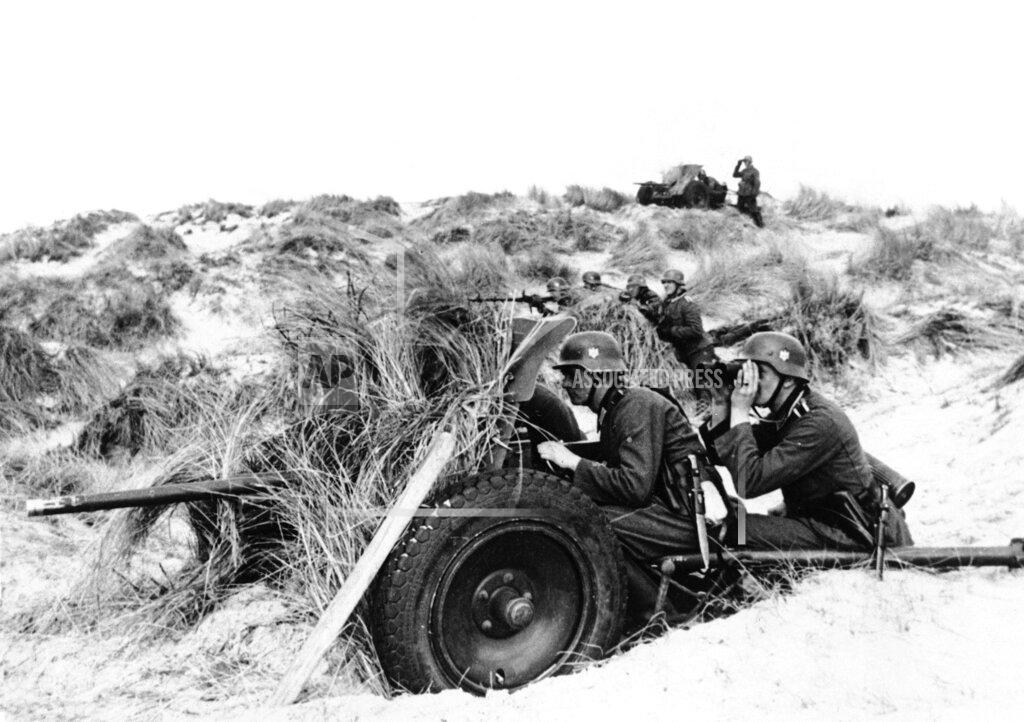
Norwegian 5th Infantry Brigade with 2,000 troops surrenders north of Trondheim.
Elements of German 359th Infantry Regiment enter Namsos north of Trondheim.
British No. 1 Independent Company occupies Mo north of Namsos.
30,000 Allied troops were present near Narvik, Norway, including units of the French Foreign Legion, French mountain troops, Polish troops, the British 24th Brigade, and Norwegian troops, aiming to take Narvik from the Germans. Meanwhile, General Feuerstein’s German 2nd Gebirgsjäger Division’s mountain troops began marching 350 miles north from Trondheim, Norway to relieve Colonel General Eduard Dietl’s German 139th Gebirgsjäger Regiment in Narvik. Detecting this, the Allies deployed 300 to 500 men each at Mosjøen, Mo, and Bodø in an attempt to stop this movement. The French troops march to Bjerkvik, opposite Narvik, but the Germans hold them at Labergdal Pass.
At Hegra Fortress, the surrounded Norwegian volunteers begin destroying radios, machine guns, small arms and other items of value. Ski patrols leave carrying important documents and messages.
A German He-115 aircraft bombed British submarine HMS Seal in the Kattegat at 0230 hours. Seal dove from the surface to the depth of 30 meters in response while continuing to deploy mines, her primary mission. While evading anti-submarine trawlers at 1830 hours, she hit a mine and began to settle to the sea floor. The crew would manage to refloat the sub the next day and attempt to reach Swedish waters. In this damaged state, Seal was captured early on the 5th by two German Arado seaplanes of the German Navy and was towed to Frederikshavn by German trawler UJ 128 (trawler Franken, 435grt) of the 12th Anti-submarine Flotilla. Lt Cdr R. P. Lonsdale, Lt T. B. J. D. Butler, Lt T. A. Beet, Lt (E) R. H.S. Clark, S/Lt A. R. L. Henderson, S/Lt R. W. H.Boulnois, forty eight ratings from submarine Seal were taken prisoner. One rating was lost with the submarine and another rating died while prisoner of war. Preliminary repairs were made to Seal at Frederikshavn by 9 May and on the 10th, she left under tow for Kiel where she arrived on the 11th. Submarine Seal was commissioned as German U-B on 30 November 1940. Four ships were lost on Seal’s FD.7 minefield.
Battleship HMS Resolution and light cruiser HMS Aurora bombarded German positions in Beisfjord.
The Polish destroyer Grom was sunk in the fjord Rombaken by a German Heinkel He 111. The Polish destroyer ORP Grom and the destroyer HMS Faulknor were patrolling in the Rombaken Fjord off Narvik and bombarding German positions when the ORP Grom was struck by a German bomb from a German He-111 aircraft of the KG 100 and sank. Of the ship’s complement, 59 died and 154 survivors were picked up by light cruiser HMS Enterprise, which lowered boats to rescue survivors at 0835, destroyers HMS Faulknor and HMS Bedouin. Light cruiser HMS Aurora picked up four survivors. Polish Lt (JG) A. Krakowski and fifty seven ratings were killed. The survivors were transferred from destroyers Faulknor and Bedouin to Battleship HMS Resolution, then to Polish destroyer Burza. The Polish survivors were embarked on a hospital ship for the passage back to England. They departed Harstad on the 10th for the Clyde.
The captured Swedish cargo ship Monark, in German service, is intercepted at 57-50N, 6-40E in the North Sea off Stavanger, Norway by Royal Navy submarine HMS Severn. After the German prize crew, which is from sunken German light cruiser Konigsberg, is captured and the Norwegian crew members set ashore, she is torpedoed and sunk.
The Royal Norwegian Navy submarine B-6 is captured by German forces.
Norwegian steamers Blaafjeld I (1146grt), Pan (1309grt), Sekstant (1626grt) were sunk by German bombing near Namsos. The entire crews of steamers Blaafjeld I and Sekstant were rescued.
The Norwegian coaster Aafjord was bombed and sunk in Breiviken by Luftwaffe aircraft. Later raised, repaired and returned to service.
The Swedish fishing boat Aimy struck a mine in the Kattegat (57°33’N 11°35’E) and sank with the loss of all four crew.
HMS Ark Royal departs Scapa Flow at 1620, escorted by the anti-aircraft cruiser HMS Curlew and six destroyers, HMS Inglefield, HMS Sikh, HMS Mashona, HMS Tartar, HMS Jaguar and HMS Encounter. Enroute she flies aboard replacement aircraft (six Swordfish, seven Skuas) and the regrouped 803 Squadron, giving her the following air group: 810 Squadron with 11 Swordfish, 820 Squadron with 8 Swordfish, 800 Squadron with 9 Skuas, 801 Squadron with 8 Skuas, and 803 Squadron with 9 Skuas. Her mission will be to provide air support for the beleaguered Allied Forces in Narvik area.
HMS Glorious arrives at Greenock for reprovisioning, rearming, and to prepare for her new mission of ferrying the 18 Hurricane Is of 46 Squadron, RAF, to Norway.
Acutely aware that military disaster has unseated more than one government, Prime Minister Neville Chamberlain tonight threw his waning political strength into the task of guiding his regime through the Norwegian campaign wreckage. Biting criticism by Laborites, Liberals and insurgent Conservatives forced the aging prime minister to prepare for a real battle in the House of Commons Tuesday. He faces an outcry of “resign” as penalty for Norway failure. The demand for resignations of Chamberlain, Chancellor of the Exchequer Sir John Simon and Air Minister Sir Samuel Hoare, as voiced by Herbert Morrison, powerful Labor party spokesman, was piled on top of bitter criticism of “complacency” and “over-satisfaction” on the part of the government. Combined, these attacks are expected to take the form of a drive to overthrow the present government. While the details of the abandoned allied attempt to take Trondheim from the Germans filtered into newspapers through unofficial military sources, Englishmen, bitter as only they can be when an enemy mocks Britain, told the government, “Get on with the war or get out.”
Britons are beginning to experience the multitudinous inconveniences in their daily life provoked by the sudden cessation of huge imports of wood pulp and other paper-making materials from the spruce and fir forests of Norway and adjoining Baltic countries that are now virtually blockaded.
Douglas Bader, a fighter pilot who lost his legs in a crash in 1931, has been fitted with metal legs and is flying missions. In some small ways, such as handling G-forces, his situation helps him. His story is well known by pilots on both sides and is quite inspirational.
Although general attention is turned to events in Norway, certain developments between the Rhine and the Moselle Rivers call for notice today. For the first time in months there has been an engagement “on a wide front,” in the words of the official statement. It is true that the operation was only in the nature of a raid, but it is described as “rather important.” Even an important raid does not rate as an offensive in the generally accepted sense, but it may herald one. Moreover, the part of the front on which it occurred — the region of the Saar River — is not without significance: this is the Forbach salient, one of the three points which various reasons indicate as likely to be chosen for major enemy thrusts. The others are immediately east of the Moselle and north of Bitche (the Ohrenthal salient). As it happens, hoth of these sectors have been the scene of prolonged artillery actions during the last twenty-four hours.
Germany began rationing gasoline and ordered civilian cars off the roads.
Concentration of allied warships in the Mediterranean, with at least seven British and French battleships reported among the combined squadrons, tonight caused Italy to issue the bluntly-worded warning she would repulse any offensive action in “Mare Nostrum” (Our Sea). The official anger that has been smoldering since. Prime Minister Chamberlain’s announcement last Thursday that the Allies were strengthening their fleets in the Mediterranean broke into the open today when the press was instructed to give a blunt warning to Britain and France that Italy was determined to repulse all attacks that might be attempted against her. This warning is linked with the news from Alexandria that the French-British naval squadrons have already reached that harbor and is all the stronger since it is obvious that the Italians have been encouraged by the success of the German air arm over the Allied naval forces in Norway that has increased their confidence in the strength of their own air and naval forces. The warning came from Premier Mussolini’s mouthpiece, Virginio Gayda, who wrote in his Il Giornale d’ltalia that if the allied concentration of naval power in the Mediterranean signifies an attempt “at an offensive undertaking” it will find Italy’s reaction “prompt and strong.”
There is an editorial in La Stampa which states that the Germans have demonstrated their invincibility in Norway and can defeat the British and occupy England.
The reported arrival of British naval reinforcements in the Aegean Sea off Salonika kept tension high in Greece as all of Southeastern Europe watched anxiously for developments in the Eastern Mediterranean.
Sources in the Vatican warn King Leopold of Belgium that German invasion is imminent.
The Netherlands today took severe action against “fifth column” elements, arresting 21 prominent Dutch Nazis including one Member of Parliament. The action was announced to the country and to the Dutch colonies beyond the sea in a special radio address by Premier D. J. de Geer. De Geer said he regretted to announce that “there is absolute proof that certain compatriots are of such mentality that they form a danger for our country and that special measures against them had to be taken.” The Member of Parliament was Dr. M. M. Rost van Tonningen, editor of the Dutch Nazi Nationale Dagblad, and a member of the second chamber of parliament. De Geer said the 21 persons were arrested last night in accordance with the regulations of the state of siege under which the Netherlands is now operating.
At 2010 hours the British steam tanker San Tiburcio struck a mine laid on 10 February 10, 1940 by the U-9 four miles from Tarbett Ness, Moray Firth, Scotland in the North Sea. Of the ship’s complement, all 40 survived. A tug and HMS Codrington (D 65) were sent to assist the tanker, but she broke in two after 45 minutes and sank. The master and 39 crew members were picked up by her escort HMS Leicester City (FY 223) (T/Lt A.R. Cornish, RNR) and landed at Invergordon. The 5,995-ton San Tiburcio was carrying fuel oil and 12 Sunderland aircraft floats and was bound for Invergordon, Scotland. The master, Walter Frederick Fynn, died when his next ship, the San Arcadio was sunk by U-107 (Gelhaus) on 31 Jan 1942.
Convoy OA.142 departed Southend. No escort vessels were listed.
Convoy OB.142 departed Liverpool escorted by destroyer HMS Walpole from 4 to 7 May. The convoy was dispersed on the 8th.
Convoy FN.162 departed Southend, escorted by destroyers HMS Wallace and HMS Valorous. The convoy arrived at the Tyne on the 6th.
Convoy FS.162 departed the Tyne, escorted by destroyer HMS Whitley and sloop HMS Egret. The convoy arrived at Southend on the 6th.
Convoy HG.29F of forty seven ships departed Gibraltar. The convoy was escorted by French sloop Chevreuil and auxiliary patrol vessel Mercedita from 4 to 10 May. The French ships arrived at Lorient on the 11th. Destroyer HMS Vimy escorted the convoy from 10 to 13 May. Destroyer HMS Windsor and corvette HMS Periwinkle from convoy OG.29F escorted the convoy from 10 to 13 May. The convoy arrived at Liverpool on the 13th.
Convoy HX.40 departed Halifax at 0900 escorted by Canadian destroyers HMCS Saguenay and HMCS Skeena, which ere detached on the 5th. The ocean escort was armed merchant cruiser HMS Esperance Bay. The Canadian destroyers arrived back at Halifax at 1345/5th. The armed merchant cruiser was detached on the 11th. Sloop HMS Enchantress and corvette HMS Arabis escorted the convoy from 16 to 18 May. The convoy arrived at Liverpool on the 19th.
The War at Sea, Saturday, 4 May 1940 (naval-history.net)
French destroyers FOUGUEUX, FRONDEUR, and L’ADRIOT carried out a sweep within twenty miles of the Belgian and Dutch coast, as far north as Egmond.
No contact was made.
Battleship RESOLUTION and light cruiser AURORA bombarded German positions in Beisfjord.
Light cruiser GLASGOW and destroyers JACKAL and JAVELIN arrived at Greenock at 1600 from Tromsø.
Destroyers HERO and FOXHOUND departed Greenock at 1300 with British tanker ATHELEMPRESS (8941grt) for Scapa Flow where they arrived at 0800/6th.
Polish destroyer ORP GROM and destroyer FAULKNOR were on patrol off Narvik bombarding German positions when GROM was struck at 0828 on her torpedo tubes by a German bomb.
Destroyer GROM (Cdr A. Hulewicz ORP) was sunk in the explosion and her survivors were picked up by light cruiser ENTERPRISE, which lowered boats to rescue survivors at 0835, destroyers FAULKNOR and BEDOUIN. Light cruiser AURORA picked up four survivors.
Polish Lt (JG) A. Krakowski and fifty seven ratings were killed. The survivors were transferred from destroyers FAULKNOR and BEDOUIN to Battleship RESOLUTION, then to Polish destroyer ORP BURZA.
The Polish survivors were embarked on a hospital ship for the passage back to England. They departed Harstad on the 10th for the Clyde.
Aircraft carrier ARK ROYAL (Vice Admiral Aircraft Carriers) departed Scapa Flow at 1620 after refueling and reprovisioning with anti-aircraft cruiser CURLEW, destroyers INGLEFIELD (D.3), SIKH, MASHONA, TARTAR, JAGUAR, and ENCOUNTER.
Aircraft carrier ARK ROYAL arrived off Northern Norway for operations on the 7th and operated aircraft daily in support of allied operations. She refueled at Tromsø on the 19th.
Destroyers DELIGHT, FEARLESS, KIMBERLEY, and FORTUNE departed Scapa Flow at 0600 with troopships LANCASTRIA (16,243grt), BATORY (14,287grt), SOBIESKI (11,030grt), and ULSTER MONARCH (3791grt) for the Clyde, where they arrived at 1230/5th.
Sloop AUCKLAND departed Scapa Flow at 1700 for Rosyth where she arrived at 0700/5th.
Submarine SEAL arrived off Goteborg and Vinga in the Kattegat to lay mines in 57-33. 5N, 11-35. 5E. Shortly after completing the minelay at 0859, SEAL struck a mine herself and was badly damaged.
In this damaged state, SEAL was captured early on the 5th by two German Arado seaplanes of the German Navy and was towed to Frederikshavn by German trawler UJ 128 (trawler FRANKEN, 435grt) of the 12th Anti-submarine Flotilla.
Lt Cdr R. P. Lonsdale, Lt T. B. J. D. Butler, Lt T. A. Beet, Lt (E) R. H.S. Clark, S/Lt A. R. L. Henderson, S/Lt R. W. H.Boulnois, forty-eight ratings from submarine SEAL were taken prisoner.
One rating was lost with the submarine and another rating died while prisoner of war.
Preliminary repairs were made to SEAL at Frederikshavn by 9 May and on the 10th, she left under tow for Kiel where she arrived on the 11th.
Submarine SEAL was commissioned as German U-B on 30 November 1940.
Four ships were lost on SEAL’s FD.7 minefield.
On 4 May, Swedish fishing boat AIMY (200grt) was lost on this minefield.
The entire crew of four of the fishing boat AIMY was lost.
On the 6th, German steamer VOGESEN (4241grt) was sunk on the minefield.
On 28 May, Swedish steamer TORSTEN (1206grt) was sunk on this minefield four miles south of Vinga.
Sixteen crew were rescued from the Swedish steamer.
On 5 June, Danish steamer SKANDIA (1248grt) was lost in the minefield.
At 0451, submarine SEVERN off Stavanger in 57-50N, 6-40E intercepted Swedish steamer MONARK (1786grt) which had been seized by German forces at Bergen on 9 April.
The Swedish steamer had departed Stavanger on the 3rd.
After removing the prize crew, which were crew from sunken light cruiser KONIGSBERG, SEVERN torpedoed and sank MONARK.
The Norwegian crew was landed twenty-five miles from Stavanger. The German prize crew was taken prisoner and returned to England.
French destroyer VERDUN, with Rear Admiral Moreau aboard, departed the Clyde to return to Brest.
Submarine TRIDENT departed Rosyth on patrol.
British steamer ROYAL ULSTERMAN (3244grt), escorted by destroyer MOHAWK departed Scapa Flow at 2150/1st. The steamer landed 290 officers and men forty-five miles north of Mosjoen. The landing was completed at 0645/4th.
Destroyer GRAFTON took stores, mail, et cetera from the steamer for Narvik.
This was the first of five landings for Operations SCISSORS. There were four more troop landings (the last the night of 13/14 May) at Mosjoen, Mo, Bodø.
Destroyer MOHAWK and steamer ROYAL ULSTERMAN arrived at Scapa Flow at 0900/6th.
Tugs BANDIT and BUCCANEER departed Scapa Flow at 1740 for Skelfjord with salvage equipment on board.
British steamers LOMBARDY (3379grt), MACGREGOR LAIRD (4015grt), EMPIRE ABILITY (7603grt) escorted by destroyers HAVANT and ACASTA departed Narvik at 0600/4th. The convoy departed Vaagsfjord during the forenoon of 4 May and was joined by anti-submarine whaler BUTTERMERE (560grt).
On the 7th at 2030, destroyers ANTELOPE and ACHERON departed Scapa Flow to join. Destroyer ACASTA was detached to Scapa Flow and whaler BUTTERMERE to Aberdeen. Both arrived at Scapa Flow on the 9th.
Destroyer HAVANT arrived at Scapa Flow at 1500/7th to refuel.
Steamers LOMBARDY and MACGREGOR LAIRD were taken on to Newport.
Destroyer ANTELOPE took steamer EMPIRE ABILITY to the Smalls and was relieved by corvette CLARKIA. Destroyer ANTELOPE then returned to the Clyde.
British tanker INVERADER arrived at Invergordon at 1430 escorted by destroyers CODRINGTON and ESCAPADE.
Destroyer ESCAPADE went on to Rosyth to boiler clean.
Destroyer CODRINGTON remained at Invergordon to escort the tanker back to Scapa Flow when loaded.
British tanker SAN TIBURCIO (5995grt), which departed Scapa Flow earlier in the day escorted by anti-submarine trawler LEICESTER CITY (422grt), at 1910 was sunk on a mine laid by U-9 on 9 February four miles 330° from Tarbett Ness in Moray Firth.
Destroyer CODRINGTON (D.1) and a tug were sent to assist the tanker.
The tanker broke in two forty-five minutes after the explosion.
The entire crew were rescued by anti-submarine trawler LEICESTER CITY (422grt) and destroyer CODRINGTON and motor anti-submarine boats searched for the submarine thought responsible.
When it was determined a submarine was not responsible, destroyer CODRINGTON returned to Invergordon.
Convoy OA.142 departed Southend. No escort vessels were listed.
Convoy OB.142 departed Liverpool escorted by destroyer WALPOLE from 4 to 7 May. The convoy was dispersed on the 8th.
Convoy FN.162 departed Southend, escorted by destroyers WALLACE and VALOROUS. The convoy arrived at the Tyne on the 6th.
Convoy FS.162 departed the Tyne, escorted by destroyer WHITLEY and sloop EGRET. The convoy arrived at Southend on the 6th.
Convoy HG.29F of forty-seven ships departed Gibraltar. The convoy was escorted by French sloop CHEVREUIL and auxiliary patrol vessel MERCEDITA from 4 to 10 May. The French ships arrived at Lorient on the 11th.
Destroyer VIMY escorted the convoy from 10 to 13 May.
Destroyer WINDSOR and corvette PERIWINKLE from convoy OG.29F escorted the convoy from 10 to 13 May. The convoy arrived at Liverpool on the 13th.
Convoy HX.40 departed Halifax at 0900 escorted by Canadian destroyers HMCS SAGUENAY and HMCS SKEENA, which ere detached on the 5th.
The ocean escort was armed merchant cruiser ESPERANCE BAY.
The Canadian destroyers arrived back at Halifax at 1345/5th.
The armed merchant cruiser was detached on the 11th.
Sloop ENCHANTRESS and corvette ARABIS escorted the convoy from 16 to 18 May. The convoy arrived at Liverpool on the 19th.
Destroyer BULLDOG departed Devonport at 1600 for the Clyde where she arrived at 1600/5th to join the Home Fleet.
Destroyers ICARUS, IVANHOE, and IMPULSIVE after escorting aircraft carrier GLORIOUS departed Greenock at 2100 for Scapa Flow, arriving at 1900/5th.
Destroyer DIANA departed Skelfjord for Scapa Flow with tanker ALDERSDALE (8402grt).
The ships parted company at Cape Wrath. The destroyer arrived at Scapa Flow and the tanker arrived at the Clyde at 1500/9th.
Norwegian steamers BLAAFJELD I (1146grt), PAN (1309grt), and SEKSTANT (1626grt) were sunk by German bombing near Namsos.
The entire crews of steamers BLAAFJELD I and SEKSTANT were rescued.
Norwegian steamer AAFJORD (335grt) was sunk by German bombing at Breiviken.
Destroyer GARLAND in dock at Malta was transferred to the Polish Navy to offset the loss of Polish destroyer ORP WICHER in September 1939. The original offer of the transfer was made to the Polish Navy on 6 February.
On the 16th, ORP GARLAND (Cdr A. Doroszkowski) departed Malta for Alexandria to join the Mediterranean Fleet. The destroyer arrived at Alexandria on the 18th.
U.S. Secretary of the Interior Harold Ickes writes in his secret diary, “Chamberlain appears to be facing a political test in Great Britain. Practically from the beginning of his premiership I have regarded him as the evil genius not only of Britain but of Western civilization. His diplomatic policy has been blundering and inept. Hitler always out-smarted him until Germany was strengthened to that point where it could go to war with confidence of a victorious result.”
In a move which, it was believed was designed to placate opponents of his government reorganization plan transferring the Civil Aeronautical Authority to the Commerce Department, President Roosevelt announced today that he expected to name Robert H. Hinckley, chairman of the agency, assistant secretary of commerce. Although the President has insisted with the support of interpretive rulings from the Director of the Budget and the Attorney General that the CAA would retain its independent status as part of the Commerce Department, the objection has persisted among Congressional opposition leaders that the agency would “become subservient to the Secretary of Commerce.”
Harry Bridges, west coast labor leader, advocated rigid neutrality and a $60 old age pension today in an address in a high school auditorium guarded by the entire police force of suburban Huntington Park, near Los Angeles, and 150 monitors from his own union ranks while 40 deputy sheriffs stood by at a nearby substation. Threats that “there will be bloodshed” if the labor leader were allowed use of the school hall did not materialize, however, and Bridges addressed a crowd of 3,000 for 45 minutes. Speaking after Bridges, California Lieutenant Governor Ellis Patterson attacked Chairman Martin Dies of the house un-American activities committee as a “witch burner who does not understand civil liberties.”
Taxes collected by all units of government in the United States last year amounted to 20.1 percent of the national income produced, nearly 5 per cent more than the share of the national income taken by taxation in 1930 but almost 2.5 percent less than the peak reached in 1938, the Tax Policy League reports.
A slight decline in industrial production combined with a slight rise in commodity prices were features of American business activity in April, according to a Commerce Department report today.
U. S. government agents sought to learn today in what manner $2,800,000 was obtained to aid war-stricken civilians in China. Leaders in San Francisco’s Chinatown, the largest in the nation, admitted that they had been questioned both by the Federal Bureau of Investigation and the Securities and Exchange Commission, but said the whole affair was “instigated by the Japanese.”
Agents of the Federal Bureau of Investigation were absolved by Attorney General Jackson today of using “third degree” methods in the arrest of twelve persons charged with recruiting forces for the Spanish Loyalist army.
Former Senator James A. Reed of Missouri, critic of the New Deal, today likened the conduct of the National Labor Relations Board to that of racketeers, and recommended that the agency be abolished overnight. He made his attack on the board before the Smith committee investigating the NLRB.
Two men suffered shock and a twostory brock “shaker-sieve” building was destroyed at 5:30 A.M. today by an explosion of smokeless powder at the powder plant of E.I. du Pont de Nemours Co. at Carneys Point, about three miles south of Penns Grove, New Jersey on the Delaware River.
The streamlined U.S. Third Army’s 70,000 regulars begin moving tomorrow for a test of the nation’s defense against lightning tactics now being used on the battlefields of Europe. The War Department has described the maneuvers, costing about $28,000,000 and scheduled to run in full force from May 11 through May 25 across Western Louisiana and Eastern Texas, as the “high point in regular army training.” No foreign military attachés have been invited to witness this greatest peacetime maneuver in United States history. The lessons learned from the highly mobilized German Army’s “blitzkrieg” in Poland and from the operations of the motorized Italian columns in Ethiopia will be tested against an American background of cutover pine land, valleys, and rivers which army men termed probably the most ideal terrain in the country for the problem at hand.
Senator Elmer Thomas of Oklahoma, chairman of a subcommittee of the Appropriations Committee, said today that testimony indicating that. American military airplanes were inferior to those of the German air force might prompt committee members to add $20,000,000 to the $785,000,000 Army Bill for additional planes. The committee, he said, probably would recommend funds for 106 aircraft of the latest type in addition to the fifty-seven planes approved in the House version of the 1941 Appropriation Bill.
President Roosevelt today named Miss Virginia Marshall of Spokane, Washington, as the sponsor for the new 35,000-ton battleship USS Washington, to be launched at the Philadelphia Navy Yard June 1. This will be the first battleship to come down the ways in the United States since 1921.
Four Japanese boat operators, charged with entering prohibited Pearl Harbor areas where the American battle fleet is anchored on the island of Oahu, Territory of Hawaii, were held for grand jury action tonight as the U. S. Navy obviously adopted increasingly stringent measures against possible espionage activities. At least one Japanese-operated sampan penetrated far into Pearl Harbor channel while three others entered proscribed areas. Observers termed the violations “particularly startling” because the relatively narrow harbor entrance has been obstructed with anti-submarine and anti-torpedo nets. Even yachts, which formerly were permitted to enter the channel, have been warned to stay clear of the restricted area.
The World’s Fair of 1940, which opens its doors and puts out the welcome mat for all America at 10 o’clock next Saturday morning, announced yesterday its official opening day program, revealing that the pomp and ceremonials of the 1939 premiere would be supplanted by the fun and informality that is the second-year keynote of the exposition.
Gallahadion won the 66th Kentucky Derby. Carroll Bierman aboard Gallahadion won in 2:05. Mrs. Ethel V. Mars’s Gallahadion, a 35-to-1 shot, won the sixty-sixth Kentucky Derby in a sensational upset at Churchill Downs in Louisville yesterday. Bimelech, Colonel E. R. Bradley’s heavily played odds-on favorite, finished second, a length and a half behind, barely lasting to nose out Arnold Hanger’s Dit for the place. Mioland was fourth. The pay-off on Gallahadion, longest priced Derby winner since 1913, was $72.40, $13.80 and $4.80 for $2 across the board. Bimelech, 2 to 5 in the straight betting, returned $3.20 for place. Gallahadion went to the front fifty yards from the finish when Jockey Carroll Bierman, in a daring move, slipped his horse through between Bimelech and the fence. From there he drew away to win. The race, richest of all Derbies, grossed $82,175, of which $60,150 went to Mrs. Mars. Colonel Matt Winn, president of the track, estimated the attendance to be 95,000.
Major League Baseball:
The Red Sox hit lightly but effectively today to give Denny Galehouse his first victory of the year, a 4–1 triumph which swept a two-game series with the luckless Browns.
The Chicago White Sox, behind the pitching of southpaw Thornton Lee, beat the Yankees, 10–3, at Yankee Stadium. Joe Kuhal’s two home runs were among the fifteen White Sox hits.
With his mates laying down a sevteen-hit barrage against three pitchers, including two home runs, Johnny Babich pitched his third victory of the season today as the Athletics whipped the Tigers, 14–5.
The Cubs edge the New York Giants, 3–2, on the strength of homers by Al Todd and Hank Leiber. Larry French gets the win; Carl Hubbell takes the loss.
Kirby Higbe, one of the Phililes’ hard luck hurlers, spoiled a well-pitched game in the eleventh inning today by fumbling a sacrifice bunt and then shooting a wild pitch on which Billy Myers scored from second base to give the Cincinnati Reds a 3–2 victory.
Fiddler Bill McGee became the first pitcher of the Cardinals to go the full nine innings this season as he defeated the Bees today, 3–1. McGee allowed just four Boston hits.
Collecting thirteen hits off a trio of Washington hurlers, Cleveland registered a 12–4 triumph over the Senators today. Ray Mack homered for the Indians.
St. Louis Browns 1, Boston Red Sox 4
New York Giants 2, Chicago Cubs 3
Philadelphia Phillies 2, Cincinnati Reds 3
Chicago White Sox 10, New York Yankees 3
Detroit Tigers 5, Philadelphia Athletics 14
Boston Bees 1, St. Louis Cardinals 3
Cleveland Indians 12, Washington Senators 4
Mexico claims the support of the American “continent” in refusing international arbitration of the oil controversy proposed by the United States, in a long note from Mexico City made public in Washington today.
Dow Jones Industrial Average: 147.55 (-0.1)
Born:
Robin Cook, American physician and novelist (“Coma”, “Pandemic”), in New York, New York.
Dick Curl, American football coach (World Bowl, 1999, Frankfurt Galaxy; NFL Europe Coach of the Year, 1998, 1999), in Chester, Pennsylvania.
The Royal Navy Shakespeare-class minesweeping trawler HMS Coriolanus (T 140) is laid down by Cochrane & Sons Shipbuilders Ltd. (Selby, U.K.); completed by Amos & Smith.
The Kriegsmarine (German Navy) Type VIIC U-boat U-355 is laid down by Flensburger Schiffsbau-Ges, Flensburg (werk 474).
The Royal Navy Flower-class corvette HMS Amaranthus (K 17) is laid down by Fleming & Ferguson Ltd. (Paisley, Scotland).
The Nihon Kaigun (Imperial Japanese Navy) Yamato-class battleship HIJMS Shinano is laid down by the Yokosuka Naval Arsenal in Yokosuka, Japan. She will be converted into an aircraft carrier before completion.
The Royal Australian Navy Bar-class boom defense vessel HMAS Kangaroo (Z 80) is launched by the Cockatoo Docks and Engineering Co. Ltd. (Sydney, New South Wales, Australia).
The Royal Canadian Navy Flower-class corvette HMCS Camellia (K 31) is launched by Harland & Wolff Ltd. (Belfast, Northern Ireland).
 History Diaries