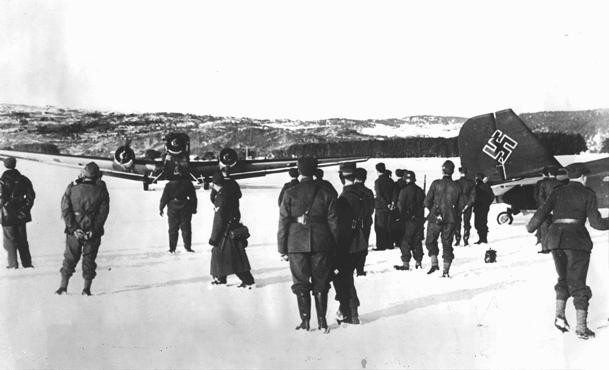
The Allied evacuation at Namsos was completed, but German aircraft located part of the evacuation fleet and sank the destroyers Afridi and Bison. The evacuation of over 4,000 Allied troops from Namsos was completed at dawn. Destroyer HMS Afridi caught up with the allied force as the Germans launched heavy air attacks on the force. Air attacks concentrated on heavy cruiser HMS Devonshire and light cruiser HMS Montcalm. French destroyer Bison was hit by a German bomb which exploded her fore magazine and blew off the fore part of the ship at 1010 in these attacks in 65 42N, 07 17E, about 110 miles west of Vega Island, Norway. Her survivors were taken off by destroyer HMS Grenade which went alongside and destroyers HMS Imperial and HMS Afridi which picked up men from the water. Afridi had rescued sixty nine Bison survivors. C. V. Bouan, L. V. Merlin, one hundred ratings were lost in destroyer Bison. Also killed on destroyer Bison was British Cdr R. R. Graham DSO, which was an observer.
Destroyer Afridi scuttled destroyer Bison. Destroyer Afridi rejoined the Main Force after picking up Bison’s survivors, but then was hit herself at 1400 in further German bombing in 66 14N, 5 45E. Destroyer Afridi foundered forty six minutes after being hit. Destroyers HMS Griffin and Imperial picked up her survivors. Warrant Telegraphist R. Mellor and forty eight of Afridi’s ratings were lost with the ship along with three of Imperial’s ratings, about 30 of Bison’s crew, thirteen military rearguard personnel evacuated from Namsos. Three Afridi ratings died of wounds and thirty one ratings were wounded. Light cruiser HMS Southampton and destroyer HMS Hyperion, HMS Hereward, and HMS Beagle departed Scapa Flow on the 3rd to support the British force. Destroyers HMS Fury, HMS Foresight, HMS Antelope, and HMS Acheron also departed Scapa Flow at 2330/3rd to support the evacuation force’s return.
The British and French ships arrived at Scapa Flow, without further damage, late on 4 and early on the 5th. Destroyers Imperial, Griffin, and Grenade arrived at Sullom Voe at 1700/4th to discharge wounded French and British sailors from destroyers Bison and Afridi and the military rearguard from Namsos to French hospital ship Sphinx. The destroyers departed Sullom Voe at 2130/4th and arrived Scapa Flow at 0730/5th. Passengers embarked from Norway were accommodated in battleship HMS Rodney. Heavy cruiser HMS York and destroyer HMS Nubian arrived at Scapa Flow at 2030/4th. Destroyers HMS Kelly and HMS Hasty and troopship El Mansour arrived at Scapa Flow at 2130/4th. Heavy cruiser Devonshire, French light cruiser HMS Montcalm, light cruiser HMS Southampton, French troopships El D’jezair and El Kantara, destroyers Acheron, Antelope, Maori, Fury, Foresight, and Hereward arrived at Scapa Flow at 0400/5th.
Wounded arriving at Scapa Flow were embarked in British hospital ship Isle Of Jersey. Most of the French troops, including some of the Bison survivors, were embarked on French passenger ship President Doumer (11,898grt), Djenne (8790grt), Flandre (8503grt), Providence (11,996grt) which left the Clyde on the 9th escorted by French large destroyers Tartu, Milan, Chevalier Paul and four British torpedo boats to return to Brest, arriving on the 11th. The rest of the French troops, including the seriously wounded, were embarked on French hospital ship Sphinx which departed Scapa Flow on the 25th escorted by minesweeper Hebe. She arrived at Brest on the 27th.
General de Wiart is grateful: “The Navy promised to evacuate my troops tonight. I thought it impossible, but the Navy does not know the word.”
Colonel Ole Berg Getz—the Norwegian commander in the Trøndelag area – announces in his order of the day that he has proposed an armistice due to his lack of supplies, particularly ammunition. He broadcasts his surrender of troops in Nord-Trøndelag during the day and advises all other Norwegian forces in Trøndelag to do the same.
Norwegian General Jacob Hvinden-Haug throws in the towel and surrenders all troops south of Trondheim. All fighting south of Trondheim, in essence, is over except for holdouts. Norwegian troops south of Trondheim surrendered to the Germans. The remaining 2,500 troops of the Norwegian 5th Infantry Division surrender in the Trondheim-Åndalsnes sector. Major General Jacob Hvinden-Haug surrendered all Norwegian troops south of Trondheim. By the evening; the fight for southern Norway is over.
The commander of one of those holdouts, Hegra Fortress, realizes from radio reports and its own situation that the end is at hand. Food is running out, and there is no hope of relief. The garrison begins destroying it artillery ammunition. Three Swedish volunteers are taken out of the fortress and escorted by a ski patrol to the Swedish border.
The British and French troops evacuated from Åndalsnes the day before arrived safely at Scapa Flow. The French units were put on French passenger ships bound for Brest, to help with the defense of France.
The British/French tilt away from the Trondheim target is a serious tell-tale sign for the direction of the entire Norwegian campaign on 3 May 1940. The Allies at this point have no hope of prevailing against Germany on the Continent in any kind of mobile warfare setting except in artificial frames such as island conflicts. Narvik provides a last gasp as an opportunity for the Allies only because, for all intents and purposes, it is an island: it is difficult to reach by land due to numerous geographical barriers and lack of roads, it has a small population and the best way to reach it with military support is via ship (military supplies cannot be sent on the rail line through neutral Sweden).
In fact, the British arguably have a slight advantage in some ways in a Narvik campaign. The British Home Fleet not only completely outclasses anything that the Kriegsmarine can put in action, but its main base at Scapa Flow, Scotland is closer to Narvik than any German ports. Conceivably, the Allies could occupy northern Norway indefinitely — so long as nothing else comes up diverting scarce resources somewhere else.
But Unfortunately…
General Ruge and Norwegian Army High Command arrive at Tromsø. King Haakon and the rest of the Norwegian government and Commander-in-chief Otto Ruge are under British protection just south of Navik at Tromsø. There is a 1000km (600 miles) buffer zone between them and the German troops further south.
The sense of hopelessness among the few active Norwegian forces remaining in the country is exacerbated by a radio broadcast by British Prime Minister Neville Chamberlain announcing the evacuation of Allied troops from the Trondheim region.
German troops in Norway seized control of the world’s only heavy water production facility. The Germans would step up production to supply the German fission program.
British RAF aircraft attacked German airfields in Denmark and Norway.
Luftwaffe aircraft attack RN battleship Resolution and cruisers Aurora and Effingham off Narvik.
The Royal Norwegian Navy 2.-class torpedo boats HNoMS Djerv and HNoMS Dristig were scuttled off Kvamsøya in Sognefjord to prevent capture by German forces.
The Kriegsmarine auxiliary minesweeper M-1102 (naval trawler H A W Müller) was torpedoed and sunk in the Skaggerak (58°08’N 6°39’E) by HMS Narwhal (Royal Navy).
Demands that “Chamberlain must go!” swelled last night as members of the British Parliament, including at least 15 of the government’s supporters, reacted angrily to the second announcement in two days of major retreat from Norway. Opposition to Prime Minister Neville Chamberlain’s war policy was increased when the war office last night announced a complete allied withdrawal from central and southern Norway with abandonment of the west coast landing base at Namsos. In an effort to remove the sting the admission, the war office said that the allies were closing in upon the Nazi-held iron ore port of Narvik, new major battlefront about 320 miles north of Namsos, and had killed and captured many Germans repulsing two Nazi counterattacks. The Narvik claim failed, however, to ease the swelling attacks upon Chamberlain which may come to a head in a wide-open “full dress” debate in parliament next Tuesday. Clement Davies, 56-year-old King’s Counsel and a government supporter heretofore, demanded in a speech at Oxford last night that “Chamberlain’s government must go.” “What we want is a real war cabinet with someone at the top who can decide a question… We are meandering and muddling through the war making excuses and boasting,” he said. “The country cannot be properly organized until the government goes.”
Hanson W. Baldwin observes in the New York Times:
“The evacuation of Southern Norway by Allied troops is a distinct Germany victory that may have wide repercussions in British internal politics, as well as in the Mediterranean area and in Southeastern Europe.
“The loss of Allied prestige, although retrievable, is a temporary factor of great importance to the immediate future of the war. For, other than the Western Front, with its minor patrol skirmishes, Norway has been the only testing ground where German and Allied. areas within the orbit of German land forces have met. And the Germans, largely because of the mighty arm of their air force, their superiority in numbers, equipment and training, in staff and command work and leadership, and particularly in the tactics of open warfare, have won a clear-cut victory in this first meeting.
“The complete evacuation of all air superiority represents primarily a victory for German air power and for the war of speed, of which the Germans are past masters.”
The 2nd Royal Marine Battalion in Bisley, Surrey received orders from London to be ready to move at two hours’ notice for an unknown destination. The battalion had been activated only the month before. Though there was a nucleus of active service officers, the troops were new recruits and only partially trained. There was a shortage of weapons, which consisted only of rifles, pistols, and bayonets, while 50 of the marines had only just received their rifles and had not had a chance to fire them. On 4 May, the battalion received some modest additional equipment in the form of Bren light machine guns, anti-tank rifles, and 2-inch mortars (51 mm). With no time to spare, zeroing of the weapons and initial familiarisation shooting would have to be conducted at sea. The force was bound for Iceland…
British industrialist Sir Alfred Edward Herbert, a huge advocate of women workers during World War I (along with minimum wages and maximum working hours), encourages women to sign up for factory work “at this grave time.”
Hitler is hard at work on Fall Gelb, the invasion of France and the Low Countries, and now is at the fine-tuning stage. He postpones the date from 5 May to 6 May, the small change showing how close the actuality is getting. He is assembling 93 Divisions along the border without the Allies apparently noticing.
Hitler sees the entire world up for grabs: “The earth is a challenge cup: it goes to those who deserve it.…”
French General Huntziger commands the 2nd Army on the Ardennes front. He is offended by the construction without his approval of anti-tank obstacles on two main roads through the forest and orders them demolished.
Arrival of a British-French battle fleet in Alexandria and reports of large-scale Italian naval, air, and army concentrations in the Dodecanese islands switched southeastern Europe’s anxiety over possible spread of the war sharply to Greece today. Athens was calm, but alert. In Turkey, the allied fleet’s arrival at its Egyptian base was greeted as new evidence Britain and France are determined to fulfill their obligations in the near east, which include a mutual assistance treaty with Turkey and guarantees of the independence of both Greece and Rumania.
Greenland, a crown colony of Denmark, sought U.S. protection, so that Danish sovereignty could be maintained during the German occupation of the homeland.
Colonel Hans Oster of the German military intelligence service, the Abwehr, tells the Dutch military attaché in Berlin, Colonel Sas, that Fall Gelb is close, perhaps ready by 8 May. Unfortunately for Oster, his credibility has been undermined by previous postponements subsequent to his alerts. The neutral Dutch decide not to pass this information along to the Allies.
Dutch intelligence detected further hints of German troop gathering near its border; this information was forwarded on to Belgium. Meanwhile, in Germany, forecast of bad weather caused a postponement of the invasion.
Franz von Papen, German Ambassador to Turkey, was authoritatively reported today to have been called urgently to Berlin for a conference with Chancellor Hitler.
Russia and Germany have a common interest in preserving Swedish neutrality, their representatives agreed at a conference in Moscow two weeks ago, it was announced tonight by Tass, official Soviet news agency.
RAF Bomber Command dispatches 10 aircraft on minelaying operations overnight.
Luftwaffe aircraft conduct minelaying operations.
The Danish schooner Magicienne ran aground west of St Abb’s Head, Berwickshire, United Kingdom. All eight crew survived.
German commerce raiders had their first success of the war when the auxiliary cruiser Atlantis sank the British freighter Scientist. The German commerce raider Atlantis, disguised as the Japanese passenger freighter Kasii Maru, fired upon, stopped and boarded the British freighter Scientist in the southern Atlantic Ocean at 19 55S, 04 20E. The Scientist was en route from Durban to Liverpool via Freetown carrying a mixed cargo of maize, chromium, copper bars, asbestos, zinc concentrate, flour, jute, hides, and tanning bark. Of the Scientist’s complement, one man died and the rest were taken prisoner. When explosive charges failed to sink the ship the Atlantis used a torpedo to complete the job. Fifteen crew were transferred to steamer Durmitor on 26 October and they were later interned in Italian Somaliland. Twenty seven crew and one passenger were transferred to the steamer Tirranna on the 2nd. One crewman and the passenger were lost when the steamer was sunk returning to France.
Large French destroyers Chevalier Paul, Milan, Tartu (Cdr J. H.Ruck-Keene, British liaison officer embarked) and destroyers Sikh and Tartar departed Scapa Flow for a raid into the Skagerrak to intercept two German merchant ships escorted by two torpedo boats in 58 45N, 04 48E at 2200/3rd. The sortie was without contact and the ships returned undamaged at 0930/4th.
Aircraft carriers HMS Ark Royal and HMS Glorious, battleship HMS Valiant, heavy cruiser HMS Berwick, destroyers HMS Fury, HMS Encounter, HMS Escort, HMS Fearless, HMS Acheron, HMS Antelope, HMS Fortune, and HMS Kimberley arrived at 1030 at Scapa Flow after operations off Norway.
Aircraft carrier HMS Glorious departed Scapa Flow at 1600 for the Clyde escorted by destroyers HMS Ivanhoe, HMS Icarus, and HMS Impulsive. HMS Glorious hastily refuels and then departs at 1630 bound for Greenock, flying off 803 Squadron enroute (including the single unused Roc she had acquired on 30 April). Aircraft carrier Glorious and the destroyers arrived at Greenock at 1630/4th.
While HMS Ark Royal refuels and reprovisions, she flies off her five Rocs to RNAS Hatston.
Convoy HK.1 departed Scapa Flow at 2100 escorted by destroyers HMS Westcott and HMS Foudroyant and sloop HMS Fleetwood. Destroyer HMS Volunteer, whaler HMS Ullswater (560grt), and trawler HMS Willow (574grt) joined during the night. The convoy was composed of tankers Broomdale (8334grt) and British Governor (6840grt) and steamers Narva (1575grt), A. S. I. S. Cromarty Firth (538grt), Emile Javary (2471grt), cable ship Lasso (930grt). Convoy HK.1 arrived at Harstad at 2200/9th.
British troopships Royal Scotsman and Ulster Prince departed Scapa Flow for the Clyde to embark troops and stores for Bodo and Mosjoen, respectively.
Convoy OA.141 departed Southend escorted by destroyer HMS Vesper from 3 to 5 May and destroyer HMS Venetia on the 5th.
Convoy OB.141 departed Liverpool escorted by destroyer HMS Vanquisher from 3 to 6 May.
Convoy BC.35 of seven steamers, including steamers Baron Kinnaird and David Livingstone (Commodore) departed Loire escorted by destroyer HMS Montrose. The destroyer Montrose was detached for anti-submarine operations on the 4th. The convoy arrived in Bristol Channel on the 5th.
Convoy FN.161 departed Southend, escorted by sloops HMS Grimsby and HMS Hastings. The convoy arrived at the Tyne on the 5th.
Convoy MT.63 departed Methil, escorted by destroyers HMS Vivien and HMS Vimiera. The convoy arrived later in the day.
Convoy FS.161 departed the Tyne, escorted by destroyers HMS Vivien and HMS Vimiera. The convoy arrived at Southend on the 5th.
Australian troop convoy US.2 arrived at Colombo en route to Egypt. On the 5th, the convoy put to sea escorted by battleship HMS Ramillies, French heavy cruiser Suffren, and RN heavy cruiser HMS Kent. Convoy US.2 was met off Aden on the 12th by Australian light cruiser HMAS Hobart and destroyers HMS Decoy and HMS Defender, which departed Aden on the 10th, in the Red Sea by light cruiser HMS Liverpool and sloop HMS Shoreham on the 13th. On 17 May, convoy US.2 arrived at Suez escorted by battleship Ramillies, French heavy cruiser Suffren, light cruiser Liverpool, Destroyers Decoy and Defender. Battleship Ramillies went to Alexandria and went into drydock for refit.
The War at Sea, Friday, 3 May 1940 (naval-history.net)
Large French destroyers CHEVALIER PAUL, MILAN, and TARTU (Cdr J. H.Ruck-Keene, British liaison officer embarked) and destroyers SIKH and TARTAR departed Scapa Flow for a raid into the Skagerrak to intercept two German merchant ships escorted by two torpedo boats in 58 45N, 04 48E at 2200/3rd.
The sortie was without contact and the ships returned undamaged at 0930/4th.
Aircraft carriers ARK ROYAL and GLORIOUS, battleship VALIANT, heavy cruiser BERWICK, and destroyers FURY, ENCOUNTER, ESCORT, FEARLESS, ACHERON, ANTELOPE, FORTUNE, and KIMBERLEY arrived at 1030 at Scapa Flow after operations off Norway.
Aircraft carrier GLORIOUS departed Scapa Flow at 1600 for the Clyde escorted by destroyers IVANHOE, ICARUS, and IMPULSIVE.
Aircraft carrier GLORIOUS and the destroyers arrived at Greenock at 1630/4th.
Destroyer BEAGLE arrived at Scapa Flow at 0630.
Destroyer JACKAL arrived at Sullom Voe at 0800 to refuel and to change her asdic oscillator.
Destroyer JACKAL sailed at 1115/3rd.
Destroyers HYPERION and HEREWARD arrived at Scapa Flow at 1330 from Sullom Voe.
Polish destroyer ORP BURZA proceeded from Harstad to Skaalanfjord where she towed landing craft with French Alpins to Gratangen. Completing this duty, she returned to Harstad.
Convoy HK.1 departed Scapa Flow at 2100 escorted by destroyers WESTCOTT and FOUDROYANT and sloop FLEETWOOD. Destroyer VOLUNTEER, whaler ULLSWATER (560grt), and trawler WILLOW (574grt) joined during the night.
The convoy was composed of tankers BROOMDALE (8334grt) and BRITISH GOVERNOR (6840grt) and steamers NARVA (1575grt), A. S. I. S. CROMARTY FIRTH (538grt), EMILE JAVARY (2471grt), and cable ship LASSO (930grt).
Convoy HK.1 arrived at Harstad at 2200/9th.
British steamers BLACKHEATH (4637grt), DELIUS (6065grt), DALLINGTON COURT (6889grt), HARMATTAN (4558grt), DROMORE CASTLE (5242grt), J. HOLT (3815grt), CISCAR (1809grt), and THISTLEFORD (4764grt) departed Scapa Flow at 1100 escorted by destroyer BEAGLE and patrol vessels GLEANER and JASON.
Two hours later, destroyer WALKER departed Scapa Flow with stragglers GUNVOR MAERSK (1977grt) and RONAN (1489grt).
Destroyers WALKER and BEAGLE escorted the Bristol Channel contingent on from the Clyde.
The destroyers after the escort went to Liverpool for boiler clean, arriving on the 6th.
British troopships ROYAL SCOTSMAN and ULSTER PRINCE departed Scapa Flow for the Clyde to embark troops and stores for Bodo and Mosjoen, respectively.
Destroyer BASILISK and sloop STORK were sent to intercept unknown ships reported fifty miles south of Vestfjord.
Old Norwegian torpedo boats DRISTIG and DJERV were scuttled at Kvamsoy in Sognefjord.
British Home Fleet destroyers HAVOCK, HEREWARD, HOSTILE, JANUS, KANDAHAR, HYPERION, KELLY, and KIMBERLEY were ordered to escort duty on the east coast.
The force was later directed to the Humber.
Anti-submarine trawlers NORTHERN PRIDE of 12th Anti-submarine Striking Force, ARGYLLSHIRE of 11th Anti-submarine Striking Force, and STELLA CAPELLA and CAPE ARGONA of the 12th Anti-submarine Group arrived at Scapa Flow from Romdalsfjord.
These trawlers departed for Aberdeen at 2015/4th.
Convoy OA.141 departed Southend escorted by destroyer VESPER from 3 to 5 May and destroyer VENETIA on the 5th.
Convoy OB.141 departed Liverpool escorted by destroyer VANQUISHER from 3 to 6 May.
Convoy BC.35 of seven steamers, including steamers BARON KINNAIRD and DAVID LIVINGSTONE (Commodore) departed Loire escorted by destroyer MONTROSE.
The destroyer MONTROSE was detached for anti-submarine operations on the 4th. The convoy arrived in Bristol Channel on the 5th.
Convoy FN.161 departed Southend, escorted by sloops GRIMSBY and HASTINGS. The convoy arrived at the Tyne on the 5th.
Convoy MT.63 departed Methil, escorted by destroyers VIVIEN and VIMIERA. The convoy arrived later in the day.
Convoy FS.161 departed the Tyne, escorted by destroyers VIVIEN and VIMIERA. The convoy arrived at Southend on the 5th.
Minesweeper SPEEDWELL completed boiler cleaning at Dover.
French sloop ADMIRAL MOUCHEZ arrived at Dover to escort French submarines PASTEUR and ORPHEE to Cherbourg.
The French ships departed Dover at 1700.
French submarine MARSOUIN departed Casablanca, escorted by armed trawler HERON. The submarine arrived at Bizerte on the 8th.
German armed merchant cruiser ATLANTIS sank British steamer SCIENTIST (6199grt) in the South Atlantic at 19 55S, 04 20E.
One crewman from steamer SCIENTIST was killed and another later died on the German merchant cruiser from his wounds.
Fifteen crew were transferred to steamer DURMITOR on 26 October and they were later interned in Italian Somaliland.
Twenty-seven crew and one passenger were transferred to the steamer TIRRANNA on the 2nd. One crewman and the passenger were lost when the steamer was sunk returning to France.
Australian troop convoy US.2 arrived at Colombo en route to Egypt. On the 5th, the convoy put to sea escorted by battleship RAMILLIES, French heavy cruiser SUFFREN, and heavy cruiser KENT.
Convoy US.2 was met off Aden on the 12th by Australian light cruiser HMAS HOBART and destroyers DECOY and DEFENDER, which departed Aden on the 10th, in the Red Sea by light cruiser LIVERPOOL and sloop SHOREHAM on the 13th.
On 17 May, convoy US.2 arrived at Suez escorted by battleship RAMILLIES, French heavy cruiser SUFFREN, light cruiser LIVERPOOL, Destroyers DECOY and DEFENDER. Battleship RAMILLIES went to Alexandria and went into drydock for refit.
Heavy cruiser SUFFREN and destroyers DECOY and DEFENDER joined the Mediterranean Fleet for operations.
Light cruiser LIVERPOOL patrolled in the Red Sea for two more weeks before joining the Mediterranean Fleet.
Repair ship RESOURCE departed Malta escorted by Australian destroyers HMAS VOYAGER, HMAS VENDETTA, and HMAS WATERHEN.
On the 5th, repair ship RESOURCE was turned over to Australian destroyers HMAS STUART and HMAS VAMPIRE which escorted her on to Alexandria.
President Roosevelt lifted the veil that has covered his discussions with Italy by announcing at his press conference today that the United States was striving to prevent the extension of the European war to new areas and other nations.
A struggle to force the Hatch “clean politics” bill out of the House Judiciary Committee, where Chairman Sumners stated earlier this week that it was tabled by majority vote, developed today coincident with a challenge of the count of committee ballots. The bill was passed by the Senate to extend to state employees paid in whole or in part with federal funds the restrictions on political activities and assessments which apply to federal workers. After a meeting of the House Judiciary Committee on Wednesday, Chairman Sumners said that the committee voted 14 to 10 to table the bill, an action which, lacking extraordinary House action, would keep it from being voted upon at this session.
Complaints by some Representatives about the Judiciary Committee vote led the Scripps-Howard Newspaper Alliance to conduct a poll of the committee, which indicated that thirteen members, a majority of those who voted on Wednesday, either voted or said they thought they voted to report out the bill. According to this poll, published here today, one which stood without challenge throughout a long day’s session of the House, thirteen members say that they voted to report out the bill, four said that they voted to table it and seven declined to state how they voted.
All prospects of wage-hour law revisions at this congress session vanished today when the House voted to direct its Labor Committee to give further study to the question, The decision climaxed a week of noisy and angry debate on proposed changes. The House had adopted amendments, one at a time, which would have exempted hundreds of thousands of workers — the exact number was in furious dispute — from law provisions. Then it surveyed its handiwork in its entirety and found it bad. A roll call vote of 211 to 171 rejected the amendments as a whole. A second vote, 205 to 175, recommitted the entire subject to the House Labor Committee for further study.
President Roosevelt, conceding deficiencies in several important categories of the national defense, indicated today that he would interpose no objection if Congress saw fit to increase its record peacetime appropriations for that purpose, but said he would not make a request for funds unless it became a matter of imperative need. With nearly $2,000,000,000 already being provided for the defense forces, the President said the nation’s productive facilities were being taxed to capacity in most instances, so that an immediate outlay of additional money would not be reflected in a corresponding outlay of materiel. He added that it was entirely a matter of Congressional discretion. The question of the adequacy of the nation’s defenses came up during the President’s press conference, when he was asked his views on statements by Secretary Edison that battleships needed greater protection from aerial attack and by Major General Henry H. Arnold, chief of the Army Air Corps, that the American military machine was behind that of Germany in several vital respects.
The “extremely difficult and uncertain status of international relations” was given today by President Roosevelt as his reason for refusing to approve a naval personnel bill intended to accelerate retirement of rear admirals and marine corps generals during the next few years.
To 5,000 Democratic women meeting in Washington to study government, President Roosevelt declared from the South Portico of the White House this afternoon that it was time for “would-be” candidates to “quit condemning each and every act of this Administration and tell us just how you would change the laws if you were in power.”
An average population gain of about 9 percent was noted today in a survey of tentative census returns from forty-two cities and towns, but five showed decreases from 1930. Although census officials said that present figures were too scanty to permit forecasts of trends, sociologists have been predicting that the growth of cities was being reversed and that suburbs and rural areas were growing. The door-to-door enumeration has not been completed in many communities, and the bulk of cities will not get even their preliminary totals for about a month. Later the figures will be revised to put transients where they belong and make other corrections. In rural areas the agricultural census is slowing up the counting.
President Roosevelt, Attorney General Jackson and Harold D. Smith, Director of the Budget, have all assured the Civil Aeronautics Authority that it would be completely independent in the exercise of its essential functions if it became a board of the Commerce Department, the President announced today, making public a letter from Mr. Smith to Robert H. Hinckley, chairman of the CAA.
Publicly denying that the Federal Bureau of Investigation operates as an “American OGPU or Gestapo,” J. Edgar Hoover, chief of the FBI, vigorously condemned yesterday critics of the bureau as Communists whose charges were designed to “cover their own Trojan horse activities.”
Agents of the Dies Congressional Committee investigating un-American activities acted illegally in raiding the Philadelphia headquarters of the Communist Party and International Workers order, a federal judge ruled today in an opinion vigorously defending rights of a minority. District Judge George A. Welsh upheld the complaint of Carl Reeve, Communist candidate for the U. S. Senate from Pennsylvania, and Frank Hellman, district I.W.O. organizer. They contended that the raids April 2, by George F. Hurley and Hester Howe, Dies agents, and Police Lieutenant Albert Granitz were illegal and violated their civil liberties. In Washington, Representative Martin Dies, Texas Democrat, announced his committee would appeal the decision immediately. Dies added that if defeated in court, he would introduce a bill to give congressional committees the right to obtain records of organizations “trying to overthrow the government.”
Charging that America is no more neutral than Italy, that it is merely “non-belligerent,” Earl Browder, general secretary of the Communist party in America, told several thousand members of the Young Communist League last night that President Roosevelt, “economic royalists” and “Wall Street” were leading the nation into the European war.
Major League Baseball:
The slugging of Jim Tabor gave the Red Sox a 9–8 victory over the Browns in ten innings today. The victory broke a tie with the idle Indians for the American League’s top rung. Tabor’s second homer of the game tied the score in the ninth and his single with the bases full in the tenth brought in Ted Williams with the winning run.
The New York Yankees thumped the Chicago White Sox, 8–4, on the strength of three home runs, by Red Rolfe, Charley Keeller, and George Selkirk.
Bill Posedel’s hurling and hitting today gave the Bees their second victory of the year, a 4–2 triumph over the faltering Cardinals. The veteran right-hander not only held the Cardinals to seven scattered hits, but his double in the sixth inning started Boston on a three-run rally.
St. Louis Browns 8, Boston Red Sox 9
Chicago White Sox 4, New York Yankees 8
Boston Bees 4, St. Louis Cardinals 2
The Mexican government has reached a settlement with the Consolidated Oil Company (Sinclair) over properties expropriated by the Mexican government. The oil, according to informed sources, will be delivered at the rate of approximately 250,000 barrels monthly over a five-year period to tankers calling at Tampico. Pricing details were unavailable but it was understood that Mexico, faced with the need for cash following collapse of its oil business with Germany and the Scandinavian countries, gave a “very attractive price.”
Battle of Tsaoyang-Ichang: Japanese 11th Army captures Changshouien and Tienchiachi.
The outcome of attacks in two widely separated areas launched by the Japanese two weeks ago to consolidate and extend their gains and smash Chinese bases remained indecisive in reports reaching here today.
In the southeastern part of Shansi Province the Japanese have gained a major objective by recapturing Chingcheng, the center of the rich Chin River valley. They had occupied and devastated the region six months ago and then relinquished it under the pressure of Chinese counter-attacks. Now the Japanese there are reported in a precarious position, virtually surrounded by Chinese troops who are reorganizing for an assault, and the Chinese have taken a number of towns along the Japanese lines of communication from the north.
In the second area of major Japanese operations, to the south of the Yangtze River between Wuhu and Anking in Anhwei Province, the Japanese are reported abandoning recently won objectives, as the Chinese have fought back with raids in the rear of their lines and direct attacks. The Chinese military spokesman here claimed that Nanling had been retaken, although Fachang was still held by the invaders.
Describing the Japanese jingo outeries for war against Russia or the United States or Britain as “sheer stupid blustering.” Foreign Minister Hachiro Arita tonight defended his policy of preserving peace with these countries. In the congenial atmosphere of the annual dinner of the Japan International Association — formerly the League of Nations Association — he declared his task was to prevent Japanese-American relations from becoming aggravated. “At present they are pretty bad,” he said. “It is my task to prevent them from becoming worse even if we do not get a treaty of commerce as a guarantee of amity. I think Ambassador Grew has the same opinion.” Mr. Arita forcefully reiterated his policy of aiming at building up a new order in East Asia and avoiding foreign quarrels.
Dow Jones Industrial Average: 147.65 (-0.11)
Born:
David Koch, American businessman and philanthropist (Koch Industries), in Wichita, Kansas (d. 2019).
Conny Plank, record producer and musician, in Hütschenhausen, Germany (d. 1987).
Died:
Henry Ossian Flipper, 84, American soldier, former slave and first African American to graduate from the United States Military Academy at West Point.
Naval Construction:
The Kriegsmarine (German Navy) Type VIIC U-boat U-378 is laid down by Howaldtswerke AG, Kiel (werk 9).
The Kriegsmarine (German Navy) Type VIIC U-boat U-701 is laid down by H C Stülcken Sohn, Hamburg (werk 760).
 History Diaries