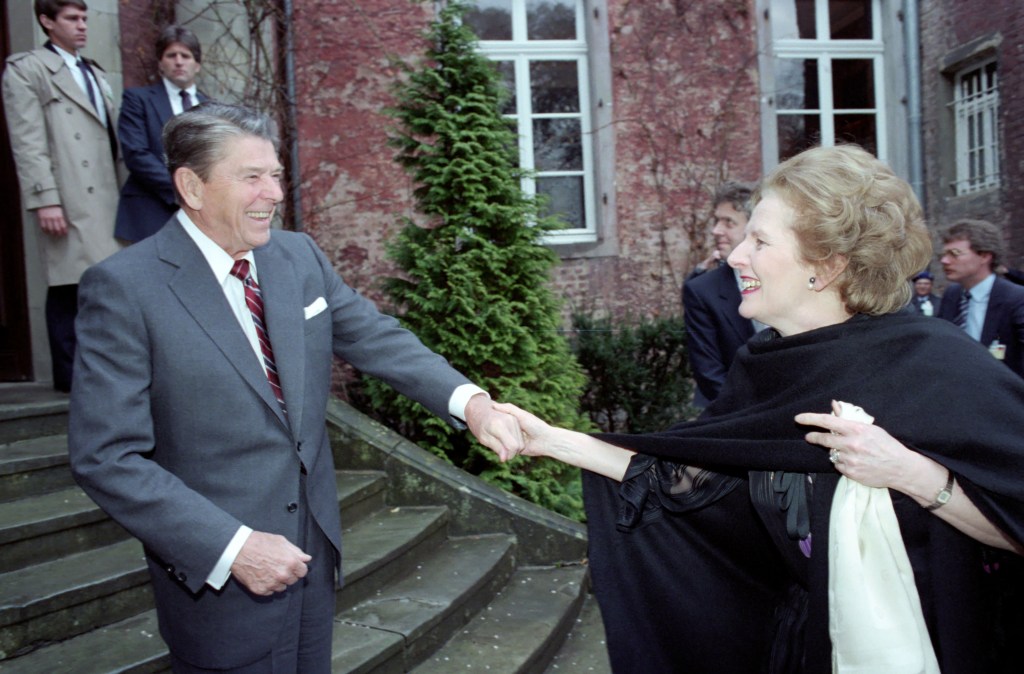
President Reagan, promoting allied support for his space arms program, pledged today not to “go it alone” and decide on deployment without consulting allies and holding discussions with the Soviet Union. In a series of individual meetings with British, French, West German and Japanese leaders hours before the seven-nation economic summit conference began, the President encountered a lukewarm response to the American proposal that other industrialized allied nations take part in the research program on developing a space-based missile defense system, which is popularly known as “Star Wars.” From Chancellor Helmut Kohl, Mr. Reagan received strong expressions of interest of West German involvement in the research effort. But both President Francois Mitterrand and Prime Minister Yasuhiro Nakasone shied away from signing up for the project at this stage.
President Reagan’s “Star Wars” program “is the major concern to strategic policy-makers in either West or East,” the International Institute for Strategic Studies said in its annual report. The non-partisan, London-based institute suggested that “even if strategic defenses were to prove feasible, they could damage stability rather than strengthen it.” The debate over the Strategic Defense Initiative, as the “Star Wars” plan is formally called, “promises to be vigorous,” the institute said.
President Reagan meets with President of the Federal Republic of Germany Richard von Weizsacker and Chancellor of the Federal Republic of Germany Helmut Kohl.
President Reagan meets with President of the French Republic Francois Mitterrand and Prime Minister of the United Kingdom of Great Britain and Northern Ireland Margaret Thatcher.
France opposed the key trade plan that President Reagan took to the economic summit meeting in Bonn of the world’s seven leading industrial democracies. President Francois Mitterand told Mr. Reagan he could not agree to set a date for early next year to begin worldwide negotiations to eliminate barriers to free trade. In a day devoted largely to ceremony, Mr. Mitterrand’s statement indicated that when the conference does get down to business it will not always have the unanimity that its rules require for major decisions. President Reagan wants an agreement from his fellow chiefs of government to set a date in early 1986 to begin worldwide talks on eliminating barriers to free trade. The Administration hopes such a commitment will cool the rising sentiment in Congress for protection against the record flow of foreign goods into the American market.
A reported comment by the President generated a dispute in Bonn. A Government spokesman quoted Mr. Reagan as having said he regretted that some Americans believed in German collective guilt for the Nazis’ slaying of millions during World War II. Larry Speakes, the White House spokesman, denied that Mr. Reagan had made the comment. Later, West German officials reiterated he had made the remark.
SS veterans feel rehabilitated by President Reagan’s planned visit to the military cemetery at Bitburg on Sunday, according to participants at a reunion of the Waffen SS Death’s Head Divison in the ski resort of Nesselwang.
The West German Government announced today that veterans of the anti-Hitler resistance movement would be present when President Reagan visits a military cemetery in Bitburg on Sunday. It was also learned that the Reagan welcoming committee at Bitburg would include Fritz Gasper, the chairman of the Bitburg rural district council and a former member of the Waffen SS 12th Panzer Division, the “Hitler Youth.” Asked whether Mr. Gasper would be among the officials who would greet Mr. Reagan and accompany him to the graveyard, the Mayor of Bitburg, Theo Hallet, said, “Of course!” However, in a telephone interview, the Mayor said it was not certain Mr. Gasper would shake Mr. Reagan’s hand. Mr. Reagan’s planned visit to the site has been severely criticized in the United States because 49 men of the Waffen SS, the combat soldiers who fought fiercely and who also left a trail of atrocities across Europe, are among 2,000 soldiers buried at the Kolmeshohe.
Jacek Kuron, an adviser to the Polish Solidarity movement who publicly urged May Day protest marchers to disperse peacefully, was sentenced today to three months in jail for taking part in the illegal procession with 15,000 people. The testimony of a police officer whose suggestions for dispersing the crowd Mr. Kuron endorsed and conveyed to the marchers was used in the misdemeanor court that quickly sentenced the 51-year-old pro-Solidarity activist. A second well-known dissident, Seweryn Jaworski, is also due to be sentenced in the neighborhood court, which is processing at least 50 people detained on May Day. Similar cases are being heard elsewhere in Poland, with 200 arrests being reported in Wroclaw alone.
In Kraków, an incident was touched off by the brief detention of two United States diplomats at the scene of a pro-Solidarity demonstration near an iron and steel plant. John Davis, the American charge d’affaires, was called in today to the Foreign Ministry and was told that the two men — William Harwood from the embassy and David Hopper from the Kraków consulate — had joined a group shouting anti-Government slogans and waving Solidarity banners. An embassy spokesman said Mr. Davis had filed a countercomplaint, charging that the two men had been roughed up while being forced into an unmarked vehicle by uniformed policemen. The spokesman said the two diplomats were later released with apologies.
Artillery exchanges between Muslim and Christian militiamen continued here today and in the hills east of the southern port of Sidon as efforts to arrange a cease-fire foundered. The police said eight people were wounded when the combatants lobbed shells at each other’s positions across the dividing line between the western Muslim sector of Beirut and Christian East Beirut. Only one of six crossing points between the two parts of the city remained open. The so-called Green Line that was dismantled a year ago after a Syrian-sponsored truce has now been re-established in the downtown area, which has been largely demolished by 10 years of sectarian strife in Lebanon. The opposing sides have rebuilt barricades and put up huge sand piles on either side of the line, recovering the positions they had turned over to the regular army when a Lebanese Cabinet of national unity was formed in April of last year.
A sister of Iran’s President Ali Khamenei surfaced in the enemy capital of Baghdad along with her five children, joining her husband in exile. Badri Hussein Khamenei told a news conference arranged by Iraq’s Ministry of Culture and Information that she and her children, ages 4 to 22, had to flee illegally from Iran when her brother refused her pleas for passports. Her husband, Sheik Ali Tehrani, an opponent of Iran’s supreme leader, the Ayatollah Ruhollah Khomeini, was granted asylum in Iraq in March, 1984.
Indira Gandhi left an estate to her three grandchildren valued at the equivalent of about $173,000, according to a copy of her will published in New Delhi. The bulk of her estate was a small farm worth about $98,000. The late prime minister appointed her son and successor, Rajiv Gandhi, and his wife, Sonia, as executors of the will but did not bequeath them. anything. Also left to the grandchildren were cash and securities valued at about $75,000.
A soldier killed Benigno S. Aquino Jr., the opposition leader, when he returned to the Philippines from exile in 1983, a Filipino woman testified. The witness, Rebecca Quijano, a businesswoman, is the first person to assert she witnessed the assassination at the trial of 25 military men and 1 civilian charged with involvement in the slaying. ‘I saw a soldier holding a gun aimed at the back of Senator Aquino’s head, and simultaneously I heard a gunshot,” the witness said at the trial of 25 military men and one civilian charged with involvement in the murder. She said she saw the shooting from the window of the airliner from which Mr. Aquino had just disembarked.
Voters in Ontario, Canada’s most powerful province, reelected at Progressive Conservative administration but left Premier Frank Miller with a shaky minority government. Miller’s party won 52 out of 125 seats, nine short of the 63 needed for a majority government in Ontario’s three-party system. The opposition Liberal Party scored the biggest gains, winning 20 additional seats for a total of 48. The New Democratic Party took the remaining 25. While pre-election polls had predicted a slide in support for Miller, none had forecast the surprising setback for the Tories.
A shift on Nicaragua rebel aid may occur in the House. The Democratic leaders there appeared to move toward reversing their opposition to aiding the insurgents. The development came a day after President Reagan ordered a trade embargo against Nicaragua, telling Congress that the Sandinistas posed an urgent threat to the security of the United States. Last week, the House voted to block all aid to the rebels. Although the embargo and the $14 million aid request for the rebels are separate issues, a congressional aide said, “There is intense interest right now on what’s happening in Managua.”
Argentina and Chile signed a Vatican-mediated pact ending their territorial dispute over the Beagle Channel at the tip of South America. The signing, by the foreign ministers of the two countries, took place in Vatican City with Pope John Paul II presiding.
The evacuation of 50,000 famine victims from their camp in Ethiopia was necessary and voluntary, but it was done too hastily and with too little preparation, Kurt Jansson, the U.N. special representative in Ethiopia, said in Addis Ababa. After visiting the camp at Ibnet, Jansson said the refugees’ grass huts were burned after they left to avoid health hazards. Ethiopia’s relief director said the people were healthy and left voluntarily to return home and plant crops now that rain has fallen. However, international relief officials said many may die in long marches.
In a sometimes heated exchange with members of the Senate Foreign Relations Committee, Chester A. Crocker, assistant secretary of state for African affairs, defended Administration policy on South Africa. At one point, he said that Americans protesting South Africa’s apartheid racial policies are enjoying “the moral equivalent of a free lunch.” Senator Richard G. Lugar (R-Indiana), the committee’s chairman, reminded Crocker that the panel voted 16 to 1 last month in favor of a bill calling for mandatory economic sanctions against South Africa unless President Reagan can certify that progress is made toward ending apartheid.
The House Foreign Affairs Committee overwhelmingly approved legislation today that would bar new private United States investment in South Africa. In a sign of growing Congressional support for sanctions against Pretoria, the committee voted 29 to 6 for the bill, which could come before the full House this month. “This is a very significant vote,” said Representative Stephen J. Solarz, Democrat of Brooklyn. “Not a single Democrat broke ranks and four of the ten Republicans were for it. That indicates we have the kind of broad, bipartisan support which is a virtual guarantee of passage when it comes before the House.”
South Africa’s governing party has retained control of seats in two by-elections, turning aside a challenge by far-right opponents. But in the elections Wednesday in Harrismith, in the Orange Free State, and Port Elizabeth, in the restive Eastern Cape, the right-wing Conservative Party seems to have gained ground.
The Senate opposed higher military spending in a second major defeat for the White House and the Republican leadership in two days. The Senate, on a voice vote, approved an amendment to the 1986 budget package that would eliminate any additional money for the Pentagon except to keep up with inflation.The amendment was strongly opposed by President Reagan, who originally sought a 6 percent increase on top of a rise to make up for inflation. He and the Republican Senate leaders had agreed on a compromise military increase of 3 percent above inflation. While the Senate budget debate has at least a week and many amendments to go, the two defeats indicated the difficulties faced by the Republican leadership and the White House in assembling a deficit-reduction package. The vote in the Senate today appeared to signal a backlash against the rapid military buildup the President has pursued since taking office in 1981. Both Democrats and Republicans, who have generally supported the buildup, seemed to be saying that it has to stop, or at least slow down.
A diverse group of House Democrats have reached an informal consensus that they say may finally resolve the long, bitter dispute over the future of the MX missile. Participants said the plan, which has attracted both past supporters and opponents of the multiwarhead intercontinental missile, would limit deployment to 40 missiles rather than the 100 desired by the Reagan Administration. It would also allow continued production of a few missiles each year, probably eight, to provide test flights and spares and to keep production lines warm in case of emergency, according to key House members and aides, some of whom spoke on the condition they not be named.
Republicans resorted to little-used parliamentary procedures to disrupt the House in protest over Wednesday’s vote to seat a Democrat in a closely contested election in Indiana’s 8th District. For nearly two hours, the Republicans demanded roll calls on routine matters. But at day’s end, Rep. Robert S. Walker (R-Pennsylvania), one of the leaders of the rebellion, said that tactics will now shift to seeking changes in the House rules to end the Democrats’ “abuse of power.”
Another of the space shuttle Challenger’s scientific instruments failed today, but scientists at the space center here were nevertheless elated by the information it had gathered. They said the instrument, part of an experiment created to detect and measure the chemistry of the upper atmosphere, had already provided more knowledge than the sum of all previous samplings by airplanes and balloons. “We’ve collected more data than our wildest dreams,” said Dr. C. Barney Farmer of the Jet Propulsion Laboratory at Pasadena, Calif., the project’s chief scientist. While Dr. Farmer and other scientists here at the Johnson Space Center appeared delighted by the experiment, the Challenger spaceship was performing well in the fourth day of its seven-day mission.
A House panel backed Amtrak, rebuffing the Reagan Administration. The subcommittee voted unanimously to maintain the Government subsidy of the national passenger railroad at its current $684 million level for two years.
House and Senate panels began a broad attack on water pollution, approving bills to require cleaner drinking water and to continue federal support for local sewage and waste-water treatment plants. The actions by the Senate Environment Committee and the House Public Works health subcommittee represented defeats for Reagan Administration budget-cutters and the Environmental Protection Agency. The two panels gave unanimous voice-vote approval to similar bills that would force the EPA to issue standards limiting the levels of about five dozen contaminants now found in tap water.
Conservative groups attacked newly installed Labor Secretary William E. Brock III for appointing a former United Auto Workers union lawyer, Steve Schlossberg, as a deputy undersecretary who will be a liaison with organized labor. “I’m surprised that Secretary Brock has sold out to the dark side of the Force so completely and so quickly,” said Steve Antosh, executive director of the Center for National Labor Policy, a legal services group.
Members of the Congressional Black Caucus introduced a resolution demanding that Marianne Mele Hall, chairman of the U.S. Copyright Royalty Tribunal, resign over the “abhorrent racist philosophies” in a 1982 book she edited. Caucus leaders said several other House members had agreed to co-sponsor the resolution. Hall has told a House subcommittee that although she was listed as a co-author she only edited the book and that she found its contents “repugnant.”
Federal health officials, buoyed by a private report of improving heart-transplant survival, are looking into the possibility of Medicare coverage for at least some future transplants, Health and Human Services Secretary Margaret M. Heckler said. Her announcement brought positive reactions from heart-transplant authorities, but it brought strong criticism from Senator Albert Gore Jr. (D-Tennessee), who said the government continues to deny health-insurance coverage — thereby causing deaths — for no good reason.
More than 250 people were arrested yesterday on campuses in California and Iowa in protests against South Africa’s policy of racial segregation, while six labor union officials in Boston surrendered to the police after occupying an office where South African gold coins were sold. In Washington, Georgetown University students presented trustees a bedsheet banner urging “Divest Now,” and 27 students at the University of Massachusetts in Amherst were freed from police lockups after a sit-in – all part of continuing efforts to end college investment in companies doing business in South Africa. Donald Donahue, chairman of the Georgetown board of trustees, and the Rev. Timothy Healy, president of the university, said after meeting with a small group of protesters that the university would give the divestment issue “very careful study.”
The Supreme Court today halted the scheduled execution of Willie Lloyd Turner less than six hours before he was to die in Virginia’s electric chair for killing a jewelry store owner. Chief Justice Warren E. Burger, without explanation, refused to lift a stay of execution granted Monday by the Unied States Court of Appeals for the Fourth Circuit.
E.F. Hutton pleaded guilty to an elaborate fraud that let the major brokerage firm use as much as $250 million a day of bank funds without paying interest. The Justice Department said the firm had pleaded guilty to 2,000 felony counts of wire and mail fraud and had agreed to pay criminal fines of $2 million, the maximum under the law, $750,000 to cover costs of the Government’s investigation and restitution of up to $8 million to the 400 banks it defrauded.
The Union Carbide Corporation plans to restart production of the chemical methyl isocyanate Friday at its pesticide plant in Institute, a company spokesman said today. The spokesman, Thad Epps, said at a news conference at Carbide’s South Charleston facility that technicians were to check the unit Thursday night, establishing cycles in preparations for the first chemical reaction, and “if everything is go” production would resume Friday morning.
The judicial system often sets up roadblocks against successfully prosecuting child abusers by making it difficult and traumatic for the victims to testify, a Senate panel was told. “People assigned to investigate these cases have no sensitivity and do not believe 3-, 4-, and 5-year-old children,” said Andrea Landis of Miami, the founder of Justice for Sexually Abused Children. Landis, a police officer, said her 4-year-old daughter was sexually abused at a baby-sitting service.
A Federal appeals court agreed today to reconsider a ruling last December that upheld the Nuclear Regulatory Commission’s operating license for the Diablo Canyon nuclear plant in California. Opponents of the $5.4 billion plant on near San Luis Obispo petitioned the court for a new hearing in February, asserting that they had new evidence that the commission illegally discussed aspects of the licensing at three closed-door meetings last summer.
New York won’t file medical misconduct charges against doctors in the case of a pregnant woman who was wrongly injected with an anti-cancer drug that induced a coma and will likely result in her death, officials said in Albany. An investigation of the injection of the drug into the spine rather than the bloodstream of cancer patient Lillian Cedeno, 21, concluded that procedural deficiencies, now corrected, at the Albany Medical Center helped create a situation that allowed the error to occur, Health Commissioner David Axelrod said.
Officers arrested 100 Hells Angels motorcycle club members and associates on charges of drug trafficking and racketeering. More than 1,000 law enforcement officers conducted the raids starting at dawn in 11 states across the country. A Connecticut state trooper was shot in the abdomen and hip when one suspect fired through the door of a Stratford house. In New York, 15 people were arrested, including an East Village resident who the Federal Bureau of Investigation said was president of the club’s East Coast and European chapters. The raids by more than 1,000 law-enforcement officers resulted from an undercover operation that lasted more than two years, in which an agent of the Federal Bureau of Investigation and an informer traveled with gang members and became friendly with them.
The U.S. performs underground nuclear test “Towanda” at the Nevada Test Site, with an estimated 150-ton yield.
Major League Baseball:
The Oakland A’s broke their seven-game losing streak the hard way Thursday with a pair of runs after two were out in the ninth inning for a come-from-behind victory over Milwaukee. “That should make us come alive,” said Alfredo Griffin, whose run-scoring single gave the A’s a 5-4 win over the Brewers at Oakland.
The Red Sox edged the Mariners, 2–1. Rich Gedman hit his second home run of the season, and three Red Sox pitchers combined on a five-hitter at Seattle as Boston snapped its five-game losing streak and the Mariners’ three-game winning streak.
Toronto Blue Jays 2, California Angels 3
Milwaukee Brewers 4, Oakland Athletics 5
Boston Red Sox 2, Seattle Mariners 1
Dow Jones Industrial Average: 1242.27 (+0.22)
Born:
Sarah Hughes, American figure skater (Olympics, gold medal, women’s singles, 2002), in Great Neck, New York.
Kyle Busch, American auto racer, (NASCAR Cup Series Champion 2015), in Las Vegas, Nevada.
Jarrod Saltalamacchia, MLB catcher and first baseman (World Series Champions-Red Sox, 2013; Atlanta Braves, Texas Rangers, Boston Red Sox, Miami Marlins, Arizona Diamondbacks, Detroit Tigers, Toronto Blue Jays), in West Palm Beach, Florida.
José Ascanio, Venezuelan MLB pitcher (Atlanta Braves, Chicago Cubs, Pittsburgh Pirates), in Maracay, Venezuela.
William Hayes, NFL defensive end (Tennessee Titans, St. Louis-Los Angeles Rams, Miami Dolphins), in High Point, North Carolina.
Lily Allen, English singer-songwriter (“It’s Not Me, It’s You”) and TV presenter (Lily Allen and Friends), in London, England, United Kingdom.
Died:
Milton S. Eisenhower, 85, U.S. academic administrator and diplomat, brother of President and General Dwight D. Eisenhower, of cancer.
Larry Clinton, 75, American trumpeter and bandleader (“My Reverie”).
 History Diaries