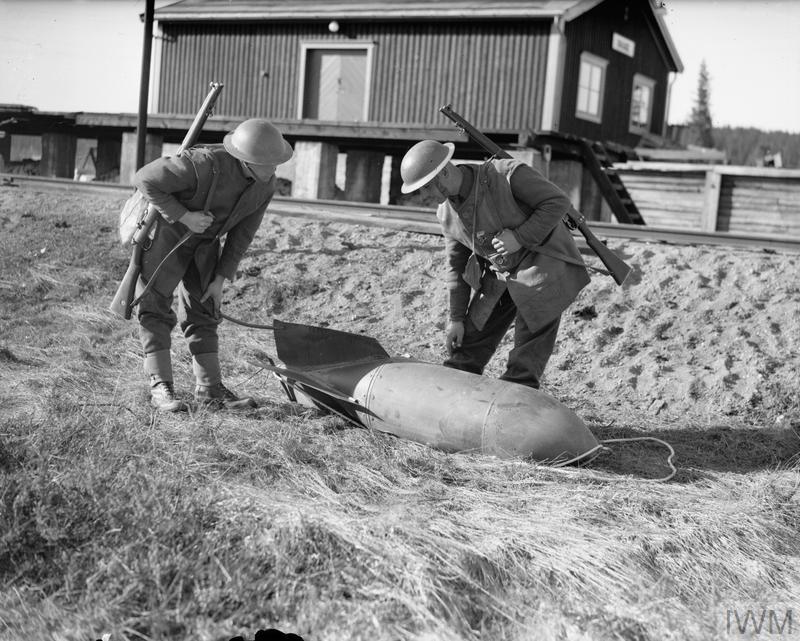
German units which have moved up the Osterdal link with their Trondheim force at Dragset. The British and French forces in the Gudbrandsdal are fighting south of Dombås when the order to retire reaches them. The Norwegian troops in this area will be forced to surrender when their allies leave. During the night the British begin to evacuate their troops from Åndalsnses.
The German 196th Division captured Dombås as the British retreated to Åndalsnes. German forces seized Dombås, a key railroad center east of Åndalsnes, and Norwegian resistance collapsed. The Germans continued to send reinforcements to the Norwegian campaign, which permitted the Germans to go on the offensive.
The German 196th Division arrived at Dombås, Norway on foot as their vehicles had been rendered useless after encountering blown bridges; their initial attacks were held off by the British 15th Brigade; despite causing heavy casualties to the Germans, the British withdrew their defensive line at dusk by train toward Åndalsnes. Elements of German 196th Infantry Division now occupied Dombas.
Elements of German 196th Infantry Division meet elements of German 359th Infantry Regiment south of Trondheim, establishing land connection with Oslo.
Hitler is pleased with the progress of Operation Weserubung and issues a congratulatory Order of the Day on 30 April 1940.
Nikolaus von Falkenhorst was awarded the Knight’s Cross of the Iron Cross medal.
General Otto Ruge issues a somewhat different statement: “Allied forces are withdrawing from Romsdal and presumably Namsos. The situation has thus been changed. A military collapse is to be expected in Gudbrandsdalen, Romsdal and Trondelag. The Government and Army High Command are transferring to Northern Norway.”
British 148th Infantry Brigade are evacuating by sea from Åndalsnes. In the United Kingdom, a British fleet consisted of cruisers HMS Manchester and HMS Birmingham and destroyers HMS Inglefield, HMS Diana, and HMS Delight, under the command of Vice Admiral Layton, departed Scapa Flow, Scotland for Norway; its mission was to evacuate the British 148th and 15th Brigades from Åndalsnes and Molde.
General de Wiart’s troops at Namsos are also waiting to be evacuated by the destroyer force that is en route from Scapa Flow.
Norwegian 6th Infantry Brigade and 7th Infantry Brigade and French 27th Demi-Brigade de Chasseurs continue slowly advancing toward Narvik from the north.
Near Oslo, RAF bombers conducted attacks on German-controlled airfields in Stavanger and Oslo-Fornebu, escorted by naval fighters launched by HMS Ark Royal and HMS Glorious; Germans detected the location of the British carriers and successfully launched a fighter attack that drove off the carriers.
RAF Bomber Command dispatches aircraft to attack Aalborg airfield in Denmark overnight.
Off Namsos, Norway, German Ju 87 aircraft attacked British anti-submarine sloop HMS Bittern, hitting her with a bomb and starting a fire on the stern that killed 20; destroyer HMS Janus rescued the survivors and scuttled HMS Bittern with a torpedo to prevent capture.
Off Trondheim, Norway, German aircraft sank British trawler HMS Warwickshire. She was raised by the Germans on 1 June 1940 and commissioned by them as NKi09/Alane. She was sunk again on 19 July 1943 near Narvik, northern Norway by the Soviet submarine S-56.
The Royal Navy ASW trawler HMS Aston Villa was bombed and damaged in the Norwegian Sea off Namsos, Norway, by Junkers Ju 87 aircraft of the Luftwaffe. She was scuttled on 3 May.
The Royal Navy ASW trawler HMS St Goran was bombed and severely damaged off Namsos by Luftwaffe aircraft. She was subsequently bombed again and sunk the next day.
The Royal Navy naval trawler HMS Gaul was bombed and damaged in the Norwegian Sea off Namsos by Luftwaffe aircraft. She was scuttled on 3 May.
ASW trawler HMS Jardine scuttled after being damaged by German aircraft off Norway the previous day.
The (British) Royal Fleet Auxiliary tanker RFA Boardale ran aground off Straume, Nordland, Norway (68°43’00?N 14°24’30?E). She sank on 2 May.
The Royal Norwegian Navy guard ship Alversund was scuttled by her own crew near Stord, Hordaland, Norway, to prevent capture by the Germans.
The Norwegian cargo ship Saturnus was bombed and sunk in Todalsfjord by Luftwaffe aircraft. Later raised, repaired and returned to service.
At 0630, HMS Glorious, accompanied by the destroyers HMS Acheron, HMS Antelope, HMS Beagle and HMS Volunteer depart Scapa Flow, flies on her remaining detachment of 803 Squadron and the Swordfish of 823 Squadron, and then steams to rejoin HMS Ark Royal and the Home Fleet off Norway.
Nothing of much importance occurred on the Western Front during the last twenty-four hours. There were clashes in No Man’s Land and the French took several prisoners. The evening communiqué of the French High Command reported that the Germans attempted two local attacks but were driven back.
Things will be very different a week from now…
Chancellor Hitler, in a jubilant proclamation to his soldiers in Norway tonight, boasted that German victories there have “conclusively nullified” the Allies’ efforts to beat Germany to her knees on the Scandinavian battle front.
Italy’s threatening attitude tonight brought an order for British ships to avoid the Mediterranean in voyages to and from India and the Far East. British ships, normally passing through the Mediterranean which Premier Benito Mussolini regards as Italy’s “Mare Nostrum,” have been ordered to take the long route around the Cape of Good Hope at the tip of Africa. The Mediterranean is the “lifeline” of both the British and French empires in the Far East. It was not indicated whether the precautionary measures affecting merchant shipping also would involve movements of the British Mediterranean fleet.
Great Britain’s decision to divert Mediterranean traffic to the Cape route was learned by the Italians with surprise and apprehension.
Stories of a stir in Italian military activity near the Yugoslav frontier caused uneasiness tonight in Croatia and Slovenia and especially Dalmatia, despite reassuring statements from Premier Dragisha Cvetkovitch.
The first guarded Jewish ghetto was established at Łódź, Poland; it was ordered sealed off with 230,000 Jews inside.
Count Stephen Csáky, the Hungarian Foreign Minister, issued a sharp warning today to German-protected Slovakia that the treatment of the Magyar minority in Slovakia must be improved. Replying in the upper house to charges of the abuse of Hungarians in Slovakia, brought by Dr. Geza Szuelloc, former champion of Hungarian interests in Czecho-Slovakia, the Foreign Minister declared that Hungary was nearing the end of her patience on this issue.
Hungary did her best, he asserted, to come to friendly terms with Slovakia. She was the first to acknowledge the independence of the small neighboring State and the first to conclude a commercial agreement with the Slovaks. Moreover, he declared, the Hungarian Government had exercised its patience to the utmost limit and had often “shut its eyes to dangerous symptoms.” That patience, however, he concluded, would come to an end unless the rights and property of Hungarians in Slovakia were respected.
Faced with a serious shortage of wheat, the government today halved the bread ration in Spain, reducing the daily amount per person from 250 to 125 grams.
Luftwaffe again conducts minelaying operations along the British coast.
During minelaying operations, a Heinkel He 111 which is carrying a magnetic mine is damaged by anti-aircraft. After trying to crash-land safely, it crashes into a suburban neighborhood at Clacton-on-Sea, Essex. It explodes and causes the deaths of the four-man crew, two civilians, 156 injured civilians, and the destruction of 50 houses.
Off Greenock, Scotland, the 2,400 ton French Vauquelin-class destroyer Maillé Brézé, is a victim of its own weaponry when two of its own torpedoes accidentally fired and slithered along the main deck exploding under the bridge structure and completely wrecking the forepart of the ship and causing a terrific explosion with flames shooting 50 feet high into the air. Some of her crewmembers tried to squeeze themselves through the portholes to safety. There were 25 dead and 48 wounded among her crew. The British destroyer HMS Firedrake rushed to the scene and rescued fifteen men who had slid down the hawse pipe.
The Royal Navy Hunt-class minesweeper HMS Dunoon hit a mine at Smith’s Knoll near Great Yarmouth (52°45’N 2°23’E) and sank, killing 27.
German minefield 17 was laid west of Jutland by German minelayers Roland, Preussen, and Cobra and escorted by destroyers Beitzen and Heinemann and Torpedo boats WOLF, Kondor, Moewe, Leopard. En route, German minelayer Preussen accidently collided with and sank German torpedo boat Leopard. Torpedo boat Wolf picked up survivors from the torpedo boat Leopard. On this minefield on 1 May, Swedish steamer Haga (1296grt) was sunk at the west entrance to the Skagerrak. Four crew on the Swedish steamer were lost. Twelve survivors were picked up by German U-30 on 3 May.
HMS Furious is turned over to dockyard hands at Greenock.
Convoy OB.136 departed Liverpool, escorted by sloop HMS Leith from 30 April to 3 May when she was detached to convoy HX.37.
Convoy FS.158 departed the Tyne. The convoy arrived at Southend on 1 May.
Danish tug Valkyrien departed Lisbon and was taken in prize by Kriegsmarine destroyer Keppel and taken to Gibraltar.
Convoy SL.30 departs Freetown for Liverpool.
Convoy HX.39 departed Halifax at 1000 escorted by Canadian destroyers HMCS Restigouche and HMCS St Laurent. At 1400 on 1 May, the destroyers turned the convoy over to armed merchant cruiser Voltaire and French submarine Archimede. The armed merchant cruiser and the submarine were detached on 11 May. On 12 May, sloop HMS Enchantress and corvette HMS Gladiolus joined the convoy and escorted it until its arrival at Liverpool on 15 May.
For the month of April 1940, German U-boats sank just 10 Allied ships (35,433 tons) and damaged 1 ship (6,999 tons). Five U-boats were sunk. The low total was largely due to the number of submarines withdrawn from the Battle of Atlantic to participate in the Norway Invasion, as well as the troubled performance of German torpedoes using magnetic (influence) exploders in that campaign, a difficulty which the United States will also be plagued with in coming years. However, the Kriegsmarine has now gained bases on the coast of Norway, and will soon add French ones as well. A time of extreme peril for the British Empire lies just over the horizon. Allied shipping losses from all causes (including aircraft and mines) are much more serious: 58 Allied ships are lost (158,218 tons).
The War at Sea, Tuesday, 30 April 1940 (naval-history.net)
German minefield 17 was laid west of Jutland by German minelayers ROLAND, PREUSSEN, COBRA and escorted by destroyers BEITZEN and HEINEMANN and torpedo boats WOLF, KONDOR, MOEWE, and LEOPARD. En route, German minelayer PREUSSEN accidently collided with and sank German torpedo boat LEOPARD. Torpedo boat WOLF picked up survivors from the torpedo boat LEOPARD. On this minefield on 1 May, Swedish steamer HAGA (1296grt) was sunk at the west entrance to the Skagerrak. Four crew on the Swedish steamer were lost.Twelve survivors were picked up by German U-30 on 3 May.
French large destroyer MAILLE BREZE was sunk at 1415 in an accidental explosion at Tail of Bank at Greenock while taking on ammunition. The ship’s torpedo tubes were trained fore and aft and one of the torpedoes was accidently discharged, exploding on the bridge. Personnel from aircraft carrier FURIOUS, destroyer FIREDRAKE, boom defense vessel BARFIELD assisting in the rescue of the survivors. Six crew were killed and twenty-seven were missing in the destroyer. Forty-seven crew were wounded. The survivors left the Clyde on 2 May in French sloops CHAMOIS and COMMANDANT DELAGE.
Destroyer ASHANTI departed Scapa Flow at 1000 for repairs at Dundee.
Destroyer VANESSA departed Dover for refitting at Devonport.
Destroyer VANSITTART departed Invergordon at 0600 with tanker WAR NIZAM for Scapa Flow, arriving at 1600/30th.
Submarine SEAL, after embarking mines at Immingham, departed the Humber on minelaying mission FD.7 in the Kattegat.
Submarine STURGEON departed Blyth on patrol to relieve submarine TRITON off Skudesnes.
Submarine PORPOISE arrived at Rosyth after patrol.
In German bombing attacks on British shipping at Aandalsnes, anti-submarine trawlers JARDINE (452grt, Lt K.B. Hopkins RNVR) and WARWICKSHIRE (466grt, Cdr Y.M. Cleeves RNR) of the 22nd Anti-Submarine Group were sunk. They were later salved by German forces as Vp.6117 (trawler CHERUSKER) and Vp.6114 (trawler ALAME), respectively. Skipper S.J. Cory RNR of JARDINE was wounded.
Minesweepers DUNOON (Lt Cdr H A Barclay) and ELGIN of the 4th Minesweeping Flotilla were minesweeping from 29 April after steamer CREE was damaged. DUNOON was recovering a parted mine sweep when she struck a mine off Great Yarmouth in 52 45N, 2 23E in the minefield laid by German minelayer Schiff 11 on 2 April. The four inch ammunition magazine exploded and she sank in 40 minutes. Lt Cdr Barclay, Lt J H C Torr RNR, Temporary S/Lt R A Hill RNVR and twenty-five ratings were lost with five ratings wounded.
Anti-aircraft CARLISLE and sloop BITTERN were stationed at Namsos as anti-aircraft guard ships. Antiaircraft cruiser CARLISLE had departed temporarily on the 28th to refuel and returned during a heavy German air attack on the 30th. Sloop BITTERN was bombed and badly damaged in her stern during this attack in 64 28N, 11 30E. Seventeen ratings were killed and three missing in the attack in the attack. Eleven ratings were wounded. Destroyer JANUS took off the wounded from BITTERN and later scuttled the sloop. Anti-submarine trawlers ST GORAN (Lt Cdr N.C. McGuigan RNR), ASTON VILLA (Lt Cdr Sir G.C. Congreve, Bt), GAUL (Temporary Lt H.M. Duff-Still RNVR) were badly damaged by German bombing at Namsos. McGuigan and three ratings were killed on ST GORAN. Destroyer JANUS, en route up the fjord, sent her medical officer to assist ST GORAN’s wounded. Two hours later, anti-aircraft cruiser CARLISLE arrived and took the survivors aboard survivors, less Lt P.W. Clark, BITTERN’s Navigator, which remained on JANUS.
Battleship RESOLUTION arrived at Tromso.
Steamers BELLEROPHON (9019grt) and LYCAON (7350grt) were brought to the Clyde arriving at 1830/27th by destroyer WESTCOTT. Destroyers ISIS, IMOGEN, and ILEX departed the Clyde at 0830 escorting these steamers for Narvik.
Norwegian destroyer HNoMS SLEIPNER departed Scapa Flow at 1330 for a refit in the Tyne, but was diverted to Rosyth due to German minelaying.
During the night of 30 April/1 May, the evacuation of Aandalsnes and Molde, codenamed Operations TUNNEL and BRICK No.1, respectively, began under the command of Vice Admiral Sir G. F. B. Edward-Collins KCVO, CB. Light cruisers ARETHUSA and GALATEA and destroyer WALKER, WANDERER, and WESTCOTT departed Scapa Flow at 1700/29th. Destroyers SOMALI, MASHONA, and TARTAR with troopships ULSTER MONARCH (3791grt) and ULSTER PRINCE (3791grt) departed Scapa Flow at 1230/29th. Destroyer SIKH departed Scapa Flow at 1540/29th to join this force. Molde was evacuated by troopship ULSTER PRINCE escorted by destroyer TARTAR from 2300/30th to 0100 on 1 May. Aandalsnes was evacuated by light cruisers GALATEA and ARETHUSA which embarked troops at the pier and destroyer WALKER and WESTCOTT which embarked troops and ferried them to light cruiser SHEFFIELD in the harbour. Troopship ULSTER MONARCH accompanied this force, but returned empty because the first night’s quota had been filled by the cruisers. Light cruiser ARETHUSA was the first ship to leave the area at about 0100 and the others followed soon after. Destroyers SIKH and WANDERER at Alfarnes, six miles north of Aandalsnes, lifted troops and ferried them to nearby light cruiser SOUTHAMPTON. While there was no enemy resistance to the operation, WANDERER went aground and SIKH had to tow her off. Destroyer WANDERER was repaired at London from 6 to 29 May. At Verblungsnes, across the mouth of the Romsdal River, destroyers MASHONA, WALKER, WESTCOTT picked up the surviving troops of the PRIMROSE force. WALKER and WESTCOTT not leaving until 0315 in order to pick up the rear-guard units. As the force left the Fjord, they were attacked by German bombers, but anti-aircraft fire forced the bombers to drop their bombs ineffectively. Destroyer SIKH and troopships ULSTER PRINCE and ULSTER MONARCH arrived at Scapa Flow at 1235 on 2 May. Light cruiser SOUTHAMPTON and destroyers WESTCOTT and WALKER arrived at Sullom Voe during the afternoon of 1 May. Light cruiser SOUTHAMPTON transferred 350 troops to destroyer WESTCOTT, which then proceeded to Scapa Flow arriving at 0800 on 2 May. Light cruiser SOUTHAMPTON and destroyer WALKER were to have returned to Aandalsnes, but the operation was cancelled when it was found that German troops arrived in the town during the day. Light cruiser SHEFFIELD arrived at Scapa Flow at 0600. Light cruiser SOUTHAMPTON and destroyer WALKER arrived at Scapa Flow at 1515 on 2 May.
Light cruisers GALATEA and ARETHUSA arrived at Scapa Flow at 0208 and 0231, respectively on 2 May.
Battleship WARSPITE departed the Clyde at 2020 escorted by destroyers HERO, FOXHOUND, and FIREDRAKE for Gibraltar and duty with the Mediterranean Fleet. The destroyers arrived back in the Clyde after the escort at 1600 on 2 May.
At 0630, aircraft carrier GLORIOUS with destroyers ACHERON, ANTELOPE, BEAGLE, and VOLUNTEER departed Scapa Flow to fly on aircraft and rendezvous with the aircraft carrier ARK ROYAL.
Destroyer VOLUNTEER arrived at Sullom Voe at 2330 to make good defects before going to Scapa Flow. Entering the anchorage, she fouled the indicator nets. The nets were cleared by the attendant boom boat with no damage to the destroyer and little damage to the nets.
Destroyer KIMBERLEY, escorting Danish steamer GUNVOR MAERSK, was ordered at 2034 to Sullom Voe to embark ammunition from destroyer JUNO, which was experiencing defects, then join aircraft carrier ARK ROYAL in JUNO’s place.
French steamer MARGAUX (1463grt) escorted by French auxiliary patrol ship HEUREUX (1016grt) arrived in the Clyde. The patrol ship departed the Clyde on 1 May to return to Brest.
Trawler ATHELSTAN (202grt) was sunk by German bombing in the North Sea.
The German 2nd S-Boat Flotilla, off Norway since the start of the Norwegian campaign, was ordered to Wilhelmshaven to prepare for the operations in the North Sea. The 1st S-Boat Flotilla remained for coastal defense; three units based at Sognefjord and two at Bergen. They departed to return to Germany on 14 May.
Convoy OB.136 departed Liverpool, escorted by sloop LEITH from 30 April to 3 May when she was detached to convoy HX.37.
Convoy FS.158 departed the Tyne. The convoy arrived at Southend on 1 May.
Danish tug VALKYRIEN departed Lisbon and was taken in prise by destroyer KEPPEL and taken to Gibraltar.
Convoy HX.39 departed Halifax at 1000 escorted by Canadian destroyers HMCS RESTIGOUCHE and HMCS ST LAURENT. At 1400 on 1 May, the destroyers turned the convoy over to Armed merchant cruiser VOLTAIRE and French submarine ARCHIMEDE. The armed merchant cruiser and the submarine were detached on 11 May. On 12 May, sloop ENCHANTRESS and corvette GLADIOLUS joined the convoy and escorted it until its arrival at Liverpool on 15 May.
Light cruiser DURBAN arrived at Singapore.
President Roosevelt in Washington today conferred with Senator Walsh and Representative Vinson, chairmen, respectively, of the Senate and House Naval Affairs Committees; with E. H. Birmingham, chairman of the Iowa Democratic State Central Committee, and with Senator Guffey. He received Tiber Eckhardt, a member of the Hungarian Parliament.
The Senate passed the Norris bill to reimburse taxing units in the Tennessee Valley Authority area for taxes lost because of the TVA, considered the Townsend bill to repeal the Silver Purchase Act and recessed at 1:43 PM until noon tomorrow.
The House defeated the Barden bill to amend the Wages and Hours Law, considered the Norton amendments to the same law and adjourned at 5 PM until noon tomorrow.
The Barden amendments to exempt large groups of workers from the wage-hour law were voted down, 156 to 66, in the House today after being so altered and “loaded” with additional legislation that their author, Representative Barden, North Carolina Democrat, disowned them. The debacle, which came as the culmination of a long controversy in which President Roosevelt vigorously fought the Barden plan, opened the way for consideration, beginning tomorrow, of less sweeping amendments offered by the house labor committee. Originally, the Barden program provided that a score of operations connected with the processing of farm products (such as the canning of vegetables) should be exempt from the 30-cents-an-hour minimum wage and the 42-hour maximum work week.
The $1,000,000,000 Commonwealth and Southern Corporation, which operates utility properties in ten States, yesterday challenged the right of the Securities and Exchange Commission to enforce against its system the “death sentence” provisions of Section 11 of the Public Utility Holding Act, and declared, in a formal answer filed in Washington to the commission’s show-cause integration proceedings, that any attempt by the SEC to force the corporation to dispose of its subsidiaries would be “detrimental to the public interest.” The corporation’s brief was signed by its president, Wendell L. Willkie, frequent critic of the Administration and of the SEC’s policies. He declared that any order which might be issued by the commission “purporting to be in pursuance” to the provisions of Section 11 — the “death sentence” — requiring Commonwealth and Southern to divest itself of any securities or properties now owned would be contrary to the intent and provisions of the act, would be unlawful and would be in violation of the Constitution of the United States.
United States Senator Burton K. Wheeler, Montana Democrat, announced yesterday at an impromtu interview in the Hotel Ambassador, that he was a candidate for the Democratic Presidential nomination. He has the backing of John L. Lewis and the C.I.O.
A reward of $1,000,000 in cash to the person or group who will deliver Adolf Hitler “alive, unwounded and unhurt” into the custody of the League of Nations was offered yesterday in behalf of a group of Pittsburgh residents by Samuel Harden Church, president of the Carnegie Institute.
The National Labor Relations Board today ordered the Ford Motor Company to reinstate with back pay ninety-four employes alleged to have been discriminated against because of membership in the C.I.O.’s United Automobile Workers.
Fourteen persons lost their lives yesterday in storms that lashed a half dozen states stretching from southern Illinois to Texas. The heaviest toll was near Benton, Arkansas, where six persons died in a tornado that swept through a rural area. Three others, including an 18 month old baby, were killed in Texas, three in Missouri and one each in Kentucky and Louisiana. Hail and heavy rains struck in the wake of the winds and did extensive damage to orchards, livestock and crops. Red Cross relief workers moved into east central Louisiana in the wake of a windstorm that killed one man and demolished most of the houses at Bordelonville, then swept into southwest Mississippi, Cloudbursts followed the winds. Tornadoes struck in southern Illinois and southeast Missouri, injured several persons, killed livestock and damaged several farm communities. A warehouse was wrecked by a tornado that dipped into Charleston, Mo., and hail shattered windows, killed birds and punctured the tops of automobiles and roofs of houses at Salem, Missouri.
Bertram Russell, foremost British philosopher whose youthful writings on sex have returned to plague his academic career, was attacked again today in a suit asking his removal at the University of California at Los Angeles. The Rev. I. R. Wall, stout, 42-year-old former pastor of Calvary Baptist church of Fresno and now an itinerant lecturer on “subversivism,” filed the suit in the district court of appeal requesting that university authorities be prohibited from paying Russell’s salary and void his teaching contract. The suit, charging the silvery-haired British nobleman with advocating “free marriage sex experience among youth,” touched off all over again the controversy started by a New York Supreme Court revoking a job proffered Russell at the City College of New York. In a last statement the philosopher said he felt attacks upon the writings of his youth should be “ignored.” “My wife and I have both contradicted some of the grosser allegations made against me, but I realize that I cannot hope to contradict them all,” he said. “I do not wish to be drawn into endless and absurd discussions as to whether I am a good man or a thoroughly evil one.”
A fire and rescue party detailed by the Commandant Sixth Naval District extinguished a fire in the Norwegian tanker Willy that was lying in the Cooper River off Charleston, South Carolina. The Willy was loaded with aviation gasoline and the sailors saved the ship and Charleston’s waterfront. If allowed to burn, it could have destroyed the ship and the Charleston pier.
Major League Baseball:
Tex Carleton of the Brooklyn Dodgers, who dropped to the minors in 1939 after successfully hurling for the Cards and Cubs, tosses a no-hitter, blanking the Reds, 3–0, in a dried-out Cincinnati. Pete Coscarart’s three-run homer in the 5th off Jim Turner is all the scoring. The win is the 9th straight for Brooklyn since Opening Day, which ties a 20th catcher Major League record set by the Giants in 1918. Carleton had been released by the Minneapolis Millers after the 1939 season, and Brooklyn signed him as a free agent. Cincinnati ends the streak tomorrow, winning 9–2, to move two games behind the Dodgers.
Catcher Al Todd, playing as a substitute after being benched for weak hitting, belted a tenth inning home run today to give the Cubs an 8–7 victory over the Boston Bees in their series opener.
Philadelphia’s rookies had a field day today at the expense of Pittsburgh’s slumping Pirates, winning a 6–2 victory after chasing the Bucs’ ace hurler, Bobby Klinger. It was the fourth straight setback for Pittsburgh.
The Chicago White Sox started in where they left off last season by combing three Red Sox pitchers today for twelve hits and a 9–4 victory. The last time the clubs met the Chisox swept a three-game series.
The Browns’ Emil Bildilli, a 25-year-old southpaw with the Browns, whose previous claim to fame was a no-hit no-run effort for Terre Haute against Peoria back in 1937, gives up hits to the first 2 Yankee batters, and that’s all as St. Louis wins, 2–1. New York is 4–6 for the young season.
Two home runs each by Hal Trosky and Ken Keltner sparked the Indians to a 10–5 victory over Philadelphia today before a crowd of 2,500. The victory gave Cleveland undisputed possession of first place in the American League race.
The Senators’ Joe Haynes’s pitching and his mates’ thirteen hits gave Washington a 9–4 victory over the Detroit Tigers today.
Chicago White Sox 9, Boston Red Sox 4
Boston Bees 7, Chicago Cubs 8
Brooklyn Dodgers 3, Cincinnati Reds 0
St. Louis Browns 2, New York Yankees 1
Cleveland Indians 10, Philadelphia Athletics 5
Philadelphia Phillies 6, Pittsburgh Pirates 2
Detroit Tigers 4, Washington Senators 9
Air New Zealand then known as TEAL makes its inaugural flight with a flight from Auckland to Sydney. Later becomes 1st airline in the world to boil hot water in-flight to offer customers hot tea and coffee.
Dow Jones Industrial Average: 148.43 (+0.02)
Born:
Burt Young [Gerald DeLouise or Richard Morea], American character actor (“Rocky”; “Convoy”; “The Choirboys”), screenwriter (“Uncle Joe Shannon”), and visual artist, born in Queens, New York, New York (d. 2023).
Dale Rolfe, Canadian NHL defenseman (Boston Bruins, Los Angeles Kings, Detroit Red Wings, New York Rangers), in Timmins, Ontario, Canada.
Died:
Henryk Dobrzański, 42, Polish Army officer and resistance fighter (killed in an ambush).
Naval Construction:
The Royal Navy monitor HMS Roberts (F 40), lead ship of her class of 2, is laid down by the John Brown Shipbuilding & Engineering Company Ltd. (Clydebank, Scotland).
The Royal Navy “U”-class (Third Group) submarines HMS Uproar (P 31) and HMS P-32 are laid down by Vickers Armstrong (Barrow-in-Furness, U.K.).
The Royal Navy Flower-class corvette HMS Lavender (K 60) is laid down by Hall, Russell & Co. Ltd. (Aberdeen, Scotland).
The Royal Navy Flower-class corvette HMS Celandine (K 75) is laid down by Grangemouth Dry Dock Co. (Grangemouth, Scotland); completed by N.E. Marine.
The Royal Navy Hunt-class (Type II) escort destroyer HMS Cowdray (L 52) is laid down by the Scotts Shipbuilding & Engineering Co. (Greenock, Scotland).
The Вое́нно-морско́й флот СССР (ВМФ) (Soviet Navy) Project 7-class (Gnevny-class) destroyer Reshitelny (Решительный, “Decisive”) is launched by Zavod imeni Leninskogo Komsomola (Komsomolsk-na-Amur, U.S.S.R.) / Yard 199.
The Royal Navy minesweeping trawler HMS Fir (T 129) is commissioned. Her first commander is Skipper James William Henry Whitelaw, RNR.
The Kriegsmarine (German Navy) Type 35 torpedo boat T6 is commissioned.
 History Diaries