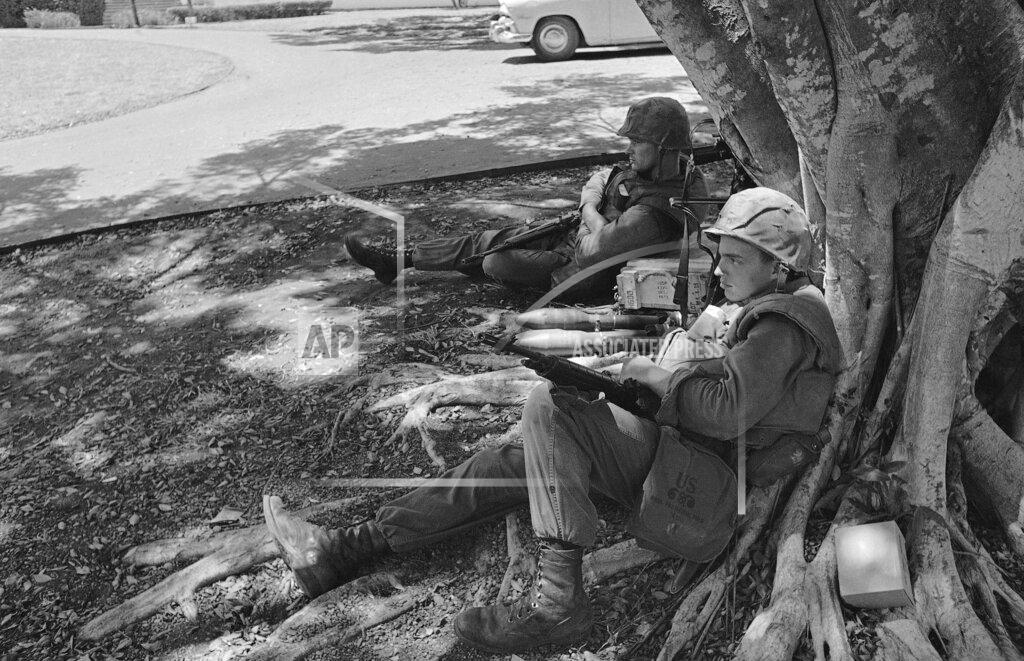
The JCS present a detailed program for deploying 48,000 U.S. and 5,250 third-country troops in Vietnam — an increase over the numbers agreed to in Honolulu.
Skyraiders from two U.S. Navy carriers bombed North Vietnam arms depots 75 and 100 miles from Hanoi. A three-stage Communist plan to infiltrate and overrun the U.S. Đà Nẵng Air Base was discovered. In an air strike against North Vietnam today United States Navy planes bombed a supply depot only 75 miles south of Hanoi. The strike was against the Thiên Linh Đồng army depot. Participating in the strike were a total of 25 A-1H Skyraiders, propeller-driven bombers, and A-4 jet Skyhawks. They were supported by 14 Navy jets from the carrier USS Midway. Pilots reported that 10 buildings were destroyed, four buildings badly damaged and four freight cars hit. Nineteen tons of bombs were dropped.
In the south, South Vietnamese and American forces told of finding a major Việt Cộng arms cache, of setting fires in the U Minh forest, one of the five principle Việt Cộng strongholds in South Vietnam, and of uncovering a Việt Cộng plot to attack the Đà Nẵng Air Base. The arms, including several hundred weapons and a ton of TNT, were found in a swamp in Kiến Hòa Province, 50 miles southwest of Saigon. The fires in the U Minh forest were described by Captain Carrol Keeter, a 37-year-old Air Force pilot of Franklin, Virginia. He said he had set the first fire from his forward air control craft early last month. When the fire continued to smolder and destroy cover throughout the forest more fires were set and napalm dropped to connect them.
The Vietnamese military spokesman who announced the uncovering of a plot said security officials had arrested 10 students from Đà Nẵng High School Wednesday for having circulated anti-American leaflets. Under interrogation, the students, whose ages ranged from 16 to 19, said they had been recruited for an attempt to break into the air base. An attack by main force Việt Cộng troops was to follow.
The Armed Forces Council, which has been the unifying force in Vietnamese politics during the many upheavals of the last six months, may disband itself next week. The decision by members whether to disband will affect the future role of the Government of Premier Phan Huy Quát and could unsettle the delicate balances within the Vietnamese military and Cabinet. American officials have frequently mentioned their gratification at the semblance of stability in Saigon. In recent weeks there have been hard-fought struggles for power below the calm surface of Vietnamese politics. Vietnamese and Western observers do not believe the present situation yet approaches a crisis.
American mission officials have in fact pressed for changes within the Quát Government. But concern is widespread that any change in the power balance, while of limited apparent significance, could trigger a relapse into the chaos of last August and January. The Armed Forces Council was formed in September, 1964, by General Nguyễn Khánh during a period of acute instability. It watched over government actions and reserved the right to intervene when necessary. Recently interest in the meetings and attendance are said to have lagged. After the strong-minded civilian Premier, Trần Văn Hương, was overthrown early this year, General Khánh saw to it that the next government was more acceptable to the Vietnamese military.
Criticism of the Armed Forces Council has come lately from its most active and influential members, including Air Vice Marshal Nguyễn Cao Kỳ. When General Khánh was voted out of his position as head of the Council, a quiet but intense struggle began between the lesser commanders to replace him in influence if not in title.
Most successful in the struggle has been Brigadier General Nguyễn Chánh Thi, the commander of the I Corps, who has managed to place several of his close associates in vital positions. Both General Thi and Marshal Kỳ were appointed to a standing committee that was to run the Council in the absence, of a single chairman. But Marshal Kỳ has found interest in the meetings and attendance at them dropping. He and General Thi have made most of the decisions of the last two months, including the appointment of officers whom the Roman Catholic community has opposed as too closely allied with the Buddhists.
Marshal Kỳ is reported to be far less concerned about the political attitudes and cooperation of the Buddhist leaders than is General Thi. The marshal has been particularly unsettled by the constant rumors that a coup d’état by Catholic officers would unseat him. When Marshal Kỳ proposed the disbanding of the council, the idea was first greeted with enthusiasm from many ranking officials. Major General Trần Văn Minh, who succeeded General Khánh as commander in chief, won the job partly because of his lack of interest in political manipulation.
Members of the Quát Government have also indicated that they would like to see the Council’s functions absorbed under an expanded Defense Ministry. At present the ministry is headed by Major General Nguyễn Văn Thiệu, who also serves as one of three Deputy Premiers.
Most Australians today swung behind the Government’s decision to send a battalion of troops to fight the Vietcong although there were strong dissenting voices.
Presidem Tito of Yugoslavia and President Gamal Abdel Nasser of the United Arab Republic urged today an immediate end to American air raids against North Vietnam and renewed a call for negotiations “between the parties concerned” to end the conflict in Vietnam.
One United States Marine was killed and at least 12 were wounded in engagements today with Dominican rebel irregulars. This was reported by official American sources. At 2:16 AM, the 3rd Brigade of the 82nd Airborne Division landed at the San Isidro Air Base and started the U.S. military intervention in the conflict. During the next couple of hours, two brigade combat teams and heavy equipment were also dispatched. At sunrise the 1st Battalion, 508th Infantry Regiment moved up the San Isidoro highway under the cover of F-4 Phantom jets flying from Puerto Rico, securing a position east of the Duarte bridge. More units of the 82nd Airborne landed and secured the entire east bank of the Ozama River. Rebel positions across the river were destroyed by 105 mm howitzers. U.S. soldiers crossed the bridge and occupied a six-block area on the western side of the Duarte Bridge, but suffered casualties from sniper fire. The 1st Battalion 505th Infantry Regiment remained at the airbase and sent out patrols to the perimeter. A force of 1,700 Marines of the 6th Marine Expeditionary Unit occupied an area containing a number of foreign embassies. The locale was proclaimed an International Security Zone by the Organization of American States (OAS). Earlier in the day, the OAS also issued a resolution calling the combatants to end all hostilities. At 4:30 p.m., representatives of the loyalists, the rebels, and the U.S. military signed a ceasefire that was to take effect at 11:45 p.m. That timing favored the demoralized Loyalists, who had lost control of Ciudad Colonial.
Clifford R. Benware, Jr. of Malone, New York, a 19-year-old private first class in the United States Marines, became the first U.S. serviceman to die in combat during the invasion of the Dominican Republic, after moving out from the Ambassador Hotel in Santo Domingo into the surrounding streets. By coincidence, the tiny New York village of less than 12,000 turned out to be the home of the sister-in-law of Francisco Caamaño, the rebel leader, and the home of one of the American families waiting to be evacuated by the U.S. Marines.
The Organization of American States voted this morning to call a special meeting of the foreign ministers of the Americas for tomorrow to consider “the serious situation” in the Dominican Republic. The action was taken as the United States sent 1,000 more Marines and 2,500 airborne troops into the Dominican Republic. There are now 1,700 Marines in the battle-torn country.
The O.A.S. resolution, sponsored by Chile, called for a meeting of consultation of the foreign ministers to consider the “serious situation created by the armed strife in the Dominican Republic.” The resolution was approved by an 18-to-1 vote, with Uruguay opposed and the Dominican Republic abstaining.
Immediately after the vote, Ellsworth Bunker, United States Ambassador to the O.A.S., announced that the United States was reinforcing its marine detachment in the Dominican Republic for the purpose of “adequately protecting American citizens and citizens of other countries.” Mr. Bunker said the United States was prepared to transfer its responsibility to the O.A.S. at the earliest possible moment. But meanwhile, he said, the United States reserves the right to protect its citizens “in a situation of anarchy.”
Mr. Bunker went on to propose that the council call on all sides to reach a cease-fire and to establish a neutral zone for refugees around the embassies in Santo Domingo. His proposal was approved. Mr. Bunker’s suggestion was in line with the strategy now being adopted by the Johnson Administration to deal with the confused and deteriorating situation in the Dominican Republic. Through a combination of hemispheric diplomacy and a military show of force, the Administration was hoping to bring about a cease-fire and prevent a Communist takeover in the Caribbean country.
Protesting U.S. Marine landings in the Dominican Republic, 200 youths threw stones at the U.S. consulate in Santiago, Chile, and Panamanians picketed the embassy.
President Johnson announced tonight that a cease-fire plan put forward by the Papal Nuncio had been agreed upon in principle in the Dominican Republic, but that fighting was still going on.
Cuba called on Secretary General Thant today to take action through United Nations bodies against “the monstrous fact of the invasion of the Dominican Republic and the military occupation of that country that is being prepared.”
The government announced plans today to renationalize the bulk of the British steel industry and to pay stockholders nearly 30 percent more than their shares were worth at yesterday’s closing prices. The terms, announced after the market closed today, brought a frantic rush for steel shares in after-hours dealings. Observers said that in setting the terms the government had moved astutely to try to soften opposition to nationalization in the financial district.
Despite the terms, steel men were bitter. Nationalization is monopolistic, they charged. Conservatives said the government was trying to pull the wool over peoples’ eyes. The Liberals lashed out also, attacking what they described as “nothing less than a full-blooded, old fashioned take-over bid.” Prime Minister Harold Wilson, with a four-seat majority in the House of Commons, faces one of his toughest tasks in getting a nationalization bill through the House.
A 23-page white paper said that assets of 14 steel companies, representing 90 percent of British steel production. would be vested in a National Steel Corporation. One of the companies, Richard Thomas & Baldwins, Ltd., remains under government ownership. The last Labor Government nationalized the industry in February, 1951. The slow denationalization process started soon after the Conservatives returned to power later that year. Annual productive capacity of the nationalized steel organization would be nearly 30 million tons. Though large in British terms, this capacity is less than 75 percent of the capacity of the United States Steel Corporation, America’s biggest producer. Britain is the world’s fifth-biggest steel-making nation.
In its white paper the Government emphasized economic rather than doctrinaire grounds as the basis for nationalization. Despite these arguments, however, steel nationalization has always been considered within the Labour party as the touchstone of determination to adhere to Socialist dogma. Even with his small majority and the possibility of defections within his party, Prime Minister Wilson has refused to retreat on the principle of nationalization.
Morrice James, British High Commissioner in Pakistan, flew here today for consultations with John Freeman, British High Commissioner in India, on the conflict between the two countries in Cutch. The talks were aimed at coordinating efforts to halt the fighting in the wasteland called the Rann. Sir Morrice will return to Karachi tomorrow, and it is widely believed that he will be carrying new proposals aimed at ending the shooting. Despite the optimism of United States and British officials here that a cease-fire will not be long delayed, Indian sources were less hopeful. It was their view that Pakistan would not give up ground she had taken and that Prime Minister Lal Bahadur Shastri of India did not have the political strength to agree to a cease-fire with Pakistani forces that were holding ground that his Government had publicly claimed as Indian soil.
Greece warned today that a new flare-up was likely in Cyprus if construction of a strategic road by Turkish Cypriots was not halted near Kyrenia. The Greek Foreign Minister, Stavros Costopoulos, told the Athens envoys of the United States, Britain and the United Nations that he feared incidents if the Turkish Cypriots were not stopped from building the military road between the hills of Kyrenia and the Turkish-held village of Temblos, three miles west of the town of Kyrenia. Military experts said the road would allow the dispatch of heavy armament to Temblos, which would threaten Greek Cypriot coastal defenses in the event of a Turkish invasion. Mr. Costopoulos told the envoys that although the first attempt by the United Nations peace force to stop construction was effective, blasting of the hillsides to open the way for the road was resumed last weekend. He said the blasting threatened a major clash between Turkish Cypriots and Greek Cypriots in the foothills below the medieval castle of St. Hilarion which is held by the Turks.
Pope Paul VI appealed today for the prayers of the faithful and for conciliatory action by world leaders at a moment when “grave new threats are endangering the supreme benefit of world peace.” The Pontiff warned that world. disturbances presumably in Vietnam, between India and Pakistan and in the Dominican Republic “could at any moment produce the spark for a terrible fresh conflict.” Increasingly embittered disputes, he said, may “degenerate into a bloody war.” He implored world leaders to persist in seeking negotiations “at all levels” to avert or halt recourse to arms.
The U.S. State Department warned today that “appropriate” defensive measures would be taken to protect United States planes flying over international waters. The warning was issued with reference to the North Korean MiG attack upon an American RB-47 reconnaissance plane reported Wednesday.
Lord Caradon, who resigned from the British delegation to the United Nations in protest against the former Conservative Government’s policy on Rhodesia rose today in the Security Council to defend the Labor Government’s modification of the policy.
Andrei A. Gromyko said today that his week’s discussions with French officials marked a “turning point” in French-Soviet relations.
The Zadar District Court in Yugoslavia today pronounced Mihajlo Mihajlov guilty of having offended the Soviet Union in his article “Moscow Summer, 1964.” He was sentenced to nine months in prison.
President Habib Bourguiba of Tunisia has asked President Gamal Abdel Nasser of the United Arab Republic to meet with him in an attempt to settle their bitter dispute over Arab policy toward Israel.
Jacques Nevard, Pakistan correspondent of The New York Times, was acquitted today on a contempt-of-court charge brought by Capt. Gohar Ayub Khan, son of President Mohammad Ayub Khan.
Prime Minister Lester Pearson of Canada affirmed today his nation’s basic support of United States foreign policy. But he warned that Canadians would worry about and sometimes disagree with the implementation of this policy.
Lady Churchill, Sir Winston’s widow, is to become a life peeress.
Senate leaders introduced their substitute voting rights bill amid indications it will have broad bipartisan support. But Senate liberals of both parties reserved judgment today on a substitute voting rights bill that had been framed to attract their support.
President Johnson announced tonight his hurried signing of a $2.2 billion supplemental appropriations bill to prevent delays in the payment of welfare checks to hundreds of thousands of persons.
Senator Russell B. Long of Louisiana, who opposed last year’s program of medical care for the aged, now seems to be moving toward the Administration camp on the issue.
Secretary of Commerce John T. Connor endorsed legislation today for Government regulation of the packaging and labeling of food and other household products, but industry witnesses said that it would increase prices.
The House Armed Services Committee asserted its Congressional authority today in its dispute with the Pentagon, then restored most of the $654 million it cut last month from defense budget requests.
I. W. Abel was declared winner of the contentious United Steelworkers of America election that had concluded on February 9. The final count showed 308,910 votes for Abel, and 298,768 for incumbent David J. McDonald, whose term would expire on June 1. The international tellers of the United Steelworkers of America declared today that I.W. Abel had been elected the union’s next president by a narrow margin. David J. McDonald, the incumbent, announced that he would go before the union’s executive board to contest the tellers’ report.
Robert C. Ruark published his last newspaper column, after having penned almost 4,000 separate installments over 20 years, distributed by the United Feature Syndicate to American newspapers. Ruark, whose column was usually referred to only by his name, was dying of cirrhosis of the liver, and would pass away on July 1, two months after his farewell column. “Quite frankly,” he wrote, “after 30 years in the newspaper business, I suddenly realize that I am nearly 50 and am weary of deadlines… My feet hurt. My fingers hurt. My brain is still sharp, I trust. But I am less and less willing to punish it on a daily schedule… Until the next dispatch floats back in a bottle, my deepest thanks to you all for being so kind and tolerant of a typewriter which seems determined not to write this last, sad piece.”
The FBI discontinued the wiretapping of Martin Luther King Jr.’s home telephone after almost a year and a half of eavesdropping on his conversations. Listening devices had been installed on November 8, 1963, and remained until he moved to a new home in Atlanta.
The worst epidemic of German measles in 20 years has hit the West Coast, the Public Health Service in Washington reported.
Preliminary calculations by some weather specialists have convinced them that the introduction of commercial supersonic air travel may bring about substantial climate changes.
Admiral Thomas Hinman Moorer relieved Admiral Harold Page Smith today as Supreme Allied Commander, Atlantic, of the North Atlantic Treaty Organization; United States unified Commander in Chief, Atlantic, and Commander in Chief of the Atlantic Fleet.
Major League Baseball:
The Mets Ron Swoboda loses a grand slam at Crosley Field in the 1st inning when his long drive to center field hits the temporary plywood wall atop the concrete fence and bounces back to Vada Pinson. The concrete is in play while the plywood is a homer. Second base umpire Frank Secory rules that the ball in in play, slicing the salami to a single. Coach Yogi Berra is ejected for arguing the call and after the game utters a classic line: “Anyone who can’t hear the difference between wood and concrete must be blind.” Pete Rose has five hits, including a homer in the 6th off Warren Spahn to knock him out of the box, as the Reds win, 6–1.
Jim (Mudcat) Grant hurled a three-hitter tonight as the Minnesota Twins stopped the Chicago White Sox five-game winning streak with a 7–0 victory.
Joe Gaines’s two-run pinch homer and Al Spangler’s sacrifice fly following Joe Morgan’s second triple of the game in the eighth inning gave the Houston Astros a 4–3 victory tonight over the Chicago Cubs.
Vernon Law had a one-hitter with two out in the seventh inning tonight until errors by Dick Schofield and Gene Alley and hits by Bill White and Phil Gagliano gave the St. Louis Cardinals a 3–2 victory over the Pittsburgh Pirates.
The Los Angeles Angels scored three runs in the fourth inning tonight and defeated the Kansas City Athletics, 4–0, behind the seven-hit pitching of Marcelino Lopez and Bob Lee.
Minnesota Twins 7, Chicago White Sox 0
New York Mets 1, Cincinnati Reds 6
Washington Senators 2, Cleveland Indians 5
Boston Red Sox 1, Detroit Tigers 4
Chicago Cubs 3, Houston Astros 4
California Angels 4, Kansas City Athletics 0
San Francisco Giants 3, Los Angeles Dodgers 6
Philadelphia Phillies 1, Milwaukee Braves 7
Baltimore Orioles 10, New York Yankees 4
Pittsburgh Pirates 2, St. Louis Cardinals 3
The stock market averages hit new highs, but the emphasis was on Blue Chips. Losers predominated on the total New York exchange list.
Dow Jones Industrial Average: 922.31 (+3.6)
Born:
Adrian Pasdar, Iranian-American actor (“Top Gun”; “Judging Amy”) and film director; in Pittsfield, Massachusetts.
Jamie Fitzgerald, NFL defensive back (Minnesota Vikings), in Spokane, Washington.
Died:
Helen Chandler, 59, American actress (“Dracula”, “Salute”, “Last Flight”).
 History Diaries