This is the end
Beautiful friend
This is the end
My only friend, the end
It hurts to set you free
But you’ll never follow me
The end of laughter and soft lies
The end of nights we tried to die
This is the end
— The Doors, 1967
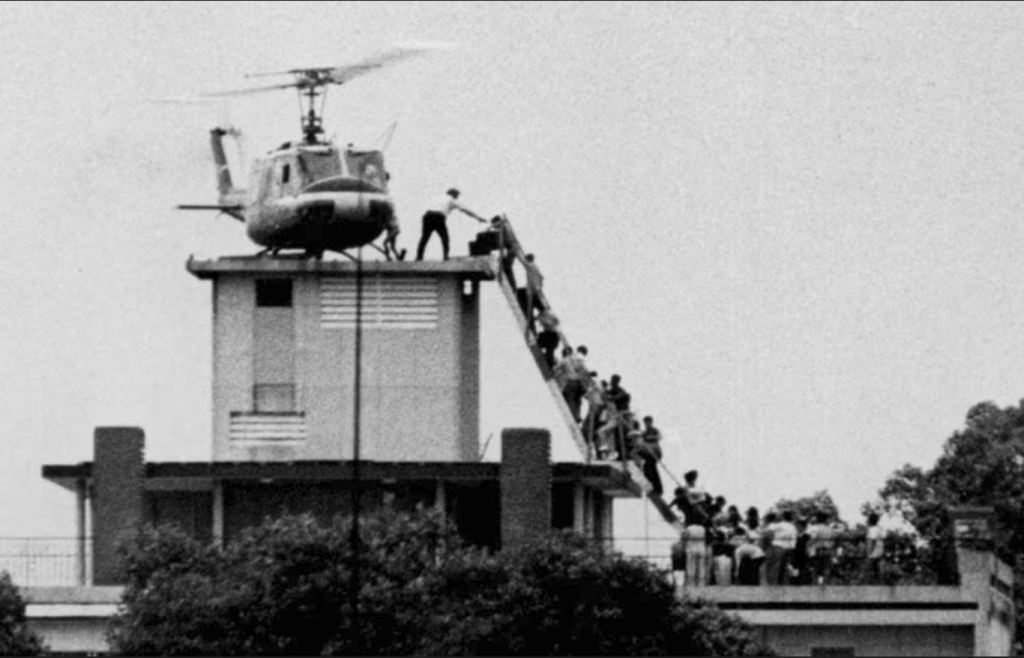

This is rock bottom. The uttermost pit of despair. America has utterly failed. The Soviets are confident, riding high. Now comes a half-decade of the Hollow Force in the military, as budgets are cut to the bone. The economic dislocation of the Carter Inflation, and the second oil shock. More ignomy in Iran and Nicaragua.
One could have given into despair and believed it was hopeless; that the American century was over. The future would be the Hammer and Sickle, and that boot stomping on every human face.
It would have been a bold person ideed who correctly guessed that in 15 years, the Berlin Wall would be gone, America’s economy would be strong again, and that the Cold War would end — not in nuclear fire, or surrender, but in Western Triumph.
Call these years, The Darkness Before the Dawn.
North Vietnamese troops capture Saigon, ending the Vietnam War.
The Fall of Saigon took place, effectively ending the Vietnam War as a victory for the Communists, at 10:24 am local time (0324 UTC) when South Vietnamese President Dương Văn Minh announced the surrender of the nation to North Vietnamese invaders. “I believe firmly in reconciliation among Vietnamese to avoid unnecessary shedding of the blood of Vietnamese”, said Minh. “For this reason, I ask the soldiers of the Republic of Vietnam to cease hostilities in calm and to stay where they are.” Shortly after Minh called for ceasefire, North Vietnamese tanks knocked down the Independence Palace gate. The Việt Cộng flag was raised over the presidential palace at 12:15 p.m. Minh was taken to a radio station to announce the government’s unconditional surrender. Throughout the day in Saigon, ARVN soldiers discarded their military uniforms.
PAVN soldiers and VC soldiers occupied all of Saigon, without resistance, by 11:00 in the morning. Earlier in the day, U.S. Ambassador Graham Martin was the last American diplomat to leave Saigon, lifting off of the U.S. Embassy roof at 4:58 am, and at 7:53 am USMC Colonel James Kean and ten U.S. Marines left on an American helicopter, ending the U.S. presence in Vietnam. Saigon was renamed “Hồ Chí Minh City.” Huỳnh Tấn Phát of North Vietnam would administer the “Provisional Revolutionary Government of the Republic of South Vietnam” as president until July 2, 1976, when the area would be formally incorporated by the North as part of the Democratic Republic of Vietnam.
Communist troops of North Vietnam and the Provisional Revolutionary Government of South Vietnam poured into Saigon as a century of Western influence came to an end. Scores of North Vietnamese tanks, armored vehicles and Chinese-built trucks rolled to the presidential palace. General Dương Văn Minh, who as president of the former non-Communist government of South Vietnam had broadcast his administration’s surrender, was taken later to a microphone by North Vietnamese soldiers for another appeal to all Saigon troops to lay down their arms. The station then gave victory broadcasts and went silent. Normal telephone and telegraph communications ceased and The Associated Press said its wire link to the capital was lost at 7 P.M. Wednesday, Saigon time (7 A.M. Wednesday, New York time).
Hundreds of Saigon residents cheered and applauded as North Vietnamese military vehicles moved to the palace grounds from which the war against the Communists had been directed by President Nguyễn Văn Thiệu, who resigned April 21, and by President Ngô Đình Diệm, who was killed in a coup in 1963. Broadcasting today in the early hours of the Communist take‐over, the Provisional Revolutionary Government’s representatives said: “We representatives of the liberation forces of Saigon formally proclaim that Saigon has been totally liberated. We accept the unconditional surrender of General Dương Văn Minh, President of the former government.”
Meanwhile, many former soldiers sought to lose themselves in the populace. However, one police colonel walked up to an army memorial statue, saluted and shot himself. He died later in a hospital. Shots rang out at one point around the City Hall. A North Vietnamese infantry platoon, dressed in olive‐drab uniforms and black rubber sandals, took up defense positions in the square in front of the building. They exchanged shots with few holdouts. Some people on motorbikes looked apprehensively to see where the firing was coming from. In a short while it subsided.
Helicopters removed the 5,500 South Vietnamese citizens because their lives were presumed to be in danger with a Communist take‐over of South Vietnam. Over the last two weeks, a total of about 55,000 South Vietnamese have been removed. Most of them will come to the United States. The helicopter flights ended the United States evacuation of South Vietnamese. The United States ended two decades of military involvement in the Vietnam war as helicopters evacuated 1,000 remaining Americans and 5,500 South Vietnamese from Saigon. The final evacuation — some two hours after the White House had announced its completion — was the removal of 11 Marines from the embassy roof. Officials said these security guards got out safely although small-arms fire had broken out around the deserted building.
The assumption in the original Pentagon planning was that a limited number of South Vietnamese might be evacuated but that the emphasis would be upon removing some 1,000 remaining Americans. This assumption was in line with the Administration’s position that the President, as Commander, in Chief, had the authority to use armed forces to remove Americans but needed authority, not yet given by Congress, to permit the armed forces to evacuate South Vietnamese.
In the end, however, even in the absence of specific Congressional authority, the Administration decided to evacuate several thousand South Vietnamese who had gathered at the Defense Attaché’s Office and at the embassy. At a televised briefing that followed conclusion of the operation, Secretary of State Kissinger said he did not believe that there had been “an undue delay” in the evacuation because of the decision by Ambassador Graham A. Martin that large numbers of South Vietnamese should he removed before all Americans were finally evacuated.
Mr. Kissinger said that Mr. Martin, who more than any other official dictated the pace and timing of the evacuation, felt “a strong moral obligation” to South Vietnamese who had worked with the United States, which, the Secretary said, “is not the worst fault in a man.” Furthermore, he said, Ambassador Martin was “in a very difficult position” of having to make judgments over the last week on how quickly the American contingent could be reduced without “triggering panic” that would have complicated the removal, of Americans.
The first flight of helicopters, which had left the carrier Hancock at 12:45 AM, had been scheduled to land at Tan Son Nhut at 2 AM. But just as the helicopters were about to land, a command came across the radio telling them to delay their landing until 3 AM. The lead helicopter, carrying Brig. Gen. Richard Carey of the Marine Corps, proceeded to land, coming under some gunfire. But the other helicopters circled for nearly an hour as Adm. Noel A. M. Gayler, Commander in Chief Pacific, and other high‐ranking officers broke in, demanding to know who had issued the order. As of tonight, the Pentagon still had not determined who gave the spurious order. With all the people evacuated from Tan Son Nhut under the protection of some 800 marines who had been flown in, the evacuation effort shifted to the embassy. There the operation was limited to two landing places, the embassy roof and a parking lot. Only two helicopters could come in at time. Toward the end of the operation, an 80‐minute break was called, apparently, as explained by Pentagon officials, because of “pilot fatigue.” in addition, night had fallen, complicating the helicopter operations. As dawn approached, the final flight of 19 helicopters went in to rescue 125 Americans and 475 South Vietnamese still at the embassy.
According to a Giải Phóng Press Agency radio broadcast, several Mekong provinces, including Cần Thơ, the capital of IV Corps, had not surrendered in accordance with Minh’s unconditional surrender. It was reported that Việt Cộng soldiers started the final drive to take over the weakened Mekong provincial capitals. The next day, all of the ARVN regiments and divisions in the Mekong Delta either dissolved or surrendered to outnumbered Việt Cộng soldiers.
By dawn on 30 April Communist forces are moving into Saigon, where they meet only sporadic resistance; that morning President Dương Văn Minh announces unconditional surrender to the Communists. Colonel Bùi Tín, who accepts the surrender from General Minh, explains, ‘You have nothing to fear. Between Vietnamese there are no victors and no vanquished. Only the Americans have been beaten. If you are patriots, consider this a moment of joy. The war for our country is over.’
[Ed: After the war, Bùi Tín became disillusioned by corruption and the continuing isolation of the newly unified Vietnam. He decided to leave Vietnam and live in exile in Paris to express his growing dissatisfaction with the Communist Party of Vietnam and their political system. He died in Paris in 2018.]
Nguyễn Tiến Hưng, Saigon’s former Minister of Planning, made public in Washington the texts of letters to his government in 1972-73 from President Nixon promising “swift and severe retaliatory action” in which the United States would “respond with full force” if North Vietnam violated the Paris cease-fire accords. President Ford formally refused to give Congress the texts, on the grounds of diplomatic confidentiality.
South Vietnam’s Provisional Revolutionary Government issued a statement in Paris hailing its “victory of historic significance” and the failure of American “aggression.” A spokesman said the Communists controlled Saigon, where the situation was “stabilized and becoming normal.” The Communists said their victory had been “supported and stanchly helped by their brothers in the North” and that the new government’s goals included “progress toward peaceful reunification of Vietnam.”
Prime Minister Indira Gandhi of India extended greetings today to the Provisional Revolutionary Government of Vietnam in what was said to be an invitation to join the movement of nonaligned countries.
United States Navy ships were picking up thousands of refugees fleeing South Vietnam in small boats. Secretary of State Kissinger raised the total number the United States may have to resettle to 70,000, and said that Congress would soon be asked for funds. Assistant Secretary Philip Habib said $500 million might be required over the next year.
American soldiers in the U.S. woke up this morning saddened, relieved, glad, embittered and frustrated over the news that the Vietnam war was over and that the side on which they had fought had lost. A few said that when they heard of Saigon’s surrender late last night, they wept.
Officials on the Thai side of the Cambodian border said the first of over 600 foreigners that the Cambodian Communists are releasing from Phnom Penh could cross the border early today. French Embassy officials in Bangkok said that they had no firm word about the number or identity of the first group. There were reports of repeated delays of the truck convoy.
Six U.S. destroyers began preparations to leave Greek waters under the agreement between Greece and the United States to end the 6th Fleet’s use of Eleusis as a home port. Washington and Athens have announced that the ships of the fleet would no longer be based at the port and the U.S. air base at Athens airport would be closed. Other American bases will remain but will be placed under Greek commanders.
Greek and Turkish Cypriot leaders have agreed to return to Vienna in June for a second round of negotiations with U.N. Secretary General Kurt Waldheim on the future of divided Cyprus, authoritative sources said. The decision, after three days of preliminary talks, was seen by diplomats as a significant commitment to keep talking despite action by Turkish Cypriots in setting up their own autonomous state.
A new guerrilla faction in Northern Ireland claimed responsibility for killing seven Catholics in the past two weeks. Existence of the previously unheard-of group, which calls itself the Protestant Action Force, was announced in a call to a Belfast newspaper. Meanwhile gunmen of the Irish Republican Army’s Official wing combed Belfast ghettos for the killer of their commander. Sources close to the IRA Official wing said that breakaway Republican Socialists were chief suspects.
Sixty leading Soviet dissidents in Moscow, including well-known writers and scientists who rarely sign public statements, called for worldwide protests against the arrest April 18 of Amnesty International official Andrei Tverdokhlebov. “The very fact of the repression of dissidents is monstrous, reminiscent of the time of the inquisition,” they said in the statement handed to Western newsmen.
Bulgaria appears eager to improve her relations with the United States despite a barrier created for the country by the Soviet Union’s rejection of a commitment to freer emigration in return for more favorable trading conditions.
Although they are surrounded by reminders of 300 years of hatred and war between France and Germany, the 1.1 million Germans of the Saar have dropped all traces of enmity toward the French.
Finnish authorities deported American student Lee Gunnar Haglund, the day after he went on trial charged with “activities that may be harmful to Finland’s foreign relations.” “The Interior Ministry has decided to deport him because he has -been involved in such activities that his presence in Finland is not desirable,” a ministry spokesman said. Informed sources said Haglund, 24, of Portland, Oregon, was secretly sent out of the country on a Finnair flight.
King Hussein of Jordan said here today that there was no substance to a report published last week saying his country and Syria had agreed to establish joint milltary commands for their land and air forces. A dispatch from Paris, appearing last Friday in The New York Times, quoted official in formation reaching the French capital from the Middle East as saying such an agreement had been reached under Soviet sponsorship. King Hussein, who met with Secretary of State Kissinger for two hours today, made his denial when speaking to reporters afterward. “These reports, in point of fact, have no substance,” the King declared.
Iraq extended by 20 days an amnesty granted Kurdish rebels March 13. Originally due to have expired March 31, it was first extended until midnight Wednesday. It covers all Kurdish soldiers or civilians who defected to rebel lines or left their government posts before the amnesty first was offered. There are 250,000 Kurdish refugees in Iran and most were expected to re-enter Iraq before the new deadline.
The worst outbreak of malaria in nearly 20 years is surging through broad sections of India, according to government officials and the office here of the World Health Organization. The number of fatalities is, however, relatively small.
Canada warned it will be forced to take unilateral action to protect its fishing resources unless there is early agreement at the U.N. conference on the law of the sea. Romeo LaBlanc, Canadian minister of state for fisheries, said in a Geneva news conference that Canada is deeply committed to a multilateral and equitable agreement. “But our ability to wait is limited by harsh realities,” LeBlanc said. The U.N. sea law conference, which held a preliminary session in Caracas last year, has been meeting in Geneva for nearly seven weeks without results.
Conflicts between Britain and the developing countries of the Commonwealth on ways of achieving a “new world economic order” appeared as the 20th postwar Commonwealth summit opened in Kingston, Jamaica. Canada and Australia reportedly were opposed to British Prime Minister Harold Wilson’s “master plan” for narrowing the gap between the have and have-not countries.
Angolan authorities imposed an overnight curfew on Luanda, the capital, after fierce fighting between rival liberation movements. The National Defense Council-made up of the Portuguese military authorities and the three liberation movements also forbade an unidentified Yugoslav ship to unload a cargo of arms and ordered it to be escorted out of Angolan territorial waters.
The political infighting in this East African country has intensified as Parliament has acted strongly to show its independence of the Government of President Jomo Kenyatta.
The White House again prodded Congress to enact comprehensive energy legislation by announcing that President Ford, while again deferring an increase in the fee on imported crude oil, was moving to phase out all crude oil price controls in two years. The move to phase out the remaining controls on crude oil prices was expected to provoke new frictions between the Republican President and some Democrats in Congress. However, the White House left open the possibility that Mr. Ford might sign legislation that would extend the decontrol period to three and a half or four years, if Congress wrote such a provision into an energy bill otherwise acceptable to the President. The Administration plan, as outlined at a White House news briefing by Frank G. Zarb, Federal Energy Administrator, is to reduce the volume of price‐controlled crude oil by about 4 percent a month for two years. Presumably, the present average ceiling price on oil still under controls would remain unchanged at $5.25 a barrel. Mr. Zarb said that this plan might go into effect as early as June 1. It could cause the price of a gallon of gasoline to rise by 1.25 cents every six months, or five cents in two years, Mr. Zarb said.
A centrist coalition in the Senate decisively defeated today attempts by both liberals and conservatives to amend the budget guidelines that have been set by the Senate Budget Committee. Those guidelines provide for Federal spending in the next fiscal year, beginning July 1, of $365‐billion and a deficit of $67‐billion to $69‐billion. Among the proposals that were defeated, as the Senate moyed toward final action tomorrow on the budget bill, were an amendment by Senator Robert Dole, Republican of Kansas. This amendment would have set a spending ceiling of $361.8‐billion, a figure that was based on adoption, unchanged, of all the spending programs in the Ford Administration’s budget but which used what its advocates said were more realistic estimates of the costs and revenues that would result from these programs. The Dole amendment would have put the deficit at $64.8‐billion.
The five-month slide in the prices of farm commodities ended with a 4 percent rise in the month ended April 15. An Agriculture Department economist noted that the increase was focused largely in areas where it would be most quickly reflected at the retail counter. He said that the department had expected a second-quarter increase in livestock prices and that it still expected retail prices to rise less sharply this quarter than in the first quarter.
The eight-member Senate Rules Committee deadlocked today on a key question in New Hampshire’s disputed United States Senate contest, the closest in its history, and the issue will be put before the full Senate.
Amtrak, the country’s semi-nationalized rail passenger system, is marking its fourth birthday somewhat unhappily as embarrassing mishaps and breakdowns have embroiled it with the Interstate Commerce Commission over the quality of its service. Disgruntled riders have been appearing at I.C.C. hearings, and Amtrak officials charge the commission with seeking to divert attention from its own critics.
The Federal Trade Commission turned down a request from six members of Congress for a specific crackdown on “image” advertising, especially ads devoted to energy and environmental issues. But it said it believed it had authority to tackle any deception in that field and was prepared to do so if such action did not violate the free speech provisions of the Constitution. Rep. Benjamin S. Rosenthal (D-New York) said he was disappointed the FTC did not adopt the rules his group had proposed. But he said he was “delighted that for the first time in its history the FTC has recognized that it has jurisdiction to act against false, misleading and deceptive image advertising and not just advertising for specific products.”
Food stamps have failed to improve the nutrition of the poor because the increased purchasing power is used to buy more expensive but less nutritious foods, a study concluded. The $4-billion-a-year program should be replaced or abolished, said Kenneth W. Clarkson, University of Virginia economist, after surveying Agriculture Department statistics. He said sweets, fatty foods and soft drinks were often bought instead of cheese, meat and eggs. In a few cases, food stamps actually left recipients with poorer diets, Clarkson claimed.
A Food and Drug Administration advisory panel recommended a federal ban on the sale of aerosol antiperspirants containing zirconium because they might cause serious and permanent lung damage. Zirconium sprays are only slightly more effective in preventing underarm wetness than other antiperspirants, the panel said, and not enough to justify the health risk. Laboratory testing would take several years to prove whether zirconium was dangerous and if it were, millions of persons would have breathed it during that time, the seven medical and scientific experts said. The FDA took the report under consideration.
All but two of the nation’s governors serving at the time that Stanley K. Hathaway left office as governor of Wyoming in 1974 have endorsed him to be the secretary of the interior, the Senate Interior Committee was told. The endorsement, delivered by Governor Calvin Rampton of Utah, a Democrat and chairman of the National Governors’ Conference, appeared to erase any doubts that Hathaway would be confirmed. The nomination is opposed by environmentalists who contend the former Republican governor sacrificed the environment in his concern with the industrial development of his state.
A Justice Department inquiry into the possible abuse of Attica inmates after the 1971 rebellion at the prison was thwarted because the presumed victims would not cooperate with Federal Bureau of Investigation agents, in the view of the official who directed the inquiry.
A Senate bill requiring the states to establish no-fault automobile insurance would raise premiums in 45 states by as much as 97%, Allstate Insurance Co. said. The estimate by Allstate, which opposes the federal no-fault plan, contrasted sharply with figures from State Farm, which favors the plan. State Farm, the nation’s largest insurer of car drivers, earlier told the Senate Commerce Committee the bill “should cause no overall increase in the cost of insurance for most policyholders. Many should get decreases.” The bill being considered by the committee is almost identical to one passed by the Senate last year, only to die in the House.
The Civil Aeronautics Board today granted United Air Lines permission to offer a Bicentennial discount fare of up to 25 per cent off under selected conditions on flights between Chicago and seven East Coast cities.
The second underground nuclear test in less than a week was detonated 1,975 feet beneath Yucca Flat, Nevada, 90 miles northwest of Las Vegas, but was not felt at the gambling spa or in nearby areas of Southern California. A spokesman for the Energy Research and Development Administration said there was no radiation leak or other problems from the test, which had a yield between 20,000 and 200,000 tons of TNT. Another low-yield nuclear test was conducted at the same site April 24. The most recent blast was the fifth announced this year and the 270th since the United States signed the limited test treaty 12 years ago.
Elvin Hayes and Phil Chenier combined for 54 points tonight as the Bullets slowed Boston’s fast break and whipped the Celtics, 117-92. It gave Washington a 2-0 lead in the National Basketball Association’s Eastern Conference final.
Major League Baseball:
Gaylord Perry moved into 14th place among career strike‐out leaders and Boog Powell drove in three runs, two with a homer, as the Indians trounced the Red Sox, 8–1. Perry, beating Boston for the 13th consecutive time, earned his fourth victory of the season in six decisions and his 202nd major league triumph.
Bobby Bonds hit a three-run ninth inning home run that spurred the New York Yankees’ comeback 6–4 victory over the Orioles at Shea Stadium. Sparky Lyle got the win in relief.
Successive doubles by Tommy Harper and Bruce Bochte drove home the tying and winning runs in the ninth inning, allowing the Angels to edge the Royals, 7–6. Mickey Rivers singled to center off Doug Bird (1–1) before Harper and Bochte delivered the decisive hits.
Robin Yount, 19‐year‐old shortstop, collected three hits, raising his batting average to a hefty .393, and Darrell Porter and George Scott supplied key hits as the Brewers beat the Detroit Tigers, 6–2, at Milwaukee last night.
Tony Perez cracked a two-run homer, Ken Griffey a two‐run triple and Joe Morgan three singles, which raised his batting mark to .405, to pace the Reds to a 4–1 win in San Francisco. The Giants’ Jim Barr (1–2) was the victim of the onslaught.
The Cubs beat the Mets today, 7–4, before a sparse assembly of 4,820 paying observers in 59-year-old Wrigley Field and thus ended the Mets’ winning streak at seven games. In reflection Yogi Berra, the Mets’ manager, said that after all he didn’t expect to win them all.
The Phillies beat the Expos, 2–1. Dave Cash rapped four hits, scored one run and drove in another, and Steve. Carlton held the Expos to six hits in earning his first victory of the season.
Lee Lacy collected three singles and drove in a pair of runs as the Dodgers unleashed a 10‐hit attack for their seventh consecutive triumph, downing the Braves, 5–2.
Cleveland Indians 8, Boston Red Sox 1
New York Mets 4, Chicago Cubs 7
California Angels 7, Kansas City Royals 6
Atlanta Braves 2, Los Angeles Dodgers 5
Detroit Tigers 2, Milwaukee Brewers 6
Baltimore Orioles 4, New York Yankees 6
Montreal Expos 1, Philadelphia Phillies 2
St. Louis Cardinals 0, Pittsburgh Pirates 5
Houston Astros 2, San Diego Padres 4
Cincinnati Reds 4, San Francisco Giants 1
Chicago White Sox 2, Texas Rangers 8
Dow Jones Industrial Average: 821.34 (+18.30, +2.28%)
Born:
Johnny Galecki, American television actor (“The Big Bang Theory”); in Bree, Belgium.
Mike Chat [Michael Chaturantabut], Thailand-born American martial arts champion and actor (Blue Ranger – “Power Rangers”), in Rayong Province, Thailand.
Elliott Sadler, American NASCAR driver also known infamously his near injury crash in 2003 EA Sports 500, in Emporia, Virginia.
Steve Webb, Canadian NHL right wing and centre (New York Islanders, Pittsburgh Penguins), in Peterborough, Ontario, Canada.
Ray Nealy, NFL running back (Miami Dolphins), in Little Rock, Arkansas.
DeMarcus Curry, NFL tackle (Tampa Bay Buccaneers), in Columbus, Georgia.
Died:
Gen Paul, 79, French painter and engraver.
Four ARVN generals committed suicide following the surrender of South Vietnam:
Le Van Hung, 42, ARVN IV Corps Deputy Commander 1974–75 in Cần Thơ
Tran Van Hai, 50, ARVN Brigadier General at Dong Tam Base Camp.
Le Nguyen Vy, 42, 5th Infantry Division commander.
Pham Van Phu, 46, II Corps commander.
 History Diaries