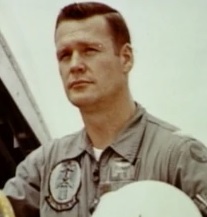
On April 29, 1965, CAPT Charles S. Shelton departed Udorn RTAFB in RF-101C Voodoo (tail number 56-0190) for a photo recon mission over Laos. Since his primary target was socked in he and his wingman went on to the secondary target near Sam Neua, which was the headquarters location of the Pathet Lao. CAPT Shelton’s Voodoo was hit by ground fire and he was forced to eject. He arrived safely on the ground and was in contact with search and rescue forces, but deteriorating weather precluded an immediate pickup attempt. By May 2nd the weather had improved to the point that SAR efforts could begin, but an unprecedented 148 sorties and the insertion of a Hmong ground team failed to locate Shelton. There is no hard information on what became of CAPT Shelton. The U.S. government did class Shelton as a prisoner of war, and he was promoted to lieutenant colonel while in that status. LTC Shelton was finally presumed dead on September 14, 1994 at the request of his family.
Charles has a military marker in his memory at Arlington National Cemetery. He is honored on the Wall at Panel 1E, line 111.
Shortly after 8:00 PM, Australia’s Prime Minister Robert Menzies informed the Parliament in Canberra that he was sending the 1st Battalion of the Royal Australian Regiment to fight in the Vietnam War, at the request of the Premier of South Vietnam. The day before, after the news of the Menzies government’s plans had been published to the press, Menzies cabled the Australian Embassy in Saigon to stress the urgent need for South Vietnam to actually send a request, and during Thursday, Ambassador H. D. Anderson and his staff had to speak to the Vietnamese Premier, Phan Huy Quát, to ask him to invite Australia to enter the war. The cablegram from Premier Quát was not received by Menzies until 5:36 PM, two and a half hours before Menzies was scheduled to speak to Parliament.
Units of the United States Coast Guard have been ordered to South Vietnam to join in coastal patrols to block infiltration of Communist guerrillas and arms. A Coast Guard spokesman said 17 high-speed cutters and 200 men would be sent to Vietnam for operations under the control of United States Navy forces. The craft that are going to Vietnam bear the designation WPB, for water patrol boat. They are 82 feet long and have a speed of 18 knots, equivalent to 20 miles an hour. Each is armed with a 20-mm gun. Each boat normally carries a crew of 10.
South Vietnamese Government forces discovered a well-fortified network of Communist trenches eight miles south of the Đà Nẵng Air Base. They bombed the area and then overran it, killing five guerrillas out of a force estimated at 500. As this evidence of a Communist build-up in Central Vietnam was uncovered, North Vietnam was broadcasting May Day messages of unusual militancy. Guided to the site of the fortifications by intelligence reports, South Vietnamese Government troops swarmed over the trenches, killing five guerrillas. A Việt Cộng battalion, 500 strong, had apparently been hidden in canefields and surrounding villages, American military sources said.
Before the ground forces entered the heavily defended positions, United States Marine Corps Phantom jets bombed and machine-gunned the area, causing the guerrillas to flee. Although armored personnel carriers were sent into the fields to pursue the Communist soldiers, by nightfall it appeared that most of the insurgents had escaped.
After government troops secured the area, bulldozers filled in the trenches. The government found a number of documents at the outpost. In Saigon, American military intelligence officers expressed hope that the captured papers might give further clues to the nature of a Communist offensive expected next month. In broadcasts monitored here, the Hanoi radio began transmitting slogans and propaganda for May Day. Analysts of Communist affairs noted a belligerent tone in the pronouncements of the Lao Động, the North Vietnamese Communist party. They also remarked on the radio’s call for support of the revolutionary troops in Laos.
Air strikes against North Vietnamese bridges and ferries continued, meanwhile, with the Vietnamese Air Force hitting the Ron Ferry on the Vàm Cỏ River, 865 miles south of Hanoi. Pilots said the raid, with 4,000 pounds of bombs and rockets, had been “highly successful” and had destroyed the northern ramp of the ferry approaches and military barracks nearby. Two United States Navy Skyhawk jet fighter-bombers and two Crusader jets from the Seventh Fleet struck two small bridges, one newly constructed near the coastal town of Phở Vĩnh. The other, the bridge at Phuongcan, had been partly sunk earlier. Low clouds made it impossible to assess damage to the Phở Vĩnh Bridge, a military spokesman said, but the approaches to the Phuongcan bridge were cratered.
In a large air-and-water operation 50 miles southwest of Saigon, 84 Việt Cộng guerrillas were reported killed and 31 captured. The action, in Kiến Hòa Province, involved airlifting two government battalions — about 800 men — into the area and then moving them along the Cửa Lớn River. Near a suspected Việt Cộng training area, resistance became intense. Four government servicemen were wounded in the operation, and 70 more guerrillas are believed to have been killed by fire from helicopters and B-57 jet bombers.
United States Air Force B-57 light jet bombers carried out a midnight attack on North Vietnam, After the raids ended early today, moderate success was reported in blasting Routes 7, 8, and 12.
France and the Soviet Union called tonight for an end to foreign intervention in Vietnam. A statement issued at the end of week-long talks between Foreign Minister Andrei A. Gromyko and French officials urged a return to the Geneva accords of 1954 and 1962 guaranteeing the independence of Vietnam, Cambodia and Laos. The two countries declared that “the situation in the Indochinese Peninsula and, in particular, in Vietnam has worsened following recent events and creates dangers for peace.”
A Laotian military spokesman said today that North Vietnamese troops overran a government post north of the Plaine des Jarres yesterday, killing three militiamen and wounding 19.
Today in the Dominican Republic, the U.S. Ambassador to the Dominican Republic, William Tapley Bennett, who had sent numerous reports to U.S. President Lyndon Johnson, reported that the situation had reached life-threatening proportions for US citizens and that the rebels were Communists. Bennett stressed that the U.S. had to act immediately, as the creation of an international coalition would be time-consuming. Contrary to the suggestions of his advisers, Johnson authorized the transformation of evacuation operations into a large-scale military intervention through Operation POWER PACK, which was aimed to prevent the development of what he saw as a second Cuban Revolution. It was the first overt U.S. military intervention in Latin America in more than 30 years, although it came on the heels of U.S.-backed coups in Guatemala and Brazil, as well as ongoing covert operations in Cuba.
The hard-pressed military junta was reported tonight to have requested direct intervention by the United States to restore law and order to the embattled capital of Santo Domingo. A quickly deteriorating civil war situation added to the pressures for intervention. The marines were ordered in Wednesday to protect the evacuation of Americans and other nationals. More than 500 landed that day, and other landings began yesterday.
Marines were drawn into action already today to repulse a series of rebel sniping raids on the American Embassy. The marines killed six of the snipers. Similar sniping attacks were reported by the embassies of El Salvador, Peru, Mexico and Ecuador, The Associated Press reported.
Fighting raged throughout the war-torn city most of the day, and an official estimate said that as many as 1,000 persons may have been killed since the outbreak of the revolution last Saturday. At that time, rebel forces favoring the return to power of the exiled former President, Juan Bosch, deposed the civilian junta that had succeeded him in 1963. The current three-man military junta, backed by the counter-revolutionary forces of Brigadier General Elias Wessin y Wessin, was named Wednesday.
Premier Fidel Castro’s Communist party newspaper called today for Cuban backing of the Dominican people, who it said were “fighting the most brutal repression.” It violently attacked the United States.
A force of “50,000 underground Dominican fighters” stands ready to destroy counter-revolutionary tanks and conduct a house-to-house battle in the civil war in the Dominican Republic, exiled supporters of Juan Bosch declared in New York.
The Senate Foreign Relations Committee served notice on all underdeveloped countries today that “they have no ‘inherent’ right to assistance from the United States,” and that any mob action against American property would result in the prompt termination of aid. Its admonition, in a report on the authorization measure, came as the House Foreign Affairs Committee completed action on its own version of the legislation, The House version set a $3.36 billion ceiling on the program in the fiscal year beginning July 1. A last-minute amendment to the House version also provided for ending aid to nations that do not protect American property. In its report on its $3.35 billion foreign aid authorization bill, the Senate group warned that “the United States is not to be regarded abroad as a muscle-bound giant unable to act in defense of its citizens, property and national interests.” The committee voted 14 to 1 recently to send the measure to the Senate floor.
Senator Wayne Morse, Democrat of Oregon, who cast the only vote against sending the bill to the floor, also filed a lengthy minority report demanding that the recommended authorization be cut by at least $500 million. President Johnson had requested an authorization of just less than $3.4 billion. The Senate panel’s unusually blunt language about destruction of United States private or government property abroad was directed to one of the major policy changes written into the new law. It described the intent of the provision as follows: “Assistance under this or any other act should be ended following incited or officially unrestrained mob action against such property, and should not be resumed unless the foreign government concerned has taken ‘appropriate measures’ to prevent a recurrence.”
Pakistani troops continued their advance against Indian positions in the disputed Rann of Cutch today, official Indian spokesmen said tonight. Meanwhile, Britain and the United States pressed efforts to achieve an end to fighting in the wasteland, the Indians said.
President Jomo Kenyatta rejected a shipment of weapons from the Soviet Union today after the bulk of it had been unloaded at Mombasa. “The Government has come to the conclusion that all the arms are old, second-hand and would be of no use to the modern army of Kenya,” the President announced from the State House. The trouble, in fact, ran deeper than that. Only 10 minutes before Mr. Kenyatta made his announcement, he met at the State House with the Soviet Ambassador, V. S. Lavrov, in an effort to patch up their differences. Mr. Kenyatta did not make the arms agreement with the Soviet Union. That was done by Oginga Odinga, the Vice President, who is sympathetic to the Communists. But Mr. Kenyatta accepted the agreement, for he was eager to get armored troop carriers, which were part of the deal.
Premier Moise Tshombe pronounces the Congo rebellion defeated, the national elections successfully concluded and the national economy. starting a comeback despite outside threats.
Delegates from 12 Arab states indirectly censured Tunisia’s President, Habib Bourguiba, today for having advocated conciliation toward Israel. The delegates declined, however, to approve proposals to oust Tunisia from the Arab League or to bar President Bourguiba from future Arab leaders’ meetings.
A spokesman for the British Embassy in Moscow said today that the embassy had thus far been unable to get permission for a visit to a British tourist held by the Soviet authorities since Sunday on unspecified charges of “alleged involvement in subversive activities.”
The manager of the American-owned Singer Company in Jakarta was detained in his office for two and a half hours this morning by the Indonesian police when he refused to hand the building keys to a group of employes who announced they had seized the concern.
British Prime Minister Harold Wilson disclosed today a British initiative for a heads-of-government meeting of the European Free Trade Association to seek policies to heal the economic split with the European Economic Community, or Common Market.
Prime Minister Harold Wilson warned Rhodesia today that she was courting “disaster” by threatening to declare her independence without negotiations.
Greek Premier George Papandreou reappointed his 46-year-old American-educated son, Professor Andreas Papandreou, today to the key Cabinet post of Alternate Minister of Economic Coordination.
The United States made a gesture today toward compromise in the deadlock over the voting rights of the Soviet Union and other countries that have refused to pay assessments for peace-keeping operations.
The Soviet Union and Communist China today concluded a trade protocol for 1965.
Malta becomes 18th member of Council of Europe.
An earthquake killed seven people and caused about US$12.5 million in damage in the area around Olympia, Washington. It had a magnitude of 6.7 on the moment magnitude scale and a maximum perceived intensity of VIII (Severe) on the Mercalli intensity scale. The quake struck at 8:28 AM PDT and of the seven fatalities, four were women who died of heart attacks, and three were men who were killed by falling debris. Three people were killed by falling debris in the Duwamish valley floor area of Seattle, and four others died from heart attacks. There was minor damage recorded over a large area, including fallen chimneys and cracked mortar. The two Boeing plants at Renton and Seattle, both built on artificial fill and mudflats, suffered major damage. The State Capitol building in Olympia suffered cracking to the dome and supporting buttresses, leaving it in a condition where a major aftershock could have caused complete collapse. Single-story unreinforced brick buildings performed the worst in the earthquake with wood-framed structures generally performing very well. Major highways had relatively little damage, with some sections of U.S. Route 101 sinking 1 to 2 feet (0.30 to 0.61 m). The Tacoma Narrows Bridge was closed for 30 minutes as a precaution but reopened with only damage to light fixtures and weather seals on cables.
The Attorney General and the senate leadership reached agreement late today on a substitute for the voting-rights bill now before the Senate. Attorney General Nicholas deB. Katzenbach, Mike Mansfield of Montana, the Democratic leader, and his Republican counterpart, Everett McKinley Dirksen of Illinois, designed a substitute to meet criticisms of the pending measure by a bipartisan coalition of liberals. The changes are few but important. The ban on the poll tax has been replaced by a court test of state fees. The so-called “automatic trigger” has been revised, and a section has been added to handle registration complaints prior to an election.
Senators Mansfield and Dirksen were confident tonight that the liberals would approve the amendments and that a bruising floor battle could be avoided that might give the Southerners an opportunity to mount a filibuster. They decided to offer the changes in a substitute in order to avoid confusion. The substitute will be offered tomorrow by the leaders. In it, the outright ban on the poll tax as a voting requirement in state and local elections has been eliminated. This ban was inserted by the liberal majority in the Judiciary subcommittee over the objections of Mr. Katzenbach and Mr. Dirksen, who believed it might be unconstitutional.
The $6 billion Medicare bill, approved earlier this month by the House, began its trek through the Senate with indications that several changes will be made before final passage expected in June.
Congress passed and sent to the White House today a compromise $2,227,563,977 appropriation bill that include $349 million to start the Appalachian regional development program.
Officials of Demopolis, Alabama, reporting progress in biracial negotiations, pledged to work beyond the duties of their offices to assist Blacks in registering to vote and in securing better job opportunities.
Nine students suspended from a Black university in Alabama last week are seeking a Federal court order that will get them back in school. The students received notices of suspension from Alabama State University for “insubordination, willful defiance of authority and conduct unbecoming a student and future teacher” when they attempted to bring a list of student grievances to the attention of school authorities by picketing and demonstrations. Judge Frank H. Johnson of the United States District Court for the Middle District of Alabama told the contending parties today that they would have to reach an agreement or he would rule on the students’ application for a temporary restraining order.
A series of Freedom Rides to the North — the first one from Selma, Alabama, to Syracuse, New York — to “dramatize Northern hypocrisy” was announced yesterday by the Congress of Racial Equality and the Student Nonviolent Coordinating Committee.
The deadline for school integration in order to receive federal funds was set for fall of 1967 by the U.S. Office of Education, and this year four grades must be desegregated by the September term.
The Supreme Court ruled that the type of life insurance policy commonly sold at airports is subject to estate taxes.
The Supreme Court ruled unanimously today that evidence obtained illegally by police officers cannot be used in a proceeding for forfeiture of personal property.
The flooding Mississippi River kept pressure on levees along a 250-mile sector of the Iowa-Illinois border tonight.
A special committee of business, academic and government economists that has spent two years studying balance-of-payments statistics of the United States asserted today that the figures had greatly exaggerated the deficit in recent years.
The chairman of a Senate subcommittee accused the Food and Drug Administration today of wholesale misconduct in the performance of its duties.
A fund-raising party for Representative Adam Clayton Powell is being investigated by the District of Columbia’s Department of Licenses and Inspections. The department is checking its records to determine whether sponsors of a $50-a-glass cocktail party in the Harlem Democrat’s honor at a night club on April 2 had obtained a license for charitable solicitation.
Canadian folk singer-songwriter Joni Anderson (soon to be known as Joni Mitchell) meets American folk singer and future husband Chuck Mitchell at a gig in Toronto, Ontario.
Major League Baseball:
Norm Sieburn’s two-run homer with two out in the eighth inning gave the Baltimore Orioles a 5–4 victory tonight over the Washington Senators.
Don Drysdale pitched the Dodgers back into first place tonight with a 2–1 victory over the San Francisco Giants. Tommy Davis drove in both Dodger runs with a triple and single.
Glenn Beckert’s two-run single capped a four-run sixth inning that helped the Chicago Cubs gain a 6–3 victory over the Cincinnati Reds tonight.
A throwing error by Curl Flood and a wild pitch by Curt Simmons helped the Milwaukee Braves score two fifth inning runs tonight and they posted a 4–1 victory over the St. Louis Cardinals.
Japanese pitcher Masanori Murakami agrees to stay with the Giants in 1965 if he can return to Japan in 1966. A baseball feud between the United States and Japan ended today when the Nankai Hawks agreed to send Masanori Murakami to the San Francisco Giants for the 1965 season.
Washington Senators 4, Baltimore Orioles 5
Chicago Cubs 6, Cincinnati Reds 3
San Francisco Giants 1, Los Angeles Dodgers 2
St. Louis Cardinals 1, Milwaukee Braves 4
Dow Jones Industrial Average: 918.71 (-0.15)
Born:
Sylvio Kroll, East German gymnast (Olympics, silver medals, vault and team, 1988), in Lübben, East Germany.
 History Diaries