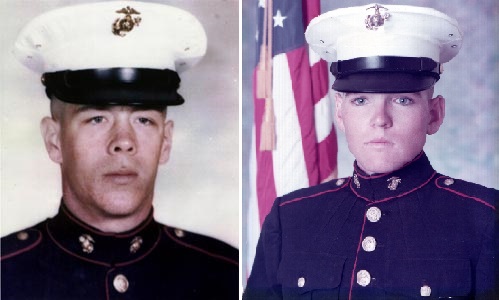
McMahon and Judge were members of the Marine Security Guard (MSG) Battalion at the US Embassy, Saigon and were providing security for the DAO Compound, adjacent to Tân Sơn Nhứt Airport, Saigon. McMahon had arrived in Saigon on 18 April, while Judge had arrived in early March. Both died in a North Vietnamese rocket attack on Tân Sơn Nhứt on the morning of April 29, 1975.
In accordance with procedures for deceased Americans in Vietnam, their bodies were transferred to the Saigon Adventist Hospital, near Tan Son Nhut. In telephone calls to the hospital on the afternoon of April 29, the few remaining staff advised that the bodies had been evacuated; in fact the bodies were left behind. Operation Frequent Wind, the American evacuation of Saigon, was completed the following day, April 30, 1975. Senator Edward M. Kennedy of Massachusetts, through diplomatic channels, secured the return of the bodies the following year. The transfer of the bodies took place on February 22, 1976, at Tân Sơn Nhứt Airport to two of Kennedy’s aides. Their caskets were loaded onto an Air France Caravelle jet chartered by the United Nations High Commissioner for Refugees and were flown to Bangkok to be received by a U.S. military honor guard and then transferred to U-Tapao Royal Thai Navy Airfield for identification.
Judge was buried with full military honors in March 1976 in Marshalltown, Iowa. There was a flag draped coffin, a Marine Honor Guard, and a rifle firing salute. The flag that covered his coffin was folded and presented to his parents. His funeral was attended by the Daily Iowan (Iowa City, Iowa). Judge was given a second Marine burial honors 25 years later through planning by Douglas Potratz, USMC MSG who served with Judge in Saigon and Ken Locke, boyhood friend and fellow Eagle Scout; retired USMC Lieutenant Colonel Jim Kean, the commanding officer of the Marines during the Fall of Saigon, presented a flag to Judge’s parents at a ceremony held at the Iowa Veteran’s Home Vietnam War Memorial.
Two other Marines died this day when their CH-46 helicopter ran out of fuel while waiting for the USS Hancock to clear her overcrowded deck. They were Captain William Nystul and First Lieutenant Michael Shea.
All four men are remembered and honored together on the Wall, at Panel 1W, line 124.
At 11:08 am ICT in Saigon (4:08 am GMT), the order to carry out Operation FREQUENT WIND was received, commencing the evacuation of all Americans from South Vietnam, as well as South Vietnamese nationals who might face retaliation. The first wave of helicopters was dispatched from the aircraft carrier USS Hancock landed by 3:00 pm on the grounds of the U.S. Defense Attaché Office compound next to Tan Son Nhut Airport. Option IV, the largest helicopter evacuation on record, begins removing the last Americans from Saigon including U.S. Ambassador Graham Martin. In 19 hours 81 helicopters carry more than 1,000 Americans and almost 6,000 Vietnamese to aircraft carriers riding offshore. In all, American helicopters evacuated 1,373 Americans, 5,595 South Vietnamese and 815 foreign nationals in a span of 18 hours.
The Bombing of Tân Sơn Nhứt Air Base caused the halt of the fixed-wing air evacuation from the base. The heaviest rocket attack of the war struck Saigon’s airport early this morning as North Vietnamese troops assaulted parts of the city’s suburbs. More than 150 rockets struck Tân Sơn Nhứt Air Base and two United States marines were reported killed. They were guarding several thousand Vietnamese and Americans waiting to be evacuated from Saigon. The rockets also destroyed a United States Air Force cargo plane used in the refugee airlift, which was suspended.
Two U.S. Marine Security Guards — Corporal Charles McMahon and Lance Corporal Darwin L. Judge — became the last American servicemen to be killed in Vietnam, the victims of North Vietnamese shelling of the airport. Their remains were inadvertently left behind, and would be buried by North Vietnamese at a Saigon cemetery. On February 22, 1976, the bodies of the two servicemen would be released back to American custody.
Two marines were lost and presumed dead when their helicopter, which was flying rescue guard duty off the carriers, crashed into the South China Sea.
President Dương Văn Minh announced the unconditional surrender of the Saigon government and its military forces to the Việt Cộng. Columns of South Vietnamese troops pulled out of their defensive positions in the capital and marched to central points to turn in their weapons. This action followed by hours the ending of American involvement through the evacuation of most of the approximately 1,000 Americans remaining in South Vietnam.
At least 74 planes of the South Vietnamese air force, including about 30 F-5 fighters, streamed into the U Taphao air base in southern Thailand from South Vietnam without warning. The pilots and passengers — about 2,000 people — requested asylum, according to American and Thai officials. More planes are arriving. A Thai Foreign Ministry spokesman said that American authorities at U Taphao had been asked to turn over the aircraft to the Thai Government, which would return them to “the new South Vietnamese government.” The pilots and passengers, the Thai spokesman said, “must leave Thailand.”
“They just landed first and asked permission afterwards,” said an astounded Thai Foreign Ministry official. Other Government sources said that apparently no efforts were made to prevent the planes from landing and no aircraft went up to intercept the fighters as they roared in.
American, Embassy officials in Bangkok declined to comment on the Thai request that the planes be returned and their status was unclear. An unresolved question here appeared to be whether the planes were still American property or belonged to whatever government continued in Saigon. The planes could be worth $200‐million, one official said. No details were available on the status of the refugees or how the planes, pilots and passengers had made their escape from South Vietnam. But all those arriving were taken to the Evacuation, Reception Center at U Taphao, which is already packed with more than 1,000 Cambodian refugees.
The unexpected arrival of these planes and new refugees scattered in other border areas of Thailand, were an embarrassment to the Thai Government, which has in recent days been avoiding direct links with the Americans, with the former pro‐American governments in Indochina and with the refugees themselves. “You have lost,” a Thai Foreign Ministry official told an American, with embarrassment. “Within 48 hours it will all be over for you. Yet we will still be here.”
Scores of South Vietnamese helicopters filled with military men and civilians fled Saigon today and headed out to sea to search for the carriers of the United States Seventh Fleet. Seven of the helicopters arrived unexpectedly above the amphibious command ship USS Blue Ridge carrying Americans and Vietnamese evacuated from South Vietnam. The seven copters made a dash for the helipad at the rear of the ship. One pilot dropped his helicopter on the blades of another that had just landed and chunks of metal ripped through the air. The top helicopter, with its load of women and children, nearly toppled into the sea, but they were rescued and there were no injuries.
United States sailors heaved the two damaged choppers overboard to clear the landing pad. For the Vietnamese it was a last‐ditch chance to survive. As other Vietnamese helicopters landed their passengers were pulled free. American sailors ripped the doors off the craft to make them sink and the pilots then jettisoned them in the sea to make room for other arrivals circling overhead. Two small craft rescued the swimming pilots. The American evacuation was reported orderly, although it was delayed several times because of weather and pilot fatigue.
The new Cambodian government ordered the expulsion of 610 foreigners who had sought refuge in the French embassy in Phnom Penh. France’s Foreign Minister, Jean Sauvagnargues, expressed concern that a proposed long road trip to Poipet at the Thai border, beginning tomorrow, would be beyond the strength of some of the weakened foreigners. French demands that a plane ready in Laos be permitted to land to evacuate the ill have gone unanswered. President Valery Giscard d’Estaing issued a statement calling for “an end to this situation, which is contrary to human rights.”
Foreign Minister Jean Sauvagnargues told newsmen after having conferred with President Valéry Giscard d’Estaing;
“We fear these extremely precarious evacuation conditions will be beyond the strength of some whose health is poor. We continue to insist that the plane that we have held in Vientiane for evacuation of the ill be allowed to land in Phnom Penh.” However, a Foreign Ministry spokesman said that so far there has been no response to French protests, addressed to the Cambodian chief of state, Prince Norodom Sihanouk, in Peking and through the United Nations. The expulsion order included two French diplomats who remained In the embassy after France broke relations with the falling Lon Nol government three weeks ago and recognized the Khmer Rouge insurgents. It was on the basis of this recognition that the French advised their citizens that it was all right to remain in Phnom Penh.
“It was negotiated with Prince Sihanouk,” the Foreign Ministry spokesman said, “but perhaps he doesns’t have the authority to speak for the Khmer Rouge that we thought he had.” The surprise and anger of the French Government at this sudden shift in what Paris had believed was a smooth transfer of relations were barely veiled. Foreign Minister Sauvagnargues said France would continue to make “diplomatic efforts” but that if the situation “is prolonged, we shall take a public position.” There was no information here about what has been going on in Phnom Penh since the insurgents entered the city on April 17. Representatives of the new government issued a statement here today saying that “all privileges and diplomatic immunities accorded under accreditation to the previous regime are invalid.”
United States and Greek officials announced in Athens that the home-port arrangement for Sixth Fleet ships at Eleusis will be ended and the American air base at Athens Airport closed. The statement said that agreement is also expected on the elimination, reduction and conservation of other United States facilities. Those which remain open will be placed under Greek commanders, the statement said. The announcement came in a joint statement at the end of a second round of talks on the status of United States military facilities in Greece. The Greek Government threatened to close all United States bases and it withdrew from the North Atlantic Treaty Organization’s military command after the invasion of Cyprus by Turkey last July. “Certain United States facilities which contribute to Greek defense needs will continue to operate on the Greek Air Force base at Hellenikon,” today’s statement said.
A huge terrorist arsenal, said to be the biggest ever found in the Irish Republic, was discovered in a farm shed in the village of Donabate, 20 miles north of Dublin. The shed, which was equipped with machines to make weapons, contained mortars, rockets with launchers, grenades and other explosives. Authorities believe the armory was operated by the militant Provisional wing of the Irish Republican Army.
The final results of Portugal’s election last Friday have given the Socialists 115 of the 247 mainland seats in the constituent assembly. The Liberal Popular Democrats came in second with 80 seats and the Communist Party third with 30 seats. The Conservative Social Democratic Center Party won 16 seats and the Portuguese Democratic Movement, which has allied itself with the Communists, took five.
Portuguese officials, apparently worried about a possible breakaway of the Azores, have informed the United States that they are ready to resume negotiations on the American-held air base there.
A 29-year-old West German who worked as a chauffeur for the U.S. military authorities in West Berlin was arrested last Thursday on suspicion of spying for an East European secret service, a Bonn government spokesman said. The man, Werner Schalitz, was carrying plans of U.S. installations, information about military personnel and a forged Swiss passport when police arrested him, the spokesman said.
A West Berlin police spokesman today announced the arrest of four men as suspects in the kidnapping of Peter Lorenz, the Berlin Christian Democratic leader.
The Soviet Union’s remote, highly secret space launching center in central Asia was described today by the first Americans ever permitted to visit the site. The three Apollo astronauts were there to compplete joint training for the Apollo-Soyuz mission this Summer.
President Ford told King Hussein of Jordan that the United States remained committed to working for a just and lasting peace in the Middle East. Mr. Ford also reaffirmed, during an hour long meeting with the king in the White House, his determination to help the Jordanian economy.
Millions are dying of hunger each year in Bangladesh and renewed flooding, expected soon, will bring even greater disaster, the head of the Salvation Army’s relief team, Maj. Eva Den Hartog, said in London. She told a news conference that “the same floods are forecast this year” as last, “and they will worsen an already desperate situation.”
China called on the people of Sikkim, who recently voted to become part of India, to fight for independence, and accused the Soviet Union of being the “behind-the-scenes boss of Indian expansionism.” The official statement broadcast by the Hsinhua news agency also asked: “Sikkim today; whose turn tomorrow?”
President Park Chung Hee asserted today that South Korea’s armed forces were prepared to repel aggression from North Korea.
A Chinese press attache has been ordered expelled from Canada for security reasons, External Affairs Minister Allan MacEachen confirmed in Ottawa. “In our view, his activities were incompatible with his status as a diplomat in Canada,” MacEachen said. He did not name the attache nor would he give detailed reasons for the expulsion.
Cuba is discussing Premier Fidel Castro’s plan to inject some democracy into the Communist one-party system here and to decentralize the state apparatus by electing provincial assemblies.
The reputed head of a Rio de Janeiro drug ring which allegedly involved nearly 40 policemen was captured in a gun battle with Rio police. The suspect, Milton Goncales (BigHead) Tiago, was seriously hurt in the battle. A recent investigation accused the nearly 40 policemen, including a commissioner, of protecting Tiago for money.
Liberian Finance Minister Steven Tolbert and five other people were reported killed when their twin-engine Cessna plane crashed into the Atlantic Ocean after takeoff at Greenville, 200 miles south of Monrovia. Others reported on the plane were Tolbert’s private secretary, the pilot, two security officers and a journalist. Tolbert, 55, youngest brother of President William Tolbert, became finance minister in 1972.
Four persons were dead and 32 wounded today when firing ended at the Israeli Consulate with the surrender of a South African Jew who had held it for 16 hours, the police reported.
Republican sources in Congress said they expected President Ford to set in motion shortly a gradual elimination of the remaining price controls on domestic crude oil, which apply to about 60 percent of domestic production. Mr. Ford was expected to defer again an increase in the fee on imported crude oil. The view among Republicans on Capitol Hill and among Mr. Ford’s own advisers was that with his 60‐day energy policy truce with Congress due to expire at midnight tomorrow, the President had to take some action to maintain his leadership. He could not, Republicans said, simply give the Democratic Congress an extension of time.
A Labor Department survey showed that Michigan and the West Coast were among the areas hardest hit by joblessness in 1974, while the South largely escaped severe impact. Data on 27 states and 30 metropolitan areas showed that 10 states had an average unemployment level above 6% in 1974 while 10 others had an average below 5%. The national jobless rate, now at 8.7%. averaged 5.6% for all of 1974. The national rate hit 6% last October. Among the reporting states, the worst average was in Michigan, 8.5%. Oregon was next with 7.5%.
Seven persons, including Senator William Proxmire, testified today on behalf of proposed legislation that would make it easier for the public and the press to get information from Federal employees. The legislation is a proposed Federal Employes Disclosure Act designed to protect civil servants who reveal information to the public from harassment and retaliation by their chiefs. Yesterday seven Federal employees told of the problems they had encountered after having made public information that was often damaging or embarrassing to the government.
A spokesman for the nation’s cities said today that President Ford’s proposed legislation to extend general revenue sharing is inadequate because it would not provide enough aid to meet rises in the rate of inflation.
NBC and ABC television networks would set aside four half-hour periods in prime time for the presidential and vice presidential candidates of the Republican and Democratic parties next year if Congress would lift the equal time rules, the Senate commerce subcommittee was told. The Communications Act requires broadcasters to provide free time for all candidates for an office if they provide free time for one. NBC Chairman Julian Goodman said, “The rule still limits the broadcaster’s ability to bring major candidates to the public in a variety of program formats.”
The Senate decisively defeated today a move by conservatives to cut $25-billion from next year’s Federal spending and increase certain taxes, thereby reducing the deficit to $34.7-billion.
A conference committee cleared tonight for final approval by the Senate and House a Federal strip-mine control bill that both environmentalists and spokesmen for the coal industry called significantly weaker than a similar measure vetoed by President Ford late last year.
The House Republican Conference voted today to open its meetings to the press and public for the first time in almost half a century.
The director of the Secret Service, H. Stuart Knight, and a local police officer were dropped today from a $1.08 million civil damage suit by order of the judge hearing the case. The action was by mutuall agreement of both sides.
The Central Intelligence Agency flew a two-man assassination team into Cuba in an unsuccessful attempt to kill Premier Fidel Castro, a retired Air Force colonel said today.
Attorney General Edward H. Levi announced the takeover of a Japanese fishing vessel in Alaska because its owners declined to pay a $350,000 settlement after the ship was found fishing in American waters. Levi said a civil action for forfeiture of the trawler Eikyu Maru No. 33 and a criminal information against its captain were filed in Anchorage. A Coast Guard patrol plane spotted fishing gear from the ship about 1.7 miles off Great Sitkan Island on April 4. The cargo of fish was auctioned for $12,001.
About 40 students, watched by a lone university policeman, took over an office and classroom building at Brandeis University in Waltham, Massachusetts, to protest proposed cuts in the budget. The administration refused to discuss their demands. “We have no intention of negotiating with any group that is occupying the building at any time,” a spokesman said. Outside Pearlman Hall, the occupied building, 100 supporters carried banners and milled around. There was no violence and no arrests were made. Brandeis is planning cuts of about $2 million to reduce its budget to about $31 million.
Two bombs exploded within less than 24 hours in Denver, one at the American National Bank and the other at the home of James Sommerville, the regional director of the Central Intelligence Agency. No one was injured in the second blast, but four women employees were injured slightly in the earlier one at the bank. Police said Sommerville was not home when the bomb went off shortly before midnight. His wife, Allane, and his son, 14, were sleeping in the rear of the house and escaped injury.
A butane gas truck exploded at Eagle Pass, Texas, and at least two people were reported dead and about 50 injured. At least two other persons were reported missing. They were the truck driver and the driver of the car just in front of the truck. Twenty-one of the injured, many with burns over 80% of their bodies, were hospitalized. The truck split in two as it tried to avoid hitting a car and overturned and exploded, police said It erupted into a ball of flame that shot 200 feet high and half of the truck rocketed into a mobile home park 400 yards away, hitting three homes. The other half landed in a used car and junk yard.
There is a trend in American elementary and secondary education, public as well as private, toward systematic efforts to help students identify and develop their personal values. A New York State Education Department official estimated that 80 percent of the schools in the state were doing something in the field of “values clarification” or “moral education.”
Major League Baseball:
In Houston’s 10–2 win over San Diego, the Astros use three sacrifice bunts in the 8-run 7th inning. This ties a Major League record. The three bunts result in an unsuccessful fielders choice and two errors.
At Kansas City, the Angels score 9 runs in the 3rd inning as they roll to a 12–1 win over the Royals. Andy Hassler is the beneficiary of the offense, led by light-hitting Orlando Ramirez with 4 hits.
The Mets crushed the Cubs, 9–1, behind the seven-hit pitching of Tom Seaver (3–2). The Mets scored three in the first inning and never looked back.
Don Hood hurled a four-hitter and the Cleveland Indians downed the New York Yankees, 3–1, at Shea Stadium. Larry Gura took the loss. Frank Duffy knocked in all three runs for the Indians.
Andy Messersmith pitched his first shutout of the season, a seven‐hitter, and Willie Crawford and Steve Garvey hit home runs as the Dodgers won their sixth straight game, routing the Braves, 8–0.
The Astros routed the Padres, 8–2, as James Rodney Richard pitched five‐hit ball and singled home two runs in Houston’s eight‐run seventh inning. With the game scoreless through the seventh, the Astros sent 13 men to the plate, made five hits and took advantage of two San Diego errors.
Auriello Rodriguez and Ron LeFlore hit home runs in the 10th as the Tigers rallied to beat the Orioles and Ross Grimsley, 4–2. Willie Horton’s two‐run homer in the eighth scoring Gary Sutherland tied the score at 2‐2. It was Horton’s fifth home run of the year and boosted his runs‐batted-in total to 14.
The Rangers edged the Twins, 3–2, as Len Randle hit a two‐run homer in the third, and Ferguson Jenkins held on to pick up his third straight victory. Jenkins gave up nine hits, walked one and struck out seven.
Detroit Tigers 4, Baltimore Orioles 2
New York Mets 9, Chicago Cubs 1
California Angels 12, Kansas City Royals 1
Atlanta Braves 0, Los Angeles Dodgers 8
Cleveland Indians 3, New York Yankees 1
Montreal Expos 0, Philadelphia Phillies 5
St. Louis Cardinals 3, Pittsburgh Pirates 0
Houston Astros 8, San Diego Padres 2
Cincinnati Reds 3, San Francisco Giants 4
Chicago White Sox 2, Texas Rangers 3
Dow Jones Industrial Average: 803.04 (-6.96, -0.86%)
Born:
Rafael Betancourt, Venezuelan MLB pitcher (Cleveland Indians, Colorado Rockies), in Cumaná, Venezuela.
Josh Booty, MLB third baseman (Florida Marlins), in Starkville, Mississippi.
John Macready, American gymnast (Olympic 5th 1996), in Los Angeles, California.
Béres Zoo, Hungarian radio shock jock DJ, in Budapest, Hungary.
 History Diaries