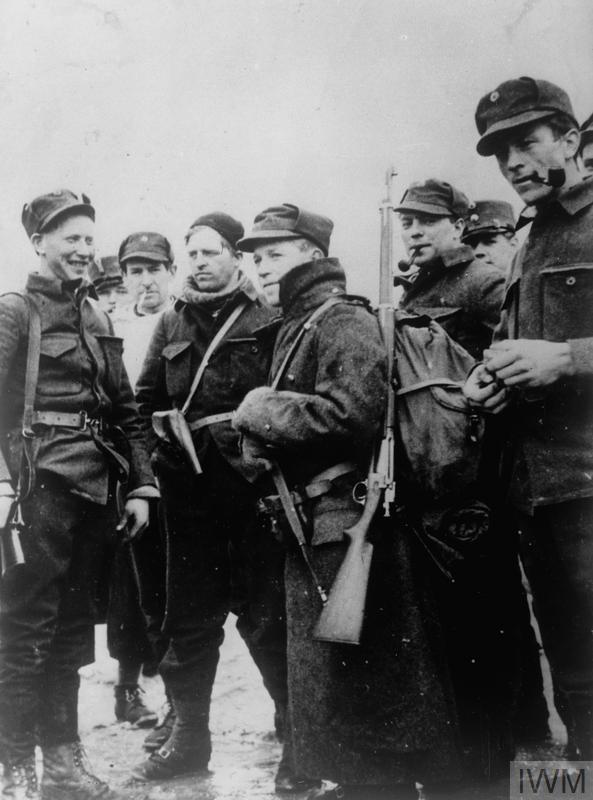
The British cabinet, given a strong recommendation on the morning of 28 April 1940 from General Massy, affirms the Military Coordination Committee (MCC) decision on 27 April to evacuate Norway. Everything is prepared for a quick exit.
Lieutenant General Claude Auchinleck is appointed commander of the British forces in Norway, now named the North-Western Expeditionary Force. He will oversee the evacuation.
General Paget at Otta and General de Wiart at Namsos both receive orders to evacuate.
Paget tells Norwegian Commander in Chief Ruge at 05:00. Ruge gets angry at both the decision and not being told previously. He still believes that the defensive 15th Brigade south of Dombås can establish a permanent line, but the decision is final. He offers to assist with the retreat as long as Norwegian troops are included in the evacuation.
The British government ordered troops at Trondheim to withdraw as the 15th Brigade fell back again to Dombås. The British War Cabinet ordered the withdrawal of British troops at Trondheim, Norway, to the dismay of Norwegian leaders.
The 15th Brigade at Otta holds its line during the day, destroying three German light tanks. During the night, it withdraws 25 north to Dombås, where it can protect its own flank. They conduct a scorched-earth policy, blowing bridges as they go.
General de Wiart in Namsos withdraws his forces into a tighter, more defensible perimeter as he prepares to depart. He faces Luftwaffe attacks only.
German 196th Infantry Division continues to advance northward.
French 27th Demi-Brigade de Chasseurs Alpins continue deploying on the mainland at Sjovegan, north of Narvik.
A further detachment of French mountain troops arrives at Harstad.
Major Vidkun Quisling, Norwegian Nazi leader, will be “punished” by the Germans in Oslo in a manner designed to appease the Norwegians, the newspaper Allehanda reported today from Gothenberg. Quisling had told the Germans, the report said, that their expedition into Norway would be as “pleasant and peaceful as a military promenade.”
Criticism of the British government’s handling of the Norwegian campaign rises. Tonight’s news of the landing of Allied reinforcements in Norway, plus successful resistance at Kvam, was announced at the beginning of what looks like a difficult week for the Chamberlain government. Ever since the Allied forces started their retreat early last week in the vicinity of Steinkjer, north of Trondheim, and in the Gudbrandsdal, there has been a lot of talk here about troops being sent to Norway too soon, without sufficient artillery and and without adequate fighter planes, anti-aircraft guns, or reinforcements. This criticism took a sharper turn today when the government’s critics started expressing their opinions in the Sunday papers. As usual, the loudest of these critics is David Lloyd George, who, from the shadows of his political eclipse, is still able, as the Prime Minister who won the last war, to get the country’s ear.
The Luftwaffe continues bombing the British ports in northern Norway.
Luftwaffe moves reinforcements and supplies into Narvik with 89 Ju-52 transports.
Having downed a German Heinkel 111 the previous night, RAF pilot Captain Partridge has crash-landed nearby. He finds a hut, then hears someone outside – it is the crew of the bomber he shot down. He invites them in, they become friends and are picked up this morning by a Norwegian ski patrol.
The Royal Navy trawler HMS Cape Siretoko was bombed and sunk in the Norwegian Sea off the west coast of Norway by Luftwaffe aircraft. Raised, repaired and put in Kriegsmarine service as Gote V-6113.
The Norwegian cargo ship Capella was bombed and sunk in Tingvollfjorden, Møre og Romsdal by Luftwaffe aircraft. Raised in 1943, repaired and returned to service as Hillevaag in July 1943.
The Norwegian coaster Gallus was bombed and sunk off Kristiansund, Møre og Romsdal by Luftwaffe aircraft. Later raised and returned to service.
Aircraft carrier HMS Ark Royal launched air strikes on Trondheim without achieving any significant results. She withdrew for refueling that evening at Scapa Flow where she arrived on 1 May. Following refueling, Ark Royal departed on 4 May for operations off northern Norway.
Destroyers HMS Ivanhoe, HMS Icarus, and HMS Impulsive departed Scapa Flow at 1600 to carry out minelaying operation ZMA in the Trondheim Leads. This was completed at 2330/29th. The destroyers retired towards the Humber, but were diverted en route at 1237 to Scapa Flow for escort duties. They arrived at 0740 on 1 May. Destroyers HMS Esk, HMS Express, and HMS Intrepid were substituted on 1 May for them at Immingham. These destroyers departed Scapa Flow at 0540 on 1 May arriving in the Humber at 2030.
The 11th Anti-Submarine Striking Force of trawlers HMS Cape Siretoko (Lt A.A.F. Talbot, SO), HMS Argyllshire, HMS Northern Pride, and HMS Wistaria departed Aberdeen on the 24th and arrived at Molde late on the 27th. Anti-submarine trawler HMS Cape Siretoko (590grt, Lt Cdr A.N. Harding (ret)) was badly damaged by German bombing at Åndalsnes and ran aground to prevent sinking. She was later salved by German forces and renamed Vp.6113 (trawler Gote) for their use. In the same attack, anti-submarine trawler HMS Wistaria of the 19th Anti-Submarine Striking Force was also damaged by bombing. The trawler was run aground to prevent sinking, but was salved. The trawlers were able to departed Molde after the evacuation on the 30th/1 May.
At 0200, the 16th Anti-Submarine Striking Force (trawlers HMS Aston Villa (SO, 546grt), HMS Gaul (550grt), HMS Angle (531grt), and HMS Arab (531grt)) arrived at Namsos to join 15th Anti-Submarine Striking Force (trawlers HMS Cape Passaro (SO, 510grt), HMS St Goran (565grt), HMS St Kenan (565grt), and HMS St Loman (565grt). These trawlers remained at Namsos until after the evacuation on 2/3 May. Trawler Arab was ordered alongside Anti-aircraft cruiser HMS Carlisle (Flagship Rear Admiral J. G. P. Vivian, 20th Cruiser Squadron) which had supplies for the French troops aboard the trawler.
The French claim German losses in patrol operations; some artillery fire is reported at various points. Calm continues to reign on the Western Front where the weather is still rainy and misty. Few planes take the air and the activity of ground troops is confined to patrols and artillery actions. The evening communiqué reports “a local encounter west of the Vosges in the course of which we inflicted losses on the enemy.”
A German attack supported by heavy artillery dislodged French soldiers from a Western Front advance post yesterday, but a French counter-attack recovered the position, military dispatches said today. Sporadic patrol attacks resulted in the capture of two German noncommissioned officers and enemy losses, the dispatches said. Artillery fire from both sides was violent, especially west of the Vosges mountain sector with patrols prospecting new terrains in the Saar and Alsace areas.
Rudolf Höss is appointed commandant of concentration camp Auschwitz.
The Bayerische Motorenwerke BMW Mille Miglia Touring Coupe wins the Mille Miglia in Germany with an average speed of 166.7 km/h (103.6 mph).
In Rome, a Fascist speaker tells Italian army to be ready; voices wish for German success.
Yugoslavia has informed the Governments of Italy, Germany, and Hungary that, owing to frequent violations of her frontiers by airplanes, particularly between April 18 and 20, orders have been given to military authorities to fire on any further violators.
Yugoslav circles were deeply worried today over the anti-Yugoslav demonstration that took place yesterday in Florence and were anxiously asking themselves whether it meant the beginning of a new phase in Italo-Yugoslav relations.
The British steam tanker Scottish American (6,999grt) was torpedoed and damaged by the U-13, commanded by Kapitänleutnant Max-Martin Schulte, at 0129 hours west of Pentland Firth in 58 41N, 04 40W. The U-boat had fired the last torpedo and left the tanker down by the bows, but the ship was salvaged and returned to service after being repaired. The 9,491 ton Scottish American was carrying fuel oil and was bound for Scapa Flow, Scotland. The steamer was towed to Loch Eribol by decoy ship Looe (steamer Beauly: 1061grt) and armed boarding vessel HMS Northern Reward (655grt). Destroyers HMS Delight, HMS Diana, and HMS Imperial en route to Scapa Flow were diverted to assist on the 28th. Minesweeping trawler HMS Juniper stood by while 8200 tons, the entire cargo less 1,000 tons of oil, which had been lost, was pumped into tanker Oil Pioneer for return to Scapa Flow. Transfer was completed on 2 May. The tanker was able to leave Loch Eribol on 5 May with tug St Mellons and trawler Juniper for North Shields. The tanker was repaired at North Shields and returned to service in August 1940.
Battleships HMS Malaya and HMS Royal Sovereign, from the Halifax Escort Force, departed Gibraltar at 1600 escorted by destroyers HMS Velox, HMS Watchman, HMS Vendetta, and HMS Waterhen to reinforce the Mediterranean Fleet. Destroyer Vendetta had arrived from Malta on the 25th. Destroyer Waterhen had arrived earlier on the 28th with transport Dilwara. Shortly before the sailing, destroyer Vendetta attacked a submarine contact 6½ miles 142° from Cape Trafalgar. Destroyer Velox joined in the search, but no further results were made. The British ships were joined on the 29th by French battleships Lorraine, Bretagne, and Provence from Algiers, and heavy cruisers Tourville and Duquesne, light cruiser Duguay Trouin, destroyers Lion, Lynx, and Forbin from Mer el Kebir. On 30 April, Australian destroyers HMAS Stuart and HMAS Vampire joined the escort force, as later did light cruiser HMS Orion and destroyers HMS Defender and HMS Decoy from Malta. This force passed Malta on 1 May and arrived at Alexandria at 1820 on 3 May.
The Queen Mary, impressed into British military service, completes a record-breaking, 12-day trip from New York to Cape Town.
Convoy OA.138GF departs Southend.
Convoy OB.138 departs Liverpool.
Convoy TS 2 of two ships departed Cardiff for the Clyde at 1130 escorted by anti-submarine trawler HMS St Cathan (565grt).
Convoy FN.156, after being delayed more than a day by fog, departed Southend, escorted by destroyers HMS Westminster and HMS Wolsey. Further hampered by fog, the convoy arrived in two sections. The first arrived at Rosyth, escorted by destroyer Westminster on the 30th. The second half arrived on 1 May, escorted by destroyer Wolsey.
Convoy FN.157 was cancelled.
The War at Sea, Sunday, 28 April 1940 (naval-history.net)
Aircraft carrier ARK ROYAL launched air strikes on Trondheim without achieving any significant results. She withdrew for refueling that evening at Scapa Flow where she arrived on 1 May. Following refueling, ARK ROYAL departed on 4 May for operations off northern Norway.
Destroyers CODRINGTON (D.1) and ARDENT departed Bogen for Skelfjord. Destroyer CODRINGTON carried out a reconnaissance of the Narvik area with General Bethouart and Brigadier Fraser on board. She bombarded an anti-aircraft battery, a railway viaduct, machine gun posts. On 29 April at 1400, destroyers CODRINGTON and ESCAPADE departed Skelfjord to escort tanker INVERARDER to Scapa Flow.
Destroyers IVANHOE, ICARUS, and IMPULSIVE departed Scapa Flow at 1600 to carry out minelaying operation ZMA in the Trondheim Leads. This was completed at 2330/29th. The destroyers retired towards the Humber, but were diverted en route at 1237 to Scapa Flow for escort duties. They arrived at 0740 on 1 May. Destroyers ESK, EXPRESS, and INTREPID were substituted on 1 May for them at Immingham. These destroyers departed Scapa Flow at 0540 on 1 May arriving in the Humber at 2030.
Destroyer JANUS departed Scapa Flow at 1400 with dispatches for Namsos and Skelfjord.
Destroyers DELIGHT, DIANA, and IMPERIAL arrived at Scapa Flow at 1900.
Destroyer INGLEFIELD departed the Clyde at 2030 for Scapa Flow to arrive at 1100/29th.
Destroyer FIREDRAKE arrived in the Clyde at 1700 to join the Home Fleet after refitting at Cardiff.
Destroyers WANDERER, ANTELOPE, ACHERON, WALKER, and WESTCOTT departed the Clyde for Scapa Flow to arrive at 1300/29th.
Destroyers WALLACE and VALOROUS departed Rosyth at 0715. Destroyer VALOROUS was detached to search for a submarine reported by air in 58 31N, 2 38W. Destroyer WALLACE and troopship ORION (23,371grt) arrived at Scapa Flow at 1530 and sailed for Rosyth at 1700. Later, both destroyers were recalled to Scapa Flow.
French destroyers INDOMPTABLE, MALIN, and TRIOMPHANT of the 8th Large Destroyer Division departed Rosyth. The first two ultimately for the Mediterranean and TRIOMPHANT for repairs at Lorient.
The 11th Anti-Submarine Striking Force of trawlers CAPE SIRETOKO (Lt A.A.F. Talbot, SO), ARGYLLSHIRE, NORTHERN PRIDE, and WISTARIA departed Aberdeen on the 24th and arrived at Molde late on the 27th. Anti-submarine trawler CAPE SIRETOKO (590grt, Lt Cdr A.N. Harding (ret)) was badly damaged by German bombing at Aandalsnes and ran aground to prevent sinking.She was later salved by German forces and renamed Vp.6113 (trawler GOTE) for their use. In the same attack, anti-submarine trawler WISTARIA of the 19th Anti-Submarine Striking Force was damaged by bombing. The trawler was run aground to prevent sinking, but was salved. The trawlers were able to departed Molde after the evacuation on the 30th/1 May.
At 0200, the 16th Anti-Submarine Striking Force (trawlers ASTON VILLA (SO, 546grt), GAUL (550grt), ANGLE (531grt), and ARAB (531grt)) arrived at Namsos to join 15th Anti-Submarine Striking Force (trawlers CAPE PASSARO (SO, 510grt), ST GORAN (565grt), ST KENAN (565grt), and ST LOMAN (565grt). These trawlers remained at Namsos until after the evacuation on 2/3 May. Trawler ARAB was ordered alongside Anti-aircraft cruiser CARLISLE (Flagship Rear Admiral J. G. P. Vivian, 20th Cruiser Squadron) which had supplies for the French troops aboard the trawler.
On 28 April, Temporary S/Lt P. Collingwood RNVR, was killed in an air attack on cruiser CARLISLE.
Sloop BLACK SWAN was badly damaged by German bombing in Romdalsfjord at 1550. The bomb passed through the stern before exploding. Little damage was done and the ship remained in action until the last attacked ended. Sloop BLACK SWAN was relieved by sloop FLEETWOOD that night, which departed Scapa Flow at 2100/27th. Sloop BLACK SWAN arrived at Scapa Flow at 1345/30th with only twenty-nine rounds of anti-aircraft ammunition left. She was given temporary repairs by depot ship WOOLWICH. Sloop BLACK SWAN departed Scapa Flow at 1930 on 2 May and arrived Falmouth at 1500 on 4 May for repairs completed in late May.
Captain J.A.W. Voelcker relieved Captain J.S. Bethell as S.6.
French submarine AMAZONE arrived at Harwich after patrol.
French submarine ACHILLE arrived at Dundee after patrol.
Submarine SWORDFISH arrived at Blyth after patrol.
Submarine TETRARCH arrived at Rosyth.
French submarine ANTIOPE departed Harwich on patrol.
Submarines SEALION and SUNFISH departed Harwich to patrol in Bohus Bay.
Battleship WARSPITE arrived at the Clyde from Scapa Flow with destroyers INGLEFIELD, ECHO, and FOXHOUND.
Convoy TS 2 of two ships departed Cardiff for the Clyde at 1130 escorted by anti-submarine trawler ST CATHAN (565grt).
Destroyer KEITH proceeded to Dover and went alongside depot ship SANDHURST for repairs to dynamos and steering gear. Repairs were completed on the 29th.
At 1017, destroyer BROKE, on passage to Devonport, ran aground 1.3 miles 189° from Goodwin Knoll Buoy. Tugs LADY BRASSEY and DORIA and destroyer VERITY (Captain D 19 (KEITH out of action)) proceeded to assist destroyer BROKE. The destroyer was refloated on the tide at 1230 and continued to Devonport. Destroyer BROKE sustained no damage in the grounding.
During the night of 28/29 April, submarine H.32 escorted by sloop FOXGLOVE and French submarine RUBIS escorted by sloop ROSEMARY anchored off Dungeness due to fog. During 29 April, the ships proceeded to the Downs, but had to remain during the night of 29/30 April. Patrol sloop SHELDRAKE from Harwich was in the Downs to relieve sloop ROSEMARY of the RUBIS escort.
Convoy FN.156, after being delayed more than a day by fog, departed Southend, escorted by destroyers WESTMINSTER and WOLSEY. Further hampered by fog, the convoy arrived in two sections. The first arrived at Rosyth, escorted by destroyer WESTMINSTER on the 30th. The second half arrived on 1 May, escorted by destroyer WOLSEY. Convoy FN.157 was cancelled.
Battleships MALAYA and ROYAL SOVEREIGN, from the Halifax Escort Force, departed Gibraltar at 1600 escorted by destroyers VELOX, WATCHMAN, HMAS VENDETTA, and HMAS WATERHEN to reinforce the Mediterranean Fleet. Destroyer VENDETTA had arrived from Malta on the 25th. Destroyer WATERHEN had arrived earlier on the 28th with transport DILWARA. Shortly before the sailing, destroyer VENDETTA attacked a submarine contact 6½ miles 142° from Cape Trafalgar. Destroyer VELOX joined in the search, but no further results were made. The British ships were joined on the 29th by French battleships LORRAINE, BRETAGNE, and PROVENCE from Algiers, heavy cruisers TOURVILLE and DUQUESNE, light cruiser DUGUAY TROUIN, destroyers LION, LYNX, and FORBIN from Mer el Kebir. On 30 April, Australian destroyers HMAS STUART and HMAS VAMPIRE joined the escort force, as later did light cruiser ORION and destroyers DEFENDER and DECOY from Malta. This force passed Malta on 1 May and arrived at Alexandria at 1820 on 3 May.
Destroyers VELOX and WATCHMAN arrived back at Gibraltar on 4 May.
Opponents of major changes in the wage-hour law engaged today in intensive maneuvering aimed at swinging enough farm votes to assure defeat of the Barden amendments in tomorrow’s house vote. Informed leaders said strategy centered on three-sided “trading” among city and farm-state members. They sized up the situation this way: If farm congressmen support urban votes against the Barden or other major amendments, city members will return the favor Tuesday by helping put across increased farm appropriations, W.P.A. Bill Support Would Be Expected In that event, sponsors of more money for relief will expect support of rural representatives when the 1941 W.P.A. appropriation bill comes up. “If the Barden amendments go in, look out for fireworks the rest of the session,” one highly-placed, Democrat said. “If they are defeated, the situation will be much simpler and each side will get what it wants.” The Barden amendments would exempt a large group of operations involving processing of farm products from both the maximum 42-hour week and minimum 30 cents an hour standards. The house labor committee is sponsoring another bill which would exempt these activities from the hour provisions for limited periods of the year.
President Roosevelt returned to the capital today from a vacation at Warm Springs, Georgia.
The U.S. Supreme Court decided Thornhill v. Alabama. Byron Thornhill joined a picket line that was protesting against his former employer. Section 3448 of Alabama state law made it an offense to picket. Pursuant to the law, Thornhill was arrested and fined $100. Thornhill, a union president, was the only picketer to be arrested and tried under the law. In an 8-to-1 decision, the Court held that Section 3448 of the Alabama State Code was facially invalid. The Court held that labor relations were “not matters of mere local or private concern,” and that free discussion concerning labor conditions and industrial disputes was “indispensable to the effective and intelligent use of the processes of popular government to shape the destiny of modern industrial society.” The Court found that no clear and present danger of destruction of life or property or of breach of the peace was inherent to labor picketing, and thus deserved First Amendment protection.
The U.S. Justice Department announced today henceforth it would exert centralized control over arrests or prosecutions for violations of neutrality laws, with an eye to civil liberties as well as national defense. A new division the neutrality laws unit will take over the work, Attorney-General Jackson said, and will have “responsibility for control of all prospective action growing out of violations or charges of violations of laws relating to neutrality.
More than 1,250,000 workers, it was disclosed today, have left the W.P.A. rolls voluntarily during the last 12 months, presumably to take private employment. Col. F. C. Harrington, commissioner of works projects, made public the figures in connection with President Roosevelt’s proclamation of the first seven days in May as National Employment week. He said 100,000 a month were leaving W.P.A. at the present time, but that many were forced to return to it. At the same time, Secretary Hopkins reported that the national income in March was 4 per cent higher than a year ago, although the increase over February was less than seasonal.
Suffering from an upset stomach and ordered by his doctor to remain in bed for forty-eight hours more, District Attorney Thomas E. Dewey, candidate for the Republican Presidential nomination, today announced a four-day postponement of the resumption of his preconvention tour.
Consolidated net earnings of General Motors Corporation, including equities in the earnings of subsidiaries not consolidated, for the March quarter totaled $67,028,461 or $1.50 a common share, compared with $53,177,928 or $1.18 per share for the corresponding 1939 quarter it was announced today. Alfred P. Sloan Jr., chairman, said in a letter to stockholders the upward movement in business “which set in about the middle of last year and which favorably affected the fourth quarter of that year, has been sufficiently maintained to result in a substantial increase in the volume of the corporation’s business in the first quarter of 1940 over the same quarter of 1939.” This resulted in “larger profits for the stockholders and larger payrolls, a greater number of available hours of work and higher weekly earnings for the corporation’s workers” compared to the corresponding 1939 quarter.
A. Phillip Randolph, president of the National Negro Congress, tonight refused re-election because of his opposition to accepting money from the Communist party and unions affiliated with the Congress of Industrial Organizations.
The world’s highest astronomical observatory, equipped for special solar studies, will be built by Harvard University this Summer in the Rocky Mountains of Colorado, it was announced today by Professor Donald H. Menzel of Harvard Observatory, who has charge of the enterprise.
John Cage, described as an “Avante-Garde experimentalist,” debuts his “Bacchanale.” It features his “prepared piano.” The Seattle Daily Times describes “Bacchanale” as being “breathtaking in its speed and rhythm as well as unusual in its piano accompaniment.” The National Academy of Arts and Letters will award Cage a $1000 honorarium – good money in those days – for the invention.
Glenn Miller records “Pennsylvania 6-5000”.
Major League Baseball:
The red-hot Brooklyn Dodgers win their 8th straight game of the young season, downing the New York Giants, 5–3. Dolf Camilli’s two-run ninth inning homer is the decisive blow.
The victory-hungry Boston Bees finally broke a six-game losing streak today to score their first triumph of the season in defeating the Phillies, 3 to 2, behind Joe (Lefty) Sullivan.
Jimmy Tabor’s home run over the left-field stands gave the Red Sox a 5–4 victory over the Athletics in an exciting twelve-inning game today before 24,006 at Shibe Park.
The Indians take a 9–3 lead into the 9th but the Tigers score 6 to tie. Hal Trosky wins it for the Indians with a 2–run, 2–out home run in the 10th, 11–9.
The Washington Senators edge the Yankees, 3–2, in ten innings at Griffith Stadium.
Philadelphia Phillies 2, Boston Bees 3
St. Louis Browns 11, Chicago White Sox 8
Pittsburgh Pirates 2, Cincinnati Reds 8
Cleveland Indians 11, Detroit Tigers 9
Brooklyn Dodgers 5, New York Giants 3
Boston Red Sox 5, Philadelphia Athletics 4
Chicago Cubs 5, St. Louis Cardinals 7
New York Yankees 2, Washington Senators 3
Heavy fighting in eastern central China, with Chinese troops said to have inflicted 5,000 casualties in Shansi province and to have captured a town near the treaty port of Wuhu, was reported today in Chinese news dispatches. One report said Chinese troops forced their way to points southeast and southwest of Wuhu, 50 miles above Nanking on the Yangtze River, which itself was said to have been threatened. Several Japanese supply columns reportedly were intercepted near Wuhu and quantities of arms and ammunition seized. The Chinese were said to have recaptured Nanling, 27 miles south of Wuhu, last Friday, breaking into the town by scaling the walls. The Japanese were said to have suffered 830 casualties. A belated Central News agency (Chinese) dispatch also said a Japanese munitions transport was blown up last Wednesday by a floating Chinese mine while sailing down the Yangtze near Anking, Japanese-occupied capital of Anh-wei. The transport sank almost immediately and only one Japanese sailor survived, the dispatch said. Chinese dispatches recorded further successes against 20,000 Japanese troops in southeast Shansi province. Japanese retreat was reported followed by Chinese capture of munitions.
Lieutenant General Seishiro Itagaki, Japanese Commander in Chief in China, declares that Chinese resistance to Japan is instigated by Britain, Russia and the United States. They oppose China’s emancipation through Japan’s assistance, he declares.
Born:
Paul Hogue, NBA center (New York Knicks, Baltimore Bullets), in Knoxville, Tennessee (d. 2009).
Died:
Luisa Tetrazzini, 68, Italian soprano.
Naval Construction:
The Regia Marina (Royal Italian Navy) Littorio-class battleship RN Vittorio Veneto is commissioned..
 History Diaries