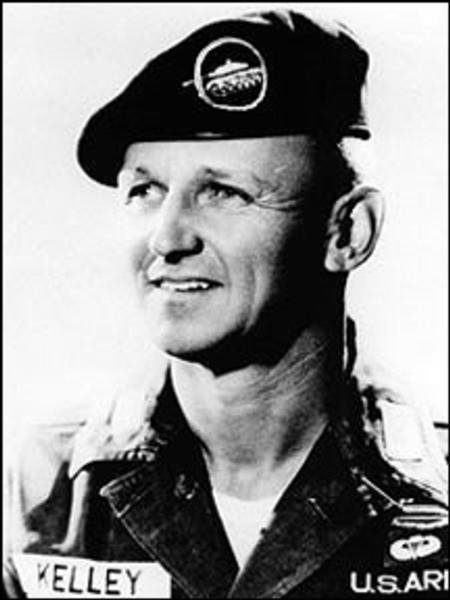
On this day, Kelley learned that a unit of the South Vietnamese army — or the Army of the Republic of Vietnam — and an American adviser had been ambushed nearby. The American adviser had been injured, and his comrades were unable to reach him through sniper fire. “Bruce, being the kind of guy he was, grabbed about four or five ARVN guys,” his friend Bob Ainsworth said. The men headed out to rescue their comrades. Kelley left his armored vehicle in search of the wounded American. Locating the man, Kelley hoisted him over his shoulder, intending to carry him to safety. That’s when a sniper’s bullet stuck Kelley in the head, killing him instantly.
Captain Kelley is buried at East Lawn Palms Cemetery, Tucson, Pima County, Arizona. He is honored on the Wall at Panel 1E, line 110.
Bitter fighting in the Mekong Delta left two United States Army advisers dead and a third wounded, United States military spokesman reported. Government sources meanwhile claimed a victory in a separate delta battle aimed at smashing a Việt Cộng guerrilla training center. The two engagements left 12 government soldiers dead and 39 wounded. The Việt Cộng were reported to have left 60 dead in the field.
United States Marine riflemen, who have suffered two dead and seven wounded in Việt Cộng action in the last eight days, killed a Việt Cộng guerrilla today in a skirmish at Hiểu Đức, a suspected Communist village 10 miles west of the Đà Nẵng air base. Ten Marine helicopters lifted members of Company F of the Second Battalion, Third Marine Regiment, to the village in conjunction with a ground patrol in the area by two other Marine companies.
General Wallace M. Greene, the Marine Corps commandant, voiced conviction today that the Việt Cộng challenge could be met and overcome “if we get enough strength in and can offer security.” The commandant said he had told his men here that their one job was “to find the Việt Cộng and kill them.” The general said he was “more convinced than ever that this job can be done.” The general avoided comments about the landing of more marines in this area, a development that some military sources term imminent, but he indicated that troop build-up would continue.
In a series of strikes today, United States and South Vietnamese pilots struck at bridges, ferry moorings and boats and junks north of the 17th Parallel, the border of north and South Vietnam. The most successful mission appeared to be a rapid-fire succession of strikes by United States Navy pilots from the carrier USS Midway (CVA-41) against four vessels at the Quảng Khê naval base, 50 miles north of the demilitarized frontier zone. Attacking two and three at a time, Skyhawk jet fighter-bombers peppered the boats with rockets and 250-pound bombs for four and a half hours and left one burning, two beached, and the forth slightly damaged.
South Vietnam’s Air Force commander, Air Vice Marshal Nguyễn Cao Kỳ, called for an immediate invasion of North Vietnam by South Vietnamese land forces. He conditionally ruled out United States troops. “With some secret bases of our own up there,” he said in an interview, “the Việt Cộng would quickly start wondering whether the war was worth it.” Marshal Kỳ questioned the effectiveness of air strikes against highways, railroads and bridges north of the 17th Parallel. His suggestions, the most outspoken by a South Vietnamese leader in recent weeks, were believed to reflect the overall official views of Premier Phan Huy Quát’s Government and the Saigon high command. The 34-year-old Marshal is regarded as the most powerful member of the high command.
Reliable United States sources disclosed today that Communist forces in South Vietnam were now equipped with high-altitude 37-mm anti-aircraft guns. The weapons are similar to those being used in the air defense of North Vietnam. The first of the antiaircraft guns positively identified was northeast of the village of Trường Chánh, in Bình Định Province, about 280 miles north of Saigon, the sources said. The largest anti-aircraft weapons the Việt Cộng guerrillas have used against American and Vietnamese aircraft in South Vietnam have been .50-caliber machine guns, equivalent to about 13 mm.
South Vietnamese Government forces have concluded one of their most successful weeks in the history of the war against the Việt Cộng, American analysts said today. In the week ended last Saturday night, six Việt Cộng guerrillas were killed for each dead government soldier. The total dead were 605 Communists and 100 government soldiers. In the past, the ratio has generally been 2 or 3 to 1 in the government’s favor. American casualties during the week ran high, however, with 18 servicemen killed.
This was also one of the few weeks in which weapons captured from the Việt Cộng exceeded those lost by the Government. The guerrillas lost 137 weapons, to the South Vietnamese Army’s 117. In the previous week, by comparison, the government lost 315 weapons as against 80 taken from the Communists. Despite these and other indicators of circumstances in the government’s favor, high American officers privately expressed a feeling of unease. Many of them suspect that the lull in Việt Cộng activity in the last two months has been a sign that the Communists are massing for large attacks next month.
Their concern was underscored by South Vietnamese intelligence reports that five regular North Vietnamese battalions are operating in South Vietnam. The United States confirmed Monday that a battalion of the 325th Division of the People’s Army of North Vietnam was in Kontum Province. Spokesmen declined comment on the new Vietnamese reports. The Vietnamese sources said that four other battalions, armed with 75-mm howitzers and mortars, were entrenched in the Vietnam area, 350 miles northeast of Saigon. That section was the scene of a fierce battle last week when South Vietnamese Government troops tried unsuccessfully to dislodge Communists from dug-in positions. There was no indication at that time that the Vietnamese Army was facing regular combat troops from the North.
There have been signs of new Việt Cộng confidence and strength in areas within 20 miles of Saigon. Guerrillas overran a ranger outpost near Hậu Nghĩa this morning, killing 35 rangers. Ten were wounded and 10 are missing, along with 23 carbines, 12 semi-automatic rifles, 7 sub-machine guns and other weapons. At about the same time, the Việt Cộng blasted Bao Trái, less than two miles from the ranger outpost, with fire from 81-mm mortars. One Government soldier was killed and six were wounded. Thirty men confined at a “re-education center” for former Việt Cộng guerrillas were also wounded by the mortar barrage.
CIA director John A McCone sends a personal memo to President Johnson stating his view that unless the United States is willing to intensify the bombing of North Vietnam, there is no use in committing more U.S. ground troops.
The F-100 Supersabre, a 10-year-old jet, is proving to be the most versatile of U.S. planes in Vietnam including newer and swifter models.
The Cambodian Government charged that four South Vietnamese planes bombed and strafed a Cambodian frontier village today, killing one person and wounding three others. An army spokesman said the attack was carried out at dawn by Skyraider fighter-bombers against Anlong Tras, a village inhabited by 53 persons in Kampong Cham province, 60 miles east of Phnom Penh and two miles inside Cambodia.
In a meeting with his military advisers in the People’s Republic of China, Chairman Mao Zedong ordered the Central Military Commission to prepare for a landing of U.S. (or U.S.-sponsored) paratroopers within the Guangxi and Yunnan Provinces that bordered North Vietnam, warning that “In all interior regions, we should build caves in mountains. If no mountain is around, hills should be created to construct defense works. We should be on guard against enemy paratroops deep inside our country and prevent the enemy from marching unstopped into China.”
President Johnson met with FBI Director J. Edgar Hoover and noted that, according to U.S. intelligence reports, American protests against the Vietnam War were part of a strategy of China, North Vietnam, and the American members of the “New Left”; with the goal that “intensified antiwar agitation in the United States would eventually create a traumatic domestic crisis leading to a complete breakdown in law and order” and that “U.S. troops would have to be withdrawn from Vietnam in order to restore domestic tranquility.”
Journalists in Australia broke the news that Prime Minister Menzies had decided to substantially increase its number of troops in South Vietnam, supposedly at the request of the Saigon government. It would later be revealed that Menzies had, at the behest of the U.S., asked the South Vietnamese to formally make the request.
Russia and France have joined the United States and Great Britain in agreeing to reconvene the 1954 Geneva Conference in order to discuss new neutrality guarantees for Cambodia. French Foreign Minister Andrei A. Gromyko of the Soviet Union has stated his agreement to holding an international conference on Cambodia, Minister of Information Alain Peyrefitte said today.
President Johnson’s latest offer of unconditional negotiations in Vietnam was likened to “impudent demagoguery” tonight by Izvestia, the Soviet Government newspaper.
United States Marines landed in the revolt-torn Dominican Republic today to protect and evacuate American citizens, President Johnson announced tonight. United States officials said 405 marines were landed by helicopter at a polo field three miles west of the downtown area of Santo Domingo, the capital, where American refugees were gathering. These officials said one platoon of marines had gone to the United States Embassy chancery. During the day, the residence of Ambassador W. Tapley Bennett Jr. came under machine-gun fire, the officials added. No American civilians were known to have been killed or injured, according to these sources.
Today, armed civilians attacked the Villa Consuelo police station and executed all of the police officers who survived the initial skirmish. One U.S. Marine Corps battalion landed in Haina and later moved to Hotel Embajador, where it provided assistance in the upcoming airlifts. During the night, 684 civilians were airlifted to the USS Boxer. One U.S. Marine was killed by a rebel sniper during the operation.
The U.S. began a military occupation of the Dominican Republic. Forces loyal to the deposed military-imposed government staged a countercoup, supported by U.S. troops sent by President Lyndon B. Johnson, ostensibly to protect U.S. citizens, but primarily to prevent “another Cuba”, the Communist takeover of a second nation in Latin America. The 6th U.S. Marine Expeditionary Unit, with 400 Marines under the command of Colonel G.W.E. Daughtry, came ashore from the USS Boxer, and began a mission to evacuate 1,300 American citizens who were caught in the area where fighting was taking place.
José Rafael Molina Ureña, installed by the military as the nation’s Acting President, was removed from his post, and would be replaced three days later by Pedro Bartolomé Benoit. Helicopters brought 150 U.S. nationals to the Boxer, while two U.S. Navy transports evacuated 640 people, most of them Americans. Eventually, there would be 23,000 U.S. troops in place, the last of whom would be removed in 1966; the event marked an end to the “Good Neighbor policy” that had been in place between the United States and Latin America after more than 30 years without an American invasion of a Western Hemisphere nation.
Rebel elements supporting former President Juan Bosch held control of the northern and central parts of Santo Domingo today, according to telephone reports from the capital of the Dominican Republic. The reports said the civilian and military supporters of Dr. Bosch were using artillery, automatic weapons and gasoline bombs. Sporadic gunfire and machine-gun bursts were heard from the outskirts of Santo Domingo, but there was no fighting in the city itself, The Associated Press reported later from the Dominican capital. During the day a three-man junta was named to govern the Dominican Republic, but it could hardly be considered an effective government because of the continued resistance of elements of the rebel regime that had ruled nominally for three days and demanded the return of Dr. Bosch.
Fighting continues in the Rann of Cutch. “They are dropping their equipment and running like hell,” the Pakistani commanding officer shouted as medium artillery a mile in front of him blasted every few minutes. We were standing on a sun-soaked mound of hard-packed sand and clay three feet above a sea of sand that stretched to a shimmering mirage-filled horizon. Biar Bet, a strong point in the desolate Rann of Cutch, is now held by grim-faced Pathans and Punjabis from northern Pakistan. Wearing British-style helmets, they crouched in trenches, bunkers and forward posts, staring south down the barrels of their rifles in the pitiless heat. This may be the most inhospitable strong point ever held by any army. The commander tapped his swagger stick against his legs as we walked around the edge of Biar Bet, an “island” in the wastes.
“We hold Biar Bet and it’s been prepared for us by the Indians,” he said, speaking impeccable English, The Pakistanis say they overran Biar Bet Monday night and Tuesday morning. As we jumped over narrow trenches, the commander — who was asked not to disclose his name — pointed to what he asserted was evidence of a hasty retreat by the Indians. He showed me anti-tank ammunition that he said was American-made. He led me into an ammunition pit. “All this hardware has been left by the Indians,” he said, indicating piles of anti-tank ammunition, heaps of water bottles, plates, shoes, berets, shell cases, ammunition boxes, walkie-talkies, and Gold Flake cigarette packages labeled “Made in India.”
A shout came from behind us. “We’ve hit one of their camps,” a tall brigadier in a green beret said. Six or seven miles away, a column of grayish white smoke rose. Spotter planes circled overhead, pinpointing targets for guns we could just see in the haze. A young helicopter pilot landed and said: “That’s an Indian camp burning.” Pointing to a barren waste, the commander said: “That’s what we came across when we attacked. They shelled us but they hit no one. “They threw everything at us but when we attacked they ran, and here we are.” In a helicopter, flying five feet above the awful no man’s land, one could see not a blade of grass, not a sign of life — just a wilderness of sand that in a month will be impassable for man, beast or machine when the monsoon tides roll in.
The Indian Government charged tonight that Pakistan was using American supplied tanks to fight Indian troops in the Rann of Cutch. A few hours earlier Prime Minister Lal Bahadur Shastri had told the Parliament that weather and not tanks would soon drive Indian troops from their positions. He said that Indian forces would have to leave many posts in the desolate area along the disputed border because the monsoon floods would submerge much of the rann, or desert. Despite this warning of an Indian retreat, Parliament unanimously adopted a motion backing the Government’s handling of the situation in the Rann. The charge that Pakistan was using American tanks put a spotlight on the delicate United States relations with Pakistan, an ally of the West that has become outspokenly pro-Chinese, and with India, technically non-aligned but militantly anti-Chinese.
A mob of rioting Arab students stoned, ransacked and set fire to the Tunisian Ambassador’s residence today. Hours later, the Ambassador boycotted a meeting of Arab states convened to discuss joint action against Israel and to denounce President Habib Bourguiba for his proposals that Arabs recognize Israel in return for the repatriation of Palestine refugees. The official Middle East News Agency reported that Ambassador Mohammed Badra had been ordered back to Tunisia along with the Tunisian envoys to Syria, Jordan and Iraq. Reliable sources said President Gamal Abdel Nasser refused to see Mr. Badra today to receive a personal message he was carrying from President Bourguiba, But they added that it would be delivered tomorrow by the Tunisian chargé d’affaires. At tonight’s meeting, delegates from 12 Arab states heard a formal demand that Mr. Bourguiba be banned from future Arab summit meetings and that the Arab League Council hold a special session in May to consider the ouster of Tunisia.
Two North Korean MIG-17 jet fighters “attacked and damaged” a United States RB-47 reconnaissance plane over the Sea of Japan last night, the Pentagon announced today. The announcement said that the attack took place over international waters and that the American plane, although damaged, had landed safely at Yokota Air Base in Japan. None of the six RB-47 crew members was injured, the Pentagon said. The encounter was said to have occurred 50 miles east of the nearest point of land on the North Korean coast, about 30 miles north of the 38th Parallel, which divides Korea.
The United States has agreed to supply a small amount of additional arms to help modernize Jordan’s army, diplomatic sources reported today. The Administration has also encouraged negotiations between Saudi Arabia and American concerns for the purchase of $100 million to $200 million worth of supersonic airplanes, antiaircraft missiles, and radar and communications equipment. Both agreements are being treated with the strictest secrecy by the State Department. Behind the secrecy are both domestic political and diplomatic considerations. The Administration has no desire to cause itself domestic political difficulties by calling attention to the fact that it is supplying arms to Arab nations hostile to Israel, which also is negotiating to purchase American arms. Nor does the Administration want to complicate its already difficult diplomatic relations in the Middle East by seeming to pick friends within the Arab world.
A large banner reading, “Let’s break diplomatic relations with the United States” was hung across the street in front of the United States Embassy in Jakarta. The banner was reported to have been put up by the National Front, an official organization that includes representatives of all political parties and the armed forces but that is under heavy Communist influence. Relations between the United States and Indonesia have gravely deteriorated over the last months, and the Communist party has been slowly but steadily increasing its demands for a complete break with Washington. In the past United States officials here have felt that President Sukarno would not go so far as breaking relations with Washington and that he was simply intent on reducing United States presence and influence in Indonesia to a minimum. There are now growing doubts about this, however, and some American officials here privately predict a diplomatic break in the next few months.
The third attempt in a month to hold an election in the Congolese capital went off so smoothly today that it could have been used as a model for an advanced civics course. Polling stations opened and closed on time, in sharp contrast to what happened on the first two attempts. By evening it seemed that all of the city’s 160,000 eligible voters had had a fair chance to cast their ballots in the Congo’s first general election since she gained independence in 1960. As originally planned, Leopoldville was to have voted on March 28, not April 28. But on March 28-and the next day, tens of thousands of voters waited in vain for a chance to mark their ballots as administrative chaos worsened to the point that the Government had to order a postponement.
Lord Chalfont, Britain’s Minister for Disarmament, warned the United Nations today that a failure to halt the spread of nuclear weapons would raise the danger of their use by irresponsible revolutionary forces, or even nuclear civil war.
Barristers in Britain learned happily today that their wigs need no longer cover their ears when they argue cases in the House of Lords.
The U.S. Chamber of Commerce urged the opening of “channels of communication” between the United States and Communist China. The Chamber of Commerce of the United States looked hopefully today toward a friendly relationship with “the people” of mainland China.
Judges and prosecutors were barred by the Supreme Court from commenting to juries on a defendant’s use of his constitutional right to remain silent. The Supreme Court’s decision on silent defendants could open a legal Pandora’s Box of hundreds of criminal cases, including the famous L. Ewing Scott murder conviction. The Supreme Court held today that state judges and prosecutors violate the Fifth Amendment to the Constitution if they comment on a defendant’s failure to testify in his own defense. The 6-to-2 decision was an elaboration of a court ruling in 1961 that said the Fifth Amendment’s guarantee against self-incrimination applies to state as well as federal trials. Since the Federal courts and the courts of 44 of the states do not allow judges or prosecutors to comment on a defendant’s failure to take the stand, the decision will not affect criminal proceedings in those jurisdictions. But in the six states that allow such comment — California, Connecticut, Iowa, New Jersey, New Mexico and Ohiomany prisoners may be freed as a result of the decision.
The U.S. Government’s Consumer Price Index went up slightly last month. The increase of 0.1 percent was caused largely by higher prices for fresh vegetables and higher medical fees. As it does virtually every month, the index set a record in March. At 109 percent of its 1957-59 average, the index was 1.2 percent higher than a year ago. Government economists consider this about as close to absolute price stability as can be expected. Two-thirds of the increase over the year was attributed to higher charges for most consumer services. Because it is difficult in most service fields to offset increases in labor and other costs by raising output per man hour, economists expect service prices to go up slowly but steadily. They do not consider such increases to be indicative of inflationary conditions. About half the increase in the index last month was caused by rising prices for fresh vegetables. These prices went up an average of 6.5 percent, the Labor Department’s Bureau of Labor Statistics reported.
Senate leaders abandoned efforts to persuade Senate liberals to retreat on the poll tax dispute and started to work on their own compromise revision of the voting rights bill. Mike Mansfield and Everett McKinley Dirksen, the Democratic and Republican leaders of the Senate, will move soon, probably tomorrow, to remove the outright ban on poll taxes from the voting-rights bill.
Ministers, priests and nuns who took part in the Alabama Freedom March accused Representative William Dickinson today of spreading slanderous falsehoods about the civil rights demonstration. They denied charges, aired by the Alabama Republican in a House speech yesterday, that sex orgies, drunkenness and other acts of debauchery, were “the order of the day” during the 50-mile march from Selma to Montgomery last month. “Congressman Dickinson is trying to defame and debunk the whole civil rights movement with a new type of McCarthyism,” said the Rev. Dom Orsini, an Episcopal priest from Pittsburgh.
The U.S. House of Representatives voted unanimously (358–0) to approve its version of the Clean Water Act, which was different from the U.S. Senate version that had passed 68–8.
The United Steelworkers Union formally approved a four-month, no-strike contract extension with the nation’s basic steel industry. The Wage Policy Committee of the United Steelworkers of America ratified this afternoon an interim agreement with major steel producers that will prevent a nationwide strike. The walkout had been scheduled for Friday at midnight.
William Raborn succeeded John A. McCone as director of the Central Intelligence Agency after being confirmed by voice vote in the U.S. Senate. Richard Helms replaces Marshall S. Carter as deputy director of CIA.
The trial of four men accused of mail fraud in the promotion of the fraudelent anti-cancer agent Krebiozen began today in United States District Court after several months of delays.
Two Food and Drug Administration inspectors violated a directive by using concealed recording equipment during a routine factory inspection, a Senate committee was told.
Leaders in international communication foresee the development of spacecasting — the transmission of television programs from an orbiting satellite into millions of homes without networks or broadcasting stations on the ground.
The crest of the most disastrous Mississippi River flood pounded weakened levees protecting the Quad Cities and continued to rise farther downstream, bursting dikes and spreading havoc to farms and cities.
A Minneapolis newspaper company has bought a half-interest in 115-year-old Harper’s Magazine, one of the country’s most influential monthlies. The other half-interest is being retained by Harper Row, book publishers.
Luciano Pavarotti makes his debut at La Scala Teatro in Milan, Italy in Franco Zeffirelli’s production of “La bohème” with Mirella Freni
“My Name is Barbra,” Barbra Streisand’s first television special, premieres on CBS.
Major League Baseball:
Lindsey Nelson, the radio broadcaster for the New York Mets, became the first and only person to call a baseball game from directly over the field, and the only person to broadcast from the ceiling of a domed stadium. At the Houston Astrodome for the Mets” game against the Astros, Nelson agreed to be hoisted in a gondola to a point 208 feet (63 m) above second base, and was afraid to stand up until the 7th inning, after initially getting game reports by walkie-talkie from his producer. When Nelson did stand up, he realized that it was impossible to tell the players apart and that “You couldn’t tell a line drive from a pop fly.” The Mets lost, 12–9, and Nelson declined to repeat the stunt.
Chicago Cubs 2, Cincinnati Reds 3
Minnesota Twins 3, Cleveland Indians 9
California Angels 4, Detroit Tigers 5
New York Mets 9, Houston Astros 12
Pittsburgh Pirates 2, Los Angeles Dodgers 0
St. Louis Cardinals 5, Milwaukee Braves 0
Kansas City Athletics 1, New York Yankees 5
Philadelphia Phillies 3, San Francisco Giants 9
Baltimore Orioles 6, Washington Senators 3
Dow Jones Industrial Average: 918.86 (+0.7)
Born:
Steve Kragthorpe, NCAA football coach (Univ. of Tulsa 2003-06, Univ. of Louisville 2007-09), in Missoula, Montana (d. 2024).
Steven Blum, American deep-voiced voice actor (anime series “Cowboy Bebop”), in Santa Monica, California.
 History Diaries