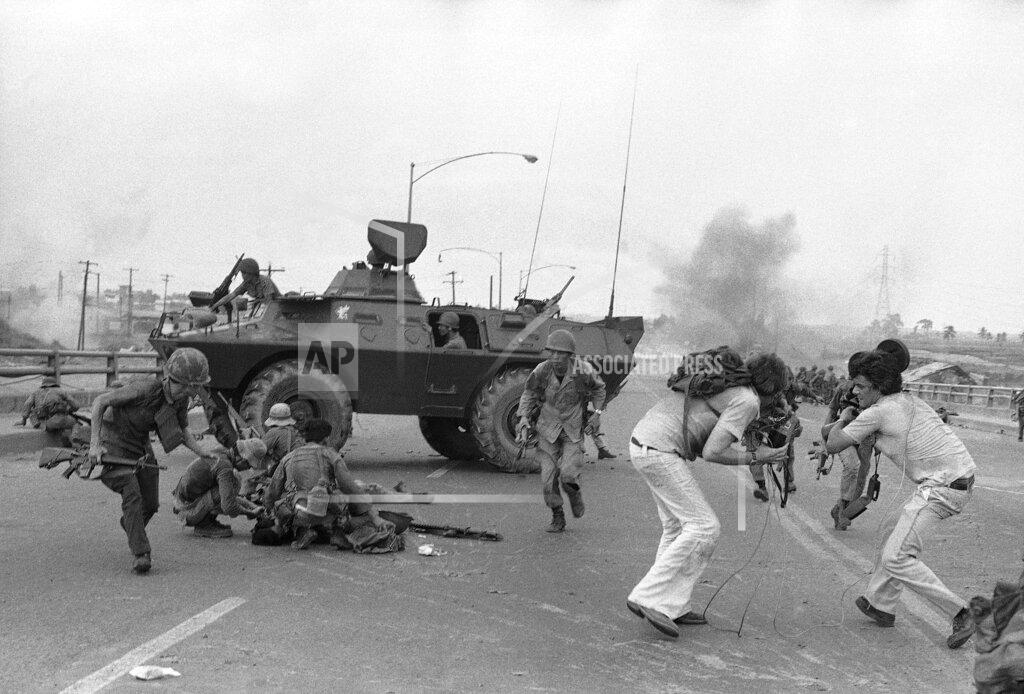
South Vietnam Vice-President Trần Văn Hương transfers authority as chief of state to General Dương Văn Minh (who helped overthrow Diệm in 1963); Dương is the South Vietnamese official with whom the Communists have indicated they are willing to negotiate. General Dương Văn Minh assumed the presidency of South Vietnam to seek peace with the Communists, but they rejected his initial declaration. Attacks continued around Saigon and rockets heavily damaged the capital’s airport. A 24-hour curfew was immediately imposed on the city, which was in fear of imminent danger, but it was not clear from whom — the Communists or South Vietnamese opposed to a settlement with the Communists.
A few hours after President Minh had spoken, Việt Cộng representatives at Tân Sơn Nhứt Airport read a statement by telephone denouncing United States policies and rejecting the President’s appeal. It appeared that the Communists were insisting that all Americans leave South Vietnam and that any “third force” politicians — presumably including General Minh’s new government — must simply subordinate themselves to the Việt Cộng. Thus, the Việt Cộng were apparently calling for complete and unconditional surrender.
For the first time shortly before 11 AM Tuesday [11 PM Monday New York time] the Việt Cộng delegation at Tân Sơn Nhứt could not be reached by telephone. But a broadcast from the Việt Cộng “Liberation Radio” heard here called for “correct and final action” by Communist forces. It said that the only role for the third force lay in “supporting the revolution.” The broadcast asked why all Americans had not been “immediately and urgently withdrawn.” It said that failure to withdraw showed that American plotting continued.
The heavy bombardment of the airport this morning, most of it apparently by inaccurate rockets rather than artillery, did not touch the Vietcong compound. Reached then by telephone, a spokesman said the North Vietnamese and Việt Cộng delegation was safe. He asked whether everything was all right in downtown Saigon, and said there was no news of any progress toward a cease‐fire.
It was understood that President Minh, with the help of aides, was working around the clock to stave off an attack and reach a peaceful settlement with the Communists. He is known to fear a possible military backlash from parts of the armed forces, and for this apparent reason, phrased his speech in such a way that it could encourage some military men to fight on. He called on them to defend the territory remaining under government control. This is thought by some analysts to have annoyed the Communist side, possibly enough to go ahead with a general attack.
The 59‐year‐old former general assumed office in a reception room of the Presidential Palace in the presence of most of the 146 members of the National Assembly and about 100 journalists and photograpers. The proceedings were broadcast by live television. The ceremony began as the first moonsoon storm of the season struck the city, and the speeches of participants were punctuated by the flash of lightning and crash of thunder, while rain and wind swept through open patio doors. The outgoing President, Trần Văn Hương, who had held office only one week following the resignation of President Nguyễn Văn Thiệu, walked slowly to the podium, leaning on his cane. He wished General Minh good luck in carrying out his mandate.
After Mr. Hương had stepped down, the Presidential seal was removed from the podium and replaced with the personal emblem of General Minh bearing Confucian symbols, including Yang and Yin, the two complementary opposites, which supporters said symbolized his will to achieve peace and reconciliation. In his 15‐minute speech, the new President referred to the Việt Cộng as “the Provisional Revolutionary Government of South Vietnam,” and addressed himself “to our friends of the other side.” Referring to the cease‐fire agreement signed in Paris in 1973, he said: “We sincerely want reconciliation. You know that Reconciliation requires that each element of the nation respect the other’s right to live. This is the spirit of the Paris agreement.” He added that the Communists had always called for implementation of that agreement.
President Minh appointed only two Government leaders. He named Nguyen Van Huyen, a lawyer, as Vice President “to help me in the negotiations,” and Vu Van Mau, prominent Buddhist and former Foreign Minister, as Premier. General Minh described his Government as one of reconciliation and concord and said it was designed “to obtain a cease‐fire accord, the sooner the better.” He promised a democratic government, freedom of the press, the freeing of political prisoners, and unity of all religious and political groups in the task of making peace. In remarks addressed to officers and soldiers, he said:
“Today an old page of history will be turned. You have new duty: This is to defend the territory that is left and to defend peace. Keep your spirit high, your ranks intact, and your positions firm to accomplish that duty. When the cease‐fire order is given, your mission will be rigorously to execute that order in accordance with the clauses of the Paris agreement and maintain order and security in your areas. You will not abandon your arms nor your ranks, and in any circumstances, you will strictly obey your officers. All undisciplined action will be immediately punished.” Although the Communists did not say so, this portion of the speech may have been the basis for their objection.
The Việt Cộng statement, read by telephone to The New York Times after the air raid, denounced the United States as still intervening in Vietnam. The statement called on the United States “to annul the Saigon Administration of war and repression,” and said the aspirations of the Vietnamese people embodied in the Paris cease‐fire accord must be met. The declaration by General Minh did “not conform to these objectives,” they said.
In Hanoi, North Vietnamese officials said General Minh’s return to power in Saigon had come too late. They indicated that a military solution was now in prospect, Agence France‐Presse reported. The revolutionary forces are determined to finish the job, the officials said. The rockets that startled falling on the city yesterday and today amounted to a sign of rejection of the overture that General Minh’s return was meant to signify. Continued infiltration of revolutionary forces around Saigon provided further evidence that a military solution was now in prospect.
After discussing the deteriorating situation in South Vietnam with the National Security Council, President Ford tonight ordered the Defense Department to begin the emergency evacuation by helicopter of all Americans remaining in South Vietnam. The evacuation affected at least 950 Americans. The evacuation of the Americans, believed to total more than 950, was expected to take less than nine hours. The plan called for picking them up in helicopters flown with United States marines as guards to Saigon from carriers lying off South Vietnam. The State and Defense Departments issued the following statement shortly before 4 AM:
“The President has ordered the evacuation of the remaining Americans from Vietnam. The military situation around Saigon, particularly at the airport, has deteriorated to such an extent that this measure has become necessary to insure their safety. “This operation is being carried out by U. S. military helicopters and is being protected by a security force of U. S. marines and tactical aircraft. Force will not be used unless essential to protect the lives of those involved. “The evacuees will be taken temporarily to carriers offshore before being moved onward to the U. S. “We do not have precise figures on the number of Americans involved, but it should be about 800 to 900.”
The evacuation by helicopter, a course that the Pentagon had hoped to avoid, was deemed necessary after North Vietnamese rocket fire had closed the Tân Sơn Nhứt airport on the edge of Saigon (where it is the 29th) and killed two American marines standing guard at the United States defense attaché office there. According to a Reuters report from Saigon, helicopters were seen landing on the roof of the United States Embassy there. The report said that a majority of the international press corps was assembling for evacuation.
The evacuation was ordered after an emergency meeting last night of the National Security Council. Ron Nessen, the Presidential press secretary, said that the meeting had lasted slightly less than an hour. Secretary of State Kissinger left the White House shortly after 2 AM and said in response to reporters’ questions: “We hope to have some good news pretty soon.” A reporter who saw President Ford commented on the President’s working late. “With good reason,” Mr. Ford replied.
The meeting of the President’s top national security advisers was called shortly after the Defense Department had received a “flash report” from the embassy in Saigon that two American marines had been killed. At the same time, the Pentagon also received a report that a United States C‐130 transport plane parked at the airport to pick up Vietnamese refugees had been destroyed by Communist rockets. As a result of the attack, American officials suspended evacuation operations for the second time in less than 12 hours.
The White House would say only that the National Security Council had met to review developments in South Vietnam. But the immediate presumption in the Defense and State Department circles was that the President and his advisers were considering whether to order a final evacuation of Americans in view of the deteriorating military situation around Tân Sơn Nhứt. Mr. Nessen said that the President had ordered the meeting after a note had been handed to him while he was meeting with energy and economic advisers in the late afternoon. Mr. Nessen said he did not know the contents of the note.
But from the timing it was apparent that the note had been handed to the President shortly after the Pentagon’s command center received the first word from Saigon of the killing of the marines and the destruction of the transport plane. According to Pentagon officials, four persons were injured in the shelling of the airplane, but it was not immediately clear whether they were Air Force crew members. No Vietnamese refugees were apparently aboard the plane when it was hit.
The Administration had been under rising Congressional pressure even before the rocket attack to order the evacuation of all Americans. In the wake of the killing of the two marines, Senator Richard S. Schweiker, Republican of Pennsylvania, issued a statement charging that the Administration was risking the lives of Americans “as a subterfuge to evacuate South Vietnamese.” “We’ve stalled this evacuation for at least a week, and maybe two,” the Senator said. “This is madness.” In the wake of the rocket attack, the Pentagon said that Tân Sơn Nhứt airport had been closed for the second time in 12 hours and that it was uncertain when it would be reopened. An alternative method of evacuating Americans would be to send helicopters and Marines from ships of the United States Seventh Fleet lying off the coast of South Vietnam. Pentagon officials, however, are concerned that there would be casualties in such an evacuation.
The new Cambodian government declared that no foreign military bases would be tolerated in Cambodia. The notice, apparently directed at North Vietnam, which has numerous troops and supply bases in Cambodia, was issued at the end of the third so-called national congress held by the new Communist leaders.
France has lost contact with her embassy in Phnom Penh and has appealed to the United Nations to intervene to rescue the French and foreign refugees who have been packed in there for 11 days, French officials said today. They said communications with the embassy were cut on Saturday, when 515 French nationals and 95 others were taking refuge there. France has asked the new Government in Phnom Penh to allow the refugees to be evacuated. Unconfirmed reports said some of them had dysentery. The French Government has become increasingly concerned with the plight of the refugees and has repeatedly appealed to the new authorities in Cambodia to allow food, water and medical supplies to enter the embassy premises.
Secretary General Waldheim has appealed to the new Cambodian Government to ease the plight of the refugees in the French Embassy in Phnom Penh. Mr. Waldheim sent an appeal to Peking addressed to Prince Norodom Sihanouk, titular head of the new regime, and another addressed simply to the “Government of Cambodia.” The Secretary General acted Saturday before departing for Vienna to open a new round of Cyprus talks, but United Nations officials said that no response had been received.
Rightist forces fought today to retake the strategic Sala Phou Khoun crossroads that they abandoned under Pathet Lao artillery bombardment earlier, military sources said. The sources said the pro-Communists had not actually moved troops onto the crossroads, which he rightists lost and regained last week, but continued to pound the area with artillery and rockets. They said the Pathet Lao apparently wanted for the present to simply keep rightist forces out of the area.
Greek and Cypriot leaders agreed in Vienna to establish a committee to study proposals for a future central government for the Mediterranean island. The decision to set up the joint study group was seen as a major achievement after three hours of talks on the first day of resumed Cyprus negotiations in Vienna under the auspices of U.N. Secretary General Kurt Waldheim.
The Common Market’s long-delayed program to help farmers in poor and mountainous areas got the final green light when farm ministers of the market agreed to fund the plan, informed sources said. The plan will benefit market members with particularly difficult geographical conditions such as Italy, Britain and Ireland.
Before Portugal’s election last weekend, the general prediction had been that the Communist party would trail, and that its voting strength would come nowhere near matching its organization and its apparent influence in public life. But few Portuguese or foreign- ers ventured to put the Communist figure as low as it turned out to be.
When the Soviet Union renounced its trade agreement with the United States last January because it would not accept the American requirement linking trading advantages to freer emigration, Bulgaria, Hungary and Czechoslovakia quickly aligned themselves with the Soviet position. Rumania, however, concluded a trade agreement with the United States on April 2. The accord is now before Congress for approval. Diplomats as well as Rumanian journalists, customarily assigned to present the official line to visiting newsmen here, view President Nicolae Ceaușescu’s decision to conclude the trade agreement as reflecting a deepening of the longstanding discord between Rumania and her Soviet neighbor. At the same time, the relatively independent line toward the Soviet Union is accompanied by what is generally felt to be a tightening of Mr. Ceausescu’s hold over all phases of life in Rumania and increasingly rigid restrictions on movement and thought.
Liam McMillan, leader of the Official wing of the Irish Republican Army in Belfast, was shot to death in a street. Republican sources said the shooting was a continuation of a bitter feud between the Marxist-oriented Official wing and the breakaway Irish Republican Socialist Party.
Paul H. Nitze, former secretary of the U.S. Navy, said a limitation on “throw-weight” of missile forces was more important than limiting the number of launchers in reducing the danger of nuclear war. Throw-weight is the amount of nuclear explosive capability that can be delivered against any specific target.
David Prosser, the lone security guard at Israel’s consulate in Johannesburg, South Africa, killed three consulate employees, held another 21 people hostage, and wounded 37 people. Although police initially estimated that six terrorists had seized the consulate, Prosser later revealed that he had fired weapons from different windows on the fifth floor, and had spoken to them by radio using different accents. South African police rushed the building after Prosser began firing from the window at crowds outside the building. Prosser, a South African Jew who had fought for Israel in the 1973 Yom Kippur, said that he had seized the consulate because he was dissatisfied with the government of Israeli Prime Minister Yitzhak Rabin. Prosser was captured alive, and later sentenced to 25 years in prison.
Soviet efforts to arrange a new session of the Geneva conference on the Middle East reached a new phase today as Yasir Arafat, head of the Palestine Liberation Organization, arrived for talks. Tass, the press agency, reported only that Mr. Arafat and a delegation of Palestinian officials were here for a “friendly visit.” The length of the visit or the specific topics to be discussed were not disclosed. There was no doubt that the visit was a step in the Soviet Union’s accelerated effort to reconvene the Geneva conference.
King Hussein of Jordan, piloting a Boeing 707, landed at Andrews Air Force Base today and was met by Secretary of State Kissinger to begin a private visit to Washington.
The Shah of Iran arrived in Saudi Arabia today for a two-day state visit that could set guidelines for future relations between the Middle Eastern gulf states.
China expressed resolute support for North Korean efforts to unite Korea but made clear it did not want to see renewed conflict on the divided peninsula. A joint communique issued in Peking following last week’s visit to China by North Korean President Kim II Sung emphasized the “peaceful reunification” of Korea.
Premier Chiang Ching-kuo was unanimously elected chairman of the ruling Kuomintang Party in a move designed to strengthen further his administrative hold over the Nationalist Chinese government on Taiwan. The party’s Central Committee convened an extraordinary one-day session to elect the 65-year-old premier to the leadership post held for 37 years by his father, Chiang Kai-shek, who died April 5.
Representatives of nine Roman Catholic orders and organizations appealed to Justice Minister Hwang San Duk to extend the residence permit of an American priest who has been ordered out of South Korea by Wednesday. The 45-year-old Maryknoll priest, the Rev. James Sinnott of Brooklyn, New York, is vicar general of the Inchon diocese and has been active in the movement agitating for democratic reforms.
Chile’s Foreign Press Association said the chief correspondent and the news editor of the French news agency Agence France-Presse in Santiago were detained by state security agents for 24 hours and then released. The association issued a communique declaring that the detention of Jacques Kaufmann, a Frenchman, and Enrique Guzman, a Chilean, were “arbitrary” and said a protest would be made to the highest levels of government.
Sixteen prominent personalities in the Argentine entertainment world apparently are defying a right-wing death squad’s ultimatum to leave the country or die. The Argentine Anti-Communist Alliance said in its ultimatum, which expired Sunday night, that the 16, among them actors, writers and directors, belonged to a Jewish-Marxist conspiracy. The AAA reportedly has killed dozens of leftists since the death of President Juan Perón last July 1.
Although businessmen and economists continue to predict that the nation’s deep recession will soon end, President Ford’s chief economic adviser, Alan Greenspan, warned that the bottom of the slide has not yet been reached, “despite a very dramatic slowing in the decline.” Mr. Greenspan, in a speech at the Eighth Annual Institutional Investor Conference in New York, said the continued drag comes primarily from the extensive inventory liquidation which is still underway. Coincidentally, the Commerce Department reported yesterday a further drop in the government’s index of leading economic indicators, which some ecomomists believe foretells the direction of business activity. The drop seemed to signal that the end of the recession could still be months away. Nevertheless, neither Mr. Greenspan, who is chairman of the President’s Council of Economic Advisers, nor most other analysts, seems especially worried about the specific timing of the recovery, which is widely expected to begin some time in the second half of the year.
The Supreme Court refused to block a second attempt by the Department of Justice to prosecute the three national television networks for violating antitrust laws by monopolizing prime-time entertainment programming. When the first suit against the networks was filed in April, 1972, network executives charged that it was an attempt by the Nixon administration to intimidate them and soften their political news coverage of the President during the election year.
After five weeks of argument, the House, voting 335 to 59, passed a $3 billion school lunch bill, but gave Republicans a partial victory by blunting proposals by the Democrats to increase the program’s cost. Although the bill is almost $1 billion above the current spending level and provides almost twice as much money as President Ford sought in his budget request, it was passed without $1 billion in increases originally sought by the Democrats.
Attorney General Edward H. Levi said the government shares with individuals the need for privacy and confidentiality if it is to perform its job properly. In what was described as a major policy statement before the Assn. of the Bar of the City of New York, Levi acknowledged the desirability of striking a balance between secrecy and openness, but he repeatedly emphasized the need for government to preserve areas of confidentiality rather than the public’s right and need to be informed. Levi said that “neither the concept of democracy nor the First Amendment confer on each citizen an unbridled power to demand access to all the information within the government’s possession.”
Richard M. Helms, former Director of Central Intelligence, denounced a newsman today for reporting charges that the Central Intelligence Agency carried out the assassination of foreign leaders. Mr. Helms made the comments to reporters after an appearance of nearly three hours before the Rockefeller commission—the longest appearance by any of the 44 witnesses who have testified during its 16‐week investigation of the CIA. The target of Mr. Helms’s attack was Daniel Schorr, the CBS newsman, who first reported that President Ford was concerned that the CIA investigation would reveal that the agency had a role in the assassination of at least three foreign leaders.
Richard M. Nixon has submitted a court statement that he authorized wiretaps on the telephone of Morton H. Halperin, former assistant to Henry A. Kissinger, “to protect national security information against foreign intelligence activities.”
A Federal judge reduced today the sentence of James W. McCord Jr., to four months in prison. It means that Mr. McCord, the chief wiretapper on the Watergate burglary team, may be free next month.
The House Ways and Means Committee voted to accept tentatively a Democratic-backed plan to increase gasoline taxes by 3 cents a gallon next year, and by up to 23 cents a gallon in 1977 if gasoline consumption is not reduced. The decision could be changed, however, as the committee goes ahead with preparing a comprehensive energy tax bill. The measure would provide that the existing 4-cent tax per gallon would be boosted by 3 cents on Jan. 1, 1976, and go up another 20 cents starting in 1977 if conservation goals were not realized. Most of the 20-cent levy, however, would be refunded for gasoline used to cover everyday driving needs.
Federal medical care of 29 million veterans is rapidly becoming second rate as “entire hospital staffs disintegrate” because of a $36,000 ceiling on pay for veterans’ doctors, a committee of more than 1,000 doctors charged. The Veterans Administration medical director, Dr. John D. Chase, conceded that care in the 171 VA hospitals was “slipping” for the same reason given by the doctors — the lowest medical pay scale in the federal service. Chase urged a House veterans affairs subcommittee to pass a bill permitting a yearly bonus of around $10,000, comparable to what other agencies pay.
An analysis prepared for the White House says prices of wheat and corn are expected to continue dropping through 1977, thus triggering billions of dollars in federal farm subsidies under the farm bill now before President Ford. The study was drafted last week by the Agriculture Department to gauge the impact of the one-year farm bill approved by Congress. It calls for increases in government price supports for major grain crops. cotton and dairy products. The White House has indicated that Mr. Ford will veto the bill. The analysis says wheat payments to farmers in 1976 could be $1.1 billion and $1.4 billion in 1977.
The Labor Department said the number of strikes during the first three months of 1975 was the smallest for any first quarter in eight years. The number of workers involved in the same period also was an eight-year low. But the strikes that did occur lasted longer. The average duration of a stoppage in this year’s first quarter was 14.7 days, compared to 8.7 days in the same period last year.
A group of physicists appointed last year by the American Physical Society to assess the safety of atomic energy reactors in the has found no reason for “substantial short-term concern,” but they were critical of the reactors’ long-range prospects. The study focused on the water-cooled reactors that are the standard energy sources in atomic power plants.
A rescue team reached the bodies of three victims of a weekend avalanche on Washington’s Mt. St. Helens. Two other members of a 29-member mountaineering class from the University of Puget Sound caught in the snow were still missing and presumed dead. The class had gone to the area for an overnight stay in tents and snow caves Saturday. The dead were identified as Richard Pfeffer, 18, of Federal Way. Karen Moniot, 24, of Tacoma and an unidentified woman. Missing were Philip Burdick of Eatonville and Erick Spurrell of Denver.
Rainbow Bridge in southern Utah does not appear damaged by the intrusion of backed-up Lake Powell waters, federal officials said. A report by the Bureau of Reclamation came after the giant arch in the Rainbow Bridge National Monument was monitored for each seasonal temperature extreme and during high and low levels of the reservoir beneath. The monitoring was started in August, 1973, the result of a federal court case challenging intrusion of water.
Artificial insemination was used to help produce the second whooping crane egg to be laid in captivity in nearly 20 years. The first such egg, laid 10 days earlier, was the product of the same pair of captive whoopers at the Patuxent Wildlife Research Station in Maryland. Artificial insemination was used for the second egg because of fears the first egg might be infertile, a spokesman said. Whooping cranes are nearly extinct, and researchers hope the eggs will hatch successfully.
Ringo Starr appears on “The Smothers Brothers Show”, singing Hoyt Axton’s “No No Song”, and John Lennon is the guest on Tom Snyder’s “Tomorrow” program, in what turns out to be his final television interview; both on NBC-TV.
The 18 N.B.A. owners ended a long search for a successor to Walter Kennedy Friday in Chicago by electing Lawrence O’Brien, former Postmaster General and chairman of the Democratic National Committee, unanimously.
Major League Baseball:
Mike Cuellar’s bases‐loaded walk to Aurelio Rodriguez in the ninth inning forced home the tying run, then Gary Sutherland tagged Dave Johnson for a two‐run single to give the Detroit Tigers a 5–3 victory over the Baltimore Orioles tonight.
Harmon Killebrew’s fourth home run of the season broke a sixth‐inning tie and Hal McRae’s bases‐loaded triple in the seventh carried the Kansas City Royals to 7–5 victory over Wilbur Wood and the Chicago White Sox tonight.
Manny Mota’s two‐run pinch single capped a three‐run eighth inning that lifted the Los Angeles Dodgers to a 4–3 victory over the Atlanta Braves tonight. The victory increased the Dodgers’ National League Western Division lead to 1½ games over the Braves.
The Yankees’ Rudy May stymied the Indians on just four hits to lead New York to a 4–1 win at Shea Stadium.
Bob Watson broke a sixthinning tie with a two‐run single to give Dave Roberts and the Houston Astros a 4–1 victory over the San Diego Padres tonight. It was the Padres’ fourth straight loss.
Detroit Tigers 5, Baltimore Orioles 3
Chicago White Sox 5, Kansas City Royals 7
Atlanta Braves 3, Los Angeles Dodgers 4
Cleveland Indians 1, New York Yankees 6
Houston Astros 4, San Diego Padres 1
Dow Jones Industrial Average: 810.00 (-1.80, -0.22%)
Born:
James Thrash, NFL wide receiver (Washington Redskins, Philadelphia Eagles), in Denver, Colorado.
Henry Slay, NFL defensive tackle (Philadelphia Eagles), in Elyria, Ohio.
Martin Lewis, NBA small forward (Toronto Raptors), in Liberal, Kansas.
Jordan Zimmerman, Canadian MLB pitcher (Seattle Mariners), in Kelowna, British Columbia, Canada.
Died:
Hans Heilbronn, 66, German-born Canadian mathematician and co-discoverer of the Deuring–Heilbronn phenomenon.
 History Diaries