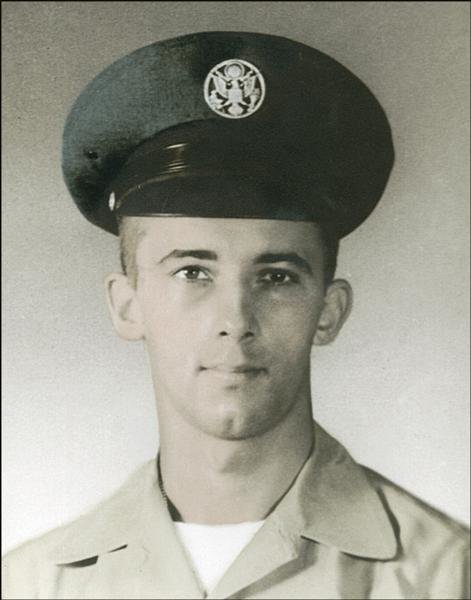
Airman First Class Robert Doss was a firefighter and rescueman with PARC Det 4. On 27 April 1965, at 1605 hours, an A-1 Skyraider of the RVNAF 23rd Tactical Wing, fully fueled and laden with Mk 82 500-pound bombs, crashed during take-off. A1C Doss and his crew responded immediately. As the rescue crew approached the burning aircraft to rescue the pilot, the ordinance on the aircraft exploded. A1C Doss was struck in the chest by a fragment from the exploding aircraft and was killed.
Robert is buried at Fort Harrison National Cemetery in Virginia. Robert is honored on the Wall at Panel 1E, Line 109.
President Johnson renews his offer of “unconditional discussions . . . with any government concerned,” and defends the U.S. bombing raids: “Our restraint was viewed as weakness. We could no longer stand by while attacks mounted.” Emphasizing the “utmost restraint” of his Administration in the war, the President defended the bombing of North Vietnam as necessary to hamper the Communists’ military effort and to demonstrate United States firmness. The bombing will continue, he said at a news conference, as long as North Vietnam’s aggression continues. At the same time, Mr. Johnson stressed his hope for a peace conference and his resolve to do “everything “within reason” to hold down the war’s cost in lives. The President’s discussion of Vietnam, which dominated his televised news conference in the East Room of the White House, capped a major effort by the Administration to explain and defend United States involvement in the war.
Mr. Johnson’s formal opening statement, read from a prompting device, and his answers to questions suggested no major changes in either diplomatic or military tactics at this stage. As in his policy address on Vietnam in Baltimore three weeks ago, the President was careful to offer “unconditional discussions” only to governments, thus apparently excluding direct talks at this time with the Việt Cộng rebels or their political organization, the National Liberation Front. Officials here refer to the rebels as agents of North Vietnam, but the Communist nations have proclaimed the front to be the “only legitimate representative” of the people of South Vietnam. Although the President said last month that he was ready to go anywhere, any time to meet with anyone, he substituted “any government” for “anyone” today. “And if any doubt our sincerity,” he added, “let them test us.”
The Saigon Government announced today that the United States Navy would begin patrolling South Vietnam’s coastal waters within the three-mile limit. In a communiqué, the Government declared those waters. a “defensive sea area” in which any ships could be stopped and searched. The statement also claimed the right to inspect ships within 12 nautical miles of the shore and to act even beyond those waters in some instances.
The United States Seventh Fleet has been patrolling the coastline for two months, relaying information about suspect vessels to the Vietnamese Navy. High-ranking United States Navy sources have said that the fleet was waiting to assume a more active role as soon as the legality of United States movements within the three-mile limit was assured, as it was today. More small and maneuverable Navy patrol boats have been reported on their way to the Seventh Fleet for the added duties. The communiqué cited the constant and increasing infiltration by sea into the Republic of Vietnam of Việt Cộng personnel, arms, ammunition and various war supplies.”
To end that infiltration, the Vietnamese and American patrol ships will consider any cargo “suspect unless it can be clearly demonstrated that it is destined for a port outside” South Vietnam, or for a legitimate importer in the country. In two airstrikes against the North today, Vietnamese and American pilots struck a ferry station and made a third pass at the Bai Duc Thon Bridge. Four propeller-driven Vietnamese Skyraiders hit piers and approaches at the Hữu Hùng ferry on the Kiến Giang River (Sông Kiến Giang) about 30 miles north of the demilitarized zone dividing North and South Vietnam. The ferry was not at the station during the attack. Eight United States Air Force fighter-bombers struck the bridge, buckling one of its three spans but not destroying it. The two strikes were supported by the same flight of 25 Air Force jets. All aircraft returned safely.
Former presidential candidate Barry Goldwater praises Johnson’s policies as what he had advocated in 1964. Barry Goldwater, the Republican candidate for the Presidency last year, said today that “my President has done the right thing in the right way” in Vietnam. Mr. Goldwater, speaking at luncheon meeting of the Anglo-American Press Association, introduced himself as the man who was portrayed in Europe as “the trigger-happy, warmongering s.o.b. who wanted to do something about supply routes in North Vietnam.” He said that people were called statesmen now for advocating the Vietnam policy that he wanted last year. “I hope that President Johnson will continue his strong policy, so that the spread of Communism will be stopped,” he said.
In answer to a question, he said that he would not advocate bombing China unless there was provocation, such as Chinese troops “in massive numbers” fighting in Vietnam. He said he sometimes thought, however, that if he were the President, he would “pray that Communist China give us provocation to attack their nuclear possibility.” But he said that he did not foresee provocation, because “it’s not in their interest.” Speaking of his future, Mr. Goldwater said: “I have no political aspirations other than the Senate.”
President de Gaulle declared tonight that he strongly disapproved of “the war in Asia, which is spreading more and more each day.” The French leader made plain his opposition to United States bombings of North Vietnam in a radio and television speech that stressed French independence of the United States but affirmed friendship with it. An assertion in the speech of French refusal to accept United States leadership came while important talks were in progress with the Soviet Union. Foreign Minister Andrei A. Gromyko had a “cordial” meeting with President de Gaulle for more than an hour in the afternoon and was believed to have renewed a standing invitation to the President to visit Moscow.
French diplomatic sources reported that Mr. Gromyko had also backed a French proposal for a disarmament conference of the five countries that have atomic weapons — the United States, Britain, France, the Soviet Union and Communist China. The President recorded his 17-minute speech this morning before he met Mr. Gromyko. The Soviet Minister began his talks with French officials yesterday. Appearing somewhat thinner but as forceful as ever, the President looked back over his seven years in power and said that the “capital fact” was that France had resisted the “siren calls of abandonment” to outside direction and had “chosen independence.”
The Soviet Government was reported today to be reluctant to act quickly on its own proposal for a conference on Cambodia. Such a meeting has been under consideration as a possible back door for arriving at negotiations to end the war in Vietnam. As co-chairmen of the 1954 Geneva conference on Indochina, Britain and the Soviet Union must act jointly to convene any talks on Cambodia. The expression of Soviet hesitation came a day after Britain had formally endorsed the proposal and two days after the United States had expressed interest in it.
Acting Foreign Minister Vasily V. Kuznetsov, in talks with Western diplomats today, was understood to have voiced concern over the fact that Prince Sihanouk, the Cambodian chief of state, had declared himself opposed to the conference proposal in a recent statement. According to informed sources, Mr. Kuznetsov indicated that the Soviet Government felt that the statement of the Prince had created a new situation and that it had to be studied carefully. He gave the impression that the Soviet Government had not yet reached a decision on whether it was advisable immediately to issue invitations for the conference, the informants said.
Communist China accused the Soviet Union of collaborating with the United States to defeat the Việt Cộng. Analysts in Hong Kong said the timing of the denunciation suggested that it was aimed at dissuading North Vietnam from accepting any Soviet peace talk proposal.
The Battle of Plaman Mapu on this day was one of the largest battles of the Indonesia-Malaysia Confrontation, a protracted undeclared war between Indonesia and a British-led Commonwealth of Nations over the creation of a new Malaysian state. The battle occurred as a result of an Indonesian effort to storm a British hilltop base at Plaman Mapu, on the border between the Malaysian state of Sarawak and Indonesia.
In the early hours of 27 April 1965, a crack battalion of Indonesian soldiers launched a surprise attack on ‘B’ Company, 2nd Battalion of the Parachute Regiment in their base at Plaman Mapu. The British garrison was outnumbered by at least five to one, but it managed to repel the Indonesian assault after an intense two hour firefight. Acting commanding officer Sergeant-Major John Williams received a Distinguished Conduct Medal for his role in the action. Relief units soon arrived by helicopter, but the battle had concluded by this point.
The battle was the last attempt by Indonesian forces to launch a major raid into Malaysian territory, and was a propaganda disaster for the Indonesian government. Dissent grew in military and political circles, particularly over the perceived foolishness of incumbent President Sukarno in continuing the conflict, and on 30 September elements of the army revolted against him. Despite the speedy defeat of the rebels, Sukarno’s rivals, particularly in the army, blamed the uprising on him and the Communist Party of Indonesia (PKI). The conflict subsequently began to wind down, and a peace treaty ending the Confrontation was signed in August 1966. The increasingly unpopular Sukarno was forced to step down from office the next year.
Plaman Mapu was a tiny Malaysian village situated less than 2 km behind the western part of the border between Sarawak and Kalimantan. There the British had established a base for ‘B’ Company of the 2nd Battalion, the Parachute Regiment. Apart from the two 3-inch mortars stationed there, the place had little strategic value beyond serving a lookout point for the detection of Indonesian raiders crossing the border. By the low standards of the makeshift British jungle bases, it was fairly well defended, being equipped with aforementioned mortars, an interconnected trench network, and a command bunker, with supporting artillery weapons within range of the base to supply cover. The defenders of the base, by contrast, were wholly unprepared for combat. The undermanned ‘B’ Company had recently been supplied with a platoon of inexperienced troopers who had little experience with jungle warfare. Due to the intensity of recent fighting, the base commander, Lieutenant Colonel Ted Eberhardie, had only been able to spare a few of the new men for a training course in such combat at Singapore, but one of those was Sergeant Major John Williams, who would play a crucial role in the coming battle.
Tension had been building among the base’s staff in recent days, and most suspected that an attack would come against one of the border stations in the near future. Ample evidence of the coming attack was discovered by British patrols, but signs of enemy troop movements were disregarded and newly cleared positions were mistaken for ambush sites. Thus the base was continually left with the bare minimum number of men as the majority that could be spared went out on patrol. As a result of these conditions, only 36 men were present in the base in the early morning hours of 27 April 1965 when it came under ferocious attack by 150 to 400 Indonesian troops, supported by artillery and rocket fire. Immediately, the Indonesians swarmed into one segment of the trenches and destroyed one of the two mortars.
Indonesian artillery fire continued to rain down on the camp, wounding several men and sending the defenders into disarray. Sergeant-Major Williams rushed to the headquarters to order the artillery officer to bombard the taken positions before attempting to organise a counterattack himself. Whilst under heavy Indonesian fire, Williams gathered a section of defenders who had taken refuge in a slit trench and led them towards the captured outer positions. A shell landed among the group and wounded half of them, but Williams and the remainder engaged at least thirty Indonesian infantry who had been firing into the base from the trench in vicious hand-to-hand combat and managed to push them from it with minor casualties. Williams then looked to secure the perimeter, but seeing that the Indonesians were massing for a second attack, he sat down in a vacated machine gun nest and sprayed the new wave of attackers, who attempted to seize the command bunker, with fire. This was not without cost, and Williams was fortunate to have escaped with a single head wound, which nevertheless blinded him in one eye, though he did not notice this in the heat of battle. Williams then began to receive supporting rifle fire from other British troops in nearby trenches, as well bombardment from the single remaining mortar and some 105mm artillery emplacements from a nearby camp.
After an hour and a half had gone (and twenty minutes had passed since the second attack) the Indonesians launched a third and final attack up the slope towards the base, which the British responded to with artillery and grenade fire. This defence was remarkably effective, and eventually the barrage of Indonesian rocket fire halted and the few remaining British soldiers rose from their hideouts and began to clear the perimeter. Soon afterwards, Gurkha soldiers and medical staff arrived at the base by helicopter, leaving the soldiers behind to secure the area and airlifting the wounded to a nearby hospital. By this point, however, Indonesian forces had withdrawn, effectively ending the battle.
Despite the sheer intensity of the fighting and the number of Indonesian troops, final casualty numbers are placed at a surprisingly low 2 killed and 8 wounded on the British side. The British in turn inflicted at least 30 casualties upon the Indonesians, but an exact number cannot be determined.
The Battle of Plaman Mapu is, by most accounts, considered a turning point in the Confrontation. Never again was such a powerful and concentrated cross-border attack attempted by the Indonesian Army. Within months Indonesia was convulsed by revolution, and as peace was secured in the next 12 months as the conflict ground to a halt. This was in part due to the actions of Lea, who responded by establishing a no-man’s land 10,000 yd (9,100 m) inside the Kalimantan frontier, through a series of intensive Claret raids, to “make absolutely clear to the Indonesians that their proper place was behind their own frontier.”
Williams was consigned to a six-month hospital leave and numerous surgical operations due to the injuries sustained during the battle. His actions were recognised as one of the most excellent examples of leadership, bravery, and professionalism during the campaign, receiving the Distinguished Conduct Medal the year after, and gained the nickname “Patch.”
In the continuing fighting of the Dominican Civil War, in the early morning of April 27, a group of 1,176 foreign civilians who had assembled in Hotel Embajador were airlifted to the Bajos de Haina naval facility, where they boarded USS Ruchamkin and USS Wood County, as well as the helicopters of HMM-264, which evacuated them from the island to USS Boxer and USS Raleigh. Later that day, 1,500 Loyalist troops, supported by armored cars and tanks, marched from the San Isidro Air Base, captured Duarte Bridge, and took position on the west bank of the Ozama River. A second force, consisting of 700 soldiers, left San Cristóbal and attacked the western suburbs of Santo Domingo. Wessin y Wessin ordered his armored units to cross the Duarte Bridge into Santo Domingo’s center. However, the tanks quickly became bogged down in fierce combat within the narrow streets; armed civilians destroyed them. Unable to advance, the Loyalists retreated to San Isidro. The battle resulted in hundreds of casualties. Rebels overran the Fortaleza Ozama police headquarters and took 700 prisoners.
After three days, the coup attempt to restore Juan Bosch as President of the Dominican Republic appeared to be collapsing after a counterattack by military forces loyal to President Donald Reid Cabral. President Molina was forced from office only two days after he had been installed by the pro-Bosch rebels, and was replaced by Colonel Pedro Bartolome Benoit of the Dominican Air Force. The actual situation was confused and fluid; with many rebels vowing to fight on. With American lives potentially threatened, President Johnson begins to plan a U.S. intervention to restore order.
Indian forces knocked out six Pakistani tanks in battle yesterday in the disputed Rann of Cutch, official Indian spokesmen said tonight. The battle, which took place at Biar Bet, 24 miles east of a ruined mud fort at Kanjarkot, ended with neither side in possession of the battlefield, the officials said. According to spokesmen, Indian losses were fewer than 10 men, while Pakistani attackers lost 140 men out of a force estimated at 3,000 to 3,500.
Indian and Pakistani troops were still facing each other along a “front” of more than 50 miles in the northern part of the desolate area but officials said that apart from shelling today there was a “comparative lull” in the Rann of Cutch. Rann means desert in the dialect of the area, although the rann is turned into an impassable salt marsh in the monsoon season. Officials suggested that Pakistani troops might be preparing for further attacks against Indian positions in the disputed territory.
Pakistani officials said yesterday that there would be no cease-fire until Indian troops withdrew south of the 24th Parallel, which would mean Indian troops would leave 3,500 square miles of territory. Pakistani officials also said they were determined to drive Indians off the high ground in the region before the monsoons, expected in three weeks to a month or two, turn the rest of the rann into a tidal marsh. The reported knocking out of six Pakistani tanks at Biar Bet brought to 10 the number of Pakistani armored vehicles Indian troops claim to have destroyed or disabled since the fighting began in the Rann early this month.
President Johnson today defended his postponement of official visits by the leaders of India and Pakistan as a wise decision and “one that I would make again.”
Some 10,000 Tunisians attacked the Egyptian and Iraqi embassies, retaliating for Arab demonstrations against Arab-Israeli peace plans by Tunis.
The United Arab Republic announced tonight that it had withdrawn its Ambassador from Tunisia in the wake of a reported attack on its embassy by Tunisian crowds. The Government also denounced any attempt by President Hahib Bourguiba of Tunisia to be an intermediary between the Arabs and Israel. “This is a case in which there can be no intermediary, no negotiation nor compromise,” Foreign Minister Mahmoud Riad told National Assembly members tonight. It was the first official Egyptian comment on Mr. Bourguiba’s proposal for Arab recognition of Israel and negotiation on repatriating Palestinian Arab refugees. The United Arab Republic rejects” these proposals and “strongly denounces the issuance of such a proposal from the head of an Arab state,” Mr. Riad declared.
A blast of dynamite today opened a 9.9-mile tunnel that will make possible an increase of Lebanon’s electric power by one-third and eventually make available for the first time a regulated flow of water on the Western slopes of the Lebanon mountains.
Prime Minister Harold Wilson of Britain, accompanied by his wife, arrived here tonight for a two-day round of friendship talks with Italian leaders. Mr. Wilson is also scheduled to have an audience with Pope Paul VI tomorrow evening. In a speech of welcome at the airport Premier Aldo Moro termed Mr. Wilson’s visit a “renewed confirmation” of the “friendly” alliance between Italy and Britain. He declared that their talks would cover a number of topics. including the Atlantic alliance, European unification, East-West relations and “situations of tensions and dangers existing in the world.”
The British Labour Party cabinet approved plans to renationalize most of Britain’s steel industry.
A Spanish magistrate and police officials have gone to Villanueva de Fresno, two miles from the Portuguese frontier, to identify three bodies, one of which was reported last night to be that of Lieutenant General Humberto Delgado, Portuguese opposition candidate for the Presidency in 1958.
Russia broke a long silence by releasing the figures on its wheat crop failure in 1963 and at the same time claimed a record production of grain and several other crops during 1964.
High Bulgarian officials said today that 8 to 10 persons had been arrested “so far” for conspiracy against the Government and the Communist party.
The Communist world is developing an elaborate propaganda campaign to turn the 20th anniversary of victory in Europe into “Hate West Germany Day.”
President Johnson said today that the federal budget deficit this fiscal year would be at least $1 billion below the January estimate. Half the estimated drop results from decreased government expenditures and half from increased revenues, the President told a news conference. The new estimate of the deficit for the year ending June 30 is $5.3 billion — the difference between $97 billion in expenditures and $91.7 billion in receipts.
Mr. Johnson attributed the drop in expenditures to “our continuing drive to hold down government spending.” The Bureau of the Budget said the spending decrease was in the Department of Defense and a number of other agencies. The President also congratulated negotiators for the steel industry and the United Steelworkers of America for having reached a “statesmanlike” interim labor agreement putting off the earliest possible strike date to September 1. Negotiators agreed today to resume bargaining on May 18 for a long-range agreement covering the basic steel industry.
President Johnson defended the nation’s antipoverty program today against what he called unfair and unjust criticism. He predicted that it would be “one of the great monuments to this Administration.” Mr. Johnson’s defense of his key legislative program enacted last year came in response to a question at his news conference. The antipoverty program came under heavy attack from groups in some cities, principally New York, Chicago and Cleveland, at Congressional hearings before Easter. The hearings will be resumed Thursday.
Critics have charged that the poor are excluded from policymaking roles and that the “powers that be” are seeking to keep the poor from becoming a new political force. “We will have difficulties.” Mr. Johnson conceded today. “We will have politicians attempting to get some jobs in the local level; we’ll have differences, as we do in all our programs.” But he said he knew of no national peacetime program “that has reached so many people so fast and effectively.” He said he had “great confidence” in the program’s director, Sargent Shriver.
Vice President Hubert H. Humphrey appeared to get nowhere in his first effort at mediating differences on the voting rights bill in the Senate. President Johnson indicated today that he would have liked a flat ban on poll taxes in the voting rights bill but had deferred to the Justice Department’s view that this might raise a constitutional problem.
An agent of the Federal Bureau of Investigation testified in Federal Court today that he saw deputies of Sheriff James G. Clark Jr. use cattle prods while putting several hundred young Blacks through a forced march on February 10 this year. The testimony was given by Joseph M. Avignonne during the second day of a hearing at which Sheriff Clark has been ordered to show cause why he should not be held in contempt for violating an order by United States District Judge Daniel H. Thomas. Judge Thomas’s order detailed how the registration of Black voters should proceed in Dallas County. Mr. Avignonne said he saw “four or five or six instances” of the use of cattle prods.
In an unprecedented move, Demopolis, Alabama, city officials and Black leaders plan a joint appearance on radio Thursday to report progress in biracial negotiations. About 250 Blackyouths held a brief protest march today in the western Alabama town that is desperately trying not to become another Selma.
President Johnson announced a surprise shakeup in top aviation agencies as part of a reshuffling that involved eight major posts.
The Supreme Court outlawed a Virginia requirement that voters file a certificate of residence as a substitute for the poll tax in federal elections.
Former Georgia Governor Ellis Arnall, testifying before a Senate subcommittee, accused the Federal Food and Drug Administration with improper use of concealed electronic equipment to record conversations.
A crowd of 500 U.S. Army and U.S. Marine Corps generals and U.S. Navy admirals, accompanied by members of the press, saw the disastrous failure of the test flight of a prototype vertical take-off jet aircraft, the Ryan XV-5 Vertifan. Test pilot Lou Everett lifted the jet from Edwards Air Force Base, and was returning for a landing when the plane failed while switching from normal horizontal flight to a straight descent. At an altitude of 800 feet (240 m), Everett was on the fifth of eight steps in the conversion process when he radioed “I’ve got to get out!” As the observers watched from 2 miles (3.2 km) away, the Vertifan jet plunged to the ground and exploded. Everett was able to eject while less than 300 feet (91 m) from the ground, but his parachute failed to open and he was killed on impact.
By voice vote, the United States Senate voted to approve an emergency appropriation of $2.2 billion to bail out government agencies that had already exhausted $17.5 billion allotted to them. What made the vote unusual was that by the time that the “brief and apathetic debate” ended, only seven of the 100 U.S. Senators remained present to vote.
The Senate Commerce Committee voted favorably today on legislation to require the printing of a health warning on cigarette packages but it balked at extending the warning to cigarette advertising.
Edward R. Murrow, whose independence and incisive reporting brought heightened journalistic stature to radio and television, died yesterday at his home in Pawling, New York, at the age of 57.
R.C. Duncan patents the “Pampers” disposable diaper.
Dow Jones Industrial Average: 918.16 (+1.3)
Major League Baseball:
The Phils set a team record with 6 home runs but still lose to the Giants 14–13. Dick Allen has 4 hits, including 2 homers, and scores 4 times. Willie McCovey has a 3–run homer and 4 RBIs for the Giants, who score the winning run in the 9th on a two-out walkoff solo homer by Matty Alou.
The Twins unload seven runs in the first inning and coast to an 11–1 win over the Indians. The big blow is Camilo Pascual’s grand slam off Stan Williams, the 2nd grand slam of his career. Pascual makes it easy as he tosses a two-hitter.
Jim Fregosi’s two-out single in the eighth inning, his third hit of the game, scored Jimmy Piersall with the decisive run as the Los Angeles Angels defeated the Detroit Tigers tonight, 4–3.
Frank Howard drove in the first four Washington runs with a homer and single tonight and the Senators went on to score a 5-2 victory over the Baltimore Orioles behind the relief pitching of Steve Ridzik.
The Milwaukee Braves unloaded a 13-hit attack, including homers by Eddie Mathews and Denny Menke, to trounce the St. Louis Cardinals, 9–5, tonight.
Dick Tracewski drove in three runs for the Los Angeles Dodgers tonight as they handed the Pittsburgh Pirates their sixth straight defeat, 5-4.
Frank Robinson and Tommy Harper rapped four hits each tonight in leading the Cincinnati Reds to a 5–3 triumph over the Chicago Cubs.
Washington Senators 5, Baltimore Orioles 2
Boston Red Sox 1, Chicago White Sox 10
Chicago Cubs 3, Cincinnati Reds 5
Minnesota Twins 11, Cleveland Indians 1
California Angels 4, Detroit Tigers 3
New York Mets 2, Houston Astros 3
Pittsburgh Pirates 4, Los Angeles Dodgers 5
St. Louis Cardinals 5, Milwaukee Braves 9
Philadelphia Phillies 13, San Francisco Giants 14
Born:
Courtenay Becker-Dey, American Europe class sailor (Olympic bronze medal, 1996), in Greenwich, Connecticut.
Bob MacDonald, MLB pitcher (Toronto Blue Jays, Detroit Tigers, New York Yankees, New York Mets), in East Orange, New Jersey.
Paul Miller, MLB pitcher (Pittsburgh Pirates), in Burlington, Wisconsin.
Doug Rothschild, NFL linebacker (Chicago Bears), in Sunnyvale, California.
Yves Heroux, Canadian NHL right wing (Quebec Nordiques), in Terrebonne, Quebec, Canada.
Anna Chancellor, English actress (“Four Weddings and a Funeral”, “The Hour”); in Richmond, London, England, United Kingdom.
Rob Squires, American rock bassist (Big Head Todd and the Monsters), in Denver, Colorado.
Died:
Edward R. Murrow, 57, pioneering American broadcast journalist, and later the director of the United States Information Agency; from lung cancer.
Alan Bunce, American radio and television actor (“Homicidal”, “Ethel & Albert”).
Lou Everett, 40, American test pilot and fighter pilot in two wars; in plane crash.
 History Diaries