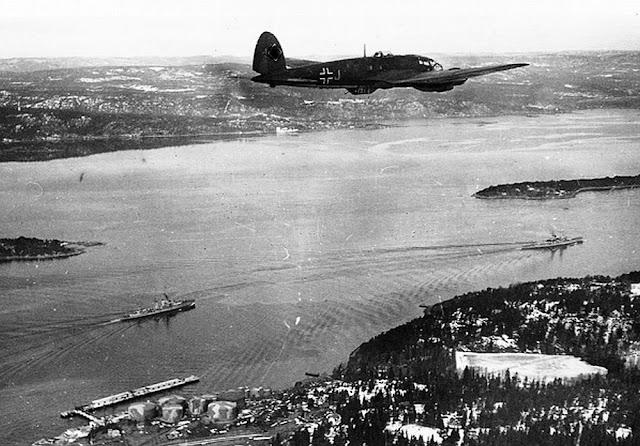
The British 15th Infantry Brigade repulsed an assault of the 196th Division of the Wehrmacht at Kvam. 3,000 troops of the British 15th Brigade were engaged by 8,500 troops of the German 196th Division at the village of Kvam in Norway, 55 kilometers south of Dombås; despite German numerical advantage and being supported by dive bombers, the British troops held ground and stopped the German advance for two days.
The topography of Kvam made it a perfect location to set up a defense against the advancing German army. Downriver from Kvam is a sharp bend in the Lågen River, known as the “Kvam’s knee.” Above the bend in the river, the Gudbrandsdal Valley widens to flat and open farmland, giving good fields of fire. At the bend in the river, the road is narrow with very steep hills to the east. There is a large island on the Lågen where the river splits. Due to ice jams on the river, much of the island was flooded. Battlefield accounts refer to the island as Viksøya (on most maps, it is called Storøya). There are hills on the island near the road directly opposite steep slopes to the east. The hillsides were still covered in knee deep snow and the local lakes were still solidly frozen over to the point that the British were briefly able to establish an airfield on one frozen lake at Leskasjog a few days before the battle. In April at Kvam’s latitude, civil twilight begins around 4:30 a.m. and ends around 10:00 p.m. It was at the small village of Kvam that the British set up their defenses to stop the German advance.
In order to slow the German movement up the Gudbrandsdal valley, the retreating British and Norwegians first tried to blow up a very narrow portion of the road south of Kvam called the Kvamsporten [the gates of Kvam]. This narrow portion of the road was lined with steep rock cliffs. The demolition did little to slow the advancing Germans. A few British planes from the airfield on the nearby lake appeared in the sky, offering encouragement of air support in the early hours of the 25 April; however, the Germans quickly destroyed the airfield, any surviving planes retreated north to safety, and British airpower was non-existent during the battle.
Upon his arrival, Brigadier H. E. F. Smyth set up his headquarters in front of the Kvam Church. The British soldiers of 1st King’s Own Yorkshire Light Infantry arrived around 4:15 AM. They quickly shed their heavy arctic clothing and, carrying only their weapons, ammunition and ’37 web gear, began to set up defensive positions. Lieutenant Colonel E.E.E. Cass put “A” and “C” companies on the island in the Lågen river west of the road and “B” company east of the road up on the steep slopes. The British soldiers were armed with rifles and bayonets, Bren light machine guns, and two Ordnance ML 3 inch mortars. In addition to their light weapons, the British soldiers had five 25 mm Hotchkiss anti-tank guns set up at the forefront, and three in support further behind.
General Jacob Hvinden Haug had informed the British that Norwegian soldiers under his command, who had dug in south of Kvam, could hold until the evening of the 25th. Unfortunately at 7:30 AM on the 25th, the Norwegian soldiers moved into Kvam, carrying their wounded through the British lines. There was now nothing between the British and the advancing German army.
The advanced elements of the German forces came up the road at 11:50 AM. As the Germans approached, the first up the road was a Panzer II tank, followed by a light tank and an armored car. The King’s Own Yorkshire Light Infantry held their fire until the Germans were within 150 yards, when they opened fire disabling the tanks and causing immediate casualties on the German infantry, who were accompanying the tanks. The Germans immediately responded with their artillery and mortars. The heavy artillery and mortar barrage caused heavy casualties for the British soldiers near the front line positions. At noon, Brigadier General Smyth was badly wounded by shrapnel from the artillery and was forced to relinquish command to Lt. Col A.L. Kent-Lemon, battalion commander of the York and Lancaster Regiment.
After a brief pause, the Germans infantry moved up the slope on the east side of the road to attack “B” company, but they were repulsed. The Germans then moved across the frozen river to attack the “A” company position on the island. “A” company had already suffered heavy losses from the artillery barrage, and was unable to stop the German offensive. By mid-afternoon, “A” company ceased to exist as an independent company, having lost 4 officers and 85 other ranks. “C” company moved forward to reinforce the line. At 5:30 PM, the first reinforcements arrived from the 1st York and Lancaster Regiment, which reinforced the left flank.
By nightfall, company “B” on the east slope had held its position against the Germans, but its position was precarious. It decided to withdraw toward the village center of Kvam. Company “B” was reportedly in high spirits, having fought off several German attacks. In their withdrawal, the company had to abandon two of its Hotchkiss anti-tank guns.
At the end of the first day of fighting, the British had 89 casualties killed or wounded, while the Germans had 4 soldiers killed.
The Battle of Gratangen ended in German victory. The surviving Norwegians retreated from Gratangsbotn. The depleted battalion was later reorganized as a reduced battalion with two rifle companies and one support company and participated actively in the rest of the campaign. Despite soundly defeating I/IR12, the Germans understood that their position in Gratangsbotn was untenable. The fresh Alta Battalion under Arne Dagfin Dahl pressed on from the north and II/IR15 resumed its advance over Lapphaugen. The Germans therefore abandoned Gratangen soon after the battle.
For the Norwegians on the Narvik front, the battle of Gratangen proved their first serious lesson in the art of war. Before the battle, the inexperienced Norwegian soldiers often had hesitated to fire on the enemy. After Gratangen, the bitterness caused by the German ruthlessness — particularly the use of civilians as human shields during the battle — ensured that any such reservations were gone.
At Hegra Fortress, the German shelling and Luftwaffe attacks continue. The Luftwaffe utilizes a seaplane carrying a 1,800 kg (4,000 lb) bomb. The bomb destroys the area surrounding the fortress and sends shrapnel flying literally for kilometers.
The group of RAF Gladiator aircraft operating on the frozen Lake Lesjaskogsvatnet in Norway was discovered by the Germans. German aircraft bombed the rough airfield on and off for eight hours, destroying 13 aircraft on the ground. Three German He 111 bombers were shot down by RAF aircraft. By the end of the day, Squadron Leader Donaldson ordered the position to be abandoned; the 5 surviving Gladiator aircraft were to be withdrawn to Stetnesmoen.
RAF Bomber Command dispatches 18 aircraft to attack targets at Oslo and Stavanger overnight.
RAF Bomber Command dispatches 28 aircraft on unsuccessful minelaying operations overnight. RAF bomber command attempts a minelaying operation with 28 aircraft that does not get to its target location. The Luftwaffe night fighter force downs one of the bombers.
The first RAF Bomber Command aircraft is downed by a Luftwaffe night fighter.
The Royal Navy trawler HMS Bradman was bombed and sunk in the Norwegian Sea off the west coast of Norway by Luftwaffe aircraft.
The Royal Navy trawler HMS Hammond was bombed and sunk in the Norwegian Sea off the west coast of Norway by Luftwaffe aircraft. She was salvaged by the Germans in 1942, repaired and entered Kriegsmarine service as Salier in 1945.
The Royal Navy trawler HMS Larwood was bombed and sunk in Fannefjord off Molde, Norway by Luftwaffe aircraft. She was salvaged by the Germans in 1940, repaired and entered Kriegsmarine service as Franke.
The Norwegian hospital ship Brand IV was bombed in the Norwegian Sea off Ålesund by Luftwaffe aircraft and ran aground.
The Royal Norwegian Navy Trygg-class torpedo boat HNoMS Trygg was bombed and sunk in the Romsdalsfjord off Åndalsnes by Luftwaffe aircraft. She was salvaged by the Germans, repaired and entered Kriegsmarine service as Zick.
The Norwegian coaster Folden was bombed and damaged off Tonnes, Nordland by Luftwaffe aircraft. She was beached with the loss of at least six of the 21 people on board. Although condemned as a total loss, she was repaired and returned to service in July 1944.
The Norwegian cargo ship Haardraade was bombed and sunk at Leirvik, Hordaland by Royal Air Force aircraft with the loss of one crew member. Later raised, repaired and returned to service as Hodnaberg.
The Norwegian cargo ship San Miguel was scuttled off Ulvik in the Hardangerfjord by Norwegian troops during a German attempt at capture. Later raised, repaired and returned to service.
The German Navy (Kriegsmarine) armed auxiliary Schiff 18 was severely damaged at Kinsarvik by Norwegian troops firing machine guns and a lorry-mounted naval gun, and forced to beach at Utne, Norway.
The German cargo ship Afrika, which had been captured by the Royal Norwegian Navy torpedo boat HNoMS Stegg on 9 April, was scuttled in Hardangerfjord off Ulvik, Norway during a German attempt at recapture.
The Dutch fishing vessel Willy struck a mine and sank in the North Sea off Terschelling, Friesland with the loss of all hands.
Destroyers HMS Somali, HMS Mashona, and HMS Tartar departed Scapa Flow at 2015 for Rosyth to escort troopships Ulster Monarch (3791grt) and Ulster Prince (3791grt) from Leith to Åndalsnes. The destroyers arrived at Scapa Flow at 1700/27th with these troopships, after being diverted en route.
A new evacuation scheme was introduced in Britain as a Ministry of Health survey showed that only 8% of eligible children had been registered. Later studies revealed that 19% of parents refused to register their children, while 73% of them simply did not respond to the registration.
Sir John Anderson, British Home Secretary and Minister of Security, told the House of Commons tonight that he was considering the question of declaring the British Communist party illegal, as part of general measures to strengthen the defense and check any internal activities that might Impede the national war effort.
An explosion set off by the Irish Republican Army rocked Dublin, Ireland. Premier Eamon de Valera took personal charge tonight of investigation of the bombing, allegedly by the outlaw Irish Republican army, of the government’s special detective bureau at Dublin castle headquarters. Five detectives were injured, none seriously, in this morning’s blast, caused by detonation of either a time bomb or a land mine. It threw tons of debris masonry, costly blue and gold stained glass memorial windows into the old castle courtyard, in the heart of the Irish capital.
Jewish leader David Ben-Gurion departs Palestine for a visit to the United Kingdom and the United States.
Italy refused to resume conversations with France regarding “outstanding differences” between the two countries when French Ambassador Andre Francois-Poncet suggested the move to Foreign Minister Count Galeazzo Ciano today, unimpeachable sources said to night. French and Italian quarters said that Count Ciano replied that he regretted that “the moment is not opportune.” Francois-Poncet intimated that this might be the last time the French government would be in a position to make overtures. Disclosure of this conversation followed an accusation by the Italian ministry of colonies, through its weekly publication, that Great Britain and France are massing a huge army in the near east with the intention of attacking Italy’s African possessions and extending the war, Great Britain and France hope to spread the war to the Mediterranean and drag in Turkey and Egypt, the ministry’s publication Azione Coloniale, alleged.
Hostility toward Great Britain and France and a conviction that the war would spread and presumably engulf Italy were expressed in the Chamber of Fasces and Corporations today by Francesco Giunta in the presence of Premier Mussolini. Signor Giunta is one of the very early Fascisti. He took an active part in the movement from before the seizure of Fiume. He is a former secretary of the party and a former vice president of the now defunct Chamber of Deputies.
Rumania’s King Carol tonight signed a sweeping amnesty for about 1,000 persons serving prison terms or awaiting trial for infractions of the law of April 15, 1938, designed to preserve order in the country. This means in effect that everyone accused of illegal political activities receives amnesty. The decree applies equally to all members of former political parties from the pro-Nazi Iron Guard to the Communists. The government said the step had been proposed to King Carol to pacify the country politically, as difficult times made complete unity essential.
Hungarian Premier Count Pál Teleki in the House of Deputies today defended former Premier Bela Imredy and Deputy Milotay against charges made on the floor yesterday that they had fostered “foreign interests” in Hungary. Count Teleki rebuked and warned their accuser, Deputy Szemere. “I must repudiate such insinuations,” the Premier said of the accusation, “and I must warn the members that such attacks against officials threaten the dignity of both the nation and this House. The attack was directed against a man whose patriotic work is recognized by the whole nation.”
Stockholm proposes joint defense of Aland Islands with Finland, but plan makes no headway due to opposition from Germany and Soviet Union.
The British cargo ship Margham Abbey in Convoy FS 53 struck a mine and sank in the Thames Estuary north of Herne Bay, Kent. All crew were rescued.
The Panamanian cargo ship Bobby collided with the Dutch ship Midsland in the English Channel, 3 nautical miles (5.6 km) south east of Dungeness, Kent, United Kingdom and sank. All 28 crew were rescued by Midsland.
Convoy OA.136 departed Southend escorted by destroyer HMS Venetia.
Convoy OB.137 departed Liverpool escorted by destroyer HMS Walpole from 25 to 28 April, when she was detached to convoy SL.28.
Convoy BC.34 of steamers Baron Carnegie, Dunkwa (Commodore), Gloucester City, Kufra, and Lottie R departed Loire escorted by destroyer HMS Montrose. The convoy arrived in Bristol Channel on the 26th.
Convoy FN.155 departed Southend, escorted by destroyer HMS Whitley and sloop HMS Londonderry. Destroyers HMS Whitley and HMS Winchester joined from convoy FN.153. The convoy arrived at the Tyne on the 27th.
Convoy MT.59 departed Methil, escorted by destroyers HMS Vivien and HMS Vimiera. The convoy arrived in the Tyne later that day.
Convoy FS.155 departed the Tyne, escorted by destroyers HMS Vivien and HMS Vimiera. The convoy arrived at Southend on the 27th.
The War at Sea, Thursday, 25 April 1940 (naval-history.net)
Destroyers SOMALI, MASHONA, TARTAR departed Scapa Flow at 2015 for Rosyth to escort troopships ULSTER MONARCH (3791grt) and ULSTER PRINCE (3791grt) from Leith to Aandalsnes. The destroyers arrived at Scapa Flow at 1700/27th with these troopships, after being diverted en route.
Sloop BLACK SWAN departed Scapa Flow at 1000 for Aandalsnes to arrive at dusk on the 26th.
Sloop FLEETWOOD arrived at Scapa Flow at 0500 with wounded from damaged sloop PELICAN. Sloop FLEETWOOD also escorted steamer HIGHLANDER (1216grt) from Lerwick to abreast Scapa Flow.
Destroyer WHITLEY attacked a submarine contact in 51-00N, 01-00E. The contact was assessed as doubtful.
Mine destructor ship CORFIELD was lent to Vice Admiral, Dover.
Motor tanker SEMINOLE (10,389grt) was damaged on a mine in 51 29N, 04 07W.
At 0545, submarine TRIDENT fired two torpedoes at German steamer PALIME (2863grt) or PELIKAN (3264grt) returning from Stavanger in 57-30N, 6-10E.
U-22 had been earlier declared lost after failing to return to Germany from her patrol area off Lindesnes. She was probably lost around 23 March on a mine twenty miles south of Kristiansand in 57N, 09E. Some sources credit U-22’s loss to an attack by French submarine ORPHEE on the 21st, but this is in error.
French submarine DORIS arrived at Harwich after patrol. Submarine DORIS had defects that required repair before she could resume patrol.
French large destroyers MAILLE BREZE and EPERVIER departed the Clyde at 0430 with French convoy FS.2 for Scapa Flow to arrive at 1000/27th. The convoy was diverted to Scapa Flow at 2129/27th. This convoy, escorted by French sloops CHAMOIS and COMMANDANT DELAGE, departed Brest on the 18th with freighters BRESTOIS (3094grt), CHATEAU PAVIE (2047grt), and SAINT FIRMIN (4528grt). On 26 April at 1900, destroyers WITCH and CAMPBELL departed Scapa Flow to relieve French destroyer MAILLE BREZE which arrived in the Clyde on the 27th. The convoy arrived safely at Harstad at 2320 on 1 May, escorted by destroyers WITCH and CAMPBELL. CHATEAU PAVIE disembarked at Stoveien, SAINT FIRMIN at Skaanland and Bogen, BRESTOIS at Skaanland.
Light cruiser EMERALD and liner DUCHESS OF RICHMOND arrived at Liverpool from Halifax. The light cruiser went on to the Clyde.
Danish steamer LILY (1281grt) departed Kirkwall for Preston with a British prize crew aboard. The steamer never arrived. Temporary Lt A.M. Speirs RNR, the five ratings of the prize crew were lost.
Convoy OA.136 departed Southend escorted by destroyer VENETIA.
Convoy OB.137 departed Liverpool escorted by destroyer WALPOLE from 25 to 28 April, when she was detached to convoy SL.28.
Convoy BC.34 of steamers BARON CARNEGIE, DUNKWA (Commodore), GLOUCESTER CITY, KUFRA, and LOTTIE R departed Loire escorted by destroyer MONTROSE. The convoy arrived in Bristol Channel on the 26th.
Convoy FN.155 departed Southend, escorted by destroyer WHITLEY and sloop LONDONDERRY. Destroyers WHITLEY and WINCHESTER joined from convoy FN.153. The convoy arrived at the Tyne on the 27th.
Convoy MT.59 departed Methil, escorted by destroyers VIVIEN and VIMIERA. The convoy arrived in the Tyne later that day.
Convoy FS.155 departed the Tyne, escorted by destroyers VIVIEN and VIMIERA. The convoy arrived at Southend on the 27th.
Dutch steamer MIDSLAND (1089grt) and Panamanian steamer BOBBY collided three miles south of Dungeness. Steamer BOBBY sank and the entire crew was picked up by the Dutch steamer. Steamer MIDSLAND had damage to her bows.
Dutch fishing vessel WILLY (147grt) was sunk in mining off Terschelling. The entire crew of the fishing vessel was lost.
U.S. President Franklin D. Roosevelt issued a proclamation declaring that a state of war existed between Germany and Norway, and issued a neutrality proclamation concerning same. In addition, he issued a proclamation prohibiting Norwegian submarines from entering American waters. In an accompanying Executive order the President also prescribed Neutrality Act regulations placing all commercial transactions between the United States and Norway on a strict cash-and-carry basis and prohibiting use of Norwegian passenger vessels by American citizens. Identical restrictions have been effective in the case of Germany since the outbreak of the European war. It was the first time that the Chief Executive had made a finding as to the existence of a state of war without a formal declaration by either party to the hostilities. Although he did make such a finding in the case of the Spanish civil war, he acted under special legislation and in an instance where there was no question of American diplomatic relations with both belligerents.
The Senate passed and returned to the House in Washington today the $150,000,000 omnibus rivers and harbors bill, postponed consideration of the bill to freeze Norwegian and Danish investments in the United States, heard Senator Norris accuse the Federal Bureau of Investigation of violating civil liberties, began consideration of the $988,054,670 Labor Department-Federal Security Administration appropriation bill and recessed at 5:38 PM until noon tomorrow.
The House adopted a rule providing for floor debate on amendments to the Wage-Hour Law, voted to override President Roosevelt’s veto of a bill granting $7,000,000 to certain Spanish American War veterans and adjourned at 4:56 PM until 11 AM tomorrow. The Dies Committee heard Ezra Chase testify regarding activities of Communists in Pacific Coast maritime unions.
House of Representatives foes of the wage-hour law today won three important parliamentary victories in their fight to amend the statute, shortly after President Roosevelt had urged that it be left unchanged for another year. The principal victory came when the house voted to enact the proposed Barden amendments, which would exempt 1,000,000 agricultural processing workers from the law. Most observers, however, felt that the changes probably will die in the Senate, particularly in view of the growing drive for congressional adjournment by June 1.
The House, overriding President Roosevelt’s veto, voted today for the third time to give approximately 15,000 Spanish-American war volunteers a special travel and subsistence allowance of about $7,000,000. After hearing the president’s message declaring the proposed payment would be “a benefit utterly without warrant,” the house voted, 274 to 82, to pass the bill. A two-thirds majority was required. A similar senate majority is necessary to make the measure law. Administration leaders contended house action constituted only a reaffirmation of two earlier endorsements of the legislation.
Wendell L. Willkie told members of the American Newspaper Publishers Association here last night that the Federal Government today “proclaims the failure of the people’s enterprises and has accepted the principle that progress comes from government itself.”
Warning that the present most optimistic predictions gave the Allies no better than a “fifty-fifty” chance of winning the war in Europe, Chicago Daily News publisher Colonel Frank Knox charged yesterday that Presidential aspirants of both major parties were playing politics with the safety and security of the American people in failing to take a stand for adequate preparedness.
The starting of the Committee for Industrial Organization’s membership. campaign several years ago gave the Communist party an opportunity to gain a foothold in the nation’s basic industries and make rapid progress, Ezra F. Chase testified before the House Committee. on Un-American Activities today. Mr. Chase was for seven years an active Communist party worker in Los Angeles and formerly was secretary of the Los Angeles branch of the American League Against War and Fascism. The party, he said, “colonized” groups in the aircraft, steel, automobile, and basic industries on the West Coast, in organizations of farm and unemployed groups, among students, and church and political organizations.
Two major strikes in New York City continued yesterday to slow construction work at the World’s Fair and sharply curtail taxicab traffic. The strike called by the Transport Workers Union, C.I.O. affiliate, on Wednesday against the Parmelee and Terminal Systems, operators of the city’s two largest taxicab fleets, remained effective yesterday, but without any apparent inconvenience to the traveling public.
The Bethlehem Steel Corporation had a net profit of $10,891,139, or $3.02 a common share, in the first quarter of 1940, the best firstquarter record in the history of the company.
The Allies have placed orders for $200,000,000 of planes and engines in their new buying program, the Allied purchasing board in Washington announced today.
The aircraft carrier USS Wasp (CV-7) was commissioned today at the Boston army base in an impressive ceremony.
Major League Baseball:
Dizzy Dean allows 2 runs in the 1st, but settles down to win 4–2 over the Reds. The Cubs beat Paul Derringer, who loses for the first time after winning 11 straight decisions. Derringer’s last loss was August 10 of last year, the same date Diz recorded his last win.
Indians’ ace Bob Feller conquered the White Sox again today, 3–1, but it took a pair of home runs—by Rollie Hemsley and Jeff Heath—to turn the trick.
Bill Lohrman struck out nine to lead the New York Giants to a 9–1 win over the Bees. It was the Giants’ third win in a row.
The Cardinals rapped out 22 hits but needed a game-ending force play at the plate to escape with a 10–9 victory over the Pirates.
Cincinnati Reds 2, Chicago Cubs 4
Chicago White Sox 1, Cleveland Indians 3
Boston Bees 1, New York Giants 9
Brooklyn Dodgers 3, Philadelphia Phillies 1
St. Louis Cardinals 10, Pittsburgh Pirates 9
Detroit Tigers 4, St. Louis Browns 2
Philadelphia Athletics 6, Washington Senators 7
Women gained the right to vote in the Canadian province of Quebec, the last province to grant women’s suffrage.
Canadian troops serving in the BEF hold a ceremony honoring the battle of Vimy Ridge, where they fought the Germans 23 years earlier.
Thirty-two Japanese bombers in two waves subjected points fifteen miles west and northeast of Chungking to a heavy bombardment and kept Chungking under a four-hour air-raid alarm, starting at 11 o’clock last night. The explosions were barely heard in the city, though the bright flares from the detonations were seen. Two squadrons of Japanese bombers did only minor damage to the suburbs of Chungking in a raid overnight, authoritative sources assert. The raid kept inhabitants in dugouts for five hours.
Sixty thousand Japanese are driving in five columns into Southern Shansi in a new effort to wrest control of that area from the Chinese armies, the Chinese military spokesman said today in his weekly review of the war situation. In the Chungtuno Mountains in Southwestern Shansi, he declared, the Japanese are making their eleventh attempt to eradicate guerrilla activities.
He claimed the sweeping Japanese offensive was being checked all along the line. The main column, from Fushan, he said, had been blocked outside Tsinshai and columns from Changchih and Hukwan had failed to capture Kaoping and Chieningchen, their initial major objectives. Another column from Yicheng was stated to have been held up at Chungtsun, while Japanese forces attacking Chungtiao Range were tangled in a complex see-saw warfare, inconclusive thus far.
The spokesman said the Southern Shansi Casualties were already heavy on both sides, and he predicted a decisive battle in the Ching Valley in Southwestern Shansi. He indicated that the Chinese troops that occupied Kaifeng yesterday were withdrawing, fighting stiff battles with Japanese relief columns converging on Kaifeng from the north, east, and south.
Japanese planes today bombed railway towns in the vicinity of Kaiyuan and the suburbs of Kwangnan in Southeastern Yunnan.
The nation of Australia honors Anzac Day on its 25th anniversary, with Australian troops currently in Egypt.
Dow Jones Industrial Average: 148.56 (+0.11)
Born:
Al Pacino, American actor (“The Godfather”, “Serpico”, “Dog Day Afternoon”, “And Justice For All”, “Scarface”, “Scent of a Woman”) and filmmaker, in Manhattan, New York, New York.
O. B. McClinton, American country singer (“Keep Your Arms Around Me”), in Senatobia, Mississippi (d. 1987).
Naval Construction:
The Royal Navy Assurance-class rescue tug HMS Restive (W 39) is laid down by Cochrane & Sons Shipbuilders Ltd. (Selby, U.K.).
The Kriegsmarine (German Navy) Type VIIC U-boats U-436 and U-438 are laid down by F Schichau GmbH, Danzig (werk 1478 and 1480).
The Royal Navy “O”-class destroyer HMS Obdurate (G 39) is laid down by William Denny & Brothers (Dumbarton, Scotland).
The U.S. Navy destroyer tender USS Dixie (AD-14), first of her class of 5, is commissioned. Her first commanding officer is Lieutenant Commander George Henry Bahm, USN.
The U.S. Navy aircraft carrier USS Wasp (CV-7), sole ship of her class, is commissioned. Her first commanding officer is Captain John Walter Reeves, Jr., USN.
 History Diaries