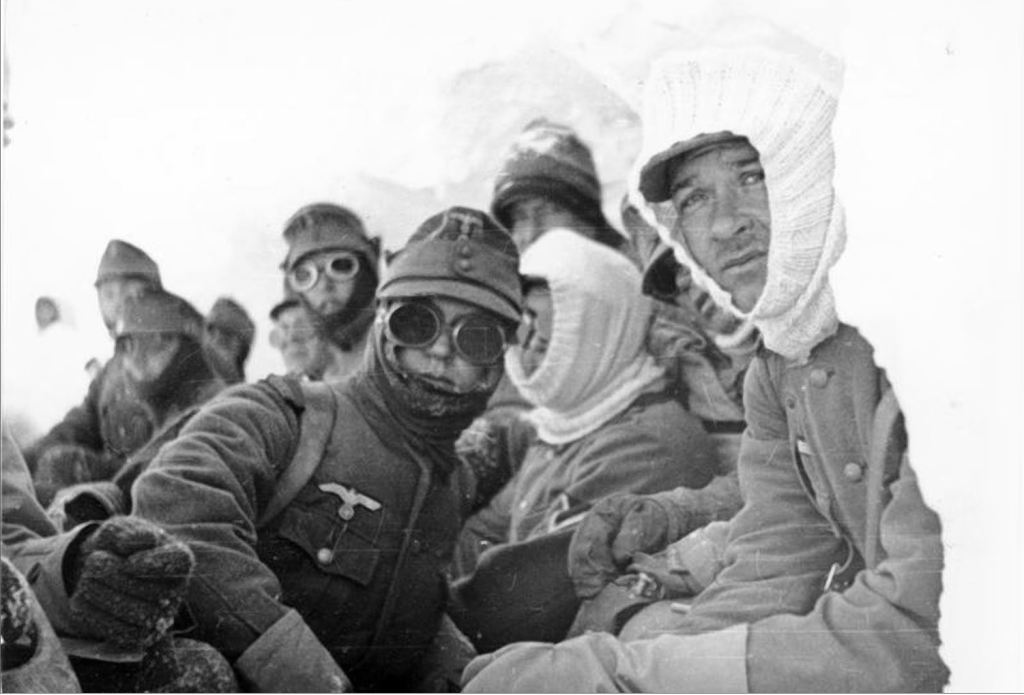
General Carton de Wiart ordered the British 146th Infantry Brigade to withdraw to Namsos to avoid being encircled by the Germans. Elements of German 181st Infantry Division and 3rd Mountain Division attack British 146th Infantry Brigade near Steinkjer north of Trondheim. There is fierce fighting at Vist between The Lincolnshire Regiment and King’s Own Yorkshire Light Infantry Regiment, defending at Krogs farm, and the German 138th Mountain Regiment. With the British 146th Territorial Brigade in risk of becoming encircled at Vist by German landings on his flank, General Carton de Wiart orders a fighting withdrawal back to Namsos. The Luftwaffe is completely crushing his base at Namsos and the British supply lines to de Wiart’s troops to the south.
Elements of German 196th Infantry Division reach Lillehammer. Elements of German 196th Infantry Division attack British 148th Infantry Brigade north of Lillehammer. The British 148th Brigade sent down to block them is forced to retreat again. They try to dig in at Faaberg, North of Lillehammer, but the German mountain troops prove that training is important when they scale the 2,165-foot Balbergkamp to sidestep the British down on the road. The British, outflanked, then retreat another 20 miles and set up a blocking position at Tretten Gorge, a narrow chokepoint in the Gudbrandsdal defile.
Other elements of German 196th Infantry Division are pushing north toward Trondheim from the south, while the German 359th Infantry Division pushes south from Trondheim to meet them.
Elements of German 69th Infantry Division are pushing east from Bergen.
Elements of German 359th Infantry Regiment are pushing south from Trondheim.
The War Office announced tonight that British troops had landed “at many places” in Norway and had “achieved considerable success in the face of great difficulties.”
[Ed: Sigh. Things will look very different soon. The British have landed “at many places.” That is part of the problem. They would have been better off with more concentration of force.]
Sigrid Undset, novelist and Nobel Prize winner, today called for punishment of pro-Nazi Norwegians who “think they can sell this land in order to be a dictator’s lap dog.”
Luftwaffe bombers attack Namsos again.
RAF bombers operating from England attack various targets in Norway.
The Norwegian cargo ship Sigurd Jarl was bombed and set on fire in Moldefjord by Luftwaffe aircraft. She sank the next day. Raised in 1942 but not repaired, sold for scrapping in 1947.
Sloop HMS Pelican, en route with a Naval Base Party (under the Command of Captain C H Champness) for Molde, was attacked by two German Ju.87 bombers at 1350 in Romdalsfjord in 62 49N, 4 20E . She was badly damaged after a bomb hit caused the detonation of her depth charges. Lt Cdr H R Thompson of the sloop, Cdr A A F MacLeish (ret), Lt Cdr H N C Webber, Paymaster Lt E F Burkitt and Boatswain H Howell of the Base Party, and forty seven ratings from both units were killed, and Lt A A F Talbot of the Base Party wounded. The uninjured members of the Base Party were put aboard steamer St Sunniva, which escorted by destroyer HMS Somali proceeded to Molde for fuel. The wounded were put aboard destroyer HMS Jackal and sloop HMS Fleetwood. Steamer St Magnus was coaling at Aalesund, while destroyer HMS Javelin was standing by. Javelin was then attacked by four German Ju bombers in Heisse Fjord but was undamaged. Jackal and St Sunniva departed the fjord at 0500/23rd for Kirkwall, while Pelican was towed by HMS Fleetwood and escorted to Lerwick by Jackal, HMS Somali and sister ship HMS Tartar joining them at 1930/22nd. Tug St Mellons came out from Lerwick and tug Brigand was detached from destroyer HMS Hotspur’s convoy. While screening Pelican, Jackal attacked a submarine contact at 2307/22nd in 62 44N, 03 48E. She also attacked a contact at 1524/23rd. Somali arrived at Scapa Flow at 0600/24th, and Pelican, in tow of St Mellons at Lerwick at 1000/24th. Jackal and Tartar proceeded from Lerwick and arrived at Scapa Flow at 1500. On 2 May at 1020, Pelican left Lerwick in tow of Brigand and escorted by destroyer HMS Wanderer to Rosyth. They were diverted en route to Sheerness and arrived in the Nore at 2200 on 5 May. Pelican was taken to Chatham for repairs lasting until 3 December 1940.
U-43 was attacked in the North Sea by two RAF Hudson aircraft with bombs and suffered slight damage.
HMS Furious, though now with a failing engine, continues to support the Allied effort. Today’s goal is to support a planned Royal Navy bombardment of German positions at Narvik. Amid abominable weather, hourly patrols of one or two Swordfish each are sent to the target area, each being armed with four 250-lb. bombs and under orders to assist as they could. 818 Squadron’s U3G – P4163, flying the second patrol, was shot down by Flak. Leading Airman Thomas George Cutler, RN (AG) was killed outright in the crash and, although Sub-Lieutenant P. C. Roberts, RN (P) and badly wounded Lieutenant Charles Robert Dalton Messenger, RN (O) were rescued by HMS Aurora, the later died of his wounds. Unfortunately, the entire effort was for naught as the bombardment had been cancelled although no one thought to inform Furious.
HMS Glorious, in company with the destroyers HMS Hyperion, HMS Hereward and HMS Hasty, arrives off Scapa Flow at 1500, where she is joined by the destroyers HMS Arrow, HMS Acheron and HMS Brazen to cover her during the flight evolutions that follow. First, the 17 RAF Gladiator IIs of 263 Squadron are flown out to the ship from Hatston by the pilots of 802 Squadron and the spare pilots of 804 Squadron. Once they are aboard, the Swordfish of 823 Squadron leaves for Hatston. Meanwhile, at 1545, the nine Sea Gladiators of 804 Squadron and the twelve Skuas of 803 Squadron fly out from Hatston. In the event, Skua 8R of 803 Squadron crashed over the side while landing aboard and though the pilot, Acting Sub-Lieutenant (A) A. S. Griffith, RN was rescued by the plane-guard destroyer, Naval Airman first class Kenneth Admiral Brown, RN (AG) was lost with the plane. With the operation complete, HMS Arrow, HMS Acheron, and HMS Bulldog are detached to Rosyth while the rest put into Scapa Flow to refuel. The RAF Gloster Gladiator squadron subsequently flew from the deck of the aircraft carrier on April 24, landing on the frozen surface of Lake Lesjaskogin in Norway. The squadron had been dispatched to support Allied ground forces around Namsos and Åndalsnes in Norway, with further assistance provided by aircraft from the HMS Glorious and the carrier HMS Ark Royal (91). No. 263 Squadron ceased operations on April 26 after running out of fuel and serviceable aircraft. During the two days the squadron was operational it made 37 interceptions of Luftwaffe aircraft and claimed six aircraft shot down and a number of others damaged.
Light cruisers HMS Galatea, HMS Sheffield, and HMS Glasgow with destroyers HMS Icarus, HMS Ivanhoe, HMS Impulsive, HMS Vansittart, HMS Witch and HMS Campbell embarked 2,200 troops of the 15th Brigade, stores and three trucks at Rosyth on the 21st. They departed on the 22nd and arrived at AÅndalsnes and Molde on the 23rd. Sheffield, Vansittart and Campbell went to Molde and the rest”to AÅndalsnes. The troops and equipment were disembarked from all ships beginning at 2100 and the British force got away before dawn on the 24th. Galatea had embarked some 200 cases of gold at AÅndalsnes for transshipment to England. She proceeded to Rosyth, and destroyers Ivanhoe, Icarus and Impulsive to Immingham, with the rest of the force proceeding to Scapa Flow.
Steamer St Magnus (1312grt) of convoy AP.1, escorted by destroyers HMS Jackal and HMS Javelin, arriving in Moldefjord was attacked by German bombers. Jackal’s main radio antenna was damaged by bomb splinters, and she was detached to escort damaged sloop HMS Pelican. Norwegian steamer Sigurd Jarl (924grt) was set afire in the bombing.
Battleship HMS Resolution with destroyers HMS Basilisk, HMS Wren and HMS Hesperus departed Greenock at 1200 for the Narvik area. On the 25th in 66 34N, 07 34E, they met southbound battleship HMS Warspite with destroyers HMS Havock, HMS Hostile, HMS Hero and HMS Foxhound returning to Scapa Flow. Resolution and her destroyers arrived at Bygden at 1615/26th.
The Anglo-French Supreme War Council, also attended by Poland and Norway,”met again in Paris. The meeting was characterized by infighting between French Prime Minister Paul Reynaud and his war minister Édouard Daladier. The leaders are out of touch with events on the ground and engage in wishful thinking about advancing on Oslo to rout the Germans.
It is reported in Paris that it is taken for granted now that the enemy attack that had been preparing on the French front just before the Scandinavian adventure is not likely to be launched. The Germans are too occupied in Norway. The operations there, according to an authorized statement, are being carried out “behind a screen of almost complete silence.” In fact, the silence here is such that the only official news about events in Norway is a quotation from a British communiqué embodied in this morning’s French communiqué. This has caused some speculation; one conjecture is that the British are conducting the joint operations of sea, land and air forces.
In Lorraine and Alsace there is very fine weather, with a full moon, moreover. As a consequence there is great aerial activity on both sides. Long-distance observation missions are numerous; French general headquarters reports that several deep reconnaissance flights were made over Germany last night. Fighter escorts frequently come to grips. In an encounter this morning a German plane was brought down, falling on Belgian soil. This brought to twelve, and possibly to fifteen, the number of German planes lost on the Western Front in three days, according to The Associated Press.
As far as ground troops are concerned, patrols and raids continue, mostly east of the Moselle. In that sector, the evening communiqué says, an enemy detachment “fell back under our fire before it could reach our outposts.”
The Germans order the Danish army disbanded and confiscate its weapons.
Germans and Poles are forbidden from entering the Jewish Ghetto of Łódź.
Three vice chiefs of staff are appointed: John Dill as Vice Chief of the General Staff; Tom Phillips, Vice Chief of the Naval Staff; and Vice-Chief of the Air Staff Sir Richard Edmund Charles Peirse. Air Marshal William Sholto Douglas is named Deputy Chief of the Air Staff, and General Percival becomes Assistant Chief of the Imperial General Staff at the War Office.
The American legation, on orders from the State Department in Washington, today advised all United States citizens remaining in Hungary to go home while there it a “means of egress” still available. Many French and British in Budapest, including diplomats, had their baggage packed for a speedy flight should it be necessary to escape a German lightning thrust in southeastern Europe.
Italian newspapers today feature the “password” contained in Premier Mussolini’s brief speech yesterday—”Work and Arm”—while stressing that there is going to be no let-up in Italy’s political, economic and military preparations.
General Percival appointed Assistant Chief of the Imperial General Staff.
The newly-arrived New Zealand Division training exercises conducted near El Saff in North Africa.
Another Luftwaffe minelaying operation is carried out along the British coast.
Luftwaffe bombers attack Scapa Flow.
French reconnaissance aircraft fly over Prague on 22-23 April.
The Dutch fishing vessel Bep was sunk in the North Sea of Terschelling, Friesland by an E boat. The crew was rescued.
The Norwegian cargo ship Bravore struck a mine and sank in the North Sea off Ramsgate, Kent, United Kingdom with the loss of 17 of the 24 people on board.
The Norwegian coaster Delamore struck a rock and sank at Marsteinen. Salvage attempts were unsuccessful.
The Dutch ship Wocana was intercepted by, and collided with, HMS Pintail (Royal Navy) in the North Sea off Great Yarmouth, Norfolk and sank.
HMS Ark Royal, again flying the flag of Vice-Admiral Aircraft Carriers L. V. Wells, CB, DSO, RN and in company with the destroyers HMS Sikh, HMS Mashona and HMS Juno departs Greenock at 0700 for Scapa Flow. She is still carrying her three TSR squadrons, 810, 820, and 821.
Convoy DS.1 departed Bristol Channel for the Clyde as part of the HAMMER operation. The steamers in this convoy were John Holt (3815grt), Thistleford (4764grt), Pizzaro (1367grt) and Cisneros (1886grt).
Convoy OA.134 departed Southend escorted by destroyer HMS Whitehall.
Convoy OB.134 departed Liverpool escorted by sloop HMS Rochester from the 21st to 25th, and dispersed on the 26th.
Convoy OG.27F was formed from convoy OB.133GF from Liverpool and Bristol, escorted by sloops HMS Leith and HMS Fowey on the 20th, convoy OA.133GF, which departed Southend on the 20th escorted by sloops HMS Scarborough and HMS Bideford, with sixty ships. The convoy was escorted by sloops Scarborough and Leith from 22 to 24 April. The sloops were then detached to convoy HG.27 F.Sloop Bideford escorted the convoy from 22 to 28 April. The convoy arrived at Gibraltar on the 28th.
Convoy FN.152 departed Southend, escorted by destroyer HMS Woolston, sloop HMS Hastings, and armed patrol yacht HMS Breda. The convoy arrived at Rosyth on the 24th.
Convoy MT.57 (convoys leaving Methil on both 21 and 22 April bore designation MT.57) departed Methil, escorted by destroyer HMS Whitley and sloop HMS Londonderry. The convoy arrived in the Tyne later that day.
Convoy FS.153 departed the Tyne, escorted by destroyer HMS Whitley and sloop HMS Londonderry. The convoy had to anchor in the Tees, owing that no ship was allow south of that point a channel could be swept in the German minefield laid by aircraft the night before. The convoy arrived at Southend on the 24th.
Convoy HX.37 departed Halifax at 0700 escorted by Canadian destroyers HMCS Restigouche and HMCS St Laurent, which were detached on the 23rd.. At 1800/23rd, the destroyers turned the convoy over to the ocean escort Armed merchant cruiser HMS Alaunia, which was detached on 6 May. Destroyer HMS Vivacious and sloop HMS Leith joined the convoy on 4 May and escorted it until its arrival at Liverpool on 7 May.
The War at Sea, Monday, 22 April 1940 (naval-history.net)
Light cruisers GALATEA, SHEFFIELD, and GLASGOW with destroyers ICARUS, IVANHOE, IMPULSIVE, VANSITTART, WITCH, and CAMPBELL embarked 2200 troops of the 15th Brigade, stores and three trucks at Rosyth on the 21st. They departed on the 22nd and arrived at Aandalsnes and Molde on the 23rd. SHEFFIELD, VANSITTART, and CAMPBELL went to Molde and the rest to Aandalsnes. The troops and equipment were disembarked from all ships beginning at 2100 and the British force got away before dawn on the 24th. GALATEA had embarked some 200 cases of gold at Aandalsnes for transshipment to England. She proceeded to Rosyth, and destroyers IVANHOE, ICARUS, and IMPULSIVE to Immingham, with the rest of the force proceeding to Scapa Flow.
Steamer ST MAGNUS (1312grt) of convoy AP.1, escorted by destroyers JACKAL and JAVELIN, arriving in Moldefjord was attacked by German bombers. JACKAL’s main radio antenna was damaged by bomb splinters, and she was detached to escort damaged sloop PELICAN. Norwegian steamer SIGURD JARL (924grt) was set afire in the bombing.
Destroyer SOMALI sighted an object on the surface at 0240 which changed position before it could be attacked in 64 22N, 8 32E, but SOMALI and sister ship TARTAR attacked the contact. TARTAR attacked another submarine contact at 1210 in 63 43N, 07 49E. U-29 escaped with only light damage.
Sloop PELICAN, en route with a Naval Base Party (under the Command of Captain C H Champness) for Molde, was attacked by two German Ju.87 bombers at 1350 in Romdalsfjord in 62 49N, 4 20E . She was badly damaged after a bomb hit caused the detonation of her depth charges. Lt Cdr H R Thompson of the sloop, Cdr A A F MacLeish (ret), Lt Cdr H N C Webber, Paymaster Lt E F Burkitt and Boatswain H Howell of the Base Party, and forty-seven ratings from both units were killed, and Lt A A F Talbot of the Base Party wounded. The uninjured members of the Base Party were put aboard steamer ST SUNNIVA, which escorted by destroyer SOMALI proceeded to Molde for fuel. The wounded were put aboard destroyer JACKAL and sloop FLEETWOOD. Steamer ST MAGNUS was coaling at Aalesund, while destroyer JAVELIN was standing by. JAVELIN was then attacked by four German Ju bombers in Heisse Fjord but was undamaged.
JACKAL and ST SUNNIVA departed the fjord at 0500/23rd for Kirkwall, while PELICAN was towed by FLEETWOOD and escorted to Lerwick by JACKAL, SOMALI, and sister ship TARTAR joining them at 1930/22nd. Tug ST MELLONS came out from Lerwick and tug BRIGAND was detached from destroyer HOTSPUR’s convoy. While screening PELICAN, JACKAL attacked a submarine contact at 2307/22nd in 62 44N, 03 48E. She also attacked a contact at 1524/23rd. SOMALI (D.6) arrived at Scapa Flow at 0600/24th, and PELICAN, in tow of ST MELLONS at Lerwick at 1000/24th.
JACKAL and TARTAR proceeded from Lerwick and arrived at Scapa Flow at 1500. On 2 May at 1020, PELICAN left Lerwick in tow of BRIGAND and escorted by destroyer WANDERER to Rosyth. They were diverted en route to Sheerness and arrived in the Nore at 2200 on 5 May. PELICAN was taken to Chatham for repairs lasting until 3 December 1940.
A Swordfish from 818 Squadron from aircraft carrier FURIOUS was shot down north of Narvik by German flak, Lt C R D Messenger died of wounds and Leading Airman T G Cutler was killed. The pilot S/Lt (A) R C Roberts was wounded, but rescued by light cruiser AURORA.
Anti-submarine whaler BUTTERMERE (560grt) ran aground at Narvik, and requested relief to permit repairs to be done.
Aircraft carrier ARK ROYAL (Vice Admiral Aircraft Carriers) departed Greenock at 0700 escorted by destroyers SIKH, MASHONA, and JUNO. They arrived at Scapa Flow at 0800/23rd.
Battleship RESOLUTION with destroyers BASILISK, WREN, and HESPERUS departed Greenock at 1200 for the Narvik area. On the 25th in 66 34N, 07 34E, they met southbound battleship WARSPITE with destroyers HAVOCK, HOSTILE, HERO, and FOXHOUND returning to Scapa Flow. RESOLUTION and her destroyers arrived at Bygden at 1615/26th.
Battlecruiser REPULSE and destroyers HAVELOCK, HAVANT, and FAME arrived at Scapa Flow.
Destroyers KIMBERLEY and GRIFFIN departed Scapa Flow at 0740 for Rosyth to escort steamer RUTLAND (1437grt) to Namsos.
Destroyer MAORI with cargo ship BLACKHEATH (4637grt) was diverted from Namsos to Skelfjord on the 22nd, but was redirected back to Namsos. They arrived there, but at 2028 were ordered to stand off and arrive at dusk on the 23rd. They went back out to sea and returned the next night. Destroyer FORTUNE departed Scapa Flow at 2359/22nd to join MAORI for escort duties. During the night of the 23rd/24th, from 2330 to 0230, BLACKHEATH’s cargo of trucks and a small quantity of ammunition and fuel were unloaded. French destroyer BISON ran aground at Namsos and was towed off by MAORI. Destroyer FORTUNE was detached at 1800/24th for Narvik, and BLACKHEATH returned to Namsos at 2130/24th to complete unloading during the night of the 24th/25th. A limited amount of motor transport and all the petrol, ammunition and rations were unloaded. At daylight on the 25th, BLACKHEATH proceeded to Scapa Flow, arriving there at 1500/27th with MAORI.
Destroyer VANSITTART, screening the 2nd Cruiser Squadron, attacked at 2120 a submarine contact closing to attack the cruisers in 59 52N, 00 10W.
Sloop BLACK SWAN attacked a submarine contact at 2150 in 60 12N, 00 31W.
Convoy DS.1 departed Bristol Channel for the Clyde as part of the HAMMER operation. The steamers in this convoy were JOHN HOLT (3815grt), THISTLEFORD (4764grt), PIZZARO (1367grt), and CISNEROS (1886grt).
French submarine SFAX fired two torpedoes at German steamers PALIME (2863grt) or PELIKAN (3264grt) on their way to Stavanger in 58-15N, 06-00E, which missed.
German aircraft laid mines in the Downs and off Harwich, which sank two ships for 2607 tons. On the 22nd, Norwegian steamer BRAVORE (1458grt) one mile south of Gull Buoy; fourteen crew members and four French Naval ratings were lost, and there were six survivors. On the 24th, British steamer STOKESLEY (1149grt) in 51 32N, 01 16E with the loss of fifteen crew.
Midshipman (A) J.O. Burr was killed when his Skua of 759 Squadron crashed on take-off at Eastleigh.
Convoy OA.134 departed Southend escorted by destroyer WHITEHALL.
Convoy OB.134 departed Liverpool escorted by sloop ROCHESTER from the 21st to 25th, and dispersed on the 26th.
Convoy OG.27F was formed from convoy OB.133GF from Liverpool and Bristol, escorted by sloops LEITH and FOWEY on the 20th, convoy OA.133GF, which departed Southend on the 20th escorted by sloops SCARBOROUGH and BIDEFORD, with sixty ships. The convoy was escorted by sloops SCARBOROUGH and LEITH from 22 to 24 April. The sloops were then detached to convoy HG.27 F.Sloop BIDEFORD escorted the convoy from 22 to 28 April. The convoy arrived at Gibraltar on the 28th.
Convoy FN.152 departed Southend, escorted by destroyer WOOLSTON, sloop HASTINGS, armed patrol yacht BREDA. The convoy arrived at Rosyth on the 24th.
Convoy MT.57 (convoys leaving Methil on both 21 and 22 April bore designation MT.57) departed Methil, escorted by destroyer WHITLEY and sloop LONDONDERRY. The convoy arrived in the Tyne later that day.
Convoy FS.153 departed the Tyne, escorted by destroyer WHITLEY and sloop LONDONDERRY. The convoy had to anchor in the Tees, owing that no ship was allow south of that point a channel could be swept in the German minefield laid by aircraft the night before. The convoy arrived at Southend on the 24th.
Patrol sloop PINTAIL intercepted Dutch skoot WOCANA inside the mine barrier east of Yarmouth. A collision occurred between the two ships. The sloop was slightly damaged and the skoot sank.
Operation “SHELLFISH” was implemented by the Nore Command. The operation was to intercept U-boats or surface craft using the telegraphic cable as an aid to navigation. The operation began on the 22nd and was conducted on subsequent nights. One patrol sloop was stationed between 52-37.5N, 2-5.25E and 52-39.25N, 2-32.5E. A second patrol sloop was station between Haisborough Light Vessel and 10 miles 285° from the Light Vessel. Anti-submarine yacht MOLLUSC with one MTB in tow and a second MTB operated in the vicinity of Haisborough Light.
Minesweeper HALCYON completed boiler cleaning at Dover.
French anti-submarine trawlers L’ORIENTAISE, LA NANTAISE, and LA CANCALAISE arrived at Dover for training prior to taking over part of the Dover Strait patrol.
From 22 to 27 April, light cruiser CERES was refitting at Singapore.
Light cruiser ORION arrived at Gibraltar for duty with the Mediterranean Fleet after having departed Trinidad on the 14th.
French submarine LE CONQUERANT departed Casablanca on the 21st, escorted by destroyer TORNADE. Both ships arrived Oran 23 April.
Light cruiser DUNEDIN departed Kingston on patrol.
Convoy HX.37 departed Halifax at 0700 escorted by Canadian destroyers HMCS RESTIGOUCHE and HMCS ST LAURENT, which were detached on the 23rd. At 1800/23rd, the destroyers turned the convoy over to the ocean escort Armed merchant cruiser ALAUNIA, which was detached on 6 May. Destroyer VIVACIOUS and sloop LEITH joined the convoy on 4 May and escorted it until its arrival at Liverpool on 7 May.
Dutch fishing vessel BEP (151grt) was sunk by a German S-boat off Terschelling. The crew of the fishing vessel was rescued.
Today in Washington, the Senate considered minor bills; received the President’s recommendation for transferring to the general fund of the Treasury the surplus funds of certain Federal corporations; heard Senator Hatch urge approval of the Logan-Walter bill and adjourned at 4 PM until noon on Wednesday. The Campaign Expenditures Committee ordered an investigation of the Maryland Democratic Senatorial primary campaign and the Naval Affairs Committee heard Admiral Taussig on the situation in the Far East.
The House adopted a resolution for a study of the problem of migrants; defeated the District of Columbia Income Tax and Sales Tax Bills and adjourned at 5:55 PM until noon tomorrow.
Anti-picketing laws enacted in Alabama and California were declared unconstitutional by the U.S. Supreme Court today as violating the fundamental guarantees of free speech and free press. Justice Murphy, newest member of the court, wrote the two opinions, from which Justice McReynolds alone dissented. “The safeguarding of these rights to the end that men may speak as they think on matters vital to them and that falsehoods may be exposed through the processes of education and discussion is essential to free government,” said Mr. Murphy in discussing the appeal of Byron Thornhill from an Alabama State law.
In the opinion in the other case, one involving a protest of John Carlson against an ordinance of Shasta County, California, Justice Murphy stated: “The sweeping and inexact terms of the ordinance disclose the threat to freedom of speech inherent in its existence.”
Meeting for the first time in two weeks, the court handed down. about a dozen opinions, but postponed, at least until next Monday, some of the most important findings on its calendar. Deferred were the issues growing out of the sitdown strike at the Apex Hosiery Company and the anti-trust trials of major oil companies. Among other cases that were put off were a challenge to the power of the Secretary of Labor under the Walsh-Healey Act and the validity of a Connecticut law under which members of Jehovah’s Witnesses were convicted for playing a phonograph record attacking the Roman Catholic Church.
Justice Murphy described peaceful picketing as a means of disseminating information “within that area of free discussion that is guaranteed by the Constitution.” The rights of labor on the picket line might be compared, he said, to the property rights and business rights of employers and must be protected as carefully. Today’s opinions on picketing continued a long line of decisions handed down by the Supreme Court in recent years to safeguard civil liberties and were written by a consistent champion of such rights.
The anti-third term forces gained a prominent supporter today when Senator Downey, California Democrat, wrote a letter to Democratic Chairman James A. Farley declaring that “no president should be elected for a third time.” Downey said he had long held that view and added pointedly, “I see no reason to change that opinion now.” The pronouncement came at a time when California Democrats are preparing for a hotly contested presidential primary. Among the groups of delegates entered are slates favoring President Roosevelt and Vice-President Garner.
Alfred M. Landon, Republican nominee for President in 1936, is being advanced by the liberals and the Western farm group to be chairman of the platform committee of the Republican National Convention.
A spectacular sideshow for the Republican national convention became a definite possibility today when President Roosevelt outlined an itinerary for a tour of the nation in June. President Roosevelt announced today that he had decided to make a twenty-one-day vacation trip to the Pacific Coast in June. Observers immediately concluded that it might develop into a major political tour since the Republican National Convention in Philadelphia will start on June 24. The President said he hoped to leave Washington at the end of the first week in June and would be on the road when the Republican convention was meeting. As outlined, the trip would take him to virtually every section of the nation. Mr. Roosevelt emphasized, however, that his travel plans were conditioned on developments in the European war, as well as the Congressional adjournment date. Laughingly he replied in the affirmative when asked whether his Western trip was to be non-political. He said he would be talking about “conservation,” but did not reply when someone inquired “conservation of what?” Four years ago he also made what the White House labeled a non-political excursion into Arkansas and Texas and produced a series of addresses which took headlines away from the Republican convention in Cleveland. Included in the presidential traveling schedule is a pause in Texas, home state of Vice-President Garner, who wants to climb a step up the political ladder into the White House.
President Roosevelt plans an informal welcome to Prime Minister Mackenzie King tomorrow. The Liberal leader will be the President’s house guest until Wednesday afternoon, arriving here from Virginia Beach, Virginia, where he has been having a Spring vacation. The President suggested that there was nothing particularly important about the visit. He said that the Canadian Prime Minister usually paid a visit to the White House in the Spring when the President was in Washington.
Testimony that one of the sixteen men accused of conspiracy to overthrow the United States Government thought that the program of the so-called Action Committee would benefit the German Government, and that he believed two of the other plotters were German agents, was given at the trial of the accused men in the Brooklyn Federal Court yesterday.
United States Minister to Canada James H. R. Cromwell said today that he would resign his post on May 21, the date of the primary election in New Jersey in which he expects to be chosen as the Democratic nominee for Senator.
Artificial creation of several new synthetic forms of Vitamin K, the hemorrhage-preventing vitamin which is saving thousands every year from bleeding to death, was reported today before the annual Spring meeting of the National Academy of Sciences.
Rear Admiral Joseph Taussig, commandant of the Fifth Naval District at Norfolk, Virginia testified before a joint House-Senate committee on Pacific fortifications and predicted that events in the Far East would bring war with Japan. He proposed that the United States should construct an “impregnable” naval base in the Philippines and agree with the allies and Holland to maintain the present status in the Pacific. Urging this course in testimony before the committee, Taussig said he did not see how this country could escape being forced into war eventually by the present trend of developments in the Far East. “If we are to remain at peace,” he said, “it is essential that we be strong enough to make Japan afraid to involve us in war.” The U.S. Navy repudiated his remarks and issued an official reprimand.
The reprimand was rescinded by U.S. President Franklin D. Roosevelt on December 8, 1941.
Major League Baseball:
Earl Averill’s pinch single in the ninth inning sent two runs home and gave the Tigers a 6–5 victory over the White Sox today.
Continuing their undefeated and errorless way, the Reds beat the Cardinals and the Ohio River flood as well today, pounding out a 6–1 victory over St. Louis behind Bucky Walters’s seven-hit pitching as water lapped into Crosley Field.
Detroit Tigers 6, Chicago White Sox 5
St. Louis Cardinals 1, Cincinnati Reds 6
Chicago Cubs 5, Pittsburgh Pirates 9
Cleveland Indians 5, St. Louis Browns 2
“Up to the present, only a fraction of our people have had to give up anything; the sacrifices are still to come,” Graham F. Towers, Governor of the Bank of Canada, told a luncheon audience in the Canadian Club in New York today.
Capture of a Japanese strategic center twenty-five miles northwest of Nanchang by Chinese troops driving toward the one-time capital of Kiangsi Province was reported today by the Chinese Central News Agency. The news agency said fighting continued around Chungtiao Mountain in the southwestern part of Shansi Province, to which the Japanese were said to have rushed reinforcements of 40,000 men in the past few days. The Chinese asserted they had blocked Japanese efforts to move southward across the Yellow River border of Shansi.
Japanese bombing planes raided a number of cities in Szechwan Province late today and tonight and did extensive damage. A German engineer, H. M. Nielson, 71, died of heart disease in a dugout during the alarm here. He had lived in Chungking for seventeen years. In the Foreign Office dugout a baby girl was born. A physician, who had sought shelter in the dugout, attended the mother and later took her home. Chinese air force headquarters said that fifty-four planes participated in the raids and that cities attacked included the provincial capital, Chengtu, and Kikang, fifty miles southwest of Chungking. Air raid precautions were in effect in Chungking for more than five hours. It was feared many Chinese were killed, but no casualty estimates were immediately available. The raid was the first in months and marked the beginning of the Summer season when cloud banks, which enshroud much of the province during the Winter, disappear.
Japan’s opposition to immigration restriction as proposed in the Philippines apparently has left the assembly in Manila cold to protests and determined to carry out the plan to place a uniform “500 yearly” limit on all nations alike.
Dow Jones Industrial Average: 148.01 (+0.34)
Born:
Ray Griff, Canadian singer-songwriter, in Vancouver, British Columbia, Canada (d. 2016).
Naval Construction:
The Royal Navy M 1-class minelayer HMS M 5 (M 74) is laid down by George Philip & Sons Ltd. (Dartmouth, U.K.).
The Kriegsmarine (German Navy) Type VIIC U-boat U-204 is laid down by F. Krupp Germaniawerft AG, Kiel (werk 633).
The Kriegsmarine (German Navy) Type VIIC U-boat U-402 is laid down by Danziger Werft AG, Danzig (werk 103).
The Royal Navy Flower-class corvette HMS Mimosa (K 11) is laid down by Charles Hill & Sons Ltd. (Bristol, U.K.); completed by Richardson, Westgarth & Clark. She is transferred before completion to the Forces Navales Françaises Libres (Free French Naval Forces) and serves as Mimosa.
The U.S. Navy light cruiser USS Atlanta (CL-51), lead ship of her class of 4, is laid down by the Federal Shipbuilding & Drydock Co. (Kearny, New Jersey, U.S.A.).
The Royal Navy Flower-class corvette HMS Honeysuckle (K 27) is launched by Ferguson Shipbuilders. Ltd. (Port Glasgow, Scotland)
The Royal Navy Flower-class corvette HMS Clematis (K 36) is launched by Charles Hill & Sons Ltd. (Bristol, U.K.); completed by Richardson, Westgarth & Clark.
The Royal Navy Flower-class corvette HMS Anemone (K 48) is launched by Blyth Shipbuilding & Drydock Co. Ltd. (Blyth, U.K.); completed by Clark.
The Royal Navy Hunt-class (Type I) escort destroyer HMS Quantock (L 58) is launched by the Scotts Shipbuilding & Engineering Co. (Greenock, Scotland).
The Royal Navy “L”-class destroyer HMS Lightning (G 55) is launched by Hawthorn Leslie & Co. (Hebburn-on-Tyne, U.K.).
The Royal Navy Flower-class corvette HMS Clarkia (K 88) is commissioned. Her first commanding officer is Lieutenant Commander Frederick John Gwynn Jones, RNR
 History Diaries