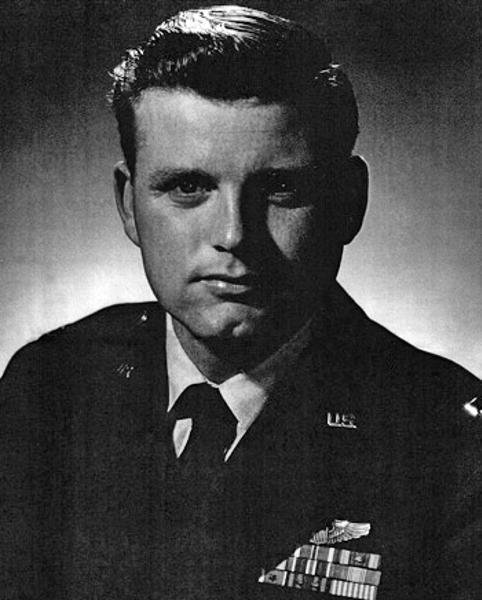
He rapidly earned a reputation for daring, accuracy and sound tactical judgement. Some FACs would fire their smoke marking rockets from an altitude of a few hundred feet but not McAllister, known to the fighter pilots and ground troops with whom he worked as “MAC the FAC”.
On the afternoon of March 25, 1965 he flew the prelude to a mission that was to earn him the AIR FORCE CROSS. A detachment of Vietnamese Marines was pinned down in a narrow valley surrounded by 3,000 foot mountains near Bong Son, 50 miles north of Quy Nhơn. In marginal weather with a ceiling lowering from 1200 feet, McAllister, under frequent heavy fire from small arms and automatic weapons, directed a series of attacks by A-1Es against enemy forces, enabling the ARVN Marines to gain their objective. He then remained in the area, a target for Việt Cộng gunners, while a helicopter from Quy Nhơn evacuated two U.S. Marine advisors who had been wounded. Low on fuel and with engine problems, McAllister limped back to base, ending another successful three-hour mission.
At 2300 hrs that same evening the ARVN Marines again called for help. Grabbing the first in-commission ‘BIRD DOG’ he could find, McAllister headed back to Bong Son, flying under a low overcast that extended up to 8500 feet. After finding the valley, which was barely wide enough for tight 360-degree turns, he called for flares. The assigned C-123 aircraft could not enter the valley under a 500-foot ceiling. McAllister told the pilot of the C-123 to climb above the overcast and drop flares from 10,000 feet using a radar fix from Pleiku. When the first flares fell away from the target he steered their aircraft into a position for accurate release using dead reckoning. The intense light of the flares created a double hazard for the FAC — his aircraft now was illuminated against the overcast, making it a clear target for enemy fire, while the light of the flares threatened to blind him and set up perfect conditions for vertigo.
When enemy fire became too hot, “MAC the FAC” climbed into the overcast and orbited in the narrow valley using the meagre instruments with which ‘BIRD DOG’ was equipped. He then requested the Air Support Operations Center at Pleiku to send a succession of flareships that would illuminate the combat area until dawn. Under the light of the flares the Vietnamese Marines were able to reorganize themselves and hold off the Việt Cộng attackers. Major McAllister helped disrupt the attack by firing an M1 carbine out the side window of his aircraft after expending the four rockets. Nearly three hours after takeoff and with his fuel gauge hovering near empty he flew out of the valley, his aircraft ventilated by many bullet holes. Shortly after his departure the Việt Cộng broke off their attack, confused and disorganized by the defenses “MAC the FAC” had directed while he contended with weather, terrain and enemy fire from which the little CESSNA O-1 was not designed.
Before MAJOR WILLIAM WALTE McALLISTER could be presented with his AIR FORCE CROSS, only the ninth of the Vietnam War up to that time, he was killed in an air accident on what would have been his last mission before returning to the United States.
Distinguished Flying Cross Award (2nd Award)
CITATION:
The President of the United States of America, authorized by Act of Congress, July 2, 1926, takes pride in presenting a Bronze Oak Leaf Cluster in lieu of a Second Award of the Distinguished Flying Cross (Posthumously) to Major William Walter McAllister, United States Air Force (Reserve), for heroism while participating in aerial flight over the Republic of Vietnam from 11 February 1965 to 8 March 1965. During this period, Major McAllister flew numerous reconnaissance and observation flights, under extremely hazardous conditions and at minimum altitudes while observing Viet Cong activity and directing successful air strikes against them. Although his aircraft sustained hits from hostile fire on several occasions, Major McAllister never failed in his mission. The outstanding heroism and selfless devotion to duty displayed by Major McAllister reflect great credit upon himself and the United States Air Force.
William is buried at Fort Rosecrans National Cemetery. He is honored on the Wall at Panel 1E, line 106.
A band of Communist guerrillas challenged a United States Marine patrol in a valley outside Đà Nẵng today and set off the Marines’ first extended ground action of the Vietnam war. The skirmish ended with the Việt Cộng guerrillas in retreat. One marine, a radioman, suffered a scalp wound from a sniper’s bullet. Two others collapsed from heat prostration. The guerrilla casualties, if any, were not determined. The Marines Involved in the skirmish near Đà Nẵng were part of a brigade that landed six weeks ago to reinforce the air base, 380 miles northeast of Saigon.
A Việt Cộng detachment of about 50 men opened up with machine guns after a patrol of 41 Americans and 38 South Vietnamese reached the hamlet of Bình Thai, nine miles from the base. The Marines responded with rifles and grenades and summoned a reserve company, which arrived by helicopter. Captain Pat Collins of Grosse Isle, Michigan, commander of the patrol, ran to the landing field alone to guide the helicopters. The Việt Cộng pulled back in the face of a determined American advance. Suspected Communist positions were hit by grenades.
The Marines and the Vietnamese Infantrymen moved south of Đà Nẵng by truck early in the morning on a joint patrol. Then they moved ahead on foot. Six Vietnamese civilians were with them for civic-action work. In reserve at Đà Nẵng were a United States Marine infantry company, 10 Marine helicopters, a Marine artillery battalion and 2 Marine Phantom attack jets.
Việt Cộng guerrillas infiltrated tonight within three miles of Đà Nẵng and fired on a South Vietnamese Government radio station. Government troops responded with artillery fire. The attack occurred as South Vietnamese forces massed for a major assault on a concentration of 3,000 Việt Cộng soldiers near Việt Na, about 28 miles from Danang. A United States Marine enlisted man was accidentally shot and wounded Friday morning by a fellow Marine while on patrol in the Đà Nẵng air base area. Four American jets and six South Vietnamese planes bombed and strafed the Việt Cộng positions near Việt Na. The strike left 60 huts in ruins and numerous fires burning. The unusually large Việt Cộng force was located in the same general area where a United States Marine reconnaissance patrol today fought its way out of a guerrilla trap.
The virtual round-the-clock bombing raids by U.S. and South Vietnamese Air Forces in recent weeks have destroyed so many bridges and highways that North Vietnamese supply routes and transportation are said to be seriously impaired.
In Saigon, the official Vietnamese press agency reported that North Vietnam, reacting to United States air strikes, had halted all daylight activity in the central region and had ordered the population to seek cover. In the latest attacks, a variety of Northern targets were destroyed or damaged.
In today’s air strikes, United States and South Vietnamese planes destroyed or damaged a variety of Northern targets. The targets included four patrol boats, a bridge, six trucks and an anti-aircraft installation. In the course of seven strikes, the South Vietnamese Air Force lost one A-1H propeller-driven Skyraider fighter-bomber. The air strikes followed the pattern of the last week, with small, regular raids against low-level military and transportation targets.
Two Skyraiders, from the Seventh Fleet carriers USS Midway and USS Hancock, staged the day’s first attack at about 12:30 AM. They destroyed five trucks and left another in flames along Highway 15, about 135 miles south of Hanoi. Other navy aircraft. including an A-4 Skyhawk light jet bomber and more Skyraiders. hit until dawn at other trucks along Highway 15 and Highway 1. No definite results were reported.
The South Vietnamese Skyraider was lost during a raid on the Mỹ Đức highway bridge, a three-span, 190-foot structure on Route 1, about 18 miles south of Đồng Hới. The bridge, previously hit but not destroyed, collapsed. Several military buildings in the area were also reported to have been heavily damaged. While American pilots have gradually reported light to moderate anti-aircraft fire over the central areas of North Vietnam, the South Vietnamese pilots termed the ground fire on their raid “rather fierce.” Vietnam Press said, however, that the missing plane had been brought down “probably by bad weather.” It added that a search for the pilot was under way.
A strike by eight United States Air Force F-105 Thunderchief fighter-bombers against the Bai Duc Thon highway bridge was less successful than the attack on Mỹ Đức. Pilots said they had damaged the bridge, 180 miles south of Hanoi on Route 12, but had not been able to destroy it. The jets did knock out an anti-aircraft installation southwest of Vĩnh, and they damaged military buildings in the Mụ Giạ Pass. Later in the afternoon, 10 Navy Skyhawk jets, protected by 8 F-8 Crusader jet fighters, hit four patrol boats and a large junk in the river mouth at Vĩnh. Pilots called the mission “highly successful.”
One of the largest recent ground and air operations ended officially 25 miles south of Đà Nẵng today. Six battalions of South Vietnamese troops proved unable to dislodge a smaller Việt Cộng force from its heavily fortified positions.
The U.S. military concentration at Đà Nẵng in the north of South Vietnam has made inevitable a comparison with the massing at Điện Biên Phủ, where the French lost a fortress and a war.
South Vietnam’s Buddhist leaders called today for a cease-fire May 14 and 15 in observance of the 2,509th birthday of Buddha. The Government was not expected to consider the proposal. Another protest suicide by fire, intended as a peace plea, was narrowly averted at Saigon’s biggest Buddhist institute. A 25-year-old nun, Nữ Huệ Thiện, doused her clothing with gasoline and knelt at a flagpole in the institute’s compound but was restrained by monks before she could strike a match.
U.S. Defense Secretary Robert S. McNamara told reporters that he would not rule out the use of nuclear weapons in the Vietnam War, as part of a press conference given under the condition that the reporters not attribute his remarks to him, nor quote him verbatim. Tom Wicker of The New York Times took notes and paraphrased the statement, in which McNamara said, “We are not following a strategy that recognizes any sanctuary or any weapons restriction. But we would use nuclear weapons only after fully applying non-nuclear arsenal. In other words, if 100 planes couldn’t take out a target… we would try 200 planes, and so on. But “inhibitions” on using nuclear weapons are not overwhelming.” Wicker’s report in the Sunday Times noted that “High officials” in the Johnson administration “emphasize that it is “inconceivable” that nuclear weapons would be used in the present circumstances of the war. They do not rule out the possibility that circumstances might arise in which nuclear weapons have to be used.”
Nikolai T. Fedorenko, the Soviet Ambassador to the United Nations, sharply criticized McNamara and the U.S. in a speech the day after the report, commenting, “See the statement made today by Mr. McNamara… The United States is not averse to utilizing — this time perhaps as tactical weapons — nuclear warheads against the people of an Asian country as they have done once before, covering themselves with indelible shame for centuries to come. Mr. McNamara clearly reserved the right to unleash nuclear war in Viet Nam.”
A Soviet party spokesman appealed to Red China to bury the Communist hatchet and present a united front with Moscow against American “imperialism” in South Vietnam.
Vice President Hubert Humphrey warned today that unless Americans had the patience to “work and bleed and die” in Vietnam the Communists might conquer the world “bit by bit.” The Vice President did not mention Vietnam by name in his speech at a Norfolk, Virginia civic luncheon. But his allusion was apparent when he asked, “Have we the patience to work and bleed and die 5,000 miles from home? If we don’t, the Communists do. I’ve often thought that the Communists don’t want to blow the world to pieces. They want to pick it up, bit by bit. And they will if we let them.”
High Philippine officials cautioned the United States today against being shortchanged in any negotiated settlement of the South Vietnamese problem. Government sources said the officials stressed this in separate talks with Henry Cabot Lodge, President Johnson’s personal representative, who is on an Asian tour to explain American policies on Vietnam. The officials told him, the informants said, that the Philippines supported the United States air attacks on North Vietnam as well as American determination to stay in South Vietnam.
Prince Souphanouvong, leader of the Pathet Lao, the pro-Communist Laotian faction, left Jakarta this morning in the company of Communist China’s Foreign Minister, Chen Yi. His departure removed the possibility of informal talks now between him and his half brother, Prince Souvanna Phouma, Premier of Laos, who arrived here yesterday for a four or five-day visit. Sources in the Indonesian Foreign Ministry said President Sukarno had hoped to arrange a meeting between the two Laotian leaders, and there was no explanation for Prince Souphanouvong’s departure. Prince Souvanna Phouma, who paid a short courtesy call on President Sukarno this morning shortly before the President left for a two-day pleasure trip to Bali, said he would confer again with President Sukarno when the President returned Saturday.
French President de Gaulle was reported today to be considering France’s withdrawal from the Southeast Asia Treaty Organization as a step toward greater diplomatic freedom in East-West negotiations. Qualified sources said that no decision had yet been reached. But they indicated that if Secretary of State Dean Rusk attempted to bind the other SEATO members, including France, to support of United States policy in Vietnam, General de Gaulle might think it necessary to sever connections with the alliance. The organization’s Ministerial Council will meet in London during the first week in May. France will send an observer rather than Foreign Minister Maurice Couve de Murville.
French diplomats and politicians are emphasizing France’s independence of her alliances in the week before the visit of Andrei A. Gromyko, the Soviet Foreign Minister. Allied diplomats believe that this signifies that General de Gaulle intends to take some new initiative, after obtaining Soviet support, toward a negotiated end of the war in Vietnam. “There is not the slightest sign that the general considers that the situation there has developed to the point where no outsider, even de Gaulle, has much influence on events,” one of these diplomats said.
In London, Harold Wilson’s Labor Government will move next week to take into complete public ownership companies producing 85 percent or more of British steel. The government’s determination to go ahead with renationalization of steel was confirmed today by qualified sources. The detailed plans will be published in a white paper next week. The move on steel will find Prime Minister Wilson in the biggest political battle of his six-month-old administration. It will require not only nerve but unusual delicacy for the Labor Government to come out unskinned. Mr. Wilson now has a majority of four in the House of Commons, with one usually Conservative seat temporarily vacant. The balance is: Labor, 316; Conservatives, 302; Liberals, 10.
Tunisian President Habib Bourguiba has proposed a settlement of the Israeli-Arab dispute on the basis of the United Nations plan put forward 17 years ago. According to this plan, Israel would have to hand back part of her territory to a Palestine Arab state. She would also have to permit the return to Israel of Arab refugees who fled the country when the state was founded in 1948. In exchange, Israel would at last emerge from the longstanding cold war with her neighbors. The proposal will be scorned and rejected out of hand — by the Arabs.
A “peace” conference proposed by Ahmed Mohammed Noman, New Premier of the republican Government of Yemen, will deal with conflicts among Republicans and not with strife between republicans and royalists, according to diplomatic information reaching Beirut.
Greece has decided to break off discreet diplomatic exchanges with Turkey as a result of Ankara’s open hostility toward the Greek minority and the Greek Orthodox Church in Istanbul. The talks have been held in recent weeks between Foreign Minister Stavros Costopoulos and Turkey’s new Ambassador, Turan Tuluy. Greece and Turkey planned to widen this airing of views, aimed at reducing differences over Cyprus, when Alexander Sgourdaios, an Istanbul-born Greek diplomat, took up his post as Ambassador to Turkey early in May. Greek-Turkish differences over Cyprus reflect the tensions between the island’s 400,000 Greek Cypriots and its 100,000 Turkish Cypriots. The minority group has resisted attempts to cut its veto power in government affairs and has advocated a partitioned Cyprus. The Greek Cypriots have opposed partition, sometimes advocating union with Greece.
A growing wave of strikes and street demonstrations by thousands of university and high school students in the larger cities of Chile prompted the government today to place the railroads under army personnel.
Communist Bulgaria acknowledged for the first time that several leaders were arrested two weeks ago, but denied reports of a coup d’état attempt. The official Bulgarian Telegraph Agency ended its two-week silence today on reports of a plot against the pro-Soviet leadership. It denied that a coup had been attempted, but acknowledged that high officials had been arrested.
The Special Committee on Colonialism urged Britain today to act immediately to cancel elections scheduled for May 7 in Southern Rhodesia that are expected to confirm the grip of the white minority on the government.
Prime Minister Lester Pearson of Canada said that when he met President Johnson earlier this month “we had an argument, of course” but “when I left him he certainly wasn’t mad.”
Italian Premier Aldo Moro of Italy arrived in New York last night after an automobile trip from Washington. En route he paid a visit to Philadelphia.
Continued United States economic aid at the present level will soon put South Korea over the “one step” needed for self-sufficiency, President Chung Hee Park declared today in an interview.
Seventeen Russian technicians arrived in Nairobi today, presumably to instruct the Kenya army in weapons it has been promised by the Soviet Union.
Adlai E. Stevenson declared tonight that the United States must learn to engage in new international partnership instead of its past “long isolation and brief supremacy.”
Assistant Secretary of Commerce Herbert W. Klotz resigned, just three days after a government complaint linked him with a controversial stock “insider trading” transaction involving Texas Gulf Sulphur Co. The resignation, in an unusual procedure, was announced by the Secretary of Commerce, John T. Connor. Changes in personnel at the subcabinet level are normally announced by the White House. The department’s announcement contained no explanation. The text of the statement was as follows: “Secretary of Commerce John T. Connor announced today that Assistant Secretary Herbert W. Klotz has submitted his resignation and that it has been accepted by the President.”
Although Commerce Department officials refused to go beyond the simple announcement, it was generally assumed here that Mr. Klotz’s resignation had been demanded by President Johnson himself. The case was the first in which any official of the Johnson Administration had been accused of improper conduct in a matter involving money.
Three Ku Klux Klansmen were free on $10,000 bonds tonight after being indicted for first-degree murder in the slaying of Mrs. Viola Liuzzo.”A state legal source said, “Rarely are bonds in murder cases set that low,” but the judge who will preside over the trial said there was nothing unusual about the amount of the bonds.”The three defendants, Collie LeRoy Wilkins Jr., 21 years old, and Eugene Thomas, 42, both of Fairfield, Alabama, and William O. Eaton, 41, of Bessemer, Alabama, surrendered to officers at the Jefferson County Courthouse in Birmingham this afternoon. The Klansmen were in the courthouse only 30 minutes while their attorney, Matt Murphy of Birmingham, general counsel of the United Klans of America, arranged for their release on bond. The three men had waited at the lawyer’s office for several hours for the arrest warrants to arrive from Lowndes County. Mrs. Liuzzo, who had been shuttling civil rights demonstrators from Montgomery to Selma after the march on the Alabama capital, was shot as she drove on a desolate stretch of U.S. Highway 80 in Lowndes County on March 25.
Civil rights workers told a statewide biracial organization today that the racial climate was easing in Mississippi and that there was less likelihood of another explosive summer.
Alabama’s Attorney General, Richmond M. Flowers, asked Governor George C. Wallace today to join him in an investigation of the Ku Klux Klan in Alabama.
The Rev. Dr. Martin Luther King Jr. brought the 20th-century civil-rights crusade north today to Boston, the cradle of the 19th-century abolitionist movement. The head of the Southern Christian Leadership Conference, who will lead a march tomorrow, addressed a joint session of the Massachusetts Legislature in the late afternoon, following a full day of appearances throughout the city. He spoke briefly in the morning at the State House with Massachusetts Governor John A. Volpe.
Senate leaders opened debate on the voting rights bill today with a moving appeal to members to make finally effective for Southern Blacks the rights proclaimed in the Declaration of Independence and embodied in the Constitution.
The United Steelworkers of America today decided to call a strike against the 11 major steel companies on May 1 if no agreement is reached by then. Strike action was approved by the union’s 171-member wage policy committee, which unanimously adopted a statement submitted to it by the union’s 33-member executive board. The statement blamed the steel companies for the impasse in negotiations and said that if May 1 came without an agreement the union would observe its traditional “no contract, no work” policy. After the union committee acted, William E. Simkin, director of the Federal Mediation and Conciliation Service, indicated that he would begin formal mediation efforts tomorrow. He scheduled separate meetings with union and industry bargainers. There were no negotiations today.
President Johnson asked Congress today for an appropriation of $1.345 billion for the fiscal year starting July 1 to carry out recently enacted law providing Federal aid to elementary and secondary schools. The White House said this would not increase the overall budget for fiscal 1966 since the amount of money was included in the January budget request. “Under the new legislation just enacted by the Congress, these funds will launch the drive! for full educational opportunity for all our children,” Mr. Johnson said in a statement.
Attorney General Nicholas D. Katzenbach asked Congress for legislation to compel testimony from witnesses who seek protection of the 5th Amendment in certain types of criminal cases involving racketeering.
A man hurled a Molotov cocktail at the main altar of St. Patrick’s Cathedral in New York, and it exploded amid a group of worshipers. One woman was burned.
Rep. Lionel Van Deerlin (D-California) introduced a bill that would slash the congressional pay of Mrs. Adam Clayton Powell, wife of the Harlem congressman.
The Rev. Billy Graham predicted yesterday that the United States would create “a truly multiracial society” within a generation. The Baptist evangelist spoke at Mayor Wagner’s second annual Prayer Breakfast at the Waldorf-Astoria.
The East Garden of the White House, seen by almost two million tourists a year, today became the Jacqueline Kennedy Garden. Mrs. Lyndon B. Johnson dedicated the dainty, eighteenth-century-style gar den of flowers, hedges and kitchen herbs while Senator and Mrs. Robert F. Kennedy; Mrs. Eunice Kennedy Shriver; Jacqueline Kennedy’s mother, Mrs. Hugh D. Auchincloss, and friends stood by.
Floodwaters of the Mississippi River, far out of its banks along a 400-mile stretch, posed new threats to communities in a four-state area.
The Abort Panel met to review abort criteria for Gemini 4 and decided that Gemini 3 rules would suffice.
The Transavia PL-12 Airtruk, a new Australian aircraft, made its maiden flight.
Major League Baseball:
At Dodger Stadium, Jack Fisher and Sandy Koufax battle to a 1-1 tie, until John Roseboro delivers a walk off hit giving Sandy Koufax the win.
Billy Williams smacked an eighth-inning single today that drove in Glenn Beckert and gave the Chicago Cubs a 3–2 victory over the Cincinnati Reds.
Luis Aparicio led a 20-hit attack tonight as the Baltimore Orioles set a D.C. Stadium scoring record by beating the Washington Senators, 18–4. Aparicio drove in four of the runs with a homer, a double land two singles in five official times at bat.
Cincinnati Reds 2, Chicago Cubs 3
New York Mets 1, Los Angeles Dodgers 2
Minnesota Twins 8, New York Yankees 2
Baltimore Orioles 18, Washington Senators 4
Dow Jones Industrial Average: 915.06 (+4.35)
Born:
Roman Coppola, American filmmaker (“CQ”), son of Francis Ford Coppola, in in Neuilly-sur-Seine, Hauts-de-Seine, France.
Lauri Hendler, American actress (Julie – “Gimme a Break”), in Ft Belvoir, Virginia.
David Vincent, American musician (vocalist and bassist for Morbid Angel), in Charlotte, North Carolina.
Peter Zezel, Canadian NHL centre (Philadelphia Flyers, St. Louis Blues, Washington Capitals, Toronto Maple Leafs, Dallas Stars, New Jersey Devils, Vancouver Canucks), in Toronto, Ontario, Canada.
Dennis Hopson, NBA shooting guard and small forward (New Jersey Nets, Chicago Blackhawks, Sacramento Kings), in Toledo, Ohio.
Doug Hire, NFL center (Seattle Seahawks), in San Diego, California.
 History Diaries