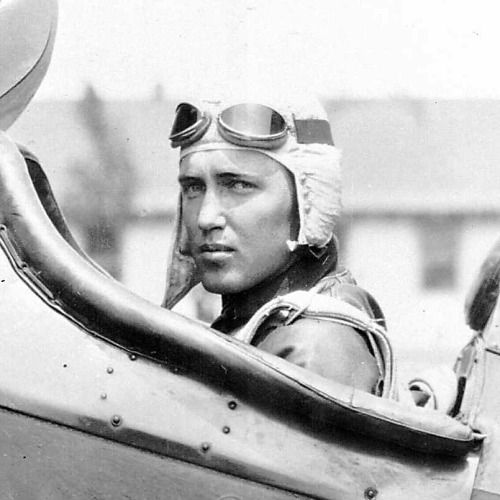
The American air attaché to the Nordic countries, U.S. Army Captain Robert Losey, was killed while observing a German bombing on the railway Junection at Dombås, Norway; Losey was the first American military casualty of WW2. U.S. Military Attaché Captain Robert E. Losey, air assistant to military attaché with the United States Embassy in Finland and a meteorologist, assists the American legation to escape to safety in Sweden. On 21 April 1940, after evacuating one party, he returns to help another. Passing through Dombås, a key road juncture which recently had been the scene of bitter fighting, Losey is caught in a Luftwaffe raid. Losey gets safely to a railway tunnel but stands near the entrance to observe the bombing. A bomb falls nearby, and a sliver pierces his heart, killing him.
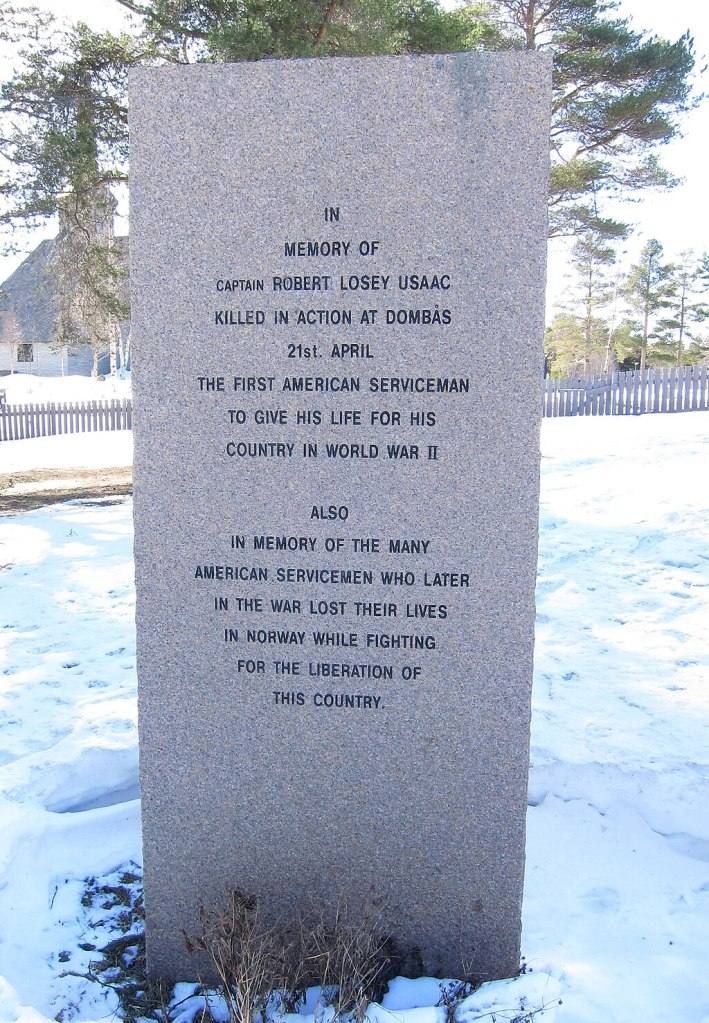
U.S. Minister to Sweden Frederick A. Sterling ordered Naval Attaché Lieutenant Commander Ole E. Hagen to Norway to retrieve Losey’s remains. Losey’s remains are buried next to those of his mother, in the West Point Cemetery. The citizens of Dombås erected a monument in Losey’s honor in 1987, with the following inscription: “In memory of Captain Robert Losey, USAAC, killed in action at Dombås 21th [sic] April; The first American serviceman to give his life for his country in World War II.”
The Germans of the 196th Infantry Division continue moving north from Oslo. The British 148th Infantry Brigade attempts to block them at Lake Mjøsa, south of Lillehammer. Around Lake Mjøsa, British 148th Brigade reinforced Norwegian positions, but on the same day German forces broke through the line, causing the entire Norwegian-British force to withdraw north toward Lillehammer. The Luftwaffe attacks the Allied positions with 8 Heinkel He 111 bombers, aided by heavy artillery. The British arrive too late to help, and both the British and Norwegians are sent reeling back to Lillehammer at midnight over snowy mountain roads.
At Bagn, on the other main road north, the Germans eliminate the Norwegians attempting to block the road and continue toward Trondheim.
The German tanks are proving highly effective in Norway. The Norwegians and the British have no effective anti-tank weaponry. Lt. Robert Wynter says: “Our anti-tank rifle is completely ineffective – simply bounces off!” This is a common problem early in the war.
Elements of German 181st Infantry Division and 3rd Mountain Division advance toward Steinkjer north of Trondheim. Near Steinkjer, there is fierce fighting around Krogs Farm at Sandvollan. Reportedly, during the battle which lasts a couple of days in Inderøy and Steinkjer, twelve British soldiers perish. These may have been — likely were — the first British soldiers to die in action against the Germans, not the ones at the separate battle further south.
German troops landed at Verdal and Kirknessvag, threatening to encircle the British 146th Infantry Brigade near Trondheim, causing the British 146th Brigade to withdraw to Vist. A German destroyer leads a troop transport up through the ice of Trondheim fjord. The transport lands mountain troops at Verdal and Kirknessvag, in front of General de Wiart’s 146th Brigade, poised to attack Trondheim. The Germans, once landed, quickly advance from Verdal to the north on the strategic British/Norwegian positions at Steinkjer. They are aided by a Luftwaffe attack that levels the town and leaves 1,800 civilians homeless in the winter. The northern British pincer of Operation Sickle is now blocked.
This also would take the pressure off of the Germans besieging Hegra Fortress, which would no longer serve any strategic purpose for the Allies as a link-up point. The Germans now are content to simply bombard Hegra fortress and wait for the inevitable Norwegian surrender there.
Luftwaffe bombers attack Namsos and Åndalsnes, Norway.
RAF Bomber Command dispatches aircraft to attack Stavanger airfield overnight. One bomber is lost, and the bombers destroy six aircraft on the field at Stavanger.
RAF Bomber Command dispatches aircraft to attack Aalborg airfield overnight.
Convoy AP.1 of small steamers St Sunniva (1368grt) and St Magnus (1312grt) departed Aberdeen at 0430/19th escorted by destroyers HMS Hesperus and HMS Jackal, which departed Scapa Flow at 1400/18th for Aberdeen. They were joined at sea by steamer Cedarbank (5159grt; sunk this same day) escorted by destroyer HMS Javelin which departed Scapa Flow at 1100/19th. At that time, Hesperus was detached and returned to Scapa Flow. The convoy arrived at Aalesund early on the 21st and completed unloading by 0500. Anti-aircraft cruiser HMS Curacoa joined for anti-aircraft support on the 21st.
Sailing with supply Convoy AP.1 to support the British landings in Norway, the British motor merchant Cedarbank was torpedoed and sunk by the U-26, commanded by Heinz Scheringer, northwest of Bergen, Norway (62°49’N 4°10’E) at 0749. Of the ship’s complement, 15 died and 30 survivors were picked up by the destroyer HMS Javelin, but the vehicles, anti-aircraft weapons, ammunition, and food destined for the British 148th Brigade near Lillehammer were all lost. The 5,159-ton Cedarbank was carrying military stores, ammunition and vehicles and was bound for Åndalsnes, Norway.
HMS Furious, with only ten Swordfish remaining, continued to cruise off Northern Norway, now in company with HMS Isis, HMS Ilex and HMS Imogen. The days only activity occurs at 1340, when the German trawler Rhein (254 BRT) is sighted and, facing overwhelming force, surrenders to Imogen.
The British trawler Hercules II was bombed and sunk in the North Sea by Luftwaffe aircraft.
The German cargo ship Jürgen Fritzen ran aground and sunk in the Kattegat off Landsort, Sweden.
The British trawler Penn was bombed and sunk in the North Sea by Luftwaffe aircraft.
The British 23rd Infantry Division begins moving to France.
A UK court holds that fathers expecting children may delay their military service to mitigate “potential nervous strain” on the expectant mothers.
Rome celebrated its birthday today with the uneasy feeling that it faces one of the most fateful periods in its approximately 2,700 years of history. Danger was seething below the calm. exterior of this beautiful Spring day, with its many ceremonies to commemorate what is also Italy’s Labor Day. Premier Mussolini appeared on a balcony at noon and told 75,000 cheering workers in the Piazza Venezia that “the password of the Italian people from the mountains to the sea is work and arm.” Giovanni Ansaldo, who again addressed the armed forces as he did last Sunday, stuck by his warning that war might come soon and told his listeners that all their hopes lay in the arms they carried.
The Luftwaffe conducts a minelaying operation along the British coast.
RAF Bomber Command dispatches 36 aircraft on minelaying operations overnight.
Luftwaffe engagements with RAF and French Air Force continue.
U-51 was attacked by submarine FS Orphee with two torpedoes, but both missed.
HMS Glorious departs Greenock in company with the destroyers HMS Hyperion, HMS Hereward and HMS Hasty to fly on her air group consisting of 802 Squadron (Sea Gladiators), 812 Squadron (Swordfish), 823 Squadron (Swordfish), and 825 Squadron (Swordfish). That afternoon, as she rounds Northern Scotland, she commences flying aircraft off and on. First, the Swordfish of 812 and 825 Squadrons depart for Prestwick, carrying the pilots of 802 Squadron ashore so that they can ferry the RAF Gladiator IIs of 263 Squadron to Hatston in preparation for flying them out to the ship. In the flurry of aerial activity that follows, one of these aircraft, N5624, crashes killing the pilot, Petty Officer Cornelius Desmond Gordon-Wilson.
Convoy MT.57departed Methil, escorted by destroyers HMS Wallace and HMS Valorous, and arrived later that day in the Tyne.
Convoy FS.152 departed the Tyne, escorted by destroyers HMS Wallace and HMS Valorous, and arrived at Southend on the 23rd.
Convoy HG.27 of 32 ships departed Gibraltar escorted by destroyers HMS Wishart and HMS Active from the 21st to 28th, after which they proceeded to Portsmouth to give leave. Sloops HMS Fowey and HMS Deptford from convoy OG.27 escorted the convoy from 28 April to 1 May. Convoy HG.27 A separated from HG.27 on the 28th. Section HG.27 A was escorted by sloop Fowey. Sloop Deptford escorted convoy HG.27 from 28 April to 1 May when the convoy arrived at Liverpool.
The War at Sea, Sunday, 21 April 1940 (naval-history.net)
Light cruiser EFFINGHAM was relieved by light cruiser ENTERPRISE on patrol off Harstad.
Convoy AP.1 of small steamers ST SUNNIVA (1368grt) and ST MAGNUS (1312grt) departed Aberdeen at 0430/19th escorted by destroyers HESPERUS and JACKAL, which departed Scapa Flow at 1400/18th for Aberdeen. They were joined at sea by steamer CEDARBANK (5159grt) escorted by destroyer JAVELIN which departed Scapa Flow at 1100/19th. At that time, HESPERUS was detached and returned to Scapa Flow. The convoy arrived at Aalesund early on the 21st and completed unloading by 0500. Anti-aircraft cruiser CURACOA joined for anti-aircraft support on the 21st.
At 0427 on the 21st, JACKAL attacked a submarine contact. However, at 0635, before CEDARBANK (5159grt) could disembark her cargo, which included anti-aircraft guns for area defence, artillery, mortars, transport and Bren carriers for troops of the 148th Infantry Brigade, she was sunk by U-26 in 62 49N, 04 10E. (The location was given in the Home Fleet Destroyer War Diary as 62-54N, 4-39W). Her crew of fourteen and one gunner was lost. Escorting destroyers JACKAL and JAVELIN were unable to inflict damage on U-26 which was returning from delivering supplies to Trondheim. ST MAGNUS and ST SUNNIVA arrived safely with their troops at Aandalsnes that evening.
The 22nd Anti-Submarine Group of trawlers WARWICKSHIRE, HAMMOND, LARWOOD, BRADMAN, and JARDINE arrived at Aandalsnes.
At 0400/21st, a small coastal steamer of some 300 tons, escorted by German destroyer JACOBI, landed 400 troops at Kirknesvaag to reinforce German positions in Trondheimsfjord and outflank British troops at Stenkjer. A torpedo boat landed an infantry company at Verdalsora to secure railway and road bridges there.
Battleship VALIANT with destroyers GRAFTON, ARROW, and ACHERON departed Rosyth at 1900 and arrived at Scapa Flow at 0830/22nd.
Destroyer NUBIAN departed Namsos at 0200, proceeded to sea and arrived back in the fjord at 1840 to find sloop AUCKLAND in harbour. AUCKLAND relieved her as anti-aircraft guard ship and as SNO Namsos, and NUBIAN departed Namsos at 1230/22nd, and arrived at Scapa Flow at 2230/23rd. AUCKLAND remained on station until relieved on the 24th.
French armed merchant cruiser VILLE D’ALGER (10,172grt), sailing as a troopship, had departed Brest on the 15th, and arrived at Scapa Flow at 2000/18th escorted by French destroyers BISON and FOUDROYANT. Designated convoy FP1B, she departed Scapa Flow at 0100/21st, escorted by British light cruiser BIRMINGHAM and anti-aircraft cruiser CALCUTTA, BISON, and FOUDROYANT, and joined destroyer MAORI and sloop AUCKLAND off Namsos that evening at 2030/21st. However, she was refused entry into Namsos that night. FOUDROYANT was detached on the 22nd for refueling at Scapa Flow arriving at 1800/23rd. The force returned at dusk on the 22nd and the French troops were disembarked but the equipment was not landed due to a damaged dock and heavy snow storm. MAORI, which was there with steamer BLACKHEATH, ferried French troops to the pier, after which VILLE D’ALGER departed Namsos at 0530/23rd and was escorted back to Scapa Flow by BISON.
Heavy cruisers DEVONSHIRE, BERWICK, and destroyer INGLEFIELD (D.3) arrived at Scapa Flow at 1000.
Anti-aircraft cruiser CURACOA relieved sloop BLACK SWAN as anti-aircraft guard ship at Aandalsnes.
Destroyers HYPERION, HEREWARD, and HASTY departed Greenock with aircraft carrier GLORIOUS at 1100 for flying on and off. They departed the Clyde at 1800 for Scapa Flow. On 22 April, during flying on, a Skua of 803 Squadron crashed attempting to land, and while Lt A S Griffith was rescued by a destroyer, Naval Airman K A Brown was killed. Nine Sea Gladiators of 804 Squadron were flown onto the ship. Destroyers ARROW, ACHERON, and BRAZEN departed Scapa Flow at 1415/22nd to join GLORIOUS during flying on and off west of the Orkneys, but where then detached at 1930 for Rosyth.
Destroyer BRAZEN departed Scapa Flow at 2050/21st with minelayer ATREUS, escorted her as far as Cape Wrath, and arrived back at 0630/22nd.
Destroyers ESCORT, BEDOUIN, FAULKNOR, and the Polish ORP BŁYSKAWICA and ORP GROM sortied into Rombaksfjord near Narvik to reconnoiter and harass German troop positions.
Destroyers VETERAN and VISCOUNT departed Plymouth at 1200 for the Clyde, where they arrived at 0850/22nd to join the Home Fleet.
Destroyer WALKER departed Workington at 1330 escorting A.S.I.S. HERON to Scapa Flow, arriving at 0800/23rd.
Aircraft carrier GLORIOUS flew 812 and 825 Squadrons ashore to Prestwick, while maintaining nine Sea Gladiators of 802 Squadron, nine Sea Gladiators of 804 Squadron, and 11 Skuas of 803 Squadron. The detached Squadrons were employed in minelaying and convoy escort duties on the south and east coasts from shore bases. They then were employed around Dunkirk. 823 Squadron was temporarily disembarked to make space for the eighteen RAF Gladiators of 263 Squadron, which were flown for transport to Norway.
French destroyer MILAN arrived at Scapa Flow at 1630 with French tanker LE LOT (4220grt).
Sloops PELICAN and FLEETWOOD departed Rosyth at 0200 with military advance parties for Aandalsnes and Molde.
At 1421, French submarine ORPHEE on patrol in the North Sea 70 miles SSW of Lister in 56 58N, 06 03E fired two torpedoes at U-51, which was being followed closely by U-19.
Submarine SEVERN arrived back at Rosyth after patrol off Kristiansand.
Convoy MT.57departed Methil, escorted by destroyers WALLACE and VALOROUS, and arrived later that day in the Tyne.
Convoy FS.152 departed the Tyne, escorted by destroyers WALLACE and VALOROUS, and arrived at Southend on the 23rd.
German aircraft dropped mines off Ramsgate and North Foreland and in King’s Channel. On the 23rd, steamer LOLWORTH (1969grt) was sunk 1/2 mile NW of Elbow Buoy near North Foreland; two crew were lost and 22 survivors rescued. On the 24th, steamer RYDAL FORCE (1101grt) was sunk 400 south of Gull Light Vessel; eleven crew were missing, and two survivors rescued by minesweeping trawler SARAH HIDE (162grt). (Note: trawler is referred to as SARAH HYDE in most lists). Then on the 25th, steamer MARGAM ABBEY (2470grt) from convoy FS.53 was sunk due north, nine cables, from East Knob Buoy, but the entire crew was rescued. Due to the minings, convoy HX.34, escorted by destroyer WHITEHALL, anchored in Dungeness Roads.
Trawlers PENN (179grt) and HERCULES II (165grt) were sunk by German bombing in the North Sea.
German steamer TOGO (5054grt) was damaged by a mine laid earlier in the month by submarine NARWHAL off Arendal, in 57-26N, 10-45E.
German steamer JURGEN FRITZEN (4465grt) was lost after grounding southeast of Landsort.
Destroyers DIAMOND and DAINTY arrived at Gibraltar on the 12th from the South Atlantic. After refueling and some refit, they departed on the 19th for Malta, where they arrived on the 21st for duty with the Mediterranean Fleet.
Light cruiser CALYPSO was refitting at Malta from 21 April to 14 May 1940.
Convoy HG.27 of 32 ships departed Gibraltar escorted by destroyers WISHART and ACTIVE from the 21st to 28th, after which they proceeded to Portsmouth to give leave. Sloops FOWEY and DEPTFORD from convoy OG.27 escorted the convoy from 28 April to 1 May. Convoy HG.27 A separated from HG.27 on the 28th. Section HG.27 A was escorted by sloop FOWEY only for five hours before the convoys split (but escorted the section from 28 April to 1 May). Sloop DEPTFORD escorted convoy HG.27 from 28 April to 1 May when the convoy arrived at Liverpool.
A fight that has been brewing for more than a year over changes in the Wages and Hours Act is expected to be decided late this week by the House, and its decision is considered likely to influence the Senate in determining whether to consider this and other legislation affecting labor at this session. A rule granted last July by the House Rules Committee but hitherto kept in abeyance by Administration leaders will bring out the measure next Thursday. It provides for the adoption by the House of one of three bills containing amendments to the act.
One measure, considered by labor to contain the “least obnoxious” amendments, is sponsored by Representative Mary T. Norton of New Jersey, chairman of the House Labor Committee. Another containing the Norton amendments and three or four additional ones was introduced by Representative Ramspeck of Georgia, ranking majority member of the Labor Committee. The third, sponsored by Representative Barden of North Carolina, contains rather drastic amendments which have the opposition of most labor organizations but are supported by several segments of industry, business, and agriculture.
John L. Lewis, president of the C.I.O., tonight marshaled his labor forces against all bills attempting to change the Wages and Hours Act and the National Labor Relations Act, consideration of which is to follow. He also urged defeat in the Senate of the House-approved Logan-Walter bill to provide for court review of rules and decisions of federal agencies. A House bloc, consisting of Southern Democrats, called by Mr. Lewis “Garner Democrats,” and Republicans, is said to favor the Barden bill with slight modifications.
The Barden bill would exempt the food processing industries from the minimum wage and maximum hour requirements of the law and would exempt salaried employees earning $150 a month or more from the hours provision. It would define more explicitly the “area of production” provision and would “repeal” the ruling of the former Wage and Hours Administrator, Elmer F. Andrews, on this question. The Norton and Ramspeck bills would exempt salaried workers earning $200 a month or more from the hours provision, called the “white collar” clause.
In the first major address of his campaign for the Democratic presidential nomination, Postmaster-General Farley laid down tonight in Boston a foreign policy program based on armed preparedness and this nation’s cooperation with its American neighbors. Nearly 2,000 persons, among them nearly every one of the state’s Democratic leaders, heard Farley strongly praise the record of President Roosevelt and Secretary of State Hull, and call for elimination of “political divisions in foreign affairs.” Farley spoke after Senator David I. Walsh, Massachusetts Democrat, had given him “unmistakable assurance” of support by Massachusetts. Three former Massachusetts Democratic governors, James M. Curley, Charles F. Hurley and Joseph B. Ely, the latter an outspoken foe of the new deal, also pledged their allegiance to Farley and urged restoration of party harmony.
Thomas E. Dewey, New York prosecutor seeking the Republican presidential nomination, declared today America’s most important tasks were to keep out of war and settle domestic problems “which are in desperate need of attention.” Dewey gave as his formula for peace the refraining “from intervening in the disposition of affairs in the rest of the world,” and “an adequate defense of our own.” He expressed belief the nation could take care of itself if attacked, but added “we must be prepared to defend both our coasts.”
Senator Pepper of Florida said today that he would introduce tomorrow a resolution aimed at getting additional funds for the WPA for the rest of this fiscal year, ending June 30. The resolution, signed by a dozen other Senators as co-authors, according to Mr. Pepper, would nullify the Woodrum amendment to the Relief Act, an amendment which requires the WPA to apportion its funds so that they will last for the full twelve months of the fiscal year. The Florida Democrat explained that his proposal was designed to let the WPA keep on its rolls, as long as its current appropriation lasts, all the relief clients drawing pay April 1. He said that about 200,000 had been out off since that date and that 600,000 more would have to be dropped if the WPA had to stay within its $1,477,000,000 appropriation for this year.
George Scalise, president of the 70,000 members of the Building Service Employees International union (A.F.L.) was arrested in his room at the Commodore Hotel in New York at 3 AM today on charges of extorting about $100,000 in the last three years from 20 local hotels and cleaning contractors. He was accused by aides of District Attorney Thomas E. Dewey, a Republican presidential aspirant, of getting money by threatening strikes or excessive wage increase demands, or by threatening to unionize non-union establishments. After spending the day in the Tombs prison, Scalise was released on $40,000 bail posted by the union through a bonding company.
A 50-mile-an-hour northeaster today splashed waves over the top of 114-foot Minot’s light outside Boston harbor, sent a high running surf surging into New England’s waterfront cellars and streets, and deposited heavy snow inland. While rain splattered the coastline, the storm left 10 inches of snow in sections of Vermont and Maine.
Walter Kohler, 65. former Republican governor of Wisconsin, industrialist, and founder of the community bearing his name, died today. He was nationally known as a politician, aviation enthusiast and manufacturer of plumbing fixtures.
“Take It or Leave It,” the forerunner to the popular quiz show “The $64,000 Question,” premiered on CBS radio.
Major League Baseball:
The Tigers blasted Bob Feller from the mound with a five-run assault in the third inning today and set the Indians down, 12–2, for the Tribe’s first defeat of the season.
St. Louis Cardinals 5, Chicago Cubs 4
Detroit Tigers 12, Cleveland Indians 2
Chicago White Sox 6, St. Louis Browns 2
Continuation today of the strife between Hindu and Moslem crowds in Rangoon has left eleven persona killed and sixty-nine injured.
Soviet patrol vessels have seized six Japanese fishing boats off Northern Korea during the past ten days, the Domei News Agency reported today from Seishin, Korea. The master of the Shingyo Maru No. 3 reached Seishin yesterday and told of seeing the capture of two ships of the fleet in which he was fishing. “We were just dropping our nets, when a fast Soviet patrol boat hove in sight and raced toward us,” he said. “The Russian ship intercepted the Hokusen Maru No. 1 and put an armed guard aboard her. She next captured the Tagyo Maru No. 3 and then started after the Kasugama Maru. We hove anchor and made off at full speed and managed to escape.”
The establishment of stringent passport control, coupled with a system of visas necessary to enter that portion of China occupied by the Japanese Army, is being contemplated by Wang Ching-wei’s Nanking regime, it was learned today.
The Japanese Consulate spokesman admitted this morning that the restriction on the number of ships trading between Hong Kong and Canton to two Japanese and one British weekly had not been removed by the Japanese declaration that the Pearl River was reopened for general traffic yesterday. The difference was that the ships are now permitted to carry cargoes. The derisive response of shipping circles to this is: “True, but under such sweeping restrictions the concession is virtually valueless.” The Japanese spokesman claims the restrictions are the same as under the Chungking government.
A Singapore Conference between UK, U.S. and Dutch military representatives is held. Air Vice-Marshall Sir Robert Brooke-Popham chaired the meeting; the U.S. naval representative was Captain ‘Spec’ Purnell, Chief of Staff to ADM Hart, Commander of the Asiatic Fleet. The “ADB” Plan was developed but both U.S. War and Navy Departments recommended it be rejected as they felt it was defeatist and compromised U.S. interests by insisting on defense of trade routes over offensive actions against Japanese.
Born:
Jacques Caron, Canadian NHL and WHA goaltender (Los Angeles Kings, St. Louis Blues, Vancouver Canucks, WHA: Cleveland Crusaders, Cincinnati Stingers), in Noranda, Quebec, Canada.
Bill Faul, MLB pitcher (Detroit Tigers, Chicago Cubs, San Francisco Giants), in Cincinnati, Ohio (d. 2002).
George DiCenzo, American actor (“Equal Justice”), in New Haven, Connecticut (d. 2010).
Souleymane Cisse, Malian pioneering filmmaker (“Waati”, “Yeelen”, “Finye”, “Baara”), in Bamako, Mali (d. 2025).
Died:
Robert M. Losey, 31, American aeronautical meteorologist considered to be the first U.S. military casualty of World War II (killed in the German bombardment of Norway).
Walter J. Kohler, Sr., 65, American businessman and politician.
Naval Construction:
The Вое́нно-морско́й флот СССР (ВМФ) (Soviet Navy) “ShCh” (ShChuka)-class (6th group, Type X-modified) submarine ShCh-135 is launched by Dalzavod (Vladivostok, U.S.S.R.) / Yard 202.
The Royal Navy “U”-class (Second Group) submarine HMS Upright (N 89) is launched by Vickers Armstrong (Barrow-in-Furness, U.K.).
 History Diaries