With the fall of Xuân Lộc, President Thiệu resigns and transfers authority to Vice-President Trần Văn Hương before any of the several plots against him can be implemented. On 25 April he flees Saigon. South Vietnam’s President Nguyễn Văn Thiệu resigns and flees the country to Taiwan five days later. After going to Thailand, Thiệu, who was succeeded by Vice-president Trần Văn Hương, moved to London. He would pass away in Newton, Massachusetts, on September 29, 2001. Denouncing the United States as untrustworthy, South Vietnam’s President, Nguyễn Văn Thiệu, has resigned after 10 years in office. He appointed his Vice President, Trần Văn Hương, to replace him and said President Hương would immediately press for an end to the war and a start of peace negotiations. In an impassioned address to his nation, Mr. Thiệu defended his character and his regime’s accomplishments.
Speaking before assembled members of his Government and National Assembly at the Presidential Palace, President Thiệu accused the United States of breaking its promises to support an anti‐Communist Government in Saigon. Mr. Thiệu said that he had objected in October, 1972, to Secretary of State Kissinger’s “acceptance of the continued presence of North Vietnamese troops in South Vietnam.” Mr. Thiệu added that South Vietnam would fight on to defend the territory left to it. The armed forces chief of staff, General Cao Văn Viên, also spoke briefly, to say that his troops would continue fighting to “defend the homeland against the communist aggressors.” “I resign but I do not desert,” President Thiệu said in concluding his one‐and‐a‐half‐hour address. “From this minute I will put myself at the disposal of the President and people. I will continue to stay close to you all in the coming task of national defense. Good‐by to you all.”
His voice taut with emotion, President Thiệu devoted most of his speech to a scathing criticism of the United States saying: “The United States has not respected its promises. It is unfair. It is inhumane. It is not trustworthy. It is irresponsible.” Mr. Thiệu said that former President Richard M. Nixon had described all accords, including the Paris peace agreement, as “pieces of paper” unless they were implemented, and had therefore promised Saigon not only military and economic aid, but also “direct and strong United States military intervention” in the event the Communists broke the accord.
But then, Mr. Thiệu said, Watergate undid American resolve in aiding Vietnam, and Washington deserted its ally. By the time former Vice President Spiro T. Agnew visited Saigon later, he said Mr. Agnew spoke “coldly,” referring only to “Vietnamization” of the war and continuing military and economic aid, but not of President Nixon’s promise before the Paris accord to send American troops and B‐52’s if needed. The State Department has said that there was no specific commitment by the United States to intervene militarily. And the White House noted earlier this month that any private assurance given by Mr. Nixon was no longer valid because of the Congressional ban on American combat activity in Indochina imposed in August, 1973. “Let me say that we need at least $722‐million, plus the B‐52’s” Mr. Thiệu said today. “Let me say that we need immediate — I say immediate —shipment of arms and equipment to the South Vietnam battlefield. “I would challenge the United States army to do better than the South Vietnamese army without B‐52’s,” the President said.
The CBU-55, that at the time, was described as “the most powerful non-nuclear weapon in the U.S. arsenal”, was used in combat for the first and only time. A Republic of Vietnam Air Force C-130 dropped the fuel bomb, which consumed all oxygen within a radius of 70 meters, killing 250 North Vietnamese troops near Xuân Lộc, capital of Bình Tuy Province. Despite a stiff resistance by the south, the province would fall later in the day.
Fighting in South Vietnam virtually ceased after President Thiệu’s resignation, highly informed military sources reported today. “There were some incidents but practically no military activity since then,” one source said. The Việt Cộng radio, while denouncing the new President, Trần Văn Hương, spoke mostly in terms of carrying out the Paris peace accord rather than making military threats. Just before President Thieu resigned the military situation was essentially stable despite continued heavy Communist shelling and probes and clashes in some places. Among the targets of the shelling were two besieged provincial capitals on the northeastern eastern and eastern approaches to Saigon.
Military informants said that a move was in progress to pull most Saigon defenders out of Xuân Lộc to strengthen the defenses of Saigon. But the Saigon command continued to deny there was any attention of abandoning the town. The other city under heavy bombardment last night was Hàm Tân, capital of Bình Tuy Province on the South China Sea 63 miles due east of Saigon. Four days ago, Phan Thiết, a provincial capital farther up the coast, fell to an overwhelming Communist force, which then became available for attacking Hàm Tân. Communist gunners also shelled Biên Hòa air base, 15 miles northeast of Saigon. Most of the base’s operations have been transferred to Saigon over the last week because of the shelling.
Sixty‐five miles northwest of Saigon, a serious situation was reported at Tây Ninh because of Communist interdiction of Route 22. The road is Tây Ninh’s supply link with Saigon. The cut in the road and sporadic shelling in the area are estimated to have driven 50,000 refugees to seek safety within the grounds of the Cao Đài cathedral in Tây Ninh. The Cao Đài are a quasi‐religious sect whose saints include Victor Hugo and Winston Churchill. Reports from Tây Ninh said food stocks were low.
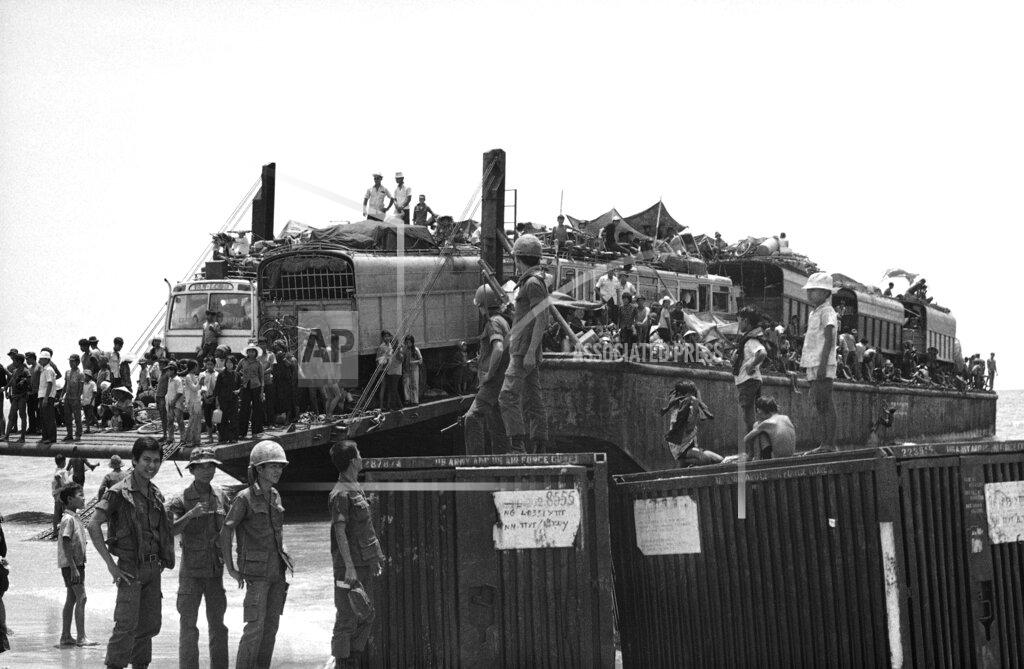
Crowds of South Vietnamese seeking places aboard junks to leave the country started a panic today in the port of Vũng Tàu following the encircement of of Xuân Lộc by the Communists, an official military source reported here. The source said that there was great confusion in Vũng Tàu among crowds of people who had come from Saigon to try to leave the country.
Administration sources in Washington said that President Ford two or three weeks ago had ordered a “hands off” policy that neither supported nor abandoned President Nguyễn Văn Thiệu. This instruction, one official said, must have been interpreted by high South Vietnamese officials as a change in American policy, and caused them to put pressure on Mr. Thieu to resign as the only hope of getting congressional approval of more military aid.
The French Government appealed urgently today for a quick resumption of negotiations to carry out the 1973 Paris agreements on Vietnam, accompanied by a ceasefire covering all South Vietnam.
Defense Department officials in Washington have concluded that the situation in South Vietnam is deteriorating so rapidly that the United States must plan for an immediate evacuation of all Americans and their dependents from Saigon. The White House, State Department and the Pentagon were reported urgently weighing the evacuation of 2,800 Americans and 1,200 Vietnamese dependents. Officials reported that Secretary of State Kissinger was resisting proposals for a complete evacuation of all Americans and their dependents. Mr. Kissinger’s basic argument is that any overt move toward evacuation — a word that he has ordered not to be used in any government announcement—could cause panic in the already unstable situation in Saigon. Meanwhile, an evacuation airlift from Saigon continued, and reports from the Philippines, where the planes were landing, said hundreds of Vietnamese, some present and former military officers, were aboard with Americans.
This evening, in a CBS television interview, Mr. Ford said there was “no problem” about his authority to use United States troops to evacuate American citizens, if necessary, from South Vietnam. But the President said that if there was resistance from either North Vietnam or South Vietnam, it would be “virtually impossible” to withdrawn large numbers of South Vietnamese citizens without a “sizable military involvement” of American troops “on a short‐term basis.” Mr. Ford said the situation is “so fluid” that nobody could be certain as to North Vietnam’s motives.
It had appeared, he said, that North Vietnam was intent upon a “quick turnover” of power. But in the last 12 hours, he said, there had been a “slowdown” in North Vietnam’s be stabilized for very long. But he also argued that Congressional approval of some emergency military aid would bolster the Saigon Government and perhaps permit “some sort of solution short of all‐out surrender.”
Athens police and anti-American demonstrators battled at the U.S. Embassy after a march by about 100.000 persons marking the eighth anniversary of the army coup. Six demonstrators and five policemen were injured. Many Greeks believe Washington propped up the military regime which collapsed last July. The United States is also accused of backing Turkey in the dispute over divided Cyprus.
Greece’s ruling New Democracy Party lost three seats to united opposition candidates in Sunday’s by-elections but won in four other races, final results showed. Premier Constantine Caramanlis’ party gained an overwhelming majority in parliament with 216 seats. Next came the Center Union Party with 61. The Communists won eight seats.
More than 25 persons were injured when left-wing extremists broke through a cordon of police and disrupted a meeting organized by the conservative Social Democratic Center Party at a theater in Guimaraes in northern Portugal. Troops were forced to fire to disperse the crowd. Another clash between leftists and conservatives was reported in Oporto, Portugal’s second largest city. Election of a 247-man constituent assembly will be held Friday.
Two men repairing a vacant house in North Ireland and their sister, who had just brought them a meal, were killed by a bomb which demolished the house, near Dungannon, about 40 miles west of Belfast. Police said they were not sure the bomb was intended for the three victims. The house had been vacant for some time, and the bomb might have been intended for security men who checked the house periodically, police said.
The Moscow leader of a pentecostal Christian sect, Ivan Fedotov, has been sentenced to three years in a labor camp for slandering the Soviet state, his wife, Valentina, said in Moscow. The sect is banned as reactionary under Soviet law. Mrs. Fedotov said many of the men in the sect had been sent to jail for refusing mandatory military service on religious grounds.
The Soviet Union is proposing an abbreviated preliminary session of the Geneva conference on the Middle East. Soviet pans for the conference, official Soviet, and Arab sources said, are being explained to Arab officials at Kremlin meetings and through high‐level diplomatic channels. The United States and Israel, it was understood, are also being kept abreast of Soviet plans through diplomatic channels. Details of the Kremlin’s tentative plans to return to Geneva were disclosed as Arab leaders followed each other into the Kremlin for talks with Soviet leaders. Few details of those talks are officially announced, but it seems unmistakably clear that the Kremlin is accelerating its efforts to reconvene the Geneva conference, which opened after the 1973 war, accomplished nothing and has not met since.
President Ford, exhibiting coolness toward Israel, said tonight that his Administration was considering three options for new Middle East neogtiations. He indicated that he favored combining a commitment to the holding of a new Geneva conference with a fresh try at bringing about a separate Egyptian‐Israeli accord. In a CBS television interview, Mr. Ford stressed, however, that no decision had been made and that the current Middle East policy review in Washington was not completed. More significant than his disclosures about the policy options under consideration were his deliberate efforts to demonstrate that the Administration was going to be as even‐handed as it could in relations with the Arab states and Israel. In context his remarks seemed chilly to Israel.
Moshe Dayan, the former Israeli Defense Minister, said tonight that Egyptian President Anwar el‐Sadat’s actions opening the Suez Canal and redeveloping the cities along the waterway were more important than any agreement that Secretary of State Kissinger might have achieved. Speaking to more than 1,200 Briarcliff College students and townspeople, Mr. Dayan said: “We attach too much to written documents and not enough to what happens on the ground. When that happens, there is a change.” “After June,” Mr. Dayan continued, “the canal will become the ground change, not a paper agreement. What was a military obstacle becomes an international waterway,” he said, adding that President Nasser would never have done it until Israel had withdrawn from all occupied territory.
A number of important figures in the fallen Cambodian government have eft their refuge in the French Embassy in Phnom Penh to surrender to the Cambodian Communists, according to reports yesterday that could not be confirmed, and many of the thousands of Cambodian civilians who fled to neighboring Thailand were said to be returning home. French sources in Paris, according to an Associated Press dispatch, said that no prominent Cambodian officials remained at the embassy. The reports did not mention anyone by name. Late last night United Press International reported from Saigon that Phnom Penh radio had returned to the air in its first broadcast since the Khmer Rouge take‐over of the city. The unconfirmed report, based on monitoring in Saigon by a Cambodian employe of U.P.I., said that the new Cambodian Information Minister, Hou Nim said the radio station of the new government had been moved from the northern province of Kratie to Phnom Penh. In the broadcast Mr. Hou Nim reportedly indicated that some fighting continued in Cambodia, but he gave no details. “We must continue our struggle to liberate our entire nation,” Mr. Hou Nim reportedly said. The broadcast gave virtually no information on events in Phnom Penh, according to the report.
The most powerful earthquake to rock southwestern Japan in postwar years injured eight people and destroyed or damaged 70 homes and buildings. Police said the quake, which registered 4 on the Japanese scale of 7. also destroyed two bridges, blocked 18 highways, caused 16 landslides in Oita province and other parts of Kyushu Island and made 180 people homeless.
President Ferdinand E. Marcos agreed to integrate insurgent Filipino Muslim forces into the Philippine military command as a step toward resolving their rebellion. He met at Malacanang, the presidential palace, with 142 leaders of 27 rebel groups from the troubled Mindanao-Sulu region. The rebel leaders were among insurgents who had attended a three-day peace conference with the government last week.
Reports that the cost of Canadian natural gas may increase about 50% resulted in scheduling a meeting in Ottawa to discuss the proposed rate hikes. Among those reportedly planning to attend from the United States were Julius Katz. deputy assistant secretary of state in the division of economics and business affairs. Frank Allen of the Federal Power Commission and Clem Malin of the Federal Energy Administration. Canadian Energy Minister Donald MacDonald has confirmed there will be a price increase in Canadian natural gas but has declined to say how much it will be.
The Kenyan police have picked up and questioned a Member of Parliament who serves on a select committee investigating the murder last month of a leading politician. The murder has touched off a wave of anger in Kenya. Charles Rubia, a former Mayor of Nairobi and a leading critic of the government, said he was taken in for questioning last week by policemen who suggested to him that he was the leader of two clandestine organizations aimed at bringing down the Government of President Jomo Kenyatta. Mr. Rubia said the allegation was untrue, and was released within a few hours. He said he still felt “hunted” and believed he was in danger of being killed, as his colleague, Josiah M. Kariuki, was, on March 2. Mr. Rubia and Mr. Kariuki were prominent spokesmen in an informal bloc that has charged that a black élite has been permitted to amass too much wealth and privilege.
President Kenneth D. Kaunda of Zambia arrived in Cuba after a state visit in Washington. He was greeted by Premier Fidel Castro. In Washington, the White House said the United States intends to seek closer ties with African nations. The statement was in response to critical statements about U.S. policy in Africa made by Kaunda during a toast at a White House state dinner.
Senator Frank Church, chairman of a Senate committee now investigating the Central Intelligence Agency, said today that he would not hesitate to summon former President Richard M. Nixon as a witness. The Idaho Democrat said the Senate’s select committee had not yet decided the key points of its inquiry. “It’s such a large mandate we’re going to have to narrow down on certain focal points,” he said. “If one of those relates to subject matter that would require President Nixon as a witness, I would have no hesitation in recommending to the committee that he be called.”
In the first major confrontation between employment and the environment in the present session of Congress, the House of Representatives has voted for jobs. The issue involved would change federal environmental protection laws in order to end legal snarls that have halted 130 highway construction jobs in New York, Connecticut and Vermont amounting to $2.3 billion and providing jobs for some 150,000 workers. One of the major projects involved here is the West Side Highway reconstruction. Another is an approach to Kennedy International Airport.
The Supreme Court declined today to review two decisions that could result in the merger of city and suburban school districts to achieve racial desegregation in an over‐all metropolitan area. In leaving lower court rulings in effect in Indianapolis and Louisville, however, the Justices did not alter their 1974 Detroit decision prohibiting school integration plans merging city school systems that have been found discriminatory with suburban districts that have not.
The federal tax returns of most Americans are routinely made available to their home states by the Internal Revenue Service, the Senate finance subcommittee on internal revenue was told. Lee Whitaker, chief counsel for the IRS. conceded that the states do not use ample safeguards to ensure privacy of the returns. IRS Commissioner Donald Alexander said that in 1974 tax information on 63 million citizens was passed to the states under “treaties” designed to ensure that taxpayers comply with both state and federal laws.
Construction union leaders called for emergency action to revive their industry where unemployment, at 18.1%, is double the national average. “The plain, simple, unvarnished fact is that we are fighting for our lives — our economic and social existence,” said Robert A. Georgine, president of the AFL-CIO Building and Construction Trades Department. Speaking at the opening of a two-day national job conference in Washington. D.C.. Georgine said the industry was in worse shape than even during the depression of the 1930s.
Stanley K. Hathaway, former Republican Governor of Wyoming, assured the Senate Interior Committee today that, if confirmed as Secretary of the Interior, he would strive conscientiously to “find the fine line between protecting the environment and developing the nation’s resources.”
Air Force documents show that a new cargo plane would cost nearly three times what officials predicted and would not be significantly better than the model it is intended to replace. said Rep. Les Aspin (D-Wisconsin). He said the documents showed the Advanced Medium Stol (short takeoff and landing) Transport, designed to replace the $6 million C-130. would cost up to $22 million each when research and development funds were included. Aspin, a former Pentagon budget analyst, said the C-130’s capabilities were almost identical to the proposed new plane.
The U.S. Appeals Court in New York City upheld a four-year-old experiment designed to provide imaginative, independent television productions during the prime time evening viewing period of 7-11 PM. The court said the ruling established by the Federal Communications Commission did not violate the Constitution or the Federal Communications Act. The rule prohibits stations in the 50 largest areas from broadcasting network programs in more than three of the four hours. The rule allows one hour for independently created programs, with the purpose being to avoid network dominance and encourage diversity.
Representatives of the United States Postal Service and four postal unions held today a short organizational session and announced plans to meet again April 29 to resume negotiations likely to lead to higher postal pay and higher postal rates.
N. Dale Anderson, former Baltimore County executive and the second state official snared in the federal probe of Maryland political corruption that forced the resignation of Vice President Spiro T. Agnew in 1973, entered federal prison at Allenwood. Pennsylvania. to begin serving a five-year sentence. Anderson, 58, last month lost an appeal of his March 20, 1974, conviction on 32 counts of conspiracy, extortion, and income tax evasion, all related to a kickback scheme.
Members of the Symbionese Liberation Army, which had kidnapped newspaper heiress Patty Hearst on February 4, 1974, robbed a branch of the Crocker National Bank in Carmichael, California. Unlike previous bank robberies by the SLA, the group killed a bystander. Myrna Opsahl, a 42-year-old mother of four, who had been at the bank depositing money collected by her church from the previous day’s services. Hearst was identified later as the driver of the getaway car.
This week has been designated Law and Order Week on the Pine Ridge Oglala Sioux Reservation in South Dakota. The irony of the designation is evident as Federal Bureau of Investigation statistics show that six persons have been killed on the reservation since the first of the year and 67 other persons have been assaulted, some with tomahawks and hammers. This gives Pine Ridge a per-capita homicide rate six times greater than that of Chicago.
The economic pinch is hurting retired military personnel, like other people, but the ones who hung up their uniforms many years ago contend they are in worse condition because of a 1958 change in the method of figuring their income.
“A major event of scientific importance” was the description given to the laying of the first egg by a whooping crane in the U.S. Fish and Wildlife Service’s captive flock. Biologists were not sure if the egg was fertile, but they were taking no chances — it was being kept in an incubator at Patuxent Wildlife Research Center in Maryland. Whooping crane eggs take 30 days to hatch. The wildlife service’s flock of 21 whoopers was established in hopes of restoring the wild population of the nearly extinct birds. Only 49 wild whoopers were counted this year in the annual winter whooping crane census, a service spokesman said.
More than $1 million in grants will be awarded next month by the Federal Energy Administration to states. communities and private utility companies working to develop new rate structures designed to lure consumers away from old electricity use habits. The new rates would encourage use of power during hours when not much electricity is normally used and establish an inverted rate schedule that would sell a block of energy at a basic rate with additional energy costing a premium rate. The new system, if proven successful in the grant-supported programs, could “at least stifle the increases and in some cases maybe even change somewhat downward the cost to the individual homeowners,” according to Frank G. Zarb. FEA director.
79th Boston Marathon: American Bill Rodgers wins men’s section in race record 2:09:55; Liane Winter of West Germany women’s champion in 2:42:24 (female world record).
Dow Jones Industrial Average: 815.86 (+7.43, +0.92%)
Major League Baseball:
Padres’ pitcher Randy Jones threw his second shutout of the season as San Diego blanked the Astos, 4–0. Jones is 2–0 with an ERA of 0.00.
Los Angeles Dodgers 2, Atlanta Braves 1
New York Yankees 12, Boston Red Sox 1
Minnesota Twins 8, California Angels 6
San Francisco Giants 4, Cincinnati Reds 3
San Diego Padres 4, Houston Astros 0
Texas Rangers 6, Oakland Athletics 11
Born:
Danyon Loader, New Zealand swimmer (Olympic gold medals, 200 and 400m freestyle, 1996; bronze, 200m butterfly, 1992), in Dunedin, New Zealand.
Aquilino López, Dominican MLB pitcher (Toronto Blue Jays, Colorado Rockies, Philadelphia Phillies, Detroit Tigers), in Villa Altagracia, Dominican Republic.
Carlos Castillo, MLB pitcher (Chicago White Sox, Boston Red Sox), in Boston, Massachusetts.
Mike Sutton, NFL defensive end (Tennessee Titans), in Jacksonville, North Carolina.
Brian J. White, American actor (“The Family Stone”), in Boston, Massachusetts.
Died:
Sisowath Sirik Matak, 61, former Prime Minister of Cambodia and Long Boret, 42, Prime Minister of Cambodia, two of the seven “supertraitors” designated by the Khmer Rouge for trial and execution, were executed on or about this date after choosing to remain in Cambodia rather than to evacuate.
 History Diaries