The Battle of Dombås ended in a Norwegian tactical victory. Forty-five German paratroopers surrendered to the Norwegian forces at Dombås. By dawn on 19 April, the Germans were completely surrounded by better-armed Norwegian troops. During the night, a final reinforcement had reached the Norwegians; a rail-mounted howitzer manned by a gun crew of Royal Marines that had arrived from Åndalsnes. The howitzer had 300 rounds available and opened fire at 06:00, firing ten rounds with good accuracy. Soon after another Ju 52 transport arrived carrying supplies to the beleaguered Germans but turned around without making its drop after receiving a radio message from Schmidt informing that the paratroopers were going to surrender.
Later on, Schmidt sent out his second-in-command — Leutnant Ernst Mössinger — to negotiate a surrender, hoping to reach favourable terms. Major Arne Sunde, the Norwegian commander, however, refused to accept anything but an unconditional surrender. Sunde told Mössinger that unless the Germans announced their surrender within 10 minutes by launching three flares the British and Norwegian artillery would recommence bombarding Lindse Farm. Nine and a half minutes later, at 11:30, the Fallschirmjäger force at Lindse fired three signal flares. Forty-five Fallschirmjäger surrendered at Lindse Farms, six of whom were wounded. After having been fed at the municipal building in Dovre, the captured Germans were sent by train to Dombås.
There are 45 Fallschirmjäger left, of whom 6 are wounded. The elimination of the Germans at Dombås clears the vital rail line and road junction. It also facilitates the escape route for King Haakon and the rest of the Norwegian government to England via the port of Andalsnes.
The Germans lost a total of 21 dead during the battle, as well as 40 wounded or injured. Of these, 15 of the fatalities occurred during the initial phase of the attack, as well as 20 wounded and 14 personnel suffering injuries. Six more were killed and another six wounded during the fighting that led to the final German surrender on 19 April. Around 150 Germans were taken as prisoners of war. Seven Junkers Ju 52 transports were shot by ground-fire and an eighth Ju 52 landed in neutral Sweden. Norwegian casualties in the battle totaled 20 dead and 20 wounded. The Norwegian and German wounded who were treated by the Norwegian medical service were first treated at a field hospital in Dombås, before being moved to a regular hospital. The first train loads of wounded, leaving Dombås on 16 April, were destined for Molde Hospital in Molde, with later transports sent with the hospital ship Brand IV from Åndalsnes to Ålesund Hospital in Ålesund. German dead were buried by the Norwegian military in mass graves, eventually being moved post-war to a German War Graves Commission cemetery in Alfaset, Oslo.
Following their surrender, the captured German soldiers were sent to During German bombing raids on Kristiansund on 28–29 April, the prisoners of war suffered several wounded. Following the bombing of Kristiansund, the prisoners were moved by lighters to Averøya near Kristiansund, where they were initially kept in a school until a proper a prisoner-of-war camp had been built at Bruhagen. Initially the prisoners had been sent to a transit prisoner-of-war-camp at Isfjorden near Åndalsnes, but this camp did not have the capacity to house the numbers captured at Dombås.
The intention of Norwegian authorities was to first keep the prisoners for interrogation and then ship them to the United Kingdom, but in the chaos of the collapse of resistance in the southern parts of Norway and the Allies’ evacuation from Åndalsnes in late April/early May the German POWs were left behind to be freed by elements of the Luftwaffe’s General Göring Regiment. Of the captured Fallschirmjägers only three fell into British hands and were brought to the United Kingdom when the British evacuated from the southern parts of Norway. One of the three had been able to evade capture after the jump over Dombås until he was caught by retreating British and Norwegian forces in Dombås proper on 29 April.
Most of the freed paratroopers soon after volunteered to jump into the isolated Narvik front in North Norway to help the hard pressed Gebirgsjägers of the German 3rd Mountain Division fighting under the command of Generalleutnant Eduard Dietl from 16 May. Many of the survivors from Dombås died fighting under the leadership of Leutnant Mössinger at Narvik. Herbert Schmidt — the leader of the Fallschirmjäger force at Dombås — received the Knight’s Cross of the Iron Cross on 24 May 1940, for his efforts during the battle. He later recovered from the wounds he had suffered, and in 1941 wrote a book detailing his experiences during the battle called Die Fallschirmjäger von Dombaas. Schmidt was killed by the French Resistance in 1944.
At Verdal, Norway, British and German land forces engaged each other for the first time in the war. The British 146th Territorial Brigade under command of General Carton de Wiart joined Norwegian forces at Steinkjer, at the northern end of the Trondheimfjord, and pushed forward 6 miles to Verdal where they encountered the German 138th Gebirgsjäger Regiment, advancing north from Trondheim. This was the first engagement between British and German land forces in World War II.
Norwegian General Ruge convinced British Brigadier Morgan to lead the British 148th Brigade in an effort to block the German advance from Oslo.
The French 5e Demi-Brigade Chasseurs Alpins arrived in Namsos. Overnight, 3 battalions of French mountain troops arrived at Namsos, Norway. This force includes the French 5th Demi-Briage of Chasseurs Alpins — specialists in mountain warfare. However, the French have been dogged by trouble. The Luftwaffe had bombed their convoy; one escorting destroyer was so badly damaged that it had to put back to France. When they reached port and began unloading cargo they discovered that their skis were useless. They had been shipped without bindings.
The Germans captured Hamar and Elverum in Norway. Elements of German 196th Infantry Division captured Hamar.
At Andalsnes, the British troops (Brigadier Morgan) have two conflicting objectives: move on Trondheim from the south as part of Operation Sickle, and support the Norwegians to their south at Lillehammer. This means moving in opposite directions.
The situation is becoming critical because the advancing German troops of the 196th Infantry Division have captured Hamar and Elverum only 50 miles to the south. As a first step, Morgan sends the 148th Brigade south down the Gudbrandsdal to Lillehammer to protect it. These troops will help General Ruge to block the German troops advancing northward, but it also at the very least delays any British move on Trondheim from the south.
On the most direct road from Oslo to Kristiansund, the Norwegians have blocked the road at Bagn. The Germans are forced to abandon their tanks and proceed on mountain trails to clear the road.
At Hegra Fortress, the fighting settles down after the failed German attacks of the past couple of days. The Germans decide that there is no point in storming the fortress and settle down to a siege, with regular bombardment by artillery and the Luftwaffe.
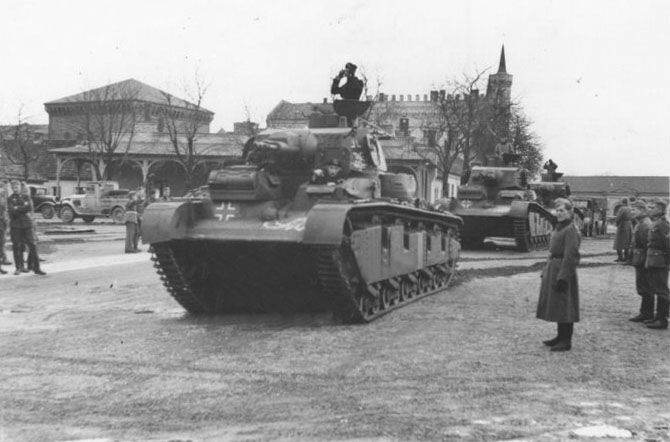
Three Neubaufahrzeug prototype heavy tanks arrived in Oslo, Norway largely as a show of force to intimidate Norwegians.
Germany announced the formation of the Reich Commissariat for the occupied Norwegian Territories.
Luftwaffe bombers attack targets near Namsos. With the British base at Namsos posing a threat to the German hold on Trondheim, the Luftwaffe sends raids against Namsos. The town suffers tremendous damage.
RAF Bomber Command dispatches 9 aircraft to attack Stavanger airfield.
The French cruiser Émile Bertin is damaged by German aircraft off Namsos, Norway; she will be sent to Brest, France for repairs.
The Royal Navy aircraft carrier HMS Furious had expected to finally get fully refueled from the newly arrived tanker War Pindari (5,559 BRT), but the need to get underway in the face of two air attacks left little doubt that Tromsø was no longer a safe haven. Abandoning further efforts, she put to sea at her best speed on three shafts, 20 knots. That afternoon, having received word (in error) that five German destroyers were at sea, a single Swordfish was sent off on an armed reconnaissance mission ahead of the ship. The aircraft, 818 Squadron’s U3K, became entangled in a snowstorm and was unable to return home. The crew navigated to Skogsfjord where they force-landed in a snowy field. The aircraft was recovered by Norwegian Navy personnel and taken to Skattoia, while the flight crew, Lieutenant (A) S. Keane, RN (P), Lieutenant A. S. Marshall, RN (O), and Naval Airman F. Clark, RN (AG) eventually reached friendly forces.
The Dutch government extends the state of siege from just the frontier region to cover the entire country. In a broadcast to the nation today Premier Dirk Jan de Geer announced the extension of the state of siege to the entire country. The Premier once more affirmed the government’s determination to pursue a policy of absolute neutrality and urged the nation to remain calm.
After a secret sitting lasting nearly all day, the Chamber of Deputies tonight, by 515 votes to none, proclaimed its confidence in the Reynaud Cabinet to carry on the war to victory. There were only sixteen abstentions.
With Hitler’s birthday tomorrow, Propaganda Minister Goebbels gives a fulsome speech entitled “Our Hitler” in which he states that “We Germans all agree: nothing can separate us from our love, obedience, & confidence in and for the Führer.”
Although fighting continued in Norway today close to the Swedish frontier, Sweden seemed more preoccupied with the home front and “the enemies within our country,” as one commentator called them.
The Swiss government issued instructions for mobilization in the event of a German invasion.
In Yugoslavia, Milan Stojadinović, the former premier, is arrested. The regent prince Paul suspects that he is trying to set himself up as the head of a puppet regime with Axis backing.
Numerous members of the British and French colonies moved out of Budapest last night and early today because of rumors in Allied quarters that Hungary was in danger of German invasion.
Turkey is vigilantly watching for possible moves by Germany and Italy in the Balkans and is taking precautionary measures for her own internal security. Political circles in the capital, however, refuse to surrender to excessive pessimism.
“Gone With The Wind” premieres in London four months after its American debut. As a film with an inherently American storyline, it loses something in the translation. About the film, which is now in many Top Ten lists of all time and which still holds the inflation-adjusted box office record, the critics say: “Good, but no masterpiece.”
The British 12th Infantry Division begins moving to France.
Luftwaffe engagements with RAF and French Air Force continue over the Western Front.
The Latvian cargo ship Jaunjelgava collided with another ship in the Baltic Sea and sank.
The Royal Navy aircraft carrier HMS Glorious docks at Greenock and begins loading stores and equipment for 263 Squadron, RAF for transport to Norway.
Convoy MT.55 departed Methil, escorted by destroyer HMS Woolston and armed patrol yacht HMS Breda. The convoy arrived in the Tyne later that day.
Convoy FS.150 departed the Tyne, escorted by destroyer HMS Woolston and armed patrol yacht HMS Breda. The convoy arrived at Southend on the 21st.
The War at Sea, Friday, 19 April 1940 (naval-history.net)
Light cruiser EFFINGHAM was attacked early on the 19th by U-38, southwest of the Lofotens, but was not damaged.
Light cruiser ENTERPRISE, arriving in Vaagsfjord during the evening of 19 April, was attacked by U-65. All the torpedoes exploded prematurely and no damage was done.
German U-boats off Vaagsfjord, Vestfjord, Namsenfjord, and Romdalsfjord were ordered to return to Germany.
At 0700, destroyers FEARLESS, FURY, and HYPERION departed Scapa Flow to meet homebound convoy HNP 1 and relieve escorting destroyers VOLUNTEER and WITHERINGTON, which then proceeded to Scapa Flow and the Clyde, respectively.
A Swordfish of 818 Squadron from FURIOUS forced landed intact on a snowfield of Lake Skogsfjord, Ringvassoy, Lt S Keane, Lt A S Marshall, and Naval Airman F Clark were rescued uninjured.
Polish destroyers ORP GROM, ORP BURZA, and ORP BŁYSKAWICA departed Scapa Flow at 2130 for Harstad to relieve destroyers there. Destroyer ESCORT rendezvoused with them off Lerwick, but BURZA was forced to return to Scapa Flow with storm damage to her bow, arriving there at 1100/20th. Also on the 20th, U-9 attacked BŁYSKAWICA northeast of the Shetlands and was counterattacked in return. The three destroyers arrived safely on the 21st off Harstad without further incident and were led into port by destroyer FAULKNOR.
Battleship VALIANT and battlecruiser RENOWN, which were to embark special shells for the Trondheim bombardment, escorted by light cruisers GALATEA and ARETHUSA and destroyers VANSITTART, CAMPBELL, WITCH, and WOLVERINE, departed Scapa Flow at 1700 for Rosyth. Destroyer GREYHOUND departed with the force and continued on to Blackwall for structural repairs.
At 0530, submarine TRIAD fired four torpedoes at German minesweeper NAUTILUS in 58-18N, 10-48E, but all missed.
Submarine SEAL arrived at Rosyth after patrol, but departed that day and proceeded to Blyth, arriving on the 20th.
French submarines DORIS and ORPHEE departed Harwich on patrol.
Submarine SNAPPER and French submarine ANTIOPE arrived at Harwich after patrol.
Submarine SUNFISH arrived at Harwich after patrol.
French convoy FP.1, carrying the 5th Chasseur Alpins Demi Brigade, consisted of French armed merchant cruisers EL D’JEZAIR (5818grt), EL KANTARA (5079grt), and EL MANSOUR (5818grt), escorted by large destroyers BISON, EPERVIER, and MILAN of the 11th Large Destroyer Division, and armed merchant cruiser VILLE D’ORAN (10,172grt), in a group arriving behind the first, escorted by large destroyers CHEVALIER PAUL, MAILLÉ BRÉZÉ, and TARTU of the 5th Large Destroyer Division, which departed Scapa Flow on the 20th for Namsenfjord. EL MANSOUR, EL KANTARA, VILLE D’ ORAN, British troopship FRANCONIA, and TARTU, CHEVALIER PAUL, MAILLÉ BRÉZÉ, and EPERVIER had departed the Clyde at 0600/16th and arrived at Scapa Flow at 0800/17th. The convoys’ passage was given close cover by French light cruiser EMILE BERTIN (Flagship Derrien) and heavy support by battlecruiser REPULSE and anti-aircraft cruiser CURLEW. Enemy opposition to the convoys was considerable.
On the 18th, U-34 unsuccessfully attacked EMILE BERTIN, and on the afternoon of the 19th in 64 44N, 07 49E, U-46 launched torpedoes without success at MAILLÉ BRÉZÉ, which counterattacked and drove her off. However, she lost touch with the convoy and did not rejoin until it had arrived at Namsos. The two groups and their escorts arrived off Namsos and were joined by anti-aircraft cruiser CAIRO which came out from there. During the disembarkation, at 1800 EMILE BERTIN in Namsenfjord was hit by a German bomb which resulted in moderate damage, and as she withdrew, escorted by MAILLÉ BRÉZÉ, she was unsuccessfully attacked by U-51. They were joined at sea by EPERVIER and British light cruiser MANCHESTER, and the group proceeded to Sullom Voe. Destroyers ANTELOPE and BROKE departed Scapa Flow at 0530 on 20 May and joined the French light cruiser for escort. After seeing her near to Scapa Flow, they returned to escort convoy FP.1 back.
VILLE D’ORAN was damaged by a near miss at 2200 while sailing up the fjord and fell behind. She was able to catch up and disembark her cargo, but had to go to Glasgow for repairs. After the disembarkation, the French ships left before dawn on the 20th with CAIRO and arrived at Sullom Voe at 1615/21st, escorted by the TARTU, CHEVALIER PAUL, MAILLÉ BRÉZÉ, BROKE, and ANTELOPE. Troopships EL D’JEZAIR, EL KANTARA, and EL MANSOUR departed Sullom Voe at 1715/22nd for Scapa Flow escorted by BROKE, ANTELOPE, TARTU, and CHEVALIER PAUL, and arrived at 0700/23rd, while VILLE D’ORAN departed Sullom Voe at 1800/22nd, escorted by EPERVIER, for the Clyde. CAIRO which had suffered some bomb damage from a near miss at Namsos arrived at Scapa Flow on the 21st, while CURLEW, which was supposed to go to Namsos as anti-aircraft guard ship, had insufficient fuel and had to return to Scapa Flow, arriving on the 20th. With no anti-aircraft protection, Namsos was heavily bombed by unopposed Luftwaffe forces and the port sustained heavy damage. Destroyer NUBIAN arrived on the 20th as an anti-aircraft guard ship, departing at 0200/21st.
Battleship WARSPITE, departing Vestfjord for Rosyth escorted by destroyers HAVOCK, HOSTILE, HERO, and FOXHOUND, was attacked by U-47 but the torpedoes prematured. The escorting destroyers subjected U-47 to a heavy depth charge attack, and WARSPITE was recalled to Narvik.
Destroyer WREN departed Scapa Flow at 1630 for Lerwick to escort steamer ST ROGNVALD (1069grt) carrying troops from Lerwick to Aberdeen. WREN then arrived back at Scapa Flow at 1815/20th, but was ordered to the Clyde without entering harbour.
Destroyer MATABELE on passage to Scapa Flow was diverted to escort minelayer TEVIOTBANK from Sullom Voe to Rosyth. Destroyer FORESTER departed Scapa Flow at 1900/20th, relieved MATABELE for the remainder of the voyage, and she and TEVIOTBANK arrived in the Humber at 1415/22nd. FORESTER went on to Hull for repairs.
French large destroyers INDOMPTABLE, MALIN, and TRIOMPHANT en route to Rosyth anchored in the Downs for the night, and at 0800/20th, continued on to Rosyth.
French submarines CALYPSO (Lieutenant de Vaisseau J.M. Petit) and THETIS (Lieutenant de Vaisseau J.E.L. Lefeuvre) of the 13th Submarine Division arrived at Harwich at 1400/19th, escorted by sloop FOXGLOVE, to reinforce the 10th Submarine Flotilla for patrol in the southern North Sea.
In operations by German naval auxiliary Schiff 18 and minesweeper M.1, which was part of the Egersund invasion force and had been left behind because of mechanical defects when the other minesweepers returned to Germany, five S-boats of the 1st Flotilla operated in Hardangersfjord, south of Bergen. Units of the 1st S-boat Flotilla sank Norwegian torpedo boat SAEL and one S-boat was damaged by two hits in the engagement at Anuglo.
Convoy MT.55 departed Methil, escorted by destroyer WOOLSTON and armed patrol yacht BREDA. The convoy arrived in the Tyne later that day.
Convoy FS.150 departed the Tyne, escorted by destroyer WOOLSTON and armed patrol yacht BREDA. The convoy arrived at Southend on the 21st.
Destroyer KEPPEL arrived at Gibraltar from Malta on completion of her repairs from her January collision.
U.S. Secretary of State Cordell Hull sought to remove himself from the 1940 Democratic presidential race again today by stating emphatically that he is not a candidate in any sense for any political office. It was his strongest statement to date on his possible candidacy and he bulwarked it at a press conference by revealing that he has asked friends and interested parties to accept his decision. In previous declarations Hull had said only that he was not seeking political advancement. He took the more decisive stand a few hours after Gov. Clyde R. Hoey of North Carolina had urged publicly that the Democrats nominate the 68-year-old cabinet officer and had praised him as the only man able to restore harmony among the warring factions of the party. Hoey’s remarks were interpreted among congressional Democrats as the start of a “draft Hull” movement.
A train derailment in Little Falls, New York killed 31 people and injured almost 140. Nine cars of the Lake Shore Limited, New York to Chicago express train, left the rails near Little Falls, New York, leaving wreckage for nearly a half mile. The only identified victims were Jesse Earl of Albany, New York, engineer, who died five minutes before rescuers with acetylene torches freed him from the crushed cab of the locomotive, and J. Y. Smith, Schenectady, New York fireman. Lieutenant John Ronan of the New York state police said 25 bodies had been recovered from the wreckage four hours after the train, running 15 minutes late, left the tracks on a wide curve, the cars tearing down communication lines and blocking the main east- west motor highway. Scores of New York state troopers, physicians and ambulances were rushed to the scene and the Little Falls hospital was taxed to capacity to care for the injured.
With his eye on the European war, and ready, as he said on leaving Washington last night, to return to the capital immediately “if another country is invaded,” is invaded,” President Roosevelt arrived here tonight for an indefinite vacation. The President went at once to his “other home” on Pine Mountain overlooking the infantile paralysis foundation he helped establish here nearly twenty years ago. The circumstances recalled his rear platform statement on leaving. here a year ago that “I will be back. in the Fall if we don’t have a war.” Mr. Roosevelt kept in touch with Washington on his eighteen-hour trip aboard his special train. En route to Georgia this afternoon, the Presidential train stopped at Gastonia, North Carolina, where a portable telephone was strung through the window of Mr. Roosevelt’s private car. It was understood that Mr. Roosevelt did not use the phone but received late reports from the White House and the State Department through a secretary.
The Senate was in recess today in Washington. Its Naval Affairs Committee heard Rear Admiral Towers on the Naval Expansion Bill. The Senate and House conferees agreed on the terms of the Wheeler-Lea Transportation Bill.
The House passed a bill to extend crop insurance to cotton. Its Rules Committee approved House consideration of the proposed amendments to the Wagner act, and its Ways and Means Committee heard opposition to the Chain Store Tax Bill. It adjourned at 4:20 PM until Monday.
House of Representatives foes of the National Labor Relations Board today put through a parliamentary maneuver which may assure them floor action on the 17 drastic Wagner act amendments proposed by the Smith N.L.R.B. Investigating committee. The victory circumvented part of the pro-administration house labor committee to use “all parliamentary means” to force house action on its own bill proposing four changes in the act and to block the Smith recommendations. The anti-N.L.R.B. forces won when the house rules committee, by a 9-to-1 vote, approved a procedural rule for floor consideration of the labor committee bill. The rule also provides that any other proposed changes may be offered from the floor as amendments to the labor committee bill. Rules Committee Chairman Adolph Sabath, Illinois Democrat, the lone dissenter, denounced the action.
The Ford Motor Company was accused in a report to the National Labor Relations Board today of fostering brutality without limit, even to the planning of murder, to prevent unionization of its employees.
The Daughters of the American Revolution today urged strengthening of the country’s armed forces because of world events which indicate “peace in the Western Hemisphere depends essentially upon national defense to maintain law and order.”
Secretary of the Navy Charles Edison arrives in San Francisco Bay aboard the cruiser USS Nashville for a two-day inspection tour of the Mare Island Navy Yard, Hunters Point Naval Shipyard dry docks and the naval air base at Alameda.
The Marquess of Lothian, British Ambassador to the United States, in an address prepared for delivery to the St. Louis Chamber of Commerce tonight, gave reasons why the British Government was “against a patched-up peace,” and described “the kind of peace we are fighting for.”
Rear Admiral John H. Towers, the navy’s ranking aeronautical officer, today predicted the ultimate development of airplanes capable of 750 miles an hour-12 miles a minute, or about the speed of sound.
Gérard Côté won the Boston Marathon.
Major League Baseball:
Philadelphia Athletics 6, Boston Red Sox 7
Philadelphia Athletics 3, Boston Red Sox 1
New York Giants 0, Brooklyn Dodgers 12
St. Louis Cardinals 0, Chicago Cubs 5
Detroit Tigers 0, Cleveland Indians 4
Washington Senators 3, New York Yankees 5
Japan will remove trade restrictions into and from Canton, China, tomorrow, the Department of Commerce reported today. “General trade restrictions will be provisionally relaxed so as to permit imports into and exports from Canton without special permission, with the exception of trade in specifled articles for which licenses will be required for inward or outward movement,” the department reported on the basis of a cable from the United States Consul at Canton.
The Japanese government informs United States that Japan has no aggressive intentions toward the Netherlands East Indies.
Dow Jones Industrial Average: 146.8 (-0.35)
Born:
Genya Ravan [Genyusha Zelkowitz], Polish-American rock singer (Goldie & the Gingerbreads – “Can’t You Hear My Heart Beat”; Ten Wheel Drive), and record producer, in Łódź, Poland
Reinhard Bonnke, German Pentecostal evangelist (d. 2019).
Naval Construction:
The Kriegsmarine (German Navy) Type IXC U-boat U-162 is laid down by Deutsche Schiff und Maschinenbau AG, Bremen (werk 701).
The Royal Australian Navy Bathurst-class minesweeper-corvette HMAS Ballarat (J 184) is laid down by the Williamstown Dockyard (Williamstown, Victoria, Australia).
The U.S. Navy 58-foot Fisher patrol motor torpedo boat USS PT-4 is launched by the Fisher Boatworks (Detroit, Michigan, U.S.A.).
The Royal Navy Tree-class minesweeping trawler HMS Hickory (T 116) is commissioned. Her first commander is Chief Skipper Arthur Pitchers, RNR.
The Royal Navy Thornycroft 55-foot motor torpedo boat HMS MTB 67 is commissioned.
The Royal Navy Thornycroft 55-foot motor torpedo boat HMS MTB 68 is commissioned.
The Royal Navy Dragonfly-class river gunboat HMS Mosquito (T 94) is commissioned. Her first commanding officer is Lieutenant Denis Harold Palmer Gardiner, RN.
 History Diaries