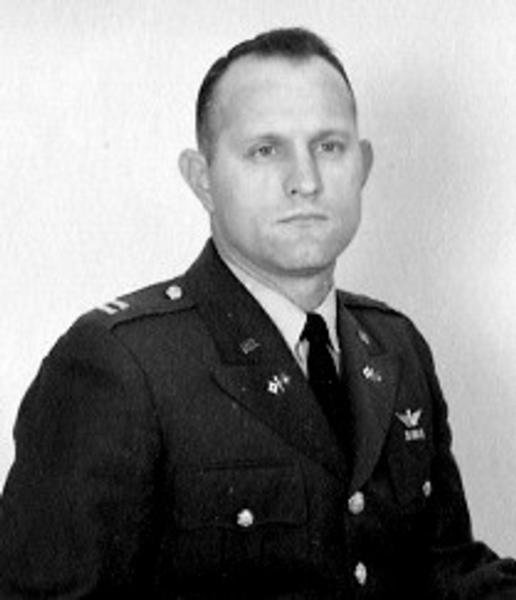
Operation Quyết Thắng (“Resolved to win”) 137 (April 19, 1965) was a troop lift of soldiers from the 22nd Army of the Republic of Vietnam (ARVN) Division by elements of the U.S. Army’s 52nd Aviation Battalion. The operation moved 320 ARVN troops from Phú Cát Air Base to LZ Alpha, situated near a Việt Cộng stronghold on flat coastal plains 19 kilometers (11.8 miles) north of Quy Nhơn in Bình Định Province, RVN. An additional 100 troops were landed at nearby LZ Bravo. Intense ground fire was received at Alpha, and two armed UH-1B helicopters were shot down while making firing runs over Việt Cộng positions. Both gunships caught fire after being hit and exploded on impact. Both ships were consumed by post-crash fire; there were no survivors. Four other aircraft were also hit with an additional pilot killed. The lost personnel included: (UH-1B #63-08632 from 145th Airlift Platoon, B Company) aircraft commander 1LT Josef L. Thorne, pilot WO1 Daniel E. Bishop, and crew chiefs SP5 Charles F. Millay and SP4 Gilbert Olivar; (UH-1B #63-08575 from 119th Assault Helicopter Company) aircraft commander 2LT Patrick P. Calhoun, pilot WO1 Douglas D. Mack, crew chief SP4 Arthur F. Hennessey Jr., and gunner SP4 Terry W. Mills; and (UH-1B #63-08646 from 119th Assault Helicopter Company) co-pilot CPT Robert D. Walker. Walker’s ship was hit seven times in the main rotor, tail rotor, and forward cabin area. One of the rounds struck Walker in the abdomen, perforating his heart. The damaged helicopter managed to remain airborne and returned to Quy Nhơn.
Also killed this day in Quảng Nam Province was 1LT Gary L. Steele, a helicopter pilot serving with the 6th Aviation Platoon, 1st Aviation Company, I Corps (Army of the Republic of Vietnam) Aviation, Military Assist Command, Vietnam (MACV)
Robert is buried at Grove Hill Memorial Park, Dallas, Dallas County, Texas. He is honored on the Wall at Panel 1E, line 105. The other nine Americans lost this day are honored along with him.
Ten U.S. Army helicopter pilots and crewmen are killed by heavy ground fire this day in two separate incidents in South Vietnam. Nine of them died in one fight in Bình Định Province. Small-arms fire from a Communist stronghold only eight miles north of Quy Nhơn brought down two armed helicopters. killing their crews. The co-pilot of a third helicopter was killed by the ground fire, but the craft returned to its base. An American military spokesman would not give details on the Bình Định Province operation because, he said, the action was continuing late today. The province, 280 miles northeast of Saigon, was the site of large battles during the Việt Cộng’s offensive. American officers have contended that government troops blunted that offensive, which had been aimed at cutting off the central provinces from communication and transportation with the south.
Armed reconnaissance missions, none very significant, were sent over North Vietnam during the day, propaganda leaflets were dropped in the cities and towns around Vĩnh.
Eleven South Vietnamese were killed and 41 persons, including 4 American enlisted men, were wounded Monday night in an explosion at a bar in Buôn Ma Thuột, 160 miles northeast of Saigon, The Associated Press reported.
At Đà Nẵng a group of F-104C Starfighters arrived, apparently to add to the United States defenses against attacks by Communist jets. The two-man Starfighter jet carries Sidewinder air-to-air missiles and 20-mm guns and flies at more than 1,400 miles an hour. An Air Force spokesman said 12 to 22 of the aircraft would be based in Taiwan and sent for duty at Đà Nẵng on a rotational basis. The planes are considered adept in air-to-air fighting of the kind that has cost the United States three aircraft in clashes with the older, slower MIG’s.
In one of their first significant brushes with the Việt Cộng, American Marines were attacked last night with a grenade. Two Marines were slightly wounded.
More than one million leaflets were dropped this afternoon over big population centers in North Vietnam. Eight United States Air Force F-105’s distributed the propaganda in exploding canisters that showered copies of President Johnson’s Vietnam speech and the Vietnamese Government’s interpretation of his remarks over cities where about 50,000 people live. The targets for the leaflets were Vĩnh, Hà Tiên, and Thanh Hóa.
High-level U.S. military and civilian leaders — including Secretary of Defense McNamara and JCS Chairman Earle Wheeler — meet at Honolulu with General Westmoreland and Ambassador Taylor. The conferees agree to double U.S. military forces from the present approved level of 40,200 to 82,000 and to bring the forces of Australia and South Korea up to some 7,250 men. Although Taylor opposes such a sudden increase in numbers and assignments for U.S. military, he is outvoted and apparently won over.
The Soviet Government warned the United States today that aerial bombardments and the use of gas in Vietnam might lead to “retaliation in kind.” Premier Aleksei N. Kosygin declared that the “reckless policy” of extending the scale of military operations was moving the United States “step by step toward a very dangerous brink.” He dismissed President Johnson’s Baltimore speech, without mentioning it specifically, as a “forced maneuver” and as “vague promises” that would “deceive no one.” Premier Kosygin made it clear that the Soviet Union continued to take the position that there could be no negotiation in Vietnam so long as American air strikes against the North continued.
His statement was the strongest made by a Soviet leader since the United States began air attacks against North Vietnam. It marked the first time that the Soviet Union raised the possibility of retaliation. It was the first rejection by a Government member of President Johnson’s offer in Baltimore of “unconditional discussions” on Vietnam. “One should not forget that the United States does not have a monopoly of modern weapons,” Premier Kosygin said to a cheering audience at the Kremlin.
Secretary of State Dean Rusk tonight reasserted the Administration’s intention of continuing air attacks against North Vietnam. Commenting in a brief news conference upon his arrival at Metropolitan Airport here prior to a speech before the Michigan Committee on Immigration, he again dismissed a suggestion that a temporary halt in the attacks might hasten! peace negotiations. In his speech, Mr. Rusk said that passage of the Administration’s immigration bill was important to the United States and “would put the principles of our basic immigration laws in line with our basic ideals as a nation and people.” He said at the airport that the matter of suspending air attacks against North Vietnam as a means of encouraging peace talks had been considered, but that “the big issue there is what else will stop if we stop bombing.” He said the strikes would continue until there was some new development to warrant a change in policy.
North Vietnam rejected today 17 neutral nations’ appeal for peace talks on Vietnam. It repeated its four-point program requiring United States withdrawal and the carrying out of Việt Cộng plans for “internal affairs” as necessary conditions for talks.
An estimated 20,000 Britons protested in London against America’s Vietnam policy in the largest pacifist demonstration in several years.
U Thant, the United Nations Secretary General, authorized a spokesman today to say that he had “high esteem” for Senator J.W. Fulbright and for “the vision and wisdom in his approach to international affairs.” Thant was pleased by Fulbright’s call for a bombing halt in North Vietnam.
Premier Aleksei N. Kosygin has announced that the next Five-Year Plan will pursue a twin policy of providing more consumer goods and higher wages to pay for them. In a speech made public today, the Soviet Premier also. disclosed the reorientation of the Soviet automotive industry toward the production of passenger cars. In the past, trucks and buses have made up two-thirds of all motor vehicle production, on an average. Both the policy of higher wages and the shift to mass production of private cars represent sharp departures from the economic policies of former Premier Nikita S. Khrushchev.
France will apply a virtual boycott to the meeting of the Ministerial Council of the Southeast Asia Treaty Organization in London next month, qualified sources reported today. Foreign Minister Maurice Couve de Murville will not confer with the seven other foreign ministers of the alliance, including Secretary of State Dean Rusk, who are to attend the meetings on May 3, 4, and 5. Instead, France will be represented by observers, the sources said. The Government’s decision was said to reflect President de Gaulle’s determination to keep France aloof from any expression of diplomatic support for United States policy in the Vietnam war.
French sources denied reports that the Government intended to withdraw from SEATO. The attitude here is that Washington has erred in continuing the bombing of targets. in North Vietnam after President Johnson offered to enter negotiations with Hanoi with-” out prior conditions. It is also felt that the United States has been far too cautious in its attitude toward a possible conference on Cambodia’s neutrality, which the French believe could be turned into a “discussion in the corridors” of a settlement in Vietnam.
Greek nationals are to be expelled from Turkey and the Ecumenical Patriarchate is to be “controlled.” This was announced today by Interior Minister Ismail Akdogan after a five-hour Cabinet meeting called to consider Turkish-Greek relations and the Cyprus situation. About 9.000 Greeks have been deported or have left voluntarily in the last year, and it is believed that 3,000 to 4,000 remain in the country, most of them in Istanbul. These are distinguished from about 50,000 members of the Greek “minority” who are Turkish subjects. The minister said the Ministry of the Interior, the Ministry of Finance and the Ministry of State had been instructed to “control” the Ecumenical Patriarchate and to examine its affairs.
Friction between Athens and Ankara over an alleged food blockade of Nicosia’s Turkish quarter today reduced hope for early Greek-Turkish contacts on a Cyprus settlement. Foreign Minister Stavros Costopoulos rejected as “untrue” Turkish protests over an alleged clampdown on food imports.
The first Chinese-Japanese diplomatic meeting in 20 years — since the end of World War II — took place here today when Premier Chou En-lai of Communist China conferred with a special envoy of Eisaku Sato, the Japanese Premier.
The Philippines Secretary for Foreign Affairs, Mauro Mendez, voiced concern today over the unfavorable drift in Philippine-Indonesian relations and called on Jakarta for a meeting to clarify the problems.
President Johnson was reported today to have sent President Gamal Abdel Nasser of the United Arab Republic a personal message urging peaceful development of the Jordan River and “equitable” distribution of the river’s waters between the Arab states and Israel.
Twenty years after the destruction of Nazi Germany by the Allied armies, the time has come for the German people to reassert their “national identity” with pride, Mayor Willy Brandt of West Berlin declared here yesterday.
Indian resentment was growing today over President Johnson’s abrupt postponement last Friday of the visit to Washington by Prime Minister Lal Bahadur Shastri scheduled for June.
Reinforced police details scattered rowdy bands of youths in four seaside resorts around Brighton, England today. Arrests for the four-day Easter holiday mounted to about 175.
President Johnson may be making a particular effort to get his Great Society program enacted as soon as possible because he fears the 1966 elections may trim his big majorities in Congress.
Governors of nine Appalachian states and representatives of two others met today to set in motion the $1.1 billion program of economic aid that grew out of a campaign promise by John F. Kennedy in 1960.
From the North Carolina coastal plain to the pine barrens of Louisiana, the Ku Klux Klan and allied organizations are now more active, and possibly stronger in numbers and influence than at any time since the Klan’s heyday of the nineteen-twenties. Klan revival has been underway off and on for a decade, but it reached a new peak in recent months as a response to passage and enforcement of the Civil Rights Act of 1961 and to the abandonment of the policy of massive resistance by the authorities in hardcore areas. Terrorist activity believed to have been inspired and carried out by Klan groups became such a disruptive force that President Johnson publicly condemned the organization and the House Un-American Activities Committee voted to start an investigation.
Of 16 widely publicized racial murders in the South from September 15, 1963, Klan members have been implicated to some degree in 11 of them. In none of the 11, however, has there been a felony conviction. Federal and state authorities. believe that Klansmen were responsible for many of the unsolved beatings. bombings, arson and other forms of violence that occurred in the South. Several communities — St. Augustine, Florida, McComb, Mississippi, Bogalusa, Louisiana, among others — were gripped for months by Klan terror.
Dr. Martin Luther King told cheering Blacks in Selma, Alabama, that continued economic pressure is necessary in the civil rights struggle in Alabama. Rev. King told the crowd in Selma tonight that last week’s advertisement by Alabama businessmen urging compliance with the Civil Rights Act of 1964 was “a positive step forward.” But he said his boycott plans would continue because “Alabama still isn’t right.” In an interview after his speech, Dr. King softened the statements he had made in the speech about the boycott. He said that he had met here today with members of the executive staff of his Southern Christian Leadership Conference and that he would meet with them again in Atlanta tomorrow, “to see if enough progress has been made to call it [the] boycott] off.”
Surging Mississippi River waters carved two breaks in dikes protecting La Crosse, Wisconsin, and forced officials at Winona, Minnesota, to order more than 1,000 persons from their homes. Floodwaters of the Mississippi tore a 75-foot hole today in a dike near La Crosse, and a gasoline storage tank complex was quickly flooded. Water began inundating the nearby La Crosse municipal airport.
Steelworkers submitted to the steel industry a proposal for a new three-year contract providing for three annual wage increases of about 17.5 cents an hour each.
The Securities and Exchange Commission filed suit today against the Texas Gulf Sulphur Company and 13 of its officers, directors and employes who allegedly bought stock in the company, or advised others to do so, while they withheld news of a rich ore discovery in Canada.
At least three tornadoes spun their deadly funnels to the ground in south Texas today as a score or more of towns were slapped by heavy hail. Damage was not estimated.
President Johnson flew to Columbia, South Carolina today to pay tribute to an old Democratic colleague, Senator Olin D. Johnston, who died yesterday.
Mariner 4 project officials showed apprehension over the increasing rain of cosmic dust on their spacecraft as it races toward Mars. As the Mariner 4 space vehicle nears its rendezvous with Mars it is encountering more and more bits of cosmic debris. The rate of micro-meteoroid impacts has increased nearly tenfold since it left the earth.
Thousands of defective babies will be born in the United States this year as a result of a German measles epidemic, a government doctor predicted.
What would become known as “Moore’s Law”, that computing power would double every two years, was first suggested by Gordon Moore in an article in Electronics magazine, titled “Cramming More Components onto Integrated Circuits.” “The complexity for minimum component costs has increased at a rate of roughly a factor of two per year,” he wrote. “Certainly over the short term this rate can be expected to continue, if not to increase. That means by 1975, the number of components per integrated circuit for minimum cost will be 65,000. I believe that such a large circuit can be built on a single wafer.” Within three years, Moore would become co-founder of the transistor and microprocessor manufacturer Intel, and as transistors became smaller, the size of a transistor would decrease over 40 years from 0.5 inches (13 mm) by 0.25 inches (6.4 mm) to a size where they were “so small that millions of them could fit on the head of a pin.”
Six American pilots, none of them astronauts, completed a 34-day experiment by NASA to study the effects of a month-long confinement during a space mission. The volunteers, officers drawn from the U.S. Navy and the U.S. Marines, “ate, worked, and slept in pressure suits” while inside a cylindrical chamber that was pressurized with an atmosphere of pure oxygen rather than normal air, and ate dehydrated food. One important discovery made from the test, which took place within the Philadelphia Navy Yard, was that the floor was covered with dust from dead skin cells because the men had been unable to bathe, which would be dangerous in a weightless environment. By the time of the launch of the first space station missions, provisions would be made to allow bathing.
Adolph P. Hugo’s home-built Hu-Go Craft made its first flight.
New York City AM radio station WINS played its final pop music record, “Out in the Streets” by The Shangri-Las, then switched formats at 8:00 PM, becoming the first all-news radio station, setting a trend toward “talk radio” that would be picked up by other AM stations.
“Whipped Cream & Other Delights”, fourth full album by Herb Alpert & the Tijuana Brass Band, is released.
The 1965 Australian One and a Half Litre Championship motor race was held at Mount Panorama Circuit and won by Bib Stillwell.
The 1st Sunday Mirror Trophy motor race (formerly the Glover Trophy) was held at Goodwood Circuit, UK, and won by Jim Clark.
The 69th Boston Marathon is won by Morio Shigematsu of Japan in a race record 2:16:33.
Dow Jones Industrial Average: 912.76 (+0.85)
Major League Baseball:
At a cost of $20,000, the outer Astrodome ceiling is painted because the sun’s glare makes fielding fly balls hazardous. Outfielders had been wearing batting helmets in preseason games because of the glare. Painting the skylights will reduce the lighting by nearly 40% and create the need for lights. But the lack of sunlight will cause the grass to die and spur the introduction of artificial turf.
Jim Maloney pitches a one hitter as the Reds top the Braves, 2–0. The only hit is Denis Menke’s single in the 8th inning.
Detroit Tigers 2, California Angels 4
Baltimore Orioles 2, Chicago White Sox 7
New York Yankees 2, Kansas City Athletics 8
Cincinnati Reds 2, Milwaukee Braves 0
Houston Astros 0, Philadelphia Phillies 8
Chicago Cubs 7, St. Louis Cardinals 3
Born:
Suge Knight [Marion Hugh Knight, Jr.], American rap record producer and co-founder and former CEO of Death Row Records; and strike-replacement NFL defensive end (Los Angeles Rams), and convicted felon, in Compton, California.
Keith Jackson, NFL tight end (NFL Champions, Super Bowl 31-Packers, 1996; Pro Bowl, 1988, 1989, 1990, 1992, 1996; Philadelphia Eagles, Miami Dolphins, Green Bay Packers), in Little Rock, Arkansas.
Natalie Dessay, French soprano and actress, in Lyon, France.
Died:
George Davis, 75, Flemish actor (“Private Lives”, “Devil May Care”)
 History Diaries