[Ed: “Unclear on the Concept”]
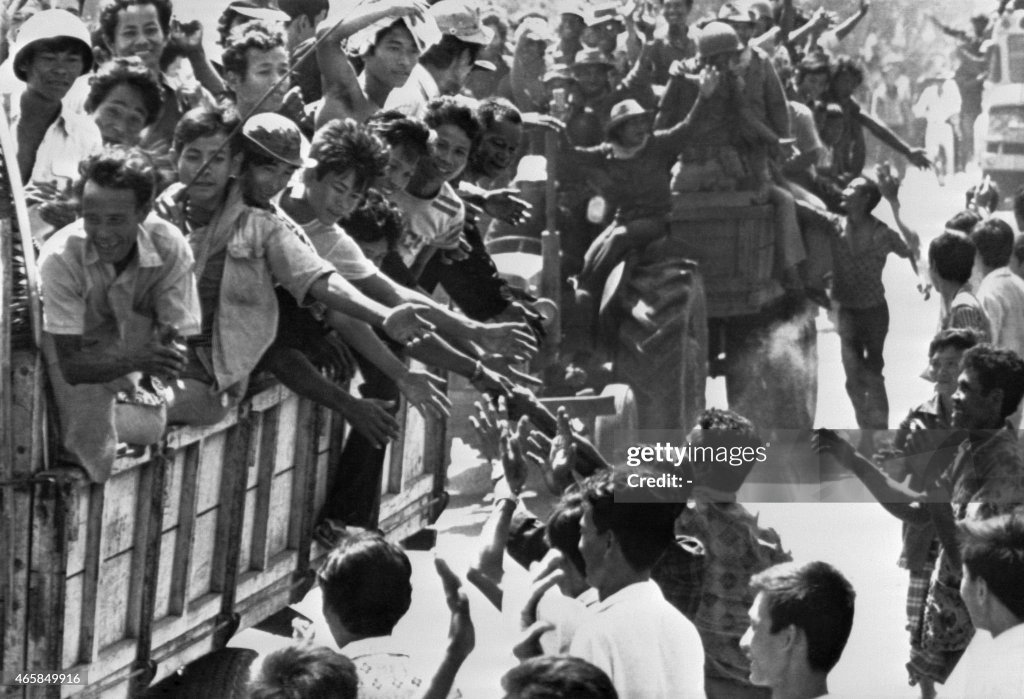
The Cambodian genocide began two days after the fall of Phnom Penh, as the new Khmer Rouge regime announced that all former government employees, including soldiers, military officers, and policemen, would be required to register with the new local authorities. Those who complied with the order were told that they would be sent for “reeducation” at a camp in Battambang on April 28.
A shroud of uncertainty brought on by a blackout on customary news channels has enveloped the situation in Cambodia and its fallen capital, Phnom Penh. Since the fall of Phnom Penh three days ago, communications have been reduced to confused refugee reports at the borders, broadcast claims by the Communist radio and tenuous diplomatic assessments in other countries. There were conflicting reports on numerous matters. These included the fate of the former Cambodian government’s leaders, among them Premier Long Boret, and of foreigners, including news correspondents.
Accounts differed also on the extent of Communist control over provincial capitals and on what was said to be continuing resistance by forces of the fallen government in some towns. Unconfirmed reports from Phnom Penh, the Cambodian capital, suggested that the new rulers had ordered a mass evacuation of civilians. Some accounts told of thousands fleeing in panic to the countryside; others described a calm city with little activity.
In Peking, more than 10,000 people and many Chinese leaders attended a rally to celebrate the conquest by the Communist forces, but Prince Norodom Sihanouk, the figurehead leader of the insurgents who has been in exile for five years, did not attend. He was said to have been absent—and to be delaying his return to Cambodia—to remain at the bedside of his mother, who is suffering from heart ailment.
The official Chinese press agency, Hsinhua, reported that Prince Sihanouk, in a cablegram to the Cambodian Com munist forces, had said that Cambodia was “the first country in the world to win a 100 per cent victory over the richest, the most powerful, the most cruel, the most perfidious, the most stubborn, the most inscilent, the most chauvinistic imperialism of all time, namely United States imperialism.” Another report from Peking by Reuters quoted the Prince as having said his government would not have diplomatic relations with South Africa, Rhodesia or Israel, and would recognize the Palestine Liberation Organization as the legitimate authority in Israel.
In other diplomatic developments, the Governments of Japan and Argentina extended recognition to the new regime in Phnom Penh. But Indonesia announced that she would withhold formal recognition until a clear picture of the pattern of authority in Cambodia emerged. On Friday, the Association of Southeast Asian Nations—Thailand, Malaysia, Singapore, the Philippines and Indonesia—announced diplomatic recognition of the new Cambodian government.
With only a trickle of often contradictory reports coming from Cambodia, the situation in Phnom Penh and the nation’s 17 provinces remained unclear. The Communists were clearly in control of the capital and of the countryside, but there were conflicting accounts of the extent of their control over several provincial capitals.
In Vietnam, Communist forces overran Phan Thiết, the last government-held enclave on the central coast, and North Vietnamese gunners brought the huge Biên Hòa air base, fifteen miles from Saigon, under heavy attack. The four-day artillery attack on the air base left it virtually unusable. The government is moving most of its fighter planes from Biên Hòa to Saigon’s Tân Sơn Nhứt airport. A Saigon military spokesman said that “radio contact” with the fishing town of Phan Thiết had been lost early yesterday following an assault by North Vietnamese infantrymen and tanks. Loss of “radio contact” is a term the South Vietnamese use when one of their positions has been captured or abandoned.
In Phan Thiết, the North Vietnamese troops began a series of artillery, tank and infantry attacks this morning on Hàm Tân, the capital of Bình Tuy Province, 29 miles farther south toward Saigon. Communist gunners also reportedly sent 21 shells of 85‐mm. artillery into Tây Ninh city, 55 miles northwest of Saigon. Eight persons, including seven civilians, were said to have been wounded.
Well‐informed Vietnamese sources disclosed that four days of artillery attacks on the air base at Biên Hòa, 15 miles north of Saigon, had forced the South Vietnamese Air Force to move many of its fighter planes to Tân Sơn Nhứt airport at the capital. Other military sources said the Government had begun to withdraw part of its large headquarters for Military Region III from Biên Hòa to Saigon. Military Region III includes the area around the capital. According to people working at Biên Hòa, the North Vietnamese have been firing longrange 130‐mm. guns at the base with great accuracy. “They fire only every 10 minutes or so,”. said an aircraft mechanic, “but it means we have to stay in our bunkers and can’t do any maintenance work on the planes.”
The 130‐mm. gun is a long-barreled, Soviet‐made artillery weapon that has a range of 15 miles. A Western intelligence official said that the fact that Biên Hòa was now “exposed” to Communist artillery was a serious development. Biên Hòa has long been the largest military complex in the Saigon area. Although a full‐scale North Vietnamese thrust at Saigon is expected at any time, the intelligence official said that the shelling of Biên Hòa indicated that the Communists were carefully laying the groundwork. This official said that a similar purpose was evident in renewed attacks yesterday long Route 4 in Long An Province, just south of Saigon. The Communists have been trying for 11 days to cut Route 4, which leads from the rice fields of the Mekong delta to Saigon.
South Vietnamese troops beat back an initial series of Communist attacks in Long An and neighboring Định Tường Province last weekend, inflicting heavy losses on the North Vietnamese. Since then, intelligence reports indicate, the Communists have continued to build up their forces in the area. They now reportedly have parts of at least two divisions and perhaps a third there.
In yesterday’s actions, the Saigon command said the Communists had made 10 attacks in Long An Province and another half‐dozen in the Bến Tranh district of Định Tường. Fifty‐seven Communists were reported killed in the clashes. The command said 2 Government soldiers were killed and 17 wounded. In addition, the command said, one civilian was killed and 10 wounded Friday night when Communist troops shelled Tân Trụ, a district town in Long An, with 82‐mm. mortars.
According to military informants, South Vietnamese troops defending Route 4 have suffered heavy casualties and may now be outnumbered, as their fellow soldiers are at the besieged provincial capital of Xuân Lộc. Only minor skirmishing and artillery duels were reported yesterday from Xuân Lộc, 38 miles northeast of Saigon. The government garrison in the Xuân Lộc area — which now constitutes Saigon’s northeastern defense line — has been surrounded for more than a week.
There were reports yesterday that five generals and five province chiefs had been ordered placed under house arrest pending investigation for their role in the rout from the northern two‐thirds of the country. The reports could not be confirmed. The five military officers, according to the reports, were Major General Phạm Văn Phú, who commanded military Region II —the Central Highlands and central coast — Lieutenant General Phạm Quốc Thuần, head of the noncommissioned officers’ school at Nha Trang, Brigadier General Nguyễn Đức Khánh, commander of the air force at Đà Nẵng, Major General Lâm Quang Thơ, head of the National Officers’ Academy at Đà Lạt, and Major General Lâm Quang Thi, who was in charge of the forward command of the Huế area military region. In a speech earlier this month, President Nguyễn Văn Thiệu charged that a number of field commanders, through “their cowardice and irresponsibility,” had caused the army rout in the highlands and along the north and central coasts.
Saigon was also swept by rumors yesterday that the Communists were about to attack because the April 19 deadline set by President Ford for Congressional approval of additional military and humanitarian aid to Vietnam had passed. Last Thursday, In an addresss to a joint session of Congress, Mr. Ford asked for $722‐million in military aid to Saigon before April 19.
Refugees arriving in Saigon yesterday from Phú Quốc, the island off the southern coast in the Gulf of Siam, reported that local Communist troops had been shelling the island’s main town. Phú Quốc, once a prisoner‐of‐war center, has been used for the last two weeks as a resettlement area for 40,000 to 50,000 refugees from the central coast.
South Vietnamese forces began on this day to withdraw from the town of Xuân Lộc in the last major battle of the Vietnam War. The JGS ordered Brigadier General Lê Minh Đảo to evacuate the 18th Division and other support units from Xuân Lộc to a new (weak) defensive line formed east of Biên Hòa at the town of Trảng Bom which was defended by the remnants of the Division, the 468th Marine Brigade and the reconstituted 258th Marine Brigade. By the end of 21 April Xuân Lộc was under North Vietnamese control and the gateway to Saigon was open.
A senior Việt Cộng official in Saigon hinted today that the Communists might delay an expected military onslaught against the capital to allow time for a possible peaceful conclusion of the war. The official, Colonel Võ Đông Giang, reiterated, however, that two conditions must be met — that President Nguyễn Văn Thiệu step down and that all American “military advisers disguised as civilians” leave the country. But he implied that there was still time to meet these conditions before a final drive against the capital was launched.
After 18 months of negotiations on a mutual and balanced reduction of their forces in central Europe, the Western and Communist sides admit that they have made no significant progress toward their goal of starting to cut back this year. The conferees of the 11 nations recessed this weekend for three weeks, concluding their fifth round. In separate public statements on Thursday, spokesmen for the North Atlantic Treaty Organization and fhe Communist Warsaw Pact countries conceded that there had been a lack of measurable movement, but also that they remained hopeful. Privately, the delegates said they were waiting for the results of the Conference on Security and Cooperation in Europe, meeting in Geneva, which is expected to conclude with a summit‐level session this summer.
Oporto, Portugal, middle‐class center of the textile and wine industries is preparing to give a large vote to non‐Communist forces in the elections April 25. All the parties are campaigning in Oporto and in the numerous rural towns to the north and east, although in Lisbon the armed forces have settled down to what they expect to be several years of almost exclusive rule. This is the wealthiest part of the country, accounting for most of its manufactured goods and exports. “Oporto works while Lisbon rules,” people here say. Now a crisis in the textile and wine industries is threatening livelihoods, and this too, some party leaders say, is alienating the people here from the government. The likelihood of a relatively conservative vote in the north has led the leftist military rulers in Lisbon to discount the results of the election in advance and to say that they will not be swayed from leading Portugal to socialism. They justify this attitude by contending that the people in this area are still influenced by old traditions of thought, and have no political education.
A cruise ship carrying aged and crippled Dutch passengers caught fire and sank at its mooring early today, leaving 19 dead or presumed dead in the worst Rhine River disaster since World War II.
An Italian Communist Party member was killed in a clash with ultraleftists and police in Florence as political violence continued into a fourth day. His was the third death in the surge of political unrest. Premier Aldo Moro conferred with Communist Party leader Enrico Berlinguer on ways to restore order.
Soviet dissidents expressed general fear today that the future of the small chapter in Moscow of Amnesty International was in jeopardy following the arrests yesterday of two members and the seizure of publications from the apartments of two other members.
Israeli manufacturers are beginning to feel the effects of Arab economic warfare. Some have been asked by foreign suppliers to route orders for raw materials through forwarding agents instead of sending them direct. Some report foreign customers have asked them to remove “Made in Israel labels from their products, and some report that distributors abroad have balked at handling Israeli products. Israeli businessmen describe these actions as “inconveniences,” however, and say that availability of raw materials and the level of exports have not been greatly affected. The businessmen did express conconcern over a growing reluctance of foreign corporations to invest in Israel. Israelis say that some foreign businessmen, without waiting to be threatened by the Arab Boycott Office, have apparently concluded that it is prudent not to deal with Israel.
Fully 60% of the Military Air Command’s Lockheed C-5 jet transports were grounded throughout the 32-day airlift of heavy military equipment to Israel during the 1973 Mideast war, the General Accounting Office reported. Compiled at the request of Rep. Lucien H. Nedzi (D-Michigan), the report said 60% were inoperable because of maintenance prob-lems or lack of spare parts. One C-5 crashed near Saigon recently on an orphan airlift flight. But the GAO said the aircraft did an excellent job in the Mideast operation.
President Anwar Sadat of Egypt is embarking on a campaign to improve relations with his fellow Arabs and with the Soviet Union, just a month after the collapse of Secretary of State Kissinger’s mediation mission. Mr. Sadat’s Foreign Minister, Ismail Fahmy, has flown to Moscow to discuss the Geneva peace conference and to seek more financial and military aid. President Sadat will go to Saudi Arabia to meet with King Khalid, President Hafez al-Assad of Syria and Yasser Arafat, head of the Palestine Liberation Organization.
Beirut reassumed many aspects of normal life today after several days of death and violence, but the political situation remained badly shaken and uncertain. The crisis that began last Sunday with a clash between Palestinian guerrillas and the right‐wing Phalangist party’s militia and later seemed to involve every armed group in this capital, has left a disturbing impression among the citizens that the government is weak in coping with such a challenge. There is scarcely a neighborhood in this city of 750,000 people that was not directly affected by the conflict. About 150 people are estimated to have been killed and several hundred were wounded. There was widespread property damage from bombs and rockets.
Fire destroyed a Beirut, Lebanon, harbor warehouse containing rolls of newsprint and bales of plastic in a spectacular blaze which lit up the waterfront skyline. Beirut Radio said the possibility of sabotage was being investigated. The harbor has been idle since the recent outbreak of fighting between Palestinian guerrillas and right-wing Phalangists.
Aryabhata, India’s first satellite, was launched into orbit from the Soviet Union. The Indian Space Research Organisation would begin launches from India (at the space center in Sriharikota, Andhra Pradesh) in 1980. India’s first satellite was shot into space from the Soviet Union atop a Soviet rocket, the New Delhi government announced. All instruments aboard the spacecraft were functioning normally after a successful launching, the government said. The launching made India, already the fifth nation to be a nuclear power, the world’s 11th nation to orbit a satellite. The spacecraft was named Aryabhata after an Indian astronomer and mathematician of the fifth century.
Premier Chou En-lai had a “very cordial and friendly conversation” with North Korean President Kim Il Sung at the Chinese leader’s Peking hospital, the official Hsinhua news agency reported. The news agency said Kim later called on Queen Sisowath Monivong Kossamak, mother of Cambodian Prince Norodom Sihanouk. He also talked with Sihanouk but no details were given.
Canada’s National Harbors Board issued a report saying the three-week-old longshoremen’s strike in Montreal had forced the diversion of more than 30 foreign ships from that port. Canadian shipping officials fear that some trade may be permanently lost to eastern Canadian ports because of the strike. The International Longshoremen’s Assn. called the strike after rejecting a contract proposal which it said did not provide job security.
A time bomb was discovered outside the Canadian national defense headquarters in Ottawa and detonated by experts, a police spokesman said. Inspector Donald McDonald said the dangerous explosive was discovered after two anonymous telephone calls from a young, English-speaking male who identified himself as a member of the U.S. radical “Weather Underground.” The group has claimed responsibility for a number of bombings in the United States.
Three weeks ago, the Argentine Government said that it had uncovered “a vast subversive terrorist operation” aimed at paralyzing steel production in the industrial zones north of Buenos Aires and at assassinating labor leaders. Several thousand policemen swept into the steel‐mill center of Villa Constitución, 140 miles northwest of Buenos Aires, and arrested more than 150 people, including 46 labor union leaders, who are still in jail. The government intervention has sparked a strike by almost all of Villa Constitución’s 6,000 steelworkers and has brought about the industrial paralysis that the Ministry of Interior said it had sought to prevent.
President Kenneth Kaunda of Zambia told President Ford in an extraordinary toast at a White House state dinner that southern Africa is poised for a dangerous armed conflict. He asked America to try to preserve peace by immediately ending support for white minority governments. The two presidents had conferred for an hour earlier.
Bobby Fischer, the deposed world chess champion, called upon a Filipino chess official to press for a face-to-face match between Fischer and Russian grandmaster Anatoly Karpov to prove who is the best chess player in the world. Florencio Campomanes of Manila, vice president of the International Chess Federation, said he received the call from Fischer and then cabled the Soviet chess federation asking Karpov to formalize an offer to meet Fischer. Karpov, 23, won the world chess title April 1 when Fischer, 32, refused to accept the rules for a championship match.
The anniversary of the battles that opened the American Revolution was celebrated by more than 160,000 Americans at the scene of the first engagements at Concord and Lexington. The way some of the onlookers marked the 200th anniversary reflected the differing strains that have developed through the years since the nation’s birth. In sharp contrast to the noisy outbursts of a throng of rain-soaked and largely beer-fueled youths at Concord, the ceremonies at Lexington went off quietly, marked with pageantry depicting the Minutemen’s first stand against the British, and a warm and cordial welcome was given President Ford.
In Concord President Ford told a huge crowd of onlookers, many of them hostile, that “now is the time for reconciliation, not recrimination.” Standing at the foot of the Old North Bridge where, 200 years ago, a small band of Minutemen turned back a column of British Regulars, the President drew jeers, boos and obscenities from a segment of the crowd when he spoke of America’s military strength and world leadership role. On two occasions small knots of protesters tried to dash across the river toward the President but were driven back through the waist-deep water by the police.
The giant milk producers’ co-op that figured in John B. Connally’s bribery trial has asked for $10,000 of the cash used as evidence in the trial. A lawyer for Associated Milk Producers, Inc., at the co-op’s San Antonio headquarters said he had written the Watergate special prosecutor’s office to request the money. Connally was acquitted Thursday of charges that he had accepted $10,000 in co-op funds in 1971 as a payoff for obtaining an increase in federal price supports for milk. The star prosecution witness, former co-op lobbyist Jake Jacobsen, said Connally had given him two different packages of $10,000 in cash as part of a scheme to cover up the alleged bribe by returning it. The prosecution produced both batches of cash in the trial.
Enforcement of federal lobbying laws is virtually nonexistent, the General Accounting Office, the congressional investigatory agency, charged in a report. Reports by lobbyists required under a 1946 law are incomplete and filed late, the agency said. “The law as it presently operates is a disgrace,” said Senator Abraham A. Ribicoff (D-Connecticut), chairman of the Government Operations Committee, which will begin hearings Tuesday on legislation designed to replace the old law with strict new disclosure requirements. The old law “prevents the American people from learning how lobbyists seek to influence the decisions of Congress and the rest of the government,” Ribicoff said.
Denying any illegal campaign contributions, the chairman of the nation’s largest airline said that a government effort to obtain blanket access to his company’s records violated constitutional guarantees against unreasonable search and seizure. Edward E. Carlson of United Airlines signaled the company’s intention to fight a Civil Aeronautics Board investigation as long as the board refused to say what it was looking for. The CAB went to court in Chicago Thursday to demand access to records at the airline’s Chicago headquarters. Informed sources said the investigation concerned charges of airline slush funds used for illegal political contributions and other purposes. In a letter attached to the suit, the CAB said it was reopening its 1973 investigation of contributions Carlson made to the Nixon reelection committee.
An Army major assigned to Selective Service headquarters in New York City was convicted of accepting $50,000 in bribes to help 400 men dodge the draft during the Vietnam war. The prosecutor charged in U.S. District Court that William Sangemino had sold his “office and uniform” for cash payments from Nathan Lemler, who is serving a prison sentence in connection with the draft scheme and a college placement service he once operated. The indictment charged that Sangemino had arranged for Lemler’s clients to fail the physical examination for induction. The major said he would appeal.
The chief prosecution witness against four young black men testified in the first week of the San Francisco “Zebra” murder trial that they were members of a group called the Death Angels, and that the group’s purpose was “to start a race war.” Quentin White, one or the defence attorneys asserted, however, that the witness, Anthony Harris, 29 years old, a police informer, was “insane” and his testimony “not reliable.” Mr. Harris is testifying under a grant of immunity from prosecution.
The Internal Revenue Service removed information on Richard M. Nixon’s tax returns from microfilm indexes in late 1973. according to a former IRS official. The action followed newspaper reports that the former President had underpaid his taxes. Francis I. Geibel, then IRS chief of internal security, said that, to help prevent further press leaks, “at that time it was decided that we would take the information off the general microfilm tapes, which were available to thousands of IRS people.” Geibel denied that there had been any attempt at a coverup.
Stocks of all major petroleum products are larger than they were a year ago, and Americans appear to be using less fuel per car than a year ago, according to the American Petroleum Institute in Washington. The API said proven oil reserves in the United States are slipping a bit. But potential reserves — those that seem promising but have not yet been proven — are up. According to the API survey, motor gasoline in storage this month totalled 233.28 million barrels, compared to 223.32 million a year ago. The Federal Highway Administration said gasoline sales for this January were up 9% over January, 1974, when the energy crisis was at its height.
Offshore oil can be recovered from the outer continental shelf in an environmentally safe manner if it is done in the right place and under strict regulation, federal Environmental Protection Agency Administrator Russell E. Train said in an address prepared for a meeting of the Audubon Society in New Orleans. “Since drilling rigs are already in short supply,” he said, “it makes sense that we focus on areas where the resource potential is high and where the adverse environmental effects would be low.” Train noted that the new federal offshore development program would more than double the total offshore acreage leased since the effort began 22 years ago.
British rock band Queen begins a concert tour of Japan.
Foolish Pleasure captured the Wood Memorial and one month later he would win the Kentucky Derby.
Major League Baseball:
In Cincinnati, the Reds spot the Astros a 7–1 lead, then roar back to score 3 in the 9th to win, 9–8. Tony Perez hits a solo home run in the 9th and Concepcion knocks in 2 runs.
San Diego Padres 8, Atlanta Braves 2
California Angels 6, Chicago White Sox 5
Houston Astros 8, Cincinnati Reds 9
Milwaukee Brewers 3, Cleveland Indians 0
New York Yankees 3, Detroit Tigers 8
San Francisco Giants 2, Los Angeles Dodgers 3
Philadelphia Phillies 3, Montreal Expos 0
Chicago Cubs 4, New York Mets 2
Minnesota Twins 1, Oakland Athletics 4
Pittsburgh Pirates 7, St. Louis Cardinals 1
Kansas City Royals 5, Texas Rangers 2
Born:
Temoc Suarez, American soccer forward (Olympic gold medal, 1996), in Greenwood, South Carolina.
John LeRoy, MLB pitcher (Atlanta Braves), in Bellevue, Washington (d. 2001, after suffering a heart attack and brain aneurysm at 26).
Brent Billingsley, MLB pitcher (Florida Marlins), in Downey, California (d. 2024).
Died:
Percy Lavon Julian, 76, African-American inventor, biochemist and entrepreneur who developed synthetic cortisone.
 History Diaries