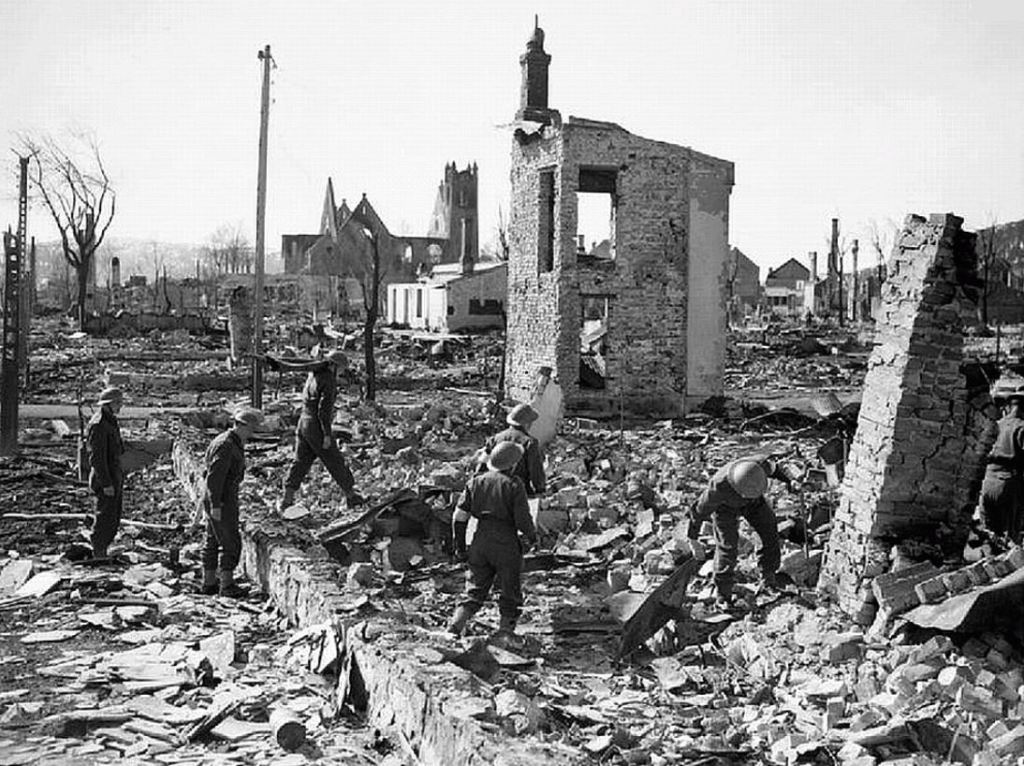
The Battle of Dombås continues. The 18th of April turned out to be a decisive day in the battle. The Germans at Lindse were surrounded to the north by the battalion I/IR 11 and to the south by No. 1 Company, IR 5, reinforced by various smaller forces that had arrived the previous day. The company in the south also had the 40 mm AA gun, positioned at Dovre Train Station, as artillery support. Early in the morning Norwegian soldiers made their way into the hills south of Lindse Farm and opened fire. According to Schmidt, this was when the situation became truly dire:
“One step out of the nest or the house brought death. We now clung on only to the thought of immediate assistance.”
Although the German positions were well fortified their ammunition was running very low and it was soon only a question of time before surrender became the only option left. Help, however, arrived that very morning when a Junkers Ju 52 air dropped ammunition, warm clothing, provisions, medical supplies and the radio frequency for communicating with headquarters. Later in the day a Norwegian officer approached Schmidt asking for his surrender, but was rejected. The Norwegian 40 mm AA gun kept up a bombardment of Lindse Farms throughout the day, firing 40–50 rounds at positions around the farm buildings and in two nearby ravines. By evening the Germans had all sought shelter in the farm houses as these could not be bombarded directly due to the Norwegian prisoners being held there.
At Hegra Fortress, the Germans make another infantry assault, which fails. They continue raking the fortress with a very heavy machine gun and mortar fire. The weather turns sour, and a German attack is foiled by a blizzard. In the snow, the Germans sometimes fire at each other in confusion. In the evening, two Norwegian doctors ask for and receive permission to evacuate the wounded from the fortress. All operations are temporarily suspended. One of the doctors is held as a hostage to make sure the operation goes as promised. They evacuated nine Norwegian wounded and a German POW, Gefreiter Bayerle, who the Norwegians released as a sign of good faith. The Norwegian wounded do not become POWs per agreement.
The Norwegians holed up in Hegra Fortress are mounting a successful defense of their position, but it is strategically of minor importance. The guns are in fixed emplacements that point away from the only target of any strategic value, the airport being used by the Luftwaffe. The Norwegians under Major Holtermann attempt to re-direct the guns toward the airport, but this proves impossible. The only other value the fortress has is as a point of juncture for other Allied forces, but the Allied forces are nowhere nearby.
The Norwegian government formally declared war on Germany after nine days of fighting. On the same day, German troops advanced past Oslo, but were held up by Norwegian forces north of the city in the village of Bagn. The British 148th Brigade arrived in Åndalsnes overnight; commanding officer Brigadier Morgan was given conflicting orders, one ordering him to march north to Trondheim, while the other ordered him to march south to support Norwegian troops in the Gudbrandsdal and Østerdal valleys north of Oslo. Meanwhile, troops of the German 181st Infantry Division began to arrive at Trondheim as reinforcements via aircraft, transport ships, and submarines (including U-26). Elements of German 196th Infantry Division were advancing north toward Lillehammer and Hamar.
The Norwegian government, which acts according to its own rhythms, declares war on Germany. Since the invasion occurred on 9 April, over a week ago, this reflects a somewhat casual attitude to the entire decision. Some Norwegian troops in the field also at times exhibit a rather carefree “whatever happens, happens” attitude which is making the Wehrmacht’s job easier. Sometimes the Norwegian civilian volunteers appear to have more spirit than some of the professional soldiers. An air of fatalism cripples the defense.
The war in Denmark is long over, and the Germans won without real opposition – but they are still unhappy. The government remains in power, and since their entire legal ruse is just to “protect” the country, there is no justification to depose the government. The Germans would like the pretext to replace the entire government with their own military regime, but this might alienate neutrals, so they continue things as is while biting their tongues.
British troops have been landed both north and south of the Norwegian west coast port of Bodø, according to reports from Norway. Bodø is 100 miles south of the far north iron ore port of Narvik, where 2,000 German soldiers are attempting to hold put against British-Norwegian forces surrounding the town. British landing parties reportedly took the village of Loding at the base of the Saltfjord, on which Bodø is located; the Landegode islands in the Atlantic off the port, and the tiny port of Valvic just north of Bodø, thus beginning a siege of Bodø and placing troops in position for a possible move north toward Narvik.
The British are still working out a strategy. The focus remains Trondheim, and the bombardment and direct assault on Trondheim — Operation Hammer — is put under the command of Brigadier Berney-Ficklin. However, in another of the calamities that afflict the campaign, his plane crashes en route to Scapa Flow. Ultimately, Operation Hammer is canceled as too risky. The pincer attack from Andalsnes in the south and Namsos in the north — Operation Sickle — now becomes the heart of the strategy.
The British 148th Infantry Brigade landed at Åndalsnes. The British troops at Andalsnes, now under the command of General Paget, are joined by a landing at Moldes, with the British establishing another base there. This is the southern pincer directed at Trondheim. The British 148th Brigade (Brigadier Morgan) had been transferred between ships back in England and in the shuffle lost much of their equipment. General Morgan has written orders to advance 150 miles northeast to Trondheim but also has received oral instructions from Chief of the Imperial Staff General Ironside to support the Norwegian troops currently to the Southeast defending the Gudbrandsdal and Østerdal valleys leading up from Oslo. He does not have enough troops to do both adequately.
The Germans appear to recognize their danger at Trondheim and reinforce the garrison there. The German 181st Infantry Division arrives in numerous transport planes, a conventional transport ship and two submarines operating as transport ships. U-26 acts as a transport and arrives at Trondheim carrying needed ammunition, weapons and other equipment.
The German 196th Infantry Division advances north toward Lillehammer and Hamar along the mountain defile that leads north. They are still far from having any strategic impact in terms of British operations to the north. The troops moving north from Oslo are delayed at the village of Bagn in the district of Valdres, approximately midway between Oslo and Bergen. The Germans are advancing by foot, bicycle and captured bus. The Norwegians ambush them from the hills after planting barricades along the mountain roads. As recalled by Norwegian volunteer Eiliv Hauge (22) from Oslo:
“We poured down bullets — the Germans tried to hide under their buses…. The Germans raised a white flag, but the men around me didn’t stop firing, so neither did I. We continued until they lay still.”
Hitler remains on tenterhooks about the entire operation. At one point, he frantically demands that the German troops at Narvik under General Dietl be evacuated in their entirety by air. There are too few planes, and the idea is a non-starter, but it shows the stress the relatively successful campaign is imposing on the Fuhrer.
There are bread, milk and meat shortages in Oslo.
Luftwaffe bombers attack Namsos north of Trondheim and British warships there.
Three aircraft of 77 Squadron (RAF) attack shipping in Trondheim Fjord.
The Royal Navy submarine HMS Sterlet, commanded by Lt. Commander Gerard H. S. Haward, was presumed sunk in the Skaggerak south of Larvik, Norway in approximate position 58.00N, 10.00E, by the German anti-submarine trawlers UJ-125, UJ-126 and UJ-128. She might also have been mined while returning to base.
The German troopship Hamm (5874 BRT) was torpedoed and damaged in the Skagerrak south east of Skagen, Denmark (58°09’N 10°32’E) by the Royal Navy submarine HMS Seawolf. She sank in the early hours of the next day.
The Royal Norwegian Navy 3.-class torpedo boat HNoMS Grib was scuttled south of Lyngør, Norway, to prevent capture by German forces.
The Royal Norwegian Navy 2.-class torpedo boat HNoMS Jo was run aground and scuttled south of Lyngør to prevent capture by German forces.
The Royal Norwegian Navy 2.-class torpedo boat HNoMS Ravn was scuttled south of Lyngør to prevent capture by German forces.
The Royal Norwegian Navy 1.-class torpedo boat HNoMS Sæl was sunk in Hardangerfjord during a battle with three Kriegsmarine E-boats.
The German U-boat U-34 fired two torpedoes on the British cruiser HMS Southampton, but both missed.
Destroyer HMS Basilisk involved in the rescue of a Whitley bomber crew that had been forced to ditch in the North Sea during operations to Trondheim. The aircraft in question was Whitley V N1352 KN-B of 77 Squadron, operating from a forward base at Kinloss, taking off at 1735 to bomb the airfield at Trondheim. At 2207 a distress call from the aircraft was received and further calls were monitored over the next half-hour or so. Shortly after 2234, the crew ditched. At around 0200 the following morning, HMS Basilisk came on the scene and picked up four survivors, F/O Chance, Sgt Tindall, Lac O’Brien and AC1 Douglas. The body of the pilot, P/O R Hall (43151) was also recovered, and this officer now rests in Lerwick New Cemetery, though his home was in Yorkshire.
The Royal Navy aircraft carrier HMS Furious, after refueling at Tromsø, is transiting the narrowest party of Grotsund fjord when she is surprised by a single Fw-200 of I/KG 40 which drops two 250 kg bombs. One lands very close, badly whipping the hull, and stripping some turbine blades. Although the ship continues operations, this damage will eventually force her home for repairs.
British cruiser HMS Suffolk, attacked by Ju 88 bombers after bombarding Stavanger, barely makes it back to Scapa Flow without sinking.
Military police in the Netherlands yesterday searched the houses of known Dutch Nazis and Nazi sympathizers in many towns for weapons and munitions, it was revealed today. A small amount of munitions was discovered In the town of Breda.
The Netherlands government disclosed today it had informed Japan it neither seeks nor accepts any “protection” for its rich overseas possessions in the East Indies.
In the midst of a European situation that seems to be becoming more and more complicated, French Premier Paul Reynaud and his Cabinet emerged today from a three-day secret session of the Senate in admittedly a firmer position, and indeed, in so far as the Premier is concerned, with warm support.
The Swiss government makes preparations for a possible surprise attack and mobilizes more men. In a proclamation obviously designed to prevent repetition in Switzerland of the hoax-helped invasion of Denmark and Norway, the Swiss government and high command tonight told the people how the entire nation will be mobilized in event of invasion. The proclamation followed closely federal council action to put an additional 60,000 militiamen under arms in the next three months. This will bring Switzerland’s armed forces close to a half-million. Swiss were warned to “beware of all radioed reports or tracts placing doubt on the will of the government and the army command to resist,” for these “will be only lies of enemy propaganda.” “Our nation will fight to the end with all means in its power against any aggressor, whoever it may be,” said the proclamation. It was signed by President Marcel Pilet-Golaz and commanding General Henri Guisan.
The Italian situation remained in a state of suspension tonight. Reports that Bari had been made a closed port were denied not only in Italy but here as well. The British attitude toward Italy remains one of watchful waiting.
General Dill is appointed the British Vice Chief of Imperial General Staff.
The Royal Air Force FIU (Fighter Interception Unit) is formed at RAF Tangmere in West Sussex to assist in the development of AI radar. It will initially fly Blenheim Mk.IF night fighters.
The Royal Navy aircraft carrier HMS Ark Royal, in company with the destroyers HMS Westcott & Bulldog, is en route to the Clyde. The Royal Navy aircraft carrier HMS Glorious, now in company with the destroyers HMS Walker & Walpole, arrives in the Clyde after nightfall.
Convoy OA.132 did not sail.
Convoy OB.132 departed Liverpool escorted by destroyer HMS Warwick from 18 to 21 April. The convoy dispersed on the 22nd.
Convoy OG.26 was formed from convoys OA.130G, which departed Southend on the 16th escorted by destroyer HMS Vivacious and OB.130G, which departed Liverpool on the 16th escorted by destroyer HMS Vimy, with 54 ships. The convoy arrived at Gibraltar on the 25th, escorted by French sloop Annamite and escort ship Vikings, which joined on the 19th from Lorient.
Convoy FN.149 departed Southend, escorted by destroyer HMS Winchester and sloop HMS Londonderry. Destroyer HMS Whitley relieved the sloop, which on relief proceeded to Rosyth. On 19 April, Winchester hit a submerged object 5.6 miles 037° from Tongue Light Vessel, but was able to continue with the convoy with damage to her asdics and propeller. The convoy arrived at the Tyne on the 20th with Whitley and Winchester.
Convoy MT.54 departed Methil, escorted by destroyer HMS Vega and sloop HMS Hastings. The convoy arrived at the Tyne later that day.
Convoy FS.149 departed the Tyne, escorted by destroyer HMS Vega and sloop HMS Hastings. The convoy arrived at Southend on the 20th.
Convoy HG.27F of twenty six ships departed Gibraltar. Destroyer HMS Velox escorted the convoy on the 18th, French destroyer Chacal and torpedo boat Batailleuse from the 18th to 24th, and sloops HMS Scarborough and HMS Leith from the 24th to 27th. Scarborough arrived in the Downs on the 26th with the Thames section of the convoy, while the main convoy arrived at Liverpool on the 27th.
Convoy HX.36 departed Halifax at 0800 escorted by Canadian destroyers HMCS Saguenay, HMCS Skeena and HMCS St Laurent, which were detached on the 19th. After screening the ocean escort, battleship HMS Revenge to sea, St Laurent returned to Halifax, with Saguenay and Skeena arriving back on the morning of the 20th. The battleship was detached on the 26th. Destroyers HMS Vimy and HMS Wakeful joined the convoy on the 30th, with Vimy detaching on 2 May and Wakeful on the 3rd, when the convoy arrived at Liverpool.
The War at Sea, Thursday, 18 April (naval-history.net)
Operation HAMMER, allied troop landings at Trondheim, was cancelled.
Destroyers ESK, ICARUS, and IVANHOE departed Scapa Flow at 0900 for Immingham where they arrived at 0600/19th.
Destroyers JUNO, JANUS, HEREWARD, and HASTY departed Scapa Flow at 1315 for the Clyde to escort aircraft carrier GLORIOUS from Greenock to Scapa Flow.
Destroyers HASTY and JACKAL arrived at Scapa Flow at 0800 for duty with the Home Fleet after repairs. HASTY arrived at Scapa Flow with destroyer WHITLEY escorting tanker WAR NIZAM. WHITLEY then returned to Rosyth.
Destroyer ESCORT departed Scapa Flow at 1240 for Lerwick with personnel and stores for damaged destroyer ECLIPSE.
Minesweeping HUSSAR completed boiler cleaning at Dover. Minesweeper HALCYON went alongside depot ship SANDHURST in the Submarine Basin at Dover for boiler cleaning.
German auxiliary submarine chasers UJ.125 (trawler JOHANNES KLATTE, 509grt), UJ.126 (trawler STEIERMARK, 446grt), and UJ.128 (trawler FRANKEN, 435grt) attacked a submarine contact in Karingoefjord. At one time it was thought this contact was the sinking of submarine STERLET, but it appears she was lost later that day. Submarine STERLET was sunk in the Skagerrak late on the 18th by German minesweeper M.75 which with old torpedo boat T.190 were escorting a southbound convoy. Lt Cdr G.H.S. Haward, Lt G.J. Wright, Lt Gilbert Wardle, Lt J.C. Paige RNR, Probationary Temporary Surgeon Lt J. S. Crone RNVR, Commissioned Engineer A.S. Sarfas, the thirty five ratings were lost.
At 0100, submarine SEAWOLF fired two torpedoes at one ship and four torpedoes at another ship from a group of three merchant ships escorted by four trawlers. One torpedo struck and sank German steamer HAMM (5874grt), returning from Oslo, off the Skaw in 58 09N, 10 32E.
In Groteintfjord near Tromso, aircraft carrier FURIOUS, escorted by destroyers ISIS and ILEX, was damaged by the concussion of a near miss from a single German Heinkel bomber attack. FURIOUS’s hull was damaged and she stripped some turbine blades. Then on 24 April, she reported two propeller shafts out of action.
A Swordfish aircraft of 816 Squadron from aircraft carrier FURIOUS crashed near Tromso when it struck a H/T wire stretched across the fjord, Lt (A) F Whittingham was killed in the crash, and of the two other crew, Lt O M Cheeke was seriously wounded and L/Air S F White slightly. Both injured airmen were rescued by a Norwegian guard ship, and destroyer INGLEFIELD unsuccessfully searched for Whittingham.
Destroyer FORTUNE escorting tanker WAR PINDARI arrived at Tromso at 2200.
Escort vessel WINCHESTER, which was working up, submarine H.28 departed Portland on anti-submarine exercises.
Polish submarine ORP ORZEŁ arrived at Rosyth after patrol.
Submarine SEALION and French submarine LA SYBILLE arrived at Harwich after patrol.
German minelayers HANSESTADT DANZIG, KAISER, ROLAND, COBRA, PREUSSEN, and KONIGIN LUISE laid anti-submarine mine barrages in the Kattegat. The minelayers were escorted by torpedo boats GREIF, SEEADLER, and MOEWE and motor minesweepers R 25 and R 27. GREIF was relieved by torpedo boat WOLF. The minefields were laid on the 18th.
Swedish steamer EDDA (1587grt) was seized by German forces outside Larvik and renamed AXEL for German service.
Swedish steamer KARE (1203grt) was attacked by German bombers, and the crew abandoned ship and went ashore. She was seized and named HELA for German service.
Convoy OA.132 did not sail.
Convoy OB.132 departed Liverpool escorted by destroyer WARWICK from 18 to 21 April. The convoy dispersed on the 22nd.
Convoy OG.26 was formed from convoys OA.130G, which departed Southend on the 16th escorted by destroyer VIVACIOUS and OB.130G, which departed Liverpool on the 16th escorted by destroyer VIMY, with 54 ships. The convoy arrived at Gibraltar on the 25th, escorted by French sloop ANNAMITE and escort ship VIKINGS, which joined on the 19th from Lorient.
Convoy FN.149 departed Southend, escorted by destroyer WINCHESTER and sloop LONDONDERRY. Destroyer WHITLEY relieved the sloop, which on relief proceeded to Rosyth. On 19 April, WINCHESTER hit a submerged object 5.6 miles 037° from Tongue Light Vessel, but was able to continue with the convoy with damage to her asdics and propeller. The convoy arrived at the Tyne on the 20th with WHITLEY and WINCHESTER.
Convoy MT.54 departed Methil, escorted by destroyer VEGA and sloop HASTINGS. The convoy arrived at the Tyne later that day.
Convoy FS.149 departed the Tyne, escorted by destroyer VEGA and sloop HASTINGS. The convoy arrived at Southend on the 20th.
Convoy HG.27F of twenty-six ships departed Gibraltar. Destroyer VELOX escorted the convoy on the 18th, French destroyer CHACAL and torpedo boat BATAILLEUSE from the 18th to 24th, and sloops SCARBOROUGH and LEITH from the 24th to 27th. SCARBOROUGH arrived in the Downs on the 26th with the Thames section of the convoy, while the main convoy arrived at Liverpool on the 27th.
Convoy HX.36 departed Halifax at 0800 escorted by Canadian destroyers HMCS SAGUENAY, HMCS SKEENA and HMCS ST LAURENT, which were detached on the 19th. After screening the ocean escort, battleship REVENGE to sea, ST LAURENT returned to Halifax, with SAGUENAY and SKEENA arriving back on the morning of the 20th. The battleship was detached on the 26th. Destroyers VIMY and WAKEFUL joined the convoy on the 30th, with VIMY detaching on 2 May and WAKEFUL on the 3rd, when the convoy arrived at Liverpool.
The Italian destroyers, purchased by Sweden, departed Naples, but a collision soon occurred between PUKE and PSILANDER. Damage required the destroyers to call at Cartagena, where they arrived on the 23rd.
In Washington, President Roosevelt today sent to Congress a request for an appropriation of $975,000,000 for relief in the 194041 fiscal year; discussed naval construction with Acting Secretary of the Navy Compton and the Texas political situation with Alvin J. Wirtz, Assistant Secretary of the Interior; expressed his approval of Secretary Secretary Hull’s statement regarding the Netherlands East Indies and departed for a vacation at Warm Springs, Georgia.
The Senate passed the $963,797,478 Navy Appropriation Bill and adjourned at 3:58 PM until noon on Monday.
The House passed the Logan-Walter bill to permit court review of regulations promulgated by certain Federal agencies, sent to conference the bill creating additional Federal judgeships, received the McLaughlin Railroad Organization Bill and the Fish resolution to authorize the purchase of Greenland and adjourned at 5:03 PM until noon tomorrow.
The U.S. Senate today passed the $963,000,000 navy appropriation bill carrying funds to start construction of two 45,000 ton super-dreadnaughts and 17 other warships. Passage by a 63-to-4 vote came unexpectedly after less than four hours of debate. Only Senators Arthur Capper, Kansas Republican, John A. Danaher, Connecticut Republican, Edwin C. Johnson, Colorado Democrat, and Clyde M. Reed, Kansas Republican, voted no. The bill now goes back to the House for acceptance of Senate changes. “Big navy” advocates hailed the overwhelming vote as an indication of prompt passage for the House-approved Vinson bill to authorize an 11 percent expansion of the fleet. Senator James F. Byrnes, South Carolina Democrat, in charge of the appropriation bill, said it was the biggest “aye” vote on a navy bill since he has been in Congress. Chairman David I. Walsh, Massachusetts Democrat, of the Naval Affairs Committee which is holding hearings on the Vinson bill, said it was the first time pro-navy votes had been cast by Senator George W. Norris, Nebraska Independent, and Senator Arthur H. Vandenberg, Michigan’s candidate for the Republican presidential nomination. The action followed a warning by Admiral Harold R. Stark, Chief of Naval Operations, that Japan may be building as many as 12 new battleships of undetermined tonnage.
The House swept aside New Deal opposition today to pass by 279 to 97 the Logan-Walter bill to subject rulings and orders of the 130 Federal bureaus and agencies to court review. The measure was assailed by the New Dealers as “a vicious thing.” President Roosevelt had previously denounced its general aims as destructive, although he did not mention it by name. Since the measure covered some of the ground that sponsors of amendments to the Wages and Hours Act and the National Labor Relations Act hope to change, the overwhelming vote was regarded as an indication of House sentiment regarding those acts. These amendments will be considered later by the House, probably next week. Representative Sumners, chairman of the Judiciary Committee, received an ovation after a speech in which he summed up the purposes of the bill. Pointing out that nearly a million persons were in the Federal service, Mr. Sumners said: “Contrary to all our philosophy of government, we have placed in one appointed personnel all three powers of government. They make the rules; they construe the rules; they enforce the rules. When one of these people goes to an ordinary private citizen he goes to him with all the powers that a king ever had. This man has no power to resist, practically speaking, the mandate of an agent of these bureaus.”
Signs of a fight appeared in congress today after President Roosevelt had requested permission to spend a $975,000,000 W.P.A. appropriation for the next fiscal year in eight months if he found it necessary. While Democratic supporters of the administration generally applauded the suggestion, Representative Fish, New York Republican, arose on the house floor to demand: “Is this another campaign slush fund? Does it mean another 500,000 people are going to be padded onto the rolls during September, October, and November at public expense?” Mr. Roosevelt put his request on the ground no one had the foggiest idea at present whether the country was going to have a boom that would provide additional private employment. In a letter to Speaker Bankhead, which was read to the house, he said that there was certainly no information now available to justify a reduction in the W.P. A. program below that carried on in the current fiscal year with an appropriation of approximately $1,500,000,000. If more than $975,000,000 proved necessary to finance work relief through the final four months of next year, he said, congress could act at its next session on this question and consider also, possibly, whether additional taxation was needed to provide the added funds.
North Carolina Governor Clyde R. Hoey predicted tonight that Secretary of State Cordell Hull would receive the presidential nomination at the Democratic convention in Chicago, and said he believed the veteran Tennessean would have the full support of President Roosevelt. Hoey’s endorsement of Hull was made in a formal statement in which he asked the North Carolina delegates to the national convention not to vote for him on the first ballot as a “favorite son.” The statement was seen as a thrust at third term advocates in this state who have formed a “North Carolina for Roosevelt” organization. “It is generally conceded,” Hoey said, “that If President Roosevelt is a candidate he will be nominated on the first ballot, and probably without serious opposition. Naturally Secretary Hull will not contest with the president, but on the contrary I have every good reason to believe that President Roosevelt will indicate his preference for his secretary of state.”
President Roosevelt reinforced with his explicit approval today the statement issued last night by Secretary of State Cordell Hull expressing the hope that the status quo of the Netherlands Indies would be maintained.
The administration’s call for all nations to keep hands off the Dutch East Indies received bi-partisan applause at the capitol today, mingled with some demands for amplification. Senator Bone, Washington Democrat, said he did not know whether it implied the United States would go to war “if Japan should seize the islands,” but if it did, it should be made plain. In the House, Representative Fish, New York Republican, asked, “Does it mean that we intend to extend the Monroe doctrine to the East Indies? Suppose Japan seizes these islands, does that mean we have to go to war?”
Great Britain and France contracted tentatively today to purchase more than 1,500 speedy American warplanes expected to cost at least $120,000,000.
Director J. Edgar Hoover of the Federal Bureau of Investigation today said anti-American bodies had issued orders to “smear” and compromise the G-men, and he added: “We accept the challenge.” Speaking at the forty-ninth annual continental congress of the Daughters of the American Revolution, Hoover replied to recent criticism of the FBI, saying: “I charge that accusations indicating a purpose on the part of the Federal Bureau of Investigation to become an O.G.P.U., a Gestapo, a national police, or anything resembling such bodies, emanate, directly or indirectly, from certain anti-American bodies who hope to discredit the FBI as a step in a general plan to disrupt the entire United States or from well-meaning but misinformed persons who have fallen for the lies and utterly false information of those who would tear asunder America’s machinery of law enforcement.” He continued: “Such monstrosities as the O.G.P.U. and the Gestapo are foreign born. They are inhuman, uncivilized, and un-American. Any person who charges that such methods have been condoned or even considered within the FBI, deliberately purveys a malignant falsehood.”
The C.I.O. faction of the United Automobile Workers of America won a decisive victory over the rival A.F. of L. group in yesterday’s National Labor Relations Board election in General Motors Corporation plants.
Major League Baseball:
Magnificent five-hit hurling by young Gene Thompson, plus successive eighthinning doubles by rookie Mike McCormick and Billy Myers, gave the Reds a series-sweeping 2–1 victory over the Cubs today.
Home runs by Hank Greenberg and Charley Gehringer enabled the Tigers to beat the Browns, 4–2, today for their first victory of the American League season. Each team had seven hits.
The Red Sox, with young Jim Bagby hurling five-hit ball, shut out the Senators today, 7–0, for the second straight time. Lefty Grove beat Washington, 1–0, in the first game on Tuesday.
Chicago Cubs 1, Cincinnati Reds 2
St. Louis Browns 2, Detroit Tigers 4
Boston Red Sox 7, Washington Senators 0
The Japanese press, declaring the United States and Japan have different ideas regarding the status quo of The Netherlands East Indies, today sharply attacked what it called “threats” by Secretary of State Cordell Hull in proclaiming a “hands off policy” for the rich Holland possessions. The newspaper Hochi said the four-power and nine-power pacts were aimed at maintaining the status quo in the Pacific but “they manifestly are incompatible with the Japanese viewpoint that until the unfair status quo, not only in the Far East but in the whole world, is replaced by a fair and new order, no peace can be expected. No doubt the Hull statement was intended as a political move to restrain Japan’s southward expansion but the United States should know that such an attempt would only inflame the Japanese.”
Dow Jones Industrial Average: 147.15 (-1.2)
Born:
Ed Garvey, American labor leader (NFL Players Association), in Burlington, Wisconsin (d. 2017).
Ira von Fürstenberg, European socialite and actress (“I Killed Rasputin”), in Rome, Italy.
Mike Vickers, British rock guitarist (Manfred Mann, 1962-65 – “Doo Wah Diddy”), in Southampton, Hampshire, England, United Kingdom.
Skip Stephenson, American comedian (“Real People”), in Omaha, Nebraska (d. 1992).
Jaak Lipso, Estonian basketball center (FIBA World Championship gold, 1967 USSR; Olympic silver, 1964, bronze, 1968; CSKA Moscow), in Tallinn, Estonia (d. 2023).
Cliff Pennington, Canadian NHL centre (Montreal Canadiens, Boston Bruins), in Winnipeg, Manitoba (d. 2020).
Al Miller, NFL linebacker (Washington Redskins), in Fostoria, Ohio.
Joseph L. Goldstein, biochemist, physician, and Nobel laureate (1985), in Kingstree, South Carolina.
Died:
H. A. L. Fisher, 75, English historian and politician, after being hit by a car during London blackout.
Florrie Forde, 64, Australian popular singer and entertainer, of a cerebral hemorrhage.
Kid McCoy, 67, American boxer.
Naval Construction:
The Kriegsmarine (German Navy) Type VIIB U-boat U-87 is laid down by Flender Werke AG, Lübeck (werk 283).
The U.S. Navy 58-foot Fisher patrol motor torpedo boat USS PT-3 is launched by Fisher Boatworks (Detroit, Michigan, U.S.A.).
The Kriegsmarine (German Navy) Type VIIB U-boat U-99 is commissioned. Her first commanding officer is Kapitänleutnant Otto Kretschmer. U-99 would be responsible for sinking 282,000 tons of Allied shipping before being cornered and sunk in March 1941. Depth charged to the surface and sunk, U-99’s captain Otto “Smiling Otto” Kretschmer and crew were taken prisoner by Donald Macintyre of the Royal Navy corvette HMS Walker.
 History Diaries