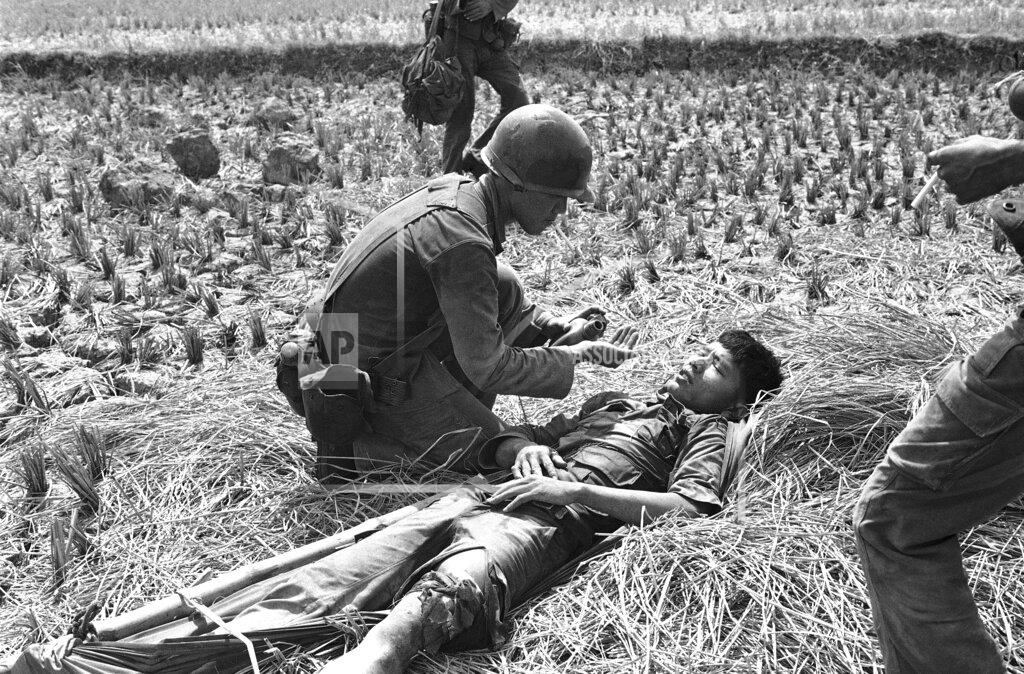
Thousands of Cambodian civilians were reported to be leaving Phnom Penh under orders from the victorious Communist force. In the last news dispatch filed from the Cambodian capital by a French news agency before communications were cut off, it was reported that Communist patrols were telling all residents to go more than 12 miles into the countryside. The patrols were reportedly saying that the city might come under shelling. Today, The Associated Press in Bangkok, Thailand, said a broadcast heard there from a Cambodian Communist radio station had asserted that most of the farmer Cambodian leaders had been beheaded. The broadcast reportedly warned all Cambodians still resisting the new regime to lay down their arms “and join our side immediately.”
The broadcast suggested that fighting was continuing in the provinces, but reliable military sources in Bangkok said most provincial capitals and towns were surrendering to the Communists. The broadcast reportedly said: “The new traitors committee established last week and which stubbornly chose to resist our forces has totally collapsed. Some have fled the country but most have had their heads cut off.” Yesterday in Bangkok, French officials who were said to have been in radio contact with Phnom Penh, where France has a consul, said that the Communists expected shelling by the Americans.
One diplomatic source there suggested that part of the reason for the evacuation order was a desire to thin out the city’s population, which had swelled to two million, more than three times its normal size. By reducing the population, the source suggested, the Communists would be better able to cope with any possible pockets of resistance and to search for officials of the surrendered government who had gone into hiding. The evacuation orders, booming over the loudspeakers after nightfall, had reportedly touched off panic in some neighborhoods. But by yesterday afternoon, according to French officials in Bangkok, the city seemed much calmer. Phnom Penh, they said, seemed almost deserted.
As the evacuation began, hundreds of Cambodians were said to have sought refuge in the French Embassy compound, which is surrounded by an iron fence. A number of foreign newsmen were also reported to be there. Reports from Peking, where Prince Norodom Sihanouk, the nominal head of the victorious Cambodian forces, is still living, quoted Cambodian sources there as denying that there had been any evacuation or that one had been ordered. These reports were distributed by Tanyug, the Yugoslav press agency.
But Tass, the Soviet press agency, said that thousands of Cambodian peasants had left Phnom Penh after the former military government had surrendered. It said they had gone back to the villages from which they had fled to the capital in the closing stages of the Cambodian war. The evacuation was also reported in Paris by the French Foreign Minister, Jean Sauvagnargues, who told reporters that his government had been “informed that the residents are fleeing from Phnom Penh.” After the last Agence France Presse dispatch was transmitted from Phnom Penh, telecommunications with the city broke off. The British Cable and Wireless Company, whose facilities in Hong Kong are the main relay station for such communications, said that it had been unable to restore Telex and telegraph service. Telephone service was also said to be out. In the last several days there have been similar breakdowns in communications for extended periods.
In Geneva, the International Committee of the Red Cross said it had been unable to make contact with its 16‐member team in Phnom Penh since early Thursday. The team, headed by Andre Pasquier, had established a neutral zone at the Hotel Le Phnom for treatment of the sick and the wounded. First reports from the Cambodian capital after the Communist take‐over said that Communist troops had not entered the hotel. According to the last dispatch, however, the situation in the northern part of the city where the hotel is situated was confused. The French Embassy compound, the French Calmette Hospital and the French Descanes Lycee are also in that area. Agence France‐Presse reported that the Descartes school was said to have been occupied by the Communist soldiers after they expelled the caretakers.
At the hospital, where a team of seven French physicians and surgeons had remained on duty, the soldiers were said to have evacuated everyone, including the patients and several dozen foreigners who had taken refuge there. There were reports also that the French Embassy was under heavy guard by Communist soldiers.
There were reports during the day that fighting continued in other areas of Cambodia in provincial capitals that had still not been taken by the Communists. But with communications cut, these reports could not be confirmed. Nor was there any firm report on the whereabouts of Premier Long Boret, who was on the Communists’ list of “traitors” who would be tried and who was last reported seen in Phnom Penh just before the formal surrender at 9 AM Thursday (10 PM Wednesday, New York time). Many Cambodians, among them the acting chief of state in the ousted Government, Lieutenant General Saksut Sakhan, managed to escape by air to neighboring Thailand. But in Bangkok officials denied reports that Mr. Long Boret had also arrived there. Other reports said the former Premier had been seized inside Cambodia by the Communists.
The Association of Southeast Asian Nations, the five countries geographically closest to the turmoil in Indochina, jointly recognized the new Government of Cambodia today. The five countries — Thailand, Malaysia, Indonesia, Singapore and the Philippines — announced the move within 36 hours of the surrender of Phnom Penh to the Communists. Some of these countries, including Thailand, had been stanch supporters of the United States for years. In recent months, however, most have reassessed their policies as evidence has mounted of a declining American commitment to the area.
Thailand yesterday closed her border with Cambodia in an effort to keep out Cambodian refugees. Many slipped through, however, and some flew over the border to United States bases in Thailand. Cambodian embassies in some countries have announced their allegiance to the new regime. In Bangkok tonight, the Cambodian chargé d’affaires, Keup Loy Hieng, said he had no comment yet on the new Government. “We will see,” he said.
The Japanese Government decided at its regular Cabinet meeting today to recognize the new Phnom Penh Government at an early date, but Prince Norodom Sihanouk said in Peking that Tokyo would not be allowed to open diplomatic ties for some years. Prince Sihanouk, titular Cambodian leader, said this was because the Japanese Government had backed the ousted Lon Nol Government, the Japanese Kyodo news agency reported.
The Chinese leaders have conveyed their “warmest congratulations and highest esteem” to Prince Norodom Sihanouk and the new Cambodian leaders on their victory. Hsinhua, the official press agency, released a message sent yesterday in the name of Chairman Mao Tse‐tung, Premier Chou En‐lai, and Chu Teh, chairman of the Standing Committee of the National People’s Congress. Accusing the United States of having engineered the coup in which Prince Sihanouk was deposed five years ago, the Chinese leaders said that the Cambodian events were “a brilliant example for the revolutionary people of the world.” “The Chinese people heartily rejoice over the victory of the Cambodian people as they would over their own.” they said. Last night Prince Sihanouk said he was overjoyed at the news of the capture of Phnom Penh. He said he did not know when he would be returning to Cambodia because his mother was ill in Peking and he expected her to die soon.
Heavy North Vietnamese reinforcements have moved into the battle for Xuân Lộc, 38 miles northeast of Saigon, as other Communist troops staged a series of small-scale attacks closer to the capital. Reports from the field said the defenders continued to hold Xuân Lộc, now a city of ruins, but they were surrounded. Some Communist units were said to have advanced about nine miles west along Route 1 toward Saigon. Fifteen miles northeast of there, the big Biên Hòa air base was struck by‐North Vietnamese heavy artillery for the fourth day in a row today. A military spokesman said that the continuous shelling forced the government yesterday to begin moving F‐5E jet fighters from Biên Hòa into Saigon’s Tân Sơn Nhứt airport. Trucks also moved 500‐pound and 750‐pound bombs from the base to Tân Sơn Nhứt for safer storage.
Meanwhile, Western intelligence officers said they still expected a full‐scale North Vietnamese thrust at Saigon in the next few days.
To the east, North Vietnamese troops led by tanks last night attacked Phan Thiết, 90 miles northeast of Saigon and the last remaining Government enclave on the central coast. A military spokesman here said he had no further information on what had happened after the assaults; it appeared that the Communists had overwhelmed the town’s small garrison. Earlier, Western analysts expressed doubt that the outnumbered defenders could hold.
The analysts said that the most ominous development for Saigon was that yet another North Vietnamese division had been detected moving into the 10‐day‐old battle for Xuân Lộc, which anchors the capital’s northeastern defense line. This unit, the 312th Division, was said to have left North Vietnam a few weeks ago. Its presence in the Xuân Lộc area now gives the Communists five divisions there. The other divisions, the analysts said, are the Sixth, Seventh, the 325th and the 341st. The 341st Division is also a new arrival from North Vietnam. The 325th was reportedly brought down in the last two weeks from the Huế area in northern South Vietnam.
In opposition, the South Vietnamese Army has the 18th Division, a brigade of paratroops and some ranger units, all of which reportedly suffered serious casualties in the last 10 days. United Press International quoted South Vietnamese military source as saying that revised estimates showed that the Communists had 80,000 men with 45 miles of Saigon and that the Saigon command had 51,000 combat-ready troops.
The Saigon command reported a series of Communist infantry and artillery attacks on the broad battlefront around Xuân Lộc. It said 9 North Vietnamese were killed in ground action during the day, and put Government casualties at 2 dead, 27 wounded. The command also reported that air strikes killed 100 Communists and knocked out a 130‐mm, long‐range gun seven miles west of Xuân Lộc on Route 1.
On the southern edge of Saigon itself, the large Phú Lâm communications base was attacked by Communist guerrillas early yesterday with B‐40 rockets and small arms. A child was killed, a military spokesman reported, and nine persons, including six civilians, were wounded. The base at Phú Lâm, built by American troops, is one of the most important in the country and has been the target of previous guerrilla raids. As the base was attacked yesterday, other guerrilla units attacked two small villages about 5 to 10 miles south of Saigon. In expectation of such attacks, government policemen and militiamen had been put on a special alert. Intelligence sources had reported that the North Vietnamese had planned to begin guerrilla attacks in and around Saigon Thursday night and to continue them for the next few nights.
Another threat to Saigon was posed yesterday from the south, where Communist troops continued to try to cut Route 4, the capital’s link with the Mekong River delta, its major source of food. Reporting on continued clashes around Route 4 in Long An Province, the Saigon command said that 22 Communists had been killed at a cost of one South Vietnamese killed and 9 wounded. Parts of the North Vietnamese Fifth Division have been trying to cut the two‐lane blacktop road for the last 10 days. Tân An, the capital of Long An Province, was reportedly hit by four 122‐mm. rockets. Casualties were said to be civilians killed and 28 wounded.
This afternoon truckloads of marines and other troops and ammunition convoys were moving up the road to forward positions in Trảng Bom District
along the border between Biên Hòa and Long Khánh Provinces, some 27 miles northeast of Saigon’s city limits. Refugees from farther east on Route 1, heading back from beleaguered Xuân Lộc toward Saigon, were still trickling in at a checkpoint here and being turned back by government troops. The Saigon command has ordered troops to keep refugees from moving closer to the capital, on the ground that many might be Communist infiltrators. Among the refugees today was an old man. Two days ago he left his home, near Biên Hòa, to identify the body of his son, an army captain killed in fighting west of Xuân Lộc. He argued bitterly with the army sentries, showing them his identity papers, insisting that he had found the body and was now merely going home. They would not let him pass.
United States officials say they are receiving reports of atrocities allegedly committed by Communists in captured areas of South Vietnam. But the reports have not been verified, and most accounts were described by only one source. The allegations are coming through the United States Embassy in Saigon. Officials here said that many of the refugees reporting atrocities, such as mass executions and killings of villagers, were distraught and that their reports could not he confirmed. One report from a monk said that about 300 South Vietnamese had been shot to death in a market place in Buôn Ma Thuột before thousands of people.
According to a cablegram from the American Embassy, the monk said that after the shootings, relatives of the victims were ordered to follow a group of armed men out of the market place and that when some tried to flee, mortar shells were fired among them and some were chased down and shot. Secretary of State Kissinger told the House International Relations Committee today that he had see “some plausible reports” of executions of South Vietnamese officials by Communists. “We expect to see the Communists try to eliminate all possible opponents,” he said, commenting on the unconfirmed reports of atrocities.
The Senate Foreign Relations Committee has approved legislation that would authorize $200 million in emergency aid for humanitarian relief and evacuation programs in South Vietnam. Meanwhile, the administration’s urgent request for $722 million in emergency military aid for the Saigon government remained stalled in Congress. Without some additional military aid, Secretary of State Kissinger predicted before the House Committee on International Relations, South Vietnamese forces would run out of ammunition by the end of May.
Similar predictions were made by General Frederick C. Weyand, the Army Chief of Staff, in testimony before the House Armed Services Cornmittee. General Weyand said that South Vietnam could survive for only “a matter of weeks” if it did not receive at least part of the emergency military aid. “One single factor which could start a complete unraveling process within South Vietnam could be final United States rejection of aid,” General Weyand said.
[Ed: It’s too late anyway. South Vietnam is out of time.]
The North Atlantic Treaty Organization agreed today to transform its regular spring meeting next month into a full‐scale conference attended by President Ford and other government chiefs, a NATO spokesman announced. Representatives of the 15 members will gather at the alliance’s headquarters here on May 29 and 30. Mr. Ford’s visit will be his first to Europe since he assumed the Presidency last August. France, which is opposed to the summit idea proposed last month by Britain and supported by Mr. Ford in his State of the World Message last week, said Wednesday that she would be represented by her Foreign Minister if the high‐level talks took place. There are also doubts whether Portugal and Greece will be represented at the highest level.
The United States said today that the new United Nations Environment Program was intruding into economic, political and other questions not related to protecting the human environment and was spreading its efforts too thinly. Addressing the third session of the agency’s governing council in Nairobi, Christian A. Herter Jr., the chief United States delegate, said that the program “has enough on its plate without trying to reform the world.” Mr. Herter’s speech was considered blunt by some of the other 57 delegations and several privately indicated an intention to rebut it.
The Soviet Union has deployed four naval task forces in the western Pacific as part of a worldwide exercise that United States naval authorities believe may be the largest the Russians have ever staged. All four Soviet fleets — Northern, Baltic, Black Sea and Pacific — are involved. National intelligence authorities in capitals of the North Atlantic Treaty Organization put the total of surface combat vessels involved at more than 220 and believe it likely that other ships will be deployed before the operation ends. Long‐range strike planes as well as anti-submarine and reconnaissance aircraft and a large number of nuclear and conventional submarines are also taking part. The four forces operating in the western Pacific have been located, southeast of the Kamchatka Peninsula, east of Japan, northeast, of the Caroline Islands and south of Japan.
Another large force of 50 to 60 surface vessels is deployed from the Norwegian Sea, northwest of Norway, to the Atlantic west of Ireland. One squadron observed moving westward north of Finmark, the northernmost Norwegian province, included landing craft and merchant ships, the latter believed to be employed as transports for Soviet marines. An additional squadron is holding exercises south of Iceland. U.S. Defense Department sources said they believed the exercise was being held to test and evaluate weapons systems and ships that have been added to the Soviet fleet in major maneuvers at sea. The Russians are expected to carry out anti-carrier, anti-submarine, amphibious and convoy operations.
The Soviet Union reported today economic gains for the first quarter of the year and issued figures indicating that the government was fulfilling its plans to devote less attention to the production of consumer goods. Compared with the first quarter of 1974, industrial production was reported to have increased 7.5 percent and productivity, a key index to economic performance, was said to have increased by 6 percent. Both increases indicated that the Soviet economy was running ahead of its 1975 production plans. But the economy’s performance in the area of consumer goods did not generally match that of heavy industry. Light industry, the category including much of what is classified as consumer goods, increased by 6 percent from the first quarter of 1974, slightly more than planned. But in the consumergoods area, the production of many coveted items lagged.
The Soviet security police moved today against four members of the small Soviet chapter of Amnesty International, apparently arresting two and searching the apartments of the two others at length. Andrei N. Tverdokhlebov, a physicist who serves as secretary of the Amnesty group, disappeared this morning on his way to work, friends said. Later he was reported under arrest, and his apartment was said to have been sealed off by the police. The apartment of Valentin F. Turchin, a computer specialist and the chapter’s chairman, was searched for 12 hours by officers of the K.G.B., or Committee of State Security. The apartment of Vladimir Albrekht, an engineer and Amnesty member, was searched for six hours.
Retail prices in Britain climbed a record of 21.2 percent in the 12 months through March, according to a government report in London. The report appeared to confirm that the British would experience the highest inflation in the industrialized world in coming months. Three days ago a government tax increase added 2.75 percent to the price index.
Sheik Ahmed Zaki Yamani, Saudi Arabia’s Minister of Petroleum, has been in Washington for three days trying to persuade Congress and the press that the United States should put more pressure on Israel to withdraw to the borders that prevailed before the 1967 war with Egypt, Syria and Jordan. In public talks and private conversations, Sheik Zaki has alluded to a possible reimposition of an oil embargo if the issue of Israel’s borders is not resolved. “Oil as a political weapon will be defused,” he said today, by reaching a peaceful solution based on the United Nations Security Council Resolution 242, which called on Israel to withdraw from occupied territories. Sheik Zaki spoke at a meeting of the American Society of Newspaper Editors.
Oil-exporting countries accounted for a sixth of official development aid from rich to poor countries last year, Western aid officials reported today.
Laotian Defense Minister Sisouk na Champassak said today that Communist troops had driven government forces from a position near a strategic crossroads north of Vientiane. Prince Sisouk said 11 Communist soldiers and two government soldiers had been killed since fighting flared up Tuesday in a mountainous area 92 miles from Vientiane. Prince Sisouk implied that the attacking forces were North Vietnamese rather than Pathet Lao units and said that there were still some 15,000 North Vietnamese troops in Laos.
Bombs exploded early today in Tokyo and in the city of Amagasaki in central Japan. The bomb in Tokyo, in the central Ginza district, destroyed the office of the Korean Industrial Economic Research Institute. In Amagasaki, the offices of the Oriental Metal Manufacturing Company were destroyed. No injuries were reported. Both concerns do business with South Korea but the police said they did not know whether the explosions were connected with earlier incidents dating back to last August in which the bombers said they had attacked companies for supporting Japanese “imperialism” in Korea or Southeast Asia.
The first complete re-examination of the defense pacts between the United States and the Philippines and of the huge strategic naval and air bases that are the keystone of America’s Pacific defenses has begun in Manila. The outcome, according to Philippine and American officials, could change the relationship between the countries. Tonight, after nearly a week of hints, leaks and statements, President Ferdinand E. Marcos said that he was calling a meeting of the Foreign Policy Council, the equivalent of the American National Security Council, for next Friday to discuss a total takeover of Clark Air Base and Subic Bay Naval Base, and abrogation of the mutual defense treaties with the United States.
Chad’s ruling military council today appointed the members of the four national commissions that are to supervise the functions of the government. The nine-member council, made up of army officers from lieutenants to generals and two police officials, said on Wednesday that all government operations would come under the four groups. They are the Commission of Inquiry for Control of Financial Matters, the Commission for the Revision of the Statutes of Public Service, the Commission for Economic and Social Service and the Military Commission. Many former officials and a few lesser‐known civil servants were among those named to the commissions, which are to be headed by soldiers.
President Kenneth D. Kaunda of Zambia arrived here today for two days of talks with United States Government officials and Congressmen about the situation in southern Africa. Though he is on a private visit, Mr. Kaunda is staying at the official visitors’ residence, Blair House, and will be the guest of honor at a White House dinner to be given tomorrow night by President Ford. It is believed by some here that the Ford Administration would like to make amends for an apparent snub the Zambian suffered in 1970, when he visited the United States last. president Nixon was campaigning for Congressional elections at the time and did not meet Mr. Kaunda.
President Ford, in New England marking the start of the American Revolution Bicentennial, called for a reversal of “the long-term movement toward big government” and a return to “the basic American virtues.” Mr. Ford, speaking at Concord and in Boston’s Old North Church on the 200th anniversary of Paul Revere’s famous ride, told his audiences his own conservative vision of America. He said the two lanterns, hung in the Old North Church steeple as the signal to Revere, “fired a torch of freedom that has been carried to the ends of the earth.”
Representative George V. Hansen, Republican of Idaho, was sentenced in Federal court today to serve two months in prison for two campaign finance violations. Before pronouncing sentence. George Hart, chief judge of the Federal District Court, reminded Mr. Hansen that the Representative had served two previous terms in Congress and then said: “If the people who make the laws can’t obey them, who can be expected to obey them?” Judge Hart then sentenced Mr. Hansen to the maximum allowable one year in prison, stipulating that two months be served in confinement, with the balance of 10 months suspended. The Representative would be on probation for one year upon release from confinement.
A Federal jury today found a self‐ordained Fundamentalist minister and a young coal miner guilty in connection with the dynamiting of public schools here last fall at the height of the Kanawha County protest over school textbooks. The jury of seven women and five men deliberated five hours before announcing a verdict of guilty on one count of Conspiracy to bomb the schools against the Rev. Marvin Horan, a 36‐year‐old former truck driver. He is now the Freewill Baptist pastor of a rural Fundamentalist church and a religious leader in Campbell’s Creek, the Appalachian hollow outside this city, from which most of the antitextbook violence has sprung. The jury acquitted Mr. Horan of three other counts alleging overt acts to obtain dynamite illegally and manufacture bombs and to place them at the Midway and Valley Grove elementary schools last October and November. The maximum penalty for the conspiracy count of which he was found guilty is five years in prison and a $10,000 fine. The preacher’s co‐defendant, Larry Elmer Stevens, 29, described by the Government as Mr. Horan’s “right‐hand man,” was found guilty on all six of the counts with which he was charged, including conspiracy to bomb, possession of dynamite, the manufacture of bombs and the bombings.
Patricia. Hearst and two fellow fugitives of the self-styled Symbionese Liberation Army have rejected terrorism but would shoot back if agents of the Federal Bureau of Investigation used force to try to capture them, The San Francisco Examiner reported today. “If the FBI shoots first, they will shoot back,” the newspaper said, quoting unidentified sources who assert they have seen and talked to Miss Hearst and William and Emily Harris. “And if the FBI breaks into where they are staying, they will shoot,” the sources said. “They are willing to die and they probably feel that it’s better to die than spend years in prison.”
The Environmental Protection Agency has found the drinking water in 79 American cities polluted with traces of organic chemicals including some that are suspected of being causes of cancer. The survey concentrated on six chemicals, two of which — chloroform and carbon tetrachloride — are considered potential causes of cancer. Tests in some cities showed drinking water contained traces of the pesticide dieldrin, and vinyl chloride. The latter has been linked to cancer in persons heavily exposed.
The total compensation to top executives of the General Motors Corporation was reduced last year by 68.3 percent because of the 60 percent decline in the corporation’s profits. The G.M. officials last year received only their salaries, without the bonuses paid in previous years, according to the corporation’s proxy statement for its annual meeting next month. Thomas A. Murphy, G.M.’s chairman, received $272,500 last year. In 1973, as vice chairman, he received $832,997 of which $562,997 was in bonus.
John B. Connally, acquitted of a bribery charge yesterday, has survived too much bizarre fortune, with too boldly unconventional a personality intact, to invite guesses about his future. Yet numerous friends, rivals and uncommitted political observers shared today a vaguely awed sense that the 58‐year‐old former Texas Governor, former Democrat, and former Treasury Secretary could be as powerful again after his near brush with scandal. He can expect to be a hero and, if he chooses, a political force in his home state, fellow Texans said. And a warm welcome awaits him, if he wants it, among a restless national movement of right‐wing Republicans. “He’s a factor,” said Clarke Reed of Mississippi, the leader among Republican state chairmen in 13 Southern states. Mr. Reed sees the Presidential contest of 1976 as a “wide‐open ballgame” in which Mr. Connally might still play a part. “He’s more of a factor than many of the announced candidates in the Democratic party,” Mr. Reed said.
Chief Justice Warren E. Burger took before the nation’s newspaper editors tonight his case for more Federal court manpower and higher judicial salaries.
An Army major in Selective Service headquarters here was convicted yesterday of accepting $50,000 in bribes over a three‐year period to help hundreds of young men escape the draft during the war in Vietnam. The 45‐year‐old major, William Sangemino, was found guilty by a jury of five men and seven women in Federal District Court in New York after almost six hours of deliberations at the end of a two‐week trial that included allegations that several doctors and school officials received payments to assist the draft‐evasion scheme. Judge Charles L. Brieant set June 3 for sentencing Major Sangemino, who could face up to 15 years in prison and a $20,000 fine for bribery, with lesser penalties for conspiracy to defraud the government and lying about it to a grand jury.
The first acidophilus milk was introduced at a luncheon at North Carolina State University. “Sweet Acidophilus”, a dairy product for people with a lactose intolerance, had been made through the co-operation of the university, the North Carolina Dairy Foundation, and Miles Laboratories, with Miles producing the lactobacillus acidophilus bacteria cultures that aided in the breakdown of lactose sugar.
The 200th anniversary of the midnight ride of Paul Revere (celebrated in Henry Wadsworth Longfellow’s 1860 poem as having occurred “on the eighteenth of April, in Seventy-Five”) was observed in Boston’s North End neighborhood. U.S. President Ford visited the Old North Church, where two signal lanterns had been placed on April 18, 1775, and lit a third lamp to symbolize the start of “America’s third century.”
John Lennon gives what becomes his final public performance at a gala salute to British media mogul Lew Grade at the Grand Ballroom of the Hilton Hotel, NYC; he performed 3 songs – Little Richard’s “Slippin’ and Slidin’”, Ben E. King’s “Stand By Me”, and closed with his own “Imagine”
The Buffalo Braves seemed on the verge of their third straight National Basketball Association playoff loss to the Washington Bullets tonight, then raced to a 108102 victory on the strength of a strong third-quarter rally and a superb 50-point performance from Bob McAdoo.
Major League Baseball:
In his first appearance at Fenway, Lee May hits a pair of 3–run homers and drives in 7 runs to pace the Orioles to a 9–7 victory over Boston. Jim Rice hits 2 homers and Fred Lynn adds one for the Sox.
Hank Aaron hit his first American League home run and the Milwaukee Brewers downed the Cleveland Indians, 5–1.
San Diego Padres 3, Atlanta Braves 1
Baltimore Orioles 9, Boston Red Sox 7
Houston Astros 2, Cincinnati Reds 5
Milwaukee Brewers 5, Cleveland Indians 1
New York Yankees 11, Detroit Tigers 3
San Francisco Giants 3, Los Angeles Dodgers 1
Philadelphia Phillies 6, Montreal Expos 3
Minnesota Twins 5, Oakland Athletics 4
Pittsburgh Pirates 4, St. Louis Cardinals 5
Kansas City Royals 5, Texas Rangers 3
Dow Jones Industrial Average: 808.43 (-11.03, -1.35%)
Born:
Patrick Mannelly, NFL long snapper (Chicago Bears), in Atlanta, Georgia.
Rob Touber [Noordervliet], 38, Dutch television music and variety director, and record producer, of a heart attack.
Died:
Hang Thun Hak, 48, former Prime Minister of Cambodia (1972–1973), was executed by the Khmer Rouge.
 History Diaries