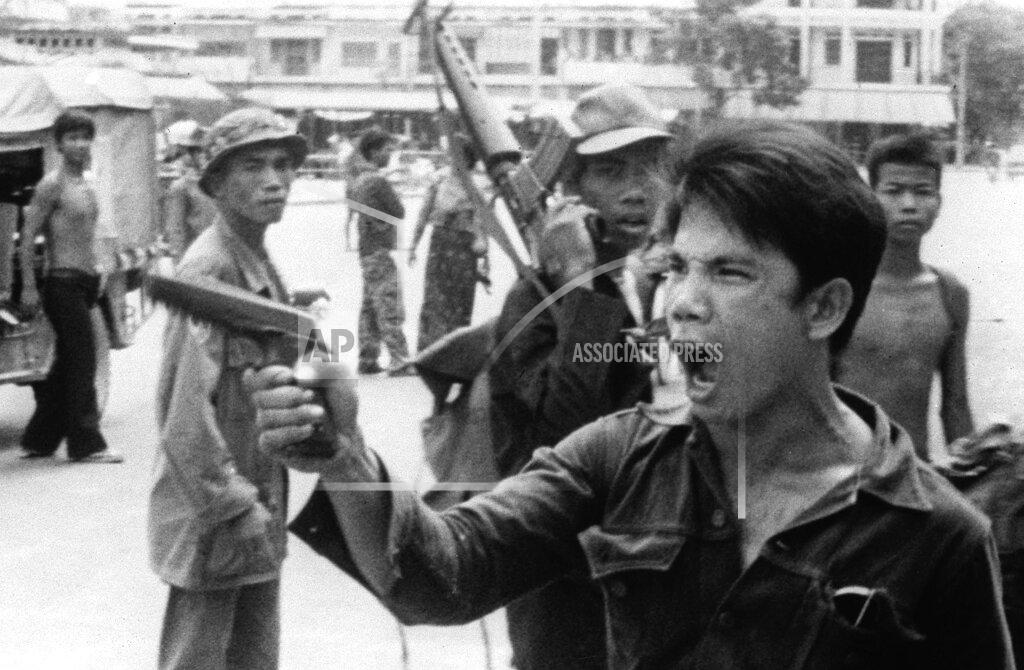
The Lon Nol government in Cambodia surrenders to the Khmer Rouge, ending five years of war. The People’s Assembly headed by Pol Pot, established in December, will cause two to four million deaths over the next three years. The Cambodian government surrendered to insurgent forces, the Cambodian radio announced. The Phnom Penh government ordered all troops to stop firing and lay down their arms. General Mey Sichan, chief of operations for the Cambodian army, went on the radio and said soldiers and functionaries should cease all combat and invite the rebels to take power. After his speech a “representative of the liberation forces” told all government officers to report to the Information Ministry, site of the radio station, under a white flag of surrender.
The rebels’ representative said the final victory for the insurgents had come at 9 AM (10 PM, Wednesday, New York time) when insurgent troops ‐seized the Information Ministry. The ministry and its third‐story broadcasting studio are in the center of Phnom Penh, about 200 yards from the Phnom Hotel. There was no initial word on the fate of the foreigners sequestered at the hotel. These included newsmen, a few diplomats and representatives of the International Red Cross and the United Nations.
The Cambodian Civil War came to an end when Khmer Rouge guerrillas captured Phnom Penh. That evening the Khmer Rouge directed the residents to leave the city for the countryside. Agence France‐Presse reported under a Phnom Penh dateline that Communist patrols with loudspeakers were moving through the streets, warning residents, regardless of nationality, to evacuate. They reportedly said that the city might come under shellfire. The people were told to go into the countryside, some 12 miles away.
At a news conference in Paris, Chau Seng, special representative of Prince Norodom Sihanouk and a member of the Politburo of the Cambodian National United Front, said the new government would follow a policy of neutrality and nonalignment. He called this a fundamental and strategic position, not a tactical or temporary policy. He said an amnesty had been proclaimed but at another point said those who had committed crimes would be tried.
The Cambodian Communists swiftly set up headquarters in Phnom Penh following its surrender. According to a broadcast monitored in Bangkok, Thailand, they invited ministers and generals in the military government “who have not run away” to join in formulating measures to restore order. The streets were reported quiet some hours after thousands were said to have stood on the sidewalk waving to the entering Communist troops.
A few hours after the surrender communications between Phnom Penh and the outside world ceased for several hours. There were reports that five American newsmen, among them Sydney H. Schanberg of The New York Times, were at the Hotel Le Phnom, which the International Committee of the Red Cross on Wednesday declared a neutral protected zone for the treatment of the sick and the wounded. The last Associated Press dispatch, filed by Cambodian newsmen before 6 AM, New York time, or nearly eight hours after the surrender, reported that the streets were quiet. But earlier they had said that thousands of people had stood on Phnom Penh’s sidewalks waving their hands in greeting the Communist troops.
From windows and roofs people were said to have cheered and waved white strips of cloth as the black‐clad troops walked triumphantly through the streets in groups of three or four. There was some shooting, but it was said to have come from jubilant Communist soldiers firing into the air. Army vehicles with loudspeakers toured the city an hour before the formal surrender instructing residents to display white flags. About the same time, Premier Long Boret, who had been on a Communist list of “traitors,” emerged sad‐faced from his villa with Information Minister Thong Lim Hong. They went to Government headquarters, and aides said that the Premier would make a broadcast. But none was heard.
The first Communist troops to enter Phnom Penh were said to have moved in from the north, parking their armored vehicles by the municipal stadium and strolling along a riverside boulevard by the Tonle Sap. Government gunboats sailed up and down both the Tonle Sap and the Mekong River flying white flags and banners. Communist troops reportedly embraced Government soldiers and lifted them aboard personnel carriers for a victory parade along the waterfront.
Al Rockoff, a freelance American photographer, climbed on the hood of a jeep loaded with Communist‐led soldiers, and the jeep drove up and down the streets. Another group of 50 armed men drove up to the Hotel Le Phnom in a truck, but the victorious soldiers did not try to enter it. Three hours after the surrender, thousands of students paraded along the main boulevards, waving banners to greet the Communist forces.
Soon thereafter, the Phnom Penh radio began broadcasting a message saying that talks between members of the surrendered military command and Communist leaders were beginning. But the broadcast was interrupted by a Communist spokesman, who said Phnom Penh had been taken by force. “We did not come here to talk,” he added.
And what of Long Boret?
Long Boret remained in office until the Khmer Rouge captured Phnom Penh. US Ambassador John Gunther Dean recalls that, unlike many government officials who fled Phnom Penh, Long chose to remain behind despite being on a death list announced from Beijing by Norodom Sihanouk:
“Long Boret refused to be evacuated. He was a competent, able man, much younger than Lon Nol or Sirik Matak. When I personally went to see him on April 12, the very morning of our evacuation, to ask him to take his wife and himself and his young children out of Phnom Penh because I feared for his safety, he thanked me but [said he] thought his life was not in danger.”
General Sak Sutsakhan recalled that on the morning of 17 April, Long decided to take his family and leave the city. Both General Sak and the journalist Jon Swain reported that Long and his family were unable to board the last helicopter flying out of the city. In his memoir, Danger Zones, Ambassador Dean stated that:
“Long Boret had stayed in Cambodia, thinking that he could have some kind of dialogue with the Khmer Rouge. When he realized that that was impossible, he raced to the airport with his family in a jeep to try and get out of the country. When they arrived at the airport, they got on a helicopter with some military officers. One officer brutally shoved him off the helicopter. The copter took off. The Khmer Rouge captured Long Boret and his wife and killed them all. Boret’s son managed to escape and is now alive.”
Long Boret was last seen by Jon Swain, Sydney Schanberg and Dith Pran outside the French Embassy. Swain reported:
“…a black Citroën pulled up and Long Boret got out, his eyes puffy and red, his face empty of expression. When we asked him how he was, he muttered a short, incoherent sentence. His thoughts were elsewhere. Dazed, legs wobbling, he surrendered to the Khmer Rouge and joined the line of prisoners. I could not fail to admire his courage.”
Schanberg gave a more detailed description of the scene:
“Long Boret arrives in a car driven by his wife…he looks wretched. His eyes are puffed. He stares at the ground. He…knows what faces him. I want to get away but I feel I must say something to him, and Pran understands. I take Long Boret’s hands and tell him what a brave thing he has done for his country and that I admire him for it. Pran takes his hands too…Long Boret tries to respond but cannot. Finally he mumbles ‘Thank you.’ And we must leave him.”
Soon after, Koy Thuon, a Khmer Rouge deputy front commander, organized the “Committee for Wiping Out Enemies” at the Hotel Monorom. Its first action was ordering the immediate execution of Lon Nol and other leading government figures. Long Boret was executed on the grounds of the Cercle Sportif in Phnom Penh. Khmer Rouge Radio subsequently reported that he had been beheaded but other reports indicate that he and Sisowath Sirik Matak were executed by firing squad.
The Agony of Cambodia is only beginning. The Hour of The Killing Fields is at hand.
South Vietnamese forces were reported holding on in Xuân Lộc and making gains nearby, but fears grew that Saigon itself was about to come under heavy attack. Reports circulated that 10 to 12 North Vietnamese divisions were waiting for a signal, and a North Vietnamese demolition group reportedly long inside the city was rumored to be prepared for action. Questions of morale appeared to be outweighing the strictly military factors.
Military sources said that the national army was preparing to make a last‐ditch stand if necessary along the banks of the Đồng Nai River adjoining the capital. Last night loudspeaker trucks advised the residents of Saigon to return to their homes shortly before the curfew hour, 9 o’clock, to keep their doors locked and to remain calm. The official explanation was that local militiamen were holding a drill.
Early today the Communist presence was felt at the southwestern edge of Saigon as infantrymen fired antitank rockets and small arms into the Phú Lâm communications center, just outside Chợ Lớn, the predominantly Chinese section of Saigon, on Route 4 leading to the Mekong delta. The Saigon spokesman said a child had been killed and six other civilians wounded.
Reports from the devastated city of Xuân Lộc, capital of Long Khánh Province, said the government defenders were still withstanding heavy shelling and sporadic ground attacks during the day.
Of greater importance to Saigon, the Communists apparently made no further progress westward toward Biên Hòa and Saigon alone Route 1, a segment of which they control west of Xuân Lộc. Their control extends to Route 1’s intersection with Route 25, which leads more directly to Saigon than does Route 1. Government troops, who fell back earlier in the week from some points along the approaches to Xuân Lộc, succeeded in reoccupying some of the lost ground during the day with heavy tank and artillery support. They re‐entered the hamlet of Hưng Lộc, which they had left in the face of heavy shelling.
Meanwhile, a new blow to Saigon’s forces appeared at hand at Phan Thiết, the coastal city due east of Xuân Lộc. A nearly continuous barrage of shells was said to be falling into the city, Communist forces in the area presumably had ample strength to take it soon. Earlier, the fall of Phan Rang, a city some 60 miles farther up the coast, was announced by the Saigon military spokesman. He said that Phan Rang’s defenders had fallen back to positions outside the city but that prolonged resistance appeared doubtful, particularly in view of severe supply problems. Lost with Phan Rang were its air base and a presumably substantial number of aircraft. These developments will free Communist troops to move to ward Saigon, reinforcing those already in position and fresh troops reportedly moving in from the north.
In case of an attack on Saigon, the highway bridges over the adjoining Đồng Nai River, leading toward Biên Hòa, would presumably be destroyed at the last moment, affording a fairly good natural barrier at least from one direction. But questions of morale clearly appeared to be outweighing the importance of military developments or the relative size and firepower of opposing units. The government‐supervised press and radio said last night that the United States would probably grant more aid to this country.
As for Cambodia, while some newspapers here reported fighting inside Phnom Penh, there were no reports that the Camhodian capital had fallen or that the war in the neighboring country had ended in a Communist victory. Neither was there any official reaction here to the fall of Cambodia, which had been expected for some time. The authorities apparently had felt the event could have a dangerous effect here on the will to continue resistance.
While the primary threat to Saigon appeared to be from the northeast, minor but draining actions were being fought over most of the Mekong River delta south of Saigon, with a dozen or so district capitals under intermittent shelling. Permanent Communist interruption of Route 4 south of Saigon would effectively isolate it from the delta, the country’s principal rice‐producing area. The Communist side has been applying steady pressure, for two weeks to accomplish this.
The main fighting in the delta yesterday was in the vicinity of Bến Tranh, 20 miles southwest of Saigon on Route 4.
In other military developments, the South Vietnamese Air Force said its planes had inflicted heavy casualties and damage in some areas today, especially to Communist positions outside Xuân Lộc. Pilots reported killing 120 North Vietnamese troops and destroying three 130‐mm heavy artillery pieces three miles northwest of the town.
At the Biên Hòa air base, the major center of air operations left to the Saigon Government there was sporadic shelling yesterday and today, some of the fire was apparently from 130-mm. artillery. Thirteen shells hit the base last night and this morning, causing no casualties, according to air force sources. They said that many aircraft. had already been moved to nearby Saigon because of the apparent danger posed by the approach of enemy artillery as well as the possibility of ground attacks on the base.
It was also reported during the day that the North Vietnamese Air Force was now operating at both Phú Bài airport, outside Huế, and at the huge American‐built air base at Communist-occupied Đà Nẵng. It was said to have MIG‐21 supersonic fighters.
Saigon authorities were said to have become concerned about the problem of safe storage of bombs for fighter‐bombers. The explosion of a bomb storage depot at the Biên Hòa base ealier this week caused heavy damage at the field an rocked Saigon, 15 miles South. Bombs are also stored at the Tân Sơn Nhứt airport
Speaking of the loss of Phan Rang and its air base, South Vietnamese Air Force source said that Brigadier General Phạm Ngọc Sang, commander of the Sixth Air Division, and Lieutenant General Nguyễn Vĩnh Nghi, commander of whatever is left of Military Region II, were last seen Wednesday afternoon outside the city trying to make that way to the shore. If they were captured, they would have been the highest officers taken prisoner by the Communists to date.
After more than four weeks. of fighting, the Vietnam campaign appears to United States military sources to be entering a final phase in which Saigon’s hopes for preventing a defeat are minimal. The North Vietnamese divisions closing in around the capital retain the tactical initiative they seized at Buôn Ma Thuột in the middle or March, in this View, and the South Vietnamese have neither the manpower nor the weapons to reverse the situation.
The sources said an offensive against the city was almost certain to open before any American resupply effort — itself dependent on Congressional sanction — and the reorganization of shattered divisions could have an impact. The morale of the South Vietnamese combat forces in the Saigon sector, which remained high during the bitter fighting for Xuân Lộc, may crack, the sources believe, once it is known that Americans are leaving and that munitions are unlikely to arrive in time.
Arms alone are not the answer, the military analysts concede. For two weeks Saigon’s need has been trained combat units. Although both the South Vietnamese Defense Ministry and the Pentagon have emphasized the presence of 100,000 militiamen in the Saigon and Mekong River delta areas, experienced officers regard the forces as ineffective against veteran Communist divisions.
Ultimately the defense of the sprawling Saigon sector depends on about 48,000 to 50,000 regular troops. Some of the units have suffered serious casualties and all are short of equipment in the present crippled state of the South Vietnamese Air Force, furthermore, they cannot expect effective support. Against this garrison the North Vietnamese have concentrated 10 to 12 divisions, or 100,000 to 120,000 men. The estimate is that fewer than half have been intensively engaged, so they are fresher and probably more confident than the tired Southerners. They are also better equipped.
In a private conversation with Senator John Sparkman of Alabama, the chairman of the Senate Foreign Relations Committee, the Foreign Minister of South Vietnam, Vương Văn Bắc, stated today that Saigon was prepared to negotiate a political and military settlement of the war with the North Vietnamese in Paris. It is hard to imagine that the North Vietnamese, with troops almost within artillery range of Saigon, would agree to negotiate with President Nguyễn Văn Thiệu, whose departure would probably do more than anything else to avoid a bloody struggle for the South Vietnamese capital. But this statement at least opens up the bare possibility of a political settlement.
The Senate Armed Services Committee dealt a serious blow to President Ford’s Vietnam policy by rejecting additional military assistance to Saigon. The House International Relations Committee approved legislation giving him limited authority to use United States forces to evacuate Americans. But the Senate Foreign Relations Committee withheld action because of dissatisfaction with the current evacuation rate. It appeared that Congress was not disposed to give further help to the Saigon government or to evacuate many Vietnamese.
Security forces killed at least two snipers in Beirut today as unidentified armed men apparently tried to disrupt a ceasefire reached yesterday between Palestinian guerrillas and the right‐wing Phalangist party militia. Gunfire in various parts of the city for the fourth day prevented many people from going to work. Banks, schools and most offices and stores remained closed. At nightfall, rockets and machinegun fire were heard in the northern Dekwane area. But Palestinian guerrillas and the Phalangist party were cooperating with police patrols in trying to eliminate trouble. There were several skirmishes in the city, but there was uncertainty about who was doing the shooting. Virtually every political group and ethnic neighborhood, Christian or Muslim, has militia formations of young men armed with automatic weapons.
Snipers have taken many lives in Beirut in the last two days. Seven armed men were killed trying to reach the roof of a tall building near the St. George’s Hospital overlooking the Christian neighborhood of Ashrafiya, a Phalangist stronghold. The Phalangists, who oppose the Palestinian guerrilla presence in Lebanon, said the seven men had been killed in a gun battle. The Phalangists reported no casualties.
The police have reported the death of 15 people since the cease‐fire was announced at 5 P.M. yesterday. This raised the death toll since Sunday to at least 135 people. Many more have been wounded. Premier Rashid al‐Solh said the cease‐fire was “80 to 90 percent effective” today, and said he hoped for a return to normal by tomorrow. Property damage as a result of rockets, mortars, bombs and bullets in many parts of the city was estimated by An Nahar, Lebanon’s leading newspaper, to total $100‐million. Rockets caused much of the damage but sabotage of property owned by Phalangist party members also was substantial.
After a Phalangist militia group machine-gunned a bus and killed 27 Palestinians on Sunday, Palestinian guerrillas carried out reprisals against homes, stores and factories of Phalangists. Sabotage was particularly evident in the Ain al‐Rummaneh area. Explosions had wrecked many stores, a fruit drink bottling plant, an automobile dealership and several large homes. Among the business places that had been bombed was a pharmacy owned by Pierre Gomayel, the head of the Phalangist party, and an office building where one of his sons has a law office. The reprisal attacks appeared to have been planned well in advance.
Although most Phalangists live in sectors of the city where the party militia can protect their homes, their stores and offices are in unprotected sectors of the city. They can kill our people and rocket our refugee camps,” a Palestinian said. “But if they want a showdown we can destroy their property — which is what hurts the Phalangists the most.”
Secretary of State Kissinger is saying he believes that by next year Portugal will be a Communist nation or a neutralist nation under heavy Communist influence. He expressed this conviction yesterday before a group of West European newsmen in a briefing characterized as “deep background”—meaning no attribution to any Administration official and no direct quotations. The New York Times learned the contents of the briefing from two participants, who had taken part in such meetings with Mr. Kissinger in the past. He uses the forum occasionally to convey Administration views on European problems that would otherwise not get a full hearing in the West European press.
Britain’s secretary for Northern Ireland, Merlyn Rees, called for an end to international humanitarian aid to both sides in the province’s conflict on the grounds the aid was being used to buy arms. Many people have contributed money to Ulster in the belief that it was being used for respectable purposes, but in fact it was being used to kill, Rees told the House of Commons. He said the funds had been collected from around the world, particularly the United States and Canada.
The four-party Turkish coalition of Premier Suleyman Demirel won a parliamentary victory when deputies rejected an opposition call for early elections. The ballot was the first parliamentary battle Demirel’s right-leaning government had faced since it narrowly won an inaugural vote of confidence a week ago. Opposition leader and former Premier Bulent Ecevit had been pressing for early elections, which are not due officially until 1977, with the hope that the popularity he won for ordering troops into Cyprus last summer would give him the edge.
Two leading Czechoslovak officials joined the critics of Alexander Dubcek after Communist Party chief Gustav Husak called the deposed liberal reformer a traitor and invited. him to go to the West. Dubcek was referred to as a traitor and renegade by trade union chief Karel Hoffman at a Prague union meeting, and Interior Minister Jaromir Obzina, in a speech marking the 30th anniversary of the founding of the present Czech police force, pledged to do all he could to halt “any anti-state activities of domestic reactionary groups and individuals…”
A new move toward Christian unity — a joint Protestant and Catholic catechism — has been introduced in London. The common catechism, to be published Monday, is the first book on Christian belief to be produced by a mixed team of Protestant and Roman Catholic theologians. The catechism has the blessing but not the official recognition of both Protestant and Catholic church leaders.
Libya has threatened to break diplomatic relations with Egypt in protest over recent remarks by President Anwar el‐Sadat about Colonel Muammar el‐Qaddafi, the Libyan leader, according to an Egyptian Government communiqué. The communiqué, published by Cairo newspapers today, said that Egypt had rejected the Libyan protest because of its unacceptably offensive language. The newspapers reported that Libya had threatened to take action against the many Egyptians working on contract in Libya. Until last year, 150,000 Egyptians were in Libya — many teaching and others working in the army, the police and in all ministries. The number has dropped, but it is believed to be still well over 50,000. The new confrontation between President Sadat and Colonel Quaddafi started last month when the Tripoli radio and the official Libyan press agency attacked Mr. Sadat and his wife as “a 20th century Caesar and Cleopatra” exploiting Egypt for personal gain and challenged Mr. Sadat to “tell his people where he has hidden the money we gave him.” Mr. Sadat retorted in an interview with a Lebanese newspaper that Mr. Qaddafi was “100 per cent sick and possessed by the devil.”
Criticism of the Indian Government’s decision to merge Sikkim with India grew today and questions arose about the future of the Chogyal, or King. The 51‐year‐old Chogyal Palden Thondup Namgyal, who once sought autonomy for his Himalayan state and hoped to bring it into the United Nations, was reported to be secluded in his palace in Gangtok, capital of Sikkim, and guarded by Indian troops. The Chogyal has requested a meeting with Prime Minister Indira Gandhi, but this has apparently been set aside. With Mrs. Gandhi’s support, the new Sikkim National Assembly voted last week to abolish the monarchy and seek full Indian statehood. A referendum on the two actions, carried out Monday, result in an overwhelming favorable vote. The Chogyal commented: “We are not going to be obliterated. I cannot be a party to the liquidation of Sikkim.” He termed the vote result fantastic and added, “Such a victory does not occur in any country except a police state.
Today there was strong criticism of the referendum in the moderate Indian press. The Hindustan Times said bluntly: “If anything has discredited Sikkim’s demand for merger with India it is the so‐called referendum, which demonstrably could not have been held and completed in a fair or reasonable manner within 72 hours.” The Indian Express, the largest English-language paper here, also questioned the honesty of the referendum, saying, “One wonders how many of the state’s largely illiterate population had time to understand the significance of the issue.”
Rep. Les Aspin (D-Wisconsin) has asked the US government to stop shipments of uranium to fuel South Korea’s nuclear power industry. Aspin charged that the United States was shipping 100,000 pounds of slightly enriched uranium that would produce enough plutonium for “an entire nuclear arsenal.”
A Russian journalist who was sent to Tokyo to cover a trade fair slipped away from his hotel to the U.S. Embassy where he asked for political asylum, an embassy spokesman said. Anatoly Davydov, 27, was handed over to Japanese authorities and was in the custody of the national police but his request has been forwarded to Washington for consideration, the spokesman said.
George Bush, head of the U.S. Liaison Office in Peking, said that relations between Washington and Peking were moving along despite difficulties. “I’ve been in China almost six months, and I think generally speaking that things are in reasonable shape,” he said. “We feel that the Chinese also believe the relationship is in reasonable shape.”
Scores of former government officials are waiting in their homes here to be told by the new military government whether, as one put it, “we will go back to work or to jail.” Some 60 aides of President Ngarta Tombalbaye, who was killed in the coup d’état on Sunday, were told by the military leaders on Tuesday to remain at home and await orders. Eight former ministers were arrested on the same day. “More arrests could come,” a civil servant said. “Who knows who will or will not go to jail?”
The World Council of Churches will spend $479,000 to step up its antiracism program with half of it going to groups seeking black majority rule in South Africa and Rhodesia. The World Council’s executive committee, which completes a one-week meeting in Geneva today, said independence for three former Portuguese colonics in Africa made it possible to give more support to the groups in Southern Africa.
Former U.S. Treasury Secretary John B. Connally was acquitted of all charges by a federal jury in a bribery trial in Washington. Connally, who had been wounded during the assassination of President Kennedy in 1963, then later switched from the Democrats to the Republicans, had been under consideration by Richard M. Nixon as successor to Vice-president Agnew in 1973, but was bypassed in favor of Gerald Ford, who became president upon Nixon’s resignation. The jury deliberated five and a half hours before finding him not guilty of accepting a total of $10,000 as an illegal gratuity from a dairy group while Secretary of the Treasury in 1971. He hinted that the verdict might prompt him to resume his political career. He had been considered a prospective Republican candidate for the presidency before his indictment.
The nation’s total output dropped at an annual rate of 10.4 percent in the first quarter of 1975. This was the sharpest decline on record but was about what had been expected, chiefly reflecting the very large liquidation of inventories. The Department of Commerce also reported that the inflation rate had dropped in the quarter to 7.2 percent, compared with 11.7 percent in the final quarter of 1974.
The White House issued a public reminder that President Ford still plans to increase the fee on imported crude oil unless Congress appears to be making substantial progress by next week toward enacting an acceptable energy program. Mr. Ford prefers to curtail consumption by higher prices, while some Democrats prefer government restrictions on imports and output.
A House judiciary subcommittee voted to expand coverage of the Voting Rights Act to include Latin-Americans as the drafting of legislation to renew the 1965 law began. The decision was considered a substantial victory for Spanish-speaking groups. The law was primarily intended to secure the voting rights of blacks in seven states of the Old South. It provides for federal registrars and voting examiners to ensure that qualified voters may register and vote. The new legislation would cover all of Texas and parts of New Mexico, California, Florida, Arizona, and Colorado.
White House Press Secretary Ron Nessen said published reports that an assistant press secretary, Louis Thompson, was dismissed because of Administration infighting over the role of Secretary of State Henry A. Kissinger were “in the realm of fiction.” Nessen said he had set in motion certain staff changes in his office more than six weeks ago. Thompson told the Des Moines Tribune this week that Nessen wrongly fired him on the grounds he was the source of leaks that some of President Ford’s aides were seeking to curb Kissinger’s power. Thompson said Nessen himself was the source of such accounts.
President Ford asked Congress to delay further action on a bill that would create a new federal agency to promote the cause of consumers. Mr. Ford wrote to the Senate and House Government Operations committees and the House Commerce Committee that “the best way to protect the consumer is to improve the existing institutions of government, not to add more government.” He said the new office would cost $60 million the first three and add hundreds of employees. The measure Mr. Ford asked to be sidetracked would create a Federal Agency for Consumer Advocacy.
Senator Abraham A. Ribicoff (D-Connecticut) offered a bill to increase substantially the federal share of health costs of the elderly under Medicare. The bill would eliminate or lower major coinsurance payments and deductibles now built into Medicare. It would extend coverage to drugs, eye glasses, dental care and dentures and hearing aids. It would wipe out the $6.70 monthly premium now paid by the elderly for Part B Medicare. Ribicoff estimated the measure would mean at least $3 billion of additional benefits on top of the $9.5 billion now paid in federal funds.
Noting high rates of cancer among nickel processing workers, a national Research Council panel warned that increasing nickel pollution in the air might become a health hazard to the general population. The seven-man committee said in a report, however, that natural concentrations of nickel in water, soil and food were not a threat to man and in fact might be essential for nutrition. But the 277-page report said studies in the last 40 years of nickel refineries had turned up high rates of lung and nasal cancers among workers in England. Canada, Norway and Russia.
Home buying costs eased in March, the government reported, largely because of lower interest rates. The Federal Home Loan Bank Board said the average purchase price of new homes bought in March was up by $1,800 to $46,200. But the effective interest rate, which includes the basic rate on mortgages plus any initial fees and charges assessed, dropped from 9.12% in February to 9.08% in March. The net effect was to make the average cost of buying a house in March $11.371 down and $268 a month.
Rick Barry scored 33 points tonight and the Golden State Warriors went on to defeat the Seattle Supersonics, 105‐96, in their third National Basketball Association Western Conference semifinal playoff game. The Warriors hold a 2‐1 lead.
I turned 14 on this day. Fifty years later, I can’t remember a thing about it.
Major League Baseball:
During a 14–7 loss to the Mets, the Cardinals Ted Simmons homers from both sides of the plate, while teammate second baseman Ted Sizemore ties a Major League record with 3 errors in the 6th inning.
The Orioles ship slugger Earl Williams to the Braves for pitcher Jimmy Freeman and $75,000.
Steve Garvey collects 5 hits as the Dodgers edge the Reds, 5–4, in 11 innings.
Houston Astros 1, Atlanta Braves 2
Texas Rangers 7, Chicago White Sox 3
Cincinnati Reds 4, Los Angeles Dodgers 5
Chicago Cubs 10, Philadelphia Phillies 9
Montreal Expos 7, Pittsburgh Pirates 4
New York Mets 14, St. Louis Cardinals 7
Dow Jones Industrial Average: 819.46 (+3.75, +0.46%)
Born:
Gabriel Soto, Mexican actor and model, in Mexico City, Mexico.
Lee Hyun-il, South Korean badminton player, in Seoul, South Korea.
Died:
Sarvepalli Radhakrishnan, 86, President of India from 1962 to 1967.
 History Diaries