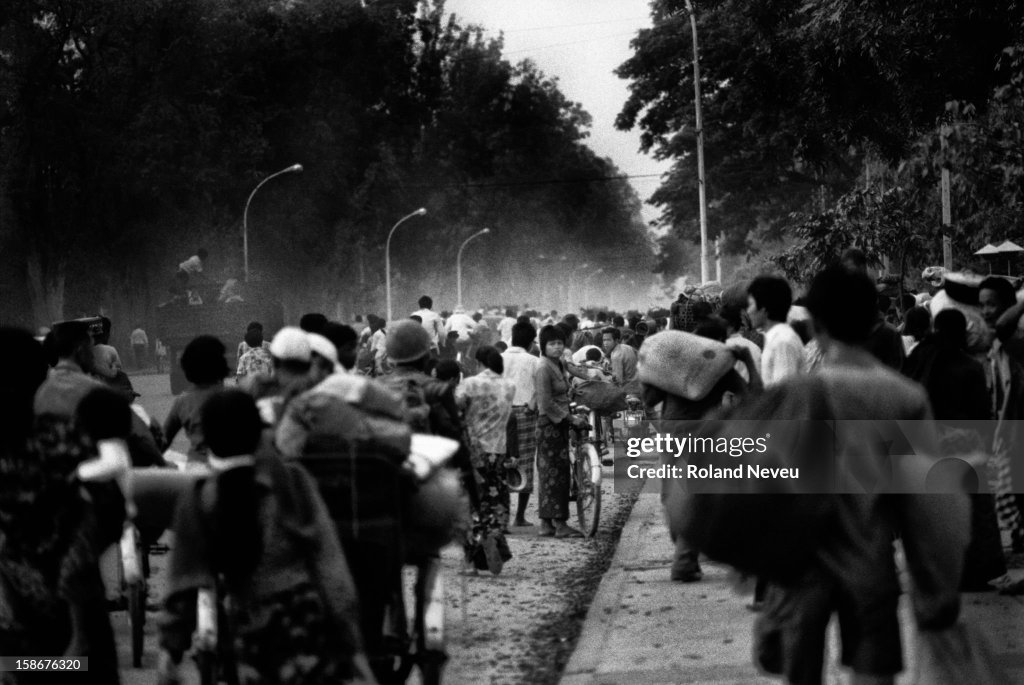
[Ed: Many of these people will be dead soon.]
The Cambodian military government asked for an immediate cease‐fire from the Cambodian insurgents, who were attacking Phnom Penh from all sides. The government said it would turn over power to them. Several hours later, reports from Peking said that Prince Norodom Sihanouk, the nominal leader of the insurgents who is in exile there, had rejected the cease‐fire proposal as unacceptable. The Phnom Penh Government’s proposal, which might be described as conditional surrender, had called for a complete transfer of power to the insurgent side under the supervision of the United Nations and representatives of the International Committee of the Red Cross who are now in Phnom Penh.
A second major point among the five in the proposal was demand for assurances that there would be no reprisals against persons or organizations for their activities during the five‐year war. The cease‐fire proposal, which was transmitted through the Red Cross delegation here, came as this suffering city of more than two million, relatively calm until now, began to show signs of collapse. Throughout the day, the Communist-led insurgents pressed closer and closer on all sides, inflicting enormous casualties and sending scores of thousands of refugees pouring frightened into the city from the near outskirts. Exhausted soldiers who had had enough joined the refugees. Many of the refugees came into the very center of this cosmopolitan city with bullock carts and squealing pigs looking for a place to rest and a bit to eat.
In the hospitals there were wounded two and three to a bed, floors slippery with blood and children’s shrieks of pain that tore any visitor’s heart out. Insurgent shells began landing last night at regular intervals in the northern part of the city. The airport, west of the city, was said to be falling. Fear was spreading. French residents of Phnom Penh started putting up French flags on their gates and walls to identify their nationality, since France has recognized the insurgent government.
Premier Long Boret, speaking in a telephone interview before the Sihanouk rejection had been reported, cited the United States decision to evacuate its embassy last Saturday and end its material support as the key factor in his government’s decision to ask for a cease‐fire. “We feel completely abandoned,” he said in a voice whose weariness was discernible even over the telephone. The 42‐year‐old Premier said the decision was made at about 11 A.M. at a meeting of the seven‐member military-dominated Supreme Committee, which has been running the country since the Americans left last Saturday. He said the decision was unanimous. Asked if there were any dissenting voices anywhere in the government, such as some of the generals, he said, “No, we are realistic.”
Mr. Long Boret, who with other Cambodian leaders has been marked for execution by the insurgents, said the military situation had become impossible, and added, “We have no more material means.” As he spoke, rockets were exploding only about 200 yards from the telegraph office from which this correspondent was telephoning. The Premier said that after the morning meting, held at the headquarters of the military high command, the proposal was taken to the head of the Red Cross delegation here. Andre Pasquier, who was asked as a neutral intermediary to pass it to Prince Sihanouk: The Prince, the former Cambodian chief of state, was ousted by the Phnom Penh Government in 1970.
Mr. Long Boret, who declared “our first objective is to end the suffering of the people,” said Mr. Pasquier informed him later that he had transmitted the message to Red Cross headquarters in Geneva, at 3 PM Cambodian time (4 AM, New York time) and that Geneva had quickly passed it to Prince Sihanouk in Peking. Mr. Pasquier sent the message over his shortwave radio from the Hotel Le Phnom, which was today turned into a Red‐Cross‐protected neutral zone for the treatment of the sick and the wounded. Huge Red Cross flags were hung around the building and atop it.
As dusk came, refugees and soldiers who had fled the fighting fronts wandered forlornly through the darkening streets looking for shelter and food. The setting sun was clouded by billows of black smoke from fires all around the city.
Tonight, reports from refugees indicated that the airport, five miles to the west, was falling and might have already gone. It had been the government’s last supply link with the outside world. Insurgents were said to be inside the airfield. Government T‐28 fighter‐bombers were reported dropping napalm on them to try to halt their advance, apparently to little effect. The control tower was said to be in insurgent hands. Retreating government troops were reported trying to pull together a defense line south of the airport. Beyond the airport, the government ammunition dumps, where everything including bombs is stored, are now cut off from the city. One of them may have fallen to the insurgents yesterday.
On the south, northwest and west, the insurgents were at the capital’s edges. In the north, refugees who reached Phnom Penh said the rebels were only a little more than a mile from the city limits and advancing steadily down Route 5. It was on this front that perhaps the greatest government casualties were suffered today. Many were civilians caught in crossfire or hit by blindly fired insurgent rockets as they ran from the fighting.
Another battle raged along, the city’s southern border, centering on the United Nations Bridge, which spans the Bassac River. Though newsmen could not get very close, the fighting seemed to be intense only a few hundred yards to the east of the bridge, in a neighborhood called Chbar Ampou. Last night, much of that neighborhood burned down as fierce fighting swirled in and around it, Hundreds of houses were reported destroyed in the blaze, which lit the sky. Government reinforcements were being rushed to the bridge area today. These soldiers looked somber as their trucks, raced through the streets of the capital in the morning.
Insurgent shells, some of them deadly accurate 105‐mm rounds, were exploding sporadically in the southern districts! of Phnom Penh. A curfew was in effect from noon yesterday “until further notice.” Nowhere was there the slightest sign of hope for the Phnom Penh Government. The main military hospital, which normany gets an average of about 200 wounded a day, had received more than 500 by 6 PM yesterday and the amnuiances were still coming in every five minutes. Inside the emergency reception center, a converted basketball court, people were bleeding moaning, whimpering and dying.
A 12‐year‐old boy died of heads wounds on a bed. Someone covered most of his body with a blue scarf. Then a soldier came in carrying his wife, bleeding from the head. There were no empty beds, so he pushed the dead boy to one side and placed his wife there as well. Rivulets of blood flowed across the floor. A 13‐year‐old girl named Chan Ny, whose body was torn by shrapnel, lay on the floor yelling: “Help me Help me! The pain is awful!” Many in this hospital were wounded children whose parents had been killed alongside them. The chief doctor tried, by questioning the children, to find out where the bodies had fallen so he could have the parents cremated. Behind the receiving Center are the operating rooms, where surgery must be quick. An 80‐year‐old woman whose right leg had just been amputated lay groaning on a wheeled bed outside the operating room.
The Phnom Penh Government has made a number of suggestions in the past — as its military fortunes have deteriorated — that a cease‐fire be declared and negotiations be started, but these have all been spurned by the insurgents. Last. July, for example, Marshall Lon Nol, then the President, proposed in a broadcast that talks be held without “prerequisite or condition.” Last Sunday, Premier Long Boret said at a news conference that while continuing the struggle the government would make every effort to persuade the other side to “accept our offer of a cease‐fire followed by negotiations and national reconciliation.” The Government’s formal. five‐point proposal followed today.
Abdulgaffar Peang‐Meth sat solemnly in the cool, sparsely furnished drawing room of the Cambodian Embassy today, far from the gummy heat and crashing shells of Phnom Penh. He discussed what seemed to be the final hours of his government with composure and unflagging politeness, but the anger and hurt showed. “I feel frustrated, bitter, “the 31‐year‐old diplomat said. “The desire to do something is very strong. I would go back to Cambodia tomorrow, tonight, if I could do something, but guess that nobody can help much now.” Mr. Peang‐Meth, the embassy’s press attaché, was the only person on duty today. The secretaries had been given a holiday, the ambassador was out of town making a speech, the minister‐counselor was “off at meetings.”
“What hurts, the diplomat said in his colloquial English, the product of an American education, “is the way the United States used us. You marched into our country, you promised us aid, you encouraged us to keep fighting, you told us you were our friends, and now you drop us. “A prostitute at least gets paid. For us, our lives, our blood, our country is ended because we helped the United States when it wanted to get its troops out. So your sons are home, and our people are left to die.”
South Vietnam troops continued to fight at Xuân Lộc, 38 miles northeast of Saigon, under heavy Communist shelling — reportedly over a thousand shells — but government units on the town’s approaches were falling back along with crowds of refugees. Fire from Communist artillery continued to disrupt fighter-bomber traffic at the Biên Hòa air base, closer to the capital. The government announced it had abandoned the port of Phan Rang on the South China sea. Saigon’s overall position appeared worse than at any time since the loss of the central part of the country.
The North Vietnamese have been rushing fresh divisions from central Vietnam to the fighting northeast of Saigon, and there are indications that some of these forces are now in combat. Several days ago, long‐barrelled 122‐mm. artillery with a range of 15 miles, about equal to that of the Communists’ 130‐mm. gun, was brought to bear on Biên Hòa as well as on Xuân Lộc and the surrounding area. In barrages yesterday, about 60 shells fell on or near the Biên Hòa air base. A government spokesman, reporting than two persons had been killed, conceded that air traffic had been hampered by damage from the shelling and from the explosion two nights ago of a large bomb storage dump. That blast apparently was set off by a commando attack. The Biên Hòa air base is the main remaining center of government air operations against the Communists.
The Communists’ 122‐mm. guns and other heavy artillery were causing continuing casualties yesterday and apparently weakening the will to fight of Government forces spread out between Biên Hòa and Xuân Lộc, 28 miles away. The Saigon command has been pouring all available troops into the fight there, but in consequence has made other areas vulnerable to attack. One such attack began early yesterday morning when a Communist force estimated at one to three divisions and supported by tanks, assaulted the small Government garrison remaining at Phan Rang, the northernmost enclave on the central coast still left in the hands of Saigon troops.
This morning a Saigon military spokesman said the new Minister of Defense, Trần Văn Đôn, had ordered South Vietnameses forces to fall back from Phan Rang and set up a “new defense line south of the city,” the spokesman said. The spokesman said that the decision had been made after Mr. Đôn personally inspected the situation at Phan Rang on Tuesday. According to the Saigon command, more than 100 North Vietnamese soldiers were killed and 20 tanks were knocked out by Phan Rang’s defenders in the battle yesterday. The decision to give up Phan Rang left Phan Thiết, 60 miles to the south, as the only port on the South China sea coast north of Saigon still under government control. Phan Rang was President Nguyễn Văn Thiệu’s home town and the site of a major air base.
In recent days, the Communists have apparently been maneuvering entire divisions with great speed and effectiveness, keeping government forces off balance. As the Communist units move their big guns forward, a South Vietnamese Air Force informant said last night it seems likely that even Tân Sơn Nhứt Airport in Saigon will come under artillery fire in the next few days. The general Communist offensive also extended over a wide area of the Mekong River delta.
The most serious delta fighting appeared to have been near Bến Tranh, a district capital 24 miles southwest of Saigon on Route 4. The Saigon command said that 47 Communist soldiers were killed in the fighting there yesterday. But Route 4, the capital’s overland link with the south, was reported closed because of the fighting, with long lines of vehicles waiting to get through. The Communist troops in the area have been hearing down hard on Route 4, with the evident aim of cutting off Saigon’s supply of rice and other provisions from the delta.
Saigon reported a success in a fight yesterday in Châu Đốc Province, 100 miles west of Saigon on the Cambodian frontier. In a battle for An Phú, a district capital, 77 enemy soldiers were said to have been killed with no government casualties.
A Saigon spokesman also voiced concern last night about one of South Vietnam’s offshore possessions — the Spratly Islands. The spokesman said that radio contact with one of the northermost islands of the chain, Song Tử Tây, 275 miles off the southern coast, was lost on Monday at 8 AM. A South Vietnamese naval vessel was dispatched Tuesday to investigate, the spokesman said.
The representative in Paris of the Việt Cộng’s Provisional Revolutionary Government called for immediate and permanent withdrawal from South Vietnam of what he called 25,000 American military personnel disguised as civilians. He said no obstacle would be placed in their path. But Đinh Bá Thi, interim head of the government’s mission here, would not respond to efforts by reporters to determine exactly what would happen to Americans and other foreigners if they remained in areas that fell under Việt Cộng control. He referred only to a previous statement saying their lives and property would he protected if they obeyed “the policy of the revolutionary power,” and he accused the Ford administration of advancing evacuation plans only as a pretext for renewed military intervention. He called statements that the lives of 200,000 South Vietnamese would be endangered “a pure fabrication” and a “calumny.”
Ambassador Thi avoided direct answers for the most part repeating continuously the words in the statements. He said he had “no precise information” on whether the Đà Nẵng airport would be opened to shipment of relief supplies piling up in Vientiane, Laos. He confirmed that his government had agreed “in principle” to permit French relief flights into Đà Nẵng, but said that if “technical difficulties” made that impossible, “the P.R.G. will find other means” of receiving the contributions. It has been reported from Vientiane that a new demand was issued for the supplies to be flown into Hanoi, then sent through North Vietnam by road. This would appear to be a North Vietnamese decision overruling the Việt Cộng agreement with the French. Mr. Thi would not say whether the Việt Cộng government was prepared to enter negotiations with the United States for evacuation of American citizens and whether it would negotiate with General Dương Văn Minh if he set up a new Saigon Government.
General Frederick Weyand, the Army Chief of Staff, told a Senate committee that one of the evacuation plans under consideration would he the establishment of a corridor from Saigon to the sea to evacuate tens of thousands of Vietnamese. Pentagon officials suggested that under hostile conditions, protection of the corridor would require at least one Marine division and air power from Navy carriers.
Although no final evacuation plan has been formulated, Genoral Weyand, according to committee members, said that one proposal would be the establishment by United States troops of a 10‐mile corridor from Saigon to Vũng Tàu on the coast. From Vũng Tàu, the Vietnamese would be evacuated to an unspecified point by American ships. Mr. Ford told Senators on Monday that he hoped to evacuate 175,000 Vietnamese. One potential problem, General Weyand reportedly said, is that Vũng Tàu is overflowing with refugees who fled from the north.
President Ford, replying to questions at the convention of the American Society of Newspaper Editors, contrasted what he called the failure of the United States to keep its commitments to Saigon with the support of Moscow and Peking for Hanoi. He said this had led to “this present tragic situation.” He said he was convinced that the South Vietnamese could stabilize the military situation today if Congress gave the military aid he requested. An aide said later that the Paris peace accords of 1973 placed a ceiling on arms to both sides but did not bind the United States to provide any.
While not mentioning Congress, the President used some of the strongest language he has employed yet to condemn what he said was the American failure to keep its commitments to South Vietnam. “For just a relatively small additional commitment in economic and military aid, relatively small compared to the $150‐billion that we spent, that at the last minute of the last quarter we don’t make that special effort and now we are faced with this human tragedy. It just makes me sick every day I hear about it, read about it and see it.” Mr. Ford said that even now he was “absolutely convinced” that if Congress made available soon the $722‐million he had requested for military aid to Saigon, “the South Vietnamese could stabilize the military situation in South Vietnam today.”
Meanwhile, in Beirut, a cease‐fire agreement, arranged with Arab mediation, brought a halt today to heavy fighting between Palestinian guerillas and the right‐wing Phalangist party’s militia, as well as other factions that got involved in the battles. Since Sunday, when the fighting erupted, about 120 people have been killed and about 200 wounded as gunfire, rockets, bombs and snipers disrupted life in this banking commercial and tourist center of the Arab world. Rockets, mortars and bombs shook the city during the night and into the morning. At 5 PM, Premier Rashid al‐Solh announced that a cease‐fire had been agreed upon by “all parties concerned.” “All armed men are to be withdrawn from the streets and public places,” he said. “The internal security forces have been given orders to apprehend troublemakers and rumormongers.”
Police patrols began to appear at nightfall in streets where armed bands had set up roadblocks and were frequently firing on any unidentified vehicles. The Palestinian guerrilla command, the Phalangist party and the leftist National Progressive Front announced acceptance of the cease‐fire. There were still some shots and explosions after the ceasefire announcement. But the heavy rain of a thunder storm seemed to cool off the armed men as much as the official cease‐fire order.
Pierre Gemayel, the 70‐year‐old leader of the Phalangist party, has been demanding that the government restrict the freedom of the Palestinian guerrillas to attack Israel from Lebanese bases. The Phalangists, the largest Christian party in the country, have been disturbed by the growth of Palestinian military power in Lebanon and by the political ties between the guerrillas and left‐wing parties.
Young Palestinians are trained at refugee camps in Lebanon for guerrilla warefare against Israel. The Phalangists train their militia with equal rigor to keep Lebanon from becoming socialist or falling under control of the Muslims, who make up about half the population. The Palestinian‐Phalangist conflict erupted Sunday when a Phalangist militia commander, Josef Abi Assi, was shot in a dispute. Inhabitants of the district of Ain al Rummaneh, a Christian enclave in a Muslim sector, then ambushed a bus carrying Palestinians from a rally, killing 27 passengers.
Under the cease‐fire agreement, the Phalangists are to surrender those responsible for the attack on the bus, and the Palestinians are to hand over the killer of Mr. Assi. Mr. Gamayel has placed two Phalangists in the custody of Antoine Dandah, director of security, for the investigation into the bus incident.
The cease‐fire arrangement was worked out with the mediation of Mahmoud Riad, Secretary General of the Arab League, who was sent here by President Anwar el‐Sadat of Egypt to find a solution that would assure continuation of the Palestinian guerrilla presence in Lebanon. But the key to the cease‐fire was the decision by President Suleiman Franjieh, a Christian, to urge Mr. Gamayel to avoid a showdown with the Palestinians. An all‐out battle could have brought about intervention by the Lebanese Army with the risk of a general conflict between the Christians and Moslems.
Another important influence in the cease‐fire was that of Imam Moussa Sadr, a leader of the Shiite Moslems in Lebanon, who is a politicial moderate trusted by both the Palestinian guerrilla ladership and the Lebanese Christians. The cease‐fire is not the final answer to the Phalangists’ demand for Lebanese control over the Palestinian guerrillas. But the Palestinian leadership has shown in the past it is ready to impose restraints on the guerrillas to avoid losing bases in Lebanon.
In this crisis, the Palestinian leadership was represented here not by Yasir Arafat, chairman of the Palestine Liberation Organization, but by Sallah Khallaf, generally regarded as Mr. Arafat’s principal deputy. Mr. Arafat remained during most of the crisis in Damascus, Syria, where he was presiding over a meeting of the Executive Committee of the P.L.O.
Alexandr Shelepin, at one time considered a successor to Leonid Brezhnev as leader of the Soviet Union, was removed from his position on the 16 member Politburo of the Soviet Communist Party. Aleksandr Shelepin was removed from the Soviet Union’s ruling Politburo “at his own request,” according to the press agency Tass. The initial reaction in Moscow was that this strengthened the hand of Leonid Brezhnev as party leader by removing a younger rival. The Central Committee meeting that took the action also scheduled the next party’s Congress to meet on February 24, 1976.
President Richard M. Nixon’s chief disarmament negotiator called on the United States and the Soviet Union today to eliminate their land-based missile defenses. Gerard C. Smith said the missile defense force based at Grand Forks, North Dakota, and a similar Soviet system around Moscow were militarily insignificant. In testimony before the arms control subcommittee of the Senate Foreign Relations Committee, he said their existence was cause for continued suspicion. Mr. Smith said the antiballistic missile sites could be viewed as harboring a hidden nucleus for a broader nationwide defense that might be quickly and suddenly deployed. “I hope we would press for a complete ban on ABM’s” he told the subcommittee, which is holding hearings on President Ford’s Vladivostok arms accord with Leonid I. Brezhnev, the Soviet leader. The accord envisages ceilings on numbers of missiles each side may have.
Portugal nationalized energy, transportation and steel in a further move by the year-old provisional government toward socialism. The government formally took over control of 14 electrical utilities, the national airline and railroad, two shipping companies and major steel and petroleum concerns. The government also froze prices on basic foods and announced a sweeping land reform program and a work program to combat unemployment.
The French Government said today that if a meeting of President Ford and other leaders of Atlantic alliance countries was held next month, as has been proposed, it would send Foreign Minister Jean Sauvagnaraues. The government made it clear that it saw no point in a summit meeting within the North Atlantic Treaty Organization at this time. The NATO Council, composed of permanent representatives, met today in Brussels to discuss the plan, which was proposed by Britain and endorsed by President Ford, who said he would attend.
A leading Swiss physician has called for a new law on mercy killing for the protection of doctors. Dr. Urs Peter Haemmerli of Zurich’s Triemly Hospital told a committee of the Council of Europe that so-called passive euthanasia, under which terminally ill patients are not prevented from dying, could only be defined and legalized when the exact limits of a doctor’s duties as well as a proper definition of death were known. Haemmerli has been under investigation following allegations that some hopelessly ill patients being artificially fed under his care had been given only water.
The Social Democrats and Free Democrats have hammered out a coalition government to run West Berlin, retaining Klaus Schuetz as mayor instead of Peter Lorenz who was kidnaped during the election, a city hall spokesman said. The coalition decision, reached after weeks of often hard and bitter negotiations, is expected to be approved by the party factions in the assembly, the spokesman said.
West German Science Minister Hans Matthoefer said that the United States had officially assured him that the supply of American enriched uranium for European atomic power stations was not in jeopardy. America’s sudden suspension of export licenses for nuclear fuel recently caused alarm in West Germany which depends on the United States for 65% of its needs.
Alexander Dubcek, the former Czechoslovak Communist party leader whose reformist regime was ended by the 1968 Soviet-led invasion by Warsaw Pact forces, was told today that he could “pack his bags tomorrow” and move to the West.
Laurence H. Silberman, former deputy attorney general, is expected to be named ambassador to Yugoslavia by the White House, State Department officials said. Silberman, 39, had been slated to be the Cabinet-level trade ambassador, but his nomination was blocked by Russell B. Long (D-Louisiana), chairman of the Senate Finance Committee. Silberman, who would succeed Malcolm Toon in Yugoslavia, has had no governmental experience in foreign affairs.
One hundred tons of poisonous arsenic waste were returned to Finland aboard a Danish freighter after a month-long odyssey in search of a dumping site. The motorship Jens Rand arrived at Naantali, Finland, and tied up at the quay of Neste, the Finnish state oil corp. owners of the arsenic trioxide waste. A spokesman said the waste would be stored at the company’s own refinery.
Israelis celebrated the 27th anniversary of their independence today in a subdued, low-key fashion that reflected the sober national mood.
Israelis are willing to talk with Palestinians to reduce enmity and dispel misunderstanding, but will negotiate on future eastern borders only with the government of Jordan, a Cabinet minister said today.
Air Force Marshal Hosni Mubarak was named as Vice President of Egypt by President Anwar Sadat, replacing Hussein el-Shafei, who had served in the post since 1961. Mubarak would begin a 29-year rule as president after the 1981 assassination of Sadat.
India criticized the United States today and, in a separate development, moved rapidly to make Sikkim a full state within the Indian union. The two developments, spurred by India’s Foreign Minister, Y. B. Chavan, have led to some confusion and anger among Western and American diplomats who are viewing recent Indian foreign policy moves with some skepticism. Several Western diplomats say that India is now applying a “double standard” in her foreign policy— condemning “expansionist” countries but taking over Sikkim—and hitting hard at the United States while accepting 800,000 tons of American food aid at concessional prices.
Seven American missionaries wearing black hoods and straw ropes around their necks staged a silent rally in the U.S. Embassy compound in Seoul to demand clarification of U.S. policy toward “deterioration of human rights in Korea.” They said their protest was sparked by the hanging last week of eight Korean political prisoners they say were unjustly executed by the government.
President Chiang Kai‐shek, the last of the allied leaders of World War II, was interred in Taiwan today beside a mountain lake. The President, who died on April 5 at the age of 87, was brought here after a simple Chinese and Christian funeral in Taipei in which the chief mourners were his widow, Mrs. Chiang, and his sons, Premier Chiang Ching‐kuo and Gen. Chiang Wei‐kuo. The general was also mourned by his aging comrades from the 30 years of battle against the warlords, the Japanese, and the Communists that ended with his defeat in 1949, and by the new President C. K. Yen, and hundreds of other government leaders and prominent people here.
The Pentagon said that allegations that it had secretly killed American convicts in a World War II poison gas test off Australia were twisted versions of an Australian experiment in which there were no fatalities. The Pentagon backed up its denial with a 1958 official Australian war history which said that the government had conducted a series of tests to check equipment designed to protect soldiers from mustard gas in the jungle. The history said volunteers for the experiments were first Melbourne University students, then the physiologists conducting the experiments and finally Australian servicemen. Commendations were awarded to all volunteers, the history said.
A 42‐year‐old brigadier general who was arrested 21 months ago on charges of trying to take over the country was named chief of state today. A broadcast announced that the general, Felix Malloum, who had been commander of the armed forces, would head the nine‐member Supreme Military Council governing this landlocked Central African country since the coup that overthrew the civilian Government Sunday. President Ngarta Tombalbaye, who ordered the general’s arrest in July, 1973, was killed during the fighting.
In what may be the forerunner of fiscal battles between the White House and Congress, the House of Representatives passed today its first regular appropriations bill for the fiscal year 1976 with $1-billion more than President Ford had sought. The Administration’s budget request had asked for $6.219billion in the bill, which provides funds to the major Federally aided education programs. But the House Appropriations Committee increased the amount by $661‐million, and $487‐million more was added by amendment today. If the Senate goes along with the increases in the House version, the final bill will almost surely be vetoed by the President, who as, late as March 29 demanded that Congress put a stop to increases such as were voted today.
The Supreme Court ruled that states may exempt some violators from compliance with air pollution requirements without federal approval, as long as they achieve and maintain national standards for atmospheric quality. Reversing a lower court decision by a 7-to-1 vote, the justices held that a state could grant an individual exemption without clearance from the Environmental Protection Agency. E.P.A. officials said later they thought this would apply only to relatively small plants.
President Ford took emergency action to delay for 60 days a strike against the nation’s railroads that had been scheduled for Friday. He created a fact-finding board to inquire into a contract dispute between the National Railway Labor Conference, composed of most of the nation’s railroads, and employees represented by the Brotherhood of Railway and Airline Clerks. Union President C.L. Dennis has refused to accept a new contract approved earlier by seven other railroad unions which provided wage and benefit increases of 41% during three years. Dennis also wants protection against layoffs among his 131,000 rail workers.
The House decided 360 to 37 that its members should not vote if they are convicted of crimes and draw sentences of two years or more, or if they are on appeal from such convictions. Backers of the new addition to the House code of conduct said it was necessary to preserve public confidence. Backers also said that while a member could go ahead and cast his vote — since the ruling was not mandatory — he would be doing so at the risk of further House action, possibly expulsion. No member is currently affected by the resolution.
House-Senate negotiators reached agreement on a 35-cent-a-ton tax of future surface coal production to help pay for restoring lands scarred by strip mining in the past. Coal from underground mines will be taxed 15 cents a ton. The conference committee, meeting for the first time, moved swiftly toward final agreement on legislation calling for minimum federal standards to protect lands from devastation by strip mining as well as the restoration of already damaged lands. The legislation, opposed by the coal mining industry, is similar to a bill vetoed last year by President Ford.
The Senate Select Committee on Intelligence has agreed to accept some top secret material from the White House with deletions of certain paragraphs, and in other cases has agreed to limit the distribution to protect national security, several congressional sources have confirmed. In general, these sources said, the “degree” of cooperation between the investigating committee and the White House appears to have improved. Senator Frank Church, the committee’s chairman, publicly confirmed after the committee’s weekly meeting today that the White House had furnished the committee the report of William E. Colby, the Director of Central Intelligence, and all but three of “several hundred” Presidential directives Mr. Church said he had asked for.
A tiny pellet of iridium 192 was lost in the bed of a pickup truck for three days last week and 10 men received radiation poisoning from it, reported Dr. Marshall Parrott, manager of radiation control for the Oregon Health Division. He said none of the men is expected to suffer any permanent aftereffects and none was hospitalized. But the man who received the heaviest dose-62.16 roentgens-may have to stay away from radiation sources for five years to permit his white blood cells to recover. The pellet became lost April 8 after a crew employed by the Pittsburgh Testing Laboratories of Portland had used indium to check the welds of heavy steel pipe.
H. R. Haldeman’s attorney sounded out U.S. District Judge John R. Sirica during the Watergate coverup trial about a possible guilty plea, sources close to the case said. A report originally broadcast by Nina Totenberg on National Public Radio said the meeting took place after the trial testimony of former White House Counsel John W. Dean III. Sources familiar with the incident said Sirica refused to discuss the matter and it was dropped. Haldeman was convicted and sentenced to a minimum of 22 years in prison.
New York’s largest medical malpractice insurer has agreed to retract proposed rate hikes of 185% for hospitals and reinstate rates in effect before January 1, the state Insurance Department announced. In addition, the California-based Argonaut Insurance Co. will extend its termination date for all policies with the Hospital Association of New York from June 1 to July 1. The agreement could mean a breakthrough in the malpractice insurance crisis that has threatened the state’s health service. A Hospital Association spokesman said, however, the agreement is not a solution” and legislative action will be needed.
The Securities and Exchange Commission filed a suit in Washington accusing the Northrop Corporation of maintaining a secret fund for political and other purposes, at least some of them illegal, amounting to $30 million. The company immediately announced that it had agreed to a settlement. This is the largest fund any company has been accused of maintaining. Northrop had previously admitted an illegal $1.2 million fund.
Smoke levels in public places are lower than previously believed and the smoke is not the primary cause of adverse reactions to tobacco by nonsmokers, a study by two Harvard scientists concluded. William C. Hinds and Melvin W. First of the Harvard School of Public Health conducted their study in restaurants, waiting rooms, commuter trains, bars and buses. The study showed that nonsmokers inhale less smoke than previously thought, but Hale said “the levels of smoke we found were still high compared with government air quality standards.” The study concluded that nonsmokers may be irritated more by invisible gases released during tobacco burning than by visible smoke particles.
The National Aeronautics and Space Administration has changed its mind and will keep $900 million worth of surplus Apollo rockets, spaceships and a Skylab space station instead of scrapping them as planned. The decision was made earlier this month and will give the agency the capability to continue manned space flights if required until its space shuttle rocket plane starts flying in 1979.
The World Football League will attempt a second season, starting in late July, with 10 teams, eight of them under new ownership and all of them newly capitalized. Christopher Hemmeter, the 35-year-old businessman from Honolulu who has been the architect of the reorganization over the last four months, announced the plans here yesterday for the league, which concluded its first season almost $10-million in debt.
Major League Baseball:
Juan Marichal makes his second and last start for the Dodgers, and it is no more successful than the first outing. Five hits in the 3rd, including a homer by Tony Perez, send him packing. But the Dodgers come back on a homer in the 4th by Ron Cey, a grand slam in the 7th by Jimmy Wynn, and an RBI single in the 9th by Steve Garvey to beat the Reds, 7–6. This is the final appearance for Marichal.
Bobby Murcer, who had a dismal campaign in Shea Stadium last season with the Yankees, smacked a triple and two singles, driving in three runs, leading the Giants to a 7–1 win over the visiting Padres, as he helped John D’Acquisto earn his first victory in two decisions. Randy Moffitt relieved over the final 1⅓ innings. The Giants broke a scoreless game open with five runs in the fifth. Murcer’s triple was the key blow.
The Texas Rangers blew out the White Sox at Comiskey, 14–4. Jim Umbarger, a rookie left-hander, shut out the White Sox on five hits over 7⅔ innings for a convincing triumph, his first in the major leagues. Umbarger relieved Jim Bibby with one out in the first inning and walked only two and struck out one.
Mike Cuellar held the Brewers to three hits and Don Baylor drove in the only run the Oriole left-hander needed, as Baltimore beat Milwaukee, 2–0.
Bobby Darwin, Craig Ausick and Larry Hisle hit two-run doubles as the Twins snapped a five-game losing streak, routing the California Angels, 10–4.
Harmon Killebrew hit his first homer of the season, off Vida Blue, and Nelson Briles scattered five hits as the Royals took over first place in the Western Division, downing the Oakland A’s, 6–2.
Houston Astros 2, Atlanta Braves 5
Milwaukee Brewers 0, Baltimore Orioles 2
Texas Rangers 14, Chicago White Sox 4
Oakland Athletics 2, Kansas City Royals 6
Cincinnati Reds 6, Los Angeles Dodgers 7
California Angels 4, Minnesota Twins 10
Boston Red Sox 4, New York Yankees 2
Chicago Cubs 9, Philadelphia Phillies 3
Montreal Expos 5, Pittsburgh Pirates 0
San Diego Padres 1, San Francisco Giants 7
New York Mets 2, St. Louis Cardinals 3
Dow Jones Industrial Average: 815.71 (+0.63, +0.08%)
Born:
Sean Maher, American actor (‘Simon Tam’ – “Firefly, “Serenity”), in Pleasantville, New York.
Nick Pickard, British actor (“Hollyoaks”), in Surrey, England, United Kingdom.
Jim Nelson, NFL linebacker (Green Bay Packers, Minnesota Vikings, Indianapolis Colts, Baltimore Ravens), in Riverside, California.
Nicky Sualua, NFL fullback (Dallas Cowboys), in Santa Ana, California.
Keon Clark, NBA center and power forward (Denver Broncos, Toronto Raptors, Sacramento Kings, Utah Jazz), in Danville, Illinois.
Isaac Fontaine, NBA shooting guard (Memphis Grizzlies), in Sacramento, California.
Kelly Dransfeldt, MLB shortstop, third baseman, second baseman (Texas Rangers, Chicago White Sox), in Joliet, Illinois.
Éric Bertrand, Canadian NHL left wing (New Jersey Devils, Atlanta Thrashers, Montreal Canadiens), in St-Ephrem, Quebec, Canada.
Joanna Ławrynowicz, Polish classical pianist, in Warsaw, Poland.
 History Diaries