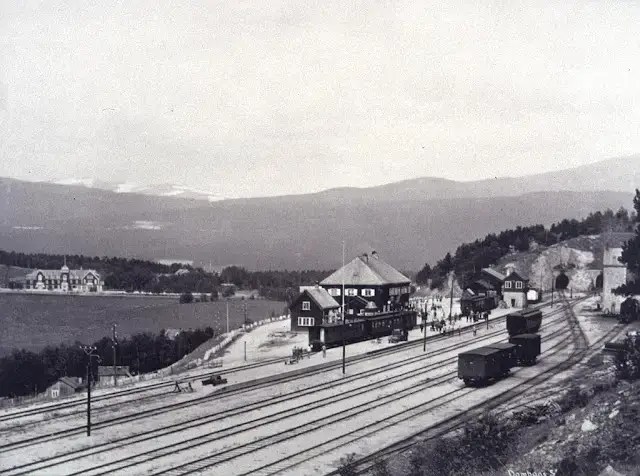
The Battle of Dombås continues. The 15th of April saw the last remaining stragglers rejoining the Fallschirmjäger force at Dombås, from then on no reinforcements reached the 1st Company. During the morning the paratroopers fulfilled part of their mission when they blew up the rail road line in three places. The damage to the line was, however, quickly repaired by Norwegian work crews, and trains passed through the next day.
In the meanwhile Norwegian forces had been assembled and ordered to stop the German advance in the Dombås area. As intelligence on the Fallschirmjägers was very scarce the Norwegian commanders had little idea of the size and location of the German force. During the day a force of two heavy machine gun platoons with 41 men under the command of Kaptein Eiliv Austlid — under orders from government minister Trygve Lie — launched an assault without the benefit of a vanguard on Schmidt’s position to secure a route of escape for the Norwegian royal family and the Norwegian cabinet. The assault team — composed of Austlid and six or seven volunteers — stormed across a 200-metre-long (220 yd) field toward the German while receiving cover fire from his own heavy machine guns. With only 75 m (82 yd) between them and the Germans, the eight Norwegians had to make their way up the hillside through deep snow. Austlid was only 8–10 m (8.7–10.9 yd) below the first German machine gun nest when he was struck down by a bullet to the chest and the counterattack faltered without its leader. Of the 41 Norwegians caught in the ambush, 28 were captured and five escaped.
The Battle of Hegra Fortress began in Norway. This was a 25-day engagement in the 1940 Norwegian campaign which saw a small force of Norwegian volunteers fighting numerically superior German forces from a fortified position. After initial fighting around the Meråker Line railway line, the Norwegians pulled back into Hegra Fortress and held off further German attacks before surrendering on 5 May as one of the last Norwegian units active in southern Norway.
At 05:30 on 15 April, the Germans attacked the Norwegian positions defending the Hegra railway station, Hegra road bridge and Mælen bridge, supported by artillery fire. Having been partly caught by surprise, the Norwegian forces at the Hegra road bridge and the railway station made a fighting retreat to the fortress over a two- to three-hour period. Early on in the fighting, the Norwegians demolished the Hegra road bridge, forcing the German infantry to cross the precarious ice of the frozen Stjørdal River under fire. At Mælen bridge, the guards withdrew to the south. Four Norwegian soldiers fell in and around Hegra, while one was killed at Mælen bridge. In addition to those killed, eight Norwegian soldiers were taken prisoner during the initial German attack.
As the German attack developed, the artillery pieces at Hegra Fortress opened up to support the Norwegian troops under attack in the valley below, and later covered their retreat. The Norwegian artillery fire was directed at German artillery positions, machine gun nests and convoys of trucks pushing east towards the Swedish border. The telephone operator at Hegra telegraph station acted as an observer for the artillery at the fortress. Artillery fire from the fortress knocked out three German artillery pieces and inflicted casualties on the attacking force.
As the Norwegian infantry force pulled out of Hegra and up the road towards the fortress, the Germans pursued them until they reached a number of field fortifications blocking the road. At this position, the Norwegians held their ground and inflicted fatalities on the attacking force. Amongst the German fatalities was the attacking platoon’s leader, Oberleutnant Hans-Joachim Herrmann. After the fighting, as the Norwegians were going through the area to seize German arms and equipment, they found the German Gefreiter Hugo Bayerle. Bayerle had been hit in both thighs, sustaining a broken femur, and was bleeding profusely. The Norwegian troops brought him on a ski sled to the fortress for medical care.
At the end of the first day of serious fighting, the Germans pushed on along the Meråkerbanen railway line and broke through the blocking position at Flornes. The troops holding Flornes withdrew first to Meråker, then further north to join other Norwegian forces. As night fell, German troops had occupied the areas around the villages of Hegra, Avelsgaard, Flornes, Ingstad and Sona. During the day, Luftwaffe aircraft had repeatedly overflown Hegra Fortress. The Norwegian troops had fired on the aircraft with both rifles and machine guns, damaging one aircraft, which crashed while attempting an emergency landing at Værnes.
The British 146th Infantry Brigade landed at Namsos and started to advance south towards Trondheim. The British 146th Territorial Brigade began arriving at Namsos, north of Trondheim under the command of General Carton de Wiart. General de Wiart’s Short Sunderland flying boat was attacked by a German fighter and his aide wounded. de Wiart, commanding Mauriceforce, immediately ordered the 146th to advance south towards Trondheim.
Further north, other British troops landed in the Lofoten Islands.
The main body of the 24th British Guards Brigade arrives in Harstad.
The main British expeditionary force arrives in the Narvik area. HMS Furious was detached from the Home Fleet with three escorting destroyers, HMS Isis, Ilex & Imogen and proceeded to enter a heretofore-unnamed fjord, which was immediately dubbed “Furious” fjord. At 1050, three Swordfish were flown off. One was assigned to photograph the German positions in the Narvik area, while the other two were to fly an A/S search of Vaagsfjord. In the event, the camera was unserviceable and no pictures were obtained. However, the observer noted an estimated 11 German transport aircraft on a frozen lake North of Narvik. At 1726 a striking force of nine Swordfish, six from 816 Squadron, led by the OC, Lieutenant-Commander H. H. Gardner, RN, and three from 818 Squadron, were dispatched to bomb grounded German aircraft. The aircraft each carried 8 x 20 lb. Cooper bombs while the commander’s aircraft carried two additional 250 lb. bombs for experimental purposes. The aircraft attacked in clear weather and results were good. Several direct hits were obtained. It was noted that the 250s blew large holes in the ice, and it was felt that the “runways” were made unserviceable. Heavy Flak was encountered. Five aircraft were hit, U4B -P4167 in the petrol tank, necessitating a water-landing near the task force, Sub-Lieutenant(A) J. N. Ball, RN (P), Lieutenant A. S. Marshall, RN (O), and Naval Airman first class R. Pike (AG) being rescued by HMS Zulu.
The Germans in Narvik are confident. Theodor Broch, Mayor of Narvik, states: “Gazing across the shell-torn port, a German officer said to me: ‘Your friends the British will never come.”
British troops landed in the Lofoten Islands in northern Norway in response to German invasion; their original objective was to secure the rail line to Swedish iron ore fields. Also in northern Norway, instead of making a landing directly at Narvik against an unknown number of German defenders, British Major General Pierse Mackesy decided to land his troops north of the city at an undefended location; due to the large amounts of snow on the ground, his troops would have to wait before making a major advance at Narvik. Further south, the British 146th Territorial Brigade landed at Namsos and was immediately ordered to march south toward Trondheim, which saw attacks by RAF Blenheim bombers based in the United Kingdom; it was the first time the Bomber Command sent aircraft based in the UK against targets overseas.
The British 15th Brigade boarded transports in France and were sent to Norway.
The Norwegian 3rd Infantry Division, with 2,100 troops, surrenders north of Kristiansand. Units of the German 138th Mountain Regiment advance via a fortified train east from Trondheim toward Sweden, the objective being to secure the “waist” of the country.
The highly despised Vidkun Quisling is forced out of the German-controlled Norwegian puppet government by the Germans and replaced temporarily by Ingolf Christensen. The Vidkun Quisling puppet government, which nobody recognizes and which is completely ineffective, “resigns” (it was never officially installed) under German pressure. The Germans are not interested in fulfilling Quisling’s fantasies of being a sort of Viceroy, but rather in crafting a government that can actually accomplish something. The Quisling government is replaced by an Administrative Council composed of Norwegian lawyers and bureaucrats, and its leader is Ingolf Christensen. Quisling is gone but definitely not forgotten, and he remains lurking in the shadows.
King Haakon broadcasts an appeal to the people of Norway asking for their continued support. He intends to leave the country because his presence is causing casualties among the people defending him.
With the German occupation a fait accompli, the Danism military de-mobilizes its troops.
A Swedish delegation begins series of meetings with Göring and then Hitler about allowing German supply trains to reach Norwegian border near Narvik. Birger Dahlerus brings with him to Berlin the commander of the Swedish Navy, Vice-Admiral Fabian Tamm. They meet Hermann Göring at the Air Ministry. Tamm warns that Sweden would defend its borders “Against everybody who tries to force their way across Sweden’s frontiers.”
The Luftwaffe continues sending Ju 52 transport planes to supply the isolated German garrison at Narvik. They land on frozen Lake Hartvigvann. HMS Furious sends airstrikes against them.
RAF Bomber Command dispatches 11 aircraft to attack Stavanger-Sola airfield during the day.
RAF Bomber Command dispatches 12 aircraft to attack Stavanger-Sola airfield again overnight.
The U-49, commanded by Kapitänleutnant Kurt von Gossler, was sunk near Narvik, Norway by depth charges from the destroyers HMS Fearless (H 67) and HMS Brazen (H 80). Of the ship’s complement, 1 died and 41 survived. During its career under Kapitänleutnant von Gossler the U-49 sank 1 merchant ship for a total of 4,258 tons.
At 2242, U-47 sighted the British troopships and three Norwegian merchant ships at anchor at Bygden. U-47 fired torpedoes against these targets, but torpedo defects prevented any damage being done.
The Royal Navy submarine HMS Snapper sank German auxiliary minesweepers M.1701 (trawler H. M. Behrens, 525grt) and M.1702 (trawler Carsten Janssen, 472grt) at 0345/15th, north of Laeso Island in 57 55N, 10 53E in an attack on a northbound convoy. She also claimed damaging two merchant ships in the convoy. Snapper fired a total of four torpedoes.
The German Naval vorpostenboot (German auxiliary patrol boat) Vp-811 (trawler Hugo Homann: 383grt) was lost in the North Sea. She was later salved and returned to duty.
The Royal Norwegian Navy A-class submarines HNoMS A-3 and HNoMS A-4 were scuttled at Tønsberg.
Dutch steamer Bernisse (951grt) was scuttled by her German prize crew at Narvik. The crew was all rescued.
British cargo ship Mersington Court was captured in the Norwegian Sea off Narvik by German forces and was scuttled.
The British cargo ship North Cornwall was captured in the Norwegian Sea off Narvik by German forces and was scuttled.
Steamers Salerno (870grt) and Salmon Pool (4803grt) were seized by German forces at Saudafjord, north of Stavanger, in Boknfjord. Twenty three of the crew from the Salerno were interned, and thirty-four from the Salmon Pool, with four from Salmon Pool returned. The ships were renamed Markirch and Putzig, respectively, for German service.
The main plan for the defense against the Germans, Anglo-French Plan D, changes slightly. Now, the French 7th Army, which is mechanized and under the command of General Henri Giraud, will move into southern Holland upon a Wehrmacht attack.
The French Government agrees to a new naval construction program with two battleships, three heavy cruisers, three destroyers, and eight submarines.
In occupied Poland, Gauleiter Hans Frank announces his plan to make Krakow “Jew-free” by deporting any Jews left there to labor camps.
Great alarm was caused in Bucharest by a decree issued by the Government Economic Council today forbidding the making of new contracts for exports of cereals. Contracts at present in force may be completely filled.
The concentration of the Italian fleet at Bari and Taranto and Giovanni Ansaldo’s speech that Italy cannot remain neutral have aroused suspicion in Cairo regarding Italy’s intentions in the immediate future. It is only suspicion and in no sense fear.
British Intelligence deciphers the German Enigma code used in Norway.
British unemployment figure decreased to 973,000, which was the lowest figure since 1920. Hitler has lowered unemployment in both Germany and in Great Britain.
HMS Ark Royal remains at Gibraltar. HMS Glorious, in company with the destroyers HMS Velox & Watchman continues towards the Clyde.
RAF Coastal Command – No. 22 Squadron’s Bristol Beauforts make their first mine-laying sortie in the mouth of the River Jade.
Convoy BC.34 with steamers Baron Carnegie, which arrived Nantes on the 17th, Dunkwa, Gloucester City, Kurfa and Lottie R departed Bristol Channel escorted by destroyer HMS Montrose. The convoy safely arrived at Loire on the 17th.
Convoy SA.37 of two steamers arrived at St Malo from Southampton.
Convoy FN.146 departed Southend, escorted by destroyer HMS Vivien and sloop HMS Pelican. The convoy arrived at Methil on the 17th.
Convoy MT.52 departed Methil, escorted by destroyer HMS Vimiera. The convoy arrived in the Tyne later that day.
Convoy FS.147 departed the Tyne, escorted by destroyer HMS Vimiera and sloop HMS Londonderry. The convoy arrived at Southend on the 17th.
Convoy SL.28 departed Freetown escorted by armed merchant cruiser HMS Bulolo until 29 April. Convoy SLF.28 merged with convoy SL.28 on the 22nd. On 29 April, destroyers HMS Vesper and HMS Walpole joined the convoy and escorted it to Liverpool, arriving on 1 May.
The War at Sea, Monday, 15 April 1940 (naval-history.net)
Steamers SALERNO (870grt) and SALMON POOL (4803grt) were seized by German forces at Saudafjord, north of Stavanger, in Boknfjord. Twenty-three crew from SALERNO were interned, and 34 from SALMON POOL, with four from SALMON POOL returned. They were renamed MARKIRCH and PUTZIG, respectively, for German service.
Submarine SNAPPER sank German auxiliary minesweepers M.1701 (trawler H. M. BEHRENS, 525grt) and M.1702 (trawler CARSTEN JANSSEN, 472grt) at 0345/15th, north of Laeso Island in 57 55N, 10 53E in an attack on a northbound convoy. She also claimed damaging two merchant ships in the convoy. SNAPPER fired a total of four torpedoes.
At 1418, submarine SHARK fired five torpedoes at German steamers ANGELBURG (3053grt) and AHRENSBURG (3200grt) escorted by German auxiliary minesweeper Sperrbrecher 1 (merchant ship SAAR:3261grt) in 57-55.5N, 10-08E. All torpedoes missed.
Destroyers GRAFTON, FAME, and DIANA arrived at Rosyth at 0700 from the Humber.
French large destroyers BISON (Capitaine de Vaisseau J.A.R. Bouan), MILAN (Capitaine de Fregatte L.M.E. Plumejeaud), EPERVIER (Capitaine de Fregatte J.J.G. Bros) of the 11th Large Destroyer Division, which had departed Brest the evening of12 April, arrived at Greenock with troop carrying French armed merchant cruisers VILLE D’ ORAN, EL D’JEZAIR, EL KANTARA, and EL MANSOUR for duty off Norway. On 14 April, approaching Greenock in 54-12N, 5-02W, destroyer MILAN was in a collision with trawler GLAMORGAN COAST. The damage was repaired from 16 to 18 April. On this date, an advance French base was established at Greenock for Norwegian operations. This base was used until 8 May.
Incomplete German heavy cruiser LUTZOW, which had been launched on 1 July 1939 and transferred to Russia on 11 February 1940, left Bremen under tow for Leningrad.
U-30 sustained some damage when she ran aground in the Trondheim area.
German auxiliary patrol boat Vp.811 (trawler HUGO HOMANN: 383grt) was lost in the North Sea. She was later salved and returned to duty.
Light cruiser SOUTHAMPTON joined light cruiser AURORA at Harstad and together went out to sea to meet convoy NP.1 with troopships BATORY (14,287grt), REINA DEL PACIFICO (17,707grt), and MONARCH OF BERMUDA (22,424grt). The convoy arrived off Harstad the morning of 15 April escorted by battleship VALIANT and destroyers CODRINGTON, AMAZON, ACASTA, ARDENT, FEARLESS, BRAZEN, GRIFFIN, WITHERINGTON, and VOLUNTEER. Despite attacks by U-38 on VALIANT and U-65 on BATORY, the convoy arrived safely off Harstad. FEARLESS and BRAZEN, patrolling ahead of the convoy, damaged U-49, on her third war patrol, in Vaagsfjord in 68 53.5N, 16 59.5E. U-49 surrendered after one depth charge attack. Many documents were recovered before the scuttling charge fired. The destroyers were able to pick up four officers and 37 of the submarine’s crew. One rating was missing. The crew was embarked on VALIANT for passage to England. Four hours later, FEARLESS, screening VALIANT, made another attack on a submarine contact in the same vicinity. Since Harstad was not big enough to accomodate the liners, the troopships were sent to Bygden and the troops, the 24th Guards Brigade, were ferried to Harstad in destroyers.
Destroyers FAULKNOR and ZULU reconnoitered the shoreward approaches to Narvik in Rombaksfjord in preparation for the allied landing.
At 2242, U-47 sighted the British troopships and three Norwegian merchant ships at anchor at Bygden. U-47 fired torpedoes against these targets, but torpedo defects prevented any damage being done.
British steamers NORTH CORNWALL (4304grt) and MERSINGTON COURT (5141grt) were scuttled by their German prize crews at Narvik. Seventeen crew from NORTH CORNWALL later arrived in England, while four were interned in Sweden. Twenty-eight crew from MERSINGTON COURT were interned in Sweden, and eight later arrived in England.
Dutch steamer BERNISSE (951grt) was scuttled by her German prize crew at Narvik. The crew was all rescued.
Major General Carton de Wiart arrived at Namsos in a Sunderland flying boat during an air raid. The Sunderland was machine gunned and destroyer SOMALI, de Wiart’s intended headquarters, was near missed by bombs. DeWiart was, however, able to assume command of the Namsos area as planned. SOMALI had also been reconnoitering the fjord, was heavily bombed during the day and expended all her HE ammunition before dark. The destroyer sustained no damage. Light cruisers GLASGOW and SHEFFIELD were in the area to provide support.
Admiral Forbes off northern Norway departed that area with battleship RODNEY, battlecruiser RENOWN, destroyers HAVOCK, HOSTILE, HERO, ESK, ICARUS, and IVANHOE. The three H’s returned to Vestfjord. Forbes had detached battleship WARSPITE and aircraft carrier FURIOUS to operate off Vestfjord. RODNEY with destroyers GREYHOUND, ESK, ICARUS, and IVANHOE arrived at Scapa Flow on the 17th and FORESTER and KIMBERLEY at 0600/18th. GREYHOUND was damaged by heavy weather and sustained structural damage en route. She departed Scapa Flow on the 19th for Sheerness, via Rosyth, and repaired in a month.
Battleship VALIANT with destroyers FEARLESS, BRAZEN, and GRIFFIN departed Vaagsfjord at 1900/15th and arrived at Scapa Flow at 1100/18th.
Destroyer JUPITER departed Scapa Flow at 1045 with repair pumps and equipment for light cruiser PENELOPE at Skelfjord. She arrived on the 16th and was then immediately sent on to Aandalsnes to support anti-aircraft cruiser CALCUTTA. When it was found CALCUTTA would arrive first, JUPITER was ordered to continue to Skelfjord.
Destroyer MACKAY arrived at Scapa Flow at 0900 escorting A.S.I.S. and other merchant ships, then departed that afternoon at 1500 and returned to Liverpool.
Captain Pegram’s destroyers MATABELE, MASHONA, AFRIDI, and SIKH arrived at Lillesjona in 66 14N, 13 00E and joined Vice Admiral Layton and his two liners carrying the 146th Brigade. These destroyers were reinforced by destroyer NUBIAN, which arrived with oiler WAR PINDARI (5559grt), and destroyer SOMALI, which arrived with General de Wiart. General de Wiart transferred to destroyer AFRIDI and SOMALI, her ammunition exhausted after two days at Namsos, was sent home arriving at Scapa Flow on the 18th. The five other destroyers embarked troops from the liners and reached Namsos and Bangsund that evening.
Light cruiser EFFINGHAM arrived at Scapa Flow after departing Portsmouth on the 13th for duty with the Home Fleet.
Aircraft of 816 and 818 Squadrons from aircraft carrier FURIOUS attacked German aircraft parked on a frozen lake in 68-35N, 17-35E. One aircraft with S/Lt (A) J Ball, Lt A.S. Marshall, Naval Airman R Pike of 816 Squadron was shot down. Destroyer ZULU’s whaler rescued the crew. Four other aircraft were damaged. Midshipman (A) W.A.B. Bland RNVR, was wounded in one of the damaged aircraft of 816 Squadron.
Convoy BC.34 with steamers BARON CARNEGIE, which arrived Nantes on the 17th, DUNKWA, GLOUCESTER CITY, KURFA, and LOTTIE R departed Bristol Channel escorted by destroyer MONTROSE. The convoy safely arrived at Loire on the 17th.
Convoy SA.37 of two steamers arrived at St Malo from Southampton.
Convoy FN.146 departed Southend, escorted by destroyer VIVIEN and sloop PELICAN. The convoy arrived at Methil on the 17th.
Convoy MT.52 departed Methil, escorted by destroyer VIMIERA. The convoy arrived in the Tyne later that day.
Convoy FS.147 departed the Tyne, escorted by destroyer VIMIERA and sloop LONDONDERRY. The convoy arrived at Southend on the 17th.
Steamers QUEEN MAUD (4976grt) and PORT HUNTER (8802grt) in convoy OA.129, were involved in a collision in the English Channel. Steamer PORT HUNTER was able to continue on her own to Southampton. Destroyer WILD SWAN screened QUEEN MAUD for a time until the steamer advised she could continue safely on her own.
Australian troop convoy US 2, composed of troopships ETTRICK (11,279grt), NEURALIA (9082grt), STRAITHAIRD (22,284grt), and DUNERA (11,162grt), departed Melbourne en route to Egypt escorted by battleship RAMILLIES and Australian light cruiser HMAS ADELAIDE. The convoy was joined on the 19th by Australian light cruiser HMAS SYDNEY. At Fremantle on the 22nd, troopship NEVASA (9056grt) was added to the convoy and ADELAIDE was detached. Australian troop convoy US 2 in the area of the Coco Islands on the 30th was joined by French heavy cruiser SUFFREN which relieved Australian light cruiser SYDNEY which was detached on the 28th for US 3 escort duties.
French battleship PROVENCE, which had departed Dakar on the 11th, and destroyer TROMBE arrived at Oran on the 16th. Battleships BRETAGNE and LORRAINE departed Toulon on the 15th and arrived at Oran on the 18th. The three battleships departed on the 26th and arrived at Algiers the next day. On 29 April, they departed and arrived at Alexandria on 3 May.
Convoy SL.28 departed Freetown escorted by armed merchant cruiser BULOLO until 29 April. Convoy SLF.28 merged with convoy SL.28 on the 22nd. On 29 April, destroyers VESPER and WALPOLE joined the convoy and escorted it to Liverpool, arriving on 1 May.
In Washington today, President Roosevelt addressed the board of governors of the Pan American Union. He conferred with William W. Howes, first assistant Postmaster General, and Spruille Braden, United States Ambassador to Colombia.
The Senate considered the bill. providing for additional Federal judgeships and recessed at 5:11 PM until noon tomorrow. The Naval Affairs Committee heard Admiral Stark on the naval expansion program and the Temporary National Economic Committee questioned J. J. Pelley on the effect of technology on the railroad industry.
The House began consideration of the Logan-Walter bill limiting quasi-judicial powers of certain government agencies and adjourned at 5:11 PM until noon tomorrow.
President Roosevelt told the rest of the world today that the American republics, committed to the way of peace in relations among themselves, would stand together to repulse any assault, direct or indirect, from overseas. Addressing the governing board of the Pan-American union, the president declared that “whoever touches one of us touches all of us. Then, observing that it was necessary to be prepared to “meet force with force if challenge is ever made,” he said: “We have adopted procedures that enable us to meet any eventuality. … I pray God that we shall not have to do more than that; but if it should be necessary, I am convinced that we shall be wholly successful. The inner strength of group of free people is irresistible when they are prepared to act.” Defeat for any attempt to dominate the world by force and engendered hate was predicted by President Roosevelt today, but he warned the Pan-American republics that they must be prepared “to meet force with force” if a challenge to their peaceful relations were ever made.
The rapid expansion of the Japanese Navy, involving all categories from battleships to submarines, was discussed with frankness today before the Senate Committee on Naval Affairs by Admiral Harold R. Stark, Chief of Naval Operations. Because of the secrecy which since 1936 has veiled the Japanese construction program, figures given by Admiral Stark were not official from Tokyo, but they represented the belief of the United States Navy’s high command based on the best information obtainable. Regarding the reported building of super-dreadnaughts, Admiral Stark said: “We feel reasonably certain that Japan has eight of these battleships actually under way now. There is at the same time some thought that she may have twelve of these ships building or authorized. In addition she has ten other battleships in commission.”
Admiral Stark, the first witness before the committee, testified in support of the enactment of the $650,000,000 naval expansion bill recently passed by the House and now awaiting Senate action. Besides three aircraft carriers, the measure authorizes 21,000 tons of submarines and 66,500 of cruisers, the size and number to be fixed by the navy. According to naval opinion, this tonnage, plus that carried in the appropriation bill for 1940-41, would bring ships now under construction or contracted for to a strength sufficient to deal with any single navy but not with a combination of navies.
Tables on the strength of first class navies, submitted by Admiral Stark, showed that in ships built or building, measured in terms of modern underage craft, the United States was in third place, with Britain first and Japan second. On paper the United States would appear to be on even terms with Japan and Great Britain in battleships, but actually this is not so, owing to the greater construction progress in those countries. In underage destroyers and submarines the United States is in seventh place, trailing Great Britain, Japan, France, Italy, Germany and Russia. And in the number of aircraft carriers the United States is a poor third.
All obstacles to the sale of American warplanes to the allies were removed today when the Anglo-French purchasing mission agreed without reservation to the U.S. government’s conditions for the release of the latest types of craft. A requirement that the allies pay at least part of the research cost for developing late model planes which are being released to them was understood to be one of the final conditions on which negotiations hinged. Secretary Morgenthau, announcing the agreement today declined to explain what the conditions were. It has been estimated that the allies will invest about $1,000,000,000 in warplanes in this country.
Denis A. Healy, the National Guardsman who says he was a volunteer informer for the Federal Bureau of Investigation in the alleged plot to overthrow the United States Government, admitted under crossexamination in Brooklyn Federal court yesterday that he had bought ammunition for the plotters with expense money provided by the FBI.
Los Angeles juvenile authorities took charge today of two small children found in a house devoid of food but littered with wine bottles. Sheriff’s Deputies Elmer H. Wayant and Reppert, called by neighbors to investigate a disturbance at Willowbrook, arrested the parents, Mr. and Mrs. Clifford Meano, and two visitors, Herbert E. Rush and Salias Hernandez of Compton, on charges of drunkenness. The deputies said the four adults, all relief clients, were highly intoxicated, and the two Meano children, 5 and 3 years of age, were lying on a mattress in a rear bedroom, covered only by a sheet.
Naval Reserve affairs pertaining to the administration of naval districts are transferred to the Naval Reserve Policy Division, Office of the Chief of Naval Operations, to prepare for expansion.
The 44th Boston Marathon is won by Gérard Côté of Canada in 2:28:28.6; first of 4 wins in the event.
The Cleveland Indians give up on the enigmatic pitcher Johnny Broaca, 4–2 last season, and ship him to the New York Giants. Broaca will make no appearances for New York and the Giants will send him back to Cleveland on June 5th at which point he will be handed his release.
British orders for war munitions to the amount of approximately $25,000,000, including $12,000,000 for shells, will be placed in Canada in the near future, it was learned today. New plants to take care of the munitions part of the orders are already in existence. France also is about to place large contracts in the Dominion, it was stated.
Mexican Communists today denied Representative Martin Dies’ charges that Russia and Germany were plotting to set up a puppet government in Mexico, and said the Texas Democrat is “publicity thirsty.”
Bolivian General Enrique Penaranda is inaugurated as president following his election in March.
The bombing from the air by the Japanese of two Catholic missions in China was reported to the State Department today by the American Ambassador, Nelson T. Johnson. On April 12 Chihkiang, in Hunan Province, was heavily bombed and the Catholic mission hospital demolished. There were no casualties. On April 13 the Catholic mission at Linchwan, in Kiangsi Province, was bombed and a building housing refugees hit, causing many casualties. There was heavy material damage. A large American flag was painted on the roof of the church and white crosses marked the other buildings. All Americans were reported safe.
These are the first bombings of American mission properties in China made public by the State Department since last Summer, but officials were not certain whether it marked a resumption of Japanese activities against foreigners until more details have been received. In recent months Japan had been proceeding with plans to indemnify Americans for damages caused to their persons and property by military activities in China.
At an official press conference Japanese Foreign Minister Arita Hachiro declared that all of Southeast Asia was “economically bound [to Japan] by an intimate relationship of mutuality in ministering to one another’s needs.” Should the European war extend to the Indies, he continued, the peace and stability of the South Seas, a region of vital importance to Japan, would be threatened. “In view of these considerations,” he concluded, “the Japanese Government cannot but be deeply concerned over any development accompanying an aggravation of the war in Europe that may affect the status quo of the Netherlands East Indies.”
Australian troop convoy US 2, composed of troopships Ettrick (11,279grt), Neuralia (9082grt), Straithaird (22,284grt), and Dunera (11,162grt), carrying the Australian 18th Infantry Brigade, departed Melbourne en route to Egypt escorted by battleship HMS Ramillies and Australian light cruiser HMAS Adelaide. The convoy was joined on the 19th by Australian light cruiser HMAS Sydney. At Fremantle on the 22nd, troopship NEVASA (9056grt) was added to the convoy and Adelaide was detached. Australian troop convoy US 2 in the area of the Coco Islands on the 30th was joined by French heavy cruiser Suffren which relieved Australian light cruiser Sydney which was detached on the 28th for US 3 escort duties.
Dow Jones Industrial Average: 149.72 (+0.06)
Born:
Willie Davis, MLB centerfielder (World Series Champions-Dodgers, 1963, 1965; All-Star, 1971, 1973; Los Angeles Dodgers, Montreal Expos, Texas Rangers, St. Louis Cardinals, San Diego Padres, California Angels), in Mineral Springs, Arkansas (d. 2010).
Edy Hubacher, Swiss 4-man bobsled (Olympic gold medal, 1972), in Bern, Switzerland.
Al Greer, NFL end (Detroit Lions), in Anniston, Alabama.
Clarence Satchell, American funk saxophonist (Ohio Players – “Fire”; “Love Rollercoaster”), in Cleveland, Ohio (d. 1995).
Jeffrey Archer, Baron Archer of Weston-super-Mare, English novelist, in Finsbury, London, England, United Kingdom.
Robert Walker Jr, American actor (“Ceremony”, “Ms Don Juan”, “Ensign Pulver”), in New York, New York.
Naval Construction:
The Kriegsmarine (German Navy) Type VIIC U-boat U-354 is laid down by Flensburger Schiffsbau-Ges, Flensburg (werk 473).
The Kriegsmarine (German Navy) Type 1936A destroyer Z30 is laid down by AG Weser (Deschimag), Bremen (werk 964).
The Kriegsmarine (German Navy) Type 1936A (Mob) destroyer Z38 is laid down by Germaniawerft, Kiel (werk 628).
The Вое́нно-морско́й флот СССР (ВМФ) (Soviet Navy) “M” (Malyutka)-class (3rd group, Type XII) submarines M-98 and M-99 are launched by Sudomekh (Leningrad, U.S.S.R.) / Yard 196.
The U.S. Navy Sims-class destroyer USS Wainwright (DD-419) is commissioned. Her first commanding officer is Lt. Commander Thomas L. Lewis, USN.
 History Diaries