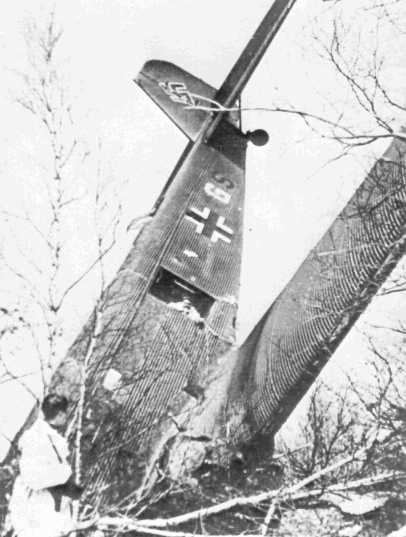
The Battle of Dombås began in Norway. As part of their conquest of Norway south of Trondheim, and as a countermeasure against reported Allied landings in the Romsdal area of south-western Norway, the Germans dropped a company of paratroopers near the vital railroad junction of Dombås on 14 April 1940. German paratroopers of the 7th Flieger Division were parachuted into Dombås, Norway; after heavy casualties incurred largely due to the fact that they landed right into Norwegian 11th Infantry Regiment’s camp, they successfully damage the nearby railways and occupied farmhouses, thus are able to hamper with Norwegian transportation efforts for several days. For the next five days, the German force blocked the Dovre Line railroad line between Oslo and Trondheim, as well as the main road between the two cities.
At around 17:00 Norwegian time on 14 April, fifteen Junkers Ju 52 transport aircraft took off from Fornebu Airport near Oslo in hail and sleet with low cloud cover. An hour earlier, one Ju 52 had flown a reconnaissance flight over the drop area at Dombås without being able to see anything through the cloud cover. Even though the officers on the site wished to postpone the mission due to the weather conditions the fact that the mission was based on a direct command from Adolf Hitler meant that it had to be carried out despite the risks involved. The mission the German Fallschirmjäger embarked on was the second opposed paratroop attack in history, the first had occurred five days previously when the Norwegian airbase of Sola near Stavanger was captured during the 9 April invasion of Norway. When the German aircraft arrived over their target area, after a 275 km (171 mi) flight, small breaks in the cloud cover enabled most of the Ju 52s to drop their sticks (loads) of paratroopers. The poor weather conditions led to the Germans being spread over a large area, stretching from Lesja 20 km (12 mi) west of the target, Vålåsjø 18 km (11 mi) north-east of the target and locations 8 km (5 mi) to the south in the Gudbrandsdal valley.
To the misfortune of the German paratroopers, their target area was coincidentally also the temporary base and encampment of the 2nd Battalion of the Norwegian Army’s Infantry Regiment 11 (II/IR 11). The battalion had been mobilised in Molde a few days previously and had arrived by train in Dombås in the evening of 13 April. The deployment had been made in preparation for what the Norwegian Army High Command expected would be a major attempt at reconquering Trondheim in cooperation with Allied forces. Although there were no anti-aircraft guns in the area, II/IR11 had positioned their 7.92 mm (0.312 in) Colt M/29 heavy machine guns on anti-aircraft mounts in order to provide some basic low-level air defence.
The arrival of the German aircraft over Dombås came as a surprise to the Norwegian forces who nonetheless soon opened fire on the Ju 52s with all available arms. Gunners aboard the Ju 52s returned fire while flying at treetop level. Soon after, the first paratroopers were dropped over the area and took heavy fire while descending to the ground. The ground fire took a heavy toll on the German transport aircraft, with only five out of the original 15 Ju 52s making it back to Fornebu, with another two landing at Værnes Airbase near Trondheim, all seven surviving aircraft riddled with bullet holes. The remaining eight transports were shot down or made forced landings. One Ju 52 made an emergency landing on Vänern Lake near Mariestad, Sweden, where it later broke through the ice and sank. The aircraft was salvaged and returned to the Luftwaffe by the Swedish authorities in January 1941. Many of the paratroopers that had been on the shot-down aircraft died in the crashes, or were killed or captured by Norwegian patrols soon after.
Of his originally 185-strong force Oberleutnant Herbert Schmidt only managed to gather around him 63 men, the rest having died or been scattered over a vast area. With this straitened force, Schmidt began carrying out the assigned task of blocking the Norwegian rail and road network. The German force blocked the main road in the area and cut the telephone wire running next to it. After capturing a Norwegian taxicab and putting as many of his men as he could in and onto the vehicle, Schmidt drove north toward Dombås, stopping at regular intervals to make forward observations.
When the taxi-borne German force reached the farmstead of Li on the road to Dombås, they ran into two truck-loads of soldiers from No. 5 Company, IR 11. After some initial confusion the Norwegian opened fire and the Germans charged with submachine guns and hand grenades. Following a short fire fight during which Schmidt was severely wounded and the Norwegians pushed back, the paratroopers abandoned their advance on Dombås. They instead pulled back and took up positions in a hedgehog defensive fighting position at the farms of Ulekleiv and Hagevolden, covering all directions and dominating the surrounding landscape. Schmidt—although seriously wounded in the hip and stomach—never relinquished command and ordered his men to use sand to write messages in the snow to the Luftwaffe asking for supplies of provisions and ammunition. The force was not spotted by Luftwaffe reconnaissance aircraft and received no supply drops while at Ulekleiv/Hagevolden.
The attack at Dombås made the Norwegian Central Bank speed up the evacuation of the Norwegian gold reserves. The 50 t (55 short tons) of gold had been evacuated from Oslo on 9 April and was being kept in a vault in Lillehammer when the German attack on Dombås began. As soon as news of German paratroopers landing spread, the gold was put on a train and brought to Åndalsnes from where it was evacuated by way of British cruisers and Norwegian fishing boats. King Haakon VII of Norway and his son, Crown Prince Olav were both at Dovre, near the drop zone and only 30 minutes from the nearest groups of paratroopers when the attack began on 14 April. The King and Crown Prince both had to be escorted out of the area by members of the Dovreskogen Rifle Club.
Norway’s King Haakon VII made a radio address telling his people that British soldiers were on their way and should be given any assistance possible.
The German military commandant, General von Falkenhorst, threatens all civilians resisting the German occupation with harsh measures. He takes 20 prominent citizens of Oslo hostage, including the Bishop. The entire situation is completely fluid: U.S. journalist James Aldridge comments that it is the “Most nonsensical war ever seen: no-one knows where ‘front’ is, every time I look for fighting, I just miss it.”
The Norwegian forces are fighting a series of delaying actions in the Glomma Valley and around Lake Mjösa against the German forces advancing north from Oslo.
The British and French are unsure how to proceed. However, they are agreed that they have to do… something. The decision comes down to getting some troops ashore and then figuring out what to do with them later. So, troops land in Norway, but far away from any opposition.
350 Royal Marines landed at Namsos, the first British troops to land in Norway. To prepare for British 146th Territorial Brigade’s arrival at Namsos, the light cruisers HMS Sheffield (24) and HMS Glasgow (21) put ashore an advance party of 350 Royal Marines, the first landing of British forces in Norway. These Marines were the first British forces to land in Norway. The landing party was under the command of Captain Edds and took up blocking positions in the hills outside town which soon attracted German aircraft. The commander, Lieutenant-General Sir Adrian Carton De Wiart, V.C., flew in the next day and his Short Sunderland flying boat was strafed by German aircraft as it landed. His aide was wounded and had to return to Britain. De Wiart was an energetic and competent commander who inspired his troops by his bravery during air attacks but no Allied aircraft were available over Namsos to provide protection against the Luftwaffe.
The British 146th Territorial Brigade was diverted south from Namsos for an attack on Trondheim. It was Vice Admiral William Whitworth’s opinion that the landing at Trondheim would be easy. Unfortunately the 146th’s artillery, anti-aircraft guns, and commanding officer continued on to Narvik.
East of Oslo, 3,000 troops of Norwegian 1st Infantry Division retreat into Sweden.
Elements of German 196th Infantry Division continue to push northward from Oslo against elements of Norwegian.
British 24th Guards Infantry Brigade begins landing at Harstad near Narvik.
General Jodl records that Hitler is suffering a nervous crisis' andterrible excitement’, despite the German successes in Norway. This is after the Fuhrer receives the news of the German naval losses at Narvik.
Six Royal Navy Fleet Air Arm Skua aircraft of 800 Squadron (Captain R.T. Partridge RM, Lt E.W.T. Taylour, Petty Officer Airman J. Hadley, Lt E.G. Finch-Noyes, Lt J.A. Rooper, Petty Officer Airman H.A. Monk) and nine Skua aircraft of 803 Squadron (Lt W.P. Lucy, Lt A.B. Fraser-Harris, Captain E.D. McIver RM, et al) departed Hatston to attack Bergen. Six aircraft of the 803 Squadron (Harris, Torin, Church, Filmer, Riddler, Spurway) did not locate the target. German motor torpedo boats S.23 and S.25, arriving from Wilhelmshaven, were strafed with slight casualties. U-60 and U-7 were attacked on the surface, but were not damaged. Captain E.D. McIver RM and Leading Airman A.A. Barnard of 803 Squadron in a Skua were lost in the raid. German supply ship Barenfels (7569grt), originally to have gone to Narvik, was badly damaged by Lt Lucy while unloading at Bergen. This would ultimately cause the ship to sink stern first to the harbor bottom, carrying her valuable cargo of anti-aircraft guns to the bottom with her.
Flight operations on board HMS Furious were limited due mainly to the poor weather. At 1220, two Swordfish were dispatched on an uneventful armed reconnaissance flight to Tromsø.
Norwegian aircraft attack German Ju52s on frozen Lake Hartvigvann near Narvik.
An unsuccessful RAF attack on Kriegsmarine destroyers returning from Trondheim is made.
At dawn, the RAF bombs Stavanger-Sola airfield and the seaplanes in Hafrs Fjord. Some damage is done to the hangars.
The British submarine HMS Sterlet damaged the German gunnery training ship and minelayer Brummer in the Skagerrak between Norway and Sweden with torpedoes; Brummer would remain afloat until the next day.
The Royal Navy heavy cruiser HMS Suffolk intercepted the German tanker Skagerrak (6044grt) northwest of Vaagso in 64 05N, 02 00E, and Skagerrak scuttled herself rather than be captured.
The Kriegsmarine troopship Florida was torpedoed and sunk in the North Sea off Orust, Sweden (57°59’N 10°51’E) by HMS Snapper (Royal Navy).
The Kriegsmarine minesweeper M-1101 struck a mine laid by HMS Narwhal (Royal Navy) in Kattegat. She was beached in the Oslofjord the next day.
The Danish ferry Nyborg struck a mine and sank in the Kattegat off Sprogø.
The Kriegsmarine U-boat support ship Schiff-35 (Oldenburg) was torpedoed and sunk in the Skagerrak (57°50’N 11°15’E) by HMS Sunfish (Royal Navy).
The Kriegsmarine tanker Ölschiff 3 was intercepted in the Arctic Ocean north west of Vågsøy, Norway and was scuttled by her crew.
The Royal Norwegian Navy 2.-class torpedo boat HNoMS Teist was scuttled in the Skagerrak off Herad to prevent capture by German forces.
The British cargo ship Disperser sank in the North Sea off Kirkwall, Orkney Islands.
The Royal navy battleship HMS Warspite, escorted by two destroyers, was attacked by U-46 and later by U-48 in Vestfjord. Fortunately for Warspite, all the torpedoes fired exploded prematurely.
On the French front the general situation remained unchanged today, although it is still believed that the enemy may make a move, if only in the hope of delaying that “immediate and efficacious aid” that the Allies have pledged themselves to give Norway. Activity was most marked in the Bitche sector, where German infantry detachments, supported by artillery fire, advanced simultaneously at several points and strove to reach the French lines. They were compelled to fall back with losses, the evening communiqué says. The morning bulletin had reported artillery actions during the night in the same region.
The Bitche sector is one of the most important on this front because it includes a wide plateau. several miles in front of the Maginot Line, possession of which would. permit flanking fire on the very strong Rohrbach position, scarcely more than eight miles distant. There is a general impression that an attempt to take this plateau might well be one of the preliminaries to a German offensive. For this reason the skirmishes today may have more than local significance.
German infantry units tried again today to force the French front lines in furious fighting west of the Vosges Mountains, but the French High Command declared they were repulsed with losses. The German troops were supported by a heavy artillery barrage at different points in the area roughly between Bitche and Saareguemines. French casualties were not disclosed. The attack followed bitter fighting yesterday near the Luxembourg frontier in which the Germans were reported to have thrown a full company of infantry at the French.
French and German guns unleashed heavy artillery barrages west of the Vosges during the morning. The cannon roared after the French patrol raided what the French said was an important sector jutting toward Zweibruecken. Military reports said the French penetrated a German outpost in a dawn attack and brought back some information on German troop dispositions.
Two German planes that flew over Paris Thursday night were brought down later by anti-aircraft fire near Laon in the Aisne Department, it was announced today. One ship fell in flames. Of the four occupants of the second plane, it was announced, one safely parachuted, two were killed in the crash and the pilot was badly injured.
Not the least significant in today’s German war activities was the increased action on the Western Front, which resulted in the longest German communiqué about this sector that has appeared in the present war. Particularly heavy artillery and shock-troop activity was reported in the sector between the Moselle River and the Palatinate forest. In the early morning hours Saturday two groups of German shock troops. forced their way into an enemy position several kilometers in French territory southwest of Merzig, near Zeringen. The Germans attacked the enemy position “from different sides” following “successful preparation” by German artillery, and destroyed it.
The Dutch military extends the areas covered by the state of siege in the northern part of the country. The Netherlands defense forces were keyed to special watchfulness tonight to prevent being taken unaware by any moves of belligerent powers. Various rumors about this country’s precarious position in “the storm corner of Europe” caused tension in many circles, but in general the public displayed no uneasiness.
Danish resistance to the German invasion was far more serious than original reports stated, according to a Danish diplomat just arrived from a foreign post somewhere in Europe seeking instructions from the Danish Legation in Paris. He claims 700 dead, and 1,200 arrested by the Nazis.
An authoritative German source says the Reich contemplates requesting a change in the International Danube Commission, which includes delegates of France and Britain in addition to the riparian States but does not include a German representative.
The Polish Embassy to the Quirinal today issued a new pamphlet on alleged German atrocities against members of the clergy and civilians in German-occupied Poland, including the closing of churches, the burying alive and assassination of clergymen, beatings, deportations and the sending of clergymen to concentration camps.
Because of a grave shortage of food in Russia, Eastern Poland is reported to have been almost completely despoiled of its reserves. Poles, Ukrainians and White Russians are said to be starving.
During the night 28 RAF aircraft are sent to lay mines in the Great and Little Belts, but only 9 succeed due to bad weather.
Vice-Admiral Aircraft Carriers Lionel V. Wells, CB, DSO, RN shifts his flag to HMS Glorious, which then departs Gibraltar at 2130 in company with the destroyers HMAS Stuart (local escort only), HMS Velox and HMS Watchman bound for the Clyde. HMS Ark Royal remains at Gibraltar.
Steamers Blackheath (4637grt) of convoy NM.1 and Cedarbank (5159grt) of convoy TM.1 departed the Downs on the 11th for Rosyth where they safely arrived at 0605/13th, escorted by destroyers HMS Arrow and HMS Acheron, respectively. These two steamers and steamers Cyclops (9076grt) and Charlbury (4836grt) formed convoy NM.1 for Namsos. Convoy NS.1 of steamers Lombardy (3379grt) and Lochee (964grt) sailed from the Clyde escorted by destroyers HMS Wolverine and HMS Vanessa to join convoy NM.1. Destroyers HMS Fame, HMS Diana, and HMS Grafton arrived at Rosyth at 0700/15th from the Humber. Convoy NM.1 of Cedarbank, Cyclops, Blackheath, Charlbury departed Leith at 1200/15th escorted by destroyers HMS Fame, HMS Imperial, and HMS Diana with destroyer HMS Grafton to join en route. Steamer Lombardy dragged anchors in a gale and struck steamer Lochee on the 15th.Both steamers were unable to proceed with the convoy. En route at 1418/16th, a Hurricane crashed near the convoy 30 miles 115° from Wick within sight of the convoy and destroyers Diana and Imperial unsuccessfully searched for the pilot. The convoy called at Scapa Flow on the 16th to empty the radiators of the vehicles in the steamers. Convoy NSM 1, with steamers Cyclops and Charlbury of NM.1, Blackheath, Macgregor Laird (4015grt),tanker Inverarder (5578grt) and collier Balmaha (1428grt), departed Scapa Flow for Namsos at 0800/17th escorted by destroyer HMS Delight, HMS Diana, and HMS Imperial. Destroyer HMS Maori departed Scapa Flow at 1345/17th to join the convoy. On 22 April, destroyer HMS Delight (escort SO) was ordered to take the convoy to Vaagsfjord.
Convoy OA.129 departed Southend escorted by destroyer HMS Whitehall from 14 to 17 April, when the convoy was dispersed. The destroyer joined conovy HX.33.
Convoy OB.129 departed Liverpool escorted by sloop HMS Rochester, which was with the convoy from 14 to 17 April, when the sloop joined convoy HX.33. The convoy was dispersed on the 18th.
Convoy OG.26F was formed with convoys OA.128GF, which departed Southend on the 12th, OB.128GF, which departed Liverpool on the 12th, with fifty four ships. The convoy was escorted by sloop HMS Enchantress on the 14th and sloop HMS Sandwich from 14 to 20 April when the convoy arrived at Gibraltar. Sloop Enchantress was withdrawn from the convoy shortly after sailing. On arrival at Gibraltar, sloop Sandwich was temporarily attached to the 13th Destroyer Flotilla as replacements for destroyers HMS Wishart and HMS Active which departed in convoy HG.27 to give leave in the UK.
Convoy FN.145 departed Southend, escorted by destroyer HMS Vega and sloops HMS Hastings and HMS Pelican. The convoy arrived at the Tyne on the 16th.
Convoy FS.146 departed the Tyne, escorted by destroyers HMS Wallace and HMS Valorous. The convoy arrived at Southend on the 16th.
Convoy MT.51 departed Methil, escorted by destroyers HMS Wallace and HMS Valorous. The convoy arrived later in the day at the Tyne.
The War at Sea, Sunday, 14 April 1940 (naval-history.net)
Light cruiser FIJI, returning from trials, was in a minor collision with armed merchant cruiser DERBYSHIRE in the Clyde.
French submarines ORPHEE (Lieutenant de Vaisseau R.H.A. Meynier) of the 16th Submarine Division and DORIS (Capitaine de Corvette J.E.M. Favreul) and CIRCE (Lieutenant de Vaisseau A. Frossard) of the 13th Submarine Division arrived at Harwich from Brest to reinforce the 10th Submarine Flotilla for patrols in the southern North Sea.
NORWEGIAN CAMPAIGN
Steamers BLACKHEATH (4637grt) of convoy NM.1 and CEDARBANK (5159grt) of convoy TM.1 departed the Downs on the 11th for Rosyth where they safely arrived at 0605/13th, escorted by destroyers ARROW and ACHERON, respectively. These two steamers and steamers CYCLOPS (9076grt) and CHARLBURY (4836grt) formed convoy NM.1 for Namsos. Convoy NS.1 of steamers LOMBARDY (3379grt) and LOCHEE (964grt) sailed from the Clyde escorted by destroyers WOLVERINE and VANESSA to join convoy NM.1. Destroyers FAME, DIANA, and GRAFTON arrived at Rosyth at 0700/15th from the Humber. Convoy NM.1 of CEDARBANK, CYCLOPS, BLACKHEATH, and CHARLBURY departed Leith at 1200/15th escorted by destroyers FAME, IMPERIAL, and DIANA with destroyer GRAFTON to join en route.
Steamer LOMBARDY dragged anchors in a gale and struck steamer LOCHEE on the 15th.Both steamers were unable to proceed with the convoy. En route at 1418/16th, a Hurricane crashed near the convoy 30 miles 115° from Wick within sight of the convoy and destroyers DIANA and IMPERIAL unsuccessfully searched for the pilot. The convoy called at Scapa Flow on the 16th to empty the radiators of the vehicles in the steamers. Convoy NSM 1, with steamers CYCLOPS and CHARLBURY of NM.1, BLACKHEATH, MACGREGOR LAIRD (4015grt), tanker INVERARDER (5578grt) and collier BALMAHA (1428grt), departed Scapa Flow for Namsos at 0800/17th escorted by destroyer DELIGHT, DIANA, and IMPERIAL. Destroyer MAORI departed Scapa Flow at 1345/17th to join the convoy. On 22 April, destroyer DELIGHT (escort SO) was ordered to take the convoy to Vaagsfjord.
German minesweeper M.6 of the 2nd Minesweeping Flotilla in the North Sea attacked a submarine contact. It was at one time thought this contact was TARPON, but she had already been lost by this time.
ALLIED SUBMARINE OPERATIONS
At 0140, submarine SNAPPER fired a torpedo at a darkened ship, which may have been Q ship Schiff 35, in 58-00N, 11-00E.
At 1407, submarine SNAPPER fired five torpedoes at German steamer FLORIDA (6148grt), carrying ammunition and supplies to Oslo, in convoy off Skagen, in 57 50N, 10-57E. The steamer was struck and sank in 57-59N, 10-51E. SNAPPER returned to England with no torpedoes remaining.
At 1945, submarine SUNFISH fired two torpedoes at German naval auxiliary Schiff 35 (steamer OLDENBURG, 2312grt), which was outfitted as a Q ship, east of Laeso Island near Skagen. Both torpedoes struck Schiff 35 and the ship sank in 57-50N, 11-15E. SUNFISH returned to England with only one torpedo remaining.
At 1800, submarine TRIAD fired two torpedoes at two merchant ships, escorted by an escort ship, near the mouth of Oslofjord.
Submarine TRITON arrived at Rosyth after patrol.
At 2100 near the Skaw in the Kattegat in 58-42N, 10-00E, submarine STERLET hit German gunnery training ship BRUMMER with one torpedo, as she was returning to Stavanger from convoy duty. Survivors were picked up escorting torpedo boats JAGUAR, FALKE and escort ship F.5 and she sank under tow during the morning of the 16th, 1/2 mile 52° of Tvesten Light in 58-55N, 9-55E.
Destroyer HAVOCK rendezvoused with Norwegian submarine B 3 in Vestfjord.
As light cruiser SOUTHAMPTON arrived in Vestfjord, she was unsuccessfully attacked by U-38. Later that day SOUTHAMPTON with destroyers ELECTRA and ESCAPADE arrived at Salangen. General Mackesy and troops aboard, two companies of the Scots Guards of the 1st Scots Guards Battalion, were disembarked a few miles west of Sjovegan in Salangenfjord.
Light cruiser AURORA, with Lord Cord Orrery aboard, arrived at Skelfjord.
Destroyer HAVELOCK (D.9) arrived at Scapa Flow at 1045 to join the Commander in Chief Home Fleet to act as an anti-submarine striking force.
Battleship WARSPITE, escorted by two destroyers, was attacked by U-46 and later by U-48 in Vestfjord. Fortunately for WARSPITE, all the torpedoes fired exploded prematurely.
Six Skua aircraft of 800 Squadron (Captain R.T. Partridge RM, Lt E.W.T. Taylour, Petty Officer Airman J. Hadley, Lt E.G. Finch-Noyes, Lt J.A. Rooper, Petty Officer Airman H.A. Monk) and nine Skua aircraft of 803 Squadron (Lt W.P. Lucy, Lt A.B. Fraser-Harris, Captain E.D. McIver RM, et al) departed Hatston to attack Bergen. Six aircraft of the 803 Squadron (Harris, Torin, Church, Filmer, RIddler, Spurway) did not locate the target. German motor torpedo boats S.23 and S.25, arriving from Wilhelmshaven, were strafed with slight casualties. U-60 and U-7 were attacked on the surface, but were not damaged. Captain E.D. McIver RM, Leading Airman A.A. Barnard of 803 Squadron in a Skua were lost in the raid. German supply ship BARENFELS (7569grt), originally to have gone to Narvik, was badly damaged by Lt Lucy while unloading at Bergen.
Battlecruiser REPULSE and destroyers JUNO, JANUS, and JAVELIN arrived at Scapa Flow at 1200 after having been covered in passing the progress of convoy NP.1 towards Vestfjord.
Light cruiser ENTERPRISE, which had departed Portsmouth on the 12th, arrived at Scapa Flow for duty with the Home Fleet off Norway.
Late on the 14th, light cruiser SHEFFIELD transferred a landing party to the destroyers SOMALI (D.6), MASHONA, and MATABELE of the 6th Destroyer Flotilla and AFRIDI (D.4), SIKH, and MOHAWK of the 4th Destroyer Flotilla and the party was ferried ashore east of Namsos. Alanding party from light cruiser GLASGOW was ferried ashore at Bangsund. These landings, code named HENRY, commenced one hour before dark. Destroyer SOMALI, joined by anti-aircraft cruiser CURLEW on the 16th, remained at Namsos to support these three hundred and fifty seamen and Royal Marines and Pegram’s force returned to sea.
Destroyer KIMBERLEY at approximately 1500 sent an investigating party of twelve men in a cutter with a crew of three ashore to Narvik. The cutter got as far as a flying boat moored at a buoy before being taken under fire from German troops in a railway tunnel, Lt H.T.D. Glynn and four ratings were killed and eight men were wounded.
Sloops BLACK SWAN, AUCKLAND, FLAMINGO, and BITTERN embarked 700 Royal Marines taken from companies of repairing capital ships NELSON, BARHAM, and HOOD. Sloop AUCKLAND with a contingent from battleship BARHAM departed Rosyth on the 14th.She was to have arrived at Aalesund twenty-four hours ahead of the other three sloops. Sloops BLACK SWAN, FLAMINGO, and BITTERN departed Rosyth at 0320/15th.In heavy seas, the three sloops overtook sloop AUCKLAND and all four spent the night of 15/16 at Invergordon. All four sloops departed at 1030/16th from Invergordon to land these troops at Aandalsnes on Operation PRIMROSE. The original plan had been for sloop AUCKLAND to have arrived and landed her troops at dawn on the 16 April.
At 1800/14th, German destroyers HEINEMANN and ECKHOLDT, both with engine room defects, departed Trondheim for Wilhelmshaven where they safely arrived in the morning of 16 April.
After refueling at Skelfjord, destroyers INGLEFIELD, IMOGEN, ISIS, and ILEX rejoined heavy cruiser DEVONSHIRE at 0700/14th in 69-30N, 16-05E. ISIS and ILEX were sent ahead to investigate Ringvassoy and Kvatsoy Fjord. Heavy cruiser BERWICK with INGLEFIELD (D.3) and IMOGEN examined Andfjord, Gratangsbotn, Vaagsfjorden and area on the 14th. Anti-submarine patrols were set up by ILEX and ISIS at the north and south entrances to Tromsofjord. DEVONSHIRE (Flagship Vice Admiral John Cunningham, CS 1) arrived at Tromso after sweeping for German shipping. At 2100 DEVONSHIRE, ISIS and ILEX put to sea. ISIS and ILEX were detached at 0100/15th off Arnoy Island in 70-15N, 20-28E to meet aircraft carrier FURIOUS. IMOGEN later joined the aircraft carrier’s screen. DEVONSHIRE joined BERWICK and INGLEFIELD ten miles north of North Cape at 0700/15th. DEVONSHIRE and BERWICK with INGLEFIELD arrived at Kirkenes at 1630/15th.
Reports of warships off Petsamo caused CS 1 to order INGLEFIELD to investigate, she departed Kirkenes at 1800/15th, and found these to be two Russian destroyers. She also encountered a Russian submarine. The heavy cruisers put to sea from Kirkenes at 2000/15 April to cover the passage of a Norwegian convoy of Danish transport DRONNING MAUD (1779grt) and Norwegian motor transport KONG HAAKON (874grt) to Tromso. INGLEFIELD joined BERWICK in escorting the convoy. On 16 April, BERWICK experienced some minor flooding caused by damage from a near miss of German bombing.
DEVONSHIRE arrived at Tromso at 1645/16th and departed again at 2000. The convoy arrived at Tromso during the night of 16/17 April. BERWICK and INGLEFIELD arrived at Tromso at 0730/17th. DEVONSHIRE arrived back in the Kirkenes at 1638/16th and joined FURIOUS with ILEX and ISIS which had arrived there. They all soon departed Kirkenes again and arrived at Tromso on the 17th. IMOGEN departed Kirkenes as the convoy escort at 2200/17th and arrived at Tromso with the convoy at 2130/19th. These two Norwegian convoys were carrying troops that had been engaged in the Neutrality Watch near the Finnish border.
Heavy cruiser SUFFOLK intercepted German tanker SKAGERRAK (6044grt) northwest of Vaagso in 64 05N, 02 00E, and she scuttled herself rather than be captured.
Norwegian torpedo boat HVAS was placed in service as an auxiliary submarine chaser by German forces at Stavern.
Destroyers MAORI and ASHANTI departed Sullom Voe at 1840 and arrived at Scapa Flow at 0530/15th.
Destroyer TARTAR and the Polish ORP GROM and ORP BŁYSKAWICA departed Scapa Flow at 1400 to sweep from Lister to Bommelford from 2200/14th to daylight on the 15 April. The operation was cancelled due to adverse weather and they arrived back at Scapa Flow at 0845/15th.
Destroyers KIPLING, HEREWARD and DELIGHT arrived at Scapa Flow for duty after refittings in the Tyne at 0600, Portsmouth at 1200, the Clyde at 1400, respectively.
French destroyers BRESTOIS and FOUDROYANT arrived at Scapa Flow from the Tyne at 1200. They refueled and went on to the Clyde arriving at 1930/15th.
#
Convoy OA.129 departed Southend escorted by destroyer WHITEHALL from 14 to 17 April, when the convoy was dispersed. The destroyer joined convoy HX.33.
Convoy OB.129 departed Liverpool escorted by sloop ROCHESTER, which was with the convoy from 14 to 17 April, when the sloop joined convoy HX.33. The convoy was dispersed on the 18th.
Convoy OG.26F was formed with convoys OA.128GF, which departed Southend on the 12th, OB.128GF, which departed Liverpool on the 12th, with fifty-four ships. The convoy was escorted by sloop ENCHANTRESS on the 14th and sloop SANDWICH from 14 to 20 April when the convoy arrived at Gibraltar. Sloop ENCHANTRESS was withdrawn from the convoy shortly after sailing. On arrival at Gibraltar, sloop SANDWICH was temporarily attached to the 13th Destroyer Flotilla as replacements for destroyers WISHART and ACTIVE which departed in convoy HG.27 to give leave in the UK.
Convoy FN.145 departed Southend, escorted by destroyer VEGA and sloops HASTINGS and PELICAN. The convoy arrived at the Tyne on the 16th.
Convoy FS.146 departed the Tyne, escorted by destroyers WALLACE and VALOROUS. The convoy arrived at Southend on the 16th.
Convoy MT.51 departed Methil, escorted by destroyers WALLACE and VALOROUS. The convoy arrived later in the day at the Tyne.
At 2130, aircraft carrier GLORIOUS (Flag Vice Admiral Aircraft Carriers transferred from aircraft carrier ARK ROYAL aboard) escorted by destroyers VELOX, WATCHMAN and the Australian HMAS STUART departed Gibraltar. GLORIOUS arrived in the Clyde late on the 18th escorted by destroyers WALKER and WALPOLE. STUART after this escort duty departed Gibraltar on the 17th for Malta. ARK ROYAL departed Gibraltar on the 16th for exercises in the vicinity of Alboran Island, but was recalled. At 1700/16th, ARK ROYAL escorted by destroyers VORTIGERN, WESTCOTT and BULLDOG departed Gibraltar. Off Cape Finisterre on the 17th, VORTIGERN was detached and arrived back at Gibraltar. Destroyers JUNO and HASTY departed Greenock at 0145/20th to join ARK ROYAL and SALADIN. ARK ROYAL with JUNO, HASTY, and SALADIN arrived in the Clyde on the 20th. BULLDOG and WESTCOTT arrived at Plymouth.
Due to a French report of sixteen ships off Texel, all destroyers at Dover were brought to immediate notice. This was later reduced to one hour’s notice. Commander in Chief, Western Approaches, was ordered to detail all available destroyers to Dover. Destroyers CAMPBELL, BROKE, VESPER, ANTELOPE, WOLVERINE, and WREN were detached from the Western Approaches to Dover.
French steamers GENERAL METZINGER and CHENONEAUX departed Marseilles and were escorted by destroyer TEMPETE from Oran. They arrived at Brest on the 20th.
Convoy HX.35 departed Halifax at 0700 escorted by Canadian destroyers HMCS ST LAURENT and HMCS RESTIGOUCHE, which were detached on the 14th. At 0700/15th, the destroyers turned the convoy over to Armed merchant cruiser LACONIA, which was detached on the 26th. Sloop ENCHANTRESS escorted the convoy from 26 to 29 April, when the convoy arrived at Liverpool.
President William Green of the American Federation of Labor charged today that John L. Lewis was secretly plotting a political revolution intended to make him dictator of the United States. He accused the head of the CIO of “suffering from delusions of grandeur” and pointed to Lewis’ recent utterances critical to the administration and his threats to organize a third party movement as support of the charge.
U.S. Attorney-General Jackson accused Senator Bridges, New Hampshire Republican, today of attempting, by a speech on the senate floor, to prejudice the government’s, case in the New York trial of 17 men accused of plotting to over throw the government. The New Hampshire Republican, in senate debate Thursday, said Communists had violated the law “on every hand” but had not been sent to jail because of failure of Jackson to prosecute.
The Administration faces one of its greatest tests of the season when the House starts consideration tomorrow of the Logan-Walter bill, designed to curb administrative officials having “Messiah complexes” by providing for court review of decisions having the force of law. Passage was in doubt, since President Roosevelt recently expressed his opposition to the general aims of the measure, although he said he had not read the bill. He said his opposition was on the ground that such legislation would tend to delay procedure and give the advantage to the litigant having the most money. The House Judiciary Committee, which, in reporting the bill, said it probably had received closer study than any other legislation in recent years, anticipated this criticism by saying that any procedure for hearings affords an opportunity for delay.
Charging the Republican party with using “the old political device of facing both ways,” Postmaster General James A. Farley declared tonight that America’s hope for peace and sound public policy lay with the Democratic party.
Pan-American Day, marking the fiftieth anniversary of the founding of the Pan American Union, was celebrated in Washington, D.C. today at a pontificial high mass at the Catholic University.
During the first six months of the war in Europe, up to the beginning of March, $9,800,000 was contributed by the American people for relief work in Europe and Asia, a survey made public yesterday disclosed.
The Federal Bureau of Investigation “should stick to the task of uprooting political corruption and eradicating kidnapping,” Malcolm Dobbs Cotton of Houston, Texas, executive secretary of the Council of Young Southerners, declared here today in a speech in which he also assailed the Dies committee.
RCA demonstrated its new electron microscope in Philadelphia.
With two outs in the 9th inning of an exhibition game against the Dodgers in Brooklyn, Joe DiMaggio injures his knee sliding into second base. Joe will miss Opening Day for the 4th time in five years.
At the Bee Hive in Boston, the Bees beat the Red Sox, 7–5, before a crowd of 9,900. Yesterday’s match was called off because of bad weather.
In Los Angeles, Carlos Bernier homers in the 18th inning to give Hollywood a 6–5 PCL win over the Angels. It is the longest game ever at Los Angeles’ Wrigley Field.
If either European belligerent or the United States takes miltary action in regard to the Netherland East Indies, the Japanese Government will declare that it reserves the right to take similar action, the newspaper Nichi Nichi predicts today. Japanese sources suggest a willingness to use force,a nd to retailiate by seizing European holdings on the Asian mainland.
Born:
Julie Christie, British BAFTA and Academy Award-winning actress (“Darling”; “Doctor Zhivago”; “Away From Her”), in Chukua, Assam, India.
Patricia Bruder, American actress (“As the World Turns”), in Brooklyn, New York, New York.
Charley Warner, AFL cornerback and kick returner (AFL Champions-Bills, 1964; AFL All-Star, 1965; Kansas City Chiefs, Buffalo Bills), in Granger, Texas (d. 2016).
Naval Construction:
The Kriegsmarine (German Navy) experimental Type V midget U-boat V-80 is launched by Germaniawerft, Kiel (werk 597). The four-man vessel was designed to test the Walter hydrogen peroxide-based turbine propulsion system. This midget submarine was never commissioned; it led to the design of the German Type XVII submarine.
The Вое́нно-морско́й флот СССР (ВМФ) (Soviet Navy) “L” (Leninec)-class (4th group, Type XIII-modified) submarine L-20 is launched by Baltiyskiy Zavod (Leningrad, U.S.S.R.) / Yard 189.
 History Diaries