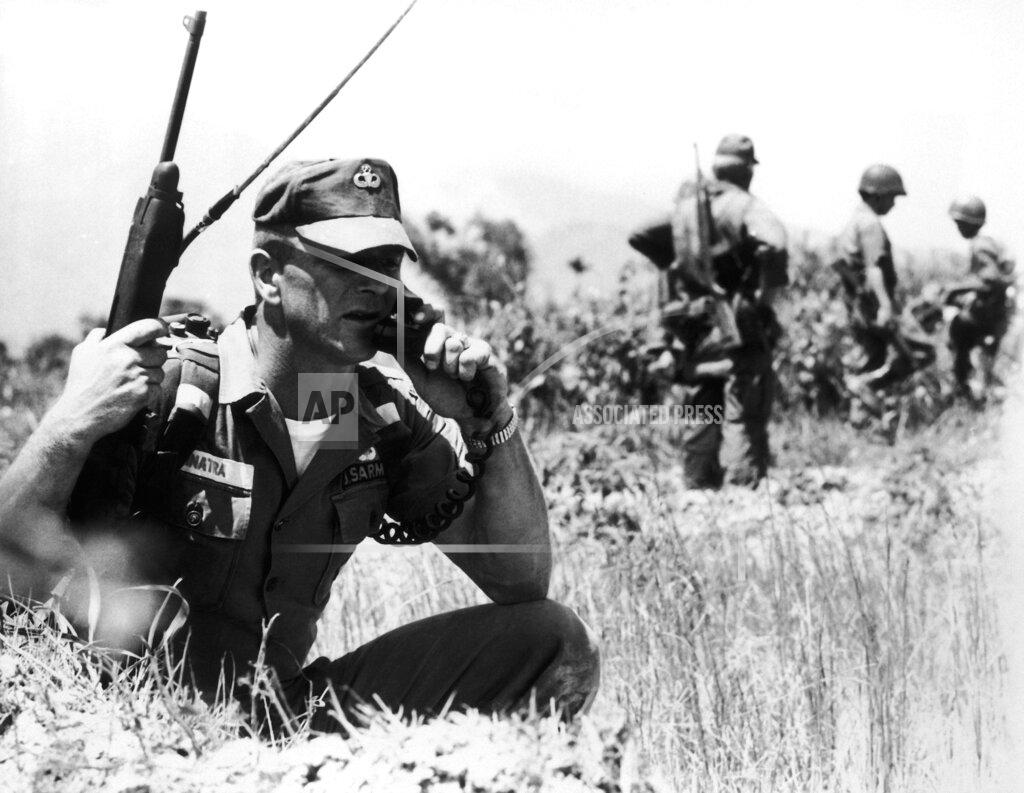
A United States Marine battalion of 1,400 men waded ashore near Đà Nẵng today to bring the number of Marines in South Vietnam to more than 8,000. The landing began at 8:35 AM (7:35 PM Tuesday, New York time). Within an hour, nearly 1,000 Marines were ashore and standing by for flights to Phú Bài airport, 35 miles to the north near the city of Huế. There they will guard an important airstrip and the approaches to the strategic Đà Nẵng air base, from which many United States and South Vietnamese take off on strikes to the North.
Military spokesmen gave conflicting accounts about participation of Marine Corps planes in strikes against Việt Cộng targets in South Vietnam. An American spokesman announced in Saigon that 12 Marine F4-B Phantom jets had been used today against Việt Cộng concentrations in Quảng Nam province, 365 miles northeast of Saigon. However, a Marine spokesman in Đà Nẵng, which is in Quảng Nam Province, said Maine Phantoms had not yet made any strikes inside Vietnam. He said a number of Phantom jets that arrived here over the weekend as part of a Marine build-up had flown a training exercise during which they fired a number of rockets into a target area. He said the weapons had not been directed against the Việt Cộng.
The JCS order the deployment of the 173rd Airborne Brigade from Okinawa to Biên Hòa-Vũng Tàu. Ambassador Maxwell Taylor is still resisting the increase of U.S. combat personnel and tries to persuade the Johnson administration to hold back, but he is overruled.
It is reported that South Vietnamese forces have discovered some 4 million pounds of rice and 21 stolen trucks in a Việt Cộng stronghold 30 miles north of Saigon. An American officer told of a ground operation that had uncovered four million pounds of rice uncovered by the Việt Cộng guerrillas and 21 trucks they had stolen. Vietnamese officers estimated that the rice, found west of a Communist stronghold known as Zone D, 30 miles north of Saigon, was enough to feed 25,000 men for a year.
Since November, more than thrée and a half million pounds of rice, in smaller piles, have been found in the provinces of Binh Long, Phước Long, and Phước Thành. Lieutenant Colonel John G. Hill, a 38-year-old senior adviser in the three provinces, said that the supply area had apparently served guerrillas that took part in the six-day Bình Giã battle last December. The Communists badly beat government forces in that battle. The government search, which ran from Saturday through Monday, resulted in 3 casualties to government forces and at least 15 for the Việt Cộng.
Thirty U.S. Air Force planes bombs on the radar installations on Hòn Mát Island.
The United States and South Vietnam began “Operation Fact Sheet”, a psychological warfare aerial mission, dropping over two million notices on those cities in North Vietnam with military facilities. The paper leaflets carried different types of messages written in the Vietnamese language. Some of them warned civilians to stay away from the areas that were to be bombed, and others suggested that civilians “could end the bombings by turning against their government”, or advocated the benefits of moving to South Vietnam. During April, May, June, and March, nearly 25 million papers were dropped. “The leaflets had no effect on North Vietnamese strategy”, an author would note later, “but they did result in a few civilians moving away from military facilities.”
The United States called on the Communist nations, and especially North Vietnam, today to reply to the recent appeal by 17 nonaligned nations that negotiations on Vietnam be started soon without any preconditions. That was the State Department’s carefully worded response to questions about a peace plan that was put forward from Hanoi, the North capital, as the Vietnamese “basis” for an international conference. A State Department spokesman said the North Vietnamese proposal, which was made public yesterday, was being studied carefully. Its significance could be better judged, he suggested, if the Soviet Union, Communist China, and North Vietnam followed the United States example of replying to the petition of the nonaligned governments.
Other officials here described the basic proposals from Hanoi as unacceptable on the ground that they would lead to a rapid Communist takeover of South Vietnam. The Johnson Administration was not prepared, however, to dismiss Hanoi’s statement as an empty gesture. Some high officials believe that, even if the proposed basis of negotiations is rejected, there might be room now for exploratory talks to devise a more acceptable basis.
The phrase “basis for negotiation” has acquired a special meaning in recent diplomacy. For instance, Washington rejected negotiations over Berlin for many years but nonetheless engaged in spirited bargaining with Moscow to find a basis for negotiations — that is, an agreed statement of the purposes of a more formal conference. The Berlin experience was being explicitly recalled here in some quarters today.
In a series of major policy speeches and declarations, the Communist leaders of North Vietnam put forward a peace plan for Southeast Asia and invited the United States to recognize it as the basis for international negotiations. Their plan called for the eventual unification of North and South Vietnam and a withdrawal of United States military forces even before reunification. It called also for a political settlement in South Vietnam “in accordance with” the program of the Việt Cộng rebels’ political organization, the National Liberation Front.
The Administration, in a step to curb the spread of atomic weapons, is considering a proposal under which the nuclear powers would provide non-nuclear nations with a guarantee of protection against atomic attack. The interest in the proposal reflects the growing belief in the Administration that one key to curbing the spread of atomic arms lies in an international security system in which the non-nuclear powers would feel no military compulsion to develop their own atomic bombs.
Harlan Cleveland, Assistant Secretary of State for International Organization Affairs, said in a Voice of America broadcast last weekend that the United States would like to discuss the “nuclear guarantee” idea when the 17-nation disarmament conference in Geneva reconvenes. Officials of the Arms Control and Disarmament Agency said the United States was not yet prepared to make a specific proposal at the disarmament conference. But they acknowledged that the Administration was looking for a way to implement and broaden an offer made by President Johnson after the Chinese Communist nuclear explosion in October.
After aborting its first landing attempt at Jersey Airport in the Channel Islands due to low cloud cover, British United Airways Flight 1030X, a Douglas C-47B, struck the outermost pole of the approach lighting system with its right wing on its second landing attempt. The wing broke off and the aircraft rolled upside down and crashed, killing 26 of the 27 people on board; the lone survivor, 23-year-old flight attendant Dominique Silliere, had both legs broken.
The House inter-American affairs subcommittee said that according to a “consensus of top intelligence officials,” there were no medium-range ballistic missiles in Cuba.
Indonesia and the United States said they have agreed the Peace Corps should cease operations in Indonesia “in light of the current situation.”
Britain’s Prime Minister Harold Wilson gave the elite of American business in New York a confident report on the regeneration of industry in Great Britain over the last six months.
The Senate Foreign Relations Committee approved today a foreign aid authorization bill calling for $3,352,170,000 in each of the next two fiscal years. The measure would also present the Johnson Administration with a legislative mandate to submit to Congress a new approach to foreign aid by July 1, 1966. It would direct that the program in its present form terminate a year later and be replaced by the new approach formulated by the President on the basis of recommendations by a 12-member planning committee. President Johnson had requested that $3.38 billion be authorized and appropriated for economic and military aid for the fiscal year beginning next July 1. The committee cut this request only $28.2 million, $9 million at the Administration’s behest.
President Johnson toured areas of the Middle West today that had been struck by tornadoes and floods. He said it was the will of the nation that “the Government of this good and generous people should be ready and will be ready to assist in every useful way.” Mr. Johnson’s main stop was at what had been the Sunnyside Addition housing development in Dunlap, Indiana, south of Elkhart.
He and his party were stunned by the devastation. Where there had been about 200 houses, only one was standing, and three persons had died in it. The area looked as though it had been shelled by heavy artillery. Most trees were broken or uprooted. Those that stood had been stripped of leaves and branches. In most cases it was hard to discern that houses had ever stood in the area. Twisted, mangled automobiles littered the ground.
Mr. Johnson stood on the rubble of what had been a Baptist church and kicked disconsolately at a cinder block, Someone had defiantly tacked a torn and dirty American flag to a splintered piece of plank. A persistent reporter from an Indiana television station kept asking Mr. Johnson for his “impressions.” The President only shook his head sorrowfully. Later he said, “It’s terrible, isn’t it? Almost unbelievable.” Twenty-seven to 29 persons, perhaps more, died in that one area of a few acres. Fifty perished in Elkhart County in the monumental windstorm Sunday.
After returning to Washington, the President designated as major disaster areas the tornado-stricken states of Indiana, Ohio and Michigan, The Associated Press reported.
The swollen Mississippi River spread havoc across Minnesota lowlands and thundered downstream, threatening scores of communities.
The House voted funds for an investigation of the Ku Klux Klan, overriding a contention that it will lead to “a witch hunt into civil rights organizations.”
Federal officials told representatives of six southern states that the 1964 Civil Rights Act made “the federal dollar colorblind.”
Because of that “baloney” sandwich (actually corned beef), astronauts will be required to sign an inventory of all items they take along on future flights.
The United Steelworkers Union will tell the basic steel industry today it will extend its May 1 strike deadline in return for immediate contract improvements.
Dow Jones Industrial Average: 912.86 (+4.85)
Major League Baseball:
In a banner finish, Al Spangler stars for the Astros by swiping home with the winning run in the 11th to give the Astros a 7–6 win over the Mets. It’s their first regulation win under the “Astros” name.
In Washington, pitcher Earl Wilson gives the Senators a 2–0 lead with a 3rd inning homer off Buster Narum. Narum retaliates with a 5th inning solo shot off Wilson as Buster emerges the winner in the 6–4 decision. Dick Radatz takes the loss.
Willie Mays hits his 455th career home run, a third-inning two-run shot to left field off future Hall of Famer Jim Bunning, in the Giants’ 5–2 victory over the Phillies at Connie Mack Stadium. The round-tripper surpasses Yankees slugger Mickey Mantle’s current total, a lead the Say Hey Kid will not again relinquish to his rival center fielder.
Chicago White Sox 0, Baltimore Orioles 6
New York Yankees 3, California Angels 4
St. Louis Cardinals 3, Chicago Cubs 7
Houston Astros 7, New York Mets 6
San Francisco Giants 5, Philadelphia Phillies 2
Los Angeles Dodgers 3, Pittsburgh Pirates 1
Boston Red Sox 4, Washington Senators 6
Born:
Khalid Sheikh Mohammed, al-Qaeda terrorist and organizer of the September 11 terror attacks; in Balochistan, Pakistan.
Stan Humphries, NFL quarterback (Washington Redskins, San Diego Chargers), in Shreveport, Louisiana.
Tom Dey, American film director (“Shanghai Noon”), in Hanover, New Hampshire.
Died:
Richard Hickock, 33, and Perry Smith, 36, whose murder of four members of the Clutter family would become the subject of the bestselling book “In Cold Blood,” were hanged at the Kansas State Penitentiary for Men in Lansing, Kansas. Hickock was hanged first, at 12:19 a.m.; at his request, the book’s author Truman Capote appeared as an official witness. Smith was hanged less than 45 minutes later, at 1:02 a.m.
 History Diaries