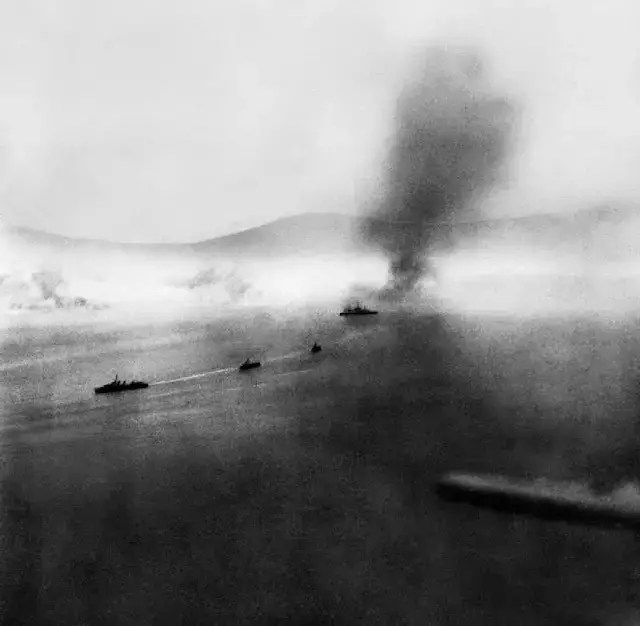
Eight German destroyers and the submarine U-64 were sunk or scuttled in the Second Battle of Narvik. The Second Battle of Narvik occurred when the British battleship HMS Warspite and 9 destroyers, supported by the aircraft carrier HMS Furious under Vice-Admiral William Jock Whitworth, entered Ototfjord to destroy the remaining German flotilla at Narvik. Three German destroyers and the submarine U-64 were sunk and 5 other German destroyers were scuttled by their own crew when their fuel and ammunition ran out. The Germans damaged three British destroyers. 2,600 German sailors survived and joined Major General Eduard Dietl’s ground forces at Narvik.
Early on the 13th, destroyer HMS Icarus led the minesweeper sweep followed by destroyers HMS Hero, HMS Foxhound and HMS Forester streaming minesweeping gear. These ships swept for mines in Vestfjord prior to battleship HMS Warspite’s entry into the Fjord for Operation DW. At 0730, the Narvik attack force was composed of battleship Warspite (Captain V.A.C. Crutchley, now flying the flag of Vice Admiral Whitworth) with destroyers Forester, Foxhound, Hero and HMS Cossack joining destroyers HMS Bedouin, HMS Kimberley, HMS Eskimo and HMS Punjabi, which formerly operated with light cruiser HMS Penelope and destroyer minelayer Icarus of the 20th Destroyer Flotilla. Destroyer HMS Ivanhoe of the 20th Destroyer Flotilla and destroyer HMS Hostile of the 2nd Destroyer Flotilla, while not taking part in the attack, entered the fjord after the Warspite force on general duties which would include screening damaged ships and picking up survivors. At 1040, the German U-boat U-48 was discovered by Eskimo in Vestfjord. Destroyers HMS Esk, HMS Ivanhoe, HMS Hostile, and HMS Havock were sent to hunt the submarine and Eskimo continued with the Warspite group. The submarine was attacked, but no damage was done. Warspite’s aircraft scouting ahead of the force located the German U-boat U-64, on her first war patrol, on the surface off Bjevik and sank her with bombs in 68 29N, 17 30E. Thirty six crew of the forty four man crew were able to swim ashore and were assisted by German Alpine troops. The crew of U-64 was returned to Germany commencing on the 13th on the Swedish railway and arriving on the 26th on a German passenger ship.
Ten Swordfish of 816 and 818 Squadrons under Captain A.R. Burch RM, from aircraft carrier HMS Furious attacked the German destroyers. Each was armed with 4 x 250 lb. SAP bombs and 8 x 20 lb. Cooper bombs. Visibility of the target area was extremely poor, the cloud base extending down to 500 feet and many rainstorms were about. After crossing Baroy Island, visibility began to improve and large caliber gun flashes were observed from HMS Warspite. At 1345, the formation split into individual sub-flights to attack several enemy destroyers observed below. The aircraft attacked first with the 250-pounders, then again with the 20-pounders, again in the face of an intense Flak barrage. Hermann Kunne and Bernd Von Armim were near missed, but not significantly damaged. The disarmed Royal Norwegian Navy patrol boat HNoMS Kelt was bombed and sunk during the attack. Two Swordfish of 818 Squadron were shot down by the German forces. The crew of one from 816 Squadron, piloted by Midshipman (A) D H Dammers, was rescued after the plane landed in a snowdrift. Dammers was wounded; his TAG Leading Airman A.J. Sturgess was unhurt. Acting S/Lt (A) G.R. Hampden and Naval Airman R. Dale of the other Swordfish were missing.
U-46, five miles up the fjord from Baroy, made an approach at periscope depth on HMS Warspite. Maneuvering submerged, she struck an unchartered rock and broke surface. U-46 was able to escape, however, on the surface as the British force was occupied with the sighting of German destroyer Kunne. Erich Koellner, escorted by Kunne, on her way to Taarstad sighted the Warspite force at 1300 as it was approaching the Narrows. Kunne sounded the alarm and destroyers Hans Ludeman, Wolfgang Zenker and Arnim got underway. Koellner slowly made her way to Djupvik Bay to wait in ambush as she was in no shape to offer battle. However, Koellner’s fate was sealed when she was located by Warspite’s aircraft. The two leading destroyers, HMS Bedouin and HMS Eskimo, alerted by the Warspite scouting plane, sighted Koellner as they rounded the point of Djupvik and sank her in a few minutes. Thirty one of her crew were killed and forty wounded on Koellner. Kunne exchanged shots with the British force as she retired down the Fjord, but at such long range, nothing came of it. As Kunne retired towards Narvik, she encountered Ludeman and Zenker and they turned towards the British force. Just as they came into sight, the German force was strengthened by the arrival of Arnim. Destroyer HMS Punjabi was hit by many five inch shells and was seriously damaged with large fires. She retired up the Fjord for a time, putting out her fires. Punjabi then returned to the battle, but was limited to fifteen knots and had a jagged hole in her bow. Six were killed, and seventeen, including Lt Cdr (E) R.R. Shorto, were wounded. One wounded died of wounds the next day on board HMS Warspite.
By this time, Kunne, Zenker and Arnim were all damaged by shellfire and had exhausted their ammunition. Kunne, retiring up Herjangsfjord and pursued by Eskimo, ran herself aground. Eskimo fired torpedoes into Kunne to complete the destruction. There were no casualties on Kunne. German destroyer Erich Giese, now with steam up, sailed out of Narvik harbor and was sunk by gunfire from Cossack, Bedouin, Foxhound, Forester, Hero and Icarus. Eighty three of her crew were killed, many wounded, and nine crew were captured from Giese. As the British force was nearing Narvik, they were taken under fire by destroyer Diether Von Roeder, but the gunfire was mistaken for coming from a shore gun. As Cossack made her way between the wrecks in the harbor, she was taken under fire by Roeder and hit eight times by five inch shells; two of which inflicted serious damage. One shell exploded against the fore end of the forward superstructure killing or wounding all the ammunition party inside. The other shell burst in the forward boiler room, killing the stokers and severing the leads from the bridge to the steering engine and the engine room telegraphs and fractured the main steam pipes. Without steerage or means to stop the engines, Cossack ran hard aground on the south shore opposite the harbor. For the next twelve hours, she remained on this perch, sniped at by General Dietl’s troops. Fortunately, most of the mountain guns carried on the destroyers for Dietl were swept away in heavy seas encountered on the voyage to Narvik. Eight ratings were killed and nineteen crew, two dying of wounds, were wounded on destroyer Cossack.
Cossack from her location, seeing that Roeder had now been abandoned, ordered Foxhound into the harbour to board her. As Foxhound neared Roeder, a burst of machine gun fire and rifle fire from the shore erupted and Foxhound stood off while she returned the fire. While this exchange was going on, Roeder exploded and was totally demolished. There were no casualties on Roeder. Destroyers Eskimo, Forester, Hero, Bedouin and Icarus went up Rombaksfjord in pursuit of Zenker, Arnim, Ludeman and Georg Thiele. Destroyer Eskimo encountered Ludeman and Thiele which opened up with the last of their main armament ammunition. Eskimo was the joined by Forester and Hero. Ludeman fired torpedoes at them but they were evaded by Eskimo and outrun by Forester and Hero. Ludeman was hit a number of times by shellfire from the three destroyers and retired up the fjord to join Zenker and Arnim where all three scuttled themselves and their crews went ashore. There were a number of casualties in the number 4 and 5 guns on Ludeman. There were no casualties on Zenker and Arnim. Thiele fired torpedoes at the British ships and then, badly damaged herself, ran aground and capsized. One of the torpedoes struck Eskimo under the forecastle blasting away the forward part of the ship. The forward turret was out of action, but B turret managed to keep up the fire. Forester and Punjabi stood by Eskimo, while Hero, Icarus and Kimberley continued up the fjord. There were fourteen killed and twenty eight wounded on Thiele. There were fifteen ratings killed and ten crew wounded on Eskimo.
Hero, Icarus and Kimberley found Thiele, Ludeman and Zenker, all aground and abandoned. As they approached, Zenker slid off the rocks and sank. A boarding party was put aboard Ludeman but after discovering that all the documents had been destroyed prior to abandoning ship, the landing party left and a torpedo was fired to complete the destruction. There was one rating killed and two wounded on Forester, and one crewman wounded on Kimberley.
At 1755, HMS Warspite escorted by destroyers Foxhound, Bedouin, Hero and Icarus retired from the area and got as far as Vestfjord at 2050 when she reversed course and returned to Ofotfjord to assist the damaged Cossack, Eskimo and Punjabi. Kimberley had been left to stand by Cossack, while Punjabi and Forester had been left to stand by Eskimo. Two other destroyers, HMS Ivanhoe and HMS Hostile, which had now arrived, were left off Narvik to investigate the merchant ships, but the detail was soon abandoned when the destroyers were ordered to hunt a German submarine.
During the battle, Norwegian steamer Cate B (4285grt) and merchant tanker Rodskjael (133grt), Swedish steamers Torne (3792grt) and Oxelosund (5613grt) and tug Styrbjoen (167grt), German tanker Jan Wellem (11,776grt) were lost, but later salved. Swedish steamer Oxelosund was sunk on 8 May by an internal explosion. U-51 had been at Narvik when the British attack began and, believing the attack to be an air raid, went into the harbor to bottom. Later, U-51 slipped out of the harbor, undetected, to attack the British force but without success. Destroyer HMS Foxhound dropped depth charges on U-25 off Tjellebotn doing minor damage to her at 1840. During the night of 13/14 April, destroyer HMS Ivanhoe found the destroyer HMS Hardy survivors and the crew of the British Narvik merchant ships that had been put ashore from the German tanker Jan Wellem during the First Battle of Narvik. Ivanhoe embarked these men at Ballengen and took them back to England.
Shortly after 2000, destroyer HMS Kimberley unsuccessfully tried to tow HMS Cossack off the ground. It was not until 0315/14th that Cossack finally got underway on her own in high water. Cossack proceeded to HMS Warspite to offload her casualties. Then with destroyer Forester escorting, Cossack proceeded stern first to Skelfjord. At Skelfjord emergency repairs were made to Cossack. Her ammunition was transferred to destroyer HMS Zulu and her torpedoes to destroyer Bedouin. Cossack departed Skelfjord at 2300/23rd after more emergency repairs with British tanker War Pindari and arrived at Scapa Flow at 0830/27th. Cossack departed Scapa Flow at 1510/28th and arrived at Portsmouth on the 30th for repairs which were completed on 15 June 1940.
However — and this is a qualification — despite the absolute devastation wreaked by the Warspite force, the Wehrmacht under General Dietl retains control of the town of Narvik itself, and 2,600 Kriegsmarine personnel from the destroyers augment the ground troops. Whitworth signals London and tells them that a single brigade could take the key port.
Morale within the Wehrmacht is skyrocketing given the latest successes in Norway. While difficult to quantify, it manifests itself in interactions with the British, who are not feeling quite so sanguine. For instance, the British rescue some of the German sailors at Narvik and make them prisoners but are nonplussed at their attitude. One of the Royal Navy sailors guarding them, Harry Neesdowne on battleship HMS Warspite, notes of them: “They are impossibly arrogant — certain of victory” — and this right after they have been pulled from the water and locked up.
Hitler is very worried by the situation in Norway and is only just prevented by his staff from issuing a series of very rash orders, particularly to the troops in Narvik. Hitler issues several orders based on this paranoia, but, for one of the very few times in the war, the officers around him countermand them and stay the course. They basically tell Hitler to go take a nap (in fact, Hitler is known to stress out over naval operations and says later that he “can’t sleep a wink” when large ships are operating). It is one of the first instances of Hitler’s unbridled paranoia which will manifest itself in various ways over the next few years to the severe detriment of the German state.
Faced with British naval attacks on Norwegian coast towns held by Germany and the continued resistance of the Norwegians themselves, General Nikolaus von Falkenhorst, commander of the rather isolated German Army in Norway, broadcast an ultimatum today to the Norwegian King and people in which, according to the Swedish press, he threatened to impose the death penalty on every Norwegian who resists the invasion or obeys the mobilization order of the Nygaardsvold government.
In London, the British War Cabinet debates about sending troops to Norway. Invasion at Trondheim is considered as a block to prevent the Wehrmacht from advancing north from Oslo. Narvik also is on the docket, as it was the original cause of the battle in the first place. Churchill, while firmly in the camp that favors a troop commitment at Narvik, comments that they need to consider: “the grave danger that we should find ourselves committed to a number of ineffectual operations along the Norwegian coast, none of which would succeed.”
Prime Minister Chamberlain, his authority reeling from the Norwegian setback and his own recent comment that Hitler has “missed the bus,” vows to send troops to Norway anyway. He tells the House of Commons, “Hitler has a real fight on his hands!”
General Carton de Wiart appointed to command Mauriceforce in Norway.
Elements of German 163rd Infantry Division occupy Larvik in the Oslo sector.
Elements of German 196th Infantry Division occupy Halden in the Oslo sector.
Other elements of German 196th Infantry Division push northward from Oslo.
Luftwaffe Ju 52s fly supplies to frozen Lake Hartvigvann near Narvik.
British troops arrive at the Faroe Islands per First Lord of the Admiralty Winston Churchill’s vow to “protect” them.
RAF aircraft reconnoiter the coastal areas of southern Norway. An enemy cruiser and destroyer are seen heading north off the Haugesund area; two enemy cruisers are anchored at Kristiansand South, and a considerable amount of Flak is encountered. Six Hudsons drop bombs on Stavanger airfield during the afternoon and are attacked by Bf110s, one Bf110 is claimed shot down and one damaged.
The RAF sends 15 Hampden bombers to drop parachute mines off the Danish coast during the night. While the Luftwaffe has dropped mines regularly, this is the first time the RAF drops mines. One aircraft is lost.
Luftwaffe bombers make unsuccessful attacks against RN vessels along Norwegian coast.
Following the successful long-range reconnaissance of Narvik from northern Scotland performed by the New Zealand (75 NZ) Squadron on 12 April, another flight is taken over Trondheim. This time, the plane fails to return.
The German U-boat U-34 scuttled the Royal Norwegian Navy minelayer Froya which had been run aground in Trondheimsfjord after severe damage from German coastal artillery on 9 April.
The German minesweeper M-1108 was sunk in a collision the Great Belt, south-west of Omø, Denmark. (55°05’N 11°04’E).
U.S. embassy official Tyler Kent gives copies of secret documents to an intermediary, Anna Wolkoff, who in turn passes them to Berlin.
Naval sources reported early today the Italian fleet was gathering to start maneuvers Monday. The maneuvers were described as “regular spring exercises.” Because of the war in Europe, unusual secrecy cloaked the naval activities. Concentration points were not disclosed but there has been talk in naval circles of preparations at Taranto, great seaport in southern Italy, and other points for the annual maneuvers.
Armed raiders seized the Cork broadcasting station last night. One of the raiders broadcast an attack on the Eire government. After five minutes the raiders left. One shot was fired in the broad casting studio. It struck a piano.
RAF Bomber Command mounted the first ARF minelaying operation of the war. Fifteen Handley Page Hampden bombers of No. 44, No. 49, No. 50, No. 61, and No. 144 Squadrons were dispatched and of this force, fourteen laid magnetic sea mines off Denmark with one aircraft being lost. During the course of the war, the RAF flew 19,917 minelaying sorties. The sea mines sank 638 vessels at a cost of 450 lost aircraft.
Oswald Mosley’s son Max Rufus Mosley was born.
In second wave of deportations, approximately 250,000 Poles from Soviet-occupied territory are banished to Siberia.
German authorities permit formation and meeting of Ukrainian Central Committee in occupied Poland.
The Royal Navy aircraft carriers HMS Ark Royal & HMS Glorious, in company with the destroyers HMAS Stuart, HMS Bulldog, HMS Westcott and HMS Wishard, arrive at Gibraltar.
Convoy NS.1 of steamers Lombardy (3379grt) and Lochee (964grt) arrived at Scapa Flow at 0800 escorted by destroyers HMS Wolverine and HMS Vanessa. After refuelling, the destroyers proceeded to Devonport at 1200.
Convoy FN.144 departed Southend, escorted by destroyers HMS Whitley and HMS Westminster. The convoy arrived at the Tyne on the 15th.
Convoy MT.50 departed Methil, escorted by destroyer HMS Wallace, sloop HMS Flamingo, anti-submarine trawlers of the 1st Anti-Submarine Group. The convoy arrived in the Tyne later that day.
Convoy OB.128 departs Liverpool.
Convoy HG.26 with thirty two ships departed Gibraltar escorted by destroyers HMS Douglas and HMS Wrestler on the 13th. Destroyer HMS Vivacious escorted the convoy from 14 to 16 April. Destroyers Douglas and Wrestler accompanied this convoy to Portsmouth to give leave. Convoy HG.26 arrived at Liverpool on the 23rd. In Home Waters, convoy HG.26 A was escorted by destroyer Vivacious.
The destroyer USS J. Fred Talbott (DD-247) returned to the Canal Zone after rendezvousing at sea with the Japanese steamship Arimasan Maru and providing medical assistance to a passenger on board. The warship’s medical officer would remain with the patient until the Japanese vessel reached Balboa, Panama.
The War at Sea, Saturday, 13 April 1940 (naval-history.net)
U-34 scuttled Norwegian minelayer FROYA which had been run aground in Trondheimsfjord after severe damage from German coastal artillery on 9 April.
Submarine CACHALOT departed Portsmouth for the Tyne on the 10th. The submarine arrived at Blyth on the 12th. CACHALOT departed Blyth on the 13th en route to Immingham to embark mines. The submarine was damaged in a collision with Italian merchant ship BEPPE (4859grt) from convoy FN.43 near Whitby. The merchant ship proceeded to Wallsend. CACHALOT was able to proceed under her own power to the Tyne arriving on the 14th.She was taken to Sheerness on the 27th escorted by destroyer WINCHESTER. Escorted by sloop FOXGLOVE, she then was taken to Chatham, arriving on 1 May for drydocking. Later, she went to Plymouth for permanent repairs completed on 16 July. This accident removed CACHALOT from minelaying mission FD.7. Submarine SEAL was scheduled on completion of her current patrol to drydock at Chatham. However, CACHALOT took over SEAL’s drydocking time and SEAL assumed the FD.7 duties.
Destroyer TARTAR and Polish destroyers GROM, BURZA, BLYSKAWICA arrived at Scapa Flow at 0630 from Rosyth.
Destroyer JUPITER arrived at Scapa Flow at 1100 from Sullom Voe.
Convoy NS.1 of steamers LOMBARDY (3379grt) and LOCHEE (964grt) arrived at Scapa Flow at 0800 escorted by destroyers WOLVERINE and VANESSA. After refuelling, the destroyers proceeded to Devonport at 1200.
SECOND BATTLE OF NARVIK
Early on the 13th, destroyer ICARUS led the minesweeper sweep followed by destroyers HERO, FOXHOUND and FORESTER streaming minesweeps. These ships swept for mines in Vestfjord prior to battleship WARSPITE’s entry into the Fjord for Operation DW. At 0730, the Narvik attack force was composed of battleship WARSPITE (Captain V.A.C. Crutchley, now flying the flag of Vice Admiral Whitworth) with destroyers FORESTER, FOXHOUND, HERO, and COSSACK joining destroyers BEDOUIN, KIMBERLEY, ESKIMO, and PUNJABI, which formerly operated with light cruiser PENELOPE and destroyer minelayer ICARUS of the 20th Destroyer Flotilla. Destroyer IVANHOE of the 20th Destroyer Flotilla and destroyer HOSTILE of the 2nd Destroyer Flotilla, while not taking part in the attack, entered the fjord after the WARSPITE force on general duties which would include screening damaged ships and picking up survivors. At 1040, U-48 was discovered by ESKIMO in Vestfjord. Destroyers ESK, IVANHOE, HOSTILE, and HAVOCK were sent to hunt the submarine and ESKIMO continued with the WARSPITE group. The submarine was attacked, but no damage was done. WARSPITE’s aircraft scouting ahead of the force located U-64, on her first war patrol, on the surface off Bjevik and sank her with bombs in 68 29N, 17 30E. Thirty-six crew of the forty-four-man crew were able to swim ashore and were assisted by German Alpine troops. The crew of U-64 was returned to Germany commencing on the 13th on the Swedish railway and arriving on the 26th on a German passenger ship.
Ten Swordfish of 816 and 818 Squadrons under Captain A.R. Burch RM, from aircraft carrier FURIOUS attacked the German destroyers. HERMANN KUNNE and BERND VON ARMIM (BA) were near missed, but not significantly damaged. Two Swordfish of 818 Squadron were shot down by the German forces. The crew of one from 816 Squadron, piloted by Midshipman (A) D H Dammers, was rescued after the plane landed in a snowdrift. Dammers was wounded; his TAG Leading Airman A.J. Sturgess was unhurt. Acting S/Lt (A) G.R. Hampden and Naval Airman R. Dale of the other SWORDFISH were missing.
U-46, five miles up the fjord from Baroy, made an approach at periscope depth on WARSPITE. Maneuvering submerged, she struck an unchartered rock and broke surface. U-46 was able to escape, however, on the surface as the British force was occupied with the sighting of German destroyer KUNNE. ERICH KOELLNER (EK), escorted by KUNNE, on her way to Taarstad sighted the WARSPITE force at 1300 as it was approaching the Narrows. KUNNE sounded the alarm and destroyers HANS LUDEMAN (HL), WOLFGANG ZENKER (WZ), and ARNIM got underway. KOELLNER slowly made her way to Djupvik Bay to wait in ambush as she was in no shape to offer battle. However, KOELLNER’s fate was sealed when she was located by WARSPITE’s aircraft. The two leading destroyers, BEDOUIN and ESKIMO, alerted by the WARSPITE scouting plane, sighted KOELLNER as they rounded the point of Djupvik and sank her in a few minutes. Thirty one crew were killed and forty wounded on KOELLNER. KUNNE exchanged shots with the British force as she retired down the Fjord, but at such long range, nothing came of it. As KUNNE retired towards Narvik, she encountered LUDEMAN and ZENKER and they turned towards the British force. Just as they came into sight, the German force was strengthened by the arrival of ARNIM. Destroyer PUNJABI was hit by many five-inch shells and was seriously damaged with large fires. She retired up the Fjord for a time, putting out her fires. PUNJABI then returned to the battle, but was limited to fifteen knots and had a jagged hole in her bow. Six were killed, and seventeen, including Lt Cdr (E) R.R. Shorto, were wounded. One wounded died of wounds the next day on board WARSPITE.
By this time, KUNNE, ZENKER, and ARNIM were all damaged by shellfire and had exhausted their ammunition. KUNNE, retiring up Herjangsfjord and pursued by ESKIMO, ran herself aground. ESKIMO fired torpedoes into KUNNE to complete the destruction. There were no casualties on KUNNE. German destroyer ERICH GIESE (EG), now with steam up, sailed out of Narvik harbour and was sunk by gunfire from COSSACK, BEDOUIN, FOXHOUND, FORESTER, HERO, and ICARUS. Eighty-three crew were killed, many wounded, and nine crew were captured from GIESE. As the British force was nearing Narvik, they were taken under fire by destroyer DIETHER VON ROEDER (VR), but the gunfire was mistaken for coming from a shore gun. As COSSACK made her way between the wrecks in the harbour, she was taken under fire by ROEDER and hit eight times by five-inch shells; two of which inflicted serious damage. One shell exploded against the fore end of the forward superstructure killing or wounding all the ammunition party inside. The other shell burst in the forward boiler room, killing the stokers and severing the leads from the bridge to the steering engine and the engine room telegraphs and fractured the main steam pipes. Without steerage or means to stop the engines, COSSACK ran hard aground on the south shore opposite the harbour. For the next twelve hours, she remained on this perch, sniped at by General Dietl’s troops. Fortunately, most of the mountain guns carried on the destroyers for Dietl were swept away in heavy seas encountered on the voyage to Narvik. Eight ratings were killed and nineteen crew, two dying of wounds, were wounded on destroyer COSSACK.
COSSACK from her location, seeing that ROEDER had now been abandoned, ordered FOXHOUND into the harbour to board her. As FOXHOUND neared ROEDER, a burst of machine gun fire and rifle fire from the shore erupted and FOXHOUND stood off while she returned the fire. While this exchange was going on, ROEDER exploded and was totally demolished. There were no casualties on ROEDER. Destroyers ESKIMO, FORESTER, HERO, BEDOUIN and ICARUS went up Rombaksfjord in pursuit of ZENKER, ARNIM, LUDEMAN and GEORG THIELE (GT). Destroyer ESKIMO encountered LUDEMAN and THIELE which opened up with the last of their main armament ammunition. ESKIMO was the joined by FORESTER and HERO. LUDEMAN fired torpedoes at them but they were evaded by ESKIMO and outrun by FORESTER and HERO. LUDEMAN was hit a number of times by shellfire from the three destroyers and retired up the fjord to join ZENKER and ARNIM where all three scuttled themselves and their crews went ashore. There were a number of casualties in the number 4 and 5 guns on LUDEMAN. There were no casualties on ZENKER and ARNIM. THIELE fired torpedoes at the British ships and then, badly damaged herself, ran aground and capsized. One of the torpedoes struck ESKIMO under the forecastle blasting away the forward part of the ship. The forward turret was out of action, but B turret managed to keep up the fire. FORESTER and PUNJABI stood by ESKIMO, while HERO, ICARUS and KIMBERLEY continued up the fjord. There were fourteen killed and twenty-eight wounded on THIELE. There were fifteen ratings killed and ten crew wounded on ESKIMO.
HERO, ICARUS, and KIMBERLEY found THIELE, LUDEMAN, and ZENKER, all aground and abandoned. As they approached, ZENKER slid off the rocks and sank. A boarding party was put aboard LUDEMAN but after discovering that all the documents had been destroyed prior to abandoning ship, the landing party left and a torpedo was fired to complete the destruction. There was one rating killed and two wounded on FORESTER, and one crewman wounded on KIMBERLEY.
At 1755, WARSPITE escorted by destroyers FOXHOUND, BEDOUIN, HERO, and ICARUS retired from the area and got as far as Vestfjord at 2050 when she reversed course and returned to Ofotfjord to assist the damaged COSSACK, ESKIMO, and PUNJABI. KIMBERLEY had been left to stand by COSSACK, while PUNJABI and FORESTER had been left to stand by ESKIMO. Two other destroyers, IVANHOE and HOSTILE, which had arrived were left off Narvik to investigate the merchant ships, but the detail was soon abandoned when the destroyers were ordered to hunt a German submarine.
During the battle, Norwegian steamer CATE B (4285grt) and merchant tanker RODSKJAEL (133grt), Swedish steamers TORNE (3792grt) and OXELOSUND (5613grt) and tug STYRBJOEN (167grt), German tanker JAN WELLEM (11,776grt) were lost, but later salved. Swedish steamer OXELOSUND was sunk on 8 May by an internal explosion. U-51 had been at Narvik when the British attack began and, believing the attack to be an air raid, went into the harbour to bottom. Later, U-51 slipped out of the harbour, undetected, to attack the British force but without success. Destroyer FOXHOUND dropped depth charges on U-25 off Tjellebotn doing minor damage to her at 1840. During the night of 13/14 April, destroyer IVANHOE found the destroyer HARDY survivors and the crew of the British Narvik merchant ships that had been put ashore from the German tanker JAN WELLEM during the First Battle of Narvik. IVANHOE embarked these men at Ballengen and took them back to England.
Shortly after 2000, destroyer KIMBERLEY unsuccessfully tried to tow COSSACK off the ground. It was not until 0315/14th that COSSACK finally got underway on her own in high water. COSSACK proceeded to WARSPITE to offload her casualties. Then with destroyer FORESTER escorting, COSSACK proceeded stern first to Skelfjord. At Skelfjord emergency repairs were made to COSSACK. Her ammunition was transferred to destroyer ZULU and her torpedoes to destroyer BEDOUIN. COSSACK departed Skelfjord at 2300/23rd after more emergency repairs with British tanker WAR PINDARI and arrived at Scapa Flow at 0830/27th. COSSACK departed Scapa Flow at 1510/28th and arrived at Portsmouth on the 30th for repairs which were completed on 15 June 1940.
ESKIMO also arrived at Skelfjord early on the 14th towed by BEDOUIN and escorted by HOSTILE and IVANHOE. After emergency repairs at Skelfjord, ESKIMO departed under the tow of British repair ship VINDICTIVE on 14 May to Tjelsundet when Skelfjord was abandoned as a base. ESKIMO proceeded under own power to Hol. She was at various anchorages before berthing at the jetty at Harstad on 17 May. On 25 May, ESKIMO was ready to be moved to England and left stern first under tow for the Clyde where she arrived on 4 June. ESKIMO was under repairs until the first week of September 1940.
PUNJABI after emergency repairs at Skelfjord departed Skelfjord during the forenoon of 20 April. PUNJABI arrived at Scapa Flow at 2200/23rd, departed at 2000/25th and went to Plymouth arriving at 1700/27th. The repairs to PUNJABI were completed on 12 June 1940.
With the loss of the German Narvik destroyers, provisions were made in Germany to supply the stranded Narvik troops. Submarines in German shipyards were loaded with supplies and sent off to Narvik. However, because of the British naval control in the area of Narvik, the submarines were diverted en route to Trondheim.
On 12 April, U-26 and U-43 with twelve and eighteen tons, respectively, of military stores set out from Wilhelmshaven. They both arrived at Trondheim on the 18th. U-29 with twenty tons of ammunition and thirty tons of fuel departed Wilhelmshaven on the 17th.U 32 with twenty tons of ammunition, an 88 mm gun, thirty tons of fuel and U-A with fifty tons of ammunition and eighty tons of fuel departed Wilhelmshaven on the 27th. U-101 with thirty-six tons of military supplies departed Kiel on the 29th. U-32 was almost lost en route when the benzine fumes penetrated into the submarine itself. U-29 arrived at Bergen on the 19th and departed on the 20th. At Fro Havet, the submarine was attacked by two Destroyers as she entered harbour on the 22nd.She arrived on the 23rd at Trondheim and remained until 27 April. U-32 was attacked by three destroyers on 1 May. She sustained no damage and arrived on 5 May at Trondheim. Three days later U-32 departed Trondheim to return to Germany. She was attacked three times by destroyers. She was attacked twice on 8 May by two destroyers and the next day by three destroyers. The submarine arrived at Wilhelmshaven on 13 May with engine defects which were corrected at Kiel in three days. U-A arrived on 2 May at Trondheim. U-101 arrived at Trondheim on 3 May. U-26 departed Wilhelmshaven on 23 May and safely at Trondheim on a second supply mission. German U-122 departed Kiel on 16 May and arrived with fifty tons of ammunition and eighty tons of fuel on 21 May.
Light cruisers GALATEA and ARETHUSA were ordered to Rosyth from Scapa Flow to embark troops which had been aboard Cruiser Squadron1 at the start of the Norwegian campaign. Troopships ORION (23,456grt), DUCHESS OF ATHOLL (20,119grt), SOBIESKI (11,030grt) in convoy TP 1 were to have been used, but in light of the danger from air attacks, these large troopship were removed from the operation and anti-aircraft cruisers CARLISLE and CURACOA were substituted. The troops embarked on the 14th were to be landed at Namsos, but these plans were later changed and the landing eventually took place at Aandalsnes. The small storeships of this operation, CEDARBANK (5159grt), ST SUNNIVA (1368grt), and ST MAGNUS (1312grt) arrived at Aandalsnes early on the 21st.
Convoy NP.1 which had departed the Clyde on the 11th and Scapa Flow on the 12th received orders to send a section of the convoy to Namsos. Vice Admiral Layton on light cruiser MANCHESTER was ordered to take troopships CHROBRY (11,442grt) and EMPRESS OF AUSTRALIA (19,665grt) escorted by his light cruisers MANCHESTER and BIRMINGHAM, anti-aircraft cruiser CAIRO, destroyers VANOC, WHIRLWIND, and HIGHLANDER to land troops and supplies at Namsos. Layton arrived safely on the 15th with his force, designated Force WX, at Lillesjona, 66-14N, 13-00E, from where the troops would be ferried on to Namsos.
Meanwhile, battleship VALIANT and battlecruiser REPULSE with destroyers JANUS, JUNO, and JAVELIN, coming south from their patrol off Vestfjord to cover convoy NP.1, were joined by destroyers FEARLESS, BRAZEN, and GRIFFIN, which had departed Sullom Voe on the 12th. Battlecruiser REPULSE and destroyers JANUS, JUNO, and JAVELIN covered the convoy in passing and continued on to Scapa Flow, arriving 1200/14th. Battleship VALIANT with destroyers FEARLESS, BRAZEN, and GRIFFIN escorted the convoy back to Vestfjord.
Since the evening of 12 April, light cruisers GLASGOW (Captain F. H. Pegram) and SHEFFIELD and destroyers SOMALI, AFRIDI, MOHAWK, SIKH, MATABELE, and MASHONA had been searching the Leads from 62-28N and northwards for enemy shipping. The cruisers had been sweeping north from Stadlandet and the destroyers had been scouting Aalesund, Aandalsnes, Molde, Namsos. The destroyers under Captain D 6 were attacked by twelve German bombers near Aalesund. No damage was done to the British ships. At 1234/13th north of the Shetlands, U-37 launched torpedoes against light cruisers GLASGOW and SHEFFIELD, which had pulled away from the Norwegian coast during the daylight hours, but the attack failed due to torpedo defects. Late on the 13th, the destroyers were sent to Aalesund to investigate a merchant ship report. On arrival, they learned that the vessels were Norwegian merchant ships and the destroyers returned to the light cruisers’ screen.
French light cruiser EMILE BERTIN, large destroyers TARTU, MAILLE BREZE, and CHEVALIER PAUL, destroyer BOULONNAIS departed Scapa Flow at 2000 for the Clyde.
Submarine NARWHAL laid mines fifty miles at 1628 north of Laeso Island near Cape Skagen in 57-26N, 10-45E. On this minefield, designated FD.5, German auxiliary minesweeper M.1101 (trawler FOCH & HUBERT, 518grt) was lost on the 14th; auxiliary minesweepers M.1703 (trawler MIDLUM, 341grt, later salved) on the 16th; and auxiliary minesweeper M.1302 (trawler SCHWABEN, 436grt) on the 23rd. German steamer TOGO (5054grt) was damaged on this minefield on the 21st.
At 1222, submarine SUNFISH fired two torpedoes at German naval auxiliary Schiff 40 (steamer SCHURBEK, 2448grt), which was outfitted as a Q ship, north of Marstrand, Sweden in 58 01N, 11 27E. One torpedo struck Schiff 40, badly damaged her and she was run ashore at Gronskren. Later Schiff 40 was taken to Wilhelmshaven for repairs.
At 2158, submarine NARWHAL fired six torpedoes at one large and one small vessel with two small escorts off Aalbeck Light. All the torpedoes missed.
Submarine PORPOISE departed Rosyth to relieve submarine CLYDE off Egersund.
S/Lt (A) L.C. Franklin of 771 Squadron, lent to Bomber Command, was killed when the Wellington of 38 Squadron he was in crashed 22 miles north of Whitby.
Convoy FN.144 departed Southend, escorted by destroyers WHITLEY and WESTMINSTER. The convoy arrived at the Tyne on the 15th.
Convoy MT.50 departed Methil, escorted by destroyer WALLACE, sloop FLAMINGO, anti-submarine trawlers of the 1st Anti-Submarine Group. The convoy arrived in the Tyne later that day.
German trawler GAZELLE (212grt) was lost to enemy action.
German trawler MALANGEN (487grt) was captured by Norwegian forces and renamed HONNINGSVAAG for Norwegian service.
German auxiliary minesweeper M.1108 (trawler DR EICHELBAUM, 476grt) was lost in a collision with a Danish steamer in the Great Belt.
German auxiliary submarine chaser IDA reported sinking a British submarine south of Oslofjord.
Convoys HG.26 with thirty-two ships departed Gibraltar escorted by destroyers DOUGLAS and WRESTLER on the 13th. Destroyer VIVACIOUS escorted the convoy from 14 to 16 April. Destroyers DOUGLAS and WRESTLER accompanied this convoy to Portsmouth to give leave. Convoy HG.26 arrived at Liverpool on the 23rd. In Home Waters, convoy HG.26 A was escorted by destroyer VIVACIOUS.
Australian light cruiser HMAS HOBART departed on the 13th Colombo en route to Aden. Shortly after departure, she encountered Danish steamer AFRIKA (8597grt) which she sent into Colombo. Light cruiser HOBART arrived at Aden on the 18th for duty in the Red Sea.
Aircraft carriers ARK ROYAL and GLORIOUS with destroyers HMAS STUART, BULLDOG, and WESTCOTT with destroyer WISHARD as additional local escort arrived at Gibraltar from Malta.
French submarines PASCAL, ARGO, and ACHERON, escorted by destroyer LA PALME, departed Casablanca. The four arrived at Bizerte on the 18th.
Australian sloop SWAN intercepted Norwegian steamer SOLHEIM (8070grt) off Fremantle and took her into harbour. Australian armed merchant cruiser WESTRALIA, en route from Balikpapen to Darwin, intercepted Norwegian tanker HAVBOR (7614grt) and escorted her to Darwin. On 15 April, Australian armed merchant cruiser MANOORA, which had been relieved by WESTRALIA on Malaya Force duties, departed Darwin with Norwegian tankers HAVBOR and THORDIS (8210grt). She also collected Norwegian steamers HOEGH GIANT (10,990grt) and ANDERS JAHRE (9970grt) at Thursday Island and all arrived at Brisbane on the 19th. New Zealand armed merchant cruiser HECTOR departed Auckland on the 13th.She arrived at the mouth of the Brisbane River on the 17th and found Norwegian tankers THORSHOV (9955grt) and SOLOR (8262grt) there under armed guard. The three departed on the 19th for Wellington. On 23 April at sea, armed merchant cruiser HECTOR was in a collision with Norwegian tanker THORSHOV. Damage to HECTOR required three weeks to repair.
President Roosevelt, in a formal statement today, condemned Germany’s invasion of Denmark and Norway, and declared if civilization itself is to survive “powerful neighbors” must respect the rights of small nations to independence. The president’s statement, first formal expression of this government’s attitude toward the Nazi Blitzkrieg into Scandinavia, was handed to reporters at the White House. It said: “Force and military aggression are once more on the march against small nations, in this instance through the invasion of Denmark and Norway. These two nations have won and maintained during a period of many generations the respect and regard not only of the American people, but of all peoples, because of their observance of the highest standards of national and international conduct. The government of the United States has on the occasion of recent invasions strongly expressed its disapprobation of such unlawful exercise of force. It here reiterates, with undiminished emphasis, its point of view as expressed on those occasions. If civilization is to survive, the rights of the smaller nations to independence, to their territorial integrity, and to the unimpeded opportunity for self-government must be respected by their more powerful neighbors.”
Chairman Martin Dies of the House Un-American investigating committee announced tonight that he plans to ask the State Department to help him uncover an alleged plot by Nazis and Communists to “circumvent the Monroe Doctrine by setting up a puppet government in Mexico. To meet such a threat, Dies said that the United States may be obliged to revise the Monroe Doctrine to meet the new menace of totalitarian aggression that of setting up puppet regimes through revolution. Dies said that next week he would ask his committee to approve a resolution calling on Secretary of State Cordell Hull to ask the Mexican government to supply the United States with “detailed information” concerning persons who have entered Mexico within the last six months. He especially wants to know the number of such persons and where they came from. All of these precautions are desirable, Dies said, because of the intrigue below the southern border. He reiterated the charge that Nazis and Communists are plotting to overthrow the Mexican government of Lazaro Cardenas by revolt and then set up a puppet regime next July if they fail to win the national election this summer. “They want to build up a force next door to the United States as a threat in case it ever appears that we may enter the war,” Dies asserted.
Norman Davis, chairman, disclosed tonight the Red Cross was considering chartering one or more ships to carry relief supplies to Norway and Sweden. Asserting this action was “highly possible,” Davis said “flying the Red Cross flag they would certainly be allowed to pass unchallenged through the war zones.” Red Cross chapters already have been instructed, Davis said, to accept voluntary contributions for relief of war-sufferers in Norway.
President Roosevelt said tonight in a message to the Pan American Union that fifty years of Pan-Americanism had culminated, in a firm determination to prevent the spread to the Americas of the “devastating contagion” of “arrogant force.” He joined the Presidents of twenty other American republics in messages to the Pan American Union, which is celebrating the fiftieth anniversary of its founding. The other messages expressed a unanimous recognition of the Union’s contribution to hemispheric peace and of democracy’s role in the present unsettled world conditions.
Reports were current at the Capitol today that the army and navy might ask $120,000,000 additional for their defense programs in the next fiscal year as a result of the spreading of the European war.
The severest April cold wave in a half century gripped the east and south last night, bringing with it sub-freezing temperatures, gale winds and spring flood threats. While the eastern half of the nation shivered from the late-season wintry onset that took at least seven lives, the Pacific coast sweltered under temperatures topping 100 degrees. Greatest damage by the cold was wrought in the south to truck and fruit crops. The temperature fell below freezing along the Louisiana coast. It dropped to a record low of 27 at Knoxville, Tennessee, and to 29 at Montgomery, Alabama.
The Omaha school board voted today to refrain from purchasing maps of Europe, Asia and Africa “until there is a greater certainty that they will not be outdated from one day to the next.”
Senator Arthur H. Vandenberg was chosen today as the 1940 Presidential candidate by the model Republican nominating convention at Bucknell University. Thomas E. Dewey was chosen as his running mate.
American athlete Cornelius “Dutch” Warmerdam, using a bamboo pole, becomes 1st man to pole vault 15 ft, at University of California, Berkeley
The New York Rangers defeated the Toronto Maple Leafs 3–2 in overtime to win hockey’s Stanley Cup, four games to two. The Rangers did not win the Cup again until 1994. In the intervening 54 years a superstitious phenomenon known as the Curse of 1940 developed.
The New York Times reports:
“Reliable information reaching Washington on the eve of the Senate Navy Bill hearings strongly indicates that Japan is about to spring on the world one of the greatest surprises in naval history, a fleet of super-dreadnoughts greatly exceeding the United States battleship flotilla in tonnage.
“Japanese naval construction for several years has been conducted in an atmosphere of extraordinary secrecy. Information that leaked out led to the belief that Japan was building three, and possibly four dreadnoughts of 40,000 to 45,000 tons each and that these are about ready for service. Recently there have been intimations that the Japanese battleship program may include eight and possibly twelve such craft.
“The United States has eight battleships under construction or allocated to navy yards, but the keels of the two largest, the Iowa and New Jersey, are still to be laid, while of the others, all of the 35,000-ton class, none has been launched and only two, the North Carolina and Washington, are in advanced stages of construction.
“Including only the four Japanese dreadnoughts said to have been under construction nearly three years and therefore completed or nearing completion, the tonnage of the battle fleets of the American and Japanese navies is about the same, 438,200 tons for the United States and 438,070 tons for Japan.”
[Ed: Of course, the information is NOT reliable, at least not entirely. The Japanese are actually building two much larger battleships. A third will be completed as an aircraft carrier. The Japanese do not have the resources to build Yamatos in such numbers as this report suggests.]
China continues to concentrate her energies on prosecution of the war with Japan, little daunted by the establishment of the Wang Ching-wei government, and is bent on continuing the fight into a future that most people believe holds scant prospect for peace for a long time. This is the essence of the impression gained by the writer on a trip, just concluded, through China’s southwestern provinces, Yunnan, Kweichow, and Szechwan, during which he visited the major cities along the Yunnan Railway and the country’s great motor road between Kunming, the capital of Yunnan, and Chungking. This section of China displays not only the will to continue the struggle but also manifold evidence of the organization of resources with which to carry it on as long as the national leaders so decree. Little mass fervor for war was found. There was considerable indifference, but among leaders there was a determination to fight on.
Bombing squadrons of China and Japan struck today, the Chinese reporting they had damaged a warship, sunk twenty small craft and damaged a munitions dump at Yochow, a Yangtze Valley base, while the Japanese said they had destroyed many military establishments along the Chinese supply road from Indo-China.
The Chinese said their planes had suffered no losses when they dropped mixed loads of bombs and propaganda leaflets on Japanese naval and military concentrations at Yochow. Japanese reports said their fighter planes shot down two of sixteen Chinese raiders and drove off the rest.
The Japanese said their army and navy air units heavily and successfully attacked river crossings and storage points along the 350-mile “lifeline” highway connecting Chiang Kai-shek’s Central China supply base in Kweichow Province, Kweiyang, with French Indo-China.
Chinese sources also reported that their land forces had occupied a number of towns in the vicinity of Nanning, but they did not indicate whether the Chinese drive had loosened the Japanese hold on the strategically located southern Kwangsi center which the Japanese took last November.
Japanese action to protect what is called here Japan’s primary interest in Netherland India if the European war involves the Netherlands is forecast by the press this morning with an emphasis that strongly indicates inspiration.
Dow Jones Industrial Average: 149.66 (+0.46)
Born:
Lester Chambers, American rock and soul singer (The Chambers Brothers – “Time Has Come Today”), in Mississippi.
Mike Beuttler, British racing driver, in Cairo, Egypt (d. 1988).
Max Mosley (d. 2021), President of Fédération Internationale de l’Automobile and son of Oswald Mosley, in London, England, United Kingdom.
Naval Construction:
The Kriegsmarine (German Navy) Type VIIC U-boats U-443 and U-444 are ordered from F Schichau GmbH, Danzig (werk 1498 and 1499).
The Royal Navy Black Swan-class sloop HMS Wild Goose (U45) is ordered from Yarrow shipyards (Scotstoun, Glasgow, Scotland).
The Royal Navy modified Black Swan-class sloop HMS Woodcock (U90) is ordered from the Fairfield Shipbuilding and Engineering Co., Ltd. (Govan, Scotland).
 History Diaries