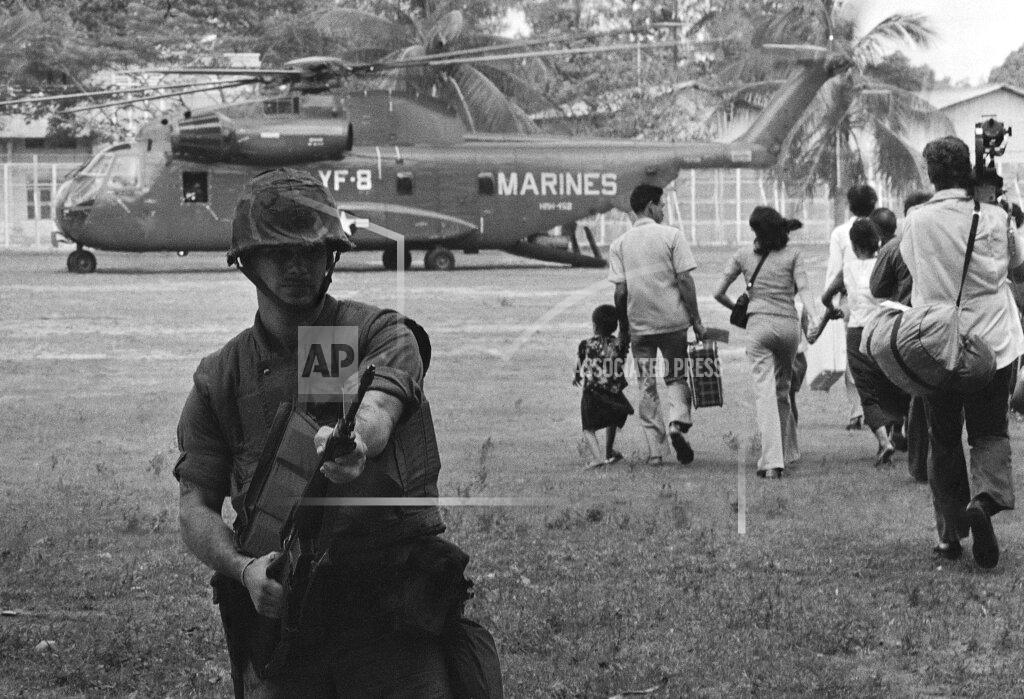
The U.S. ambassador to Cambodia and his staff leave Phnom Penh. Operation EAGLE PULL started as the United States closed its embassy in Cambodia, and began the evacuation of all American citizens. American military helicopters from the aircraft carrier USS Hancock, and 180 U.S. Marines from the amphibious assault ship USS Okinawa, arrived at Phnom Penh. There was no interference from the Khmer Rouge during the rescue.
More than a dozen foreign newsmen are staying behind in the embattled Cambodian capital, Phnom Penh, some by their own choice and others because they missed the evacuation helicopters. Among those who chose to stay are Sydney H. Schanberg of The New York Times and his Cambodian assistant, Dith Pran. According to the Associated Press, two other American Journalists, Al Rockoff, a free‐lance photographer, and Richard Boyle, foreign editor of the Pacific News Service of California, are also still in Phnom Penh along with a number of French, Italian and Swedish journalists.
Waiting at the airport are several Cambodian newsmen and their families who have been employed by American news organizations. The Cambodians reached the airport too late because the United States Embassy kept the evacuation operation secret until the last minute. The journalists who were evacated, totaling about 40, got the word as they gathered in the breakfast room, of a hotel only two hours before the operation began at the United States Embassy compound. A total of 276 people were evacuated in four Marine Corps helicopters
Early today President Ford said that despite the evacuation of the American Embassy the United States would continue “to do whatever possible” to support Cambodia. In a statement issued by the White House, Mr. Ford said: “I decided with a heavy heart on the evacuation of American personnel from Cambodia because of my responsibility for the safety of Americans who have served there so valiantly. Despite that evacuation, we will continue to do whatever possible to support an independent, peaceful, neutral and unified Cambodia.” Speaking of the evacuation by the American armed forces, the President said “It was carried out with great skill, and in a manner that reflects the highest credit on all of those American servicemen who participated. I am deeply grateful to them for a job well done.”
The actual evacuation was taking place from landing zones near the American Embassy in Phnom Penh, the State Department said, because, the airport was effectively closed as the result of “Khmer Communists’ rockets, artillery and mortars.” The decision to pull out the last 150 Americans in Phnom Penh meant that no more foreign missions were staffed in Cambodia. It also underscored the belief in Washington that the Cambodian Government could not hold out much longer against the attacking insurgent forces.
The State Department said that the United States regretted the need to withdraw its remaining mission employees “because of its obvious implications for the Government of the Khmer Republic.” It said that the United States was also trying to evacuate foreign nationals working for the United States Government, news services and voluntary agencies, as well as Cambodian employes of the embassy and their families, “and as many other Cambodians who have been associated with us as circumstances permit.”
The State Department said that there was no intention to use military force “but if necessary it will be applied only to protect the lives of the evacuees.” Late last night, a State Department official said that there had been no reports of casualties. He said he did not know yet which Cambodian officials, if any, had elected to be taken out of the country with the Americans. The department said Congressional leaders were consulted last week and again last night about the evacuation plans.
In Cambodia, the Government reacted with anger and a sense of abandonment to Mr. Ford’s speech. In a statement, the Cambodian Government said it was “profoundly disappointed” with Mr. Ford’s speech. It added: “We have noted that the President of the United States seeks to avoid the responsibility for insisting on the request for aid to our people. As for us, we are determined to pursue our struggle in search of a negotiated peace. The attitude of President Ford affects in no way our steadfast position, which consists of seeking a cease‐fire as a prelude to cessation of hostilities and national reconciliation. In the pursuit of this objective, we will not hesitate in the future to revise our attitude toward the great powers.”
Premier Long Boret of Cambodia announced today that a “summit committee” dominated by generals had been formed to run the government and continue the fight against the insurgents. The radio announcement was made several hours after the American Embassy in Phnom Penh had been closed and Ambassador John Gunther Dean and the last remaining staff members were evacuated by helicopter. Fleeing the country on the Ambassador’s helicopter was Lieutenant General Saukham Khoy, who had been acting president of Cambodia since Marshal Lon Nol went into exile on April 1.
The Americans, who had scaled down their embassy staff a week ago from its original 285, had the last remaining foreign mission in the capital and were the only foreign support of the Phnom Penh Government. With the evacuation, that support in effect ended. In fact, the American supply airlift that has been keeping this Government alive for two months ended with yesterday’s flights. The airlift, from South Vietnam and Thailand, had been bringing in up to 1,400 tons of ammunition, fuel and food every day.
Although the airlift built up some stocks, it seems unlikely that the government can now last for more than a few weeks.
Despite heavy fighting in some places, the military situation during the day did not change much. The insurgents surround the capital and all the Government’s isolated provincial enclaves. Their circle around Phnom Penh is less than five miles from the: capital at points, not counting their closerpositions on the eastern bank of the Mekong River. These are primarily shelling sites and are not likely to be routes for ground invasion because of the river. The insurgents are less than three miles from the airport and government lines all around are thin. The shelling of both the airport and Phnom Penh continued during the day.
Prince Norodom Sihanouk said in Peking that the United States had informed him that “everyone in Phnom Penh” wanted him to return there to head a new government and help work out a cease-fire with the Communist forces that have encircled the capital. He said, in a statement that he made public, that he declined the offer which he said had been made in a letter Friday night from George Bush, chief of the American liaison office in Peking.
Administration officials said that the United States believed Phnom Penh’s fate would be decided in the next two or three days.
The Saigon government said that its forces had fought off the Communists at Xuân Lộc, 38 miles northeast of Saigon and on a key road 21 miles southwest of the capital. But it appeared that some Communist units had bypassed Xuân Lộc on both the northern and southern flanks of Route 1, moving westward toward Biên Hòa and Saigon. Indications were growing, however, that an attack on Saigon, regarded by military analysts as imminent, might come from within the city. Many Communist demolition units are believed to be already there, awaiting a signal to begin the kind of attacks that characterized the Communists’ 1968 Tet offensive.
A warning that an “uprising” in Saigon was imminent unless President Nguyễn Văn Thiệu resigns immediately and the Americans leave was made at Tân Sơn Nhứt airport yesterday morning by Colonel Võ Đông Giang, deputy chief of the military delegation of the Việt Cộng’s Provisional Revolutionary Government.
A Saigon Government spokesman said last night that in the battle of Xuân Lộc, the capital of Long Khánh Province, more than 1,000 Communist, troops had been killed in and around the city, which is now in ruins. He put Government casualties at 1.8 killed and 100 wounded. Communist pressure on Xuân Lộc continued today, however. A Government spokesman said that before dawn today the Communists began an artillery attack with 100‐mm. guns and that at 4:50 A.M. Communist infantry and tanks attacked the northern part of the town. The results of the new attacks were not immediately known.
ARVN General Staff sends numbers of South Vietnamese fighter-bombers to slow down or halt PAVN units to attempt major ambushes and attacks at the highway and at Xuân Lộc. South Vietnamese fighter bombers uses 80-120 sorties per day to stiff strong resistance.
Communist troops and tanks penetrated the city last Wednesday and for a time held nearly half of it. According to the Saigon spokesman, 20 Communist tanks and many trucks were destroyed by Government forces, which included airborne troops committed to the defense of Saigon.
The spokesman said that Government forces fighting to maintain control over Route 4, which connects Saigon with the rice‐producing areas of the Mekong Delta, had killed nearly 300 Communist ‐troops.This engagement had been fought 21 miles southwest of here at a point between Tân An, capital of Long An Province, and Bến Tranh, a nearby district capital. At the beginning of the fighting there, Tân An was subjected to shelling and the road was cut for a time. Among the Communist forces reportedly operating in that area are several fresh North Vietnamese units newly infiltrated into the province from the so‐called Parrot’s Beak section of Cambodia.
In other military developments, Communist forces reportedly fired three heavy rockets at Biên Hòa air base early yesterday. The Saigon spokesman said that they had landed in “the vicinity” of the installation and had caused no casualties. Small numbers of rockets were also reported continuing to fall in and around the city of Tây Ninh, northwest of here near the Cambodian border. Last night and early today shelling and infantry attacks were reported at a number of government strongholds in the Mekong Delta, especially in Phong Dinh Province and near Cần Thơ, the second largest city besides Saigon still under government control. Mortar shelling was reported at Phan Thiết, one of the last Saigon‐controlled towns on the South China Sea due east of the capital.
It has been evident in the last few days that Saigon has been using ammunition heavily — especially aircraft bombs and, howitzer shells — despite the rationing that had been ordered. Asked about this last night, the Saigon spokesman acknowledged that the troops and pilots had been warned not to waste ammunition but said they had also been told that they should use whatever was needed to defend themselves adequately.
North Vietnam appears to be pursuing a strategy that seeks the commitment of all of the Saigon Government’s physical and psychological resources to a single battle, the defense of Saigon around Xuân Lộc, United States military sources suggested today. The situation is regarded as analogous to that in 1954 when France’s ability to hold Điện Biên Phủ became the touchIstone for defeat or victory against the Communist forces of Võ Nguyên Giáp, who is still believed to be Hanoi’s military planner.
The impact on Saigon’s morale of the withdrawal of Americans from Phnom Penh and the expected capitulation of the Cambodian capital will be much more important than the military effect, the sources said. North Vietnamese advisers are with the Cambodian insurgents and Hanoi has provided small arms, recoilless rifles, land mines and some light artillery. But there are no important North Vietnamese units in Cambodia that would be freed by Phnom Penh’s fall to enter the campaign around Saigon.
Any indication that United States support for anti‐Communist forces in Southeast Asia is weakening will sap Saigon’s resistance, the sources said. They did not think that the impact of the Cambodian evacuation would be serious, especially when the Saigon forces have rewon some of their lost confidence after their defense of Xuân Lộc. But they said the first hint of a comparable evacuation from Saigon could have a disastrous effect on morale. “What Congress does with the President’s request for aid is far away and not too well understood by the average soldier,” one source said. “But Americans leaving Saigon? That would be proof they could see that we had given up.”
There is widespread fear among American officials in Saigon that in an evacuation, many Americans and almost all the South Vietnamese who have worked for Americans will be trapped. Diplomats familiar with the embassy’s planning say the estimated 6,000 or more Americans still in Saigon could be taken out safely only if Saigon government soldiers and police remained friendly. Few of them believe that if fighting did spread to the capital, the South Vietnamese could be counted to refrain from disorder or violence against the remaining foreigners.
When Đà Nẵng and Nha Trang collapsed two weeks ago, government troops fought their way aboard planes and rioted in the streets, endangering the evacuation of even the small number of Americans. Such problems would be magnified in Saigon, a city of two‐million, which has tens of thousands of police and soldiers. Even the city’s Tân Sơn Nhứt Airport, three and a half miles from the embassy, may not be usable in an emergency, United States sources believe.
The evacuation of American officials and newsmen from Phnom Penh did not change this assessment. One diplomat said it only increased the fear of Vietnamese that the United States would abandon them. Moreover, there were only 150 Americans to be evacuated from Phnom Penh, and most of them were concentrated in two downtown hotels. Whatever the difficulties of getting Americans out of South Vietnam, United States officials say it will be even more difficult to evacuate the hundreds of thousands of Vietnamese who have worked for the Americans. An American diplomat cautioned a friend, “I would advise you to rely on your own resources in getting your Vietnamese out.
Several Vietnamese employes of the embassy said they had been told nothing about plans for evacuating them. “No one has said a word, nothing,” commented a 30‐year‐old secretary who has worked in the embassy for 10 years. “It is very simple,” she added. “The Communists will come and kill us.”
Secretary of the Treasury William E. Simon today assured the Soviet Union that the Ford Administration would work for the removal of barriers to mutual trade, particularly limits on Government‐backed credits. In an interview with Moscow radio, Mr. Simon said that he had had “extremely useful” talks with the Soviet Communist party leader, Leonid I. Brezhnev, and Foreign Trade Minister Nikolai S. Patolichev during his two‐day visit here. “The Government of the United States intends to continue efforts to remove barriers hindering the normal development of trade between our countries,” Mr. Simon said. “Above all this concerns the limitations on credits for Soviet‐American trade.” Mr. Simon left Moscow today for the Black Sea resort of Sochi.
Six Catholic civilians are killed in a Ulster Volunteer Force gun and grenade attack on Strand Bar in Belfast, North Ireland. It is difficult to say how many have been killed,” a police spokesman said. “The place is just a bloody mess, and God knows how many are trapped in the rubble.” A spokesman for the Royal Victoria Hospital said that at least four persons died instantly in the blast. More than 40 persons were taken to hospitals, many of them seriously injured, according to the police spokesman. The bomb was left in a doorway of the Strand bar, a pub in a Roman Catholic enclave of predominantly protestant East Belfast.
Parliament gave a narrow vote of confidence to the right‐of‐center Turkish Government of Premier Suleyman Demirel today. Deputies in the lower house voted 222 to 218 in favor of Mr. Demirel and his four‐party alliance, put together two weeks ago after six months of political impasse. There were two abstentions and five deputies did not vote. When Mr. Demirel’s coalition took power, it controlled 227 of Parliament’s 447 occupied scats, but defections narrowed his majority. The return to power of Mr. Demirel, a former Premier who was forced to resign in 1971 by the military, has been accompanied by clashes between leftists and rightists in which two persons have died.
Rioting convicts did thousands of dollars in damage during an 18‐hour rampage in Santa Maria Maggiore prison here, police sources said. Most of the 120 prisoners who virtually took over the jail returned peacefully to their cells today, but one or two were still holding out on the roof. They were watched by policemen who surrounded the jail soon after yesterday’s violent outburst began. According to first estimates, there was more than $161,000 in damage when prisoners stormed through the jail setting fire to mattresses and smashing windows and furniture. The revolt was sparked by the return of four prisoners from punitive sentences in a Sardinian jail, where they had been sent after similar disturbances a year ago, the police sources said. The four convicts refused to return to their cells after exercise and encouraged others to join them in the revolt.
Former inmates of the Nazi death camp Buchenwald were among 30,000 people at a ceremony in honor of the prisoners who liberated themselves 30 years ago, according to reports from East Germany, where the site of Buchenwald is located. On April 11, 1945, shortly before U.S. troops reached the death camp, inmates rose up against their Nazi guards.
Aleksandr I. Solzhenitsyn said last night in a television interview in Paris that if he had not been imprisoned for his dissident views, “I would have perhaps become a writer in the Soviet Union, but I do not believe that I could have ever really appreciated or understood my true tasks.”
Despite concessions by both developed and developing countries, a preparatory meeting for a world energy conference in Paris remained deadlocked in its sixth day today, but delegates were continuing to try to reach an agreement.
Nearly 300 Soviet Jews demanded that a special international commission be set up to investigate alleged violations of human rights in the Soviet Union over Jewish emigration to Israel. The appeal, directed at Jewish organizations abroad who have dedicated today as “a day of solidarity with Soviet Jewry,” was signed by 280 Jews from 19 Soviet cities and handed by Jewish activists to Western correspondents in Moscow.
President Anwar Sadat of Egypt, who was interviewed outside Cairo, said, in effect, that American mediation in the Middle East is no longer enough and that the administration must state clearly that it wants Israel to withdraw to its borders of 1967. He said that Israeli behavior during Secretary of State Kissinger’s mission last month “has humiliated the United States in the area.” He vowed that in spite of the increased danger of war, he will continue his policy of economic and political liberalization at home. “This policy is irreversible,” he said.
For thousands of Iraqi farmers along the river, which passes the ruins of Babylon here, the low water level and the empty irrigation ditches pose a critical problem, and the Iraqi Government lays the fault to neighboring Syria, which has built a huge dam across the Euphrates. “We are going to take this before the Arab League where we will accuse Syria of violating our water rights,” said Saadoun Hammadi, Iraq’s Foreign Minister.
Syria rejected today an Iraqi request for an urgent meeting of Arab foreign ministers to discuss the disputed distribution of the Euphrates River waters betwen the two countries, the Arab League an nounced. In a message to the league, Syria said the Euphrates problem was a technical question and did not require a meeting of Arab foreign ministers.
New York socialite Hope Cooke, queen of Sikkim, denounced India’s involvement in the political crisis there as colonialism and appealed for the safety of her husband. Indian troops last week subdued the palace guard of the tiny nation’s king, after Sikkim’s national assembly requested a merger, and abolition of the monarchy. Miss Cooke, who is living in New York, described the Indian action as a “bloody assault” and said her husband, who lost most of his powers last year, was being held prisoner.
Archeologists report having unearthed a 3,000‐year‐old settlement in eastern China where relics throw new light on the early use of the Chinese language. Hsinhua, the official New China News Agency said yesterday that the settlement, dating to the Shang Dynasty of the 16th to 11th century B.C., had been uncovered at a commune at Wucheng. Kiangsi Province, in the Yangtze River Valley. Relics found included household utensils, pottery and casts for moulding bronze arrowheads. Initial studies revealed more than 60 characters and markings on pottery in groupings seldom found elsewhere. The agency said that the presence of so many characters indicated wide use of a written language and meant that Chinese was spoken before the time of the the Shang Dynasty.
President Ford told Japanese leaders that the United States would continue its role in maintaining peace in Asia, a White House spokesman said. In a 20-minute meeting with Japanese Foreign Minister Kiichi Miyazawa, the President “reaffirmed the high importance we attach to our alliance with Japan and our determination to continue our vital role as regards the future peace and stability of Asia,” the spokesman said.
Vice President Rockefeller will head a nine-member U.S. delegation to the funeral Wednesday of President Chiang Kai-shek in Taiwan. Others in the delegation named by President Ford include Senator Barry Goldwater (D-Arizona), Senator Hiram Fong (R-Hawaii), Rep. Roy Taylor (D-North Carolina), Walter Judd, a former congressman from Minnesota, and Mrs. Anna Chennault, widow of “Flying Tiger” General Lee Chennault, and a leading figure in the U.S. China Lobby.
Prime Minister Abdul Razak said today that recent Communist attacks on Malaysian security forces could have been inspired by events in Indochina. Mr. Abdul Razak told reporters that it was proving difficult to track down the guerrillas who killed 12 soldiers and wounded 25 others in the northern states of Kedah and Perak this week. More troops were being sent to the two states near the Thai border, he said. Army troops in Kedah reportedly clashed yesterday with the guerrillas, who then retreated deeper into the jungle.
President Ferdinand E. Marcos has called for a review of the Philippines’ security relationship with the United States because of the “apparent new perception of American commitments to its allies, particularly in Asia,” high government sources said in Manila. The sources said they were disturbed by the impression that commitments made by U.S. presidents “do not bind the American people, the Congress or the government.”
Douglas Cellini, a Frenchman who set sail for Texas in a 25-foot boat after recent open heart surgery, reported that he had gone aground west of Marseilles, about 30 miles after beginning his voyage. Cellini, 43, had said he wanted to show other heart patients “that we’re not invalids.”
A country music singer, calling his flight “an aerial ballet” staged to protest loss of his pilot’s license, buzzed the Calgary Airport control tower and several buildings before dumping 100 pounds of manure on the Canadian city along with 100 copies of one of his records. After a three-hour nighttime flight, Cal Cavendish, 34, landed the stolen single-engine plane on a dirt road. Then he went to a bar for a beer and a sandwich before hitchhiking to the police station to surrender. Cavendish’s license was suspended because he had sought psychiatric treatment.
A civilian has been killed and an unknown number of soldiers and civilians have been wounded in clashes between rival liberation movements in Luso, a town in east central Angola, Portuguese military authorities said today. An official statement said the situation in Luso was now under control after fighting between the Marxist‐led Popular Movement for the Liberation of Angola and the National Front for the Liberation of Angola. The authorities did not say what prompted the fighting, which occurred on Wednesday.
Arson is said to be the country’s fastest growing major crime. Nationwide, known losses from arson are expected to total more than $1 billion this year for the first time, and are estimated to be increasing 10 to 15 percent annually. Arson investigators believe that the recession is a principal factor in the increase.
Daniel P. Moynihan characterized the nation’s liberal establishment last night as exhibiting a “failure of nerve” and an “immobilized” state of mind that constituted an accommodation “to totalitarianism without precedent in our history.” The former Ambassador to India maintained that Americans no longer manifested any interest in freedom overseas but only with “freedom from involvement.”
A 26-year-old Buffalo woman said yesterday that she had infiltrated the Attica defense camp and reported back to the Federal Bureau of Investigation on legal strategy surrounding the trials of former inmates under indictment for crimes stemming from the 1971 prison rebellion.
The Internal Revenue Service continued a form of political surveillance as long as 17 months after the agency officially, ended such activities, according to court documents in Los Angeles.
Seven states and Puerto Rico have been forced to borrow from the federal government to pay unemployment insurance benefits, government officials said. Trust funds in several other states are nearly depleted and the special fund that makes loans, the Federal Unemployment Account, is at its lowest level in years — $53.8 million. Since January, the government has lent a total of $491 million, and the Ford Administration is seeking $5 billion to replenish the fund and to pay the federal share of existing unemployment compensation programs. The states that have borrowed funds are Connecticut, Massachusetts, Michigan, New Jersey, Rhode Island, Vermont and Washington.
New beef-grading standards will not be implemented unless a federal court injunction issued in Nebraska is overturned, Agriculture Secretary Earl L. Butz said. Butz contradicted one of his department’s lawyers, Robert Werdig, who had said he saw no reason why the standards should not be implemented Monday, as scheduled. The new standards have been strongly criticized by national consumer organizations. Essentially, the standards would allow lowering of the fat marbling required for cattle to be graded “choice,” thus allowing cattle in the classification to be fed more cheaply on more grass and less grain.
Financially plagued Mansion House Center in St. Louis has been ordered to pay $8.5 million immediately to the federal government as the result of a government audit showing “massive and flagrant irregularities” in the project’s operations. The owners of the downtown apartment and hotel complex were also notified that their mortgage arrangement with the government, criticized as a “sweetheart” deal, had been canceled. Owners include Henry Ford II of the Ford Motor Co. and top executives of International Telephone and Telegraph Co, including its chairman, Harold Geneen. Among violations cited were excessive management fees, uncollected rent of $111,000 on a single apartment and diversion of federal funds to convert one of the buildings in the complex into a hotel.
Democrats outnumber Republicans 2 to 1 as the number of Americans professing allegiance to the GOP continues to slide, according to a Gallup Poll of political party affiliations. Twenty-two percent of the voters. questioned classified themselves as Republicans, 46% as Democrats and the balance, 32%, as independents or members of minor parties. The percentage of Republicans was the lowest since Gallup first measured political affiliations 35 years ago. The trend has been steadily downward since October, 1972.
Adm. Hyman G. Rickover charged that the Navy had become a top-heavy land force with layers of bureaucracy stifling initiative and sapping productive energy. In remarks for delivery to the Marine Club of Hartford, Connecticut, where he received an award, Rickover said, “The Navy and Defense Department would do well to cut out much of the layering, the staffs, the over-administration. As it is, he said, the Navy has 288 admirals for its 500 ships. Only 31% of all Navy officers are assigned to ships, he said, with the remainder holding down desk jobs on shore.
Arson and murder charges were filed against a textile millhand, Sylvester Brown Jr., 27, in Beulah, Alabama, in a house fire that killed nine children, five of them his own. The nine victims, including a babysitter and ranging in age from 5 months to 14. years, were killed when fire swept a five-room farm home belonging to Emma Lee Patterson, the Brown children’s grandmother.
A simply prepared drink in which sugar and salt are among the constituents has proved so successful in the treatment of severe diarrhea that it promises to eliminate cholera as a major killer and perhaps mitigate the effects for tourists and babies of other such disorders, according to a specialist in the diseases of the intestinal tract. The assessment was presented by Dr. Eugene Gangerosa of the Center for Disease Control of the United States Public Health Service in Atlanta. However, another physician says that the mixture could not be patented and thus might not promise sufficient profits to interest drug companies.
The Los Angeles Police Department, in a move to reform its intelligence-gathering activities, says it has destroyed nearly two million secret files it kept on Los Angeles citizens and organizations over the last 50 years.
The National Aeronautics and Space Administration has invited scientists to propose experiments for a new, unmanned Moon‐orbiting spacecraft, the first American moon mission since the end of the Apollo project in 1972. According to preliminary plans, the mission would be launched in June, 1980, and would run at least one year. It would be aimed primarily at mapping the moon’s chemical composition and its gravity field. The mission would be called the Lunar Polar Orbiter. Scientists have urged for several years that such a mission be the next logical step in the exploration of the moon. The project grew out of a 1972 post‐Apollo study of the Lunar Science Institute in Houston.
[Ed: Government indifference led to the cancellation of the polar orbiter. A similar mission, called Clementine, was finally flown in 1992, and gave the first hint that water might exist in useful quantities at the lunar poles.]
Josephine Baker, the American dancer and singer who became one of France’s most famous music hall stars, died in Paris at the age of 68. She suffered a stroke Thursday, four days after opening a new revue celebrating her 50 years as an entertainer.
Major League Baseball:
At Yankee Stadium, the Tigers do all their scoring in the 7th to beat the Yankees, 7–1. Starter Pat Dobson surrenders a homer to Bill Freehan and a grand slam to Nate Colbert.
Boston Red Sox 3, Baltimore Orioles 2
Chicago White Sox 3, California Angels 4
Montreal Expos 3, Chicago Cubs 6
Los Angeles Dodgers 5, Houston Astros 7
Minnesota Twins 1, Kansas City Royals 2
Cleveland Indians 5, Milwaukee Brewers 6
Detroit Tigers 7, New York Yankees 2
St. Louis Cardinals 7, Philadelphia Phillies 5
Cincinnati Reds 2, San Diego Padres 3
Atlanta Braves 7, San Francisco Giants 4
Oakland Athletics 5, Texas Rangers 4
Born:
Angel Rubio, NFL defensive end (Arizona Cardinals), in Los Angeles, California.
Marcie Alberts, WNBA guard (Cleveland Rockers), in Wooster, Ohio.
Died:
Josephine Baker, 68, African-American dancer, who attained fame in France and then worldwide, actress, and civil rights activist, dies of a cerebral hemorrhage.
 History Diaries