The Norwegian government and Royal Family have left Oslo and Quisling has been installed by the Nazis to lead a new government.
German minister for Norway Curt Bräuer traveled to Elverum, Norway where the legitimate government of Norway had moved to after the invasion. Bräuer demanded that King Haakon appoint Vidkun Quisling Prime Minister and return to Oslo. In an emotional meeting with the cabinet, King Haakon let it be known he would sooner abdicate than appoint any government headed by Quisling. By this time, the news of Quisling’s treason had reached Elverum. The government unanimously voted to advise the king not to recognize Quisling and urged the people to continue to resist. With no popular support, Quisling was no longer of use to German Chancellor Adolf Hitler.
German forces at Oslo, Kristiansand, Stavanger, Bergen, Trondheim, and Narvik consolidate and expand perimeters.
With their seizure of so many of the country’s large towns the Germans have taken most of the stocks of arms at the Norwegian mobilization centers. The Norwegians, therefore, have even less chance for resistance than might have been expected.
Denmark is under German occupation.
With Denmark occupied by the Nazis, Iceland effectively declared independence when the Althing granted full powers of government to the Icelandic cabinet. The Icelandic parliament, Althing, granted full powers of government to the Icelandic cabinet, thus effectively declaring independence from Denmark, which was then under German occupation.
The Battle of Midtskogen was fought in the early morning hours and resulted in Norwegian victory. At Midtskogen farm, situated approximately 5 km (3.1 mi) west of the town Elverum at the mouth of the Østerdalen valley in southern Norway, German forces of about 100 Fallschirmjäger traveling in a convoy are ambushed by a scratch Norwegian force of Norwegian Royal Guards and local rifle club volunteers. The Germans are searching for King Haakon. At about 01:30, they are stopped at a roadblock and a firefight erupts. While casualties are light, the military attaché Hauptmann Eberhard Spiller, leader of the expedition, is killed. The Germans turn around at about 03:00 and head back to Oslo. The battle, while only a skirmish, is important for Norwegian morale.
Elsewhere, the Wehrmacht is largely unopposed and expands its holdings wherever they have landed. The ground troops at Narvik, however, are extremely isolated and short of supplies.
Nikolaus von Falkenhorst was mentioned in the Wehrmachtbericht daily radio report.
Narvik is the most isolated spot in Norway that the Wehrmacht has occupied, so German forces there are dangling perilously on the end of a long string. It is the one area in the entire country where the Allied forces could be said to have a home-field advantage. However, Allied ineptitude and unpreparedness will soon squander that advantage.
The Königsberg-class light cruiser SMS Königsberg was bombed and sunk at Bergen, Norway by Blackburn Skuas of 800 and 803 Naval Air Squadron, of the Royal Navy Fleet Air Arm. She was the first major warship to be sunk by dive bombing in the war. The raid consisted of sixteen Blackburn Skua dive bombers of the British Fleet Air Arm (seven of 800 Naval Air Squadron and nine of 803 Naval Air Squadron), launched from RNAS Hatston, Orkney. Königsberg’s thin deck armor rendered her quite vulnerable to dive bomber attack. The Skuas attacked in three groups: the nine of 803 NAS, six of 800 NAS, and one aircraft of 800 NAS which lost contact during the outward flight but found Königsberg independently. The dive bombers attacked at 7:20, catching the ship’s crew off guard. Half of the dive bombers had completed their dives before the crew realized they were under attack. Only one large anti-aircraft gun was reported as being manned with shells being fired once every five seconds from the aft of the ship with lighter anti-air weapons firing from the shore and adjacent ships firing even later in the attack.
Königsberg was hit by at least five 100-pound (45 kg) bombs, which caused serious damage to the ship. One penetrated her thin deck armor, went through the ship, and exploded in the water, causing significant structural damage. Another hit destroyed the auxiliary boiler room. Two more bombs exploded in the water next to the ship; the concussion from the blasts tore large holes in the hull. She took on a heavy list almost immediately, and the captain ordered the crew to abandon the ship. It took slightly less than three hours from the start of the attack for the ship to completely capsize and sink, which gave the crew enough time to evacuate many of the dead and wounded. They also had time to remove a significant amount of ammunition and equipment from the stricken cruiser. Only eighteen men were killed in the attack.
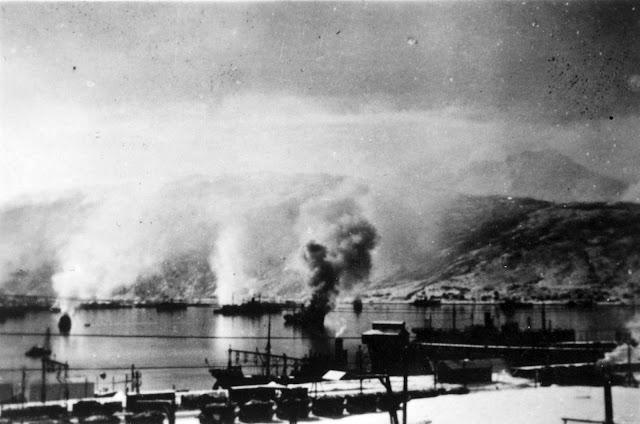
The 2nd Destroyer Flotilla under Commodore Bernard Warburton-Lee comprising of five H class destroyers: the HMS Hardy (flagship), HMS Hotspur, HMS Havock, HMS Hunter and HMS Hostile moved up the Ofotfjord at Narvik in the early morning. This force surprised and engaged a German force at the entrance to the harbor and sank two destroyers SMS Wilhelm Heidkamp (killing the German naval commander, Kommodore Friedrich Bonte) and SMS Anton Schmidt, heavily damaged the destroyer SMS Diether von Roeder and inflicted lesser damage on two other destroyers. They also exchanged fire with German invasion troops ashore, but did not have a landing force aboard and therefore turned to leave. Before the destroyers left the scene the HMS Hostile fired her torpedoes at the merchant ships in the harbor. In total eleven merchant ships (six German, one British, two Swedish and two Norwegian) were sunk during the engagement. The German cargo vessels Aachen, Altona, Frielinghaus, Hein Hoyer, Martha Heindrik Fisser and Neuenfels, the Norwegian cargo ships Elrid and Saphir, the Swedish cargo ship Boden, and the British cargo ship Blythmoor are also sunk and the Swedish ship Stråssa is damaged; she blows up and sinks on 11 May.
As the British flotilla was leaving it engaged three more German destroyers, the SMS Wolfgang Zenker, SMS Erich Koellner, and SMS Erich Giese, emerging from the Herjangsfjord and then two more, the SMS Georg Thiele and SMS Bernd von Arnim coming from Ballangen Bay. In the ensuing battle the HMS Hardy and HMS Hunter were lost and the HMS Hotspur was damaged badly by a torpedo. The HMS Hotspur and the other remaining British destroyers left the battlefield, damaging the Georg Thiele as they left. The German destroyers, now short of fuel and ammunition, did not pursue and the British ships were able to sink the 8,460 ton-ammunition supply ship Rauenfels which they encountered on their way out the fjord. The Rauenfels was carrying supplies for Generalleutnant Eduard Dietl’s 138th Gebirgsjäger Regiment at Narvik. Both the British and German naval commanders were killed in the battle. Warburton-Lee was posthumously awarded the Victoria Cross and Bonte was posthumously awarded the Knight’s Cross of the Iron Cross.
The submarine HMS Thistle commanded by Lt. Commander Wilfrid F. Haselfoot, was torpedoed and sunk by the U-4, commanded by Oberleutnant zur See Hans-Peter Hinsch, while on the surface recharging her batteries southwest off Stavanger, Norway, at 0213 hours. The HMS Thistle had earlier fired upon the U-4 but missed. All of the ship’s complement of 53 died.
British submarine HMS Tarpon attacked a German vessel (Q-ship), Schiff 40 (trawler Arthur Duncker, 278 grt), with torpedoes 50 miles off of the Danish coast. Schiff 40 fought back with depth charges. Tarpon was sunk during the counterattack, killing the entire crew of 53.
The Raubvogel-class German torpedo boat Albatros ran aground in Oslofjord, Norway after a battle with Oslofjord Fortress and was wrecked.
The German troopship Antares was torpedoed and sunk in the Skaggerak off Lysekil, Sweden (58°11’N 11°17’E) by the Royal Navy submarine HMS Sunfish.
The German troopship Friedenau is torpedoed and sunk in the Skaggerak off the Pater Noster Lighthouse, Sweden by the Royal Navy submarine HMS Triton.
The German troopship Wigbert was also torpedoed and sunk in the Skagerrak off the Pater Noster Lighthouse by the Royal Navy submarine HMS Triton.
The Kriegsmarine vorpostenboot V-1507 was also torpedoed and sunk in the Skagerrak off the Pater Noster Lighthouse by the Royal Navy submarine HMS Triton.
The Swedish fishing vessel Ines struck a mine and sunk in the Skaggerak north west of Hantsholm, Norway with the loss of all six crew.
The German cargo ship Muansa struck a mine and sunk in Oslofjord.
The German cargo ship Planet was scuttled beneath Jan Wellem (Kriegsmarine) to protect the latter against torpedoes off Narvik, Norway.
The German merchant ship Alster was captured by destroyer HMS Icarus in the Vestfjord, north of Bodö and was escorted to Britain by trawler HMS Ullswater. The vessel was renamed Empire Endurance by the Ministry of War Transport (MoWT).
German minelayer Hansestadt Danzig landed troops at Roenne to occupy the island of Bornholm.
Henry Tizard established the Military Application of Uranium Detonation (MAUD) Committee in the United Kingdom to investigate the feasibility of an atomic weapon.
Netherlands defense measures were thrown into high gear early today to guard against a possible surprise attack. Most army and navy leaves were cancelled and government ministers continued conferences into the early morning after two extraordinary sessions of the cabinet to consider what consequences the new war situation in Scandinavia may hold for Holland. The Hague, Amsterdam and other larger cities were calm, but guards were placed at important public buildings.
Belgian government rejects Allied request to allow troops into the country.
French government signs contracts for purchase of 2,400 American fighters and 2,160 bombers with deliveries to begin in September. Many of these will end up in British service after the collapse of France.
French Army officials and members of the American colony in Paris honored at luncheon today the young Americans who are going to the French front this week as drivers with the Myron T. Herrick Section of the American Volunteers’ Ambulance.
Dread of a quickly spreading war gripped the neutral nations of southeastern Europe today as the German invasion of Scandinavia was coupled with reports that the Nazis had demanded the right to police the Danube and the Allies were preparing to strike in the Black sea area. Authoritative quarters said Germany was pressing Rumania, Yugoslavia, Bulgaria and Hungary to accept a strict German guard along the entire navigable length of the great international river by which the Reich imports vast quantities of oil, grain and other supplies.
The Pope is understood to have instructed all Nuncios and Apostolic Delegates in Western, Central and Northern Europe to communicate directly by telephone to the Secretariat of State all the important developments of the war.
The events in Scandinavia make any talk about neutrality pure nonsense, says the Turkish press today.
The newspaper Izvestia, official organ of the Presidium of the Supreme Council of the U.S.S.R., said editorially that the German military action in Denmark and Norway was provoked by the Allies’ “violation of the neutrality” of Scandinavia, the official Tass Agency reported today.
Luftwaffe bombers are intercepted by RAF fighters off Scotland.
The British Home Fleet is now reinforced by battleship HMS Warspite and carrier HMS Furious.
The French battleship Bretagne and cruiser Algerie return to France. They sailed in March for Canada, with 2,379 gold bullion bars part of the national reserve.
The unescorted and neutral Swedish motor tanker Sveaborg was torpedoed and sunk by the U-37, commanded by Korvettenkapitän Werner Hartmann, at 0215 hours northwest of the Faroe Islands in the northern Atlantic Ocean (62°52’N 7°34’W). Of the ship’s complement, 5 died and 29 survivors were picked up by the armed boarding vessel HMS Northern Chief. The 9,076 ton Sveaborg was carrying gas, diesel oil, and fuel oil and was bound for Gothenburg, Sweden.
The unescorted Norwegian motor merchant Tosca was also torpedoed and sunk by the U-37 at 0323 hours approximately 45 miles northwest of the Faroe Islands (62°52’N 7°34’W). Of the ship’s complement, 2 died and 32 survivors were picked up by the armed boarding vessel HMS Northern Chief. The 5,128 ton Tosca was carrying general cargo, including zinc concentrate, cotton seed, lead, wheat, and beans and was bound for Eitrheim, Norway.
Convoy OA.127 departed Southend escorted by destroyer HMS Whitehall from 10 to 12 April. Destroyer HMS Wild Swan joined on the 12th and remained with the convoy until dispersal on the 13th.
Convoy OB.127 departed Liverpool escorted by destroyers HMS Versatile from 10 to 11 April and HMS Vanquisher from 10 to 13 April. Destroyer Vanquisher was detached to convoy HX.32 on the 13th. The convoy dispersed on the 14th.
Convoy OG.25 was formed from convoys OA.125G, which departed Southend, escorted by destroyers HMS Wakeful and HMS Broke from 8 to 10 April, OB.125G, which departed Liverpool on the 8th, escorted by destroyer HMS Verity. The convoy was escorted by destroyers HMS Wakeful, HMS Broke, HMS Verity from 10 April. On the 10th, Wakeful was detached to convoy HG.25 as was destroyer Broke on the 11th. Destroyer Verity was detached on the 11th. French destroyer Chacal escorted the convoy from 11 to 14 April. French torpedo boat Batailleuse escorted the convoy from 11 to 16 April. Destroyer HMS Vortigern escorted the convoy from 14 to 16 April when the convoy arrived at Gibraltar.
Convoy FN.142 departed Southend, escorted by destroyer HMS Vimieria and sloop HMS Black Swan. The convoy arrived in the Tyne on the 12th.
Convoy MT.48 departed Methil, escorted by destroyers HMS Whitley and HMS Westminster, sloop HMS Londonderry, anti-submarine trawlers of the 1ST Anti-Submarine Group. The convoy arrived in the Tyne, later that day.
Convoy FS.142 departed the Tyne, escorted destroyers HMS Whitley and HMS Westminster and sloop HMS Londonderry. The convoy arrived at Southend on the 12th.
Convoy HG.26F departed Gibraltar with seventeen ships. The convoy was escorted by destroyer HMS Velox from 10 to 13 April. French destroyer Lynx and auxiliary patrol vessel Minerve escorted the convoy from 10 to 16 April. Sloop HMS Deptford escorted the convoy from 16 to 19 April. The convoy arrived at Liverpool on the 19th.
Convoy HX.34 departed Halifax at 0800 escorted by Canadian destroyers HMCS Ottawa, HMCS Saguenay, and HMCS Restigouche, which were detached on the 11th. At 1650, Canadian destroyer Ottawa returned to Halifax after colliding with Canadian tug Bansurf (175grt). The ocean escort for the convoy was Battleship HMS Royal Sovereign, which was leaving the command for duty with the Mediterranean Fleet. The battleship was detached on the 20th. Destroyer Ottawa was repaired at Halifax completing on 13 June. Destroyers HMS Warwick and HMS Windsor escorted the convoy from 23 to 26 April, then the convoy arrived at Liverpool.
The War at Sea, Wednesday, 10 April 1940 (naval-history.net)
NORWEGIAN CAMPAIGN
ALLIED SUBMARINE OPERATIONS
At 1604/9th in 59-00N, 05-10E, submarine THISTLE fired six torpedoes at U-4 which submerged in time to evade the torpedoes. THISTLE received orders to dive into Stavanger harbour and attack merchant ships there, but when she reported her encounter with the German submarine, was instructed to remain in the area for another chance at the submarine. THISTLE with only two torpedo warheads remaining was then to return to Rosyth. At 0113/10th, U-4 torpedoed and sank THISTLE, which was recharging her batteries on the surface, northwest of Stavanger off Skudesnes in 59.00N, 05.00E. Lt Cdr W. F. Hanselfoot, Lt K. J. Harper, Lt L. A. Jones, Lt R. P. N. Ennor RNR, Warrant Engineer G. A. Bowen, and the entire crew of forty eight ratings were lost.
Submarine TARPON (Lt Cdr H. J. Caldwell), which was on her first patrol and working up, encountered by German Schiff 40 (trawler ARTHUR DUNCKER – 278grt) in 56 43. 5N, 06 20. 33E in the North Sea. At 0620, TARPON fired two torpedoes at the German ship which was outfitted as a Q ship, but in the counterattack, was lost to depth charges. Lt Cdr Caldwell, Lt Cdr C. B. L. Wren RNR (Ret), Lt L. H. Kettle, S/Lt H. D. A. Weatherall, Warrant Engineer R. W. Sherry, and forty-eight ratings were lost.
At 1150, submarine SUNFISH fired one torpedo at German steamer HANAU (5892grt) three miles off Masekar Light, Sweden.
At 1520, submarine SUNFISH fired two torpedoes at a German steamer off Masekar Light. The attack was observed by a trawler of the German 7th VP Flotilla.
At 1626/10th, submarine TRITON in the Kattegat in 57-50N, 11-23E sighted the 2nd German Transport Convoy. Submarine TRITON fired six torpedoes and sank steamers FRIEDENAU (5219grt), WIGBERT (3648grt) and auxiliary patrol boat Vp.1507 (trawler RAU VI, 354grt). Nine hundred German soldiers of the 340th and 345th Infantry Regiments of the 196th Division were drowned on the two German transports. TRITON escaped the counter attack without severe damage.
At 1822, Polish submarine ORZEL fired two torpedoes at German trawler VP 705 (German trawler CARSTEN – 258grt) off Larvik in the Skagerrak.
At 1845, submarine TRIDENT fired two torpedoes at German steamer WANDSBEK (2388grt) in 58-38N, 10-32E.
At 2000, submarine SUNFISH hit German steamer ANTARES (2598grt) with one torpedo off Skagen in 58 11N, 11 17E, near Lysekill, Sweden, and she sank by the stern at 2230.
Submarine SPEARFISH was under attack by anti-submarine trawlers of the 11th UJ.Flotilla east, southeast of Kristiansand from 1730 to 1840 and again at 2000.
German heavy cruiser LUTZOW left Oslo in the early afternoon of the 19th at 1440 as she was required back at Kiel to prepare for a raid into the Atlantic. As there were no fast escorts in the Oslo Force, it was decided that LUTZOW’s speed and darkness would be sufficient protection. Intelligence reports of the presence and sinkings by submarines TRITON and SUNFISH caused LUTZOW to take a course to the west of these submarines’ patrol areas. Ten miles north of the Skaw at 0029/11th, LUTZOW entered submarine SPEARFISH’s patrol area.
Submarine SPEARFISH sighted and fired six torpedoes at the German cruiser at 0033. She was able to strike LUTZOW with one torpedo, wrecking her propellers and rudder. Some 1300 tons of water flooded into LUTZOW. Not knowing LUTZOW was unescorted, SPEARFISH made off. Captain Thiele of the LUTZOW considered running his ship aground near Laeso Island, but word that auxiliary minesweepers of the 19th Flotilla and auxiliary submarine chasers of the 17th UJ Flotilla along with two German and Danish tug GARM coming to his aid held him off. At 0900/11th, four torpedo boats, including torpedo boats LUCHS, SEEADLER, and GREIF, and four escort ships, including auxiliary minesweepers M.1907 (trawler HEINRICH BAUMGARTEN, 467grt) and M.1908 (trawler YORCK, 470grt), the tugs arrived and six hundred men were taken off LUTZOW and taken to Frederikshavn. LUTZOW was towed back to Kiel arriving late on the 13th.
Light cruiser MANCHESTER, returning to Scapa Flow for refueling, reported running over a submerging German submarine in the North Sea at 0057.
Destroyers HESPERUS and HAVANT departed Scapa Flow at 1430 to search for a German submarine reported by aircraft in 58 37N, 1 54W.
Light cruiser BIRMINGHAM, returning to Scapa Flow for refueling, sighted a submarine in 59 28N, 3 23W, but no damage was done to either ship. Destroyers HESPERUS and HAVANT were sent at 1700 to the area to search for the submarine. After this patrol, the destroyers patrolled north of the Shetlands.
U-37 sank Swedish steamer SVEABORG (9076grt) in 62 52N, 07 34W, with the loss of five crew. Norwegian steamer TOSCA (5128grt) received SVEABORG’s distress signal, arrived on the scene to rescue survivors, and was then herself sunk by U-37, in 62 52N, 07 34W. Two crew were lost, and the survivors from both ships rescued by armed boarding vessel NORTHERN CHIEF (655grt).
Swedish fishing vessel INES (48grt) was sunk on a mine northwest of Hantsholm, with the loss of her crew of six.
U-49 sighted two British cruisers west of Stadlandet at 0159.
FIRST BATTLE OF NARVIK
Early on the 10th, German destroyer DIETHER VON ROEDER was supposed to be on patrol across the mouth of Ofotfjord, but the approaches were unguarded. ROEDER was supposed to remain on patrol until relieved by HANS LUDEMANN (HL), but in ROEDER’s diary there was the entry “Am relieving SCHMIDT from 0300 as anti-submarine patrol until dawn.” ROEDER left her patrol area across Ofotofjord and turned towards Narvik with the British 2nd Destroyer Flotilla less than a mile behind in heavy snow and mist. ROEDER anchored at Narvik at 0420. German refueling was far behind schedule. While tanker JAN WELLEM (11,776grt) had arrived on schedule, the second tanker, KATTEGAT (6031grt) was sunk late on the 9th before reaching Narvik. LUDEMANN and HERMANN KUNNE (HK) were alongside the converted whaler JAN WELLEM when the British attack began at 0430.
Destroyer HARDY went in first into the harbour and fired seven torpedoes. One exploded in the after magazine of destroyer WILHELM HEIDKAMP (WH) blowing off her stern; eighty-one crew members including Commodore Bonte were killed. Finally, on the 11th at 0600, as a result of culminating damage, HEIDKAMP capsized and sank. Other torpedoes from HARDY struck merchant ships in the harbour. As destroyer HARDY withdrew, destroyers HUNTER and HAVOCK entered the harbour firing torpedoes. Torpedoes from HAVOCK struck ANTON SCHMITT (AS) , seriously damaging her. Destroyer KUNNE, getting underway from alongside the tanker, was near SCHMITT when the torpedoes hit and sustained damage to her engines from the concussion. SCHMITT, rolling over, settled onto KUNNE immobilizing her for forty minutes. Sixty-three crew were killed on the destroyer SCHMITT. German destroyer LUDEMAN had a gun knocked out from shellfire and a fire which necessitated flooding of her after magazine. Two crew were killed on the destroyer LUDEMAN.
Destroyers HOSTILE and HOTSPUR had been detailed to neutralize nonexistent coastal batteries on the north shore of Narvik. Upon finding no batteries, the destroyers entered the harbour fight. Destroyer HOTSPUR fired torpedoes at numerous merchant ships in the harbour and HOSTILE went into a gun action with German destroyer ROEDER damaging her so severely that the German captain ordered his ship abandoned. As the destroyers withdrew, destroyers HOSTILE and HOTSPUR laid a smoke screen and HOSTILE fired her torpedoes against merchant ships in the harbour. The 2nd Destroyer Flotilla then began its withdrawal out of the fjord. During this battle, British steamer BLYTHMOOR (6582grt), Norwegian steamers SAPHIR (4306grt) and ELRID (1712grt), Swedish steamers STRASSA (5602grt) and BODEN (4265grt), German steamers FRIELINGHAUS (4339grt), HEIN HOYER (5836grt), NEUENFELS (8096grt), MARTHA HEINDRIK FISSER (4879grt), AACHEN (6388grt), ALTONA (5398grt) were lost to British torpedoes and British and German gunfire. Six of crew of the BLYTHMOOR were lost. Thirty crew were interned in Sweden. Seven of the British steamer crew were picked up by HM ships and returned to England. The entire crew of Norwegian steamer ELRID was rescued. The wreck of ELRID was sunk on 5 May. The wreck of Swedish steamer STRASSA was sunk on 11 May by an internal explosion.
German destroyers WOLFGANG ZENKER (WK), ERICH GIESE (EG), and ERICH KOELLNER (EK) in Herjansfjord, waiting to refuel, got the alarm of the British intrusion at 0515 and got underway at 0530. They chased the British ships up the fjord and theywere on the verge of escaping as the German destroyers did not have fuel to continue the chase further. However, German destroyers GEORG THIELE (GT) and BERND VON ARNIM (BA), getting underway from Ballengenfjord at 0540, contacted the British force and attacked. In the ensuing fray, THIELE had two guns knocked out, a magazine flooded, was set afire and ARNIM was hit five times and had a boiler room flooded. Destroyers ZENKER, KOELLNER and GIESE expended more than half of their ammunition. Fifteen crew were killed and twenty three wounded on destroyer THIELE. Two crew was killed on destroyer ARNIM.
In the exchange, destroyer HARDY was badly damaged and was run aground near Virek to prevent sinking. Captain B. A. W. Warburton-Lee, Lt E. K. U. Clark, MVO, Lt C. P. W. Cross, sixteen ratings were killed. The surviving crew went ashore. Lt Cdr R. C. Gordon-Smith, Paymaster Lt G. H. Stanning, Temporary Surgeon A. P. B. Waind RNVR, six ratings were seriously wounded. Gordon-Smith died of wounds on 17 July 1940. Three other ratings were less seriously wounded. Waind, left in a local hospital, was later captured by the Germans. He was repatriated in 1944. Destroyer HUNTER was also badly damaged. As she lost speed, she swerved into the path of destroyer HOTSPUR which was unable to avoid ramming her. In this condition, HUNTER was sunk and HOTSPUR was badly damaged by German gunfire. Lt Cdr L. de Villiers, Lt K. B. P. Pearson, Lt H. R. M.Maidlow, Probationary S/Lt P. N. Lancaster RNVR, Probationary Temporary Surgeon Lt H. G. Evans RNVR, ninety eight ratings were lost with HUNTER. Forty-six survivors, including Lt H. A. Stuart-Menteth, Lt (E) A. G. Reid, Acting Gunner (T) J. H. Coombe, were picked up by German destroyers ZENKER, KOELLNER, GIESE. They were put ashore on the 13th from destroyer GIESE where they had been held. Stuart-Menteth and thirty-seven ratings were later able to escape to Sweden. Lt Reid and eight ratings remained prisoners of war through the end of the war. Gunner Coombe died of wounds on the 23rd and four ratings also died of wounds and exposure.
Destroyers HOSTILE and HAVOCK escaped without serious damage, but HOTSPUR suffered thirteen ratings and the NAAFI manager killed, with three other ratings dying of wounds, S/Lt L. J. Tillie and ten ratings wounded. Retiring up the Fjord, destroyers HOTSPUR, HAVOCK, and HOSTILE encountered the German supply ship RAUENFELS (8460grt) carrying the Narvik force’s ammunition supplies. Destroyers HAVOCK and HOSTILE hit RAUENFELS several times with gunfire and a fire was started that soon detonated the ammunition and destroyed RAUENFELS. Destroyer HAVOCK picked up the Captain and eighteen crew from one boat from the German steamer. The two other boats rowed ashore and were captured by Norwegian forces. Destroyer HAVOCK sustained some hull damage from the concussion, but the German forces at Narvik now had no reserve ammunition which was sorely needed.
Light cruiser PENELOPE and destroyers BEDOUIN, ESKIMO, PUNJABI, and KIMBERLEY hastened into Vestfjord to guard the retirement of destroyers HOSTILE, HAVOCK, and HOTSPUR. On meeting the retiring the 2nd Flotilla, PENELOPE, BEDOUIN, ESKIMO, PUNJABI, KIMBERLEY, and HAVOCK returned to support the 20th Destroyer Flotilla guarding the Vestfjord minefields. Damaged destroyer HOTSPUR arrived at Skelfjord at 1640 escorted by destroyer HOSTILE. Destroyer HOTSPUR departed Skelfjord during the forenoon of 20 April and arrived at Scapa Flow at 2200/23rd. Destroyer HOTSPUR departed Scapa Flow at 2030/26th in the company of damaged anti-aircraft cruiser CURACOA for Chatham, arriving on 1 May, for repairs completed in mid July 1940.
German destroyers GIESE and ZENKER were refueled by early afternoon, but KOELLNER would not be ready until midnight. Destroyer ROEDER was so badly damaged that she could not leave the pier, so she was assigned in an immobile harbour defence role. The other four surviving German destroyers at Narvik required much work before they would be fully combatant units again; two days would be required to make the ships merely fit to go to sea.
LIGHT CRUISER KONIGSBERG BOMBED AND SUNK
Early on the 10th, five Fleet Air Arm Skuas from 800 Squadron (Captain R. T. Partridge, RM; Petty Officer Airman H. A. Monk, Petty Officer Airman Jack Hadley, Lt E. W. T. Taylour, Lt J. A. Rooper) and eleven from 803 Squadron (Lt W. P. Lucy; Captain E. D. MacIver, RM, Lt A. B. F. Harris, Lt H. E. R. Torin, Lt L. A. Harris, Lt W. C. A. Church, Lt B. J. Smeeton, Lt C. H. Filmer, Acting Petty Officer Airman T. F. Riddler, Lt K. V. V. Spurway, Acting Petty Officer Airman J. A. Gardner) from Hatston, attacked the German light cruiser KONIGSBERG at Bergen sinking her with three direct hits and two near misses. Captain Partridge and Lt E. W. T. Taylour of the 800 Squadron, Lt C. H. Filmer, Lt A. B. Fraser-Harris, Lt E. D. Mciver, RM, of the 803 Squadron made damaging attacks. One Skua of the 803 Squadron with Acting Lt B. J. Smeeton and Midshipman (A) F. Watkinson was lost. Eleven crew were killed in the cruiser. The Germans were later able to refloat KONIGSBERG in 1942, but the cruiser capsized on 29 July 1944. The cruiser was stripped for equipment and scrapped after the war.
On the 10th, German torpedo boat ALBATROS after damage by gunfire was ran aground in Oslofjord at Bolarne. Her damaged was found to be beyond repair, and she was abandoned, towed into deep water and sunk.
Admiral Forbes’ Main Fleet was reinforced at about 0800 by the arrival of battleship WARSPITE with destroyers ESCORT, ECLIPSE, JANUS, JUNO, and JAVELIN from Scapa Flow and aircraft carrier FURIOUS with destroyers ASHANTI, MAORI, and FORTUNE from the Clyde.
Light cruiser AURORA arrived in Scapa Flow with destroyer GURKHA survivors during another air raid by German bombers. Light cruisers SHEFFIELD and GLASGOW were in harbour refueling. As on the 8th, the raid, which took place between 2102 and 2148, caused no damage.
At 1525, off Varoy in 67 33. 5N, 12 47. 5E, destroyer GREYHOUND escorting destroyer HAVOCK attacked U-64 without success. GREYHOUND dropped one pattern of depth charges and the submarine was presumed sunk or badly damaged, but no damage was done.
Destroyer FEARLESS arrived at Sullom Voe at 0630 to refuel.
Mid-morning on the 10th, the aircraft carrier FURIOUS was being considered for an air strike on Bergen, but the decision was made to leave Bergen to the Fleet Air Arm and the Royal Air Force and the FURIOUS would launch her planes against ships at Trondheim. Admiral Forbes now had with him battleships RODNEY, VALIANT, and WARSPITE, carrier FURIOUS, heavy cruisers DEVONSHIRE, BERWICK, and YORK, and destroyers ASHANTI, COSSACK, ZULU, MAORI, ECLIPSE, ESCORT, ISIS, ILEX, IMOGEN, INGLEFIELD, JANUS, JAVELIN, JUNO, FORESTER, FOXHOUND, and FAULKNOR.
Destroyers HERO and HYPERION left Sullom Voe at 0300 after refueling on the 10th and joined Forbes at sea. North, northeast of the Shetlands at 1007, HERO attacked a submarine contact which was later thought to have been U-50 on her second war patrol. However, the target was not a submarine and U-50 had already been lost.
With this force, Forbes steered north to a position where FURIOUS could fly off her aircraft against Trondheim on the 11th and cover the movement of convoy HN.25 to Rosyth.
German steamer MUANSA (5472grt) was lost on a mine near Oslofjord.
Just after dark on the 10th, German heavy cruiser ADMIRAL HIPPER and destroyer FRIEDRICH ECKHOLDT left Trondheimsfjord but in heavy seas, ECKHOLDT had to turn back and make her way back to Trondheim. Due to the non arrival of German tanker SKAGERRAK (6044grt), ADMIRAL HIPPER was forced to return to Germany without refueling and she would ultimately arrive at Wilhelmshaven with 123 tons of fuel remaining in her bunkers. German battleships GNEISENAU and SCHARNHORST had been patrolling in the Arctic waiting to escort the Narvik group back to Germany, but the damage done to the destroyer force by the British 2nd Destroyer Flotilla precluded the necessity of a escort at this time. Battleships GNEISENAU and SCHARNHORST refueled from their supply ship NORDMARK (10,845grt) and later rendezvoused with German heavy cruiser ADMIRAL HIPPER at 0830/12th.
The German force was sighted off Egersund at 0721 on the 12th by a British Hudson of 224 Squadron, but contact was lost at 0925. Seven Blenheims of 224 and twelve of 233 Squadrons of Coastal Command were airborne searching in the area. Thirty-six Wellington of 9 (nine aircraft), 37 and 75 (eleven aircraft), 38 and 149 Squadrons (twelve aircraft) and twenty four Hampton bombers of 44 (seven aircraft), 50 (five aircraft), 61, 144 Squadrons of Bomber Command aircraft attempted to attack but none contacted the German force due to snow, sleet, low visibility. The twelve Hamptons of 61 and 144 Squadron turned back due to being unable to locate the target. Four Hamptons of 50 Squadron and two of 44 Squadron, one Wellington bomber from 9, one from 38 Squadron, two from 149 Squadrons, one Hudson from 233 Squadron were lost to air attacks. At 1000/12 April, the German force was joined by German destroyers BEITZEN and SCHOEMANN and all arrived at Wilhelmshaven during the evening of 12 April.
The evening of 10 April, destroyers BEDOUIN and ESKIMO were south of Tjeldoy. Destroyers PUNJABI and KIMBERLEY were northeast of Tranoy. Light cruiser PENELOPE was off Tranoy Light. Destroyers GREYHOUND and HAVOCK were submarine hunting off Rost. Destroyers ESK (D.20), ICARUS, and IVANHOE were patrolling in Vestjord with battlecruisers REPULSE and RENOWN out to seaward. Destroyers HOSTILE and HOTSPUR were anchored at Skelfjord.
On the night of 10 April, destroyers BEDOUIN and ESKIMO on patrol at Baroy were attacked by U-25, which fired torpedoes at BEDOUIN, but they prematurely exploded. BEDOUIN was undamaged and continued patrol, thinking the explosions were detonations of a radio-controlled minefield.
On the night of 10 April, Captain Erich Bey, senior surviving officer of the Narvik Destroyer Group, took his only operational destroyers, GIESE and ZENKER, to sea in an attempt to break out. However, they soon encountered near Tranoy the light cruiser PENELOPE and destroyers PUNJABI and KIMBERLEY and were forced to return to Narvik, undetected.
German minelayer HANSESTADT DANZIG landed troops at Roenne to occupy the island of Bornholm.
#
Minesweeper HALCYON arrived at Dover at 1045 to join the 6th Mine Sweeping Flotilla.
Minesweeper LEDA departed Dover at 1437 to rejoin the 5th Mine Sweeping Flotilla in the Humber.
Tug FAIRPLAY and two lighters grounded at 1900 on the Goodwins. The vessels were refloated at 0830/11th by tug LADY BRASSEY. The lighters were undamaged. Tug FAIRPLAY proceeded to Ramsgate for inspection.
Convoy OA.127 departed Southend escorted by destroyer WHITEHALL from 10 to 12 April. Destroyer WILD SWAN joined on the 12th and remained with the convoy until dispersal on the 13th.
Convoy OB.127 departed Liverpool escorted by destroyers VERSATILE from 10 to 11 April and VANQUISHER from 10 to 13 April. Destroyer VANQUISHER was detached to convoy HX.32 on the 13th. The convoy dispersed on the 14th.
Convoy OG.25 was formed from convoys OA.125G, which departed Southend, escorted by destroyers WAKEFUL and BROKE from 8 to 10 April, OB.125G, which departed Liverpool on the 8th, escorted by destroyer VERITY. The convoy was escorted by destroyers WAKEFUL, BROKE, and VERITY from 10 April. On the 10th, WAKEFUL was detached to convoy HG.25 as was destroyer BROKE on the 11th. Destroyer VERITY was detached on the 11th. French destroyer CHACAL escorted the convoy from 11 to 14 April. French torpedo boat BATAILLEUSE escorted the convoy from 11 to 16 April. Destroyer VORTIGERN escorted the convoy from 14 to 16 April when the convoy arrived at Gibraltar.
Convoy FN.142 departed Southend, escorted by destroyer VIMIERIA and sloop BLACK SWAN. The convoy arrived in the Tyne on the 12th.
Convoy MT.48 departed Methil, escorted by destroyers WHITLEY and WESTMINSTER, sloop LONDONDERRY, anti-submarine trawlers of the 1ST Anti-Submarine Group. The convoy arrived in the Tyne, later that day.
Convoy FS.142 departed the Tyne, escorted destroyers WHITLEY and WESTMINSTER and sloop LONDONDERRY. The convoy arrived at Southend on the 12th.
Convoy HG.26F departed Gibraltar with seventeen ships. The convoy was escorted by destroyer VELOX from 10 to 13 April. French destroyer LYNX and auxiliary patrol vessel MINERVE escorted the convoy from 10 to 16 April. Sloop DEPTFORD escorted the convoy from 16 to 19 April. The convoy arrived at Liverpool on the 19th.
Convoy HX.34 departed Halifax at 0800 escorted by Canadian destroyers OTTAWA, SAGUENAY, and RESTIGOUCHE, which were detached on the 11th. At 1650, Canadian destroyer OTTAWA returned to Halifax after colliding with Canadian tug BANSURF (175grt). The ocean escort for the convoy was Battleship ROYAL SOVEREIGN, which was leaving the command for duty with the Mediterranean Fleet. The battleship was detached on the 20th. Destroyer OTTAWA was repaired at Halifax completing on 13 June. Destroyers WARWICK and WINDSOR escorted the convoy from 23 to 26 April, then the convoy arrived at Liverpool.
French destroyers TRAMONTANE, TORNADE, and TYPHON departed Toulon on the 10th and proceeded to Casablanca for escort duties. Destroyer TYPHON arrived at Gibraltar on the 15th after escorting convoy 87 KF, which departed Casablanca on the 13th. The destroyer departed for Casablanca on the 16th.
In Washington, President Roosevelt issued an executive order freezing all balances or exchange transactions in this country involving Norway and Denmark or their nationals and a proclamation extending the European combat zone to all waters adjacent to the Scandinavian peninsula, thus closing those waters to American shipping. He conferred with several officials on problems pertaining to the European situation, discussed the legislative situation with Senator Barkley and Representative Rayburn and received a delegation representing the Farmers Union.
The Senate considered minor bills, confirmed the nomination of Representative Marvin Jones to be a judge of the Federal Court of Claims and recessed at 4:58 PM until noon tomorrow.
The House passed the bill authorizing a Labor Department survey of productivity and labor costs in industry, heard debate on the activities of the Dies committee and adjourned at 4:02 PM until noon tomorrow.
The Temporary National Economic Committee heard Edsel Ford and others on problems of technology; a Senate Appropriations subcommittee approved the $967,414,878 Navy Appropriation Bill, and the Senate Interstate Commerce Committee heard testimony regarding the Federal Communications Commission’s television order.
U.S. President Franklin D. Roosevelt, acting under the Neutrality Act of 1939, issued a proclamation extending the combat zone to include the northwestern part of the Soviet Union on a line to the southern point of Svalbard, a Norwegian possession, to the northwestern tip of the combat zone issued in the President’s proclamation of November 4, 1939.
U.S. President Franklin D. Roosevelt issued Executive Order 8389, freezing Danish and Norwegian assets in the United States so the Germans could not access them. The United States followed France and Great Britain today in “freezing” by executive action all balances and foreign exchange transactions in which the Danish and Norwegian Governments or their nationals have an interest. President Roosevelt acted by executive order after issuing a proclamation barring all American shipping from the theatre of the latest German military operations. After a conference earlier in the day with Undersecretary of State Sumner Welles and Jesse H. Jones, Federal Loan Administrator, the President ordered that all credit allocations to Norway and Denmark by the Export-Import Bank be rescinded pending the receipt of official information on the exact state of affairs there.
With an eye on intensification of the European war, the U.S. Senate Appropriations Subcommittee today reported favorably a $967,414,878 navy bill under which construction will be started on two 45,000-ton (Iowa-class) battleships, two cruisers, one aircraft carrier, eight destroyers, and six submarines.
Allied victory in the war was declared to be essential to the preservation of liberty and establishment of enduring peace by speakers who addressed the dinner of the Economic Club of New York at the Hotel Astor last night.
The French sign contracts for the purchase of 2,400 fighters and 2,160 bombers, with first deliveries to be in September 1940. A little too late.
Only one major race in Nebraska’s primaries was undecided tonight after unofficial returns from all but a few scattered precincts gave Thomas E. Dewey of New York, a Republican Presidential preference victory by a ratio of 4 to 3.
President Roosevelt and Thomas E. Dewey,of New York emerged from “advisory” primary elections yesterday in Illinois and Nebraska as the undisputed popular-choice leaders far the Presidential nominations in their respective parties.
A move to organize popular support for the nomination for President of Wendell L. Willkie, public utilities official and critic of many New Deal policies, became known yesterday by the circulation of material, in New York, Washington, and elsewhere, favoring his candidacy.
Representative Martin Dies of Texas, chairman of the House Committee to Investigate un-American Activities; told the House today that he would fight the legal battle with Communists to the Supreme Court, if necessary. Mr. Dies appeared to be alluding to proceedings before Federal Judge George A. Welsh of Philadelphia. Judge Welsh issued bench warrants for the arrests of two Dies Committee investigators who seized Communist records there recently. Mr. Dies assailed Attorney General Robert H. Jackson for dismissing indictments against seventeen persons at Detroit who were accused of recruiting illegally for the Spanish Loyalist cause two years ago.
Technological improvements introduced by the Ford Motor Company have increased instead of decreasing employment, Edsel Ford, company president, told the Temporary National Economic Committee today in its study of the effect of technology on employment and business progress.
A parachute-jumping student at the naval air station at Lakehurst, New Jersey plummeted 1,500 feet through the air today before getting his parachute open and then narrowly missed a crowd of women and children spectators as he landed unhurt.
The U.S. Pacific Fleet arrives in Pearl Harbor, Oahu, Territory of Hawaii from California.
Preparation of all major New York World’s Fair stage shows, including Billy Rose’s Aquacade, Railroads on Parade, Michael Todd’s ventures and the Ford Motor Company presentation, is scheduled to come to a complete halt today following the collapse of negotiations between the World’s Fair Corporation and the American Federation of Labor theatrical unions.
In an exhibition game in Ashland, Kentucky, the Yankees collect only 2 hits off Max Macon and Newel Kimball but beat the Dodgers, 7–6. The scoring comes in the 4th on Rolfe’s single, 4 walks, and 2 errors, and in the 6th on Dahlgren’s solo home run. The Yanks do lose Jake Powell, who suffers a brain concussion in a collision. Powell will play just 12 games this season.
“It seems the demarcation line between belligerent and neutral nations is steadily growing thinner,” said Yakichiro Suma, Japanese foreign office spokesman today. It was his only comment on the German invasion of Norway and Denmark.
As the military effort in the China war decreases, the emphasis in the Japanese Army’s program is shifting to a permanent expansion of military and industrial power for Japan’s role in East Asia. Addressing divisional commanders in Tokyo today, General Shunroku Hata, the War Minister, hardly referred to the China operations. “With the advent of Wang Ching-wei’s government, the China affair enters a different stage,” he said. “We face the task of completion of our national defense in conformity with the new situation.”
Current developments at home and abroad have not inspired optimism, in General Hata’s opinion. He said the army must seek a further strengthening of the national structure and the nation’s emergence from a position of dependence on foreign supplies. “Impregnable defense must be established for national security and to cause third powers to understand the Japanese Empire’s immovable strength,” he concluded. Those ideals have been expounded by every War Minister in recent years. What is noticeable in General Hata’s presentation is the shift in emphasis from the China campaign to a permanent increase in I military strength.
Dow Jones Industrial Average: 149.59 (-0.72)
Born:
Gloria Hunniford, Northern Irish broadcaster and actress (“Old Curiosity Shop”) in Portadown, County Armagh, Ulster, United Kingdom.
Naval Construction:
The Kriegsmarine (German Navy) Type IID U-boats U-147 and U-148 are laid down by Deutsche Werke AG, Kiel (werk 276 and 277).
The Royal Navy Flower-class corvette HMS Snowdrop (K 67) is laid down by Smiths Dock Co., Ltd. (South Bank-on-Tees, U.K.).
The Royal Navy Hunt-class (Type II) escort destroyers HMS Hurworth (L 28) and HMS Middleton (L 74) are laid down by Vickers Armstrong (Newcastle-on-Tyne, U.K.); completed by Parsons.
The Royal Navy Hunt-class (Type II) escort destroyer HMS Lamerton (L 88) is laid down by Swan Hunter and Wigham Richardson Ltd. (Wallsend-on-Tyne, U.K.); completed by Wallsend.
The Kriegsmarine (German Navy) Type VIIB U-boat U-100 is launched by F. Krupp Germaniawerft AG, Kiel (werk 594).
The Nihon Kaigun (Imperial Japanese Navy) B1 type submarine HIJMS I-26 is launched by Kure Naval Arsenal, Kure, Japan.
The Nihon Kaigun (Imperial Japanese Navy) Shimushu-class kaibōkan (escort ship) HIJMS Hachijō (八丈) is launched by the Sasebo Naval Arsenal, Sasebo, Nagasaki, Japan.
The Royal Navy Flower-class corvette HMS Gardenia (K 99) is launched by William Simons & Co. Ltd. (Renfrew, Scotland).
The Nihon Kaigun (Imperial Japanese Navy) Kagerō-class destroyer HIJMS Urakaze (浦風, “Wind on the Sea”) is launched by the Fujinagata Shipyards, Osaka, Japan.
 History Diaries