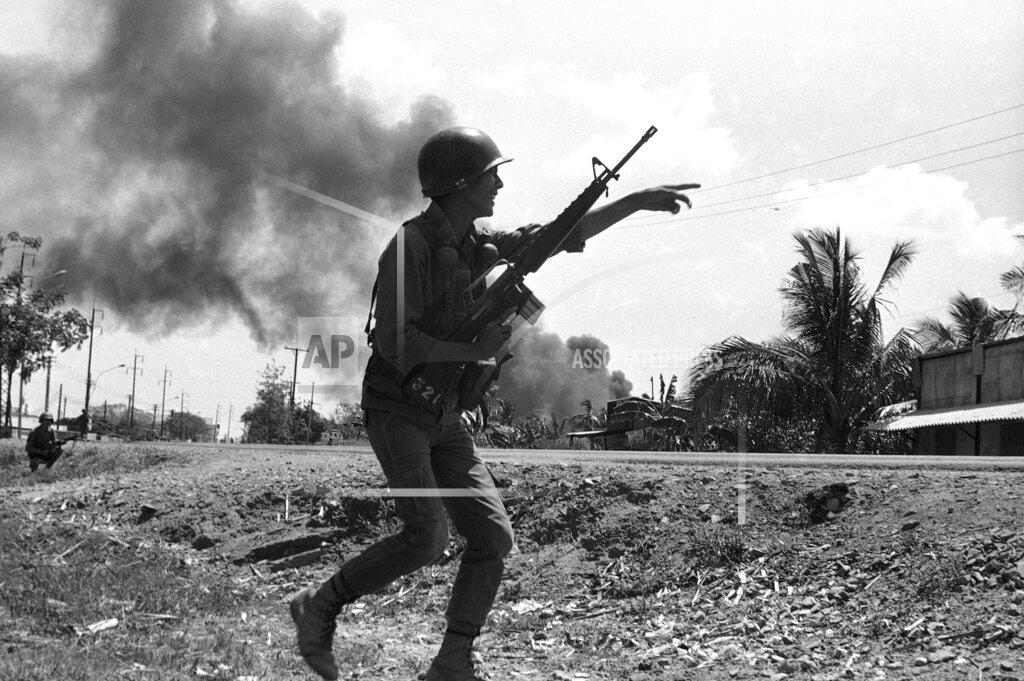
Communist forces, backed by tanks and heavy artillery, maintained their pressure on Saigon with more heavy fighting in and around Xuân Lộc, a key provincial city 38 miles northeast of the capital. Control of the area was uncertain in a fluid battle situation. Reports from the area said that the defenders were not abandoning territory as Saigon troops had done in the last few weeks in retreating from northern parts of the country. Airborne troops at Xuân Lộc were fighting, but Communist soldiers were said to be slipping past them on both sides chopping at their flanks and moving closer to Saigon. Government spokesmen said that South Vietnamese fighter-bombers struck enemy positions in the Xuân Lộc area and that there was destruction or damage to 25 trucks and two tanks. The battle, now in its third day, and fighting along the road west toward Biên Hòa, are considered a critical test of how determined the South Vietnamese are to defend Saigon.
Infantry units continued close fighting with the Communists around Xuân Lộc, reporting that they killed 400 of the opposing force and seized 155 weapons in the last 48 hours. South Vietnamese casualties were given as 16 killed and 85 wounded. Yesterday another 1,000 artillery shells hit Xuân Lộc, a city that until recent days had 100,000 residents and now is virtually destroyed. This morning, officials said that the main opposing force, identified from prisoner interrogations as the 266th Regiment of North Vietnam’s 341st Division, had been forced out of the city, and that Communist commandos had been cleared from what was left of the market place.
On Phú Quốc island in the Gulf of Siam, where some 40,000 refugees from the north have been landed, South Vietnamese officials reported having “shot on the spot” 16 persons they called “undisciplined elements.”
South of Saigon, meanwhile, an increase in Communist probing attacks was reported, with several sharp encounters in areas previously generally free of Communist infiltration. These forays, occurring in the principal rice‐producing area of South Vietnam, further increased tensions here in the capital. Reporting on armed incidents in the delta in the previous 24 hours, a Saigon spokesman said yesterday that they included a clash near Cần Thơ, a provincial capital 125 miles southwest of here. He asserted that 92 of the attacking force had been killed, and put government casualties at 5 wounded.
Closer to Saigon, Communist troops were reported continuing their efforts to sever Route 4, the major road connecting the delta with Saigon. They succeeded in cutting it for a few hours Wednesday about 18 miles from the city and reportedly did so again yesterday in the same general area. But the road, a two‐lane blacktop highway that winds through rice paddies now seasonally dry, was reopened later in the day. The Saigon spokesman said that in all the incidents during the previous 24 hours, government troops had killed 105 of the opposing force while losing 17. He said also that 22 weapons had been captured.
Until late last week, the Delta had been generally quiet, with Communist forces concentrating their efforts on the northern two‐thirds of South Vietnam, where they scored major gains in the last month in brief fights or because of large‐scale, unorganized South Vietnamese retreats. In many cases it took only a few rockets and mortar rounds — or just the sight of some strangers on the edge of town — to send civilians and soldiers into flight. The few units that did stand and fight were soon outflanked by Communists moving into areas vacated by retreating units. There was some concern here in Saigon that the same might be happening in the battle for Xuân Lộc, as indications were reported that Communist troops were bypassing Saigon units, slipping through abandoned rubber plantations, fields and dense jungle.
Northwest of Saigon, in the Tây Ninh area, Communist gunners sent more than 40 rockets into the city, damaging portions of the market and some houses. But government troops reportedly continued to resist the Communist advances. Intelligence sources at Tây Ninh reported large numbers of enemy trucks moving eastward from that area toward Chơn Thành in neighboring Bình Long Province. This could be a move to test the Saigon defense perimeter from the north, since the northwest has so far held.
In other military activity, South Vietnamese naval forces, cruising near Phan Thiết on the central coast, shelled a Communist convoy, reportedly destroying four trucks and two artillery pieces that were being towed.
Refugees who fled from areas of South Vietnam lost by the Saigon government in the last month report that the Communists have moved quickly to round up all ranking South Vietnamese army and government officers. But the refugees said they knew of only a few executions of government officials. According to the refugees, the Communists often appeared surprised by the speed of the local governmental collapse and in many cases, were not prepared to assume the tasks of local administration fully.
But the Communists, usually led by small numbers of teenaged North Vietnamese soldiers, have generally succeeded in restoring order, getting water and electricity running again and taking a census. In addition, the refugees say, students in occupied areas have been ordered to go hack to school, take poltical‐indoctrination courses and report to the Việt Cộng authorities on family members or neighbors who worked for the local Saigon Government structure.
This picture of life in the two‐thirds of South Vietnam that has been yielded to the Communists since March 8 was pieced together from accounts of refugees who fled from such cities as Huế and Quảng Ngãi in the north, Tuy Hòa and Nha Trang on the central coast and Buôn Ma Thuột and Pleiku in the Central Highlands. In almost every case, the refugees related, local people long associated with the Việt Cộng have been appointed to new jobs in Communist civil administrations, but the troops in charge are North Vietnamese. The refugees’ accounts also suggested that the Communists were able to set up new governments most quickly where they had long had strong local sympathy and organized guerrilla movements.
For example, a functioning Provisional Revolutionary Government — as, the Việt Cộng’s political branch is called — was in place almost immediately in Tuy Hòa, the capital of Phú Yên Province, for, years a Việt Cộng stronghold. But in Nha Trang, a prosperous port and resort, 62 miles south, the Communists had still not sent representatives around to houses or reopened schools after a week in control.
A South Vietnamese lieutenant, 26‐year‐old Nguyễn Văn Phú, escaped Buôn Ma Thuột after two weeks of living under the Communists. Buôn Ma Thuột, where there are many nonethnic‐Vietnamese Montagnards, was the first city taken by the North Vietnamese during a sudden attack on March 10. As recounted by Lieuteriand Phú, the Communists’ first act was to set up a “military and administrative committee” near a Buôn Ma Thuột pagoda. On the, first day of the occupation, soundtrucks drove around the city broadcasting an order for all Saigon Government officials, army officers and soldiers to report to the committee, the lieutenant recalled.
“They also ordered all the men to soak the bodies of the dead with gas and burn them while the women were to dig air‐raid shelters,” he said in an interview today.“Communist cadres came around to each house distributing Việt Cộng flags and pictures of Hồ Chí Minh and Nguyễn Hữu Thọ and Huỳnh Tấn Phát” — the late North Vietnamese leader and two top officers of the Provisional Revolutionary Government.
Lieutenant Phú, who had been in charge of paying death benefits to widows of dead soldiers under Saigon rule, said that the cadres had issued small amounts of rice and that they confiscated all the rice in the Saigon Government storehouse and shipped it off in trucks. The cadres also commandeered all cars, Honda motorcycles and trucks, issuing signed slips of paper in exchange, the officer said. “All the students were told to go back to school where they were given propaganda lessons and taught to sing. Việt Cộng songs,” Lieutenant Phú went on. “There were no real classes and it was very scary for me because they were told to report anyone in the family or neighbors who had served with the government.”
A sergeant in whose house Lieutenant Phú was staying followed the Communists’ orders and reported to the new administrative committee. He was told to write a “self‐confession,” listing everything he had done for the “American-Thiệu clique.” But the Communists were so unprepared to govern Buôn Ma Thuột, Lieutenant Phú said, that they did not have any paper and the sergeant had to buy some on his own. The sergeant was released after completing his confession, but other officers and higher-level civil servants were visited in the middle of the night by Communists who took them off for what they termed special courses. “They did not come back,” the lieutenant added.
Việt Cộng authorities have told the United Nations Children’s Fund that assistance for children will be given high priority “because Vietnam has lost so many men in 20 years and because children are the future.”
In an address to a joint session of Congress tonight, President Ford appealed for approval of nearly a billion dollars in military and humanitarian aid for Saigon to give South Vietnam a chance to “save itself” as a country and make possible a large-scale evacuation of Americans and South Vietnamese “should the worst come to pass.” Mr. Ford — as well as other officials — stressed that the aid request, which he asked to be acted upon by April 19, was meant not only to keep Saigon from a military collapse, but to give the United States time to try and arrange a political solution between Hanoi and Saigon.
The response of congressional leaders to President Ford’s request for $722 million in additional military aid to South Vietnam was quick and overwhelmingly negative. But there appeared to be support for $250 million in economic and humanitarian aid as well as for presidential authority for the use of United States military forces for the limited purpose of insuring the possible evacuation of Americans in Saigon.
Weary and thinly stretched government forces defending Phnom Penh, encircled by Communist-led Cambodian insurgents, fell back at several points, leaving large gaps in their lines. Government commanders made frantic but poorly coordinated efforts to plug the holes. The insurgents were less than three miles from Phnom Penh’s airport, its last link to the outside world.
The Communist‐led Cambodian insurgents have been shelling the airport daily with artillery and rockets. But now they are close enough to fire their even more accurate mortars. This morning the American airlift that keeps this government alive was interrupted briefly by a barrage that killed and wounded several Cambodian cargo handlers. As yet, no large concentrations of insurgent troops have poured through the defense gaps directly north of the airport, but as one pessimistic military source put it tonight “The stage is set.” Other developments added to the feeling that the process of deterioration may be accelerating:
- Under increasing pressure, more Government units abandoned their, positions on the banks of the Mekong River opposite the city, with many soldiers trying to swim to safety. Shells from those shores, less than two miles from Phnom Penh, began to fall on the capital.
- Government casualties were running at least 50 per cent higher than at any time in the last week. Nearly 300 wounded were brought to the main military hospital in a steady stream of ambulances, Many seemed exhausted, tattered and even malnourished.
- The American Embassy, on instructions from Washington, strongly urged the press corps of about 45 foreign newsmen to thin its ranks immediately because the embassy “cannot guarantee their departure on U.S. Government-provided transportation at the last moment if it should become necessary.” Ambassador John Gunther Dean made the appeal to the newsmen, sometimes emotionally, and some reporters, including the Voice of America man, who as a government employee is the only one the embassy can order out, began leaving on embassy flights to Thailand. One of the Cambodian Government’s few official acts was to warn foreign newsmen that those who reported “tendentious news,” such as that some government officials support the idea of an orderly surrender, “will no longer be tolerated” and would be expelled from the country.
- With United States military aid to Cambodia about to run out and with Congress expected to refuse any more, there were growing indications that the American embassy, which has already evacuated most of its staff, including Cambodians, may be preparing to be able to pull out in a week or less. It is the only foreign mission left here.
- In the last few days the embassy evacuated most of the American civilian pilots who have been working for private domestic airlines here, flying aging DC‐3’s between Phnom Penh and the isolated provincial towns. The departure of the pilots makes these enclaves even more isolated and vulnerable to enemy pressure.
Meanwhile, Government leaders continued private discussions on ways of meeting the crisis. Most informed observers here believe they have but one realistic option—to negotiate some kind of a surrender to the insurgents.
This morning, about 200 crippled solders massed at the Veterans Ministry to protest that their pensions had not been paid. Getting no satisfaction, they broke up some desks and grabbed two sacks of rice and spilled them in the street. Hungry refugees living in nearby shanties rushed forward to scoop up the rice and stuff it in their clothes and pockets.
But not all Cambodians were hungry or troubled or wounded. A lieutenant colonel whose troops are in disarray on a highway southwest of the city enjoyed a long and expensive lunch with his family near the pool of the Hotel Le Phnom. Asked about an episode in which government artillery batteries mistakenly fired on their own troops in his area last night, the colonel called the mistake “regrettable.” But he quickly added that such things happen all the time in war.
The mistaken firing killed at least 20 men and panicked government troops into a sizable retreat along a substantial front. Reports from the field indicated that the government had retaken all or most of the yielded ground today, but at heavy cost. There were conflicting reports about the cause of the mistaken shelling. One said that the insurgents, using field radios, had duped the Government artillery crews into firing on their own positions. But another said it was a case of government confusion.
The biggest setback, however, was the gaping hole that the insurgents punched in the government’s thin defenses north of the airport, which sits five miles west of Phnom Penh. The insurgents first overran the village of Samrong Tiev, less than three miles from the airport, and later seized a village nearly a mile closer, Ang Ta Kov, where an unseasoned unit of military policemen was said to have broken and fled.
At nightfall, despite hectic government efforts to re‐establish its defense line, gaping holes remained and the insurgents controlled Samrong Tiev. There were no late reports about who controlled the other village. If the insurgents continue to hold it, they will be able to fire virtually every heavy weapon they have against the airport with accuracy and in quantity. If the break in the defense line, perhaps a mile wide, is not repaired quickly, not only could the airport be shut down, but the entire line could collapse, which would lead to the fall of the city.
There were few signs that the Cambodian command was marshaling its resources in a coordinated fashion. At several command posts units commanders seemed to be more occupied with recriminations over who was responsible for what failure than with pulling their troops together to hold the line.
“The situation is more and more critical,” said one brigade commander. “The units on my flanks are getting worse every day. If they collapse, I will not be able to hold my position.” Villagers showed no confidence in the government troops. A mile east of the breach, at one of the biggest refugee settlements in the Phnom Penh area, many of the 10,000 people there were hitching up their bullock carts and pulling out.
The ruling leftist military government in Portugal is dissatisfied with Portugal’s 12 civilian political parties, Information Minister Jorge Jesuino said in Lisbon. “It may have been an error to let the political parties be formed after last April 25 when the army toppled the old dictatorship in the name of democracy,” Jesuino told a news conference. He said that all the parties “fight among themselves and forget the main aim of the revolution… to fight for collective happiness.”
[Ed: LOL. First time Leftism?]
Britain’s Parliament ceded some of its prerogatives and voted tonight to authorize a national referendum on the question whether to stay in the Common Market. The House of Commons approved the referendum bill on second reading, the main legislative stage, by 312 to 248 votes. The referendum will be held June 5; the results will be announced three days later. The referendum idea was bitterly criticized, mostly by Conservative members, in today’s debate. “It is a device which is damaging to the rule of law and an affront to Parliament,” said Maurice Macmillan, son of a former Conservative Prime Minister. Prime Minister Harold Wilson is pledged to leave the decision to the British people. Hence the referendum, which is something new to this country.
Turkey accused Greece today of violating aninternational peace treaty by establishing military installations in the Dodecanese islands in the Aegean Sea. In a letter to Secretary General Waldheim, reproduced as a Security Council document, the Turkish delegate, Osman Olcay, said that the “unlawful and unilateral actions by Greece” tended to compromise the balance in the Aegean area. He said they violated the February, 1947, Paris peace treaty — under which the Allies and Italy ceded the islands to Greece on the condition that they remain demilitarized — and constituted a threat to the security of Turkey.
The Common Market’s Executive Commission will protest to the United States over its decision to stop sending supplies of enriched uranium to the community, Energy Commissioner Henri Simonet said in Luxembourg. He told a meeting of the market’s European parliament that the commission would make “very strong representations” to the U.S. ambassador in Brussels over the U.S. decision to stop shipments for security reasons. The market is heavily dependent on U.S. supplies of enriched uranium for its nuclear reactors, and estimates that it will not be self-sufficient in the material until at least 1980.
Swiss authorities said that terrorist groups in West Germany, Italy, and Spain had been supplied with arms stolen from Swiss army depots. Federal prosecutor Rudolf Gerber also told a news conference in Zurich that documents seized in arresting five suspected anarchists last month included evidence of a Europe-wide network of terrorists. He said another document contained detailed information of the Shah of Iran’s vacation stay in Switzerland, indicating possible plans of some terrorist activity against him. The five suspects included a 36-year-old German woman, Petra Krause, whom Gerber termed a key go-between in an international terrorist network.
“Historic France salutes independent Algeria,” said French President Valery Giscard d’Estaing as he arrived in Algiers for the first visit of a French chief of state since Algeria won its independence from France in 1962. Greeted by Algerian President Houari Boumedienne, one of the leaders in the fight for independence, Giscard d’Estaing noted that a million Algerian workers make their living in France and that thousands of French teachers and technicians work in Algeria.
Half a century after Bedouin warriors, called the Ikhwan, united most of the Arabian Peninsula under King Ihn Saud, the Government of King Khaled plans to pass some power back to the far‐flung provinces, according to well‐placed informants. A decentralization of authority is one of several steps anmiunced or hinted at since King Khaled succeeded King Faisal, who was assassinated March 25. King Khaled and Crown Prince Fahd have repeatedly declared that they are merely continuing the policies laid down by King Faisal, an ultraconservative who was a figure of awe to most Saudis.
The legislature for the Kingdom of Sikkim, located in the Himalayan Mountains, voted to abolish the monarchy and to make the nation one of the states of India.
South Korean policemen today blocked a funeral mass for one of eight men hanged yesterday as a convicted plotter against the Government. The police seized the body and had it cremated without the family’s consent.
The South Korean government closed Hankook Theological College indefinitely after a battle between police and anti-government students. But there were more protests at four other Seoul schools and one in Taegu. Korea University also has been closed by President Park Chung Hee and eight others have voluntarily suspended classes since the new semester opened early in March and protests resumed against the authoritarian rule of Park.
Two Cuban exile groups have been formed in support of a normalization of relations between the United States and Cuba. The groups, representing an admittedly minority opinion among Cuban exiles, are called the Cuban Christians for Justice and Freedom, and the People’s Revolutionary Party. The combined membership of the two groups is about 250, said Miguel Rivas, a Boston University professor and a leader of the Christian movement. Rivas said the groups support the lifting of the U.S. embargo against Cuba on the grounds that it had caused unnecessary hardships for the Cuban people.
The Brazilian Congressional opposition, defying veiled warnings from right‐wing elements of the military government, today sought to summon the Minister of Justice before Congress for questioning on the treatment of political prisoners. But the government party, which holds a majority in Congress, voted down the summons on the ground that it was “provocation.” The vote was 192 to 136. The question of political prisoners and human rights in general has become a major public issue since General Ernesto Geisel became President a year ago and initiated a gradual liberalization of the authoritarian regime.
Chilean President Augusto Pinochet is considering adding more civilians to his cabinet to tackle the nation’s economic problems following the mass resignation of his ministers. His cabinet, composed of 14 members of the armed forces and three civilians, has resigned to give him “the most absolute freedom of action in the economic situation.” But an official said the president had asked the ministers to remain in their posts until he decided on the composition of a new cabinet. For the second straight year the Chilean inflation rate is the highest in the world-totalling 370% last year and already up 61% for the first quarter of 1975.
The Senate, by a vote of 60 to 25, passed legislation that would put a price ceiling on all oil produced in the United States. This was the first formal action in what is expected to be a year-long effort by the Democratic-controlled Congress to develop a national energy policy. The measure is strongly opposed by President Ford, who wants to remove oil-price controls.
The Senate Budget Committee voted to make net cuts of $4 billion in its fiscal 1976 budget plan, trimming the anticipated budget deficit to $63.2 billion. The new cuts would reduce the 1976 spending figure to $362.1 billion. The House Budget Committee has proposed a deficit of about $73 billion and President Ford has said he might accept a deficit of $60 billion.
Senator Edward M. Kennedy (D-Massachusetts) led a Senate floor fight to defeat an amendment that would have cut off federal Medicaid funds for abortions, even though he said he personally opposes abortion. The amendment would have barred use of federal funds “to pay for or encourage the performance of abortions, except such abortions as are necessary to save the life of the mother.” The bill itself, passed 77 to 14 and sent to the House, would provide $2.5 billion over three years for various health programs.
The Pentagon said only five of its agencies are authorized “under strictly controlled conditions” to engage in wiretapping and electronic eavesdropping. Other federal investigative agencies joined in insisting that, contrary to the contention of the American Civil Liberties Union, they routinely inform the U.S. attorney general about wiretapping and bugging operations. The controversy arose when the ACLU reported that 22 agencies were listed in government affidavits answering a wiretapping or bugging charge.
President Ford made an impassioned appeal to Congress tonight not to allow its investigations of the United States intelligence community to destroy national security or harm the affectiveness of the Central Intelligence Agency.
The House Appropriations Committee voted a $5 billion boost for unemployment benefits programs, including an extension of regular jobless benefits by another 13 weeks. It was included in an $11.3 billion supplemental money bill to fund a score of programs in the current fiscal year. It also provides $1.7 billion for federal pay increases, $182.6 million for veterans’ pensions and medical benefits and $462 million for the Head Start preschool program.
White House Economic Adviser L William Seidman said President Ford is trying to decide if the federal government should take complete control of energy research in the United States. Seidman said the Administration is not convinced that private energy companies can handle the job effectively. Developing a national energy program became Ford’s top priority after the tax cut was enacted, according to Seidman. Seidmar said 2% of the GNP will be spent on foreign oil this year. “This is a major reason for the need for a conservation program,” he said.
The Florida House passed the proposed Equal Rights Amendment and sent it to the Senate, which rejected it last year. Florida would be the 35th state to ratify, with 38 needed for it to become part of the US Constitution.
In the last of the free-wheeling, big-spending election campaigns, candidates for House and Senate seats spent almost $74 million last year, Common Cause reported. Its survey said that sum was spent by the 1,161 candidates for Congress in the 1974 primaries, runoffs and general elections. That was the last major campaign before the new reform law took effect on Jan. 1. Democrats spent $38.4 million in the congressional races and Republicans $32.5 million. The biggest spender was Sen. Alan Cranston (D-California), who had a budget of $1,336,000.
A federal panel estimated today that the United States economy was losing billions of dollars annually because of illegal use of easily obtained false identity papers.
Supreme Court Justice William O. Douglas returned to the Walter Reed Army Medical Center for what was described as tests and a checkup. A court spokesman said the 76-year-old jurist, who suffered a stroke Dec. 31 and returned to the bench March 19, would be absent from the court only a few days. A reliable source said Douglas has often complained of physical exhaustion since his return to work and needed bed rest. He is still unable to walk and is confined to a wheelchair. The court has less than two months left in its current term, with a large number of the most difficult cases still on its docket.
Dr. Martin Luther King should be the first black American to have his portrait or statue placed in the US. Capitol, says Senator Walter F. Mondale (D-Minnesota). He has introduced a bill to commission a portrayal of the late civil rights leader for such a display. “Not a single black American has been honored by having his likeness placed in the Capitol,” he said. “This is supposed to be a building that symbolizes a government of all the people.”
Connie Peters, 34, mother of three, became the first woman mayor of Wichita, Kansas, on a 3-2 vote by the City Commission.
In what was described as one of the biggest changes in engine technology in recent decades, the Chrysler Corporation will put a radically modified computerized engine in many of its 1976 models, starting this fall, that will eliminate antipollution catalysts and improve fuel efficiency. The new engine will be installed in at least 200,000 standard-size Chryslers, Dodges and Plymouths. It will not affect their basic price.
Soul singer Isaac Hayes has asked a Memphis court to dismiss a petition in which his former wife complains he is behind $5,000 in alimony and child support payments. Hayes’ motion contends his former wife, Emily Ruth Hayes, “is openly and notoriously living with another man” and “has given birth to a child out of wedlock.” The two were divorced in 1972.
Walker Evans, the photographer noted for his pictures of American life, died in New Haven at the age of 71. He was professor emeritus of graphic arts at Yale’s School of Art and Architecture.
Lee Elder became the first African-American golfer to play in the Masters’ Tournament
Major League Baseball:
Well, this is easy. Oakland’s Mike Norris shuts out Chicago, 9–0, on 3 hits in his Major League debut. Chicago leadoff hitter Pat Kelly singles and Norris picks him off. Reggie Jackson supplies a 3–run homer off Stan Bahnsen.
The Reds come from behind again to beat the Dodgers, this time spotting LA a 5–0 lead before winning, 7–6. The Reds sweep the 3–game series.
Pittsburgh Pirates 8, Chicago Cubs 4
Los Angeles Dodgers 6, Cincinnati Reds 7
Baltimore Orioles 10, Detroit Tigers 0
Philadelphia Phillies 3, New York Mets 2
Chicago White Sox 0, Oakland Athletics 9
San Francisco Giants 2, San Diego Padres 0
Montreal Expos 2, St. Louis Cardinals 7
Minnesota Twins 4, Texas Rangers 5
Dow Jones Industrial Average: 781.29 (+13.30, +1.73%)
Born:
David Harbour, American actor “Hellboy”, “Stranger Things”), in White Plains, New York.
Floris, Prince of Netherlands, son of Princess Margriet of the Netherlands and Pieter van Vollenhoven, in Nijmegen, Netherlands.
Mike Lincoln, MLB pitcher (Minnesota Twins, Pittsburgh Pirates, St. Louis Cardinals, Cincinnati Reds), in Carmichael, California.
Steve Washburn, Canadian NHL centre (Florida Panthers, Vancouver Canucks, Philadelphia Flyers), in Ottawa, Ontario, Canada.
Chris Carrabba, American rock singer and guitarist (Dashboard Confessional – “Stolen”; “Vindicated”), in West Hartford, Connecticut.
Died:
Marjorie Main, 85, American actress (Phoebe “Ma” Kettle – “Ma and Pa Kettle” films, “Another Thin Man”), of lung cancer.
Walker Evans, 71, American photographer (Fortune Magazine).
 History Diaries