At 5:20 AM in Norway (4:20 AM in Denmark), the German envoys in Oslo and Copenhagen presented the Norwegian and Danish governments with a German ultimatum demanding that they immediately accept the “protection of the Reich.” Denmark capitulated so as to not provoke mass bloodshed at the hands of the Germans, and the country was invaded in six hours. Norwegian Foreign Affairs Minister Halvdan Koht, however, responded with the defiant words “Vi gir oss ikke frivillig, kampen er allerede i gang” (“We will not submit voluntarily; the struggle is already underway”). The entire Norwegian government including King Haakon VII fled the capital that morning for the mountains in the north.
Germany launches Operation Weserübung, invading Denmark and Norway. German radio reports: “The high command of the German army announces that in order to counteract the actions against Denmark and Norway and to prevent a possible hostile attack against these countries, the German army has taken these two countries under its protection. The strong forces of the German army have therefore invaded these countries this morning.”
Prior to the invasion of Norway and Denmark, there had been secret peace talks conducted through the Vatican. While little known, and contingent upon removal of Adolf Hitler from power, they may have borne fruit. After the invasion, however, those talks ended. Peace based in any way on the status quo ante became impossible.
Operation Weserübung was a decisive moment in the chain of events which led to the Soviet conquest of Berlin. The Phony War may have died a quiet death if neither side had launched a major attack on the other. After this, each link in the chain also could have been broken, but it became progressively harder as each side became hardened in its position. Norway and Denmark also were the last two virtually untouched portions of the Nazi Reich when the war ended.
London receives request for immediate assistance from Norway.
The French and British put Plan R 4 into action.
Nazi sympathizer Vidkun Quisling speaks on Oslo Radio, urging Norwegians to cease further resistance. Quisling deposes the legal government, and appoints himself Prime Minister.
The Norwegian government of King Haakon and Premier Johan Nygaarsvold, driven out of its capital to the little village of Hamar by a German army of occupation, strove tonight to rally the country to resistance and denied it had resigned in favor of a Nazi-led cabinet.
The Action off Lofoten was fought. Out at sea, British battlecruiser HMS Renown intercepts the German battleships Scharnhorst and Gneisenau after they had successfully escorted Marine Gruppe 1 to Narvik; Renown fires first, hitting Gneisenau three times, but receives two hits before the German ships disengage from the battle. At 03:50, Gneisenau sighted Renown on its radar (but failed to identify her) and the German ships cleared for action. Due to poor weather, neither side was able to engage until 04:05, as heavy seas and poor visibility prevented the two squadrons from closing within range. Renown began the action by opening fire on Gneisenau with her 15-inch guns. The German warships replied at 04:11 with Gneisenau obtaining two hits on Renown with her 11-inch shells. Both shells failed to explode, with the first hitting the British battlecruiser’s foremast and the second passing through the ship near the steering gear room. About the same time, Renown struck Gneisenau with two shells and a third a little later.
The hits damaged Gneisenau on the director tower forward range finders and aft turret putting it out of action, a port anti-aircraft gun was also hit. Renown then transferred fire to Scharnhorst, which had moved to hide Gneisenau with smoke. Both German ships suffered damage from the heavy seas as they sought to avoid Renown’s fire and both suffered serious electrical problems in their turrets as a result, resulting in a reduced rate of fire. Renown suffered some damage to her starboard bulge from the rough seas and firing of her guns, limiting speed. The early salvos were sporadic and lasted until 05:00, when the engagement was broken off for 20 minutes due to waves breaking over Renown’s forward turrets as the German ships headed directly into the storm to escape. By this time Renown’s destroyer escort had fallen back due to the severe weather and Scharnhorst started to suffer radar problems at about 04:20.
At 05:20, the action resumed, with ineffectual fire coming from both sides. With both ships damaged by their speed through the storm, Gneisenau missing a turret and Scharnhorst’s radar out of action, as well as fearing a torpedo attack on Gneisenau, the Germans increased their speed and disengaged at 06:15. The Germans mistook Whitworth’s smaller vessels for much more powerful capital ships and as a result thought they were substantially outgunned. Damaged and determined to steer clear of what he thought was a superior force, Lütjens managed to shake off the British squadron and end the action by sailing west into the Arctic Ocean. With her damaged bulge and the problems of firing forwards into a storm, Renown was forced to break off the search, instead moving to cut off the ships should they turn round. Renown fired 230 fifteen-inch and one thousand and sixty-five 4.5-inch rounds during the action, while Scharnhorst fired a hundred and eighty-two 11-inch rounds and Gneisenau fifty-four 11-inch rounds.
Despite the Royal Navy winning a minor tactical victory over the Kriegsmarine, the Germans considered the engagement a strategic success due to the fact that Whitworth’s force was delayed long enough to keep it from interfering with the landings at Narvik. After the action, Whitworth’s force continued to search for the German capital ships. With the British squadron occupied, the German destroyer-transports managed to make their way through to Narvik after destroying two Norwegian coastal defence ships in their path. After their engagement with Renown, the German battleships rendezvoused with Admiral Hipper on 11 April near Trondheim. From there, they returned to Germany, reaching Wilhelmshaven on 12 April where the battle and weather damage to Scharnhorst and Gneisenau was repaired.
Two German divisions under the command of General Kaupitsch invade Denmark as part of Operation Weserübung. Copenhagen is taken within 12 hours. Motorized troops cross the border into Denmark at 0500 hours, as amphibious landings are made on Danish islands and on the waterfront of Copenhagen. Luftwaffe aircraft attack Vaerlose airfield north of Copenhagen. A battalion of the German 308th Infantry Regiment lands by ship in Copenhagen harbor. German 170th Infantry Division and 11th Motorized Brigade, supported by tanks, cross the border into Jutland. German paratroopers drop at Vordingborg on Zealand and capture Storstrom Bridge. Some elements of the German 198th Infantry Division conduct a landing on Funen Island. They secure the bridge from Jutland and the ferry crossing to Zealand. German paratroopers drop and capture Alborg airfield in northern Jutland. German troops land by ship at Tyboron and Esbjerg. There is a brief firefight at Amalienborg Palace in Copenhagen, Denmark. Following this, Denmark surrenders. The Danish-German Agreement is signed, resulting in Denmark’s Jews being left unmolested for a time. Prime Minister Thorvald Stauning ordered cessation of hostilities, twelve hours after the start of the invasion. The German envoy informed the Danish government that Denmark would be protected for the duration of the war, and no interference by German military authorities would be made in the country’s internal affairs. Germany completed the conquest Denmark with only 20 casualties.
German forces land in Norway with six different forces at widely separated points on the coast and take control of the ports of Narvik, Trondheim, Bergen, and Stavanger as well as the capitol city of Oslo. The German invasion of Norway beats the Franco-British invasion by only twelve hours. The German government claims the invasion is made to forestall a British invasion.
At Narvik, German destroyers sink the Royal Norwegian Navy coastal defense ships HNoMS Eidsvold and HNoMS Norge, killing 276. The Eidsvold is sunk by Kriegsmarine destroyer Wilhelm Heidkamp, the Norge is sunk by Kriegsmarine destroyer Bernd von Arnim. The 139th Mountain Regiment of the German 3rd Mountain Division under command of General Dietl is landed at Narvik and Bjerkvik, Norway by Kriegsmarine destroyers. The German cargo ship Bockenheim is scuttled off Narvik, Norway by her crew who mistakenly believed that the German destroyers attacking Narvik are British.
At Trondheim, German warships pretend to be British ships and sail by the coastal batteries without being challenged. The city is captured with relative ease. Elements of the 138th Mountain Regiment of the German 3rd Mountain Division are landed here by this naval group led by Kriegsmarine heavy cruiser Hipper.
At Bergen, the coastal batteries at Fort Kvarven damage German light cruiser Königsberg and minelayer Bremse. Elements of the 159th Infantry Regiment of the German 69th Infantry Division are landed at Bergen by a naval group led by Kriegsmarine cruisers Koln and Königsberg. RAF Bomber Command sends 24 aircraft to attack Kriegsmarine warships at Bergen, Norway without success. Off Bergen, German Ju 88 and He 111 aircraft attack the Royal Navy battleship HMS Rodney and destroyer HMS Gurkha at 1400 hours; Rodney was hit by a dud 500-kg bomb, and Gurkha sank at 1600 hours, killing 15; only four German Ju 88 aircraft were lost in this attack. The Gurkha participated in the very first moves of the Norwegian Campaign sailing with HMS Afridi and a force of cruisers and destroyers from Rosyth, England on 7/8th April 1940.
On the 9th April at 1400, the force was attacked by Ju-88 and He-111 bombers. One bomb hit her aft end and blew a 40-foot hole in the starboard side. The stern caught fire and the after magazine had to be flooded. Soon the stern was awash and Gurkha had a 45-degree list to starboard. All the lights were out but the wounded were brought up and laid on the foc’sle. Many were blinded by fuel oil and everyone had to cling to the guardrails or anchor chains to keep from falling overboard. Some made it to the boats and Carley floats. It was now getting dark and cold. Useable guns fired air bursts to attract anyone’s attention. HMS Aurora arrived on the scene. She stopped 200 yards away and lowered her boats. Gurkha heeled over onto her side. Those men who had not lost their hold on the foc’sle clambered through the guardrails and sat on the port side. At 1900, she rolled right over and sank. HMS Aurora managed to pick up 190 survivors. They were treated and eventually ended up in Devonport, England and given survivors leave. HMS Gurkha was the first Tribal and first British destroyer to be sunk by air attack.
Sola airfield outside Stavanger, Norway, is captured by a company of German paratroopers. Battalions of the 193rd Infantry Regiment of the German 69th Infantry Division are airlifted into Sola and Stavanger, Norway. The German Naval supply ship Roda is captured off Stavanger, Norway by the Royal Norwegian Navy Sleipner-class small “destroyer” (torpedo boat) HNoMS Ægir and sunk. The Ægir is then bombed and sunk by Luftwaffe aircraft off Stavanger, with the loss of eight of her 75 crew.
Just after midnight, Royal Norwegian Navy submarine A.2 attempts to attack the German Oslo Group as it enters Oslofjord off Bolaerne, but is damaged in the counterattack by motor minesweeper R.23 and forced to the surface. A.2 is able to escape, but is damaged beyond repair and she surrenders at Teie on the 13th. Norwegian patrol boat Pol III (trawler, 214grt) then encounters the Oslo Group. She challenges the German ships and getting no reply opens fire with her single gun. Pol III is soon overcome and sunk by German torpedo boat Albatros with the loss of eighteen of her crew.
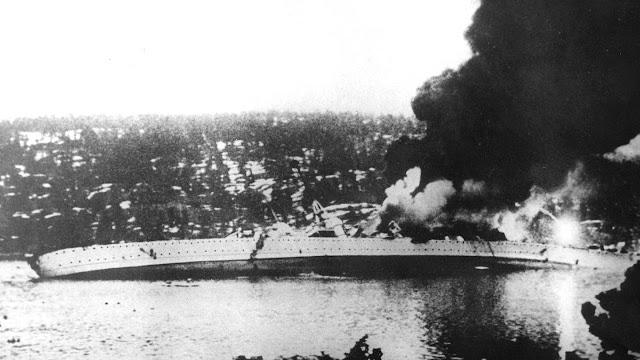
At Oslo, in the Battle of Drøbak Sound, the batteries at Oscarborg sink the German heavy cruiser Blücher in the Oslofjord, killing 830. The Kriegsmarine torpedo boat Albatros is also damaged by Norwegian shore battery in Oslofjord. The Norwegian civilian cargo cutter Sørland stumbles into the battle and is shelled and set on fire in Oslofjord by German minesweepers R-18 and R-19 (both Kriegsmarine) and is beached with the loss of two of her five crew. She is a total loss. A German parachute battalion, the first to be used in war, captures the Fornebu Airfield at Oslo, Norway, while transport planes drop more troops and guns. Elements of 324th Infantry Regiment of German 163rd Infantry Division are landed outside Oslo by naval group led by Kriegsmarine heavy cruiser Lutzow. Norwegian troops abandon Fornebu Airfield outside Oslo as German Me-110 fighters land followed by Ju-52 transports carrying a battalion of 324th Infantry Regiment of German 163rd Infantry Division. Additional elements of 324th Infantry Regiment of German 163rd Infantry Division and two companies of 1st Fallschirmjaeger Regiments are airlifted to Fornebu Airfield. Given the dire situation, the Norwegian royal family, the government, and the country’s gold reserves (with over 48 tons of gold) departs from Oslo at 0830 hours.
King Haakon and Prime Minister Nygaardsvold elude German capture after the Norwegian garrison is betrayed by Colonel Sundio.
The Norwegian gold reserve leaves Oslo in the morning. It is in 818 cases weighing 40 kilos each, 685 cases weighing 25 cases each, and 39 kegs weighing 80 kilos each. The shipment totals 53 tonnes, of which the gold itself weighs 48.8 tonnes.
Early on the 9th, the German Naval motor minesweepers R.20 and R.24 land troops at Rauoy, and R.22 and R.23 at Bolaerne. However, when minesweepers R.17 and R.21 attempt to land German troops at Horten, Norwegian minelayer HNoMS Olav Trygvasson and minesweeper HNoMS Rauma sink R.17 and damage torpedo boat Albatros and motor minesweeper R.21, despite covering gunfire from Albatros and Kondor. At 0735hours, after German threats of aerial bombardment of the naval base and the city right next to it, Norwegian coast defense ships HNoMS Harald Haarfagre and HNoMS Tordenskjold, small “destroyer” (torpedo boat) HNoMS Balder, minelayer Olav Tryggvason and minesweepers Rauma and HNoMS Hauk (58grt) and auxiliary patrol boats HNoMS Hval III (246grt) and HNoMS Beta (168grt) are surrendered to German forces at Horten, Norway.
Elements of 310th Infantry Regiment of German 163rd Infantry Division are landed at Kristiansand, Norway by a naval group led by Kriegsmarine cruiser Karlsruhe. The German cargo liner Seattle is sunk off Kristiansand, Norway by Norwegian coastal artillery.
The British submarine HMS Truant torpedoes and heavily damages the German light cruiser Karlsruhe in the Skagerrak, while returning from Kristiansand, Norway, at 1957 hours. After the crew is rescued, German torpedo boat Grief scuttles Karlsruhe.
A detachment of German troops lands at Arendal, Norway and captures the cable station there.
The cable station at Egersund and protecting torpedo boat HNoMS Skarv are taken by surprise by German minesweepers M.1, M2, M.9 and M.13. Both fall into German hands with no resistance.
The Norwegian small Sleipner-class “destroyers” (torpedo boats) HNoMS Odin and HNoMS Gyller, submarine HNoMS B-2, torpedo boat HNoMS Kjell, old torpedo boats HNoMS Lyn (38grt), HNoMS Blink (38grt) and HNoMS Kvik (38grt), and auxiliary patrol vessels HNoMS W. Barents (205grt), HNoMS Firern (217grt), HNoMS Lyngdal (149grt), HNoMS Hval IV (248grt), HNoMS Hval VI (248grt) and HNoMS Hval VII (247grt) are captured by German forces at Marvika, Norway.
The Norwegian submarine HNoMS B-5 is captured by German forces at at Fiskå, Norway.
The Royal Norwegian Navy Sleipner-class “destroyer” (torpedo boat) Tor is scuttled off Fredrikstad to avoid capture by German forces. She will be salvaged by the Germans, repaired and enters German service as Tiger. She will survive the war and will be taken back into Royal Norwegian Navy service as Tor in 1945.
The German cargo ship Amasis is torpedoed and sunk off Måseskär, Sweden (58°13’N 11°13’E) by HMS Sunfish (Royal Navy). All 51 crew are rescued.
The German naval supply ship Main is captured in the North Sea, off Haugesund, Norway by the pre-World War I Royal Norwegian Navy 578-ton “destroyer” HNoMS Draug. The Main is later bombed and severely damaged by Luftwaffe aircraft and is scuttled by the Draug. The Draug escapes to England.
The German naval tanker Kattegat is scuttled in Glomfjord, Ørnes, Norway while under attack by the 234-ton Royal Norwegian Navy fishery protection vessel HNoMS Nordkapp.
The German Naval supply ship Sao Paulo strikes a mine off Bergen, Norway (60°30’N 5°10’E) and sinks.
The Swedish fishing vessel Dagny strikes a mine and sinks north of Hantsholm, Denmark with the loss of six crew.
Norwegian government belatedly orders full military mobilization to begin 11 April.
German note insists Sweden will not be invaded, but must remain neutral, restrict naval activities, maintain telecommunications between Norway and Germany, and continue exports of iron ore.
British War Cabinet decides to occupy Faeroe Islands and offer assistance to Iceland.
The British Home Fleet is forced away from the Norwegian coast by Luftwaffe aircraft as they quickly gain air superiority.
French submarine Sybille, under British command, departs Harwich, England to patrol the North Sea west of Denmark.
Thirty U-boats patrol off Norway and British bases, but throughout the campaign they suffer from major torpedo defects.
Royal Navy submarine HMS Thistle, on patrol off Utsira, makes an attack on the German U-boat U-4 near Skudenes, Norway shortly before midnight, but her torpedoes miss.
G.H. Archambault of the New York Times observes:
“With the realization that, after 221 days, the war between the Allies and the Nazi Reich is about to become total, it would not have surprised the French if there had been a German demonstration against the Maginot Line for the purpose of fixing Allied troops there and hindering aid to Norway. The news this morning of artillery activity east of the Moselle, initiated by the enemy, seemed to point to the beginning of such a demonstration, but the fire soon abated and the rest of the day was quiet on the whole front, apart from exchanges of shots across the Rhine.
“German action between the Rhine and the Moselle, nevertheless, remains possible. Indeed, it would come in the logical order of things. Two likely sectors have. been mentioned in recent weeks in academic discussions of probabilities. One is along the Moselle, north of Thionville — this is where the artillery action occurred today — the other north of Bitche, or, in the phraseology of the French communiqués, “west of the Vosges,” where German patrols have been particularly active for some time. Only yesterday there was a sharp skirmish there.”
Allies request permission to move troops into Belgium.
The Netherlands Government has decided to cancel all military leaves with a few unimportant exceptions. All soldiers at present on leave have been ordered immediately to rejoin their units..
Daladier, Gamelin, and Darlan fly to London for meeting of Allied Supreme War Council. Acting with quick decision on behalf of France, Premier Paul Reynaud this morning summoned first his War Cabinet then his full Cabinet. By 11 o’clock he had told Norwegian Minister H. H. Bachke that France was ready to give “immediate and complete aid to Norway” and would continue the war in full association with that country. Accompanied by War Minister Edouard Daladier, the Premier then flew to London to meet British colleagues on the Allied Supreme War Council to decide in complete accord what naval and military measures must be taken at once in view of Germany’s new acts of aggression. By 8:15 tonight MM. Reynaud and Daladier were back in Paris to continue the preparations they had set in motion this morning.
There are 212,000 children in London, and the government is trying to get them to safer locales. Only 20% of parents respond to that request, and authorities blame “parental apathy.”
The loss of food supplies from Denmark, for many years the world’s most important exporter of eggs, butter and bacon, will not affect British food rationing, at least for the time being. But the seizure of Denmark and Norway will deal a hard blow to British trade. The new Minister of Food, Lord Woolton, said today that the authorities had allowed in advance for just such an emergency and had laid in sufficient reserves of butter and bacon in addition to building up alternative sources in the empire.
Clarence Decatur C. D. Howe 1886-1960 appointed Minister of Munitions and Supply; phases out War Supply Board.
The Stockholm radio said tonight that Russia had made new demands on Finland.
Convoy OA.126 departed Southend escorted by destroyer HMS Windsor from the 9th to 10th, and dispersed on the 12th.
Convoy OB.126 departed Liverpool escorted by sloop HMS Leith from the 9th to 12th, when she detached to convoy SL.26. Destroyer HMS Venetia and anti-submarine trawler HMS York City joined the escort on the 9th and 10th. The convoy was dispersed on the 13th.
Convoy BC.32 of four steamers, including Baron Kinnarid, John Holt (Commodore) and Pizarro departed the Loire escorted by destroyer HMS Montrose, and arrived in the Bristol Channel on the 11th.
Convoy FN.141 departed Southend, escorted by destroyer HMS Valorous and sloop HMS Lowestoft, and arrived in the Tyne on the 11th.
Convoy FS.141 departed the Tyne, escorted by sloops HMS Fleetwood and HMS Auckland, and arrived at Southend on the 11th.
The War at Sea, Tuesday, 9 April 1940 (naval-history.net)
NORWEGIAN CAMPAIGN
GERMAN OSLO GROUP
Just after midnight, Norwegian submarine A.2 attempted to attack the German Oslo Group as it entered Oslofjord off Bolaerne, but was damaged in the counterattack by motor minesweeper R.23 and forced to the surface. A.2 was able to escape, but she surrendered at Teie on the 13th. Norwegian patrol boat POL III (trawler, 214grt) then encountered the Oslo Group. She challenged the German ships and getting no reply opened fire with her single gun. POL III was soon overcome and sunk by German torpedo boat ALBATROS with the loss of eighteen crew.
Early on the 9th, motor minesweepers R.20 and R.24 landed troops at Rauoy, and R.22 and R.23 at Bolaerne. However, when R.17 and R.21 attempted to landed troops at Horten, Norwegian minelayer OLAV TRYGVASSON and minesweeper RAUMA sank R.17 and damaged torpedo boat ALBATROS and motor minesweeper R.21, despite covering gunfire from ALBATROS and KONDOR.
Early on the 9th, in the Drobak Narrows, German heavy cruiser BLUCHER was sunk by eight- and eleven-inch gunfire from the fortifications at Drobak and Kaholm and two torpedoes from the Kaholm fortification. She was struck by the first eleven-inch shell at 0520 and two torpedoes at 0521. At 0732, she rolled over and sank with Kapt. z. S. H. Woldag, thirty-eight officers, and 985 ratings lost. Heavy cruiser LUTZOW was struck by three eleven-inch shells and light cruiser EMDEN was hit but not seriously. With this damage, the German force retired temporarily. Oslo fell to ground forces brought there by aircraft and the Oslo Naval Group entered Oslo midday on the 10th. EMDEN and the R-boat Flotilla remained at Oslo for six weeks for anti-aircraft defense and garrison duties. They returned to Germany on 21 May.
With the fall of Oslo, the Germans gained possession of two unnamed Norwegian destroyers building at Horten, SLEIPNER class destroyers TOR outfitting at Fredrikstad, BALDER outfitting at Horten, minelayer OLAV TRYGVASSON, and submarines A.3, A.4 and B.4. The destroyers under construction were never completed during the war due to continuing acts of sabotage. TOR and BALDER had been scuttled, but the Germans were able to salve them and recommission them on 13 June and 26 July, respectively. OLAV TRYGVASSON was commissioned on the 28th as ALBATROS, and later in 1941 renamed BRUMMER. Submarines A.3 and A.4 were scuttled by German forces on the 16th at Sauholmsundet near Tonsberg, while B 4, which surrendered at Filtvedt on the 10th, was considered for use by the Germans, but due to her poor condition was never commissioned.
Norwegian minesweepers RAUMA (370grt), HAUK (58grt) and auxiliary patrol boats HVAL III (246grt) and BETA (168grt) surrendered at Horten on the 9th. Minesweeper OTRA (370grt) was seized at Filtvedt on the 10th. Minesweeper HVAS (58grt) was seized at Stavern on the 12th. Auxiliary patrol vessels ALPHA (235grt) and FURU (85grt) surrendered at Halvorshamn on the 12th. Minesweepers FALK (58grt). KJAEK (58grt) and auxiliary patrol vessels FARM (424grt), SKUDD I (247grt), SKUDD II (247grt), OTER I (251grt), HVAL II (224grt), RAMOEN (299grt), SAETRE (172grt) and SARPEN (187grt) surrendered at Tonsberg on the 13th. Minelayer BRAGE (236grt) and auxiliary patrol vessel TREFF (204grt) surrendered at Melsomvik on the 14th. Whale catchers SAIMA (217grt) and SOUSA (217grt) laid up at Tonsberg were seized on the 9th.
Oslo was supplied by small tankers EUROLAND (869grt) and SENATOR (845grt) which had departed Hamburg on the 6th and cargo ships ANTARES (2593grt), IONIA (3102grt), ITAURI (6838grt), MUANSA (5472grt) and NEIDENFELS (7838grt) which had departed Stettin at 0200/7th and arrived as soon as Oslo was secured.
They were followed two days later by eleven steamers carrying the 196th Division. These were ESPANA (7456grt), FRIEDENAU (5219grt), HAMM (5874grt), HANAU (5892grt), KELLERWALD (5032grt), ROSARIO (6079grt), TUCUMAN (4621grt), WANDSBEK (2388grt), WIGBERT (3648grt) and WOLFRAM (3648grt) which departed Gotenhafen at 1600/8th for Oslo, and steamer SCHARHORN (2643grt) which departed Konigsberg at 1600/8th for Frederikstad.
Three days later, twelve steamers (72,575grt) departed Hamburg carrying the 181st Infantry Division. In this group were tanker FRIEDRICH BREME (10,397grt) which was carrying fuel for aircraft based near Oslo and steamer FLORIDA (6148grt).
Three days after the third group, another convoy carrying the 214th Infantry Division and rest of the 196th Infantry Division arrived at Oslo. In addition, independently-routed supply ships began to regularly arrived at Oslo starting with MOLTKEFELS (7863grt), UTLANDSHORN (2643grt) and URUNDI (5791grt) on the 16th, LEUNA (6856grt) and BUENAS AIRES (6097grt) on the 18th with Machine Gun Battalion 13, and ENTRERIOS (5179grt), CAMPINAS (4541grt), CORDOBA (4611grt) and SCHARHORN (2643grt) on the 22nd.
GERMAN U-BOAT OPERATIONS
German U-boats operated off Norway in support of Fleet operations under Operation HARTMUTH. Early on the 9th, they were deployed as following. In Vestfjord were U-25, U-46, U-51 and U-64 which had departed Kiel on the 6th and was en route. Off Trondheim were U-30 and U-34. Off Bergen were five submarines – U-9 and U-14 southwest of Bergen, U-56 due west of Bergen, and U-60 and U-62 northwest of Bergen. Off Stavanger were U-1 and U-4, with U-1 off the actual harbour entrance and U-4 off the outer channel in a position to protect Haugesand as well. Northeast of Lerwick, Shetlands were U-48, U-49, U-52. U-50 was supposed to be southeast of Lerwick, but had been lost on a mine on the 6th in 54-15N, 5-06E with the entire crew of forty-four dead. U-38 and U-47 were to the north of the Shetlands. U-37 escorted armed merchant cruiser ATLANTIS as far as the Denmark Strait until being detached on the 5th, after which she arrived off the Shetlands and joined this group.
East of the Pentland Firth were U-13 and U-57 with U-58 and U-59 to the west of Pentland Firth. Off Stavanger and the Naze were U-2, U-5, U-6 and later U-3. U-2 was west, southwest of Egersund, U 5 was west, southwest of Lindesnes, and U-6 was southeast of Lindesnes. On arrival, U-3 was stationed west, northwest of Lindesnes. U-2 was forced to return to Wilhelmshaven on the 12th with hydroplane defects. The submarine arrived on the 15th for repairs. Southeast of the Shetlands were U-7, U-10 and U-19. U-7 was southeast of Sumburgh Head, with U-10 and U-19 east of Fair Island. At the east end of the English Channel off Rotterdam and Antwerp were U-17, U-23, U-24 and U-61. The submarine group northeast of the Shetlands was dispersed on the 11th with U-50 and U-52 redeployed off Trondheim and U-38, U-47, U-48 and U-49 in Vaagsfjord. U-50, however, had already been lost on a mine on the 6th before her order for redeployment was sent. The submarine group at the east end of the English Channel was redeployed on the 13th with U-17, U-23 and U-24 were ordered to patrol off Bergen and U-61 off Trondheim.
BATTLECRUISER RENOWN’S ENGAGEMENT WITH SCHARNHORST and GNEISENAU
At 0337/9th, Battlecruiser RENOWN with destroyers GREYHOUND, ICARUS, IVANHOE, ESK, IMPULSIVE, HARDY, HUNTER, HAVOCK, and HOTSPUR encountered German battleships GNEISENAU and SCHARNHORST and an action ensued in 67 22N, 09 42E. RENOWN hit GNEISENAU’s main armament control system putting it out of order and forcing the German ships to retire. RENOWN began to pursue the German ships. HARDY and HUNTER were able to keep up with RENOWN for a time in the heavy weather, but the others fell behind. At 0658 the destroyers were ordered to patrol the entrance to Vestfjord. RENOWN scored two more hits on GNEISENAU, one of them crippled GNEISENAU’s forward turret, opening it directly to the sea. RENOWN received two hits in return. The one hit passing through the extreme stern without exploding and the second perforating the foremast, severing all internal cables, but also not exploding. The searchlights sustained minor damage by splinters. Lt Cdr M.J. Evans was the only crewman wounded. In the high speed retirement, both SCHARNHORST and GNEISENAU sustained weather damage in the form of flooding their forward turrets; GNEISENAU’s damage being much more severe because of the shell damage to her gun house from RENOWN’s hit. Three hours after the action began, the German battleships were able to outdistance RENOWN which returned to her patrol off Vestfjord.
Very early on the 9th, Norwegian destroyer DRAUG at Haugesand captured German supply ship MAIN (7624grt) carrying mines to Trondheim. Later that morning, German aircraft bombed and badly damaged MAIN. Destroyer DRAUG was forced to scuttle MAIN after taking aboard her crew of sixty-seven. Destroyers MATABELE and SIKH were ordered to join DRAUG and escort her towards Sullom Voe, where she arrived at 1700/10th. The destroyers then rejoined Adm Forbes’ Main Force. At 2000/10th, French destroyer BRESTOIS departed Sullom Voe for Kirkwall with the 65 German prisoners brought there by DRAUG, and then went on to Scapa Flow. French destroyer BOULONNAIS escorted DRAUG directly to Scapa Flow.
Destroyers ESCORT, JAVELIN, JANUS, JUNO, and ECLIPSE departed Scapa Flow at 2130 escorting battleship WARSPITE. Aircraft carrier FURIOUS with destroyers ASHANTI, MAORI, DELIGHT, and FORTUNE departed the Clyde at 0001 on the 9th. Aircraft carrier FURIOUS flew on nine Swordfish aircraft of the 816 Squadron and nine Swordfish of 818 Squadron. The Skuas of the 801 Squadron were not embarked. DELIGHT suffered weather damage and was forced to return to Greenock. The WARSPITE and FURIOUS groups proceeded to a rendezvous ten miles north of Muckle Flugga where they met at 0500/10th. Together, the ships proceeded to join the Commander in Chief Home Fleet on course 115°, 16 knots, in 61-24N, 2W at 0700/10th.
GERMAN NARVIK GROUP
Norwegian naval forces at Narvik were coastal defense ships NORGE and EIDSVOLD at Narvik, submarines B.1 and B.3 of the 3rd Submarine Division were at Liland near Narvik. The following merchant ships were at Narvik early on the 9th – Norwegian steamers CATE B (4285grt), ELRID (1712grt), HAALEGG (1758grt) and SAPHIR (4306grt), Dutch steamer BERNISSE (951grt), Swedish steamers BODEN (4264grt), OXELOSUND (5613grt) and STRASSA (5603grt), British steamers BLYTHMOOR (6582grt), MERSINGTON COURT (5141grt), NORTH CORNWALL (4304grt), RIVERTON (5378grt) and ROMANBY (4887grt), German steamers AACHEN (6388grt), ALTONA (5398grt), BOCKENHEIM (4902grt), HEIN HOYER(5386grt),MARTHA HENRICH FISSER (4879grt), NEUENFELS (8096grt), ODIN (5806grt), JAN WELLEM (11,776grt),LIPPE (7849GRT), FRIELINGHAUS (4339grt) and PLANET (5881grt), and Swedish tugs DIANA (213grt) and STYRBJORN (167grt).
The German Narvik Group, less GIESE whose hull was holed in heavy water and had fallen behind, entered Ofotfjord at 0410 without opposition. The force entered Ofotfjord and encountered Norwegian fishery protection vessels MICHAEL SARS (207grt) and SENJA (243grt). They ordered the Norwegian guard ships to turn about and return to Narvik. German destroyer ROEDER was detached to patrol off Baroy to await the arrival of destroyer GIESE. She captured Norwegian auxiliary patrol boat KELT (376grt) while on this patrol. At the Ramnes Narrows, German destroyer flotilla commander Bonte detached destroyers LUDEMAN and SCHMIDT to land troops and capture the Narvik fortifications which prove to be nonexistent. Abreast of Herjansfjord, destroyers ZENKER, KUNNE and KOELLNER were detached to go up the fjord to Elvegaard where the Norwegian regimental depot for the area was located. The depot was captured without resistance.
Destroyers HEIDKAMP (Pennant Bonte), ARNIM and THIELE continued on to the harbour of Narvik. German steamer BOCKENHEIM (4902grt), believing the approaching warships to be British, ran aground and set herself afire. These destroyers encountered Norwegian coastal defense ship EIDSVOLD which HEIDKAMP sank after a perfunctory request for free passage. EIDSVOLD sank taking with her 177 officers and ratings. Only eight survivors were rescued. Destroyer ARNIM was already alongside the wharf when coastal defense ship NORGE opened fire on her, but ARNIM was able to sink NORGE without damage to herself. NORGE sank with 104 officers and ratings lost and 97 survivors, one later dying of wounds. Norwegian submarine B.1 scuttled herself at Liland in Ofotfjord after an unsuccessful attempt to get to sea. Submarine B.3 was able to escape and reached safety in a fjord further north on the Norwegian coast.
GERMAN EGERSUND GROUP
The cable station at Egersund and protecting torpedo boat SKARV were taken by surprise by German minesweepers M.1, M2, M.9 and M.13. Both fell into German hands with no resistance. On the 11th, submarine CLYDE was ordered to investigate the landing of troops at Egersund.
GERMAN KRISTANSAND GROUP
Norwegian naval forces at Kristiansand were composed of SLEIPNER class destroyers ODIN and GYLLER, submarines B.2 and B.5, refitting torpedo boat KJELL, which was under repair, old torpedo boats LYN, BLINK, which was under repair, and KVIK. Norwegian destroyer SLEIPNER of the 2nd Destroyer Division based at Bergen was at Kristiansand. German torpedo boat GREIF of the Kristiansand force was detached to land troops at Arendal. Although landings were delayed by fog until 0900, Arendal fell without difficulty to German troops. The German Kristiansand force entering harbour was forced to retire twice under bombardment from shore batteries at Odderoy. Later in the morning, a message in Norwegian code was sent to the Norwegian commander stating that French destroyers were coming to his aid. Expecting these, light cruiser KARLSRUHE and torpedo boats LUCHS and SEEADLER were allowed to enter the port by the defending Norwegian forces and the town was forced to surrender by 1700/9th. The Norwegian ships surrendered at naval station at Marvika on the 11th. Destroyers ODIN and GYLLER, submarines B.2 and B.5, torpedo boat KJELL, old torpedo boats LYN (38grt), BLINK (38grt) and KVIK (38grt), auxiliary patrol vessels W. BARENTS (205grt), FIRERN (217grt), LYNGDAL (149grt), HVAL IV (248grt), HVAL VI (248grt) and HVAL VII (247grt) surrendered at Marvika.
The two Norwegian destroyers were taken over on the 11th by the German Navy and commissioned on the 25th 1940 as LOWE (former GYLLER) and PANTHER (former ODIN) for duty in the 7th Torpedo Boat Flotilla. The 7th Torpedo Boat Flotilla was later also composed of TIGER (former TOR which had been scuttled at Horten), commissioned on 13 June 1940 and LEOPARD (former BALDER also taken at Horten), commissioned on 26 July 1940. In December 1940, the 7th Torpedo Boat Flotilla command was terminated and the former Norwegian destroyers were transferred to the 27th Submarine Hunting (UJ) Flotilla. Submarine B.5 was commissioned at Kristiansand on 20 November 1940 as UC.1, and torpedo boat KJEL at Kristiansand on the 19th 1940 as TIGER and renamed KT.1 in June 1940.
Torpedo boat TEIST, which was at Farsund, when the attack took place, scuttled herself near Farsund on the 14th. Old torpedo boats JO (55grt), which had been at Arendal, GRIB (55grt), which had been at Risor, and RAVN (55grt), which had been at Langesund, were scuttled at Lyngor on the 17th. In addition, torpedo boats ORN (55grt) and LOM (55grt) of this division were repairing at Horten and surrendered there on the 9th. Swedish steamer ALBERT (1745grt) was seized by German forces at Kristiansand, and renamed DORA CHRISTOPHERSON for German use.
German steamer SEATTLE (7369grt), which had departed Curacao on 5/6 March and called at Tromso on 31 March, arrived off Kristiansand as the German force arrived. She was sunk by gunfire from Norwegian destroyer GYLLER. (Seekrieg – destroyer Sleipner)
Supplies for the Kristiansand and Arendal German troops were embarked on German steamers AUGUST LEONHARDT (2593grt), which was lost at sea en route, KRETA (2359grt), which arrived three days late, WESTSEE (5911grt) and WIEGAND (5869grt) which had all departed Stettin at 1700/6th.
GERMAN BERGEN GROUP
The Norwegian naval vessels at Bergen were torpedo boats STORM and SAEL, minelayers TYR (281grt) at Klokkarvik, VALE at Littlebergen, ULLER at Bergen and GOR at Herdia of the 2nd Minelayer Division, plus armed auxiliaries HAUS (135grt), LINDAAS (138grt), ALVERSUND (178grt), MANGER (153grt) and OYGAR (128grt). The 1st Destroyer Division was based at Bergen, with GARM at Herdla, north of Bergen, TROLL at Maloy, and DRAUG at Haugesand. The 2nd Destroyer Division was also based at Bergen, with AEGER at Stavanger and SLEIPNER at Kristiansund. Old torpedo boats DJERV and DRISTIG were at Littlebergen. The 1st Torpedo Boat Division was based at Bergen, with SNOGG was at Floro and STEGG at Skudesneshavn. The 4th Torpedo Boat Division was based at at Bergen, with STORM at Hummelsund, BRAND at Bergen, and SAEL at Brandasund. The 5th Torpedo Boat Division was originally based at Trondheim, but was in the Bergen area with SKREI at Hestvika on Hita (scuttled 8 May at Aspoy), SILD at Kristiansand (scuttled 5 May at Svanholmen) while SAKS was under repair at Trondheim and surrendered on the 13th.
The German Bergen Group arrived off Bergen and the cruisers identified themselves as HMS CAIRO and HMS CALCUTTA and KARL PETERS identified herself as HMS HALCYON which were regular callers at Bergen since being assigned to the ON/HN convoy escorts. As such, German light cruisers KOLN and KONIGSBERG were allowed to enter the fjord, but the shore batteries at Kvarven awoke to the deception and put three eight-inch shells into KONIGSBERG and one into training ship BREMSE. On KONIGSBERG sixteen crew were killed and thirty-one wounded. Norwegian minelayer TYR hurriedly dropped eight mines between Sotra and Leroy and withdrew undetected at the mouth of the fjord. Norwegian torpedo boat STORM torpedoed the leading German torpedo boat, but the torpedo failed to explode. Bergen surrendered before dawn on the 9th. All the defending Norwegian naval vessels were able to escape into nearby Hardangersfjord. The fortifications at Sandviken fired on light cruiser KOLN at anchor in the harbour, but when KOLN returned fire, the fort ceased firing. By 0930, both Kvarven and Sandviken were in German hands.
The following vessels were seized by German forces at Bergen and mostly renamed for German service. Swedish merchant ship GALLIA (1419grt), renamed DEIME. Swedish steamer FAVERVIK (1912grt), renamed TURKHEIM. Swedish steamer MONARK (1786grt) was lost when the German prize crew attempted to sail her back to Germany in early May. Finnish steamer ANTON H. (1436grt), renamed ADMIRAL KARL HERING. Finnish steamer USKO (1876grt) , renamed DIETRICK OLDENDORF. Estonian steamer KADLI (1818grt), renamed HUMMEL. Estonian steamer ARCTURUS (1682grt), whose crew was returned to Tallinn, via Stockholm. Estonian steamer AKSI (844grt), renamed STRASSBURG. Danish steamer GERDA (1151grt) had arrived at Bergen on the 4th, was later ordered to Stavanger, and en route, struck a mine on 8 May off Flesland and drifted ashore. Panamanian steamer ANGLO (2978grt) renamed SEEFAHRER.
Supplies for the German Bergen force were embarked on tanker BELT (322grt), which departed Brunsbuttel on the 9th, steamers CURITYBA (4969grt), MARIE LEONHARDT (2594grt), and RIO DE JANIERO (5261grt) which departed Stettin at 0400/6th. However, RIO DE JANIERO was lost en route and CURITYBA was considerably delayed. On the 7th, four miles north of Helsingborg, she ran aground, two tugs and one anti-submarine patrol boat arrived to assist and CURITYBA was refloated on the 8th to continue her voyage.
A RAF Coastal Command Blenheim of 254 Squadron, carrying observer Lt Cdr G. Hare RN, of 712 Squadron in light cruiser SHEFFIELD, sighted the German warships at Bergen during the morning. At 1900, twelve Hampden bombers of 50 Squadron, six Wellington bombers of 9 Squadron, and six Wellington bombers of 115 Squadron of Bomber Command attacked light cruisers KOLN, KONIGSBERG and training ship BREMSE at anchor at Bergen but did not score any hits. During the evening of the 9th, KOLN with torpedo boats WOLF and LEOPARD was preparing to leave Bergen, KONIGSBERG was unfit for sea and left behind for repairs. KOLN put to sea at 2100 with the two torpedo boats and followed the Leads south, anchoring at Maurangersfjord until the afternoon of the 10th before continuing. Off the Elbe at 0545/11th, they were joined by German destroyers SCHOEMANN and BEITZEN which escorted them to Wilhelmshaven, arriving at 1700 that evening.
GERMAN TRONDHEIM GROUP
The primary Norwegian naval unit at Trondheim was minelayer FROYA, which was en route from the Kirkenes to Horten. On the 9th, she was in Skjornfjord in Trondheimsfjord. Also at Trondheim was the 14th Patrol Boat Division with auxiliary patrol boats HEILHORN (192grt) at Beiarn and STENKJAER (158grt) and FOSEN (273grt) at Agdenes. The two patrol boats at Agdenes surrendered at Hasselvika on the 9th. Finally, patrol boat NAUMA (219grt) of this division was under repair at Trondheim and surrendered on the 13th. The Trondheim Group entered Trondheimsfjord without firing a shot. Destroyers JACOBI, RIEDEL, HEINEMANN were detached near the fortifications of Brettingen and Hysnes with landing parties to neutralize the forts, while heavy cruiser ADMIRAL HIPPER and destroyer ECKHOLDT continued on to Trondheim.
Cruiser ADMIRAL HIPPER had already passed the fortifications when the guns at Hysnes opened fire. Destroyer RIEDEL getting underway rapidly, accidentally ran aground doing considerable damage to her hull. Gunfire from ADMIRAL HIPPER sent up clouds and smoke and dust spoiling the aim of the fort’s gunners. RIEDEL was able to get herself off only by the crew all going aft. The destroyer was then beached in Strommen Bay for repairs until 20 April. ADMIRAL HIPPER and destroyer ECKHOLDT anchored in Trondheim harbour at 0525 and the town surrendered without a shot. Norwegian minelayer FROYA attempted to escape from Trondheimsfjord, but was damaged by German coastal artillery and forced aground where she was scuttled by her crew on the 13th (Seekrieg – sunk by U-34 in Drontheim Fjord). Finnish steamer EMMI (1592grt) was seized by German forces at Trondheim and renamed SCHIRMECK for German service.
The Trondheim supply ships, tanker MOONSUND (321grt), had departed Brunsbuttel on the 9th, steamers MAIN (7624grt) and SAO PAULO (4977grt) were lost en route; SAO PAULO late on the 9th at Brantholm in 60 30N, 05 10E. The fourth supply ship, steamer LEVANTE (4770grt) did not arrive until 12 April.
Just after dark on the 10th, heavy cruiser ADMIRAL HIPPER left Trondheim, bombarding the fortifications once as she left the fjord. She took destroyer ECKHOLDT with her, but in heavy seas, the destroyer was forced to return to Trondheim. The other three German destroyers were immobile. Destroyer RIEDEL, which had run aground, and HEINEMANN, which had defects, were cripples and JACOBI was too low on fuel to even attempt the return trip. The non arrival of tanker SKAGERRAK (6044grt), which was delayed at Kopervik, and the loss of supply ship SAO PAULO (4977grt), which was mined near Bergen, was greatly affecting German destroyer activity. The fuel supply was so acute that ADMIRAL HIPPER had to return without refueling and arrived back in Germany with only 123 tons of fuel (two and a half hours steaming) remaining in her bunkers.
By mid-morning on the 9th, reinforcements had reached Admiral Forbes in the form of heavy cruisers DEVONSHIRE, BERWICK and YORK of the 1st Cruiser Squadron, light cruisers ARETHUSA and GALATEA of the 2nd Cruiser Squadron, GLASGOW, SOUTHAMPTON, and MANCHESTER of the 18th Cruiser Squadron, French light cruiser EMILE BERTIN, destroyers ELECTRA, CODRINGTON, GRIFFIN, ESCAPADE, GURKHA, SIKH, AFRIDI, MOHAWK, ZULU, and COSSACK, Polish destroyers GROM, BURZA, and BLYSKAWICA and French large destroyers MAILLE BREZE and TARTU. At 0400, destroyer KELVIN ran into KASHMIR’s stern in 60 28N, 2 25E. KASHMIR’s stern was badly damaged and Temporary Surgeon Lt J. N. Haggar RNVR, of KASHMIR, killed in his bunk. Destroyer COSSACK was ordered to tow KASHMIR to Lerwick escorted by destroyers ZULU and the damaged KELVIN.
At 1415, destroyer ZULU attacked U-19 north of the Orkneys after the submarine surfaced near the British ships, but she escaped with no more than light damage. The British ships arrived safely at Lerwick on the 9th. Destroyers COSSACK and ZULU immediately departed after refueling on the 10th to rejoin the British forces off Norway. French destroyers BRESTOIS and FOUDROYANT departed Scapa Flow at 1325/12th for Lerwick. On the 12th, destroyers KELVIN, proceeding stern first, and KASHMIR departed Lerwick for the Tyne, and were met at sea by the French destroyers. They all safely arrived on the 13th at 2030. KELVIN arrived at Scapa Flow after repairs on 28 May and KASHMIR returned to service on 13 June.
Destroyers JANUS and ECLIPSE carried out six depth charge attacks at 1355 on a submarine contact in 59 01N, 2 24W. This contact was later found to be a wreck.
Destroyers HYPERION and HERO arrived at Sullom Voe to refuel at 1430.
Convoy HN.25 had departed Bergen on the 7th, but was recalled, and on the morning of the 9th was waiting in a fjord near Hovden, north of Bergen, when word was received that Bergen had fallen to German troops. When German tanker SKAGERRAK (6044grt) arrived at Hovden at noon on the 9th en route to Trondheim, Captain J. S. Pinkney, acting convoy commodore and Master of steamer FYLINGDALE (3918grt) left with the convoy at 1400. Convoy HN.25 was composed of twelve British, nine Norwegian, eight Swedish, five Danish, two Finnish and three Estonian ships. It was formed into four columns with steamers FYLINGDALE (3918grt), GLEN TILT (871grt), BRIGHTON (5359grt) and LEO (1140grt) as column leaders. In this convoy were British steamers NYANZA (4974grt) and NORTH DEVON (3658grt) which were in fjord after arriving from the aborted ON.25 convoy. NYANZA was the last steamer to leave Hovden. Destroyer ZULU and Polish destroyers GROM, BURZA, and BLYSKAWICA were ordered to join convoy HN.25 and escort it into the Firth of Forth, but ZULU was replaced by destroyer TARTAR before joining the convoy. At 1500/9th, the allied destroyers joined convoy HN.25, and at 1700/11th, TARTAR attacked a submarine contact, which brought up air and oil, but no submarine was lost at that time. The last Norwegian convoy arrived safely at Methil at 1300/12th.
At Boknfjord, near Stavanger, Norwegian destroyer AEGER sank German steamer RODA (6780grt), carrying anti-aircraft guns. RODA, which had departed Hamburg on the 3rd, was bringing these guns and other supplies to two battalions of German paratroopers which had captured Sola airfield. Later on the 9th, AEGER was sunk by German Ju.88 aircraft of KG.4, already based at Sola on the 9th. Seven crew were killed, one fatally wounded, and one severely wounded.
Greek steamer SPYRIDON (3527grt) arrived at Stavanger on the 9th for repairs, seized by German forces and renamed EKENES for German service.
U-56 at 0920 sighted Battleship RODNEY and VALIANT southwest of Stadlandet steering south and radioed this information to the German command.
At 1130, Admiral Forbes dispatched light cruisers SOUTHAMPTON, MANCHESTER, SHEFFIELD, and GLASGOW of the 18th Cruiser Squadron with destroyers GURKHA, SIKH, MOHAWK, MATABELE, MASHONA, SOMALI, and AFRIDI for a raid on Bergen where the damaged German ships KONIGSBERG and BREMSE and undamaged cruiser KOLN were located. At 1400, the Admiralty cancelled the operation and ordered the force to set course to return to the Main Fleet which had turned north to open the distance between themselves and German land-based aircraft. As the Bergen raiding force arrived back at the Main Fleet, the Luftwaffe, which was alerted by U-56’s report arrived on the scene with 47 Ju.88 bombers from KG.30 and 41 He.111 bombers from KG.25, southwest of Bergen. German attacks on the British fleet continued from 1430 to 1730, and four JU.88’s were downed.
Destroyer GURKHA, which had reduced speed to improve her gunnery in heavy seas, was fatally damaged by near misses aft in these attacks 100 miles southwest of Bergen. Lt M.F. J. Ferguson, Lt D. O. Smith, Lt Cdr (E) I. C. Howden, Probationary S/Lt N. C. J. S. Hutchings RNVR, Temporary Surgeon Lt D. N. B. Morgan RNVR, ten ratings were lost with GURKHA, which was left behind in a sinking condition as the Main Fleet continued on under heavy bombing attacks (Seekrieg – sunk by He.111’s of KG.26). Light cruiser AURORA, en route from Scapa Flow to join Adm Forbes, came upon the sinking GURKHA, and fought off five air assaults while picking up 194 survivors and attempting to tow the damaged ship. Destroyer MASHONA picked up five survivors and one dead rating. GURKHA sank four and a half hours after receiving her fatal damage, and her survivors taken directly to Scapa Flow.
Battleship RODNEY was struck by a 500-kilogram bomb which failed to penetrate the armour belt and caused only injuries to Paymaster Midshipman W. R. H. Lapper, Commissioned Gunner F. G. Roper, Midshipman J. C. S. Wright, and seven ratings. Attacks on heavy cruiser DEVONSHIRE caused some splinter damage from near misses. Light cruisers SOUTHAMPTON and GLASGOW were damaged by near misses. SOUTHAMPTON’s damage was minor and no time was spent out of service. GLASGOW’s damage from two near misses took ‘A’ turret out of action for a short time and the ship’s speed was reduced for about thirty minutes. Damage to GLASGOW was repaired in two days while continuing patrol at sea. Two ratings were killed and five ratings, one dying of wounds, were wounded in GLASGOW. Light cruiser ARETHUSA and French destroyers TARTU and MAILLE BREZE were near missed by bombs, but not damaged. Among the German claims for these attacks was the sinking of the French heavy cruiser FOCH. In later communiques, this claim was changed to light cruiser EMILE BERTIN which was present, but undamaged.
At Narvik, steamers BLYTHMOOR (6582grt), MERSINGTON COURT (5141grt), NORTH CORNWALL (4304grt), ROMANBY (4887grt) and RIVERTON (5378grt) were seized by German forces and their crews taken prisoner and placed aboard German tanker JAN WELLEM (11,776grt). A working party from the German steamer LIPPE (7849grt) removed the deck guns from the captured steamers for coastal defense of the German positions.
At Trondheim, steamer THISTLEBRAE (4747grt) in drydock for a 4 April collision at Trondheim, was seized by German forces, renamed ALTKIRCH for German service, and later renamed INSTER. Her thirty-three-man crew was made prisoners of war. American steamer MORMACSEA (4996grt) was also at Trondheim. However, her captain would not allow German guards aboard the ship. Finally, on the 14th, MORMACSEA was allowed to sail with a hidden cargo of four and a half million dollars in Swedish gold bullion for transport to the United States for safekeeping.
ALLIED SUBMARINE OPERATIONS
At 1324/9th, the Admiralty gave Vice Admiral Horton permission for his submarines to sink without warning any German merchant ship in the Skagerrak, the Kattegat and Heligoland Bight.
At 1700, submarine SUNFISH sank German steamer AMASIS (7129grt) with two torpedoes northeast of the Skaw off Goteborg in 58 13N, 11 13E.
Submarine UNITY in the Heligoland Bight reported that she had been depth charged by a merchant ship.
Submarine TRUANT off Kristiansand at 1856 sighted the German light cruiser KARLSRUHE and torpedo boats LUCHS, SEEADLER, GREIF as they left harbour that evening on their voyage back to Germany. Submarine TRUANT fired ten torpedoes at the German cruiser, one of which wrecked her stern and put her engines out of commission. Slowly settling and without means to contain the flooding, KARLSRUHE was abandoned and her crew were aboard the torpedo boats. Torpedo boat GREIF administered the coup de grace at 2250 in 57-56N, 8-14E. TRUANT was able to escape with only minor damage, despite a determined effort by the torpedo boats and motor torpedo boats in a five-hour submarine hunt. She returned to Rosyth on the 12th to make good damage and defects.
German steamer KRETA (2359grt) reported that she was under attack by a submarine near Faerder Lightship in the Skagerrak. Later overdue at Kristiansand, she was presumed lost but she arrived on the 12th unharmed.
At 1815/9th, U-49 sighted Forbes’ Main Fleet steering north of the Norwegian coast northwest of Bergen.
Late on the 9th, Admiral Forbes ordered all his light cruisers and most of his destroyers to return to Scapa Flow or Sullom Voe for refueling. The last units arrived about noon on the 11th. At 1530/10th, light cruisers SHEFFIELD, GLASGOW, MANCHESTER, and SOUTHAMPTON and destroyers AFRIDI, SOMALI (D.6), CODRINGTON (D.1), MOHAWK, MASHONA, JUPITER, BRAZEN, ESCAPADE, and ELECTRA arrived at Sullom Voe foe refueling. Light cruisers BIRMINGHAM refueled at Scapa Flow, AURORA at Rosyth., and GALATEA and ARETHUSA refueled, all on the 11th. French large destroyers TARTU and MAILLE BREZE arrived at Scapa Flow with the British cruiser force at 1900/10th.
During the evening of 9 April, German destroyer FRIEDRICH ECKHOLDT penetrated Trondheimsfjord as far as the neighbourhood of Inderoy where Trondheimsfjord branches into the smaller Beitstadfjord. German destroyer PAUL JACOBI, after refueling from damaged destroyer THEODOR RIEDEL, joined FRIEDRICH ECKHOLDT on the morning of 10 April. However, heavy ice in the fjord prevented the destroyers from progressing beyond Inderoy.
German naval auxiliary Schiff 111 (lumbership JUPITER, 2152grt) arrived at Bergen with a cargo of mines to mine the harbour.
At 0600, destroyers FAULKNOR (D.8), FOXHOUND, and FORESTER arrived at Scapa Flow from the Clyde, then departed at 1500 to rendezvous with the Commander in Chief Home Fleet.
Destroyer GRENADE arrived at Scapa Flow at 1230 to refuel.
Destroyers GRENADE and ENCOUNTER departed Scapa Flow at 1600 with oiler BRITISH LADY (6098grt) for Vestfjord arriving at 1700/12th.
French large destroyer CHEVALIER PAUL arrived at Scapa Flow at 0830 and was led into harbour by destroyer ENCOUNTER.
French destroyers BRESTOIS and BOULONNAIS departed Scapa Flow with British tanker ALDERSDALE, arriving at Sullom Voe at 1300/10th.
Off Vestfjord late on the 9th were Minelaying destroyers ESK, IVANHOE, ICARUS, HARDY, HOTSPUR, HUNTER, HAVOCK, and GREYHOUND. Destroyer IMPULSIVE with a damaged paravane boom was sent to Scapa Flow arriving at 0445/11th. Battlecruiser RENOWN, reinforced by battlecruiser REPULSE, light cruiser PENELOPE, and destroyers ESKIMO, KIMBERLEY, PUNJABI, BEDOUIN, and HOSTILE which had arrived off Vestfjord at 1130/9th were out to seaward of Vestfjord on patrol.
On orders from the Admiralty, the destroyers of the 2nd Destroyer Flotilla, HARDY (Captain B. A. W. Warburton-Lee, D 2), HOTSPUR, HAVOCK, and HUNTER proceeded up Vestfjord on Operation TN towards Narvik leaving the destroyers of the 20th Destroyer Flotilla to patrol the minefield. Destroyer HOSTILE with the battlecruisers at sea was detached and joined the 2nd Flotilla off Tranoy. At 2022 on the 9th, U-51 sighted the five Destroyers of the 2nd Destroyer Flotilla in Vestfjord steering westbound, apparently leaving the fjord. However, this westward movement was only to adjust the destroyers’ arrival time off Narvik allowing them to arrive off that port at dawn.
German supply ship ALSTER (8514grt) and tanker KATTEGAT (6031grt), which had been delayed at Kopervik over the night of 5/6 April, were in the Bodo area. KATTEGAT was sunk late on the 9th by Norwegian patrol boat NORDKAPP off Neverdal in Tannholmford, south of Bodo. ALSTER was stopped on the 8th by Norwegian patrol vessel SYRIAN (298grt) and sent into Bodo, but was captured by destroyer ICARUS on the 11th. Also at Bodo was Norwegian auxiliary patrol vessel SVALBARD 2 (270grt).
Norwegian fishery protection vessels FRIDTJOF NANSEN and HEIMDAL were stationed at Honningsvaag and Tromso, respectively, on this date.
#
Escort vessel WINCHESTER completed conversion at Portsmouth. Following working up at Portland, she joined Convoy C operating from Rosyth.
Leading Airman H. E. Cook was killed when his RAF Battle of 1 SFTS Netheravon crashed near Collingbourne Kingston, Wilts. Passenger AC 2/c W. I. Hammond was also killed.
Petty Officer W. E. Chinn and Naval Airman T. G. L. Burgess were killed when their Skua of 803 Squadron from Hatston crashed on convoy duty.
Swedish fishing vessel DAGNY (47grt) was sunk on a mine north of Hantsholm. Six crew were lost.
Swedish steamer FRAMNAS (721grt) was seized near Kopervik, renamed BURGEN and used as a German meteorological ship.
Convoy OA.126 departed Southend escorted by destroyer WINDSOR from the 9th to 10th, and dispersed on the 12th.
Convoy OB.126 departed Liverpool escorted by sloop LEITH from the 9th to 12th, when she detached to convoy SL.26. Destroyer VENETIA and anti-submarine trawler YORK CITY joined the escort on the 9th and 10th. The convoy was dispersed on the 13th.
Convoy BC.32 of four steamers, including BARON KINNARID, JOHN HOLT (Commodore), and PIZARRO departed the Loire escorted by destroyer MONTROSE, and arrived in the Bristol Channel on the 11th.
Convoy FN.141 departed Southend, escorted by destroyer VALOROUS and sloop LOWESTOFT, and arrived in the Tyne on the 11th.
Convoy FS.141 departed the Tyne, escorted by sloops FLEETWOOD and AUCKLAND, and arrived at Southend on the 11th.
French battleships DUNKERQUE and STRASBOURG with light cruisers GLOIRE and MONTCALM and destroyers MOGADOR, L’INDOMPTABLE, L’TRIOMPHANT, and LE MALIN departed Oran for Brest, arriving on the 12th. Destroyer TERRIBLE which had come with this group from Brest departed Oran on the 11th, escorting armed merchant cruiser COLOMBIE, and arrived at Brest on the 15th.
Destroyer VIDETTE was taken in hand for refitting at Gibraltar.
Submarine PANDORA departed Hong Kong on this date, Singapore on the 14th, Colombo on the 21st, Aden on the 29th, and was at Suez on 3 and 4 May. She arrived at Alexandria on the 5th for operations with the Home Fleet.
Today in Washington, President Roosevelt returned from Hyde Park and conferred with Secretary Hull and Under-Secretary Welles on the European situation.
The Senate considered the Bankhead bill to reimburse cotton cooperatives for certain losses, received from the White House the nomination of Representative Marvin Jones as judge of the Court of Claims, and recessed at 4:59 PM until noon tomorrow. The Temporary National Economic Committee heard Charles F. Kettering testify on inventive progress, and the Appropriations Committee approved the revised War Department civil functions appropriation bill.
The House defeated the bill providing for a new procedure for trials of federal judges, received the Labor Committee minority’s report on proposed amendments to the National Labor Relations Act, and adjourned at 5 PM until noon tomorrow. The Military Affairs Committee approved a bill revising the army promotion system.
Joint Planning Committee of the Joint Board submits a new general estimate of the world situation in relation to American defense and preparations for war and defense needs — which, due to events in Scandinavia, is immediately outdated. This is part of the revision of existing plans, and for developing or completing new plans of the rainbow series. Formulators of the rainbow plans envision multiple, simultaneous enemies, instead of individual enemies each designated by a single color (ORANGE, for example, stands for Japan).
President Roosevelt discussed with diplomatic and military officials at a White House conference tonight the international situation created by the extension of the European war to Scandinavia and the policy of the United States toward it.
President Roosevelt reminded the nation today that Germany’s invasion of Scandinavian countries had given Americans reason to ponder more seriously the potentialities of the European war. He said developments in the last forty-eight hours had subordinated politics and Presidential primaries to the category of relative unimportance.
Extension of the U.S. Neutrality Act to areas affected by the German-Scandinavian crisis will be delayed at least until tomorrow, the White House announced tonight after President Roosevelt had hastened here from Hyde Park to take command of the situation. The chief executive’s decision reportedly was influenced by Secretary of State Cordell Hull, Undersecretary Sumner Welles and Assistant Secretary of War Louis Johnson, who met him at Union Station and accompanied him to the White House for a conference. The three officials were said to have taken the position that action should be delayed until all available data on the German invasion of Denmark and Norway had been sifted for its possible effect on United States foreign policy.
Germany’s invasion of Denmark and Norway provoked expressions of resentment today in Congressional circles at this violation of the rights of neutrals but elicited no noticeable weakening of isolationist sentiment in the Senate and the House.
A Gallup survey finds that 84% of Americans want the Allies to win, 2% want the Germans to win, and only 23% actually want to fight the war.
A sweep for President Roosevelt and the third-term in Illinois with Thomas E Dewey holding a small lead over Senator Arthur Vandenberg in Nebraska was the story told early today by returns from presidential primary voting. Dewey, endeavoring to duplicate his feat of last week in Wisconsin, held a 4-3 margin in the Nebraska Republican vote-counting. Mr. Roosevelt, entered without his consent against Vice-President Garner in the Illinois Democratic primary, was leading by more than 6 to 1. Garner’s anti-third term backers conceded defeat, but contended nevertheless, that the vice-president’s showing was impressive. Mayor Kelly of Chicago, on the other hand, asserted that the vote gave “overwhelming emphasis” to the Democratic Party’s “demand that President Roosevelt continue his leadership for another four years.”
Philip Frankfeld and Thomas P. F. O’Dea, of Boston, two of five Communists cited for contempt of the Dies committee, were freed from custody today by a federal Judge who said they had been “unlawfully detained.” Shortly afterward, Chairman Dies, Texas Democrat, said all records seized by committee investigators and Philadelphia police in a raid on Communist headquarters In Philadelphia last week had been returned to Jacob Dogole, Philadelphia magistrate.
Canada’s official reaction to the news of the German invasion of Denmark and Norway is the creation of a Department of Munitions and Supply to supersede the War Supply Board hitherto acting.
U.S. Navy destroyer USS Williams (DD-108) transports hydrographic survey party to Palmetto Island, British West Indies.
U.S. Navy submarine tender USS Bushnell (AS-2), operating as a survey ship under the auspices of the Hydrographic Office, arrives in Venezuelan waters to commence hydrographic surveys of the Cape San Roman-to-Bahia Vela de Coro region (see 15 June).
Several Chinese farmers have been hospitalized in Hong Kong in the last two days with wounds received in Japanese bombings of villages a few miles from the British frontier. The bombings and the presence of Japanese warships in Bias Bay are interpreted as signs of a renewed Japanese offensive in the East River area and along the Kowloon-Canton Railway.
Meanwhile on the Kwangsi front Chinese forces are said to be converging on Nanning and to be only a few miles from the former capital.
Dow Jones Industrial Average: 150.31 (-0.98)
Born:
Jim Roberts, Canadian NHL defenceman and right wing (NHL Champions, Stanley Cup-Canadiens, 1965, 1966, 1973, 1976, 1977; NHL All Star 1965, 1969, 1970; Montreal Canadiens, St. Louis Blues), in Toronto, Canada (d. 2015).
Vasily Dmitriyevich Shcheglov, Russian cosmonaut (never flew in space), in Melovashka, Ukrainian SSR, Soviet Union (d. 1973, lung cancer).
Died:
Mrs. Patrick Campbell, 75, English actress (“Outcast Lady”, “Riptide”).
Naval Construction:
The U.S. Navy 70-foot Elco patrol motor torpedo boat USS PT-12 is laid down by the Electric Launch Company Ltd. (Elco), (Bayonne, New Jersey, U.S.A.).
The Kriegsmarine (German Navy) Type VIIC U-boat U-653 is laid down by Howaldtswerke Hamburg AG, Hamburg (werk 802).
The Royal Navy “T”-class (First Group) submarine HMS Torbay (N 79) is launched by the Chatham Dockyard (Chatham, U.K.).
The Royal Navy Hunt-class (Type I) escort destroyer HMS Mendip (L 60) is launched by Swan Hunter and Wigham Richardson Ltd. (Wallsend-on-Tyne, U.K.); completed by Wallsend.
The Royal Navy King George V-class battleship HMS Howe (32) is launched by the Fairfield Shipbuilding & Engineering Co. (Govan, Scotland).
The Royal Navy Bar-class boom defense vessel HMS Barnstone (Z 37) is commissioned.
 History Diaries