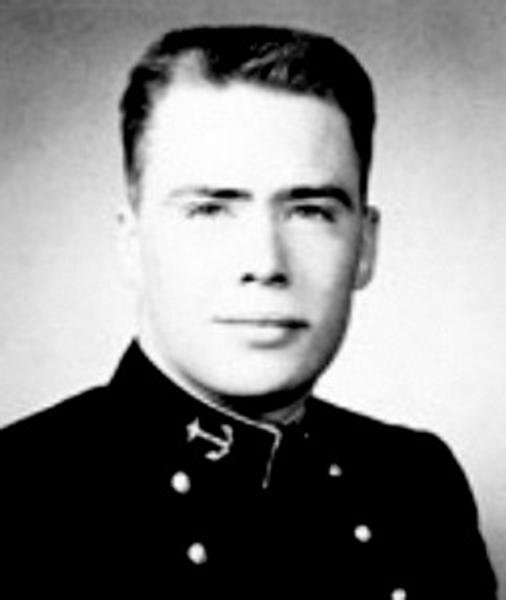
LTJG Terence M. Murphy was a pilot assigned to Fighter Squadron 96 onboard the aircraft carrier USS Ranger in the Gulf of Tonkin. On April 9, 1965, he launched with his Radar Intercept Officer (RIO) ENS Ronald J. Fegan in their F-4B Phantom fighter jet. They were to fly a Combat Air Patrol mission over the Gulf of Tonkin. LTJG Murphy and other mission aircraft engaged enemy aircraft at approximately 8:40 a.m. some 25 miles from the nearest land. After breaking off the engagement, LTJG Murphy’s aircraft did not check in with the flight leader and was neither seen or heard from again. An aerial and surface search of the area turned up no evidence of a plane crash, seat ejection or emergency radio beacon. Search and rescue efforts covered an area of 2000 square miles utilizing aircraft from three carriers, destroyers and a submarine. The search was terminated on April 11 with negative results. It was later discovered the the MIG aircraft that were engaged were not Vietnamese, but Chinese. The incident took place near the Chinese island of Hainan. Peking Radio stated later that day that eight U.S. military planes had intruded over the areas of Aihsien, Paisha and Changkan of China’s Hainan Island. They further stated that Chinese planes immediately took off to engage them and that a U.S. aircraft had been shot down by other U.S. planes. Careful investigation revealed no basis of fact to support this claim. Both crewmen were listed in a status of Missing in Action. This status was changed three weeks later to Determined Dead/Body Not Recovered.
LTJG Terence Meredith Murphy has a stone in his memory in Memory Section H of the Arlington National Cemetery. He is honored on the Wall at Panel 1E, line 103.
U.S. Navy F-4 Phantom IIs of Fighter Squadron 96 (VF-96) clashed with Chinese MiG-17 fighters over the South China Sea south of Hainan. Each side lost one fighter. In the course of U.S. raids over North Vietnam, four U.S. carrier-based F-4 Phanton jets clash with Chinese MiGs off Hainan Island, the Chinese island opposite Vietnam. On 12 April, the United States will admit that one Phantom and its two pilots were lost, but it will not confirm that they were shot down by one of their own missiles. The day after two F-4B Phantoms had flown over the Yulin Naval Base, two groups of American planes, each with four U.S. Navy F-4Bs, flew over China’s Hainan Island. This time, a squadron of four Jian-5 jet fighters from the People’s Liberation Army Air Force intercepted them, with instructions not to fire unless fired upon. The American pilots stated that they had believed that they were outside China’s airspace, and in an area 36 miles southwest of Hainan, while China accused the U.S. of trying to provoke a war.
U.S. jets did not intrude over Red China’s Hainan Island either before or during the brief air battle with MiGs in the Gulf of Tonkin, the Defense Department said.
After the engagement with the MIG’s, 70 A-1 Skyraiders and Skyhawks flew off the carriers USS Coral Sea and USS Ranger to drop 100 tons of bombs on the Tam Đa highway and railroad bridge, 120 miles south of Hanoi on Highway 1. But naval reconnaissance flights showed that the bridge had not been badly damaged by the morning flight. After noon, 70 strike aircraft, accompanied as they had been in the morning by about the same number of F-4 Phantom and F-8 Crusader jets, returned to the site. On the second raid, the spokesman said they destroyed two spans of the bridge. No MIG’s were sighted, and no planes were lost during the return strike.
At about 1 PM, 50 United States Air Force F-105’s struck two other bridges in the center of North Vietnam with a total of 145 tons of bombs. An Air Force announcement said that both bridges had been destroyed and that no planes had been downed during the operations. During a strike last Sunday against another North Vietnamese bridge, two United States Air Force F-105’s were shot down by North Vietnamese MIG’S.
The Air Force targets today were the Quý Vinh railroad bridge, about 10 miles north of the Tamda bridge attacked by the Navy, and the Khe Kiền highway bridge. The Khe Kiền bridge was about parallel with the Quý Vinh bridge but about 20 miles east of the Laos border on Highway 7. The Air Force said the planes knocked down about one-third of the Khe Kiền bridge and sank one span of the Quý Vinh bridge. The three targets today raise to six the number of bridges that the United States has struck and has claimed to have rendered unusable within the last seven days.
President Hồ Chí Minh of North Vietnam was reported today to have demanded the withdrawal of United States forces from South Vietnam as a condition for any settlement. He dismissed United States talk of negotiations as “misleading,” it was reported, and said the Vietnamese people were “determined to fight to the end against the aggressors.” President Hồ’s remarks were made in a recent interview with a correspondent of Akahata, journal of the Japanese Communist party. Thus they did not constitute a direct reply to President Johnson’s speech in Baltimore Wednesday night, which offered in effect negotiations without prior conditions.
But the prominent attention given to Mr. Hồ’s interview today by the North Vietnam Press Agency suggested that it was intended to serve for now as a statement of Hanoi’s policy. In the Akahata interview, President Hồ also said that if the United States withdrew from South Vietnam and stopped “provocative attacks” against North Vietnam, this would “bring about favorable conditions for a conference along the pattern of the 1954 Geneva conference” that divided Vietnam into Communist and non-Communist sectors.
Mr. Hồ added that American “imperialists” had recently “put forward misleading talk about ‘peace’ and ‘negotiation.’ ” Replying to such bids, he asserted: “The peoples of the world are fully aware of their aggressive and warlike nature. The step-up in aggression in South Vietnam and the bombing of the North are part of their policy of ‘special warfare.’ “
Communist China’s first response to President Johnson’s speech was expressed today in a dispatch by Hsinhua, the Chinese Communist press agency, printed in all Peking papers. President Johnson “told a pack of lies and made many deceptive remarks” in his speech, Hsinhua said. His proposal for negotiations, Hsinhua added, is “but an old device presented in a new form” to lure the Vietnamese people “to lay down their arms and cease their struggle.” Apart from this “hoax,” the agency added, all President Johnson’s address had to offer was “gangster’s logic and big lies.”
North Vietnam’s senior diplomat in Paris said tonight that negotiation with the United States in the present situation would amount to surrender.
In Budapest, highly reliable Eastern European sources reported that North Vietnam was willing to talk about the neutralization of both northern and southern Vietnam. It was suggested that bitterness over the United States air strikes was preventing the North Vietnamese from publicly stating such a willingness.
Poland and the Soviet Union accused the United States tonight of endangering world peace with “armed aggression” against North Vietnam.
Adlai E. Stevenson conferred for an hour today with the Secretary General, U Thant, on President Johnson’s ideas for United States and United Nations cooperation in working for peace and economic development in Southeast Asia.
Soviet and East German control authorities staged another snap shutdown of the Berlin-West Germany autobahn tonight, dashing hopes that this week’s Communist squeeze on Western allied communications had ended. Barriers were raised at both ends of the 110-mile interzonal highway at 5 PM after a day of almost normal traffic flow. The highway was reopened three hours later, the Communist procedure following a pattern laid down in other brief shutdowns in the four preceding days. Allied officials lodged yet another protest at the autobahn checkpoints.
An East German announcement this morning that the “first phase” of the Soviet-East German army maneuvers was over had stirred optimism in allied quarters that a week of Communist harassment was drawing to a close. The maneuvers are the ostensible reason for the sporadic slowdowns and occasional total stoppages of civilian and military vehicles traveling the access highways to West Berlin, which is 110 miles from the West German border. Otto Winzer, East German Deputy Foreign Minister, gave a more candid explanation in a statement distributed by A.D.N., the official press agency. He said the harassment tactics were intended to teach the “unteachable” West German Government that it could not get away with such “provocations” as Wednesday’s plenary sitting of the Bundestag, or lower house of Parliament, in West Berlin.
The continuing slowdown in clearing civilian traffic into West Berlin has begun to have a damaging effect on the city’s economy. Trucks that deliver most of its perishable food are still suffering delays of 30 to 50 hours in a normal three-hour run from West Germany. As the daylight hours passed today without new infringement of allied access rights, Western officials began to hope that the serious Soviet infringement tactics had ceased. The Russians also withdrew special altitude restrictions on flights to and from Berlin. These restrictions, announced last weekend, called for Western traffic in the three air corridors to West Germany to remain above 6,500 feet during the Soviet-East German maneuvers. The British spokesman said that the Soviet controller at the four-power Berlin air safety center announced this morning that the restrictions had been revoked.
[The Russians allowed the first elements of several hundred American troops — in full battle dress — to proceed to Berlin from West Germany early the next morning.]
West Germany’s Bundesrat, the upper house of parliament, voted by a show of hands to approve the bill to extend the statute of limitations on prosecution of Nazi war crimes, up to January 1, 1970. The Bundestag had voted its approval on March 25.
A special West German envoy said today that Bonn had promised the Government of the United Arab Republic that its recognition of Israel would not include any guarantee of her borders.
Israeli Premier Levi Eshkol said today that the United States had attached “no strings” to any American arms aid to Israel.
First indications have appeared in the press that the Egyptian Government plans to slow its ambitious economic development program and is reconciled to falling short of its goal of doubling the national income in a decade.
Indian officials said at least 27 Pakistanis were killed or wounded and four captured in fighting that broke out in a disputed border area today. India’s losses were put at two killed, and three wounded. The clash was described as one of the most severe in recent months. Reports from Ahmedabad, capital of the western Indian state of Gujarat, said regular infantry units of Pakistan’s Army, supported by artillery, tanks, and armored cars, took part in the fighting. The reports added that the Indian police, often as well armed as regular army units, were receiving support and reinforcements.
Two thousand Marines and more than 1,700 Army paratroopers landed from sea and sky today on the sandy beaches and mesquite covered hills of Vieques Island in Puerto Rico. Twenty-two naval ships and more than 160 Air Force, Navy and Marine Corps aircraft participated with the assault troops in a joint amphibious and air exercise, the first of its kind held outside the United States. The exercise, which will end Sunday as the troops overrun the 3-mile-wide, 21-mile-long island of Vieques, is known as QUICK KICK. It is under the command of Admiral H. Page Smith, commander in chief, Atlantic, with headquarters at Norfolk, Virginia. In the past, QUICK KICK has been held in the United States in the Onslow Beach-Camp Lejeune area of North Carolina.
Today, the paratroopers of the 82d Airborne Division flew directly to the drop zone here in C-124 Globemasters of the Military Air Transport Command. The Marines, embarked in amphibious ships, were landed in landing craft and helicopters. The operation was closely monitored by a Soviet trawler, equipped, according to naval officers, with electronic monitoring gear and tape recording instruments. Communications traffic and radar frequencies were presumably noted by the Russian ship, which was in plain sight of the shore.
An explosion in a coal mine on Iwo Jima killed 19 coal miners and left another 11 missing.
The Government of Kenya issued today one of its clearest statements on its intention to adhere to moderate and prudent policies and nonalignment with the Communist world. In doing so it publicly rebuked a junior minister for suggesting otherwise.
A United States researcher said today that Communist China was a month behind schedule in carrying out its second nuclear test. He suggested that there might be political or technical reasons for the delay.
The U.S. Senate gave final approval to the aid to education bill. The measure will be signed by President Johnson in the Texas schoolhouse he attended as a youth. The Senate passed the Administration’s $1.3 billion school aid bill tonight without change and sent it to the White House. The vote was 73 to 18. Administration forces were jubilant, hailing passage as President Johnson’s greatest legislative victory. The vote came just a day after an almost equally spectacular show of Administration strength: the House approval of a program of medical care for the aged. That bill has not yet been taken up by the Senate. The action culminated nearly 20 years of effort in Congress to provide a broad program of federal aid to the nation’s elementary and secondary schools. The bill is keyed largely to aiding public schools in areas of poverty. Benefits in the form of special services and loans of textbook and library materials, would be provided to parochial school students.
The Senate Judiciary Committee sent a reshaped voting rights bill to the Senate floor. Debate was slated to start April 21. Beating a midnight deadline by a scant four hours, the Senate Judiciary Committee reported a voting rights bill to the Senate tonight without recommendation. Earlier, a House Judiciary subcommittee approved, 10 to 1, its version of a voting rights measure.
After a morning City Hall march by Blacks was broken up by a melee, an afternoon attempt succeeded peacefully under police guard in Bogalusa, Louisiana. A traffic accident during the morning Black protest march touched off a flurry of violence that threatened to turn into a riot in downtown Bogalusa today. An automobile driven by the city’s assistant police chief struck and injured a young white man who was rushing across the street toward the Black marchers. The injured man’s friends were enraged. They had already attacked a news photographer and had tried without success to get at the Black demonstrators. When the accident occurred, half a dozen pushed through the police lines and attacked the marchers. One white man with a blackjack threatened James Farmer, national director of the Congress of Racial Equality, who was leading the march. A policeman stepped in and Mr. Farmer escaped with nothing worse than a twisted necktie.
The anger of the whites turned against the police after a few minutes. “We ought to kill them,” one yelled. An agent of the Federal Bureau of Investigation was struck as he made motion pictures of the white bystanders. Several other photographers were roughed up. The crowd calmed after the injured man was taken to a hospital and after the march stopped and turned back to the Black community.
Four hundred Blacks and a handful of out-of-state white CORE workers repeated the march this afternoon without incident. Mayor Jesse H. Cutrer Jr., a political moderate, greeted the marchers in front of the City Hall with a brief speech pledging the city government’s help in working out racial problems. The purpose of the march was to protest intimidation of Blacks by the Ku Klux Klan and to air other grievances against the white community, Mr. Farmer said. He said the Blacks demanded police protection, equal employment opportunities, desegregation of public accommodations and the hiring of Black policemen.
Vice President Humphrey, taking note of racial disturbances in Bogalusa, Louisiana, declared today that the nation had a sense of justice that says, “We must rid ourselves of racism and do it in our lifetime.”
The International Longshoremen’s and Warehousemen’s Union has imposed a boycott on the handling of Alabama-made products by its 65,000 members.
Manufacturing employment rose in March to 17,814,000, its highest point in 21 years, the Labor Department said today. It is a post-World War II peak.
In Houston, the Harris County Domed Stadium (later known as the Astrodome) opened with an exhibition baseball game between the Houston Astros and the New York Yankees. The game, the first Major League Baseball contest to be played indoors, took place before a crowd of 47,876 people that included the President and Lady Bird Johnson, and the home team won, 2–1 in 12 innings on a Nellie Fox single. Mickey Mantle hits the first home run (MLB’s 1st indoor home run) in the new park. Fans who watched batting practice during the daylight hours saw the flaw in the indoor stadium design: the transparent panels and the pattern of interconnecting girders on the dome created glare when the sun was out, and the outfielders lost track of fly balls. “The players shagging fly balls in left and center field particularly stumbled, hesitated, covered their heads in self defense or threw up both hands in despair,” a UPI report noted the next day, often missing the path of the ball “by yards and yards.”
Daytime exhibition games on Saturday and Sunday were not affected by the glare because of cloudy skies, but the Astros” owner was prepared to cancel a game “if… it develops into a keystone comedy act with players on both sides unable to follow the flight of a ball.” Before the next afternoon home game, the team solved the problem by painting over the clear panels, which would cause a different problem because the natural grass could not grow without sunlight.
The 100th anniversary of the end of the American Civil War was observed in ceremonies near Appomattox, Virginia. Virginia Governor Albertis S. Harrison, Jr., known for resisting school integration while serving as the state attorney general, told thousands of listeners that “the belief and the principles for which the Confederate forces fought are still with us… All that was really surrendered here a century ago was the idea that these beliefs and the principles could best be served by dividing this nation in two, and that differences between Americans could really be settled by armed conflict.” Speakers at the dedication of the reconstructed Appomattox Courthouse included retired Major General Ulysses S. Grant III, and Robert E. Lee IV of San Francisco.
Weary flood workers watched for a crest of the Minnesota River which has forced 8,000 persons from their homes. Mayor Ray Eckes of North Mankato ordered 5,000 residents out as a precautionary measure.
There is still a chance that an American astronaut may attempt to match the Soviet feat of moving around outside his spacecraft on the next Gemini flight, the Federal space agency said today. There also is some hope that the four-day, 63-orbit flight can be made in late May. Officially, the flight of the Gemini 4 is still scheduled for June and does not even call for the opening of the cockpit hatch. However, two factors — the success of recent Gemini flights and the acrobatics of Lieutenant Colonel Aleksei A. Leonov outside his Voskhod capsule last March 18 — may help to rewrite the Gemini flight plan.
The Early Bird communications satellite was moved into a final orbit today that stationed it over the Atlantic.
The Beatles” song “Ticket to Ride” was released as a single in the United Kingdom, and reached number one on the British chart of best-selling singles that was published five days later. It would be released in the United States on April 19, and reach number one on Billboard on May 22.
The stock market recorded its third straight gain and did it on the heaviest volume in over two months.
Dow Jones Industrial Average: 901.29 (+3.39)
Born:
Paulina Porizkova, Czech-born American model; in Prostějov, Czechoslovakia.
Hal Morris, MLB first baseman and outfielder (World Series Champions-Reds, 1990; New York Yankees, Cincinnati Reds, Kansas City Royals, Detroit Tigers), in Fort Rucker, Alabama.
Aric Anderson, NFL linebacker (Green Bay Packers), in Waverly, Iowa.
Helen Alfredsson, Swedish golfer (Nabisco Dinah Shore 1993), in Gothenburg, Sweden.
Mark Pellegrino, American actor (Lucifer-Supernatural), in Los Angeles, California.
Jeff Zucker, American television executive (President of CNN, 2013-22; CEO of NBC Universal, 2000-10), in Homestead, Florida.
Jay Wesley Neill, American convicted mass murderer (killed four people during a bank robbery in Geronimo, Oklahoma), in Pensacola, Florida (d. 2002, executed).
 History Diaries