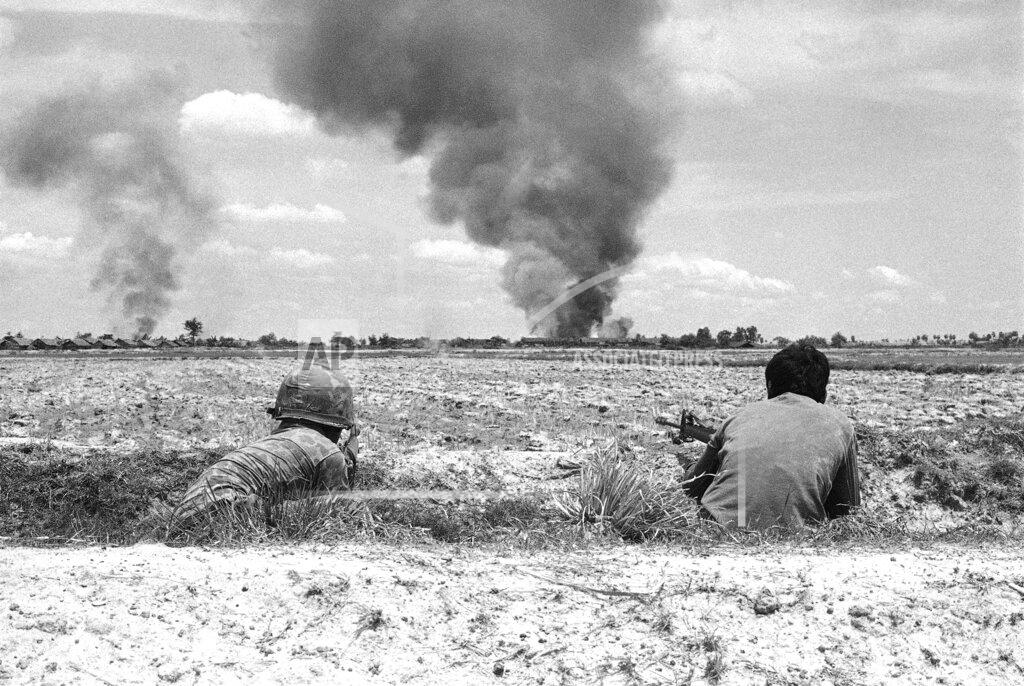
The Battle of Xuân Lộc, the last major battle of the Vietnam War, began. South Vietnamese forces held out against superior North Vietnamese forces before finally withdrawing on April 19.
Communist forces are continuing an assault on the key provincial capital of Xuân Lộc, 36 miles northeast of Saigon. It was part of a drive apparently aimed at isolating the national capital. Another hard blow was also struck at the provincial capital Tân An on the highway connecting Saigon with the Mekong Delta area to the southwest. More Communist troops are known to be concentrating in the area.
For the second day Xuân Lộc, capital of Long Khánh province, came under attack today, with the Communists pouring thousands of shells into the city. The city reportedly was almost demolished in yesterday’s fighting, when Communist troops occupied most of it. Today, a Government spokesman said that after the renewed barrage this morning North Vietnamese troops had been pushed out of Xuân Lộc. But the spokesman said the Communists were still shelling the city and it was unclear whether government forces would be able to hold it.
Yesterday saw the beginning of major attacks apparently aimed at isolating Saigon. Although the most threatening of the action was at Long Khánh, Communist forces also struck hard at the provincial capital Tân An to the southwest and temporarily cut Route 4, on which it is situated. The road, Saigon’s lifeline to its main source of rice and other food in the Mekong Delta, was severed at a point in Long An Province after Communist gunners had shelled Tân An. But by midafternoon, government troops reported breaking through and the road again was said to be safe for travel. evertheless, the fact that the road had been cut appeared to indicate that more serious trouble was ahead, particularly since large enemy forces are known to be concentrating in the area.
Communist troops also pressed yesterday on the city of of Tây Ninh 50 miles northwest of Saigon. Reports from Tây Ninh said that two barrages of 122‐mm. rockets had crashed into the city, resulting in a number of killed and wounded. One of the rockets was said to have hit an ammunition dump, setting off explosions that continued for nearly an hour.
While the main Communist assault northeast of Saigon was centered on the small city of Xuân Lộc, the North Vietnamese troops were also apparently attempting to isolate the defenders with attacks nearby. Tanks and infantry yesterday afternoon attacked a government rear headquarters base a mile east of the city and a second command post two miles farther east was heavily shelled apparently in preparation for an attack, the government spokesman said. Xuân Lộc is at the edge of a dense jungle region known as D Zone, a traditional Communist sanctuary. It lies on the approach to Biên Hòa, a key city 12 miles northeast of Saigon, whose big air base is the most important remaining operations center for government fighters and bombers. The air base came under shellfire yesterday morning, and the 26 rounds that landed reportedly killed two military men and wounded 15 other persons.
Delayed reports reaching Saigon of Communist action south of the capital said a number of district capitals in Kiên Giang Province and other provinces bordering Cambodia were shelled Tuesday night. In a clash near Sa Đéc Tuesday, government forces reported having killed 47 enemy soldiers, suffering only one wounded. The claimed enemy casualties therefore must have been caused by air strikes or shelling.
The Saigon spokesman said last night that an investigation was continuing into the death Tuesday night of Major General Nguyễn Văn Hiếu, deputy commander of Military Region III, which surrounds Saigon. According to the official account of the incident, the general shot himself by accident after repairing a German‐made P‐38 pistol, the operation of which had been unfamiliar to him. But when asked how many shots had hit General Hiếu, the spokesman last night said he did not know. General Hiếu, who had headed an anticorruption commission, was widely known for his honesty and vigor in rooting out official malfeasance. There had been reports of a dispute between the general and his commander, Lieutenant General Nguyễn Văn Toàn.
The Saigon spokesman reported that early today one of the barges used to carry refugees from central Vietnam to the port of Vũng Tàu had struck a mine there. The spokesman said the damage was minor and there had been no casualties.
North Vietnamese attacks east and southwest of Saigon may represent the opening of an offensive in the area, according to United States military sources. The attacks at Xuân Lộc, 38 miles east of Saigon, and near Tân An, 18 miles to the southwest, were preceded by heavy artillery and rocket preparation. Senior officers believe that the main attack on Saigon will be launched from the north down the Saigon River corridor. Forces in the Tây Ninh area, they suggested, may link up with the Sixth Division, if it is successful at Xuân Lộc, for a drive from the north.
Some sources suggested that the current high-level discussions in Washington about military aid had led the Communists to accelerate the pace of their attacks. A more general view was that the Communists, having completed their preparations, were moving into the first phase of their offensive. The character of the terrain on three sides of Saigon is one reason for expecting that the Communists’ main thrust will develop from the north. To the east, south and west, low‐lying ground is cut by small streams feeding rice paddy or trickling into the Saigon River or the sea. The terrain was characterized by ue officer as “difficult to defend and damn near impossible for a major conventional attack with tanks and self‐propelled guns.” The impact of shells and bombs would break down the tiny dams in the area and shatter the banks of the streams. Forces moving toward the city would have to advance across open country unaccompanied by armor and would be vulnerable to air attack and to long-range artillery fire.
Of the two current Communist attacks, the one at Xuân Lộc, if successful, appears to offer the greater opportunities for successful exploitation. American sources said the Communists could advance westward along a reasonably good road through heavily wooded country that provides cover against air attack. Once at Biên Hòa, which was shelled yesterday, the Sixth Division could unite with Communist forces pushing southeast from the Tây Ninh area and form a formidable force poised to take the Saigon River corridor route south to the capital.
For a week, Communist operations have methodically cut Saigon’s communications to the east, north and west. This, the sources conceded, may sound more important from a military standpoint than is actually the case. The Saigon divisions in the capital area, perhaps 40,000 men facing an estimated 65,000 Communists, cannot expect reinforcement from the east or the northwest.
The government forces by now have received and rearmed all the stragglers and small units fleeing from the north that are capable of another effort. The three divisions in the Mekong Delta are occupied with an increasing number of Communist attacks and, apparently, lack the mobility to provide rapid reinforcement for the capital area’s garrison. Existing supplies are largely based in the Saigon area with some fuel, ammunition and spare parts at outlying positions like the air base at Biên Hòa. American military aid is being flown into the capital and is distributed to the forces fighting outside the city.
For some Vietnamese, the war just means sitting and waiting in the hot sun. More than 10,000 people did that in Gò Đền today when Communist troops cut Route 4, the main road from the populous Mekong Delta to Saigon, and stopped traffic for miles. There was no sound of gunfire and no artillery shells landed nearby. No one could see the Communists, who were an unknown number of miles farther down the road. The biggest enemy was boredom and the heat.
The scene was familiar enough for the Vietnamese, accustomed for years to Communist ambushes and roadblocks. But today’s tie‐up was particularly serious because this village, where the lead vehicle was stopped, is only 15 miles south of Saigon. The cutting of Route 4 here has a dual effect—it increases the sense of fear in Saigon and it blocks the capital from its major source of rice, vegetables and fruit in the delta. The Communists have previously cut the highways leading to Saigon from the east and north. For some of the people in the hundreds of buses stuck here today, it was also painfully frustrating.
A short stocky paratrooper in mottled‐green camouflage uniform paced up and the endless column of red, green, blue and silver buses. One arm was in a sling, the other bore a red gash from wrist to elbow. “I have a two‐day leave to go home to visit my family,” the paratrooper said. “Our battalion just got evacuated hack to Saigon, now I won’t have much time at home.” The deeply tanned soldier, who wore his elite division’s red beret and parachute insignia, was wounded last week in fighting near Nha Trang on the central coast.
“We were advancing, not retreating, we could have advanced all the way to Ban Me Thuot,” he said proudly, referring to a city in the Central Highlands captured by the North Vietnamese. “The Communists were not so tough, even though they shelled us all the time with 105’s they captured from the infantry. But then everyone behind us ran away, so we had to pull back ourselves,” he added with disgust.
No one seemed to know what was happening up ahead, or how long they would have to wait. By noon many had already been held up for five hours. Traffic finally did begin to move after 2 PM, when government troops cleared the Communists from the road near Tân An, the capital of Long An Province.
A militia lieutenant who had been ordered to stop any vehicles from going farther and getting shot at by the Communists sat on a large white tombstone. “I beard, over my radio that the Communists are shelling Tân An,” he said when asked what had happened. “But no one tells me anything.” Three young soldiers under his command leaned on their M‐16 rifles, paying little attention to the blocked traffic or to possible Communists lurking in the rice fields. “We don’t know anything,” one commented. It was another typical day in the war for Vietnam.
[Ed: “We don’t know anything.” How many millions of soldiers have said the same, since the days of the Roman centurions?]
The White House said President Nixon gave private assurances to Saigon in 1973 that the United States would react vigorously to a major Communist violation of the cease-fire agreement. The statement, in response to Senator Henry Jackson’s charge of “secret agreements,” said the private assurances had been substantially the same as what Mr. Nixon and others were saying in public. They lost validity, the White House said, because Congress imposed a ban on American combat activity in Indochina in August, 1973. Senator Jackson clearly felt the statement vindicated the charge he had made.
President Ford is considering contingency plans to evacuate thousands of South Vietnamese officials who have worked closely with the United States and military officers whose lives might be in jeopardy in a Communist takeover. The plans were reportedly discussed at a National Security Council meeting called to review foreign policy. Decisions on military and humanitarian aid and possible evacuation will figure in Mr. Ford’s speech to Congress tomorrow night.
Soviet Premier Aleksei N. Kosygin asserted today that the Saigon Government was guilty of the “new crime” of forcing civilians out of areas it had lost in Vietnam. Mr. Kosygin’s remarks, at a Kremlin dinner tonight honoring a high‐level Yugoslav delegation, made him the first ranking Soviet leader to comment directly on the recent events in Vietnam. The Soviet Premier spoke with apparent gusto as he assailed the leadership of President Nguyễn Văn Thiệu.
Continued erosion of Government positions north of Pochentong Airport is putting the installation within range of insurgent mortars, military sources reported today. Insurgent forces have infiltrated to within four miles of the airport, the sources said, and now control most of a dirt embankment, known as the northern dyke, along which government forces had been seeking to establish a firm line of defense. Pochentong Airport is encircled Phnom Penh’s last supply link with the outside world. The slow but steady advance of the insurgents jeopardizes the American airlift of ammunition, weapons and rice.
[Reuters reported from Bangkok the next morning that a rocket hit the airport killing three Cambodian loaders and temporarily halting part of the airlift, according to American military sources.]
Insurgent forces east of the capital were also advancing to within mortar range. A government outpost on the east bank of the Mekong River at Arey Khsat had to call for reinforcements last night after an insurgent attack that resulted in more than 40 government casualties. Arey Klisat, is only two miles from the former royal palace in the heart of Phnom Penh. There were reports today that the insurgents had started firing 75‐mm. recoiless rifles into populated areas on the northeastern edge of Phnom Penh from positions on the east bank of the Tonle Sap.
In northwest Cambodia, the insurgents reportedly cut Route 5 between Battambang and the town of Poipet on the Thai border. The highway was the government’s last surface link to Thailand. Fighting continued in the streets of the provincial capital of Kompong Speu, 30 miles west of Phnom Penh. But there were indications that the fighting might he tapering off and rumors that the insurgents and government forces there might be arranging a local accommodation of some kind.
The Ford Administration’s leading arms control expert said today that transfer of peaceful nuclear technology “provides not only the means, but also the cover” for a spread or nuclear weapons. Fred C. Iklé, director of the Arms Control and Disarmament Agency, said at a conference here on nuclear proliferation: “Now we suspect that the intent to make nuclear weapons exists in several places even though the capability is not yet there.” It was authoritatively learned that the “several places” included Argentina, Brazil, Israel, Libya, Taiwan, South Korea, and Pakistan. Taiwan and South Korea have acceded to the nonproliferation treaty.
The House of Commons voted 396 to 170 in favor of continued British membership in the Common Market, but Prime Minister Harold Wilson suffered a potentially damaging loss of support from about half his Labor party’s members in the House. Opposition Conservatives supported Mr. Wilson’s call for remaining in the market on the recently renegotiated terms. The big majority in the House of Commons vote was expected to be an influential factor when the British people make the final decision on market membership in a referendum on June 5.
Portuguese military police made a new wave of arrests and detained in the notorious Cadias prison a journalist planning to found an independent newspaper. The arrests of 28 military men and three civilians were in connection with an abortive conservative uprising last March 11, officials said. Among those held was Nuno Rocha, who has been assembling capital and a team of journalists for an independent newspaper to counterbalance what he believed was slanted reporting in the Portuguese press.
Finance ministers from major non-Communist industrial nations agreed at a Paris conference that the worst of the world’s recession was over and no further measures are needed to stimulate the start of recovery. They signed an agreement for a $25 billion lending facility for industrial nations suffering from high oil prices.
Mikhail Agursky, one of Moscow’s most prominent Jewish dissenters, arrived in Israel after a three-year struggle to leave the Soviet Union. Agursky, who flew to Tel Aviv from Vienna with his wife and two children, said he had recently served as a link between Jewish activists and foreign correspondents in Moscow. Agursky, whose father, Samuel, was sent by Lenin to form a Communist Party in the United States in the early 1920s, said the Soviet Union wanted to isolate and “eventually stifle” the dissident movement.
Thousands of workers are being “drafted” from Eastern European countries to work on major construction sites in the Soviet Union, a British newspaper reported in London. The right-wing Daily Telegraph added that East Europeans were reluctant to work far from home in harsh Soviet conditions. The paper gave no details of how the alleged drafting was carried out.
The Vatican’s Sacred Congregation for the Doctrine of the Faith issued a decree, approved by Pope Paul VI, reinstituting a limited form of censorship on religious books. It replaced old-and much sterner-laws that barred both priests and lay Catholics from publishing any writings about religion or morals without the imprimatur (permission) from their bishop.
24 OECD members sign an agreement to establish a $25 billion lending facility to provide assistance to industrial nations hurt by high oil prices.
An opposition deputy in the Turkish parliament accused Iraqi forces of annihilating Kurds in northern Iraq. Mikail Ilcin, whose constituency is in the Kurdish-dominated eastern province of Hakkari along the Iraqi border, made the claim in a written appeal to the International Red Cross in Geneva urging it to help the Kurds.
Troops from the Indian Army invaded the Kingdom of Sikkim in response to an appeal by the Himalayan kingdom’s prime minister and disarmed the 400 guards of the King of Sikkim at his palace in Gangtok. The King (Chogyal) Palden Thondup Namgyal was confined to the royal palace under house arrest.
About 150 policemen surrounded the Seoul Penitentiary this morning as eight men convicted by a military tribunal of having been members of an outlawed party were hanged. The executions took place barely 24 hours after the Supreme Court rejected the men’s appeals in a turbulent session. The condemned men were among a group of 21 South Koreans who were arrested in April last year on charges of having plotted to overthrow the Government of President Park Chung Hee by force. All were accused of being members of a Communist spy group called the People’s Revolutionary party. The Government said that the group, acting under orders from the Communist government in North Korea, had organized student demonstrations against Mr. Park. The 21 were tried, in secret by military courts under the emergency decrees issued by President Park last year. During the trials the defendants insisted they had been tortured into making false confessions. Nine other defendants were sentenced to life imprisonment and others received shorter terms.
Meanwhile, about 300 students here defied the government’s emergency decree closing Korea University and staged a street demonstration demanding the release of jailed students and lifting of the decree. The police released 18 of the 36 students detained during clashes Monday at Seoul National University and referred the rest to summary court for legal proceedings. About 3,000 students at three other universities here held rallies on their campuses to protest the closing of Korea University. They also demanded revision of the Constitution, the release of jailed students and the lifting of the, emergency decree.
The Philippine Basketball Association, Asia’s first professional basketball league, played its first game before a crowd of 18,000 at the Araneta Coliseum in Quezon City, with the Mariwasa-Noritake Porcelain Makers defeating the Concepcion Carriers, 101 to 98 in the opener of a doubleheader, followed by the Toyota Comets’ 105–101 defeat of the Universal Textile Weavers. Gregorio Dionisio of the Carriers scored the first basket.
Cuban Premier Fidel Castro told his countrymen and a visiting delegation from Guyana that it was the duty of Latin American countries to “challenge the neocolonialist policy established by the United States.” Prime Minister Forbes Burnham of Guyana said he had witnessed more revolutionary spirit in his two-day visit to Cuba than in any other country.
Former U.S. ambassador to Haiti Claude G. Ross denied a charge that the CIA had tried to assassinate the late Haitian President Francois Duvalier in 1968. The charge was made by syndicated columnist Jack Anderson. Ross, who is retired, made the denial in Copenhagen, where he is vacationing.
Nigerian journalists are up in arms about recent attacks on them by the country’s military leaders. About 30 of them marched in protest on the office of Federal Information Commissioner Edwin Clark in Lagos and handed over a letter calling on General Yakubu Gowon, head of state, to make a policy statement on the press. They carried placards including one which said that General Gowon “needs the press to rule.”
The House Ways and Means Committee approved a $2.8 billion-a-year tax on health insurance premiums to provide health insurance for more than 3 million unemployed. The proposal would place an 8% excise tax on group health insurance premiums, which would be paid by the health plan organizations and passed on to the employers and workers. The committee expects to put the finishing touches on the bill Monday. It rejected a version urged by organized labor to rely mainly on revenues.
Although final ratification of the Equal Rights Amendment appears unlikely this year, a majority of Americans in the latest Gallup Poll voted in favor of the measure which would abolish any law or legal practice that discriminated on the basis of sex. Six persons in 10 (58%) say they favor it, 24% are opposed and 18% do not express an opinion. Support is greatest in the East and West, least in the Midwest and South. Younger persons are more likely to favor it than older persons and men are more inclined to back it than women. Least in favor of it are women aged 50 and over. A total of 34 states have ratified it, with 38 required.
The House voted to continue a summer lunch program for 1.7 million poverty area children and authorized $52.7 million for the project through this year. The measure was sent to the Senate, which earlier approved a similar bill. The House changed the Senate version by knocking out funding of the program through customs revenues levied on imported goods. Such revenues have been held in reserve to help pay farmers who get less for their commodities than is paid in the United States. The House measure would require the direct authorization of funds for the lunch program, which is carried out at recreation centers, settlement houses, playgrounds and neighborhood houses in poor areas.
The United States Commission on Civil Rights said today that it favored expansion of the Voting Rights Act of 1965 to protect the right of Americans of Spanish-speaking origin to vote, just as the law has helped to enfranchise black Americans in the last decade.
Ralph Nader accused House Judiciary Committee Chairman Peter W. Rodino Jr. (D-New Jersey) of suppressing information gathered last year during the nomination hearings on Vice President Rockefeller. He said Rodino’s refusal to release the materials “amounts to an information coverup.” Rodino said many of the documents could not be released “without severe and unnecessary intrusions upon personal privacy and for other legitimate reasons. “The vast bulk of the information has already been made public, much in printed form,” Rodino said.
Preserving jobs rather than increasing wages should be the goal in labor-management negotiations this year, the Council on Wage and Price Stability said. The report said inflation was easing but “wage increases will become a more important element in the inflationary process this year. The council also disclosed that it planned to study pricing practices in a number of industries, including metal cans, rubber tires and industrial chemicals. The council said a “plausible range for inflation in consumer prices in 1975 would be 7% to 10%, compared with 12.2% last year.
The Transportation Department proposed a one-year delay in regulations requiring all cars built after August 15 to be equipped with air bags or other passive restraint systems. No reason was given for the delay, but a spokesman noted that the air-bag issue was “very controversial.”
About 30 militant Indians left the offices in Horton, Kansas, of the U.S. Bureau of Indian Affairs with a promise from the BIA to transfer Reservation Superintendent Jack Carson and recognize a recently elected tribal council. The demands were made by a group of Kickapoo and Potawatomi tribal members and agreed to on the recommendation of Charles James, area director of the BIA in Anadarko, Oklahoma.
New York Governor Carey said that his counsel, Judah Gribetz, would meet shortly with senior state judicial officials to discuss the alleged cover-up of possible crimes by law enforcement officers during and after the Attica prison revolt in 1971. He said they would determine if judicial-branch action was warranted to resolve charges brought by a member of the Attica prosecution team who resigned.
The Beame administration in New York City is filling federally-financed jobs in the Office of Neighborhood Services with political patronage appointees rather than the long-term unemployed for whom the jobs are intended. Names referred by Democratic Councilmen, Assemblymen, State Senators, Borough Presidents and county leaders have been cleared through City Hall, according to officials within the office. An examination by a reporter of the names of 16 persons listed in the City Record for April 3 as hired to be neighborhood aides or their assistants showed that 11 had political connections. Some were district leaders.
The Securities and Exchange Commission charged the United Brands Company with having paid a $1.25 million bribe to government officials of Honduras to get favorable tax treatment on banana shipments from that country. In a suit filed in Washington, the S.E.C. also accused the company of having paid $750,000 in bribes to European officials. The suit followed a routine inquiry into the company’s affairs after the suicide on February 3 of its chairman and president, Eli Black.
Banning of some chemicals used to provide pressure in aerosol spray cans was urged by Senator Thomas McIntyre (D-New Hampshire) unless it can be proved the chemicals do not destroy parts of the earth’s protective ozone layer. Scientific evidence has indicated some gases serving as propellants for aerosol cans are destroying the ozone layer, which shields the earth from overdoses of ultraviolet rays. Researchers have warned that reduction in the ozone layer 15 miles above the earth could increase the incidence of skin cancer and cause biological and climatic changes.
Rainstorms swamped a large area of the South while snow piled up in sections of the upper Midwest. Residents in parts of central Mississippi were warned of the possibility of flash flooding and rain clouds extended along the Gulf Coast from Louisiana to Florida and northward into the lower Ohio Valley. Fresh snow piled 4 to 6 inches deep in parts of Minnesota and a half-foot or more fell in northern Iowa.
The directors of the National Association of Broadcasters voted overwhelmingly to amend the Television Code, starting with the 1975–76 season, to designate the hours from 7 to 9 P.M. as “family viewing time.” Stations that show programs deemed unsuitable for children without special warning could have their code membership revoked.
Major League Baseball:
Against Mike Marshall, the Reds score 2 runs in the 9th inning to beat the Dodgers, 4–3 at Cincinnati.
On the Astrodome’s 10th Anniversary, Houston drills the Braves with six runs in the fourth and eight more in the seventh for a 14–2 massacre. Doug Rader, Roger Metzger and Enos Cabell lead the assault with three hits apiece.
Gene Tenace belts a 3rd-inning grand slam off Jim Kaat to give the host Athletics a 5–1 lead over the White Sox, but Chicago scores 3 in the 8th and another 3 in the 9th to win, 7–5.
Milwaukee Brewers 7, Boston Red Sox 4
Kansas City Royals 7, California Angels 6
Los Angeles Dodgers 3, Cincinnati Reds 4
Atlanta Braves 2, Houston Astros 14
Chicago White Sox 7, Oakland Athletics 5
Montreal Expos 0, St. Louis Cardinals 4
Minnesota Twins 3, Texas Rangers 2
Dow Jones Industrial Average: 767.99 (+18.77, +2.51%)
Born:
David Gordon Green, American filmmaker (“George Washington”), in Little Rock, Arkansas.
Talmadge Nunnari, MLB first baseman (Montreal Expos), in Pensacola, Florida.
Died:
“Joey”, 34, the world’s oldest canary. Joey spent his entire life in a cage at the home of a Mrs. Ross in Hull, England.
 History Diaries