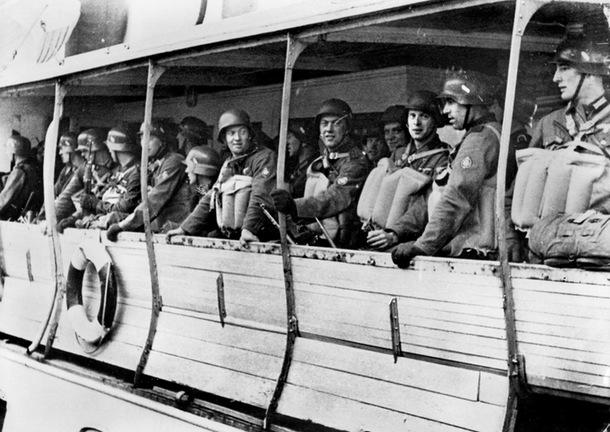
The majority of the German warships begin to leave their home ports for the invasion of Norway. The British have detected the concentration of shipping in Kiel but because they have no previous information to compare this with they fail to appreciate the significance. Some of the German units are sighted and attacked by British aircraft, however. The whole of the German surface fleet is committed to this operation, sailing at different times in six groups. They plan to land at Narvik, Trondheim, Bergen, Kristiansand, Oslo and a small detachment at Egersund. The battle cruisers Scharnhorst and Gneisenau sail with the Narvik group but are to go on to operate against shipping in the Arctic. A large part of the U-boat fleet is also involved in the campaign but they achieve very little, partly because they use torpedoes with magnetic exploders which do not function properly in high latitudes. (This error is discovered during the campaign and is later rectified.)
The ships carry units of three divisions for the assault. Three more are earmarked for a second wave. Only one, 3rd Mountain Division, is regarded by the Germans as being of best quality. They have air support from 500 transport planes, over 300 bombers and 100 fighters. For this air support to be effective it will be necessary quickly to take airfields in northern Denmark and Norway itself. This difficult task will be achieved. Meanwhile, British units are preparing to sail for their own mining operations. In the evening the main forces of the Home Fleet sail.
Oslo receives two more reports from Berlin about impending German invasion, but still there is no action taken.
British destroyers lay minefields in Norwegian waters.
Norwegian government protests British minelaying operations off the Norwegian coast.
In a short, sharp scuffle a strong police turnout today prevented between 2,000 and 3,000 Communist demonstrators from marching on the French Embassy in London to deliver a resolution protesting the conviction of forty-four French Communist Deputies and demanding their immediate release.
The Hans Frank government in Poland expels all foreigners, including the International Red Cross.
Italy and Yugoslavia are considering closing the Adriatic to all foreign warships by means of Italian guns dominating the straits of Otranto to prevent the British navy from enforcing the allied blockade there. Italian Foreign Minister Count Galcazzo Ciano and the Yugoslav minister, Buchko Christitch, in a weekend consultation, were reported to have discussed the advisability of “strong measures” to defeat British blockade efforts in the Adriatic.
Russian writer Aleksandr Solzhenitsyn (21) weds Natalya Reshetovskaya.
Luftwaffe fighter engagements occur with RAF and French Air Force planes over the front.
A flight of Bf 109s encounters RAF bombers over the North Sea and downs two RAF planes, losing one of their own. A “swarm” of German pursuit planes today attacked twenty-four British Wellington bombers over the North Sea off the coast of Denmark and shot down two of them, the official D.N.B. news agency in Berlin announced.
During the afternoon, after the sighting by the Hudson, the RAF sends 12 Blenheims and 24 Wellingtons to attack the German fleet heading to Norway, but they make no hits.
German naval forces for the Narvik and Trondheim occupations put to sea at midnight on the 7th. The Narvik group was composed of destroyers Wilhelm Heidkamp (Flagship Commodore Bonte), Georg Thiele (Leader of 1st Destroyer Flotilla) of the 1st Destroyer Flotilla, Hans Ludeman (Leader of 3rd Destroyer Flotilla), Hermann Kunne, Anton Schmidt, Diether Von Roeder of the 3rd Destroyer Flotilla, Wolfgang Zenker (Leader of 4th Destroyer Flotilla), Bernd Von Arnim, Erich Koellner and Erich Giese of the 4th Destroyer Flotilla, each destroyer carrying 200 troops of the 139th Gebirgsjager Regiment (mountain troops), departed Wesermunde at the mouth of the River Weser at 0000/7 April. Additionally, destroyer Richard Beitzen of the 1st Destroyer Flotilla was in the Weser as a reserve destroyer for this force, but was not required.
The Trondheim Group was composed of heavy cruiser Admiral Hipper and destroyers Paul Jacobi (Leader of 2nd Destroyer Flotilla), Theodor Riedel and Bruno Heinemann of the 2nd Destroyer Flotilla and Friedrich Eckholdt of the 1st Destroyer Flotilla carrying troops of the 138th Gebirgsjager Regiment. This group departed Cuxhaven at 0000/7 April. Two destroyers of the Trondheim force were designated to remain at Trondheim after the landings for harbour defense duties. The Narvik Group and the Trondheim Group rendezvoused in Schillig Roads and proceeded north in company. At 0200 southwest of Heligoland, these destroyer groups joined German battleships Scharnhorst and Gneisenau under Admiral Lutjens which departed Wilhelmshaven early on the 7th.
The covering forces are divided up as follows:
Warship Group 1 (Narvik): Commodore Bonte with the destroyers Wilhelm Heidkamp, Georg Thiele, Wolfgang Zenker, Bernd von Arnim, Erich Giese, Erich Koellner , Diether von Roeder, Hans Lüdemann, Hermann Künne and Anton Schmitt.
Warship Group 2 (Trondheim): Kpt.z.S. Heye on the heavy cruiser Admiral Hipper and the destroyers Paul Jacobi, Theodor Riedel, Bruno Heinemann and Friedrich Eckoldt .
Warship Group 3 (Bergen): Rear Admiral Schmundt with the light cruisers Köln (Kpt.zS Kratzenberg) and Konigsberg (Kpt . Z . S. Ruhfus), the artillery training ship Bremse (FKpt. Förschner), the torpedo boats Leopard and Wolf, speedboat Begleitschiff Carl Peters with the S – boats S 19 , S 21 , S 22 , S 23 and S 24 and the auxiliary ships ship 9 / Koblenz and ship 18 / Old country. When approaching Stavanger, S 19 and S 21 collide, with the former heavily damaged.
Warship Group 4 (Kristiansand South and Arendal): Kpt.z.S. Rieve on the light cruiser Karlsruhe, with the T – boats Luchs , Griffin, Eagle and speedboat Begleitschiff Tsingtao and S – boats S 9 , S 14 , S 16 , S 30 , S 31 , S 32 , S 33.
Warship Group 5 (Oslo): Rear Admiral Kummetz with the heavy cruisers Blücher (Kpt.zS Woldag) and Lutzow (Kpt.zS Thiele), the light cruiser Emden (Kpt.zS Lange), the T – boats Albatross, Condor and Gull, the 1st Minesweeper Group (Kptlt. Forstmann) with R 17, R 18, R 19, R 20, R 21, R 22, R 23, R 24 and whale boats 7 and 8.
Warship Group 6 (Egersund): KKpt Thoma (Captain of the 2nd Minesweeping flotilla) with the Minesweeping boats M 1 , M 2 , M 9 and M13.
Warship Group 7 (Nyborg and Korsor): Kpt.z.S. Kleikamp on the battleship Schleswig – Holstein and the experimental boats Claus von Bevern, Nautilus, Pelikan, van Campinas (4541 BRT) and Cordoba (4611 BRT), 2 tugs and the B.S.O. – School Flotilla (FKpt . Dannenberg) with 6 trawlers.
Warship Group 8 (Copenhagen): KKpt Schröder on the minelayer Hansestadt Danzig and the icebreaker Stettin, passing through the Belt of boats of 13 Vp. flotilla (Kptlt Fischer).
Warship Group 9 (Middelfart and Beltbrücke): Kpt z p Leissner (FdV East) on the steamer Rugard (1358 BRT) , and the M – boats M 157, Otto Braun, Arkona, the R – boats R 6 and R 7, the outposts boats V 102 and V 103, the submarine hunter UJ 172 and the Navy tugs Passat and Monsoon.
Warship Group 10 (Esbjerg and Nordby on Fanoe): Commodore Ruge (FdM West) with leading boat Queen Louise (F 6) , the M – boats M 4 , M 20 , M 84 , M 102 , the 12th Minensuchflottille (KKpt Marguth) M 1201 M 1202 M 1203 M 1204 M 1205 M 1206 M 1207 M 1208 (large trawlers) and the 2nd Räumbootflottille (KKpt . von Kamptz) with R 25 , R 26 , R 27 , R 28, R 29, R 30, R 31 and R 32.
Warship Group 11 (Tyborön, the Limfjord): KKpt Berger (head of the 4th Minesweeping Flotilla) with M 61, M 89, M 110, M 111, M 134 and M 136 and the 3rd Minesweeping Flotilla directed from the escort ship (previously Kptlt Sexton) Groeben, with the R-boats R 33, R 34, R 35, R 36, R 37, R 38, R 39, R 40.
In Danish waters, there is coverage from the old Battleship Silesia (Kpt.z.S. Horstmann), which has sailed from Kiel.
U-boat coverage also is heavy. The Submarine Group (management of individual boats is handled directly by B.d.U. Rear Admiral Doenitz):
1 (West Fjord): U-25, U-46, U-51, U-64, U-65.
2 (Trondheim): U-30, U-34.
3 (Bergen): U-9, U-14, U-56, U-60, U-62.
4 (Stavanger): U-1, U-4.
5 (East Shetland): U-47, U-48, U-49, U-50, U-52, U-37 (later).
6 ( Pentland Firth): U-13 , U-19 , U-57, U-58 , U-59.
8 (Lindesnes): U-2 , U-3 , U-5 , U-6.
9 (Shetland Orkney): U-7, U-10.
The U-boat operation turns into a failure with few successes due to torpedo failures. It is not yet understood that northern waters (higher latitudes) cause problems with torpedo depth control and their magnetic exploding processes. Operation Weserubung at least exposes the problem so that it can be corrected.
British reconnaissance aircraft spotted a large German naval force heading northward. RAF bombers were dispatched to attack the group but this attack was not successful. At 0848 and 1342, A Lockheed Hudson reconnaissance aircraft of 220 Squadron RAF reported German naval forces east of the German declared minefield steering northwest, comprised of 1 cruiser and 6 destroyers, sailing in a northward direction; 12 Blenheim and 24 Wellington bombers were dispatched to attack this group but the attack was not successful.. The force was later identified as one battlecruiser, one pocket battleship, three Leipzig class cruisers, and twelve destroyers. This set British Home Fleet operations in motion.
The British Admiralty, receiving reports of major German naval movements, incorrectly assumed the Germans were launching a major attack into the Atlantic Ocean. The Home Fleet departed from Scapa Flow at 2015 hours, commanded by Admiral Forbes (C-in-C Home Fleet) in battleship HMS Rodney with HMS Valiant, battlecruiser HMS Repulse, RN light cruisers HMS Sheffield, and HMS Penelope, French light cruiser Emile Bertin, destroyers HMS Eskimo, HMS Punjabi, HMS Bedouin, HMS Kimberley, HMS Jupiter, HMS Codrington (D.1), HMS Griffin, HMS Brazen, HMS Escapade and HMS Electra. Destroyers HMS Tartar, HMS Somali (D.6), HMS Matabele and HMS Mashona, which had departed Rosyth on the 7th at 2330, joined Forbes at sea. Forbes proceeded with his fleet to cover the minelaying operations soon to commence off the Norwegian coast. French cruiser Emile Bertin lost touch with the Fleet and returned to Scapa Flow arriving at 0800/8th.
In conjunction with the minelaying of operation WILFRED, troops were to be landed at Stavanger, Trondheim, Bergen, Narvik under operation AVONMOUTH (plan R.4). These troops were already embarked in British naval vessels. At Rosyth were heavy cruisers HMS Devonshire, HMS Berwick and HMS York of the 1st Cruiser Squadron and light cruiser HMS Glasgow, which had just completed refitting, of the 18th Cruiser Squadron each with 90 tons of stores in addition to the troops embarked. These cruisers were to land troops at Stavanger and Bergen but only if it became apparent that Germany intended to violate Norwegian territory. Destroyers HMS Afridi, HMS Gurkha, HMS Sikh, HMS Mohawk, HMS Zulu and HMS Cossack of the 4th Destroyer Flotilla were at Rosyth to escort these cruisers. In the Clyde were troopships Chrobry (11,442grt) and Batory (14,287grt) with troops to be landed at Trondheim and Narvik to be escorted by light cruiser HMS Aurora and destroyers HMS Faulknor, HMS Forester and HMS Fortune which arrived at the Clyde on the 3rd, destroyers HMS Delight, HMS Ashanti and HMS Foxhound, which arrived at the Clyde on the 5th, destroyer HMS Maori which completed repairs at the Clyde on the 3rd.
Minelayer HMS Teviotbank was recalled at 2251 on the 7th before the WS minelaying was accomplished. She was ordered to cancel the minelaying and steer to the northwest. Minelayer Teviotbank arrived at Sullom Voe at 1100/9th. Destroyers HMS Inglefield, HMS Ilex, HMS Imogen and HMS Isis arrived at Sullom Voe at 0830/9th. The destroyers were placed at the disposal of Admiral Forbes. The four I-class destroyers, HMS Hero and HMS Hyperion, after refuelling, departed Sullom Voe at 0300/10th and joined Forbes at 1100/10th.
Royal Navy and French submarines are ordered to intercept the German invasion force. British submarines HMS Shark and Seawolf depart from Harwich to patrol off the Dutch coast. HMS Clyde and Thistle depart from Scapa Flow to patrol off Norway.
Estonian steamer Mare (1217grt) was seized by German forces, and renamed Bug for German use. The Estonian crew was returned to Estonia via Stockholm.
The German cargo ship Curityba ran aground at Kullen, Sweden.
The Norwegian coaster Elling sprang a leak and sank at Lindesnes, Vest-Agder. Later raised, repaired and returned to service.
Additionally at Rosyth were light cruisers HMS Galatea and HMS Arethusa. Convoy HN.24 had just arrived at Rosyth with destroyers HMS Somali, HMS Matabele, HMS Mashona and HMS Tartar. The destroyers immediately put back out and joined Admiral Forbes at sea. Convoy ON.25, which had put to sea on the 5th, was recalled at 1851 on the 7th and her escort of light cruisers HMS Manchester, HMS Southampton, anti-aircraft cruiser HMS Calcutta, and destroyers HMS Janus, HMS Juno, HMS Javelin, HMS Eclipse and HMS Grenade were ordered to Scapa Flow. Convoy ON.25 was at that time in 61-20N, 1E. The convoy was ordered to reverse course and remain west of the Shetland Islands until further notice. Calcutta arrived at Sullom Voe and Grenade at Scapa Flow at 1230/9th for refuelling. Destroyers Janus, Juno, Javelin and Grenade were reassigned en route, but later arrived at Scapa Flow at 1820/9th for refuelling.
Among the effects of the British intelligence failure is that Vice Admiral Edward Collins at Rosyth disembarks the expeditionary troops that were allocated for Norway so that he can engage in this “sea battle.” This makes the British unable to quickly land troops in response to the Wehrmacht landings.
Convoy BC.33 six steamers, including Atlantic Coast, Batna, British Coast, City Of Lancaster and Marslew (Commodore) departed Bristol Channel escorted by destroyer HMS Montrose. The convoy arrived at Loire on the 9th.
Convoy FN.140 departed Southend, escorted by destroyers HMS Vega and HMS Woolston, and arrived in the Tyne on the 9th.
Convoy MT.46 departed Methil, escorted by destroyer HMS Vimiera, sloop HMS Black Swan and anti-submarine trawlers of the 23rd Anti-Submarine Group, and arrived later that day.
Convoy TM.40 departed the Tyne, escorted by destroyer HMS Vivien, sloop HMS Pelican and anti-submarine trawlers of the 1st Anti-Submarine Group, and joined convoy FN.139 at daylight on the 8th.
Convoy FS.140 departed the Tyne, escorted by destroyer HMS Vimiera and sloop HMS Black Swan, and arrived at Southend on the 9th.
Convoy SL.27 departed Freetown escorted by armed merchant cruiser HMS Moolton until the 21st, when sloop HMS Folkestone and destroyer HMS Venetia joined the escort. The convoy arrived at Liverpool on the 24th.
The War at Sea, Sunday, 7 April 1940 (naval-history.net)
NORWEGIAN CAMPAIGN
The German invasion of Norway, WESERUBUNG (Exercise Weser), was originally set for 20 March. However, like British operations, various delays postponed the operations and the invasion was finally set for 9 April.
GERMAN NAVAL MOVEMENTS
German naval forces for the Narvik and Trondheim occupations put to sea at midnight on the 7th. The Narvik group was composed of destroyers WILHELM HEIDKAMP (Flagship Commodore Bonte) and GEORG THIELE (Leader of 1st Destroyer Flotilla) of the 1st Destroyer Flotilla, HANS LUDEMAN (Leader of 3rd Destroyer Flotilla), HERMANN KUNNE, ANTON SCHMIDT, and DIETHER VON ROEDER of the 3rd Destroyer Flotilla, WOLFGANG ZENKER (Leader of 4th Destroyer Flotilla), BERND VON ARNIM, ERICH KOELLNER, and ERICH GIESE of the 4th Destroyer Flotilla, each destroyer carrying 200 troops of the 139th Gebirgsjager Regiment (mountain troops), departed Wesermunde at the mouth of the River Weser at 0000/7 April. Additionally, destroyer RICHARD BEITZEN of the 1st Destroyer Flotilla was in the Weser as a reserve destroyer for this force, but was not required.
The Trondheim Group was composed of heavy cruiser ADMIRAL HIPPER and destroyers PAUL JACOBI (Leader of 2nd Destroyer Flotilla), THEODOR RIEDEL, and BRUNO HEINEMANN of the 2nd Destroyer Flotilla and FRIEDRICH ECKHOLDT of the 1st Destroyer Flotilla carrying troops of the 138th Gebirgsjager Regiment. This group departed Cuxhaven at 0000/7 April. Two destroyers of the Trondheim force were designated to remain at Trondheim after the landings for harbour defense duties. The Narvik Group and the Trondheim Group rendezvoused in Schillig Roads and proceeded north in company. At 0200 southwest of Heligoland, these destroyer groups joined German battleships SCHARNHORST and GNEISENAU under Admiral Lutjens which departed Wilhelmshaven early on the 7th.
At 0848 and 1342, Allied aircraft reported German naval forces east of the German declared minefield steering northwest. The force was later identified as one battlecruiser, one pocket battleship, three LEIPZIG class cruisers, twelve destroyers. This set British Home Fleet operations in motion.
HOME FLEET OPERATIONS
Admiral Forbes (C-in-C Home Fleet) in battleship RODNEY with VALIANT, battlecruiser REPULSE, light cruisers SHEFFIELD, PENELOPE, and French EMILE BERTIN, destroyers ESKIMO, PUNJABI, BEDOUIN, KIMBERLEY, JUPITER, CODRINGTON (D.1), GRIFFIN, BRAZEN, ESCAPADE, and ELECTRA departed Scapa Flow at 2015/7th. Destroyers TARTAR, SOMALI (D.6), MATABELE, and MASHONA, which had departed Rosyth on the 7th at 2330, joined Forbes at sea. Forbes proceeded with his fleet to cover the minelaying operations soon to commence off the Norwegian coast. French cruiser EMILE BERTIN lost touch with the Fleet and returned to Scapa Flow arriving at 0800/8th.
ALLIED TROOP-LANDING PLANS
In conjunction with the minelaying of operation WILFRED, troops were to be landed at Stavanger, Trondheim, Bergen, Narvik under operation AVONMOUTH (plan R.4). These troops were already embarked in British naval vessels. At Rosyth were heavy cruisers DEVONSHIRE, BERWICK and YORK of the 1st Cruiser Squadron and light cruiser GLASGOW, which had just completed refitting, of the 18th Cruiser Squadron each with 90 tons of stores in addition to the troops embarked. These cruisers were to land troops at Stavanger and Bergen but only if it became apparent that Germany intended to violate Norwegian territory. Destroyers AFRIDI, GURKHA, SIKH, MOHAWK, ZULU, and COSSACK of the 4th Destroyer Flotilla were at Rosyth to escort these cruisers. In the Clyde were troopships CHROBRY (11,442grt) and BATORY (14,287grt) with troops to be landed at Trondheim and Narvik to be escorted by light cruiser AURORA and destroyers FAULKNOR, FORESTER, and FORTUNE which arrived at the Clyde on the 3rd, destroyers DELIGHT, ASHANTI, and FOXHOUND, which arrived at the Clyde on the 5th, destroyer MAORI which completed repairs at the Clyde on the 3rd.
OTHER ALLIED NAVY MOVEMENTS
Additionally at Rosyth were light cruisers GALATEA and ARETHUSA. Convoy HN.24 had just arrived at Rosyth with destroyers SOMALI, MATABELE, MASHONA, and TARTAR. The destroyers immediately put back out and joined Adm Forbes at sea. Convoy ON.25, which had put to sea on the 5th, was recalled at 1851 on the 7th and her escort of light cruisers MANCHESTER, SOUTHAMPTON, anti-aircraft cruiser CALCUTTA, and destroyers JANUS, JUNO, JAVELIN, ECLIPSE, and GRENADE were ordered to Scapa Flow. Convoy ON.25 was at that time in 61-20N, 1E. The convoy was ordered to reverse course and remain west of the Shetland Islands until further notice. CALCUTTA arrived at Sullom Voe and GRENADE at Scapa Flow at 1230/9th for refueling. Destroyers JANUS, JUNO, JAVELIN and GRENADE were reassigned en route, but later arrived at Scapa Flow at 1820/9th for refueling.
French light cruiser EMILE BERTIN and destroyers MAILLE BREZE and TARTU arrived off Scapa Flow at 1700/7th for operations with the Home Fleet. The light cruiser was met outside Hoxa Sound and was lead into harbour by destroyer JUPITER.
Light cruiser BIRMINGHAM on patrol since 31 March was ordered to join the RENOWN group off Vestfjord. However, in heavy weather, she was unable to make the rendezvous and later arrived at Scapa Flow on the 11th after refueling at Sullom Voe on the 10th. Destroyer FEARLESS of the group had been detached for refueling after the capture of German trawler BLANKENBURG on the 5th, proceeded to Sullom Voe and departed after refueling on the 7th. On the 7th, destroyer FEARLESS captured German auxiliary patrol boat Vp.411 (trawler NORDLAND, 392grt) in the North Sea, proceeded with her to Sullom Voe, arriving on the 10th, and went on to Kirkwall the next day arriving on the 11th. Destroyer HOSTILE of this group had been detached to escort trawler FRIESLAND to Scapa Flow and later joined the British forces off Vestfjord.
Light cruisers ARETHUSA and GALATEA (CS.2) departed Rosyth at 2130 with destroyers AFRIDI (D.4), GURKHA, SIKH, MOHAWK, ZULU, COSSACK, KELVIN, and KASHMIR, plus Polish destroyers GROM, BURZA, and BŁYSKAWICA, sailed for a position 80 miles west of Stavanger to arrive at 1700/8th from whence they would sweep north.
#
Destroyers ESCAPADE and ELECTRA departed Scapa Flow at 1030 to escort base ship MANCHESTER CITY to Kirkwall. The ships safely arrived at 1415 and the destroyers returned to Scapa Flow.
Minelayer TEVIOTBANK was recalled at 2251 on the 7th before the WS minelay was accomplished. She was ordered to cancel the minelaying and steer to the northwest. Minelayer TEVIOTBANK arrived at Sullom Voe at 1100/9th. Destroyers INGLEFIELD, ILEX, IMOGEN and ISIS arrived at Sullom Voe at 0830/9th. The destroyers were placed at the disposal of Admiral Forbes. The four I-class destroyers, HERO and HYPERION, after refueling, departed Sullom Voe at 0300/10th and joined Forbes at 1100/10th.
Steamer ULSTER MONARCH (3791grt) reported sighting a U-boat 37 miles NE of Cape Barfleur, . Destroyers WILD SWAN escorting convoy OA.124 and WINDSOR escorting convoy SL25A were detached to investigate.
Estonian steamer MARE (1217grt) was seized by German forces, and renamed BUG for German use. The Estonian crew was returned to Estonia via Stockholm.
Convoy BC.33 six steamers, including ATLANTIC COAST, BATNA, BRITISH COAST, CITY OF LANCASTER, and MARSLEW (Commodore) departed Bristol Channel escorted by destroyer MONTROSE. The convoy arrived at Loire on the 9th.
Convoy FN.140 departed Southend, escorted by destroyers VEGA and WOOLSTON, and arrived in the Tyne on the 9th.
Convoy MT.46 departed Methil, escorted by destroyer VIMIERA, sloop BLACK SWAN and anti-submarine trawlers of the 23rd Anti-Submarine Group, and arrived later that day.
Convoy TM.40 departed the Tyne, escorted by destroyer VIVIEN, sloop PELICAN and anti-submarine trawlers of the 1st Anti-Submarine Group, and joined convoy FN.139 at daylight on the 8th.
Convoy FS.140 departed the Tyne, escorted by destroyer VIMIERA and sloop BLACK SWAN, and arrived at Southend on the 9th.
Convoy SL.27 departed Freetown escorted by armed merchant cruiser MOOLTON until the 21st, when sloop FOLKESTONE and destroyer VENETIA joined the escort. The convoy arrived at Liverpool on the 24th.
Chairman Dies, Texas Democrat, of the House Committee on Un-American activities said today he would put to President Roosevelt the “direct question” of supporting the committee’s latest proposal for exposing “foreign affiliated” organizations. Within 10 days or two weeks, Dies said, he would present to the president, the state and justice departments and congressional leaders a bill to require organizations with international affiliations to register with the state department and file their true membership lists. Saying the proposed bill was “the most important development in the whole thing,” Dies declared, “I’m going to ask the president the direct question of whether he will approve such a measure.”
He predicted public sentiment for the bill would be too strong for congress to resist. Frequently in the past, Dies has accused the administration of opposing his investigation. When the committee published the Washington mailing list of the American League for Peace and Democracy, the president characterized its action as “sordid.” Meantime, the American Civil Liberties union, contending political party members are entitled to protection from “exposure to contempt, prejudice or antagonism,” announced it would aid Communist officials facing contempt charges for refusing to give membership lists to the committee, or answer questions concerning members.
A formal Presidential request for more 1941 relief funds is expected in Congressional circles in order to remove a serious obstacle in the House Appropriations Committee, which was reported to have given a cool reception to hints by Colonel F.C. Harrington, Works Projects Commissioner, that from $250,000,000 to $500,000,000 additional would be needed to carry the relief rolls during the next fiscal year.
The Puerto Rican Democratic convention today pledged its six delegates to support of Postmaster-General James A. Farley if his name is placed in nomination for the presidency at the national convention in Chicago.
Rejecting the advice of John L. Lewis, Labor’s Non-Partisan League of New Jersey went on record today in favor of a third term for President Roosevelt.
President Roosevelt today wished the Civilian Conservation Corps a long life as “the happy medium of dual service to American youth and to the American nation.”
The U.S. Socialist Party acclaimed Norman Thomas its 1940 presidential candidate today to run on a platform emphasizing socialization of essential industries and non-participation in the European war. For second place on the ticket the party chose, almost unanimously, Maynard C. Krueger, youthful professor of economics at the University of Chicago, who yesterday delivered the convention’s keynote address.
An assertion by Senator Tobey, New Hampshire Democrat, tonight that the justice department had planned to use the 1940 census as “the most complete police list in the history of the world” drew immediate denial from Attorney General Jackson. Tobey said in a statement the department had “conceived” and secretly submitted to the budget bureau legislation to make census records available to the Federal Bureau of Investigation and the army and navy intelligence divisions for use in espionage investigations and “other matters relating to national defense.”
Mention of Senator Arthur H. Vandenberg’s name drew a chorus of boos and shouts of “Throw him out!” from 10,000 members of the Congress of Industrial Organizations in Flint, Michigan this afternoon when John. L. Lewis, their leader, declared that the Michigan candidate for the Presidency “hasn’t acted like a man who has the answer” to the country’s economic ills.
Industrial productivity in the United States has increased 43 to 100 per cent in the last two decades, according to the Brookings Institution, and the increased efficiency has brought better quality and lower prices of goods to consumers and shorter hours to labor, while the return on invested capital declined.
The University of California today announced a gift of $1,150,000 from the Rockefeller foundation for construction of a 4,900-ton cyclotron, 20 times bigger than the present largest “atom smasher,” which may be capable of revealing some of the secrets of the creation of the universe.
Menacing clouds along the southern annular eclipse path cleaned away just in time today to give millions of persons their first chance in 75 years to see such a phenomenon. The eclipse, caused by the moon coming between the earth and the sun, started at daybreak far out in the Pacific Ocean and entered the United States at Big Bend, Texas, at 4:40 PM. It headed out over the Atlantic Ocean after a five-minute performance here at 5:13 PM. Millions of laymen joined astronomers and other scientists in peering at the fiery ring as it covered its 2,000-mile-long path in about 30 minutes. What the average man saw was the moon gradually moving over the face of the sun until nothing was left but a thin rim of orange light. The moon did not entirely black out the sun because the sun was comparatively close to the earth, while the moon was farther away than ordinarily. The relative distance resulted in the ring phenomenon which will not be seen again in this country until May, 1994.
Tornadoes ripping across Southern Louisiana early today, brought death to at least four persons, left one missing, injured twenty-seven and caused extensive property damage.
The U.S. Post Office issues first postage stamp of African American educator Booker T. Washington.
Jimmy Demaret won the 7th Masters Tournament at Augusta National Golf Club in Georgia.
James H.R. Cromwell, who since his arrival three months ago as Minister to Canada, has upset a number of precedents in diplomacy as practiced in Ottawa, is planning another innovation. Starting in June Mr. Cromwell intends to tour the Dominion from coast to coast. On most of the trip he will be accompanied by Mrs. Cromwell.
While on neutrality patrol off Cuba, the U.S. Navy Wickes-class destroyer USS Twiggs (DD-127) attempted to tow the Norwegian freighter Spind off some rocks approximately six miles off Cape San Antonio but was unsuccessful in two tries. The Salvage tug Warbler, however, freed the Spind from her predicament. The USS Twiggs resumed her patrol.
The U.S. Navy Wickes-class destroyer USS J. Fred Talbott (DD-156) departed the Canal Zone to rendezvous at sea with the Japanese steamship Arimasan Maru to provide medical assistance to a passenger on board. The warship’s medical officer would remain with the patient until the Japanese vessel reached Balboa, Panama.
The Soviet rush to fortify the 3,000-mile long Siberian-Manchukuoan frontier is regarded by some observers as indicative of expected military developments in the Near East or the Balkans because Russia would want to make her Far Eastern frontier secure against Japanese attacks. But with Japan so deeply involved in China there seems to be a small possibility of her army attacking the Red forces in Siberia, so other observers are trying to interpret the fortification activities as a probable sign that the Soviet intends to attack Japan while she is busy in China.
The Japanese trade delegation that has been negotiating since January 10 with Soviet Russian officials for a Japanese-Russian commercial treaty decided today to leave Moscow.
The Japanese-dominated Chinese Wang Ching-wei puppet government in Nanking announces conscription of all men 19 and older. It will begin in the new year.
Although without authority, except what is obtained by the backing of Japanese bayonets, Wang Ching-wei’s new Nanking regime is giving a great show of activity. It is adopting resolutions and enacting decrees precisely as if it were a functioning government. One of the most amazing decrees issued over the weekend comes from the “military commission,” ordering the rank and file of the Chinese armies “immediately to cease hostilities and await further instructions.” This step is necessitated, the decree proclaims, because peace is one of the government’s main problems “since its return to the capital.” All the statements and announcements contain this phrase, thus asserting that the Wang regime is China’s legitimate government and is reassuming the occupation of the nation’s capital.
Born:
Jan Wilhelm Morthenson, Swedish composer, in Örnsköldsvik, Sweden.
 History Diaries