Addressing the Norwegian parliament amidst new apprehension over the issue of Scandinavian neutrality, Foreign Minister Halvdan Koht said today that Norway “will at once be at war” if free shipping in Norwegian waters should be interfered with to the advantage of one party in the European war. This was interpreted as in no way a threat of war, least of all against Britain, but as indicative of Norway’s fears that interference with German shipping in Norwegian waters would bring retaliation from Germany, which would drag Norway into the conflict.
A French fighter squadron downs two Dornier Do 17 fast bombers over the Western Front.
Military dispatches from Paris today said that French artillery fire had dispersed German laborers attempting to construct defense fortifications near Saarbruecken.
The French idea to bomb the Soviet oil fields remains alive at the highest Allied levels. Aerial photos recently taken of the fields arrive in London as the Generals decide whether to proceed with the operation. This is a “panacea” mission: “This will decide the entire course of the war.” The tentative plan is to bomb 122 Soviet oil refineries over the course of 45 days.
“Feuertaufe” (“Baptism of Fire”) premieres in Berlin. Hermann Goering attends. The film glorifies the Luftwaffe attacks on Poland. Its theme song is “Bombs Over England,” which has the pungent line, “We drive the British lion to the last deciding battle.…”
The German Government recalls all 1, 2, 5 & 10 pfenning coins, which contain scarce and valuable copper and bronze. The replacement coins are made of plentiful zinc.
A Belgian journalist, A. Visson, writes that “It is extremely risky to predict anything in the present war, especially since everything seems a paradox. If one prediction can be made, however, it is this: If Germany carries out her threat of an offensive in the West, she will also be forced to strike in the East to assure her supplies of oil for 1940.”
The persecution of Jews in Poland now extends to those in the provinces of Bohemia and Moravia (former Czechoslovakia). Jews are herded into synagogues as collection points, then put on trucks that will take them to Poland.
The executions of Polish officers continues. Polish prisoners are taken to certain locations to be killed. At Kalinin Prison, they kill 390 on the first day, 250 today. The NKVD executioners find that they must pace themselves, the pace of killings is too great.
Premier Benito Mussolini, in a brief speech to the Air Defense Militia this morning, warned the country that if war comes it will be totalitarian in character. Meanwhile, the newspapers are continuing to discuss the possibility of Italy being involved in the conflict, sooner or later.
This coming week will see an intensification of the Allied effort to close Germany’s “back doors” in the Baltic and the Balkans. There is every indication that the strong diplomatic pressure already exerted upon Scandinavia will be matched by vigorous economic pressure in the South.
Britain will have enrolled the man power for an army of more than 3,000,000 by the end of June, and may lay the basis for an army of more than 5,000,000 by the end of 1940, it was estimated today.
The British Ministry of Food announces that the new rationing slogan is “The Kitchen Front.”
A controversy is raging over the freedom of movement enjoyed by many thousands of Austrians and Germans in Britain. Despite the government’s appointment of twelve regional advisory committees to review the position of any friendly or enemy aliens if complaints are made, there is a demand for wholesale internment.
RAF Bomber Command suspended leaflet dropping missions in Germany. RAF Bomber Command ends its leaflet (“Nickel”) raids over German occupied Europe. Since September 3, 1939 about 65 million leaflets and “newspapers” have been dropped. The operation has received some public disdain as that “inglorious confetti war.”
RAF aircraft conducted a photo reconnaissance mission over Kiel, Germany to monitor preparations for the German invasion of Norway.
The Type IIA German U-boat U-1, commanded by Korvettenkapitän Jürgen Deecke, was lost around 6 April, 1940 in the North Sea, probably to a British mine in the mine barrage Field No 7. All of the ship’s complement of 24 died. During its career under Kapitänleutnant Deecke the U-1 sank or damaged no ships.
The Type VIIB German U-boat U-50, commanded by Kapitänleutnant Max-Hermann Bauer, struck a mine and sank in the North Sea north of the Terschelling, exact position not known. All of the ship’s complement of 44 died. During its career under Kapitänleutnant Bauer the U-50 sank 4 merchant ships for a total of 16,089 tons.
The Norwegian steam merchant Navarra from Convoy HN.10B was torpedoed and sunk by the U-59, commanded by Kapitänleutnant Harald Jürst, at 0316 hours, north of Scotland in the northern Atlantic Ocean (approximately 59°N 4°W). Of the ship’s complement, 12 died and 14 survivors were picked up by the Finnish steam merchant Atlas. The Navarra was hit on the starboard side abreast of #3 hatch by one torpedo from U-59 and sank within seven minutes. Six men were probably killed in the explosion. The ship was immediately abandoned in two lifeboats, but one capsized in the high seas, resulting in the death of the master, three officers and two passengers. The 14 survivors in the other lifeboat were spotted by a British aircraft, which notified the Finnish steam merchant Atlas. They were picked up about nine hours after the sinking and landed at Kirkwall. The 2,118-ton Navarra was carrying coal and was bound for Oslo, Norway.
The British cargo ship Dunstan was bombed and sunk by aircraft in the Atlantic Ocean (59°09′N 8°22′W) with the loss of two of her 48 crew.
The Belgian tanker Esso Belgium ran aground in the North Sea 5 nautical miles (9.3 km) off Nieuwpoort, West Flanders.
The British trawler Leonora sank in the North Sea 60 nautical miles (110 km) east of Scarborough, Yorkshire.
British submarines HMS Truant and HMS Seal departed Rosyth, Scotland for the Norwegian coast, while HMS Tarpon was ordered to patrol the German coast near Helgoland Bight.
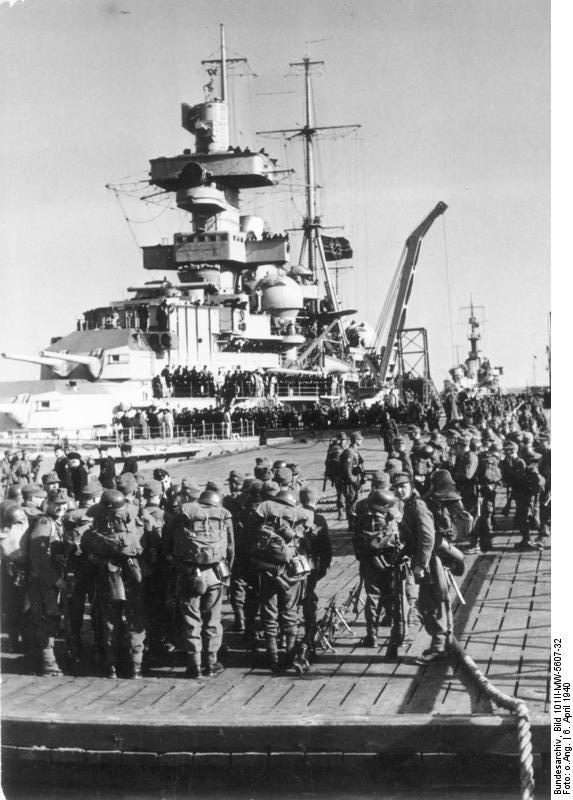
Kriegsmarine Marine Gruppe 1 departs from Cuxhaven for Narvik (10 destroyers carrying 2000 troops, plus battleships Scharnhorst & Gneisenau).
Kriegsmarine Marine Gruppe 2 departs from Wesermünde for Trondheim (cruiser Admiral Hipper & 4 destroyers carrying 1700 troops).
German gunnery ship Brummer and torpedo boats Falke and Jaguar departed Cuxhaven at 0700/6th with steamers Mendoza (5193grt), Tijuca (5918grt) and Tubingen (5453grt) for Stavanger, Norway. German tanker Dollart (233grt) departed Brunsbuttel on the 9th for Stavanger.
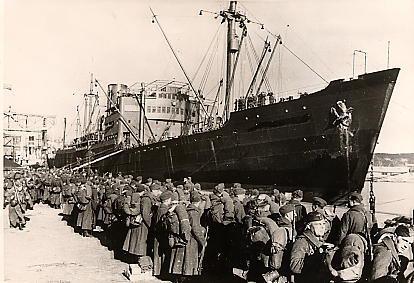
During the night, a sea transport squadron leaves from Stettin with 15 steamers. In is taking 3,900 troops, 742 horses, 942 armoured vehicles. It is headed for Oslo.
German armed merchant cruiser Orion departed Kiel for operations in the South Atlantic, Indian Ocean and Pacific Ocean. She was escorted in the Skagerrak by torpedo boats Seeadler and Luchs, and through the North Sea by U-64 which was then detached for Narvik operations.
Convoy OB.123GF departed Liverpool on the 4th escorted by destroyer HMS Vimy and sloop HMS Rochester, while convoy OA.123GF departed Southend escorted by sloops HMS Wellington and HMS Aberdeen. The convoys merged as OG.25F with fifty-seven ships. Rochester escorted OG.25F from the 6th to 7th when she detached to convoy HG.25F. Vimy, Wellington and Aberdeen escorted the convoy from the 6th to 12th, and it was joined near Gibraltar by destroyer HMS Wishart which joined the escort from the 9th to 12th, when it arrived at Gibraltar. Wellington and Aberdeen were temporarily attached to the 13th Destroyer Flotilla to replace destroyers HMS Douglas and HMS Wrestler which were proceeding with convoy HG.26 to give their crews leave in the UK.
Convoy OA.124 departed Southend escorted by destroyer HMS Wild Swan on the 6th and 7th, destroyer HMS Vesper on the 7th, and destroyer HMS Campbell on the 8th and 9th. The convoy was dispersed on the 9th and destroyer Campbell joined inbound convoy HX.31.
Convoy OB.124 departed Liverpool escorted by destroyer HMS Warwick and sloop HMS Folkestone from the 6th to 9th, when they were detached to convoy HX.31. Convoy OB.124 dispersed on the 10th.
Convoy SA.36 with one steamer departed Southampton, escorted by destroyer HMS Acheron, and arrived at Brest on the 8th.
Convoy FN.139 departed Southend, escorted by destroyer HMS Vivien and sloop HMS Pelican, and arrived in the Tyne on the 8th.
Convoy FS.139 departed the Tyne, escorted by destroyer HMS Valorous and sloop HMS Lowestoft, and arrived at Southend on the 8th.
Convoy TM.39 departed the Tyne, escorted by destroyer HMS Wallace, sloop HMS Flamingo, and anti-submarine trawlers of the 19th Anti-Submarine Group. The convoy joined convoy FN.138 on the 7th.
Convoy HX.33 departed Halifax at 0800 escorted by Canadian destroyers HMCS Ottawa, HMCS Restigouche and HMCS Skeena with Restigouche returning to harbor after dark. At noon on the following day, the destroyers turned the convoy over to the ocean escort, armed merchant cruiser HMS Ascania and French submarine Beveziers, which detached on the 15th. Destroyer HMS Whitehall and sloop HMS Rochester escorted the convoy from the 18th to 20th, when it arrived at Liverpool.
The War at Sea, Saturday, 6 April 1940 (naval-history.net)
Destroyer TARTAR arrived at Scapa Flow at 1200 to land a medical case. Destroyer TARTAR then proceeded to Rosyth.
Minelayer PRINCESS VICTORIA escorted by patrol sloops SHELDRAKE, SHEARWATER, PINTAIL, and PUFFIN laid a minefield eight miles, 10° from 51-34. 2N, 02-28E in Operation PB.
Minesweepers SKIPJACK and HUSSAR arrived at Dover to join the 6th Mine Sweeping Flotilla.
Minesweeper HARRIER completed boiler cleaning at Dover. Minesweeper LEDA went alongside depot ship SANDHURST for boiler cleaning prior to proceeding to the Humber.
NORWEGIAN CAMPAIGN
BRITISH MINELAYING OPERATIONS
Minelaying destroyers ESK (D.20), IMPULSIVE, ICARUS, and IVANHOE of the 20th Destroyer Flotilla escorted by destroyers HARDY, HUNTER, HOTSPUR, and HAVOCK of the 2nd Destroyer Flotilla departed Sullom Voe at 0515 as Force WV to lay mines in Vestfjord off Hovden in 67 24N, 14 36E. At sea, Force WV rendezvoused with battlecruiser RENOWN and her escorts which had departed Scapa Flow the day before. Destroyer GLOWWORM was detached from the RENOWN screen to recover a crewman lost overboard in heavy weather. GLOWWORM lost sight of RENOWN even as she turned, but the crewman was rescued. Destroyers HYPERION and HERO, also of the RENOWN force, were detached to refuel at Lerwick prior to operating as Force WB, a simulated minelay off Bud in 62 54N, 06 55E. They arrived at Sullom Voe at 1545/6th and departed at 0615/7th. If they encountered GLOWWORM, the destroyers were ordered to tell her to meet RENOWN off Vestfjord.
GERMAN SHIPPING MOVEMENTS
German gunnery ship BRUMMER and torpedo boats FALKE and JAGUAR departed Cuxhaven at 0700/6th with steamers MENDOZA (5193grt), TIJUCA (5918grt) and TUBINGEN (5453grt) for Stavanger. German tanker DOLLART (233grt) departed Brunsbuttel on the 9th for Stavanger.
#
Drifter SEABREEZE in difficulty in heavy weather was spoken to by destroyer JANUS at 0710. When it was ascertained that the drifter was making for a lee in the Shetland Islands, JANUS continued on her way. Destroyer JUPITER was later ordered to search for the drifter when she made an SOS, but at 2200, JUPITER returned to Scapa Flow when SEABREEZE was reported in the company of a trawler.
German armed merchant cruiser ORION departed Kiel for operations in the South Atlantic, Indian Ocean and Pacific Ocean. She was escorted in the Skagerrak by torpedo boats SEEADLER and LUCHS, and through the North Sea by U-64 which was then detached for Narvik operations.
U-59 sank Norwegian steamer NAVARRA (2118grt) in 59N, 04W, with the loss of ten crew and two passengers. Fourteen survivors were picked up by Finnish steamer ATLAS (1098grt). By the 7th, Norway had lost 54 ships (117,208grt) and 392 men of her merchant shipping fleet. One ship was sunk by pocket battleship DEUTSCHLAND, 39 by submarine attack, 12 by air attacks and air or destroyer mining, and two by unknown causes.
French light cruiser EMILE BERTIN (Flagship Contre Amiral Edmond L. Derrien, Commander Force Z, Capitaine de Vaisseau Robert M.J. Battet) and large destroyers MAILLE BREZE (Capitaine de Fregate H. M.E. A. Glotin) and TARTU (Capitaine de Fregate J. M.Chomel) of the 5th Large Destroyer Division departed Brest for Scapa Flow.
Convoy OB.123GF departed Liverpool on the 4th escorted by destroyer VIMY and sloop ROCHESTER, while convoy OA.123GF departed Southend escorted by sloops WELLINGTON and ABERDEEN. The convoys merged as OG.25F with fifty-seven ships. ROCHESTER escorted OG.25F from the 6th to 7th when she detached to convoy HG.25F. VIMY, WELLINGTON, and ABERDEEN escorted the convoy from the 6th to 12th, and it was joined near Gibraltar by destroyer WISHART which joined the escort from the 9th to 12th, when it arrived at Gibraltar. WELLINGTON and ABERDEEN were temporarily attached to the 13th Destroyer Flotilla to replace destroyers DOUGLAS and WRESTLER which were proceeding with convoy HG.26 to give their crews leave in the UK.
Convoy OA.124 departed Southend escorted by destroyer WILD SWAN on the 6th and 7th, destroyer VESPER on the 7th, and destroyer CAMPBELL on the 8th and 9th. The convoy was dispersed on the 9th and destroyer CAMPBELL joined inbound convoy HX.31.
Convoy OB.124 departed Liverpool escorted by destroyer WARWICK and sloop FOLKESTONE from the 6th to 9th, when they were detached to convoy HX.31. Convoy OB.124 dispersed on the 10th.
Convoy SA.36 with one steamer departed Southampton, escorted by destroyer ACHERON, and arrived at Brest on the 8th.
Convoy FN.139 departed Southend, escorted by destroyer VIVIEN and sloop PELICAN, and arrived in the Tyne on the 8th.
Convoy FS.139 departed the Tyne, escorted by destroyer VALOROUS and sloop LOWESTOFT, and arrived at Southend on the 8th.
Convoy TM.39 departed the Tyne, escorted by destroyer WALLACE, sloop FLAMINGO, and anti-submarine trawlers of the 19th Anti-Submarine Group. The convoy joined convoy FN.138 on the 7th.
Convoy HX.33 departed Halifax at 0800 escorted by Canadian destroyers HMCS OTTAWA, HMCS RESTIGOUCHE, and HMCS SKEENA, with RESTIGOUCHE returning to harbour after dark. At noon on the following day, the destroyers turned the convoy over to the ocean escort, armed merchant cruiser ASCANIA and French submarine BEVEZIERS, which detached on the 15th. Destroyer WHITEHALL and sloop ROCHESTER escorted the convoy from the 18th to 20th, when it arrived at Liverpool.
U.S. State Department officials doubted tonight that the “total blockade” which the allies are attempting to force around Germany would affect the United States any more than present trade restrictions. They watched with keen interest, however, the development of allied plans to cut off trade and speculated whether the “total blockade” might include interfering with American transatlantic clipper planes plying the route to Portugal. These planes have been flying nonstop from the Azores to New York since shortly after the British imposed censorship of the airmail. At the present the other United States carrier’s ships comply with allied contraband control in the Atlantic area. This leaves the Pacific as the only remaining quarter for blockade restrictions vitally affecting the United States. Officials declined to comment about what might result from imposition of contraband control in that area. Possibility of interfering with the clippers was considered remote.
Immediate effects of the Congressional extension of the Trade Agreements Act until June 12, 1943, will be mainly psychological rather than practical, Administration experts agreed today in appraising the situation after the exciting parliamentary battle of the last two weeks in the Senate. Their gratification was only slightly tempered by references to what they considered the ingratitude of some Senators whose States they felt had been greatly helped by the trade agreements program, but who voted against its continuance.
President Roosevelt and Secretary Hull expressed their thanks to Senator Harrison, chairman of the Finance Committee, for his skillful guidance of the Administration measure to its final and complete victory. Mr. Roosevelt wrote that “there was only one right way to settle this question and the Senate happily decided to adopt that way,” while Mr. Hull congratulated the Mississippi Senator on his “fine leadership and invaluable cooperation in the fight,” adding that he would remain “eternally grateful” to Mr. Harrison.
Economy advocates in congress virtually resigned themselves today to an increase in next year’s relief fund beyond President Roosevelt’s budget estimate of $985,000,000. Senator Adams, Colorado Democrat, chairman of the relief appropriation subcommittee, said the budget estimate would have to be increased but said he did not think the total outlay would exceed $1,300,000,000.
Saying that he was as good a Democrat as anybody in the room but tired of being a “sucker Democrat,” General Hugh S. Johnson declared tonight at the annual Jefferson Day dinner in New York that the Roosevelt administration had spread a $20,000,000,000 “salve” on the causes of national discontent but had improved neither industry, agriculture, business nor employment.
Senator Burton K. Wheeler, Montana Democrat, just back from a California trip, aroused by what he saw of the plight of transient farm workers, declared unemployment was the ‘No. 1 problem facing the country.” Asserting the existing relief set up was “only a palliative which has not cured,” the Montanan said congress was going to have to appropriate more money “until we can find a solution.”
President Roosevelt returned to his boyhood home at Hyde Park, New York today on a weekend trip which promised a complete break from official routine and an opportunity to complete his recovery from an attack of intestinal influenza.
The U.S. Socialist Party overwhelmingly adopted today a “keep out of war” resolution vigorously condemning any form of American assistance to either side in the European hostilities. This action was taken over pro test of a minority group, which, while as determined to keep the United States at peace as the majority, felt a distinction should be drawn in favor of the allies, as against Hitler and Stalin.
HUAC Chairman Martin Dies, Texas Democrat, announced tonight the House Committee on Un-American Activities had ordered 90 subpoenas served this week-end in a general drive against the Communist party and the German-American Bund. Dies said 50 subpoenas had been issued for Communists including William Z. Foster, national chairman, and Earl Browder, general secretary. Forty subpoenas, he said, were issued for Bundsmen including officials who have taken charge of that organization since Fritz Kuhn, its former leader, was sent to prison In New York after conviction of misappropriating bund funds. “We want to get all the facts concerning these organizations,” Dies declared. “We have ordered all these people to bring all their records with them.”
The committee chairman said he would not make public the list of persons ordered subpoenaed or their cities of residence at this time. He said, however, Communists involved were scattered all over the country. Most bund members, he said, were residents of eastern or Pacific coast states. Simultaneously it was learned the committee plans to call again William Dudley Pelley, leader of the Silver Shirt Legion of America, for the purpose of obtaining new information about that organization, including its membership. It was understood also subpoenas were planned for leaders of other organizations which have been described by the committee as fascist or communist.
The imminent reopening of hearings by the Federal Communications Commission on the practicability of television broadcasting evoked today contradictory opinions indicating sharp divisions in this controversy among officials within the FCC, as well as between the FCC and the leading television interests.
Jackie Cochran set a Fédération Aéronautique Internationale and National Aeronautic Association speed record over a 2,000 kilometer (1,242.742 miles) course from Mount Wilson, California (northeast of Los Angeles) to Mesa Giganta, New Mexico (west of Albuquerque) with an average speed of 533.845 kilometers per hour (331.716 miles per hour). Jacqueline Cochran, aviatrix, traveled 2,000 kilometers today at a speed of approximately 324 miles per hour and claimed a new world’s record for the distance. She left Union air terminal in Burbank, California, at 8:38 a.m., rounded a pylon 30 miles west of Albuquerque, New Mexico, and crossed the finish line at 12:22.47. Her elapsed time was 3 hours, 44 minutes, 47 seconds. The accepted record for the distance is 311 miles per hour, established by Ernst Seibert in a twin-engined German Junkers bomber. Miss Cochran flew a single-engined, oxygen-equipped Seversky AP-7A monoplane.
Sitting in a tiny cubicle of one of the world’s largest bombing planes, with only the faces of a dozen fluorescent instruments to guide him, Major Carl B. McDaniel, an Army Air Corps officer, completed today the first “all blind” flight in the history of aviation. He flew from Mitchell Field in New York to Langley Field in Virginia with only instruments; a canvas screen blocked off the view from the pilot’s seat. The co-pilot had a clear view in case of trouble.
The biggest and in many respects the most impressive parade in the history of Army Day marched down upper Fifth Avenue in New York to the stirring music of military bands and the acclaim of 200,000 spectators. Lasting more than four hours, the martial spectacle had 25,000 participants.
Creation of a Manchukuoan conscript army to be united to the Japanese Army under the sole command of the Japanese commander-in-chief was decided today by the Hsinking government. All fit youths aged 19 will be liable for service but only one-tenth of those available will be called for three years’ training. On this basis the first levies will total about 33,000. Conscription will begin one year hence after the country has been prepared by intensive propaganda.
Central News, official Chinese agency, reported today that at least sixty Japanese warships, including three aircraft carriers, were off the coast of Fukien Province and that a Japanese conference at Amoy apparently was in preparation for large-scale maneuvers around South China islands. Chinese sources said a “mop-up” campaign on Hainan Island was being intensified preliminary to establishing a Japanese naval base there for operations in the South Pacific. These sources said that 3,000 Japanese troops had been sent from Southern Kwangal to Hainan.
Chinese circles expressed the belief tonight that the Japanese Navy was contemplating maneuvers in Formosan waters as a counter-demonstration to United States fleet maneuvers in the Pacific.
San Francisco Japanese are “tickled” by the spectacle of Mrs. Franklin D. Roosevelt buying Japanese goods after leading the boycott on Japanese silks, according to the San Francisco correspondent of the newspaper Asahi. Mrs. Roosevelt replies to reporters she has never led any such boycott.
Dow Jones Industrial Average: 151.1 (+0.74)
Born:
Pedro Armendáriz, Jr. [as Pedro Armendáriz Bohr], Mexican actor (“Licence to Kill”), in Mexico City, Mexico (d. 2011).
Donald Myrick, American saxophonist (“If Leaving Me Is Easy”; “One More Night”), born in Chicago, Illinois (d. 1993).
Homero Aridjis, Mexican poet and novelist (Mirándola dormir, The Child Poet), born in Contepec, Mexico.
Ken Byers, NFL guard (New York Giants, Minnesota Vikings), in Logan, Ohio.
Died:
Andrés Isasi, 49, Spanish Basque composer.
Naval Construction:
The Royal Navy Flower-class corvette HMS Hibiscus (K 24) is launched by Harland & Wolff Ltd. (Belfast, Northern Ireland). In 1942 she will be transferred to the United States under Reverse Lend-Lease and become the U.S. Navy corvette USS Spry.
The Royal Navy Flower-class corvette HMS Gladiolus (K 34) is commissioned. Her first commanding officer is Lieutenant Commander Harry M. C. Sanders, RNR.
 History Diaries