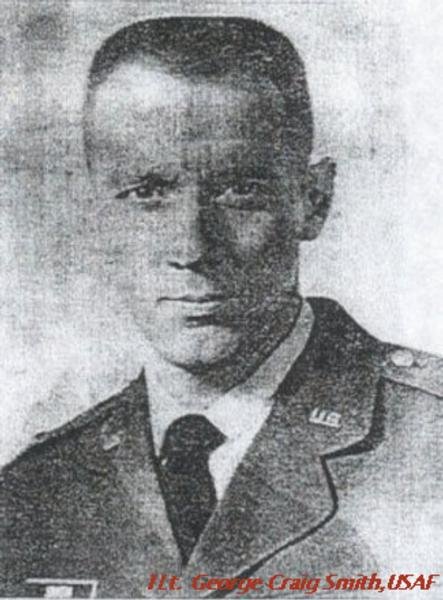
In March 1965, a decision was made to interdict the North Vietnamese rail system at the Thanh Hóa Railroad and Highway Bridge spanning the Sông Mã River, 70 miles from Hanoi. This led immediately to the April 3, 1965, strike against the bridge. LTC Robinson Risner was designated overall mission coordinator for the attack. He assembled a force consisting of 79 aircraft 46 F-105’s, 21 F-100’s, 2 RF-101’s and 10 KC-135 tankers. The F-100’s came from bases in South Vietnam, while the rest of the aircraft were from temporary duty squadrons at various Thailand bases. 1LT George R. Smith was the pilot of a USAF F-100D (55-3625) from the 615th Tactical Fighter Squadron, 401st Tactical Fighter Wing, 13th Air Force. He was part of a flight of three aircraft tasked with suppressing anti-aircraft batteries in the area. On his second pass, his aircraft was hit by enemy fire. The jet was too low for Smith to eject and he was killed in the crash. His remains were not recovered.
George has a military marker in his memory at Arlington National Cemetery. He is honored on the Wall at Panel 1E, line 100.
U.S. and South Vietnamese planes make a series of raids on bridges and roads in North Vietnam — in particular, against the Thanh Hóa (Hàm Rồng) and Đông Phương Bridges, the major rail links to Hanoi. Four Russian-built MiG fighters attack the U.S. planes, in the first reported combat by the North Vietnamese Air Force. These raids are also the farthest north in the ROLLING THUNDER operation, and the first explicitly aimed against non-military targets. The U.S. will concede that six of its planes were shot down on these raids.
The first jet-to-jet combat of the Vietnam War took place when four U.S. Navy F-8E Crusaders from the USS Hancock carried out a mission against the Thanh Hóa Bridge, and were engaged by eight MiG-17 fighters from the 921st Sao Đỏ Regiment of the North Vietnamese Air Force. One of the F-8Es, piloted by Lieutenant Commander Spence Thomas, was set on fire by cannons fired from a MiG-17 piloted by NVAF Captain Phạm Ngọc Lan, but Thomas was able to land safely at Đà Nẵng. Phạm Ngọc Lan ran out of fuel and survived a crash landing. In future years, April 3 would be a Vietnamese public holiday commemorated as “Air Force Day.”
A Navy spokesman said the MIG’s had made a pass at an American aircraft, but he said he did not know whether they had fired at it. He added that he thought the United States Navy jets had “probably fired” at the MIG’s but had missed. The MIG’s immediately withdrew, he said. It was not clear what model the MIG’s were or whether they carried the markings of North Vietnam. The North Vietnamese are known to possess MIG-15’s and MIG-17’s, comparatively slow aircraft. The Soviet Union and Communist China have more advanced models.
The bombed bridges had carried both rail and vehicular traffic. The United States Navy, flying jets and propeller-driven planes from the Coral Sea and the Hancock, aircraft carriers of the Seventh Fleet, hit the 500-foot bridge at Đông Phương twice. Commander Joseph Schneiders of the Coral Sea said he led the first attack, with 30 aircraft, at 10 AM. Reconnaissance aircraft reported that the bridge had been only moderately damaged, and 30 more Skyraider and Skyhawk fighter-bombers returned to the bridge at 2:30 PM.
Commander Schneiders, whose home town is Chula Vista, California, said the second strike had sunk one of the bridge’s three spans into the Mã River. Of another span he said, “One good sonic boom and it ought to drop.” The bridge and a second one, seven miles to the south, are part of Highway 1, which connected Saigon and Hanoi until the country was divided under the Geneva agreements of 1954.
Fifty United States Air Force F-100 and F-105 jets bombed the second target, the Hàm Rồng Bridge, with less definite success. Major Gen, J. H. Moore, commander of the Second Air Division, said that many of the bombers had hit it but that it was still standing. Commander Schneiders reported light anti-aircraft fire in the morning and heavier ground fire during the afternoon raid. He said he had not seen civilians in the area of the strike although the bridges were not far north of Thanh Hóa, a medium-size city. At least 130 American aircraft were over North Vietnam at some time during the day. No Vietnamese planes took part in the strikes.
In the ground action in South Vietnam, recently arrived South Korean forces were tested for the first time by the Việt Cộng. Communist guerrillas attacked a Korean engineer camp in Biên Hòa Province, about 10 miles northeast of Saigon, with 60-mm. and 81-mm.. mortar rounds and small-arms fire. The Koreans, protected by their security units, fired back with mortars for about 20 minutes. At daybreak the body of one Communist guerrilla was found. Eleven Korean soldiers were wounded.
Chiêu Hồi, the South Vietnamese Government’s “Open Arms” program. through which it hopes to rehabilitate Việt Cộng defectors, was given another push this week with the opening of a training course for provincial Chiêu Hồi directors.
President Johnson and Prime Minister Lester B. Pearson of Canada talked informally about Vietnam over a luncheon today at Camp David near here. But they apparently reached no agreement on Mr. Pearson’s suggestion that a brief let-up should be called in the United States-South Vietnamese air strikes against North Vietnam. The Prime Minister advanced such a proposal in a speech in Philadelphia last night. After the luncheon meeting, the President appeared to be in a sober mood and clearly was not desirous of extending the discussions about Vietnam.
Reports have circulated in Hanoi, according to word reaching Saigon, that older North Vietnamese leaders recently have lost some influence to a younger group that leans more toward Peking and favors a harder line toward the West. There is reason to believe that Hồ Chí Minh, the 75-year-old President and chairman of the Lao Động (Communist) party, may be among those who have bowed to the young militants. Diplomatic analysts said however, that the reported power realignment did not appear to have upset the delicate balance that Hanoi has maintained in its relations with Communist China and the Soviet Union. Publicly its propagandists have avoided involvement in the Moscow-Peking ideological clash. While a hardening of Hanoi’s attitude may have diminished prospects for peace negotiations in South Vietnam, the North Vietnamese leaders have avoided categorically excluding negotiations, as the Chinese Communists have. Neither has Hanoi echoed Peking’s charge that the Soviet Union is disposed to negotiations that would undermine the Việt Cộng effort in South Vietnam.
Soviet Premier Aleksei N. Kosygin appealed today to all the nations that favored world peace to join the “active struggle” to end “aggression” in Vietnam. He made his declaration at a Kremlin dinner honoring President Mohammad Ayub Khan of Pakistan, who arrived today for an eight-day goodwill visit, the first ever paid to the Soviet Union by a Pakistani chief of state.
A sampling of recent letters received by a dozen U.S. Senators shows the writers to be preponderantly in favor of negotiations that would permit the United States to extricate itself from the Vietnam war.
Britain and France have agreed that it is time for new initiatives in the search for Germany’s reunification, Prime Minister Harold Wilson declared today. A communiqué issued after two days of talks between Prime Minister Wilson and President de Gaulle reported their agreement to work for “a steady improvement” of their relations with the Soviet Union and its East European allies. Mr. Wilson said he “very much hoped” to see Premier Aleksei N. Kosygin in Britain soon. The Soviet leader has. accepted an invitation to Britain and the Prime Minister has been invited to Moscow. “I hope it will not be too long before these visits take place,” Mr. Wilson added at a news conference.
His emphasis on improving relations with the Soviet Union and on new initiatives on German unity appeared to range Britain alongside France in General de Gaulle’s effort to establish an understanding with the new Soviet leadership. Mr. Wilson flew back to London this afternoon confident that nearly four hours of plain speaking with his host had done much to restore the intimate working relationship between the two Governments broken 27 months ago by France’s veto of Britain’s bid to enter the European Common Market. The Prime Minister believes, according to one of his staff, that “the relationship has been put on a businesslike and friendly basis suitable to two nations that have to cooperate and compete at the same time.”
In notes to the United States, Britain, and France, the East German Government warned that they would bear the consequences of any Communist countermeasures if they allowed the West German Bundestag to meet in West Berlin Wednesday. The East Germans continued to harass Western traffic in and out of the city.
The United Arab Republic has dropped its plans for recognizing East Germany when West Germany formally establishes diplomatic relations with Israel, usually well-informed sources said today. These sources declared high Egyptian authorities had indicated that Cairo’s reprisal against Bonn would include a break in diplomatic relations but that the further step of recognizing the East German Communist regime was now “out of the question.” Diplomatic and Egyptian informants also said that the Government of President Gamal Abdel Nasser was willing to permit West Germany to maintain a consulate here so that its representation would be on a roughly equal footing with East Germany’s. Less than a month ago, the United Arab Republic was taking a tough and adamant stand against Bonn, but its position has shifted considerably in three weeks of behind-the-scenes diplomatic maneuvering throughout the Arab world.
Japanese and South Korean leaders hailed the new agreements between the two countries today as opening a new era in relations between Japan and her closest neighbor on Asia’s mainland. However, there were signs of trouble ahead in both countries, before the two Governments concluded a final treaty establishing the first formal diplomatic relations between Japan and her former colony. Agreements on fishing rights, Korean claims against Japan: and the legal status of Korean residents in this country were initialed here today. The only remaining issue between the two Governments is the disputed; ownership of Takeshima, a small, uninhabited and economically insignificant island in the” Japan Sea. Opposition parties in South Korea were urging the volatile student community to take to the streets against what they called a “humiliating” pact with the old enemy. Memories of the Japanese occupation of Korea from 1910 to 1915 are still bitter in Seoul.
Relations between Indonesia and the United States deteriorated further today following the seizure of an American company and Government action to close the Indonesian-American Friendship Association.
The United States accused the Soviet Union today of “dangerous harassment” of American naval operations on the high seas. In a note delivered yesterday to the Soviet Embassy and made public by the State Department today, the United States expressed “grave concern.” The note cited six occasions on which “reckless harassing maneuvers” by Soviet ships had endangered United States Navy ships in the Atlantic, the Pacific and the Mediterranean.
In most of the incidents, according to the note, the Soviet ships deliberately attempted to interfere with operations by sailing on collision courses with the United States vessels. The note said the Soviet ships had violated the rules of the road, disregarded the practices of good seamanship and ignored the principle of the freedom of the seas. It warned the Soviet Government that “it would bear full responsibility for the serious consequences that would result should a collision occur.”
According to Navy officials, the examples cited in the note are typical of scores of incidents over the last few years in which Soviet trawlers, oceanographic ships, and tugs have engaged in surveillance of United States naval operations. Aside from following United States ships in operating areas, the Soviet ships frequently deliberately sail on courses that force United States ships to halt operations such as refueling or launching planes, the officials said.
In the last year, according to Navy officials, the Soviet ships have become bolder, passing within several yards of American ships. In some cases, Navy officials said, the Soviet crews could be seen laughing as the American ships were forced to change course or break off operations. The State Department up to now had refrained from protesting, partly because the Soviet ships in most cases had been careful to conform strictly to international rules of the road as they got on collision course with American ships.
The Greek Council of Ministers is scheduled to meet Thursday to determine Greece’s policy on the report submitted to the United Nations last Friday by Gale Plaza Lasso, the mediator in Cyprus.
At the precise moment decreed by three Buddhit astrologers, a former New York debutante, Hope Cooke, became today the Queen of Sikkim. She is probably the first American to wear a royal crown in Asia.
The United States and the Soviet Union have destroyed their own satellites in orbit to keep them from falling into each other’s hands, official sources said today. Neither nation is known to have knocked down a spacecraft belonging to the other, these sources said. It is widely accepted that either country could do so by using nuclear-armed missiles. It also would be possible, but much more difficult, to knock down a satellite by the use of non-nuclear warheads. In destroying their spacecraft, each nation used radio signals to set off detonations.
Impatient with the Vatican’s hesitancy on birth control, some Catholic priests in Brazil are quietly advocating contraceptive methods.
The longest session of parliament in Canada’s history ended at 3:00 in the morning in Ottawa, after holding its 249th and final sitting day since opening on February 18, 1964. Only 50 of the 265 members of the House of Commons, and just 30 Senators, remained at the close, with plans to open a new session on Monday.
Senate liberals began a drive to broaden the scope of President Johnson’s proposed Black voting rights bill. But Senator Hugh Scott (R-Pennsylvania), a sponsor of the bill, objected to a flat ban on state literacy tests on grounds it might make the bill unconstitutional.
Attorney General Richmond Flowers of Alabama said today his state apparently stood alone in a hopeless defiance of racial change and must face up to segregation’s legal demise. “Segregation as we know it is gone,” Mr. Flowers said in an interview. “Somehow, some way we have got to face it and adjust to it.” Mr. Flowers, who has pushed for racial moderation in opposition to Governor George C. Wallace for two years, said Mississippi and Louisiana were profiting “from Alabama’s mistakes. Alabama apparently stands alone in this hopeless defiance.” The big, red-haired Attorney General readily conceded that he was risking his political future. Nevertheless, he said he could not escape the conviction that “there are three things the people might as well forget”:
“Segregation as we know it is gone. Somehow, someway we have got to face it and adjust to it. Secondly, there’s the civil rights bill. We have lost that fight. And on the matter of federal encroachment, we might as well quit bellyaching. This President and the one before him have let us know they’re going to run us.”
Charred wooden crosses were found today in three different places in Detroit. One was found in the backyard of the home of Mrs. Viola Gregg Liuzzo, the civilrights worker who was shot to death in Alabama.
The Rev. Dr. Martin Luther King Jr. will advise Negro leaders in one or two Northern cities on how to conduct non-violent demonstrations before the start of the summer.
The federal government left the door ajar tonight for those who face hardship in paying their income tax in full on April 15. But the burden of proof rests on the taxpayer. Further, he must convince the Internal Revenue Service that the hardship results from underwithholding from his pay. The policy of permitting people to file a return without paying the whole bill right away is not new. The service has never tried to put people in jail for failure to pay on time. But the service issued a special statement making these points:
- It warned all taxpayers that their returns must be submitted by the April 15 deadline to avoid severe penalties under the law.
- It urged taxpayers to pay the full amount due at that time if it were at all possible.
- It recommended payment of as much as possible if full payment “would result in undue hardship, as distinguished from mere inconvenience.”
- It said those who did not pay in full would receive a bill for the unpaid balance.
- It instructed those receiving such balance-due bills to “promptly write or visit the nearest Internal Revenue Service office to arrange payment” in what it described as “a reasonable period of time.” It added that full payment should be made “as quickly as possible.”
- It noted that interest at 6 percent would be charged on unpaid balances.
The turn of events in Vietnam has at last given Barry Goldwater his innings against his critics, even though the runs do not count now that the election is over.
President Johnson said he was naming a committee to study whether 11 Veterans Administration hospitals and old soldiers’ homes should be closed.
Henry Fowler takes over as secretary of the Treasury at a time when the nation’s economy keeps grinding upward at a rate that is neither too fast nor too slow.
A Federal mediator reported “a little progress” last night in bargaining talks between Pan American World Airways and its striking pilots.
SNAP-10A, the first nuclear reactor launched into space, and the only one ever sent by the United States, was sent aloft from Vandenberg AFB, California, and placed into an orbit 815 miles (1,312 km) above the Earth. “SNAP” was an acronym for Systems for Nuclear Auxiliary Power. The cesium-fueled ion engine would be shut down after 43 days “to permit the radioactive material in the reactor to decay to safe levels… before the spacecraft reenters the atmosphere”, according to a spokesman, which was not expected to happen for 3,000 years.
Dr Andrew C. Ivy, who was considered to be among the nation’s most distinguished medical scientists, goes on trial Monday in the Federal District Court here on criminal fraud charges arising from his part in promoting Krebiozen.
Born:
Julie Anne Haddock, American actress (‘Cindy Webster’ – “The Facts of Life”), in Los Angeles, California.
Nazia Hassan, Pakistani singer-songwriter known as the “Queen of South Asian Pop”; in Karachi (died of lung cancer, 2000).
Died:
Ray Enright, 69, American director of 73 films between 1927 and 1953
 History Diaries