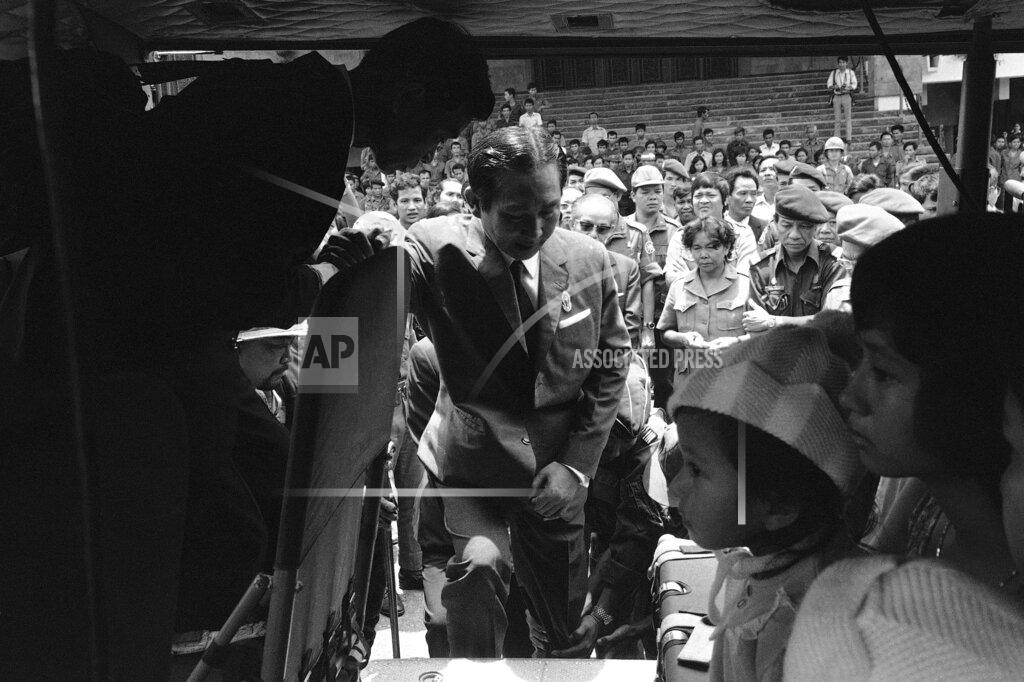
Quy Nhơn and Nha Trang fall in the accellerating collapse of South Vietnam.
Of the 10,000 men who formed South Vietnam’s 22nd Division a week earlier in Bình Định Province, pushed south by waves of refugees from Quảng Ngãi Province and North Vietnamese tanks and artillery, 2,000 are evacuated by sea from Quy Nhơn. More than half of South Vietnam’s territory is now controlled by the North Vietnamese. During the first week in April Communist forces coming from the south push into Long An Province, just south of Saigon, threatening to cut Highway 4, Saigon’s main link with the Mekong Delta.
Government troops abandoned South Vietnam’s third largest city, Quy Nhơn, amid indications that the North Vietnamese were pouring through most of the country without having to do much fighting. As the Communists pressed closer to Saigon, Western diplomats voiced dismay at the government’s relative silence, and some believed an attack on the capital might be imminent. At least six regular North Vietnamese divisions are said to be in the region. According to military sources, Quy Nhơn, like Đà Nẵng, was handed to the North Vietnamese with scant fighting, panic, and a mass exodus of civilians and deserters.
Over the last two weeks, the impression has gained ground here that President Nguyễn Văn Thiệu no longer controls the nation, or even the Government and armed forces. More than 40 opposition senators were scheduled to meet with the President today. Reuters and United Press International reported that Premier Trần Thiện Khiêm had offered his resignation to President Thiệu, but there were conflicting reports as to whether the resignation would be accepted.
The loss of Quy Nhơn, on the coast 260 miles northeast of Saigon, means that the North Vietnamese now command a major port in the middle of the country. Among the refugees arriving in Saigon today were security troops who had been guarding Nha Trang Airport, but abandoned it this morning. They said there had been some burning of houses and shooting in town, but no sign of any Communist forces and no combat, other than between looters. No further flights were being attempted to Nha Trang today, and it appeared that most of the population there was cut off. There have been rumors during the last two days that a column of North Vietnamese tanks were in the vicinity, but no hard evidence exists of any such force.
Military sources in Saigon said they understood that some time earlier, the command of Military Region II also had been evacuated from Nha Trang. There were also reports yesterday that some elements of the South Vietnamese 22d Division — the main defenders of Bình Định Province of which Quy Nhơn is the capital — were trapped in the province.
Virtually the entire South China Sea coast has been closed to air and sea access, either because the towns were actually in Communist hands or were expected to fall shortly. In the mountains about 140 miles northeast of Saigon, Đà Lạt was finally closed off today. Until the last few days, Air Vietnam had been maintaining a schedule of 18 or more evacuation flights a day. Now all flights have stopped.
The status of the coast city of Phan Thiết due east of Saigon is still unclear. Its radio beacon for aircraft is still broadcasting the airfield’s call sign, but no aircraft have landed there in some time. Knowledgeable airline people say that if Phan Thiết falls many commercial lines who fly directly over it will stop flying to Saigon.
Overall, the estimated equivalent of six South Vietnamese infantry divisions, or about 75,000 men, have deserted, have been scattered or have fallen behind the North Vietnamese lines. With Quy Nhơn, North Vietnamese troops have now taken over 14 province capitals, three of the nation’s four largest cities and a vast tier that stretches from the northern provinces over the Central Highlands and to provinces that would afford access to Saigon itself. Military sources said that Quy Nhơn was lost — as Đà Nẵng was over the weekend — with scant fighting, with panic and against an exodus of civilians and army deserters.
In their retreat, the armed forces have abandoned well over $1‐billion worth of weapons and other equipment. Yesterday, a United States Air Force C‐5 brought in 14 howitzers, signaling the start of an airlift of military and medical supplies. It was not expected to have a sizable impact on the morale or military capability of the South Vietnamese Army.
Several Western diplomats say they are convinced that Saigon itself is the target of the Communists’ final thrusts in their three‐week‐old drive, and that an attack may be imminent. Some Western embassies were burning documents and evacuating dependents. “I fully expect to be trapped in the city, to be penned here,” said a Western diplomat last night. “I can see a situation rapidly developing along the lines of Phnom Penh.”
Yesterday there was fighting near Xuân Lộc, the capital of Long Khanh Province, 45 miles east of Saigon, and Chơn Thành, an isolated district seat about 45 miles north of the capital. Significance was attached to reports that the government forces had encountered many tanks at Chơn Thành. The government reported that its forces destroyed 12 of them.
This morning the Saigon command disclosed that sharp fighting had broken out in three provinces near Saigon — Long Khánh, Hậu Nghĩa, and Bình Dương. Fighting has also picked up in Phong Dinh Province in the Mekong delta. Cần Thơ, the province capital, is the biggest city in the delta.
Intelligence officials say that at least six regular North Vietnamese divisions, more than 170,000 men, are in the region around Saigon and that more may be moving south from the Central Highlands. An informed intelligence source said yesterday that while an attack on Saigon might come from the northeastern and northwestern corridors leading into the city, there may also be an attack from the Mekong delta. At least three North Vietnamese divisions are believed to be in the delta, the rice belt of the nation. Intelligence sources say that these units are preparing to step up their activity south of Saigon. Overall, the North Vietnamese are believed to have about 400,000 men in South Vietnam.
Several military analysts have said in recent days that a major North Vietnamese assault against Saigon could not be adequately resisted, largely because the army is demoralized and lacks the will. Virtually the only hope would appear to be a rapid regrouping of the army to defend Saigon and the Mekong delta, where half of Vietnam’s 20 million people live. At this point the North Vietnamese control two‐thirds of the nation, including 14 of its 44 provinces. The North Vietnamese offensive has taken control of South Vietnam’s second, third and fourth largest cities. Đà Nẵng, the second largest, fell over the weekend, and Huế, the fourth largest, fell earlier. Saigon, the largest city, with a population of nearly two million, is now a tense capital. There is a 10 PM curfew, but most stores close by 9. The mood seems at once uneasy and potentially volatile.
As many Americans and Europeans prepared to leave Saigon, diplomats here were bitterly criticizing President Thiệu. “There’s just no leadership, no exhorting, no emergency measures, just silence, zilch,” said one American official. “There was a total breakdown of leadership in Đà Nẵng — sheer, unreasoning panic — and that’s what’s happening all over the country.” An intelligence official said: “There’s a complete lack of communication, a breakdown in the chain of command. Colonels aren’t following orders. No one cares. It’s become every man for himself. There’s paralysis in the Government set in by worry and panic. And there’s silence at the top.”
Perhaps the most respected soldier in the army, Lieutenant General Ngô Quang Trưởng, the commander of the northern Military Region I, was reported exhausted and hospitalized. “The poor man is torn to pieces,” said a Western military official. “He witnessed the debacle in Đà Nẵng and was powerless to stop it.” Of the three infantry divisions in the northern provinces — as well as a marine division — “there now remains only a few ragged, mostly unarmed soldiers,” said one Vietnamese source.
[Ed: Lieutenant General Ngô Quang Trưởng was the best of the Vietnamese generals. Creighton Abrams believed he was better than many of the American officers in Vietnam and could easily have commanded an American division. He was a skilled fighter and, in an all too rare thing in South Vietnam, utterly uninterested in comfort or wealth; utterly incorruptible. If only more had been like him, Saigon would still be Saigon today.]
“The I Corps is no more,” said one dismayed Vietnamese journalist. “The II Corps [in the Central Highlands] is in agony. There is nothing left, not even shame and humiliation, not even despair, not a single trace of vitality in the once 1.1‐million‐man army.” The Saigon Government has estimated that Mr. Thiệu’s decision to abandon most of the Central Highlands and the northern provinces rapidly — coupled with the Communist surge — has generated more than two million refugees. Tens of thousands in Đà Nẵng were unable to leave because of North Vietnamese rocket attacks on barges, crammed with refugees, seeking, to move toward evacution vessels in the South China Sea.
Panic held the city of Nha Trang, long an important coastal resort, in its grip today as terror‐stricken people, fearing that they would be trapped, fled in scenes of confusion like those that accompanied, the fall of Đà Nẵng two days ago. Soldiers who left the abandoned Central Highlands and others recently arrived from Đà Nẵng, roamed the streets, plundering and looting. Shops closed yesterday and no public buildings remained open, nor did the banks and the post office. The dial telephone was out of order. Local officials and army officers had started the wave of panic by sending their families to Saigon, 275 miles to the south. Up to 24 hours ago Nha Trang was under the firm control of the province commander, a colonel. Now it is prey to armed hordes firing indiscriminately, victims of a general fear they are helping to fan.
Cam Ranh Bay, one of the most picturesquely beautiful places on the South China Sea, has become a hell on earth for the hundred thousand or more refugees who have arrived there from Đà Nẵng and also from the whole central part of the country. Today, they are scarcely safer than when they fled; they are starving and gasping from thirst. Cam Ranh Bay, one of the best deep‐water ports in Asia, was the main United States logistical base in Vietnam. Some of the refugees had paid as much as $1,200 to get, to Cam Ranh from the dying city of Đà Nẵng.
At Cam Ranh, money does not matter. Fortunes are stolen by some, and these are robbed by others. Piasters, gold, diamonds, bits of priceless family treasure — none of it means anything in comparison with the need to survive. At Cam Ranh, the suffering of the civilians was far and away the worst, with babies dying on ships or ashore, with the body of an old man lying ignored all day at a pier. But the ragged remnants of the South Vietnamese forces there have their ordeal, too. The general morale has not been buoyed by the fact that many senior officials of Military Region II have left Cam Ranh for Saigon.
No one has any clear idea how many have died. Bodies eventually just disappear. One wealthy man is said to have been murdered on shipboard in front of his wife, and his body was thrown overboard. Four babies were reported trampled to death on another ship. There are no Americans at Cam Ranh, and there is no help in the form of transport planes or helicopters. For nearly everyone who traveled so far to get here, this appeared to be the end of the line — waiting and listening for the approaching rumble of North Vietnamese tanks.
Despite an official American denial that the United States Embassy has begun evacuating personnel, Americans are streaming out of Vietnam. Airlines reported departing flights fully booked. Other Americans appeared to be leading their normal lives. Many seemed either unable to grasp the collapse of the South Vietnamese army or simply unconcerned. Some senior officials were said to be deeply alarmed at the rout and aware that Saigon itself might not last much longer. “I wouldn’t plan any parties for the weekend,” one formerly hawkish official told a friend.
Opposition to President Nguyễn Văn Thiệu has become widespread and vocal as the impression has grown that he no longer controls the people of South Vietnam, or even the government and armed forces. A South Vietnamese official reported hearing a broadcast from the northern city of Đà Nẵng, occupied by the North Vietnamese army on Sunday, announcing that it was being governed by a coalition rather than the Việt Cộng. The chief flag flown was said to be that of the National Force of Reconciliation and Concord, a Saigon Buddhist group. There was speculation that the Communists may plan such a coalition for Saigon.
The Việt Cộng strongly protested today what they called an illegal airlift of arms from California to Saigon. A Việt Cộng communiqué issued to the press here said the airlift, which began today, was a new attempt on the part of the Ford Administration “to raise the morale of the Saigon Army and phantom administration which are on the point of collapse and to breath new life into the belligerent group of Nguyễn Văn Thiệu so it can continue the war.” The communiqué, which was backed by a statement from the North Vietnamese Foreign Ministry, called for an end to the airlift today.
Lon Nol flees Cambodia. Marshal Lon Nol’s five-year rule came to a virtual end as he left Phnom Penh’s airport under rocket attack on his way to Indonesia. He left to his friends and supporters the task of trying to use his departure to obtain new aid from the United States or for negotiations with the insurgents. The marshal’s Caravelle jet lifted off the runway at Pochentong airport about noon today after a quiet send‐off, and moments later his recorded message told the Cambodian people he had left them. The marshal left behind as “interim President’ the 60‐year‐old president of the Senate, Saukam Khoy, an aging politician with no political following and no particular popularity with the military, although he holds the rank of three‐star general.
The departure of the ailing Lon Nol was attended with as much secrecy as all of his movements and political views in the last year. After a brief helicopter trip to Pochentong airport, the marshal and his party of 32, including the nation’s Premier, Long Boret, boarded the Air Combodge plane carefully shielded from photographers and reporters. The marshal’s brother, Lon Non, saluted the presidential plane as the President slowly climbed the stairs. Several rockets hit Pochentong airfield — two fewer than 200 yards from the Caravelle parked on the civilian side of the field — as the marshal walked up the ramp. Earlier several rockets hit the presidential palace as the presidential party prepared to leave there. There were no injuries.
The marshal flew first to U Taphao air base in Thailand where he transferred to an Indonesian plane for the flight to Jakarta. After a brief stay in Indonesia, he is expected to fly to Hawaii. The only foreigners to watch the marshal’s departure were the United States Ambassador, John Gunther Dean, and an aide. The Ambassador stood at the foot of the ramp and shook the marshal’s hand.
Neak Leung fell to Khmer Rouge insurgency, cutting off a critical supply line to the Cambodian capital of Phnom Penh. Neak Luong, the Cambodian Government’s last enclave on the lower Mekong River has fallen before a heavy onslaught by Communist‐led insurgent troops and artillery. The fall of the city, and its twin city of Banam, came at dusk yesterday, according to American military sources, who said that confirmation was received this morning by aerial observation. At least 3,000 government soldiers, 40,000 civilian residents and 20,000 refugees were reportedly in the city when the insurgent troops broke through the government lines.
The fall of Neak Luong, which appeared inevitable for several months has two key strategic consequences for the fate of Cambodia. It effectively seals the entire Mekong River — the major supply link for the Cambodian capital. Now — even during the rainy period that many were hoping could lead to a reopening of the waterway — it is virtually imposible for government forces to make any progress in this direction.
The fall of Neak Luong frees as many as 6,000 to 10,000 insurgent troops to be moved north toward the capital. American and other Western military? sources have long said that when Neak Luong falls, the insurgents may launch major assaults from the thinly defended southern area of Phnom Penhan area they have ignored until now. Still unanswered are the key questions of the safety of the troops and civilians remaining in the town.
For nearly two months the civilian population of Neak Luong has lived underground in deep bunkers, as a result of the daily barrage of 400 or more shells and rockets launched by insurgents from positions across the Mekong and in recent days from positions north and south of the city as well. Late yesterday afternoon, American military sources reported that the insurgents had broken the fragile defense perimeter of the city and had taken its northern half. At that time, Government soldiers were reported making a final stand in the central market, and troops and civilians had moved to the southern part of the city. That defense however, apparently gave out at nightfall.
The U.N. peace force in Cyprus condemned Monday’s two-hour gun battle between Greek and Turkish Cypriots and the Turkish army in Nicosia as a serious breach of last July’s cease-fire. A Canadian officer serving with the force was found dead in his room at the Ledra Palace Hotel with a bullet hole in his forehead, apparently from a stray shot. Two Greek Cypriots were wounded in the battle.
The owner of a chain of supermarkets in Marseilles, France, has been kidnaped by men demanding a $690,000 ransom, police said. Antranick Paroutian, an Armenian who had spent 13 years in jail in the United States for drug smuggling, was kidnaped March 24, police said. No conditions for his release have yet been made by the kidnapers, the police added.
An unidentified group of enlisted men specializing in missile maintenance has told Rep. Les Aspin (D-Wisconsin) that 80% of Hawk missiles at a base in West Germany “would have been useless if needed for combat” last fall. Aspin said the group also alleged that maintenance records on the missiles had been falsified in one section of an artillery battalion by a staff sergeant. They asserted that no action was taken against the sergeant after the deficiencies were discovered.
Police in Arnhem, Holland, have arrested 10 militant Indonesian rebels who planned to hold Queen Juliana hostage and occupy the royal palace, the public prosecutor said. He said the rebels, one of whom had a submachine gun, planned to drive a truck through the palace fence and overpower the royal guards. He said the group intended to hold the queen hostage to back demands that Indonesia grant independence to the South Moluccan Islands.
Japanese radicals have conspired to hijack or destroy civilian airliners at Stuttgart, West Germany, in hope of disrupting the trial of a German terrorist gang, Rep. John Murphy (D-New York) said in Washington. He made public a February 11 report by the Federal Aviation Administration that included the names of 22 of the alleged conspirators.
Moscow police allowed more than 100 Jews to celebrate the third in a series of Passover services in the city’s only synagogue. Services last Wednesday and Saturday were harassed by police, who blocked off the street and on one occasion entered the synagogue and dispersed the people who were inside.
Egypt has formally asked the United States and the Soviet Union to reconvene the Geneva peace conference on the Middle East. The request was made by Foreign Minister Ismail Fahmy at a meeting with the Soviet Ambassador, Vladimir Polyakov, last night and with the United States Ambassador, Hermann F. Eilts, this morning, according to informed sources. The Soviet Union and the United States are cochairmen at the Geneva conference. Mr. Fahmy did not specify a date on which Egypt would like to see the conference start but emphasized that the Palestine Liberation Organization would have to be represented, the sources said. Egypt, it is believed, would like to see Secretary of State Kissinger continue his mediation efforts on a bilateral basis while the preparations for Geneva are going on and even after the conference has started.
Several persons were arrested for questioning after a number of explosions near military camps in four west Malaysian states. Police sources said the arrests were made in raids by joint army and police units in various parts of the country following the explosions.
The Seoul criminal court sentenced three men to death as spies. They were Chin Du Hyon, Park Ki Rae and Kim Tae Yol, all accused of being members of a spy ring based in Japan that was headed by Chin. In a related case, South Korea’s intelligence agency said it had broken up an eight-member North Korean spy ring headed by a Korean living in Japan.
Authoritative American military officers and Western diplomats in Seoul see little danger of a new Korean war despite Communist advances in Southeast Asia and rising tension in the Middle East.
A legislator has introduced a bill calling on the Argentine Government to manufacture a nuclear bomb for national defense. The bill, proposed yesterday by Edgar Cossi Isasi, a member of a small provincial party allied with the Perónist majority, is given almost no chance of passing. But by underlining the country’s potential to produce its own nuclear weapons, it is expected to fuel a debate on the issue that has been intensifying in the last few months.
“Recent events have demonstrated that nations gain increasing recognition in the international arena in accordance with their power,” Mr. Cossi said in his draft bill. “Until the People’s Republic of China increased its arsenal, the great powers deliberately ignored its existence, recognizing instead a minuscule part dismembered from the continent”—that is, the Nationalist Government on Taiwan. Asserting that construction of an atom bomb was in keeping with the wishes of the late Juan Domingo Perón, the legislature urged that Argentina build nuclear weapons that would raise her to the level of the United States, the Soviet Union, Britain, France, China and India.
Bishop Abel Muzorewa, leader of the Rhodesian black African movement, said it was “not out of the question” that South African Prime Minister John Vorster might serve as chairman of the coming constitutional conference on Rhodesia. The bishop praised Vorster and his efforts to help bring about a settlement in the Rhodesian conflict.
The trial of John Connally on charges that as Secretary of the Treasury in 1971 he accepted a bribe of $10,000 from a dairy industry official opened in federal court in Washington. Mr. Connally, once considered a leading contender for the Republican presidential nomination for 1976, has persistently denied the charge that he took the money in exchange for efforts to persuade President Nixon to raise the federal supports for milk prices. He declined comment on entering and leaving the courthouse. Mr. Connally stood impassively as Frank M. Tuerkheimer, an associate Watergate special prosecutor, identified him to 75 prospective jurors as the defendant against charges that in 1971, when he was Secretary of the Treasury, he accepted $10,000 from a dairy industry official.
Courts and bar associations, at the urging of some lawyers but to the outrage of others, are moving slowly and cautiously to improve the quality of legal services by forcing lawyers to take periodic refresher courses or leave the bar. At the request of the Minnesota Bar Association, the Supreme Court of that state is expected to impose such an order within a week. The Supreme Court of Iowa is expected to adopt a similar plan, and other states are working on or considering their own plans.
Governor Byrne and the Democratic leaders of the New Jersey Legislature announced that they had achieved consensus on the need of some kind of state income tax to meet the fiscal crisis. This showed unprecedented unity on tax policy, but did not extend to an agreement on the form the income tax should take or the amount of revenue it would produce. Mr. Byrne said he thought all had agreed that the income tax would be the priority item when the legislature met later this month.
A federal judge who declared the papers and tapes of the Nixon White House to be public instead of private property removed himself from any further consideration of the issue. U.S. District Judge Charles R. Richey’s opinion was handed down on January 31, but the U.S. Court of Appeals instructed him not to sign the order implementing it. Instead the appeals court named a special three-judge court — with Richey as a member — to decide if the case raises constitutional questions. In his latest action. Richey withdrew from both the special court and as the judge with jurisdiction in the case, which involves an estimated 42 million documents and 880 tapes.
The largely black Louisville, Kentucky, school system was merged with the predominantly white Jefferson County system, creating a district thought to be the 12th largest in the nation. It has 130,000 pupils. The merger became effective shortly after U.S. District Judge James F. Gordon issued an order allowing the boards of the two old systems to submit separate desegregation plans. The city board has said it favors a plan to bus about 30.500 pupils among city and county schools. County school authorities favor a limited busing plan based on a new law passed by Congress last summer.
George B. Parr, the south Texas political boss who faced a prison term for income tax evasion, was found dead in his car in a ranch pasture near Concepcion, Texas, by law officers who had been sent to arrest him. Authorities ruled that Parr, 74, had shot himself in the right temple with a .45-caliber pistol. Parr was convicted of tax evasion in March, 1974, for failing to report $287,000 in income between 1966 and 1969. He was sentenced to 10 years in prison but was free under bond pending appeal. Parr’s history included charges of ballot-box stuffing in the 1948 race in which Lyndon B. Johnson was elected to the U.S. Senate, winning the primary by 87 votes.
Poppy Cannon, 69 jumped or fell to her death in New York City from her 23rd floor terrace apartment on Park Avenue. Her fully clothed body was found atop a seventh-floor setback of a nearby building. Police said the fall occurred about 1:30 AM. She left no note. Cannon was one of the first television chefs. In the 1950s, she was the first food editor of the NBC Home Show. She previously had been food editor of the Ladies Home Journal, Town and Country, House Beautiful, and Mademoiselle, and had published several cook books. Her assistant said she had “seemed despondent” recently and was “still more or less mourning the death of her husband, Walter White, one-time executive secretary of the NAACP, who died in 1955.
Comedian David M. (Brother Dave) Gardner has been fined $2,000 and placed on inactive probation for one year for failing to file federal income tax returns. Gardner pleaded no contest last week in Gulfport, Mississippi, to federal charges of failure to file income tax returns during a four-year period, 1967-70. Gardner and his wife, Mildred, were indicted by a grand jury in Los Angeles last year for failure to file returns and the case was transferred to Mississippi. The charges later were dismissed against Mrs. Gardner.
Attorneys general from 14 coastal states, meeting in Washington, D.C., agreed to ask the federal government to grant states half the money the government derives from offshore oil and gas reserves. The attorneys general named a committee to draft legislation giving the coastal states 37½% of the offshore oil and gas revenues — and apportioning another 12½% among all 50 states. They said the coastal states’ share would be used to pay for the extra public services that such oil and gas development would require, such as repair of damage to coastlines and prevention of future environmental damage. The 12½% fund for all 50 states could be distributed according to population and used for any purpose the individual states choose.
The American “Freedom Train” began its tour of the United States in celebration of the United States Bicentennial, starting with a display in Wilmington, Delaware, and then proceeding westward. After reaching San Diego on January 14, the train began its return trip, stopping in Harrisburg, Pennsylvania, on July 4, 1976, and finishing its tour on December 31 in Miami. In all, 7,000,000 visitors would see the train and its exhibits.
Dow Jones Industrial Average: 761.58 (-6.57, -0.86%)
Born:
Kristine Quance, American swimmer (Olympics, gold medal, 4×100m medley relay, 1996), in Northridge, California.
Magdalena Maleeva, Bulgarian tennis player (10 x WTA titles; World #4 1996), in Sofia, Bulgaria.
John Butler, American-Australian singer, songwriter, and music producer (John Butler Trio), in Torrance, California.
DeShawn Fogle, NFL linebacker (Philadephia Eagles), in New York, New York.
Died:
George Parr, 74, Texas politician known as “The Duke of Duval”, by suicide. His manipulation of election results in Duval County, Texas, helped future U.S. President Lyndon B. Johnson become a U.S. Senator for Texas in 1948.
More photographs here: https://www.facebook.com/mark.olivares.71
 History Diaries