


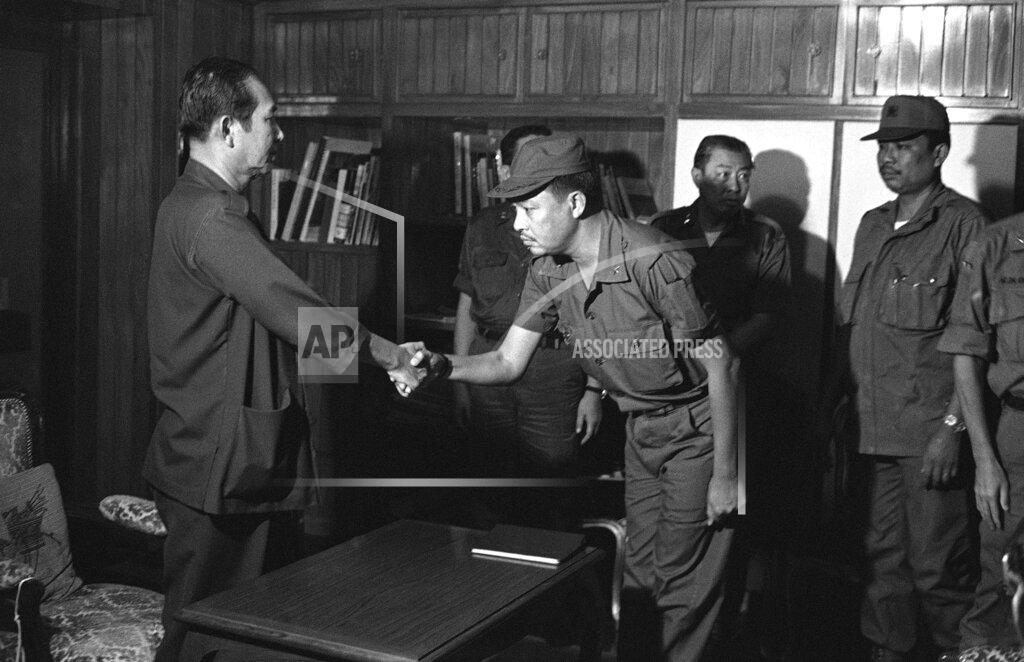

Amid growing fears of an attack on Saigon, North Vietnamese troops swept into South Vietnamese government enclaves on the country’s central coast and thwarted the American evacuation of refugees. Advancing Communist troops pushed south along the coast and radio contact was lost with Quy Nhơn, South Vietnam’s hird largest city about 270 miles northeast of Saigon. Although the city’s loss to the Communists seemed inevitable, its present status was unknown. The Saigon command reported that Chơn Thành, a district town 50 miles north of Saigon, was heavily attacked and that 12 Communist tanks were destroyed in the battle. Some American and other Western officials now term the overall situation in South Vietnam as one of panic and some anarchy, and claim that the North Vietnamese are surging through the country and meeting only sporadic resistance, and that territory is being taken by virtual default.
American military sources reported that the evacuation by sea from Đà Nẵng, the city taken over by the North Vietnamese on the weekend, had been suspended because the North Vietnamese and the Việt Cộng fired rockets at the barges and tugboats that were taking refugees to ships offshore. In the meantime, the situation in the nation was deteriorating so rapidly that government troops in Cam Ranh Bay, which was surging with panicky refugees, were firing on American helicopters and chartered aircraft seeking to land.
The South Vietnamese armed forces, numbering about 1.1 million, were reported in virtual disarray. An intelligence source estimated last night that about half the nation’s army was on the run, was deserting or was in the hands of the North Vietnamese, and that the government here was in a state of upheaval. With the military situation worsening, American and South Vietnamese officials were evacuating the coastal enclave of Nha Trang about 275 miles south of Đà Nẵng. There were indications that some staff members and families of the American Embassy were leaving Saigon.
While American officials strongly denied that an evacuation was underway, reliable Western sources, said that “numerous” officials were sending out their wives and families and that some of the officials themselves were planning to leave. Rumors spread last night that President Nguyễn Văn Thiệu was preparing to depart. “An evacuation is when an embassy orders people to move out,” an official source said. This is not happening now. But under present circumstances, if families choose to go, they can.” There are nearly 6,000 Americans in South Vietnam, most of them in Saigon. Last night several representatives of oil companies and other American businesses were reportedly leaving the capital in the wake of the North Vietnamese advance, which has swept over two‐thirds of the nation.
Western intelligence officials say there are six regular North Vietnamese divisions in Communist‐held areas around the capital and that they have several hundred Soviet‐made T‐34 tanks and dozens of 130‐mm. artillery pieces that can fire shells as far as 15 miles. This morning, a United States C‐5A Galaxy transport with 14 105‐mm howitzers arrived in Saigon’s Tân Sơn Nhứt Air Base, the start of an American airlift of military and medical supplies. The arrival of the supplies is viewed by South Vietnamese and American officials as a “token” and is not expected to have any impact on the effort to block the North Vietnamese advance.
In the evacuation at Đà Nẵng, the nation’s second largest city, American officials estimated that 30,000 to 50,000 refugees managed to escape by sea and that 2,000 to 4,000 had fled by air before the North Vietnamese moved in. “We are not able to work there,” an American military source said, referring to Đà Nẵng, “because the Communists are not being very cooperative. They are firing.”
United States officials said that all Americans had been evacuated from Quy Nhơn and from Tuy Hòa, 50 miles south. American civilians and their families have been evacuated from Nha Trang, but the United States Consulate there remained open. Reports from Nha Trang yesterday painted a picture of panic, with refugees surging over the airport to scramble onto planes, mobs in the streets, soldiers firing in the air, and looting.
In an interview here late yesterday a senior Western official said of the deteriorating military situation: “This Government seems to be on a deliberate suicide course. I can’t quite believe — they’re paralyzed. They seem to keep thinking that B‐52’s and the marines will come back. “The situation is extremely grave and they’re doing nothing. The American Embassy is two steps behind the times, They know the situation is serious, but even they can’t comprehend what’s taking place. There’s no sense of how grave this situation is.” The North Vietnamese are now believed to have at least 16 divisions, numbering 400,000 men, in South Vietnam. Their surge southward was made easier by the decision of President Thiệu two weeks ago to abandon virtually the entire northern two‐thirds of the country.
A Hanoi broadcast, monitored in Tokyo, said that the Việt Cộng were ready to hold talks with a South Vietnamese government that excluded President Nguyễn Văn Thiệu and would abide by the Paris agreements of 1973 to “quickly settle all the affairs of South Vietnam,” The Associated Press reported. The statement, broadcast by North Vietnam’s official press agency, was in an appeal issued by the Vietcong’s Provisional Revolutionary Government, which declared: “The Nguyễn Văn Thiệu junta — main obstacle to the settlement of the political question in South Vietnam — must be overthrown, and an administration standing for peace, independence, democracy, national concord and strict application of the Paris agreement must be established.”
It said the Provisional Revolutionary Government “is ready to hold talks with such an administration to quickly settle all the affairs of South Vietnam.” But it added: “Realities have proved that the U.S. imperialists still refuse to end their military involvement and interference in the internal affairs of South Vietnam. Though its situation is hopeless, the Nguyễn Văn Thiệu junta is clamoring for war, feverishly stepping up forcible evacuation of the population, exploitation, repression, persecution and massacres.”
Thousands of refugees are milling about in the seaside city of Nha Trang amid reports that North Vietnamese forces are moving rapidly in this direction. With the loss of Huế and Đà Nẵng, and with the fate of Quy Nhơn unclear, Nha Trang is the last major city along the coast north of Saigon known with certainty to be in government hands. American officials said that North Vietnamese forces were moving toward Nha Trang both down the coast from Bình Định Province and from the Central Highlands.
The officials said that Major General Phạm Văn Phú, the commander of Military Region II, which used to be made up of the highlands and the central coast, had given orders to evacuate is temporary headquarters from Nha Trang. It was unclear when General Phú and his staff would depart — they fled Pleiku two weeks ago — or where they would move to.
The imminence of the fighting made for incongruous scenes in this usually tranquil city, which looks like a Caribbean resort. Young boys still swam in azure waters of the South China Sea, which swept in gently onto the long white curving beachfront in town. Old women still offered beach umbrellas for rent, and others peddled coconut milk to quench a thirst produced by the bright tropical sun. Thousands of refugees milled about the city or sat in hot buses, displaying on their sides destinations such as Đà Nẵng, Quy Nhơn and even Buôn Ma Thuột, the city in the highlands whose capture by the Communists began the government’s rout.
Others swarmed around the large whitewashed. United States Consulate building, try‐ ing to arrange a rare scat on a United Slates‐sponsored evacuation flight to Saigon. American officials dashed in and out of offices with the precious lists of names of the lucky ones, who included all the socalled “third country” nationals in Nha Trang. The term, widely used by Americans in Vietnam, includes all non‐Americans and non-Vietnamese, And yesterday it seemed to mean largely local: French businessmen and Indian merchants, who crammed eagerly aboard the available plane seats at Nha Trang’s airfield.
The widening demoralization of the South Vietnamese Army has increased pessimism in the U.S. Defense Department over the South’s ability to hold Saigon against a Communist offensive. The Saigon area is still regarded as defensible by military sources with experience in Vietnam, but they regard the situation as less promising than it was a week ago in view of reports of panicky retreats, looting and indiscipline. Some analysts, surprised that the Communists have waited so long to launch their expected attack on the capital, were puzzled by the prediction yesterday by Secretary of Defense James R. Schlesinger that the northern forces would make major thrusts toward Saigon in the next month or so.
Whether the North Vietnamese forces move toward Saigon, Mr. Schlesinger said, depends on whether they follow their pattern and how quickly they can assemble supplies and troops. He said he had concluded that “there will be major actions toward Saigon in the next month or two.” Heretofore the accepted intelligence appraisal was that the North Vietnamese forces would not launch such an offensive until 1976. The analysts said they considered that the North Vietnamese had sufficient strength in the sector now to mount an offensive. Estimates of that strength run up to six regular North Vietnamese infantry divisions, supported by three brigades of armor and powerful field and antiaircraft artillery.
To many officers the significant aspect of the morale situation is the apparent failure of company and battalion officers to retain control of their troops. American officers recognized that nepotism and corruption would be rife at the higher levels of command once the United States forces departed. They believed, however, that the program, undertaken at their urging, of promotion on merit of experienced noncommissioned officers to commissioned rank and of veteran lieutenants and captains to company and battalion command would create a cadre whose professional efficiency would outweigh the ineptitude of senior officers. In numerous instances in the recent fighting in the northern and central sectors, however, company and battalion officers have fled, leaving their men to surrender or find their way back.
Defense Department officials clearly had expected more from the southern units fighting in the Nha Trang area, where one of the best Saigon generals, Phạm Văn Phú, was in command. With American military supplies reported to be reaching the Saigon area, some sources are already asking whether, in view of the South Vietnamese performance elsewhere, the airlift would serve any useful purpose. “We may find out that all we have done is to provide the North Vietnamese with some expensive military hardware,” a retired general said.
One of South Vietnam’s most influential political experts says that he believes that the Communists have won the war. Tôn Thất Thiện, a prominent anti‐Communist opponent of President Nguyễn Văn Thiệu, said in an interview that he saw no possibility of negotiating a settlement for a coalition government in Saigon.
“Why should the other side be interested in coalition or negotiations now?” he asked. “They have won.”
Mr. Thiện held ministerial rank in the government of the late President Ngô Đình Diệm and later served as an adviser to General Dương Văn Minh, the general who overthrew Mr. Diệm in 1963. Mr. Thiện has championed the idea of a third force, free of domination by either the Communists or the Americans. Asked whether he felt an anti‐Communist government in Saigon stood a chance at this point, he replied:
“You cannot throw people into a cataract and then ask what they plan to do to save themselves. Kissinger wanted peace in 1973 and he got it.
“Now we are suffering the consequences of what Kissinger did to us in Paris. At this point, the other side has the entire initiative. It’s up to the Việt Cộng to decide what will happen to us.
“This is the result of a policy of détente, of so‐called peace with honor. It was incredible that Kissinger could have signed the Paris agreement without getting guarantees from the other side.
“He did it, of course, to help the Nixon campaign. Now Kissinger stands exposed as a phony, of course, but with Vietnam on the brink, it hardly matters to us. It will be the same with Israel, although perhaps the Israelis are stronger and smarter.
“But, the point is, no one believes in America anymore. I certainly do not.”
President Lon Nol of Cambodia boarded a military helicopter and took off on a journey that was expected to carry him to permanent exile after going through a series of tearful farewells in Phnom Penh. Sources at the presidential palace said that Marshal Lon Nol had been too overwrought to record a planned farewell address to the nation, which learned of his plans only from foreign broadcasts.
Clinging to the trappings of his offfice until his last moment on Cambodian soil, the head of state—who has been partly paralyzed since 1971—walked slowly in review past an honor guard and military band, followed by all the top ministers and generals in his Government. The helicopter carried him to Pochentong Airport, which has been under daily rocket attack for almost three months. There, he boarded a waiting plane that was to carry him on the first leg of a trip to Indonesia.
Meanwhile, the fighting was less than five miles away. In action north of the airport the Government forces managed to hold a perimeter by sending two battalions of reinforcements and a squadron of armored personnel carriers to plug a hole in their defenses that the insurgents discovered over the weekend.
Heavy shooting erupted along the three-mile “green line” that divides the Greek and Turkish Cypriot sectors of Nicosia. There were no reports of casualties but many GreekCypriot families living near the cease-fire line abandoned their homes and fled to more secure zones. The U.N. peace force that has troops posted in the no-man’s-land dividing the Greek and Turkish Cypriots tried to get both sides to stop the shooting. A spokesman said an agreement has been reached but then gunfire flared again.
Premier-designate Suleyman Demirel of Turkey announced a coalition cabinet of four conservative parties to end the 6-month-old government crisis. The new government, which still needs to be approved by the National Assembly, immediately pledged support for a separate Turkish Cypriot state on Cyprus. It also called for repeal of the U.S. arms embargo against Turkey.
Portugal’s leftist military government, in keeping with its decolonization policy, has been trying to give Macao back to China, but the Peking government has said no, according to diplomatic officials in Washington. Macao has been Portuguese territory since 1887, but Macao has functioned as a Chinese dependency for some years and Peking proclaimed it “part of Chinese territory” in 1972. The Chinese leadership reportedly has advised the Lisbon government that it wanted no change in the status of Macao.
An armada of small fishing boats blockaded Aberdeen and Glasgow, Scotland, and 40 other ports in northern Britain in a campaign to keep imported fish from cutting their profits. A protest leader said 43 of Britain’s 250 ports were affected and the number would rise. One organizer, skipper George Crawford, said. “We aim to do in four days what Hitler couldn’t achieve in four years,” meaning the sealing off of Britain.
Soviet grandmaster Anatoly Karpov formally has consented to play the $5 million match for the world chess title according to the rules and regulations adopted by the International Chess Federation, Tass reported. The match is scheduled for June 1 in Manila but American champion Bobby Fischer has said he would not defend his title because the federation did not accept both of his proposals for rule changes. Karpov is expected to become the world champion by default unless Fischer backs down.
Secretary of Defense James Schlesinger said that the United States would be “reluctant” to enter into any new arms commitments to Israel while the current reassessment of American policy in the Middle East was going on. The policy review was ordered by President Ford last week, and the State Department said that the ambassadors to Israel, Egypt, Syria and Jordan had been summoned home.
About 20,000 Israelis converged today on the site of Samaria, an ancient Judean capital on the West Bank of the Jordan River, at the end of a two-day protest march to dramatize their call for more Jewish settlements in the occupied region.
Members of 17 third-world countries have agreed that punitive measures against Israel, including dismissal from the United Nations, should be considered by the more than 70 countries that make up their influential bloc there.
The State Department announced that it has called home the American ambassadors in Egypt, Jordan and Syria to help reassess U.S. policy in the Middle East. The recall was part of the reassessment announced last week by Secretary of State Henry A. Kissinger following collapse of his efforts to achieve a settlement between Israel and the Arab states.
The new Saudi Arabian regime declared tonight that it would continue the build-up of the nation’s armed forces so that they would be “a force in the defense of the Arab nation and of the Arab cause.”
Iraqi armed forces were ordered today to “advance toward” control of areas held by Kurdish rebels as a cease-fire ended at midnight.
Iraq has extended until the end of April its amnesty for Kurdish rebels who have fled to neighboring Iran, the British Broadcasting Corp. reported. Quoting Baghdad Radio, it said the Iraq revolutionary command hoped the move would encourage the Kurds to return and lay the foundations of self-rule and the building of their homeland.
Egypt will let cargo bound for Israel pass through the Suez Canal only if an agreement is reached leading to a further withdrawal of Israeli forces from positions they now hold 10 to 15 miles from the canal, Egyptian officials said today.
Seoul police used tear gas to prevent about 500 students from marching out of the campus of Korea University for a demonstration against President Park Chung Hee. It was the first class between students and police since the university opened for a new term early in March. Meanwhile, leading political opponents of Park agreed to merge the New Democratic Party and the Democratic Unification Party to make their campaign against him more effective.
Five Ethiopian army officers have been executed by firing squad in the northern province of Eritrea, where the death toll in two months of virtual civil war is now estimated at more than 6,000. Sources in Addis Ababa said that the officers had been found guilty by court-martial on charges connected with a lack of discipline and lack of military judgement resulting in the death of soldiers in battle.
President Ford’s clemency program for Vietnam war deserters and draft evaders has ended with results that are as controversial as the program itself has been since it was established six months ago. As the program ended, only about 22,500 of the 120,000 men eligible for it had signed up. Charles Goodell, chairman of the Presidential Clemency Board, said that he had regarded the program as “reasonable and successful,” and that he would have liked the program extended but the President had said it was not possible.
The Agriculture Department reported that farm prices declined 2 percent in the month ended March 15 from the averages of a month earlier, extending the easing of major agricultural commodities for the fifth consecutive month. The decline was generally viewed by department officials as reinforcing earlier predictions by the department of lower food prices for consumers despite a slight firming of the farm markets since mid-March.
Rep. Les Aspin (D-Wisconsin) reported that the Federal Energy Administration was investigating possible overcharges totaling $101 million by Gulf Oil Corp. The FEA confirmed the investigation and Gulf issued a statement that the FEA and Gulf were “still discussing the matter.” Aspin and the FEA said Gulf had agreed to deduct from its books $40 million in claimed “costs” which otherwise might have been passed on to consumers. But the Gulf spokesman insisted that Gulf had not admitted any $40 million overcharge and had not agreed to deduct that amount from its costs. Meanwhile, Gulf announced a price increase of 1 cent a gallon for all automotive gasoline and said the action was in accordance with FEA regulations.
Senator William Proxmire (D-Wisconsin) said he had asked the Federal Trade Commission chairman, Lewis A. Engman, for a full explanation of why the FTC had suspended a condominium housing industry investigation. Proxmire said in a statement that the inquiry could have saved condominium owners millions of dollars. An FTC spokesman had said earlier the commission had decided by a 3-2 vote to break off the investigation because it was duplicating a similar one by the Department of Housing and Urban Development. The senator said he was pushing legislation for federal regulation but that FTC action was the only way to help buyers already victimized.
The United States has 120,000 fewer hospital beds than it had in 1960, and those beds serve nearly 30 million more people, the American Hospital Association disclosed. The report also shows that the nation has fewer hospital beds for each 10,000 persons than other major industrialized countries, and that the rate of occupancy in the United States has been rising. The report was prepared in response to critics who alleged there were too many hospital beds, an AHA spokesman said. The nation’s 7,123 hospitals had 1.54 million beds in 1973.
The Louisiana Supreme Court overturned the convictions of nine Black Muslims sentenced to 21 years each for inciting a 1972 riot in which five persons died. The high court said the Muslims should have been granted a hearing to determine whether they could receive a fair trial in Baton Rouge. The nine had argued during the April, 1973, trial that racial and religious passions in the community were running so high that they could not receive an impartial trial. The defendants were arrested after a January 10, 1972, shootout on a street in the black business district.
Chicago voters are expected to give Mayor Richard J. Daley an easy victory today and four more years in the office he has held for two decades. Daley, who beat three challengers in the February Democratic primary, faces Republican John Hoellen and Willie Mae Reid, a candidate of the Socialist Workers Party. Both are running a thankless race on shoestring budgets in a city where neither party is a match for the Daley organization.
Any major increase in the number of currently designed jet planes flying in the stratosphere will diminish the earth’s protective layer of ozone and likely increase the amount of skin cancer, a National Academy of Sciences report concluded. Supersonic transports pose the biggest danger because they are designed to fly at extremely high altitudes where the air is stagnant and pollution remains for a long time. But even subsonic planes can deplete the ozone layer with nitrogen oxides emissions if the current trend toward planes that fly higher continues, the report said.
The Vermont Legislature passed a law giving itself the right to accept or reject any proposed nuclear power plants in the state. Although Governor Thomas P. Salmon had expressed reservations about taking the power to control nuclear power construction from the governor and turning it over to the legislature, his aides predicted he would sign the measure. The Vermont Department of Health already enforces guidelines for the operation of the state’s only nuclear plant, the Vermont Yankee station at Vernon.
The state of Idaho asked the U.S. Supreme Court to force the states of Oregon and Washington to impose substantial limits on commercial fishing of the Columbia River in order to preserve the spring salmon spawning runs. In its appeal to the high court, Idaho’s lawyers argued that salmon, shad, and steelhead trout border on extinction and asked that the court order the other two states to admit Idaho to the Columbia Basin Compact. The three fish species are anadromous types that spawn in the fresh waters of the Snake River in Idaho, then descend to the sea and live out most of their adult lives in saltwater.
The New Zealand Broadcasting Corporation made its last broadcasts under that name. The channel frequencies in Dunedin and Wellington become TV1 (now TVNZ 1) the next morning, while those in Auckland and Christchurch were not used until the launch of TV2 (now TVNZ 2) on June 30 later that year.
The 635th and final original episode of the long-running TV series “Gunsmoke,” titled “The Sharecroppers,” was telecast. After originally being a radio series, the show had started on television on September 10, 1955 and ran for 20 seasons.
In his final game on the sideline, John Wooden coached UCLA to its 10th national championship in 12 seasons when the Bruins defeated Kentucky 92–85 in the title game at San Diego, California.
Dow Jones Industrial Average: 768.15 (-2.11, -0.27%)
Born:
Ryan Rupe, MLB pitcher (Tampa Bay Devil Rays, Boston Red Sox), in Houston, Texas.
Tim Christman, MLB pitcher (Colorado Rockies), in Oneonta, New York.


 History Diaries