


Easter Sunday.
The North Vietnamese took over Đà Nẵng following the collapse of government resistance and the panicky flight of tens of thousands of refugees. There were reports that North Vietnamese troops were advancing south along the coast of South Vietnam, and that the cities of Quy Nhơn and Tuy Hòa were threatened. American officials and South Vietnamese were being evacuated from these coastal cities. Quy Nhơn airport was reportedly packed with soldiers and families vainly seeking to get out by plane. Virtually all flights to Quy Nhơn were stopped because of the panic at the airport.
Some fighting was reported in the city but South Vietnamese army and marine units were reported to have crumbled rapidly. Streets were said to be swollen with refugees and mobs of frantic families. The loss of Đà Nẵng — the second largest city in South Vietnam and the headquarters of United States Marines during the years of American involvement in Indo-China — is considered perhaps the biggest single reverse the Saigon regime has had yet.
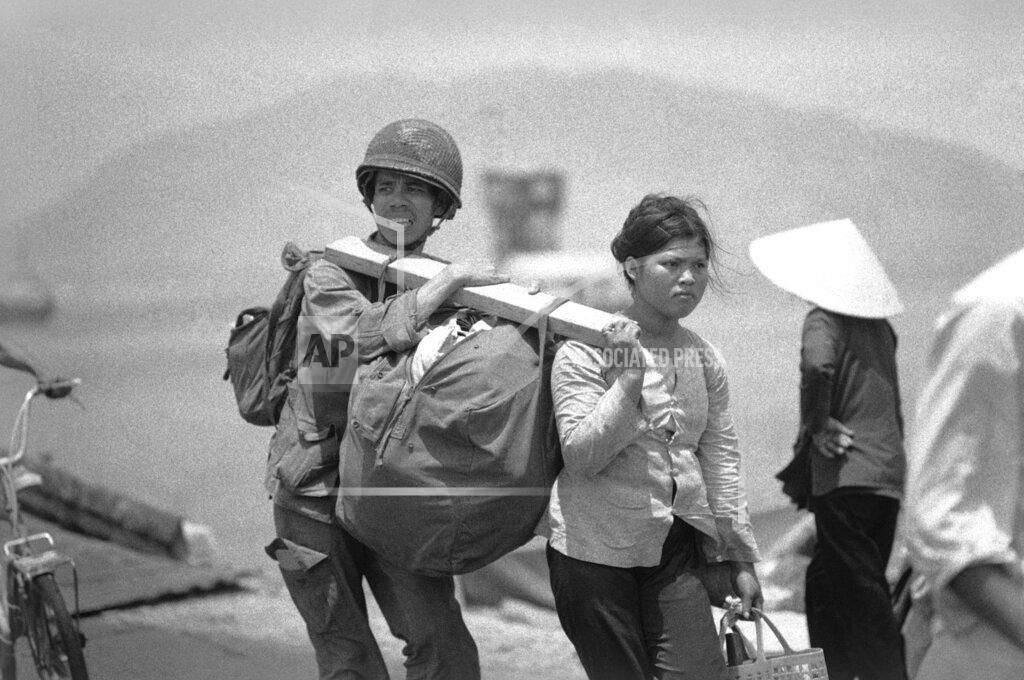
The end came for Đà Nẵng on Easter Sunday. The city was conquered, but in effect by Saigon’s own troops, rather than the North Vietnamese. The reign of terror of government forces in the city cost many lives and effectively kept aid from being sent in and kept refugees from getting out. The government soldiers were prepared to kill anyone, including women and children, to escape the city. They sometimes did. But very few succeeding in getting away.
The Saigon command said this morning that heavy fighting had flared near Bình Khê, a district town about 25 miles northwest of Quy Nhơn and on the highway leading to the port. Military officials say that tho threatened loss of Quy Nhơn would give the North Vietnamese a substantial coastal belt that reaches into the center of the nation and would enable the Communists to pick up another major port in their offensive.
With the loss of Đà Nẵng, the outlook for the South Vietnamese armed forces now seems grim. One Vietnamese military source said that there were about 100,000 troops in and around the Đà Nẵng area — most of them on the run or trapped. The troops come from government units that were considered some of South Vietnam’s best: the First, Second and Third Infantry Divisions, the Marine Division and about a half‐dozen ranger battalions.
At this point, South Vietnam’s northernmost military zone — Military Region I — is under virtually complete Communist control after a stunning disintegration of government and military authority. Moreover the loss of Đà Nẵng, a city that seemed militarily invulnerable two weeks ago, was a severe blow to President Nguyễn Văn Thiệu, whose government was in disarray.
News of the loss of Đà Nẵng was made public here dramatically yesterday morning by South Vietnam’s Deputy Premier, Phan Quang Đán, who said at a news conference: “It is lost. The Communists have taken Đà Nẵng.” Later in the day, the Saigon command’s spokesman, Lieutenant Colonel Lê Trung Hiền, said: “We have lost contact with our headquarters in Đà Nẵng city. We know the situation in the city was in serious chaos. The order has not been restored. It is difficult for us to find out what is happening in the city.”
Although North Vietnamese Army units had moved to within three miles of the city to the south and west—and had fired rockets and shells at the American‐built airport and naval base in recent days—the loss of the city of 500,000 was widely attributed to a breakdown in the army ranks, the influx of as many as 1.5 million refugees and to conditions in streets that verged on anarchy. “Law and order evaporated,” said a Western source. “There was no battle of Đà Nẵng. It was a rout.”
One reliable Western source said last night that North Vietnamese soldiers were known to be moving through the streets of Đà Nẵng, a city 370 miles northeast of Saigon. A Việt Cộng spokesman in Saigon, Major Phương Nam, said the Communists had been in complete control of Đà Nẵng since Saturday afternoon. “And it is true, the Việt Cộng flag is flying in Đà Nẵng.”
By last evening, however, there was some confusion in Saigon about developments in Đà Nẵng and North Vietnamese movements in the city. One highly informed intelligence source said: “Certainly there are North Vietnamese Army forces in Đà Nẵng. There’s not all that much organized resistance but there are plenty of people around with guns and it’s chaotic.”
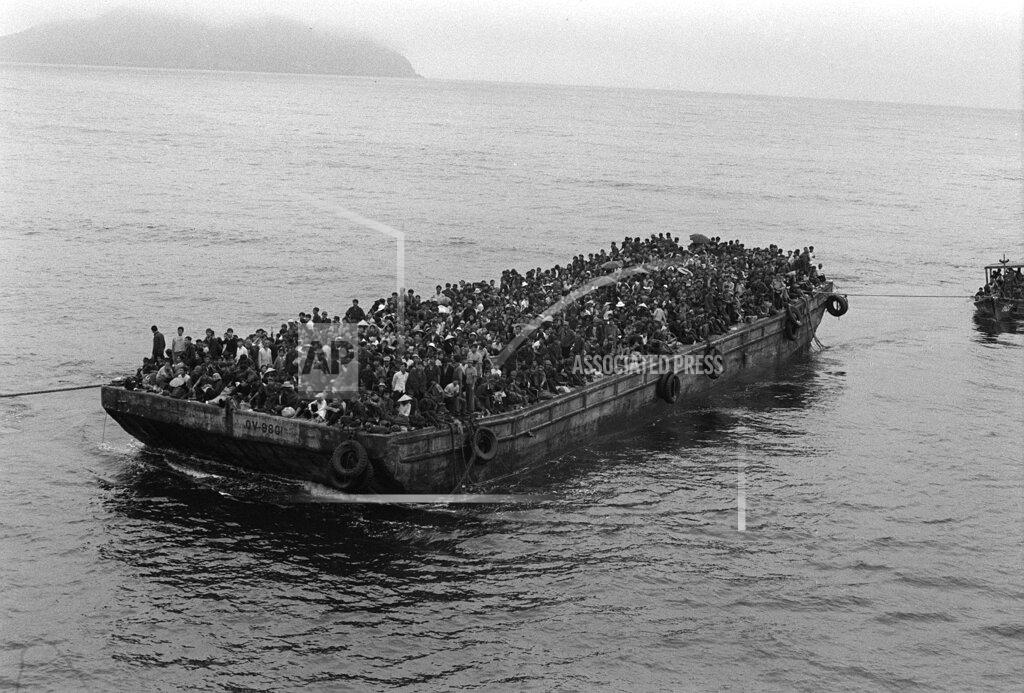
There were reports of looting, mass desertions among government forces, fires in the city and chaos as refugees packed piers and bridges to board barges for ships standing offshore in the South China Sea. Heavy rains and rough waves were thwarting the feverish flight of families and soldiers seeking to flee the port by boat.
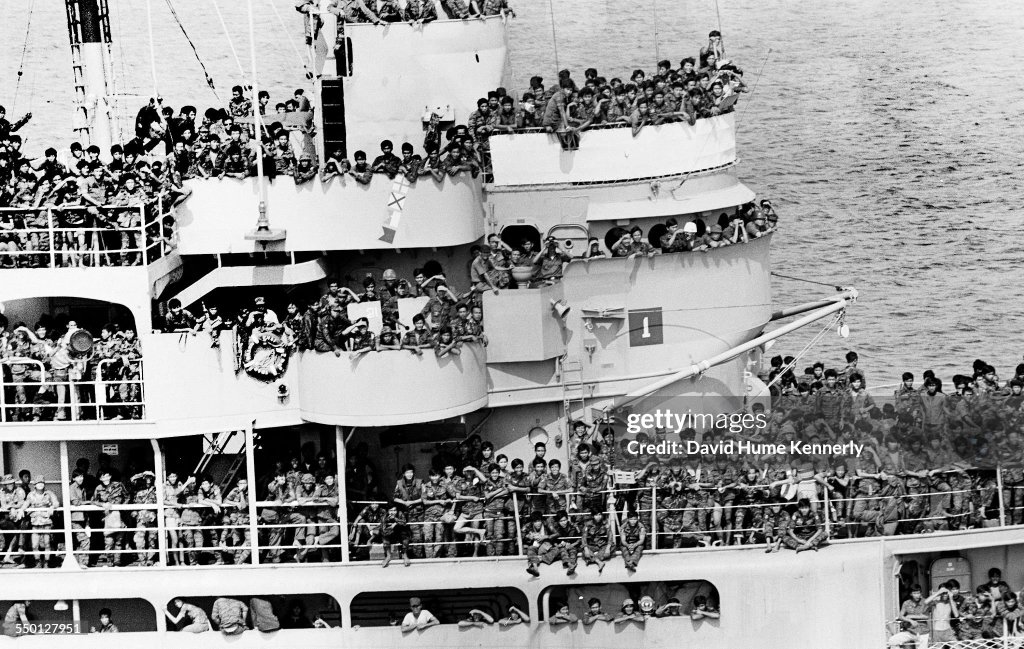
The United States Military Sea Command is operating several chartered ships for the operation. Two of the cargo vessels, the Pioneer Contender and the Pioneer Commander were near Đà Nẵng late yesterday afternoon and boarding nearly 15,000 refugees for the 15‐hour trip south to Cam Ranh Bay. A reliable Western source said that the North Vietnamese were not thwarting the evacuation and that the operation would continue.
Nearly 30,000 refugees, clinging to railings and packing the decks of freighters and ships, have arrived in Cam Ranh Bay from Đà Nẵng in a desperate and fevered flight from the North Vietnamese. Tens of thousands of others, including army deserters, are still awaiting evacuation from Đà Nẵng, a city that seems to have fallen into the hands of the North Vietnamese virtually by default.
Western sources here say that President Ford’s decision to send four United States amphibious ships to help evacuate refugees is not expected to have any insignificant impact on the operation. The four ships — each carries 2,000 people — will arrive in the area within the next day. But, with thousands seeking to flee, the arrival of the four transports are viewed here as insignificant, given the need and the panic of the civilian refugees.
With the loss of Đà Nẵng, military officials said, were millions of dollars worth of equipment, including scores of airplanes, tanks and artillery pieces. Within the last few weeks, the South Vietnamese Army has lost more than $1‐billion in American‐made equipment in the rapid abandonment of two‐thirds of the nation. North Vietnam now controls virtually the entire upper, half of South Vietnam, freeing some of its ten infantry divisions in the north to press southward along the coast to Quy Nhơn, 175 miles south of Đà Nẵng, Tuy Hòa, and possibly even Nha Trang and Cam Ranh Bay. These two enclaves, now swarming with tens of thousands of refugees, are now considered vulnerable by South Vietnamese military authorities.
A reliable Western source said last night that North Vietnamese activity had picked up sharply and abruptly along the coast in recent days. Two port cities, Quy Nhơn and Tuy Hòa, 45 miles to the south, were being evacuated. And the major city of Nha Trang, about 95 miles northeast of Saigon, is now suffering a scare that has resulted in an abrupt demand for airline tickets to Saigon and rumors of an impending North Vietnamese attack. The loss of Đà Nẵng was viewed as the largest single reverse experienced by government forces in Vietnam. From the time that the North Vietnamese seized Huế, the former imperial capital, 40 miles to the north, and then the provincial capital of Tam Kỳ, about 50 miles south of Đà Nẵng, it was obvious to military analysts that Đà Nẵng was in some peril. But few Vietnamese and few Americans expected the city to be lost so rapidly.
“It fell without a fight,” said one highly informed Western source. “One of the tragedies is that you had marine elements fighting outside the city, but inside there was simply a collapse of internal order. It swept all over the city. It was sheer panic.” Clearly, the panic that swept Đà Nẵng was the result of President Thiệu’s decision to abandon the northern two‐thirds of the nation, the abrupt flight of hundreds of thousands of refugees in the northern provinces and the Central Highlands, the erosion of army morale and widespread desertions, the collapse of administrative authority in the provinces and the lack of government preparation for the flow of refugees.
What has especially shaken army morale is the fact that Lieutenant General Ngô Quang Trưởng, the commander of Military Region I, and his staff were forced to leave their headquarters on Saturday for a navy ship on the South China Sea. General Trưởng is considered one of the best officers in the Army, and his evacuation was the result of a North Vietnamese rocket and artillery barrage as well as the panic.
A major question in Saigon was how Vietnamese Communist forces could accomplish in three weeks, almost effortlessly, what had been far beyond their reach for a quarter of a century. The Communist gains in the last three weeks were far greater than the worst fears of the Saigon leaders and their American allies. Even the American officials who believed consistently over the years in an ultimate victory over the Communists are suddenly letting it be known that they feel defeat is near. There seems to be general agreement that the North Vietnamese have been successful not because of overwhelming power but because of the collapse of Saigon’s forces in about two‐thirds of the country, and their lack of will to fight.
In Saigon, very few officials of any nationality will say that a non‐Communist government can survive much longer. Nonetheless, about a million South Vietnamese are still under government arms, Saigon still has one of the largest air forces in the world, and there appears to be ample ammunition and equipment to carry on a war. However, many South Vietnamese army and air force officers feel that things have gone too far and nothing can stop the Communists now. One said that he expected the war to be over in two weeks. “There is nothing anyone can do.” said another, an air force colonel. “It is time for us, the officers, to look after ourselves and our families now.”
Some Americans said they believed that the end for Saigon was imminent and that foreigners left in the country, especially Americans, would be slaughtered by the very officers and men they had once assisted and advised. “Never mind the Việt Cộng,” an American said. “They are at least disciplined. The people to fear most now are those who feel we have betrayed them, that somehow we are to blame for this whole nightmare.”
Four of the 13 divisions and four of the independent ranger and armored brigades with which South Vietnam began the present campaign have ceased to exist as organized units, according to reports reaching Washington from Saigon. The First Division, once regarded as one of the best in the army, has “disappeared.” About 4,000 men of the Second Division are reported making their way south by ship and road. Only 6,000 men of the Marine Division have escaped capture. Two ranger brigades involved in the Northern fighting have been out of contact with their headquarters for more than a week.
South Vietnamese infantry and artillery are attempting to establish a line north of the coastal port of Nha Trang in an effort to halt a Communist offensive developing along the seacoast, according to United States military sources. The offensive will be accompanied, the sources predicted, by a steady intensification of pressure to test the morale of South Vietnam’s forces defending the Saigon area.
The Ford administration gave elaborate assurances that the United States Navy ships ordered to assist in the evacuation of refugees from South Vietnam’s coastal cities would not become involved in hostilities. “Our vessels will not enter. the combat areas or participate; in any hostilities,” Ron Nessen, the President’s press secretary, said today. “This humanitarian effort is not designed to become involved in hostilities.” United States officials in Saigon said that the ships would arrive within two days. American officials in Saigon identified the Navy ships as the transport dock USS Dubuque, the amphibious command vessel USS Blue Ridge, the landing ship USS Frederick and the cargo ship USS Durham, The Associated Press reported.
North Vietnam and the Việt Cộng today condemned President Ford’s decision to order United States naval ships to Đà Nẵng to evacuate refugees, the North Vietnam press agency reported. The North Vietnamese Foreign Ministry, in a statement issued in Hanoi, called President Ford’s order “a very grave violation” of the Paris agreement on Vietnam, according to the agency.
China congratulated the Việt Cộng today on its military successes and declared that the Government of President Nguyễn Văn Thiệu was being punished for “consistently sabotaging the Paris agreement.” The Chinese statement, distributed abroad by Hsinhua, the Chinese press agency, appeared as an article today in Jenmin Jih Pao, the official party and Government newspaper. China criticized the United States for sending General Fredrick C. Weyand, the Army Chief of Staff, to Saigon “to plot for Nguyễn Văn Thiệu,” and for sending warships to “intimidate” the South Vietnamese people.
President Lon Nol met today with Cambodian Government and military advisers and Buddhist religious leaders to discuss his departure from the country this week. The marshal called the meeting at the presidential palace to make known some of his immediate plans as news of his departure began to circulate. The President’s planned departure has not been announced to the Cambodian people, and palace sources said that it had still not been decided whether to do so before he leaves.
Official Cambodian sources said that Lon Nol plans to leave Tuesday, although that schedule could change by 24 hours in either direction. He is to stop first briefly in Bangkok, Thailand, and then go to Jakarta, Indonesia, for about two weeks and finally to Hawaii. It is understood that the President, who was crippled by a stroke in 1971 that has left him paralyzed on one side, will seek medical treatment in Hawaii. If he decides on permanent residence in the United States, it is considered likely that he may stay in Hawaii.
The President’s party on the trip will be his immediate family, his wife and two children; General Ek Proeung, former interior minister and now the marshal’s private security chief; General Koang Keng, and marshal’s personal physician, and Chang Song, a former information minister who speaks fluent English. The families of the two generals will also accompany them. Premier Long Boret will accompany the party to Jakarta, but government officials insisted that the Premier would return to the country within a few days. There is much speculation here that the trip may be a prelude to talks with the insurgents, who have refused to negotiate with Lon Nol.
The military situation around Phnom Penh stabilized somewhat today. Government reinforcements in the area north of the airport apparently halted the advance of insurgent units that began Friday. American military observers reported that the reinforcements had apparently closed the large gaps that insurgent troops had opened in the line north of Pochentong Airport but that the Government had not retaken any of the ground lost. Nearly 30 rockets and artillery shells fell on Pochentong airport but the American airlift of rice, fuel and ammunition into the capital continued without interruption.
Elsewhere, insurgent troops continued a slow push down the east bank of the Tonle Sap about four miles northeast of Phnom Penh, and the insurgents continued heavy shelling of the Mekong River town of Neak Luong, 38 miles south of the capital.
Communist-led insurgents overran a government position six miles from Phnom Penh in their drive against the Cambodian capital’s northern defense line. About 30 government soldiers reportedly abandoned the position at Prek Rang. Their retreat was followed by an insurgent mortar attack on villages that killed three persons.
Former Chancellor Willy Brandt of West Germany, in a television interview broadcast today, discounted fears that a refusal by the United States to provide military aid to South Vietnam and Cambodia would provoke European fears that the United States was pulling back from its commitments.
Portugal’s labor minister, Major Jose da Costa Martins, said Soviet assistance to his country was growing “in a climate of good understanding and mutual respect.” The minister, speaking at Moscow’s airport before returning to Lisbon, said he believed his week-long talks with Soviet officials, including a 3-hour meeting Wednesday with Soviet Premier Alexei N. Kosygin, would help increase cooperation between the two countries, which signed an economic and trade pact late last year.
Seamus Twomey, a leader of the Provisional wing of the Irish Republican Army, told an Easter parade in Belfast that it would be “back to war” unless the British accepts IRA conditions for Northern Ireland. Parades, called by the IRA to mark the Easter uprising against the British in Dublin in 1916, were held in Belfast, Newry and Londonderry.
Mental retardation among Glasgow children has been linked in a Scottish epdimiological study to contamination of drinking water with low levels of lead.
Police broke up a banned Basque fiesta in Guernica, Spain, and arrested 38 persons, including two members of the Belgian parliament who later were expelled from the country, the national news agency Cifra said. Basque separatist groups had called for peaceful demonstrations to mark their national holiday, Aberri Eguna. In San Sebastián, funeral services were held for a police plainclothesman who had been machine-gunned to death, apparently by Basque guerrillas.
Gunmen shot and severely wounded Mladen Dugovic, 36, Yugoslav vice consul in Lyons, France, as he got out of his car in an underground garage near his home. Newspapers in Belgrade attributed the shooting to the right-wing Ustashi movement, which is fighting for the secession of Croatia from the Yugoslav federation. Tanjug, the national Yugoslav news agency, said Ustashi members were in Lyons recently to attend a seminar of right-wing extremist groups.
Greek voters elected mayors and other local officials for the first time in 11 years. A government spokesman said the election was orderly and we have no reports of trouble.” Counting began immediately after the polls closed and early returns showed a trend toward “popular” front” opposition parties.
After years of nearly fruitless wrangling, 150 nations are finally getting down to serious negotiation here to write what John R. Stevenson, the chief United States delegate, has called “a constitution for the oceans.”
Israeli-bound cargo aboard ships of other nations as well as Israeli ships will be barred from passage through the Suez Canal when it is opened to international shipping in June, Egyptian officials said. They explained that one of the main objectives in barring Israel’s use of the canal was to “isolate Israel diplomatically” and rebut Israeli charges that Egypt was not ready for peace. Earlier President Sadat and his chief aides had been on record as saying that the canal would remain closed unless the Israelis withdrew beyond the Sinai mountain passes and from the Abu Rudeis oilfields.
President Sadat has frequently in the past told visitors that Israel‐bound cargo aboard third‐nation vessels would be permitted to pass through the canal if a new disengagement agreement was signed. And the Egyptian‐Israeli disengagement accord of January, 1974, contains “secret” assurances by Egypt to Mr. Kissinger, conveyed by him to Israel, that Israel‐bound ships would be allowed to enter the canal when it was reopened. However, the Egyptian officials said today that their Government had every right to keep Israel from benefiting from the opening of the canal under present circumstances. They said that the Constantinople Convention of 1888 that defined the circumstances under which the canal was to be kept open to international traffic gave Egypt the right to restrict use of the canal if necessary for her own national security and for the security of the canal.
In Tel Aviv, Premier Yitzhak Rabin said that the announcement by Mr. Sadat of the extension of the United Nations peace‐keeping forces’ mandate in Sinai for three months — instead of six as had been done before — was a “negative move” in the quest for peace. The Premier commented at a Cabinet meeting in Jerusalem on President Sadat’s statement in Cairo yesterday that the mandate from the Security Council, which expires April 24, should be extended until July 24. The mandate for the peacekeeping force was originally for a six‐month period and this was renewed for six months more.
The young Saudi prince who assassinated King Faisal has been examined and declared to have been sane at the time of the killing, the Saudi Government radio said today.
The wife and daughter of Sir Edmund Hillary, who made the first ascent of Mt. Everest, the world’s highest mountain, in 1953, were among five persons killed in an air crash at Katmandu. Nepalese officials said they died in a single-engine plane that crashed on takeoff from Katmandu Airport on a flight to an airstrip near Everest where Hillary has been supervising construction of schools and hospitals for Sherpa guides.
Two months after government troops and secessionist guerrillas clashed in large‐scale battles in and around the northern city of Asmara, what had been virtual civil war in Ethiopia has slowed to a stalemate. Combined attempts by guerrillas of the Eritrean Liberation Front and the Popular Liberation Front to free that northernmost province from Ethiopia, in the opinion of several Ethiopian and foreign diplomatic and military sources, have been reduced for the present to the status of a “serious problem.” One diplomatic source said: “it is just one of many serious problems in this country.” The sources contend that government forces, numbering more than 20,000 troops, are in control of the province’s principal population centers, ports, airfields and road and rail lines.
South African Prime Minister John Vorster was quoted in a Lagos, Nigeria, newspaper as saying that he wants detente with black Africa but that this does not mean his ruling National Party will abandon apartheid at home. His policy of separate development was not contrary to human rights, he said in an interview with the editor of Nigeria’s mass circulation Sunday Times. Vorster added that South Africa’s black tribal homelands would be independent “in time to come.”
Deceptions and errors are draining away hundreds of millions of dollars budgeted to feed hungry Americans under the federal food stamp program. This is the conclusion of the Department of Agriculture’s latest and, according to most observers, most accurate statistics on the rapidly growing food stamp program. Losses resulting from “errors” — deceptive practices and simple mathematical mistakes — are estimated at $740 million a year.
Grim disclosures of misery and profiteering in the care of aged Americans are being made with increasing frequency around the country. While those since last year have focused on the New York metropolitan area, reports from a score of states indicate that the scandal in the nursing-home industry has reached nationwide proportions.
On Easter Sunday, James Ruppert, 40, murdered his mother, his brother and sister-in-law, and the couple’s eight children, ranging in age from 4 to 17 years old, in Hamilton, Ohio. Ruppert surrendered to police, and was later sentenced to two life terms in prison. On Easter Sunday, Ruppert’s brother Leonard Jr. and his wife, Alma, brought their eight children ranging in age from 4 to 17 for Easter dinner at their house located at 635 Minor Avenue. Ruppert stayed upstairs, sleeping off a night of drinking, while the other family members participated in an Easter egg hunt on the front lawn. At around 4:00 p.m., James woke up, loaded a .357 Magnum, two .22 caliber handguns, and a .22 caliber rifle, then went downstairs.
His mother Charity was preparing sloppy joes in the kitchen, in the company of Leonard Jr. and Alma. Most of the children were playing in the living room. He killed Leonard Jr. when he shot him in the head in the kitchen, then he shot his sister-in-law, Alma. Then, as his mother lunged at him, he shot her once in the head and twice in the chest. He then killed David, 11, Teresa, 9, and Carol, 13. James turned the corner into the living room. One by one, James shot his remaining niece and nephews: Ann, 12, Leonard III, 17, Michael, 16, Thomas, 15, and John, 4. Charity had been shot once in the chest; the remaining victims were shot in the head and shot again, to ensure they had died. The only sign of a struggle at the crime scene was one overturned wastepaper bin. Ruppert died in prison in 2022.
Charles Schmid Jr., the “Pied Piper of Tucson” who was convicted of killing three teenage girls in the 1960s, died from 20 stab wounds inflicted 10 days earlier by other convicts at Arizona State Prison. Schmid, 32, died in Maricopa County (Phoenix) Hospital, where he had been in critical condition since the March 20 attack. Two unidentified inmates were being investigated in connection with the stabbing. Schmid was sentenced to death in 1965, later reduced to life in prison, for the slayings of Gretchen and Wendy Fritz. He later was convicted of second-degree murder in the death of Aileen Rowe.
Russell Little and Joseph Remiro go on trial tomorrow for murder in what is expected to provide the first opportunity for courtroom scrutiny of the so-called Symbionese Liberation Army, a terrorist group. The two killed Oakland Superintendent of Schools Marcus Foster in November, 1973.
A study issued by the Police Foundation, based in Washington, D.C., pictured corruption as a natural “disease” of police work. “The very nature of the police function is bound to subject officers to tempting offers,” said Herman Goldstein, a Wisconsin University law professor. In advanced form “it overshadows all other problems.” Foundation President. Patrick V. Murphy, former New York City police commissioner, said the purpose of the study was to get corruption talked about — to take the skeleton out of the police closet. “Failure to discuss corruption openly has permitted it to flourish,” he said.
A petition urging the Food and Drug Administration to require warning labels for patients on some prescription drugs will be filed tomorrow by a coalition of major consumer and women’s groups.
In the face of mounting criticism over court decisions dealing with the rights of institutionalized persons, Federal Judge Frank M. Johnson Jr. says that while judges are “properly hesitant about making decisions calling for the exercise of political judgment,” they often have no alternative “but to invoke and require adherence to the Constitution.”
New doubts have been raised about the success of efforts to recall automobiles with safety defects. The efforts are continuing on a broad scale, though they are attracting less attention.
The cost of going to college will be 6 to 8 percent higher next fall, according to a survey by the College Entrance Examination Board, which found that the largest increases will be at publicly supported institutions.
Vacationing youths clashed briefly with policemen in Daytona Beach, Florida, Easter morning during a stone-and-bottle throwing disturbance. Police said 270 persons were arrested. Nine youths were reported slightly injured. More than 125 police officers carrying nightsticks made the arrests after the crowd of about 1,000 people refused to clear streets near the beach, police said. “I can’t say that what we had was a riot,” Police Chief Robert Palmer said. “What we had was a fray.” Police said up to 100,000 persons were in the resort city for the holiday.
Parts of Virginia and North Carolina were inundated by torrential rains over the weekend, with two persons reported dead in Virginia. One of the dead was a man who reportedly drowned after falling from a foot. bridge. A second man was killed in a storm-caused highway crash. In western North Carolina, thousands of young persons attending the 51st Old Time Fiddlers Convention were driven to high ground by the rain, which left the festival site, a cow pasture, in mud. Meanwhile, winds ranging up to 85 mph swept through British Columbia, overturning parked airplanes, smashing windows and grounding boats in the Strait of Georgia. A blast of cold Canadian air swept through northeast Montana, bringing light snow and winds up to 80 mph through the northern Rockies.
After completing a semifinal victory earlier in the day, Rod Laver returned to the court to defeat Vitas Gerulaitis, 6-3, 6-4, in the final of a $60,000 World Championship Tennis circuit tournament today. It was the fourth tournament in a row he had won.
Born:
Toby Gowin, NFL punter (Dallas Cowboys, New Orleans Saints, New York Jets), in Jacksonville, Texas.
Mike Rucinski, NHL defenseman (Carolina Hurricanes), in Trenton, Michigan.
Daliborka Vilipic, Serbian WNBA forward and center (Los Angeles Spars), in Banja Luka, Yugoslavia.




 History Diaries