
LCDR Kenneth E. Hume was the pilot of an F-8D Crusader. On March 29, 1965, Hume’s aircraft crashed at sea at a point near Bạch Long Vĩ Island in the Gulf of Tonkin. No parachute was observed, nor was an ejection seat seen. Hume was declared Killed/Body Not Recovered.
Distinguished Flying Cross (Posthumous)
Citation:
The President of the United States of America takes pride in presenting the Distinguished Flying Cross (Posthumously) to Lieutenant Commander Kenneth Edward Hume, United States Navy, for heroism and extraordinary achievement while participating in aerial flight while serving with Fighter Squadron ONE HUNDRED FIFTY-FOUR (VF-154), in the Republic of Vietnam on 29 March 1965. As an aircraft Section Leader, Lieutenant Commander Hume led his unit in a rocket attack against an enemy military installation of prime importance. The unit made a diving attack in the face of heavy hostile ground fire, scoring direct hits and inflicting severe damage to the objective. After completing his attack, Lieutenant Commander Hume reported a fire in the after section of his aircraft and attempted to save the plane by flying at reduced power to his carrier base. However, control was subsequently lost and his aircraft crashed into the sea.
The Vought F-8 “Crusader” saw action early in U.S. involvement in Southeast Asia. Its fighter models participated both in the first Gulf of Tonkin reprisal in August 1964 and in the myriad attacks against North Vietnam during Operation Rolling Thunder. The Crusader was used exclusively by the Navy and Marine air wings (although there is one U.S. Air Force pilot reported shot down on an F-8) and represented half or more of the carrier fighters in the Gulf of Tonkin during the first four years of the war. The aircraft was credited with nearly 53% of MiG kills in Vietnam. The most frequently used fighter versions of the Crusader in Vietnam were the C, D, and E models although the H and J were also used. The Charlie carried only Sidewinders on fuselage racks, and were assigned such missions as CAP (Combat Air Patrol), flying at higher altitudes. The Echo model had a heavier reinforced wing able to carry extra Sidewinders or bombs, and were used to attack ground targets, giving it increased vulnerability. The Echo version launched with less fuel, to accommodate the larger bomb store, and frequently arrived back at ship low on fuel. The RF models were equipped for photo reconnaissance. The combat attrition rate of the Crusader was comparable to similar fighters. Between 1964 to 1972, eighty-three Crusaders were either lost or destroyed by enemy fire. Another 109 required major rebuilding. One hundred forty-five Crusader pilots were recovered; 57 were not. Twenty of these pilots were captured and released. The other 43 remained missing at the end of the war.
Kenneth has a military marker in his memory at Arlington National Cemetery. He is honored on the Wall at Panel 1E, line 98.

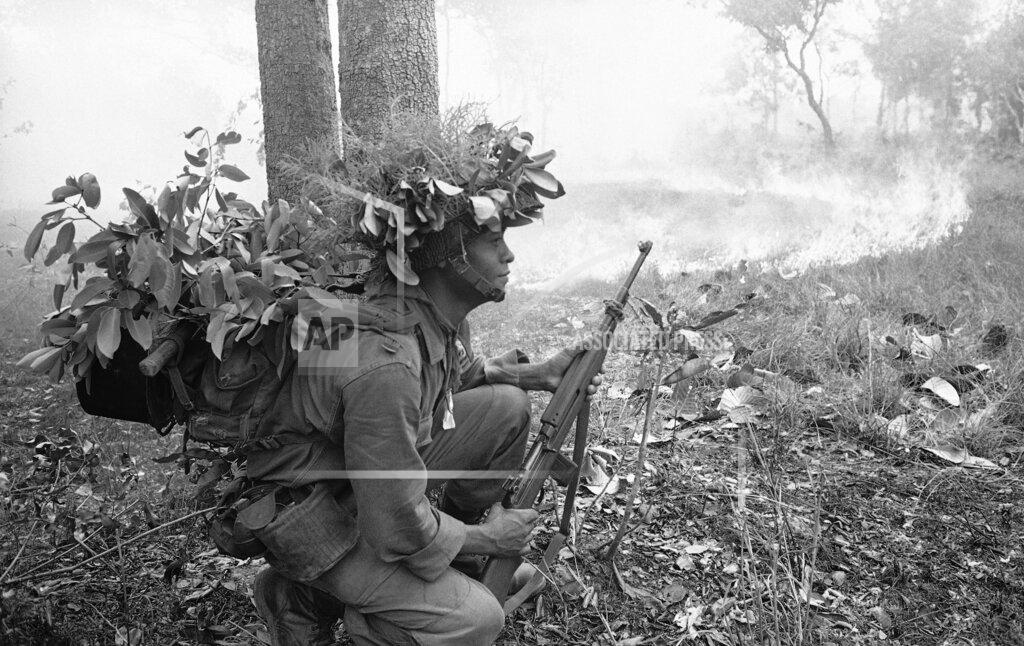
ARVN troops discover a Việt Cộng camp some 60 miles northwest of Saigon, in Tây Ninh Province, and confiscate supplies, rations, and ammunition. It included 72 huts, 4 training| schools, 5 dispensaries and 12 kitchens. Supplies and rations that were confiscated included 440 pounds of dried fish, 200 rounds of .45-caliber ammunition, 1,000 grenades, 150 large anti-tank mines, and 440 pounds of medical supplies.
In Bình Định Province, in Central Vietnam, the South Vietnamese Government scored a small victory with a helicopter lift of troops into Việt Cộng territory. In ground action, 10 Việt Cộng guerrillas were killed and 6 suspects detained. One government soldier was wounded. Helicopter fire destroyed 30 huts and killed about 25 Communist guerrillas. One United States enlisted man was wounded slightly in the knee by small-arms fire.
Forty-two U.S. planes drop 45 tons of bombs on the Bạch Long radar station in North Vietnam. Jets and propeller-driven planes bombed the island, about 120 miles southeast of Hanoi. A smaller Navy force, also from carriers of the Seventh Fleet, attacked the island last Friday. At least one plane, an A-4 Skyhawk, was downed by ground fire after the raid. The pilot was recovered at sea. The naval commander who led the flight said in Saigon afterward that the mission had been more successful than the previous strike against the radar installation and other military targets.
Commander Henry P. Glindeman of Coeur d’Alene, Idaho, was permitted today to disclose the kind of information on the raid that had been withheld after other recent air strikes. He said that 12 Navy planes had flown on a support mission, principally to suppress Communist anti-aircraft fire, and that 45 tons of bombs had been dropped. These included 250-pound, 500-pound and 1,000-pound bombs, he added. Napalm, or jellied gasoline, was also used. Data on support aircraft and bomb tonnage were withheld in raids earlier this month under directives from the Defense Department.
Briefing officers now said they could provide such details but would still refuse to: identify the Southeast Asian land bases from which the strikes were flown. There have been frequent reports that United States jets based in Thailand have flown missions against North Vietnam. The Thai Government is believed unwilling to permit any official disclosure of such flights. The strike last Friday, also by planes from the Seventh Fleet, was against four targets, including Bạch Long.
The base, which the French, called Nightingale Island when they ruled Indochina, is about 80 miles west of Hainan, a large island held by the Chinese Communists. Bạch Long is Vietnamese for “white dragon’s tail.” Commander Glindeman said he could not be certain until after a full briefing whether further raids would be necessary against the island’s radar equipment. Despite some haze, the commander said, visibility over the half-acre target area was much better this time than during the; previous strike.
Asked whether he had noticed any significant difference! in the target due to damage from Friday’s raid, the husky 40-year-old commander replied: “Well, there’s a difference now.” The commander flew an F-4 Phantom jet. He said there had also been A-1 Skyraiders, A-4 Skyhawks and A-3 Skywarriors, all from the carrier USS Coral Sea (CVA-43). The commander began his briefing by describing the action today as a “punitive strike.” Asked about the phrase, he said, “That’s the descriptive term assigned to the current operation.”
After a three-year testing period that had started with the beginning of Operation RANCH HAND on December 29, 1961, the United States moved into the second phase of the operation with the heavy use of defoliants and herbicides in combat zones. Initially, four tactical herbicides, codenamed Purple, Pink, Green and Blue, were used, with Purple, a combination of 2,4-Dichlorophenoxyacetic acid (2,4-D) and 2,4,5-Trichlorophenoxyacetic acid (2,4,5-T) being the used the most. In 1967, heavy usage began of Herbicide White and the most potent of the defoliants, Herbicide Orange, which included 2,3,7,8-Tetrachlorodibenzodioxin (2,3,7,8-TCDD or “dioxin”) with the 2,4-D and 2,4,5-T and which would be better known as “Agent Orange.” In all, 208,330 drums or 1,144,722 U.S. gallons (4,333,240 L) of Orange would be used during the war, until January 7, 1971.
Maxwell D. Taylor, United States Ambassador to South Vietnam, met with the Secretaries of State and Defense today to discuss the results of seven weeks of aerial warfare against North Vietnam.
The Laotian Army High Command has given an ultimatum to rebels holding Thakhek to surrender within 48 hours, General Ouane Rathikone, the chief of staff, said today. If the rebels refuse, two armored columns, one poised north of the town, the other to the south, will attack, the general said. The ultimatum, which expires tomorrow evening, was dropped by air force planes last night. The general estimated the rebel force to consist of at least 500 men.
A new series of tremors increased fear in central Chile today in the wake of one of the worst earthquakes to strike the country in half a century. Reports from the devastated coastal cities and mining communities 90 miles northwest of the capital put the death toll at more than 400. The casualties were expected to rise, however, as military and civilian relief units began digging into the rubble and earth dislodged by the sharp tremor at 12:35 PM yesterday. Valparaiso and the nearby ocean resorts of Vina del Mar and Zapallar staggered apprehensively from 14 aftershocks between 3:30 AM and noon today. Only the one at noon was also felt in Santiago, the capital, where two persons were killed and 100 injured by falling debris during yesterday’s quake. A handful of survivors helped rescue crews digging for bodies and personal effects in El Cobre, Chile, where nearly 400 lost their lives when Sunday’s earthquake burst a dam and buried the village.
Archbishop Makarios, President of Cyprus, said today that some Soviet-manufactured anti-aircraft missile equipment was on the island. “Part of the equipment is in Cyprus,” the Archbishop said in an interview at the Presidential Palace. But he declined to say whether the missiles themselves were here, as has been indicated in recent foreign news reports. However, the President’s remarks tended to support the assessment of Western, diplomatic and United Nations sources that ancillary missile components, such as radar target-tracking equipment, but not the actual missiles, were in Cyprus. These sources also have reported the construction of missile sites on the island, as well as the training in missile operations in the United Arab Republic of Greek Army officers attached to the Greek Cypriot security forces.
French President de Gaulle has castigated French scientists who “betray” their language by not speaking it at international scientific meetings. “It is indeed deplorable,” the general said in a letter to the Academy of Sciences made public today, “that the French language, so remarkably suited by its clarity and precision to the expression of scientific thought, is too often betrayed even by those who should insure and require its use.” A government spokesman said the charge had been motivated by annoyance at the increasing use of English as the language of scientists.
France in effect vetoed today an Italian proposal for a meeting of Common Market foreign ministers this spring to discuss European political unity. Maurice Couve de Murville, France’s Foreign Minister, was reported at the end of a three-day visit here to have agreed in principle to the proposal of Italy’s Foreign Minister, Amintore Fanfani. But the French minister declined to be pinned down on a date. He was reported to have said that there was not enough evidence of sufficient agreement among the six nations to give a spring conference much chance of success.
West German Chancellor Ludwig Erhard’s dissension-racked Christian Democratic Union met in pre-election convention today determined to establish the appearance of a united and purposeful party. The prospects of success for the Government party, 16 years in office and striving to stretch its popular mandate another four years in the September elections, are not bright. Dr. Erhard and his 89-year-old predecessor, Konrad Adenauer, turned last night’s preconvention rally into a veiled debate on the basic directions of West German policy. Dr. Adenauer, in fine form before an appreciative audience of Rhinelanders, painted a picture of a perilous world in which West Germany had to cling to fundamental principles to ensure its survival. These fundamentals, Dr. Adenauer said, are a tough antiCommunism and intimate partnership with France.
A West German court sentenced Albert Rapp today to life imprisonment 10 times over at hard labor for his role in the murder of 1,180 persons during World War II.
Pope Paul VI has urged his commission of priests, scientists and laymen to recommend soon a Roman Catholic policy on birth control in response to “the anguish of so many souls” on the issue.
Morocco’s King Hassan II called tonight for national unity and strongly warned against a repetition of last week’s bloody street riots in Casablanca. In a radio address, the 35-year-old monarch chided opposition politicians for “empty speeches” and expressed his “anger” over Morocco’s worst street violence since she obtained independence from France in 1956.
King Faisal of Saudi Arabia named his brother Khaled, the Deputy Premier, as Crown Prince tonight.
Congolese Government forces occupied the town of Watsa today, the last important rebel stronghold in the northeastern Congo. Five Europeans were rescued after having survived seven months as hostages of the rebels. Military observers here were astonished by what appeared to be the collapse of the rebellion as an organized movement. Some warned that the insurgents might be regrouping in the bush. The Government column, led by 25 white mercenaries, cut swiftly through territory that was long assumed to have been heavily fortified by the rebels. It seized Aba on Saturday, Faradje yesterday, and Watsa this morning, covering a distance of 110 miles. As originally planned, this part of the campaign would have been measured in weeks, not days.
President Maurice Yameogo of Upper Volta hinted today that his Government might shut off the water for Ghana’s giant Volta River dam if President Kwame Nkrumah did not change his “hostile attitudes.”
Canada’s House of Commons voted 159–12 to approve a bill to create the Canada Pension Plan, starting on January 1, 1966, for persons whose annual wages were $5,000 or less. Under the legislation, 3.6% of annual wages would be payable into the public pension fund and a flat monthly payment (initially $75 Canadian) would be payable to people 70 and older. The age for qualifying would be lowered annually from 70 to 65 by 1970.
The new Prime Minister of Ceylon said today that credits from abroad, particularly from the United States, were essential if his Government were to make a “quick impact” on the problems of unemployment, the high cost of living and the shortage of foreign exchange.
The collision of a commuter train with a derailed freight train killed 19 people and injured 33 in Nova Iguaçu, a suburb of Rio de Janeiro in Brazil.
Powerful figures in the British art world are fighting to keep Rembrandt’s portrait of his son from being taken out of the country by Norton Simon, a Los Angeles businessman, who bought it 10 days ago.
President Johnson’s attack on the Ku Klux Klan will probably take the form of strengthened penalties against those convicted of violating the civil rights of any person. These stronger penalties would be added to a statute enacted in 1870 specifically to cope with the Ku Klux Klan of that day. The statute prohibits conspiracies to deprive any person of his constitutional rights. The constitutional base of new legislation would be in the 14th Amendment, with its guarantee of “equal protection of the laws” to all citizens. Justice Department sources said they were also studying “some devices” that would give the present conspiracy statute broader application to a wide range of possible Klan activities. In addition, there is some possibility that Congressional investigation of the Klan could lead to legislation that would enable the organization to be treated as subversive, and thus required to disclose more of its activities. President Johnson’s legal advisers, however, are pinning their primary hopes on stiffening the conspiracy statutes first aimed at the Klan in Reconstruction times. Here is one way their proposals would work:
If a group of persons murdered a civil rights worker or a Black trying to exercise his rights, they could be charged under the existing statute with the federal crime of violating the civil rights of the victim. Under present law, however, only the state in which the crime occurred could charge the defendants with murder, since murder is not a federal crime. The Administration plan is that such defendants would still be charged by the federal government with violating a citizen’s civil rights. But if convicted on the federal charge, they would be liable to penalties not less severe than those that the state involved could hand down on a murder charge. Thus, defendants convicted in such a case — for instance, in the murder of Mrs. Viola Gregg Liuzzo in Alabama last Thursday — would be found guilty of violating a citizen’s civil rights, but would be sentenced as severely as if convicted of murder under state law.
The present penalties provided by the statute, Section 241 of Title XVIII of the United States Code, are fines up to $5,000 and imprisonment up to 10 years. The statute makes it a federal crime for “two or more persons” to conspire to “injure.i oppress, threaten, or intimidate any citizen in the free exercise or enjoyment of any right or privilege secured to him by the Constitution or laws of the United States, or because of his having so exercised the same.” Reflecting its original intent of coping with the Ku Klux Klan of nearly a century ago, the statute also makes it unlawful for persons to “go in disguise on the highway, or on the premises of another, with intent to prevent or hinder his free exercise or enjoyment of any right or privilege” secured by the Constitution and the laws.
Dr. Martin Luther King’s proposal for an economic boycott of Alabama received a cool to frigid reception from both friend and foe of his civil rights aims. Teamsters Union chief James R. Hoffa turned Dr. King down flat.
Governor George C. Wallace agreed to meet today with civil rights leaders in a confrontation that may ease Alabama’s racial strife or prolong it. The office of Governor Wallace announced in Montgomery tonight that the governor would meet tomorrow with Black leaders who wish to present grievances against the state government.
A white Protestant Episcopal priest called tonight for the resignation of the Episcopal Bishop of Alabama in a bitter attack on the church leader’s stand on civil rights. The Rev. Carl R. Sayers, rector of St. Stephen’s Episcopal Church in suburban Birmingham, said the Right Rev. Charles Colcock Jones Carpenter, the Bishop of Alabama, should resign because he had refused three times to allow integrated groups to worship in St. Paul’s Episcopal Church in Selma, Alabama.
Southerners lined up before House and Senate committees to attack President Johnson’s voting rights bill.
A Republican Congressman from Georgia proposed a voting rights bill today that would have broader coverage in some respects, than the Administration measure.
The Supreme Court ruled that an employer can close his entire business for any reason, but that he cannot shut down part of it to “chill unionism” in the remaining plants. The Supreme Court held today that an employer could close down his business entirely to avoid dealing with a union, but not partly if the intent and effect is to discourage unionism at his other plants. The opinion, supported by all seven Justices participating. came in one of the most controversial labor cases ever before the Court. The case had its origin in an organizing drive by the Textile Workers Union of America at the Darlington Manufacturing Company’s plant at Darlington, South Carolina. In an election held by the National Labor Relations Board in 1956, the union won by a narrow margin the right to represent the workers. The Darlington plant then was shut down.
Justices of the Supreme Court questioned the opposing lawyers in the Connecticut birth-control case today about the widely known fact that contraceptives are sold “under the counter” in that state.
The chairman of the Federal Trade Commission, Paul Rand Dixon, told Congress today that his agency would go ahead with its plans to regulate cigarette advertising whether or not Congress authorizes it to do so.
A year-long Pentagon study of manpower needs, completion of which has now been delayed a month, has found that some form of Selective Service is required to keep the armed forces up to strength.
The Army announced that it has successfully flight-tested its latest anti-missile missile, the Sprint. The test was conducted at the White Sands Proving Grounds in New Mexico.
New Yorkers littered the sky yesterday with tons of swirling ticker tape, confetti and old newspaper headlines — and at the bottom of it all, moving slowly up lower Broadway, surrounded by marching bands, were two quiet Americans: Virgil I. Grissom and John W. Young.
The possibility of doing more than the previously planned stand-up form of extravehicular activity (EVA) was introduced at an informal meeting in the office of Director Robert R. Gilruth at Manned Spacecraft Center (MSC). Present at the meeting, in addition to Gilruth and Deputy Director George M. Low, were Richard S. Johnston of Crew Systems Division (CSD) and Warren J. North of Flight Crew Operations Division. Johnston presented a mock-up of an EVA chestpack, as well as a prototype hand-held maneuvering unit. North expressed his division’s confidence that an umbilical EVA could be successfully achieved on the Gemini 4 mission.
Receiving a go-ahead from Gilruth, CSD briefed George E. Mueller, Associate Administrator for Manned Space Flight, on April 3 in Washington, D.C. He, in turn, briefed the Headquarters Directorates. The relevant MSC divisions were given tentative approval to continue the preparations and training required for the operation. Associate Administrator of NASA, Robert C. Seamans, Jr., visited MSC for further briefing on May 14. The enthusiasm he carried back to Washington regarding flight-readiness soon prompted final NASA Headquarters approval.
H.L. Hunt, the right-wing Texas oil millionaire, said today that his Life Line Foundation had lost its tax-exempt status.
Dow Jones Industrial Average: 887.82 (-3.84)
Born:
Louise Casey [Baroness Casey of Blackstock], English government official (led review of the Metropolitan Police), in Redruth, England, United Kingdom.
Voula Patoulidou, Greek athlete (Olympic gold medal, 100m hurdles, 1992), in Tripotamo, Greece.
William Oefelein, American astronaut (NASA Group 17, 1998; STS-116, Space Shuttle Discovery, 2006), in Fort Belvoir, Virginia.
Emilios T. Harlaftis, Greek astrophysicist, in Kiato, Greece (d. 2005).
Ricky Thomas, NFL defensive back (Seattle Seahawks), in Eglin Air Force Base, Florida.





 History Diaries