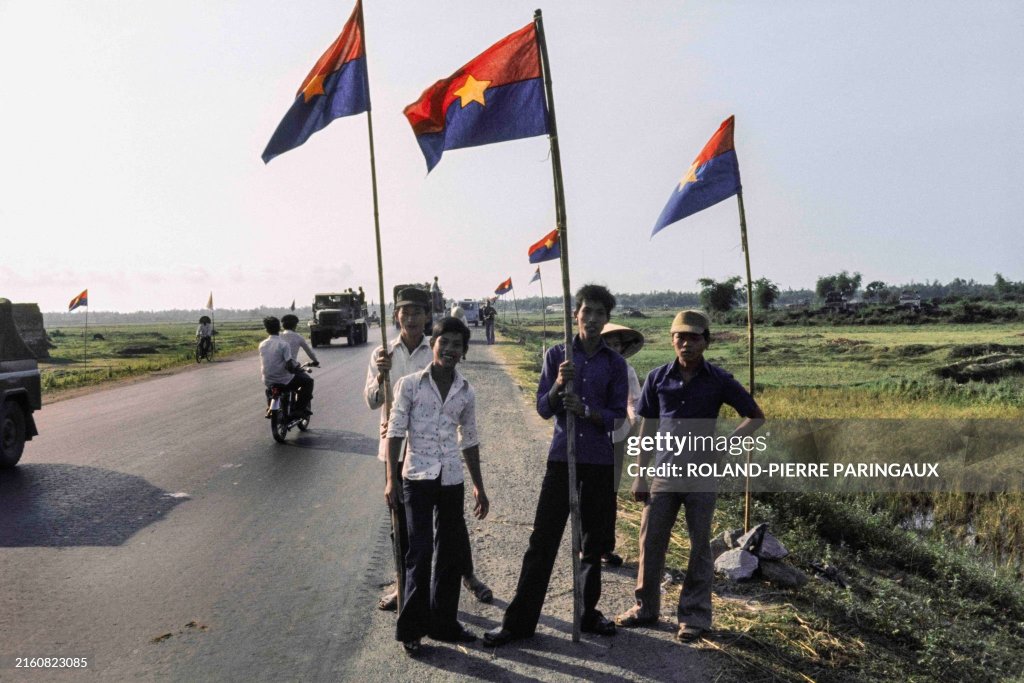
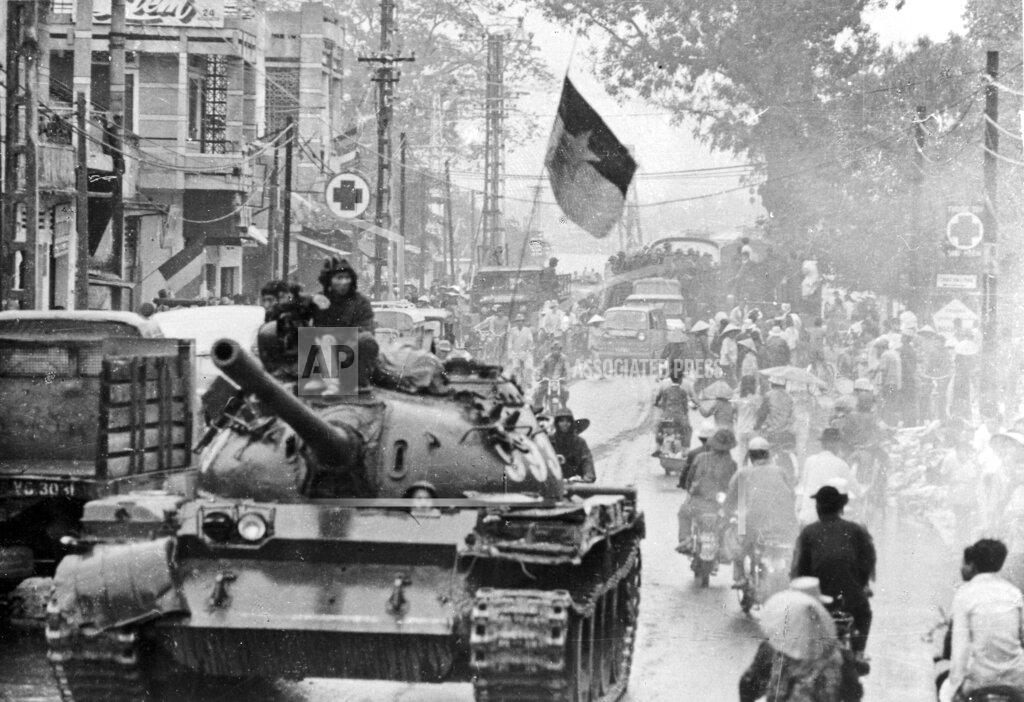
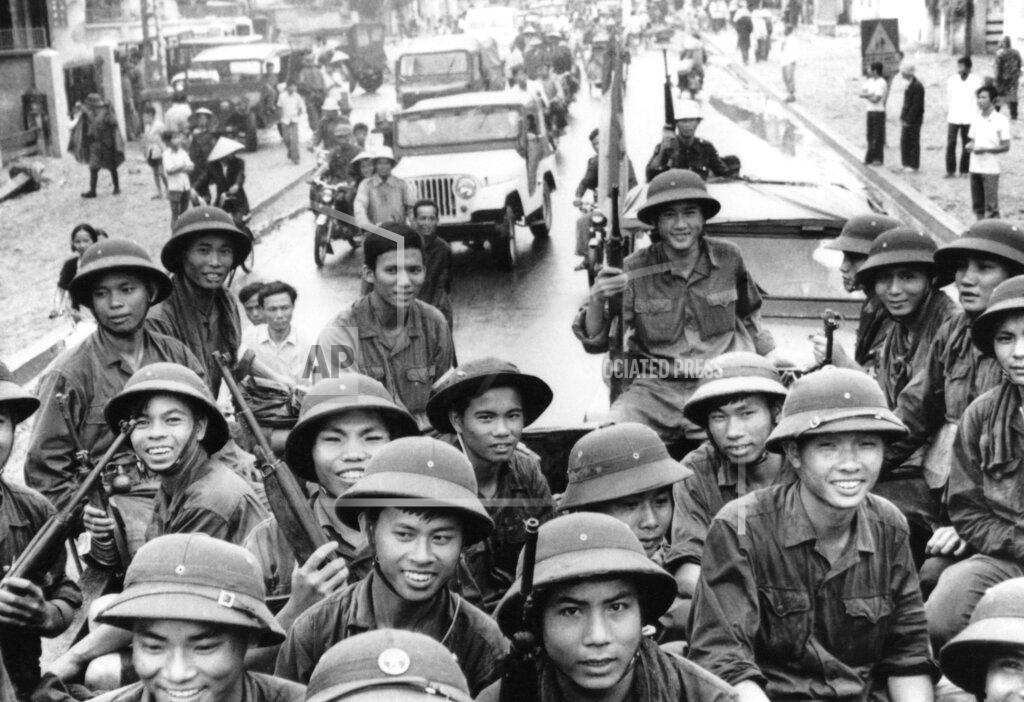
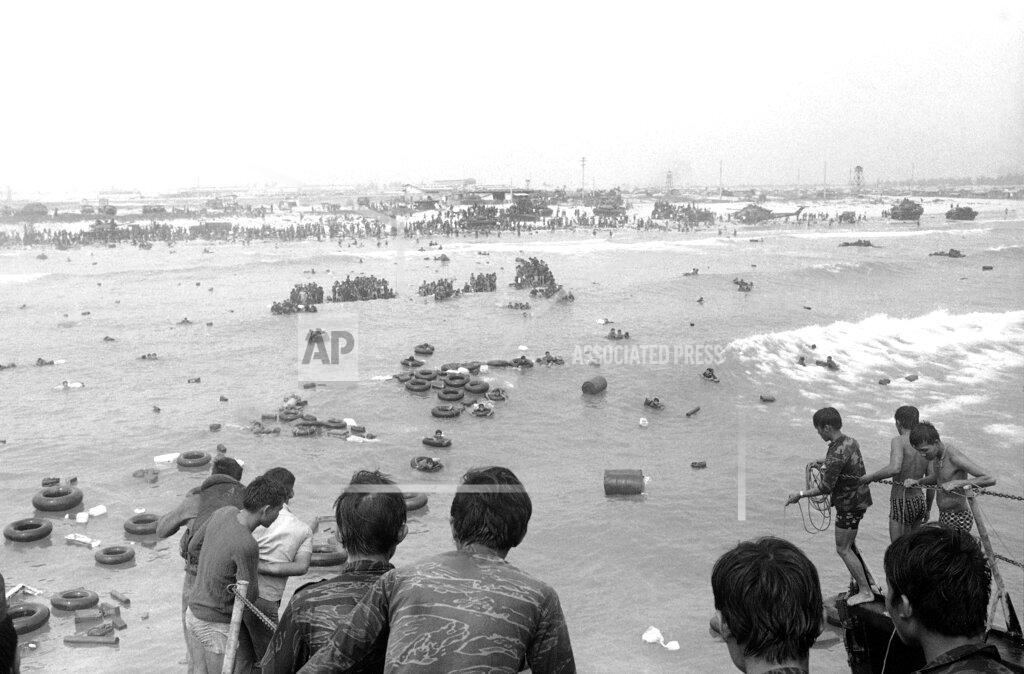
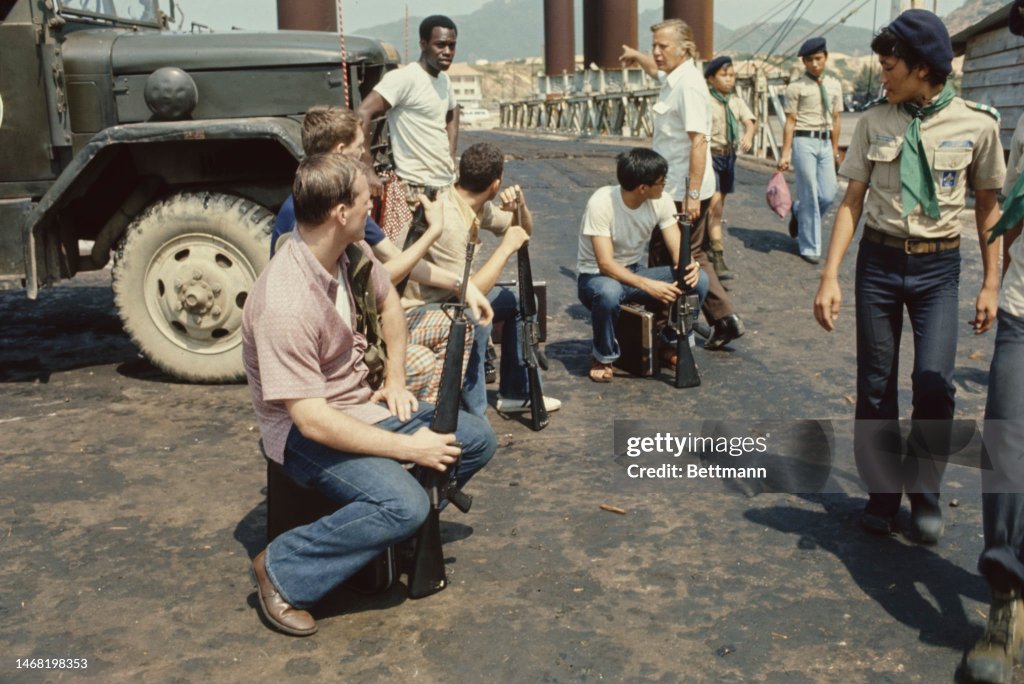
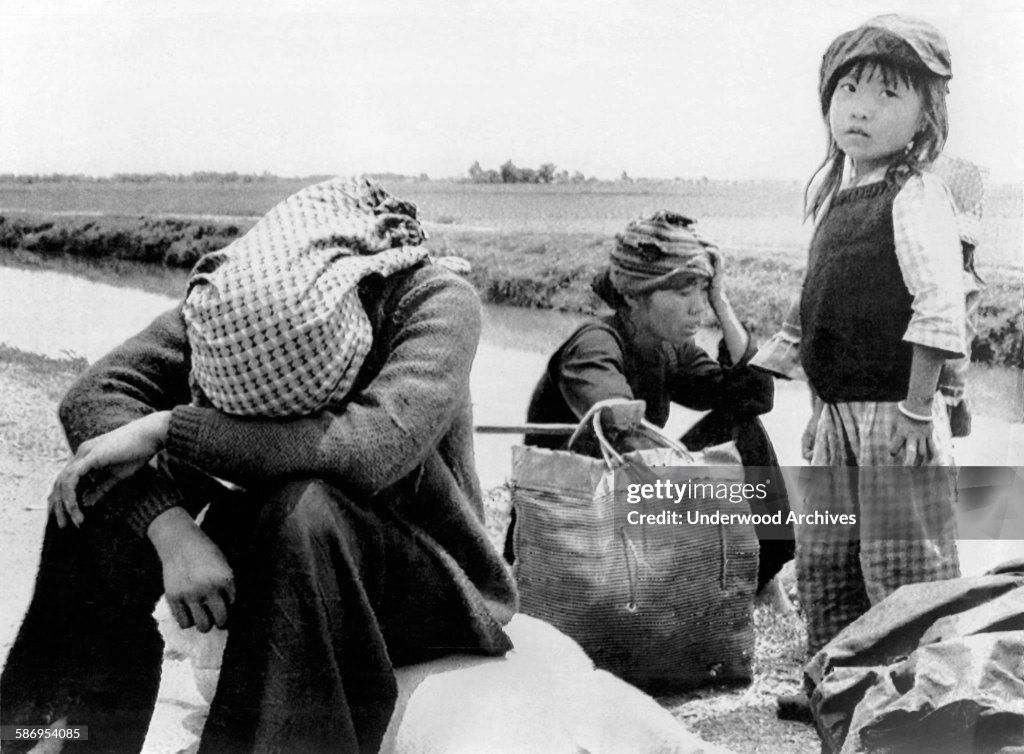
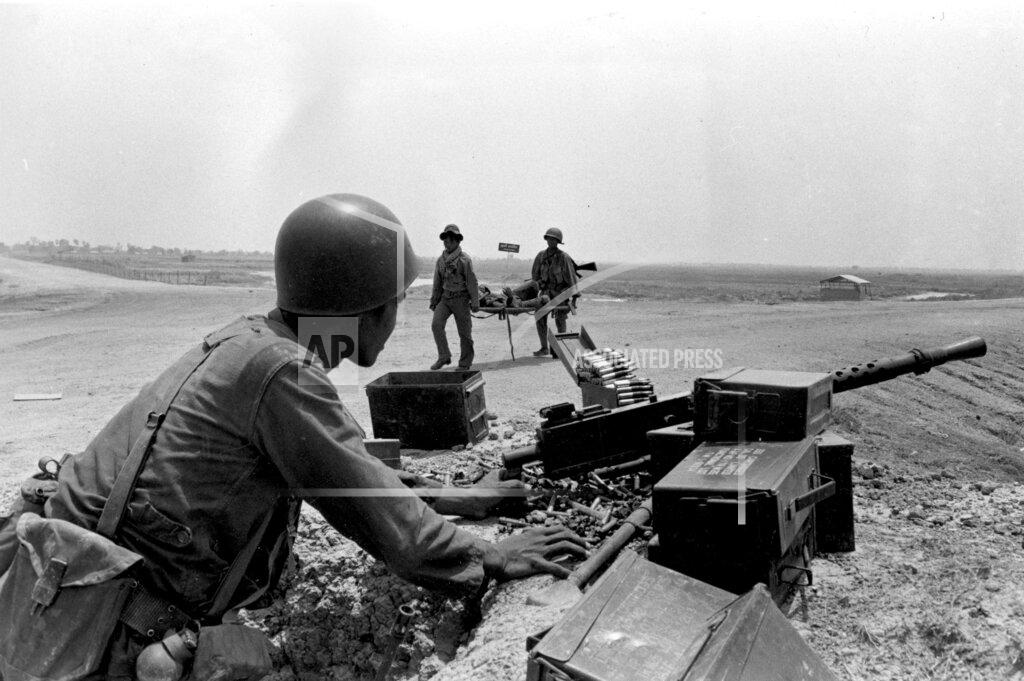
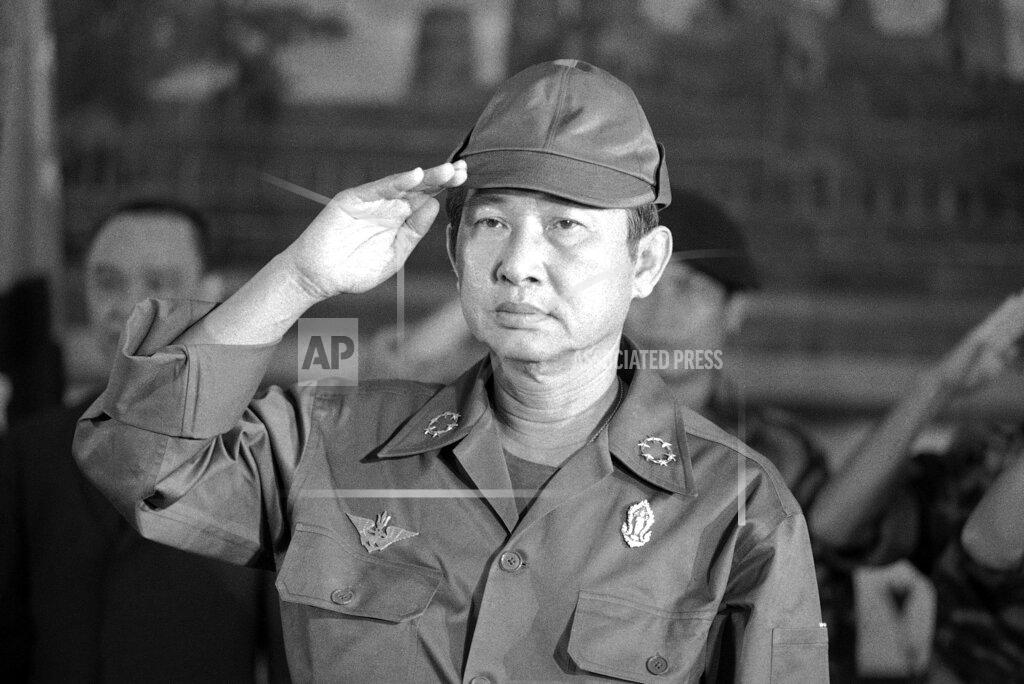
Đà Nẵng falls to the Communists. Many citizens die in the general chaos while attempting to escape from the airport, docks, and beaches. South Vietnam’s Deputy Premier for Social Welfare, Phan Quang Đán, said at a news conference in Saigon that Communist forces had captured Đà Nẵng, according to news agency reports.
A spokesman for the Saigon government said radio contact with the encircled city of Đà Nẵng had been lost, indicating that it had fallen. Another highly informed source said, however, that he was in contact with observers in a boat just off shore. But it was clear that Saigon had written off South Vietnam’s second largest city. The observers said that there did not appear to be any fighting going on, but added that there was no way of knowing whether North Vietnamese troops had entered the city. Since the only contact with Đà Nẵng at present is with observers off shore, real conditions there are unknown. One observer, calling from a ship, reported that “all we can see is wall‐to‐wall people along the shore.”
Scattered fighting was reported yesterday in an area covering the provinces near Saigon and the Mekong River delta to the south. While no large‐scale engagements were reported, pressure appeared to be mounting in provinces west and north of Saigon, notably Tây Ninh, Hậu Nghĩa, and Bình Dương. As for far northern South Vietnam, the Government spokesman reported that the North Vienamese Army had moved to within three miles of Đà Nẵng to the south and west, but that there had been no fighting except where South Vietnamese Government patrols had encountered Communists outside the city. He said that the city was shelled Saturday morning, with the main concentrations of fire directed at the naval base and at the airport.
The United States Embassy communiqué announcing the granting of the latest shipments of aid followed visits made Friday by General Frederick C. Weyand, the United States Army Chief of Staff, to President Nguyễn Văn Thiệu and other Saigon leaders. The statement said that General Weyand had conveyed “as surances of President’s Ford’s strong support in the determined resistance of the people of South Vietnam to the massive invasion by a North Vietnamese expeditionary corps in flagrant and cynical disregard of the provisions of the Paris agreement.” Despite the implication in the announcement that the South Vietnamese armed forces were fighting hard, the indications were that there was practically no resistance to the Communists anywhere in the northern part of South Vietnam.
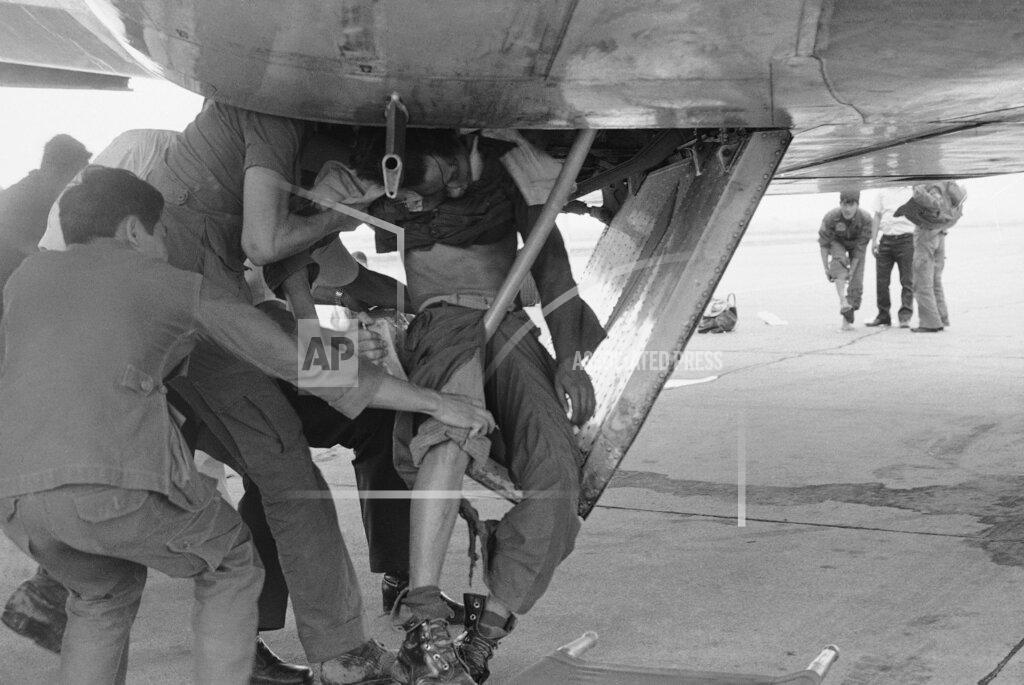
As North Vietnam’s army made its way into Đà Nẵng, a World Airways Boeing 727 made its fourth and final flight to evacuate refugees to safety in South Vietnam. When the airline’s President, Ed Dalye, arrived, there were over 1,000 people at Đà Nẵng. Instead of women and children, 400 South Vietnamese soldiers forced their way onto a plane which normally carried 150 passengers. The jet took off with its back stairway still open, and those who did not make it on board tried to climb on into the wheelwells and the undercarriage of the jet.
Other people, seeking to flee the beleaguered city, lay in front of and under the plane to keep it from leaving. The transport, operated by World Airways, was mobbed by soldiers as it taxied off the runway to the ramp. At least one soldier was seen firing his pistol at the cockpit. The jet finally took off. A big part of one wing‐flap was damaged when it reached Saigon. The pilots said after teaching here that the damage had been done by a grenade. Aviation authorities, however, said it appeared that the damage was due to an obstacle in the path of the plane’s wheels, not to an explosion. To avoid destruction, the plane took off from the taxiway rather than to the runway. The pilots found the taxiway jammed with people.
“Only the fastest, the strongest and the meanest” got out on what may have been the last refugee plane from Đà Nẵng, said Paul Vogle, a correspondent for United Press International who was on the plane. People fought one another and died trying to get aboard. He said it was a flight out of hell and only the expertise of the American pilot “got us back to Saigon’s Tân Sơn Nhứt Air Base alive.” “As we started rolling, insanity gripped those who had missed their chance. government troops opened fire at us,” the reporter said. Somebody lobbed a hand grenade toward the wing. The explosion jammed the extended flaps. The undercarriage was in full extension. Communist rockets began exploding at a distance.
They said they knew of no deaths resulting from this. But aviation experts here said after talking to passengers and stowaways on the plane that between 20 and 30 persons had probably been killed — some run over on take‐off, some dropping away from the wheel wells and the hold. The aviation authorities said the body of one soldier had been found in a wheel well on arrival here; others on the flight said that unknown numbers of others had dropped off the plane in flight. About 270 people were jammed into the cabin of our little 727, only two women and one baby among them. The rest were soldiers. They didn’t talk to each other or us. When the plane arrived in Saigon, the mutinous troops were put under guard. Except for the World Airways Boeing, no aircraft were reported to have landed at Đà Nẵng yesterday.
However, lighters and barges were managing to get some people off the piers and beaches of Đà Nẵng to ships standing offshore in the South China Sea. The United States Military Sealift Command is operating several chartered ships for the evacuation. One such ship, the Pioneer Contender, took on a load of about 9,000 evacuees off the Đà Nẵng coast Friday night and arrived about midday yesterday at Cam Ranh Bay, to the south. A similar group was taken out Friday by the Pioneer Commander, and a United States naval vessel, the USNS Miller, has reportedly joined the evacuation effort. Informants said that the command headquarters of Government forces at Đà Nẵng, such as they were, moved from Đà Nẵng itself yesterday to three South Vietnamese Navy ships offshore. Radio communication with the command was lost Friday night but re‐established yesterday only after Lieutenant General Ngô Quang Trưởng, commander of Military Region I, moved to the ships.
In leaving Đà Nẵng yesterday, the South Vietnamese Air Force reportedly ran into very bad luck. In the morning, 10 air force UH‐1 helicopters, carrying the last escaping air force personnel, took off from Đà Nẵng with scant fuel. The helicopters, each carrying at least 20 persons, flew first to the nearby Marble Mountain air field, Đà Nẵng’s second airport, where the pilots hoped to refuel. Some succeeded, but only after outrunning jeeps and armored cars filled with soldiers who tried to force the helicopter crews to take them aboard. One copter, low on fuel, was forced to land on Ré Island in the South China Sea 72 miles southeast. Another was forced to land at Chu Lai, a former American base occupied for the last few days by the North Vietnamese, and was seen being captured by the Communists.
Four more helicopters were shot down by Communist antiaircraft near Chu Lai. Only four of the original 10 made it to Saigon. Forces the size of two infantry divisions have ceased to exist as organized units, and thousands of soldiers have discarded uniforms and weapons to blend with the more than one million residents and refugees jammed into Đà Nẵng, the country’s second largest city. Yesterday, for the first time, Saigon officially acknowledged the fall of Huế to the Communists.
A South Vietnamese soldier in maroon undershorts sat in the shade of a deserted house in Gò Dầu Hạ today as North Vietnamese shells landed around him. He didn’t flinch. In Gò Dầu Hạ, a vital highway junction town 32 miles northwest of Saigon, the shelling has become normal, commonplace. The town has been surrounded by parts of two North Vietnamese divisions for the last few days, and intelligence reports indicate it is a prime target for a new Communist assault toward Saigon. Almost all of Gò Dầu Hạ’s 42,000 residents have fled in the last week as Communist troops occupied nearby villages. Today most houses were shuttered and shops closed, with color pictures of Vietnamese calendar girls visible through the open‐wire grill front of an abandoned restaurant.
The South Vietnamese soldiers encamped around Gò Dầu Hạ fired no artillery back at the Communists this morning, unlike earlier years when they had nearly unlimited supplies of ammunition. Now, with the cutback in American military aid, they are limited to a few rounds a day for their 105‐mm. and 155‐mm. guns. Nor were there any government air strikes, though the North Vietnamese lines were only a few hundred yards west of town. For the South Vietnamese Air Force has also been forced to curtail its fighter-bomber missions drastically because of shortages of spare parts and aviation fuel.
But all morning large convoys of South Vietnamese rangers, infantry, armored bars and trucks poured up Route 1 from Saigon, apparently to bolster the defense of the town. Lieutenant General Nguyễn Văn Toàn, the commander of Military Region III, which centers on Saigon, appeared to be throwing in everything he had with troops from all of his three divisions, the 5th, 18th and 25th. At night the few people left here sleep in a five‐story yellow Cao Đài pagoda, The Cao Đài are a Vietnamese political‐religious sect cornbining elements of Buddhism, Christianity and Western Philosophy.
The precariousness of the town’s situation is illustrated by the fate of a small hamlet on Route 1 near Củ Chi, 15 miles further back toward, Saigon. The tiny cluster of houses, named Cây Trôm, was turned into a few crumbling earth walls and black smudges in the ground five days ago when Communist soldiers ambushed a government convoy there. The South Vietnamese, unlike in the Central Highlands and in the north around Huế and Đà Nẵng, fought back here. After a full day’s battle they drove the Communists away from Route 1 and freed the convoy. But in the process the village was obliterated. “There is nothing, nothing not even my clothes,” said an old woman with a green towel wrapped around her head as she searched in a small mound of ashes.
A wave of anti-American sentiment and charges of betrayal by the Ford administration are sweeping Saigon. The anger against Americans is evident in newspaper editorials, political speeches and private comments by South Vietnamese. It worries the United States Embassy, and some officials are plainly nervous about violence against Americans here as the North Vietnamese surge near Saigon, as refugees begin to stream into the capital and as the South Vietnamese Army seems on the edge of disarray. The anti-American mood is not expected to diminish despite the announcement that the United States would begin an emergency airlift of military and medical supplies to South Vietnam. Government and army officials, stunned by the rout of the army and the huge loss of military equipment, believe that the reduction of American aid was a major factor in the nation’s military defeat.
Americans in Saigon were especially shaken by an incident last week when a group of South Vietnamese soldiers opened fire on an American helicopter, flown by Air America, a private company, wounding a crew member and a woman passenger. The helicopter was bringing members of the United States Consulate staff from Đà Nẵng to Saigon, and touched down at Chu Lai, a military base 350 miles northwest of Saigon. According to reports, a group of about 50 government soldiers on the base sought to get aboard the crowded helicopter, and one of them opened fire when their plea was rejected. The crewman was slightly wounded in the mouth and the passenger was struck in the leg. The helicopter flew back to Đà Nẵng, and the injured persons were sent to Saigon in a light plane.
The United States Embassy announced today that an airlift of “urgently needed military and medical supplies” had begun to Vietnam. The first plane loads reportedly began landing by noon today. The announcement came in an embassy statement. The statement noted that General Frederick C. Weyand, United States Army Chief of Staff, had arrived here yesterday to determine how the United States “can best assist the South Vietnamese people.” The statement said the American commander would make further recommendations to President Ford on his return to the United States.
President Ford announced tonight that he has ordered United States Navy ships and other vessels to evacuate “helpless refugees” from coastal cities in South Vietnam and take them to “safe haven in the south.” He also called on “all nations and corporations that have ships in the vicinity of the South Vietnamese coast to help evacuate refugees in the south.” Four Navy LST’s, part of the Seventh Fleet, were moving toward South Vietnam from various points in the Pacific, a Defense Department spokesman said.
President Lon Nol of Cambodia has decided to leave for visits to Indonesia and the United States, according to Cambodian political sources in Phnom Penh. While plans for his trip have not been officially announced, they have been made known to officials at the State Department. Senior Cambodian officials reportedly will leave tomorrow to prepare for Marshal Lon Nol’s visits. The purpose of the trips is understood to be closely linked with efforts that may be undertaken to start talks with Khmer Rouge officials on ending the fighting in Cambodia.
With the Cambodian insurgent offensive now three months old, Phnom Penh, the capital of over two million people, remains surrounded. The government over the last few weeks has been losing a post here and a post there on its shrinking perimeter. This has given the rebels a far freer hand in hurling rockets and shells into the city as well as into the airport, which sits about five miles west of the city. Although the downward slide of the Phnom Penh Government is. now visible and its collapse is regarded as inevitable, it is impossible to predict with any confidence when the fall might come. The pace of this war has always resembled more the slow and erosive drip of a leaking faucet than the rush of a mountain rapids. Thus — though the collapse could possibly happen soon and suddenly — it might also be many months before a denouement takes place.
The threat to the airport seems to be increasing, with the insurgents pushing closer. They are now firing accurately from captured American‐made artillery pieces instead or using the less‐accurate rockets. The rebels had hit the airport with artillery before, but a silence of about two weeks had led the Americans and Cambodians to believe that Government troops might have pushed the howitzers out of shelling range. The importance of the airport to the defense of Phnom Penh lies in the fact that the only thing keeping the Lon Nol Government alive, since mid-February, has been the big Ameridan airlift. All other supply lines, including the crucial Mekong River, have been choked off by the insurgents. The airlift remains in jeopardy from the insurgent shells and rockets, and has been suspended more and more often.
In the Cambodian high command, a few generals recommend abandoning some of the isolated province capitals so that the troops there can be brought in for the defense of Phnom Penh. An amnesty for deserters has been declared and, because several hundred men responded, it has been extended. Huge gaps appear in the perilously thin government defense, particularly to the west and northwest, often within 10 miles of the capital. These are being filled with second‐rate troops, the only ones available. Most diplomatic observers have felt that as long as American aid keeps coming, and the airport can be kept open for the airlift, the government has a reasonable chance of holding off the insurgents.
The Americans and some other analysts here have always suggested that the insurgents, because of the heavier losses they are said to have suffered from the government’s superior firepower, are just as thin in their ranks as are the Phnom Penh forces. But there are strong indications now that the insurgents are deep in reserves and have still not committed all the troops at their disposal. The American aid question remains pivotal. Congress has adjourned until April 7 without acting on President Ford’s request for emergency military aid. Many Cambodians and foreign observers have taken this as a sign that the Lon Nol Government will get little or no fresh aid. The Administration has said that the existing aid will run out by the end of April. Some military analysts here think the ammunition could last until the end of May or a little longer. But such details may become academic if demoralization sets in here. The consensus is that no army under these circumstances would fight to the last bullet and that when government commanders conclude that the ammunition pipeline has been irrevocably cut this army will begin to crumble.
The insurgents, meanwhile, keep nibbling away around Phnom Penh. They are less than eight miles from the center of the city at some points and government troops keep slowly pulling back and “regrouping.” In Phnom Penh, there is an aura of sponginess. No strong center of power is discernible as the government’s control becomes more and more tenuous. Some observers see the American Embassy as the power center now, but that seems highly exaggerated. Many foreign observers here, including Americans, feel that the situation is out of anyone’s control on this side. Students and many others are saying that the war, which has killed or wounded an estimated one million of Cambodia’s seven million people, must end now, and that the only way to stop it is for American. aid to halt.
In its continuing decline, this capital is awash with rumors. Among the most dramatic is a report in diplomatic circles of a scenario in which Marshal Lon Nol will either leave the country or get out of the way by going to the sea resort of Kompong Som so that the Government could reorganize and put itself into a position to negotiate a turnover of power — that is a surrender. Another report said that the American Ambassador, John Gunther Dean, told the marshal to stay in Phnom Penh because his was no time to be away from the capital. Still another report said that Mr. Dean now strongly favored Lon Nes departure as a step toward ending the war, but that Secretary or State. Kissinger opposed the idea on the theory that if the Phnom Penh Government could be held together into the wet season, when fighting sometimes diminishes, negotiations might become more possible.
Suspected Basque guerrillas hiding in a stolen minibus ambushed a plainclothes police officer in front of his home in San Sebastián, Spain, and shot him to death. The slaying of Deputy Inspector Jose Diaz Linares, 29, came amid a wave of bombings in the Basque provinces of northern Spain attributed to members of the ETA — “Basque homeland and liberty.”
Twenty more members of the Irish Republican Army were freed from the Maze Prison today, completing the Easter release of 40 prisoners jailed without trial on suspicion of terrorist activity. The British administrator for Northern Ireland, Merlyn Rees, in announcing the beginning of releases on Thursday, said it was the result of continued observance of the I.R.A. cease‐fire. The Easter release of 20 inmates yesterday and 20 more today leaves 436 jailed in Ulster on suspicion of terrorist activity. Most of them are members of the I.R.A. Since the 26‐day Christmas cease‐fire, British authorities have released 200 detainees. Most were I.R.A. members but some were Protestant extremists.
Longshoremen’s unofficial leaders have decided to continue what employers describe as the most serious strike ever to hit the port of London. The 4-week-old stoppage, over fears by the 11,500 dock workers about their future employment, has held up an estimated $575 million worth of goods and the employers claim it has cost them $13.8 million so far.
Faulty wiring in an unattended infants ward in a Rijeka, Yugoslavia, hospital was blamed for a file that killed 25 of 28 babies there. A preliminary investigation revealed that the ward was not patrolled by the nurse on duty. Jandranka Bolf. The fire. which killed 18 boys and seven girls between one and seven days old, was caused by a short circuit in the wiring of a wall heater. The surviving babies, all suffering third-degree burns, were reported in critical condition.
Uniformed police pushed into the vestibule of Moscow’s synagogue as Sabbath morning services ended today and ordered several hundred persons to clear out and go home, Jewish activists reported.
Pope Paul VI baptized 21 converts, including an 11-year-old South Korean girl and a 55-year-old former Buddhist monk from Thailand, in an Easter vigil service in St. Peter’s Basilica. Elsewhere, black-robed monks and choirboys clad in crimson held a solemn procession through the Church of the Holy Sepulchre in Jerusalem, observing Holy Saturday. the day Christians believe Jesus lay in his tomb before rising from the dead. As for the converts, they came to Rome to be ushered into Catholicism in a revival of a papal practice that had been unused for some 15 centuries.
An innovation in investment banking is helping the French get around the Arabs’ practice of blacklisting Jewish ‐ controlled banks in the syndication of corporate borrowings. A small group of banks is buying up an entire issue of bonds to be offered by a corporate borrower. Each bank in this group is then free to bring in other banks, which may or may not be on the blacklist, to help underwrite and distribute its share of the issue without consulting other members. The blacklist was disclosed earlier this year when Kuwait told French banks that Arabs would not participate in syndications unless three Jewishcontrolled banks were kept out.
President Anwar Sadat of Egypt announced that he would open the Suez Canal to international shipping on June 5 despite Secretary of State Kissinger’s failure to bring about a new Egyptian-Israeli agreement on Sinai. He also declared that he would renew the mandate of the United Nations Emergency Force in Sinai for three months. The present term expires April 24. His declaration, made in a televised speech to the National Assembly, took his listeners by surprise. He and other Egyptian officials have been stating frequently in recent months that the canal would stay closed unless Israeli forces withdrew from their present positions some 10 to 15 miles away. Mr. Sadat clearly was aware of the surprising nature of his statement.
“Some expected me to react emotionally and keep the Suez Canal closed but I shall do the exact opposite. I shall open the canal on the date I had set originally — which is June 5, God willing,” he said, according to the simultaneous English translation carried by the Cairo radio. He made it clear that he had set the date originally on the assumption that Secretary of State Kissinger’s step‐by‐step mediation would bring about a second‐stage Israeli withdrawal from the Sinai mountain passes and the oilfield Abu Rudeis. The renewal of the mandate of the United Nations forces also was unexpected. After the breakdown of Mr. Kissinger’s mission, Foreign Minister Ismail Fahmy strongly indicated that Egypt would either refuse to renew the mandate in April or would make renewal contingent on further peace moves.
Senator George McGovern (D-South Dakota) said, “American policy should take into serious consideration the question of recognizing the PLO.” He added that it was “imperative for some kind of Palestinian national entity to emerge, because it is difficult to achieve stability in the area unless the Palestinians exercise an efficient political existence.” McGovern voiced his opinions after talks in Beirut with Palestinian guerrilla leader Yasser Arafat.
A new collective leadership took office today in Saudi Arabia under King Khalid, the successor to the late King Faisal, whose personal rule was unchallenged. By royal decree, King Khalid appointed a new Council of Ministers in which the two principal factions in the royal family are both represented — one led by Crown Prince Fahd ibn Abdel Aziz, and the other by Prince Abdallah bin Abdel Aziz, the commander of the National Guard. King Khalid, who is a moderating force, retained the titular position of Premier for himself. He appointed Crown Prince Fahd as First Deputy Premier and Prince Abdallah, who entered the council for the first time, as Second Deputy Premier. The new Cabinet, named five days after the assassination of King Faisal, retained Sheik Ahmed Zaki Yemeni as Minister of Petroleum and Mineral Resources.
Fierce clashes between Iraqi forces and Kurdish rebels appeared to have erupted today in northern Iraq, with the Kurds making a fighting retreat before advancing government troops. The independent Hurriyet Haber News Agency said the sound of heavy artillery fire could be heard from Hakari, 25 miles inside Turkey from the, border with Iraq. Turkish security forces are sealing off the frontier against the possibility of a mass influx of Kurdish refugees fleeing their mountain homes after the, collapse of their 13‐year’s rebellion. Local officials near the border said heavy snow was being cleared from roads leading to the border in case the Turkish forces needed reinforcement. Turkey’s caretaker premier, Sadi Irmak, has asserted that, the Kurds have threatened to fight their way into Turkey if Ankara does not reverse its decision to keep them out.
The State Department has been accused of retreating from the 1972 U.S.-Chinese Shanghai communique because it canceled a U.S. tour by a Chinese entertainment group. The postponement followed Chinese insistence that the troupe’s program include a song vowing to liberate Taiwan. William Hinton, chairman of the National Committee on U.S.-China Relations, the tour’s sponsor, said that the department’s insistence on the right to censor the program was not in keeping with the Shanghai communique.
To the delight of the multinational corporations in Quebec, and to the despair of confused consumers, Canada is converting to the metric system. The gradual switch to meters and liters and grams, which begins April 1, will leave the United States as the only major country in which the metric system is neither in force nor in the process of being adopted. Since Canada is the United States’ major trading partner by far, the conversion is expected to increase pressure for a similar move south of the border, where legislation has been introduced in Congress year after year without success.
Jean Gueury, French ambassador to the Somali Republic who was held for five days by African terrorists, called kidnapping “a new form of diplomacy.” Gueury was freed in South Yemen in exchange for a ransom of $100,000 in gold paid by France and the release of two men held in French prisons. He told newsmen: “The diplomat is now a front line fighter. Diplomats generally live in a sort of cocoon. But what has happened is now the rule of the game.”
Seventy persons were killed and 100 others injured as two trains collided head-on about 90 miles north of the Mozambique capital of Lourenco Marques. The accident was tentatively blamed on faulty signals.
President Ford, saying that he had no choice but to “take it or leave it,” signed the $22.8 billion tax-cut bill passed by Congress last Wednesday. Announcing his decision over nationwide television and radio, Mr. Ford expressed serious reservations about the legislation, which will provide one of the biggest tax cuts in the nation’s history.
The auto industry in Detroit, already shaken by the energy crisis, has been plunged into an economic crisis that has left many of its executives feeling helpless and uncertain. They still have confidence in the predominance of the industry, but their feeling is that the pressure of energy supplies, inflation and further government intervention will determine much of the industry’s future. The days are over, they believe, when designers could indulge their fantasies, engineers ignore efficiency, and when top executives could smugly predict an ever-expanding auto market.
Telephone lines at the clemency board in Washington will remain open until midnight Monday, the deadline for Vietnam deserters and draft evaders to sign up for the program. Only a fraction of those eligible, about 22,500 of estimated 117,000, have registered for a clemency pardon from President Ford since the program began September 12.
In his first term as President, Richard M. Nixon considered the possiblity of seeking Spiro T. Agnew’s resignation as Vice President and appointing John B. Connally as his successor under the 25th Amendment, according to Mr. Nixon’s former chief of staff, H.R. Haldeman.
A Federal judge sitting in President Ford’s hometown has ruled that Mr. Ford’s pardon of former President Richard M. Nixon was constitutional.
Congress has further complicated the already difficult United States relations with the major international lending institutions by imposing for the first time “earmarking” provisions on how the United States contribution to one of these banks can be used.
Alabama Governor George C. Wallace is the top choice of both Democrats and independents for the 1976 Democratic presidential nomination, the Gallup Poll reported. Wallace received 22% of the Democrats’ support. He was followed by Senator Hubert H. Humphrey of Minnesota with 16%. Senator Henry M. Jackson of Washington with 13%, Senator George S. McGovern of South Dakota with 10% and Senator Edmund S. Muskie of Mame with 9%. Wallace was the first choice of independents also, winning 28% of the vote Jackson was second with 13%. followed by Humphrey with 9% and McGovern and Muskie with 7% each.
Encouraged by Governor George C. Wallace’s consistently good showing in the political polls, 45 of his leading California supporters gathered in Los Angeles a few nights ago to set up a statewide campaign organization for 1976.
A former mortgage broker said his office concocted phony mortgages that netted $3 million or $4 million in a scheme he thought was benefiting the CIA, the Miami Herald reported. The CIA said it was not involved in the operation, which reportedly is being investigated by a federal grand jury and several federal agencies. Andres Castro, the former broker, said one of two men he had assisted in the scheme had shown him CIA credentials and appealed to his patriotism, saying the money was needed because CIA funding had been frozen due to the Watergate scandal. “The CIA made me do it.” Castro said of the scheme, which involved doubling mortgages by selling good ones along with forged ones. But the Herald quoted a spokesman for the CIA as saying. “This poor guy’s been taken, and it’s none of our doing whatsoever. This one ain’t on us, dad.”
More than 1,000 Salt Lake City residents carried off bags, boxes, and garbage cans full of potatoes given to them free by disgruntled farmers who said they would rather see the poor get the potatoes than sell them to supermarkets for a penny a pound. “We feel that the supermarkets selling potatoes for 20-25 cents a pound are just getting too much…” one farmer said. The growers gave away 70,000 pounds of potatoes in Salt Lake City. Earlier they handed out 59.000 pounds from trucks in Boise.
A seventh victim died from injuries suffered when a tornado struck Warren. Arkansas, ripping into homes, businesses, its only hospital, and a mill, the largest industry in the western Arkansas town of 6,000. Governor David H. Pryor requested that President Ford designate the county a major disaster area. One of every four residents was homeless.
Use of pocket calculators will continue to be barred on airplanes, the Federal Aviation Administration decided. It refused to lift a ban on the portable electronic devices, some models of which had been found to interfere with in-flight aircraft equipment. Even though evidence had been presented that certain calculators, under some conditions, did not adversely affect instruments, the FAA decided that testing every model of calculator would place “an unreasonable and excessive burden” on the agency.
Though 34 million Americans are admitted to hospitals annually and the average person will be hospitalized 11 times in a lifetime, many hospitals are “human rights wastelands.” This is the picture drawn in the latest handbook of the American Civil Liberties Union —“The Rights of Hospital Patients,” by George J. Annas. Mr. Annas, a lawyer, is director of the Center for Law and Human Sciences at the Boston University School of Law.
The appellate division of the New York Supreme Court reversed the conviction of former Queens District Attorney Thomas J. Mackell in the coverup of a get-rich-quick scheme. Mackell had been sentenced to six months in prison. Mackell and two of his staff members had been accused of covering up a swindle in which money from new investors was used to pay on money from earlier investors.
“Lady Marmalade” by Labelle reaches #1 on U.S. singles chart.
Mel Stottlemyre, suffering from a torn rotator cuff, is given his unconditional release by the Yankees. The team’s future pitching coach compiled a 164-139 record and a 2.97 ERA, tossing 152 complete games that include 40 shutouts in an eleven-season major league career with the Yankees. Stottlemyre, returned as a pitching coach when Joe Torre was hired as manager. Stottlemyre’s tenure lasted throughout the modern Yankees dynasty, winning four World Series from 1996-2000 and advancing to two more. He resigned after the Yankees were eliminated by the Angels in the 2005 ALDS, and earned a plaque in Monument Park in 2015.
Born:
Jan Bos, Dutch sprint skater and two time world-champion; in Harderwijk, Netherlands.
Danny Kolb, MLB pitcher (All-Star, 2004; Texas Rangers, Milwaukee Brewers Atlanta Braves, Pittsburgh Pirates), in Sterling, Illinois.
Marcus Jones, MLB pitcher (Oakland A’s), in Bellflower, California.
Korie Hlede, Croatian WNBA guard (Detroit Shock, Utah Starzz, New York Liberty), in Zagreb, S.R. Croatia, Yugoslavia.



 History Diaries