


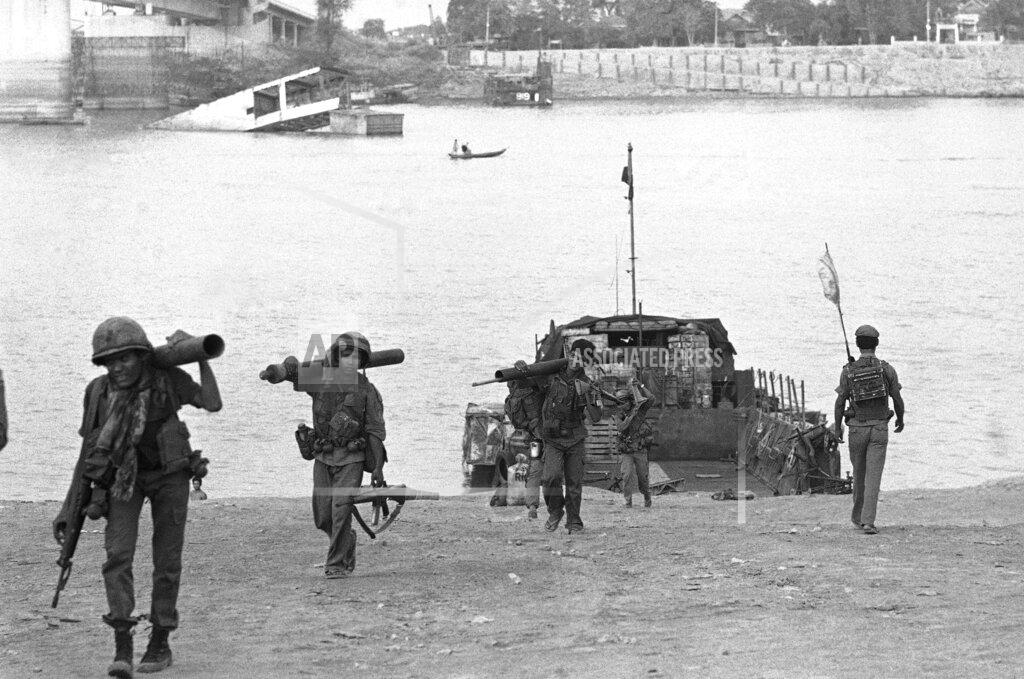
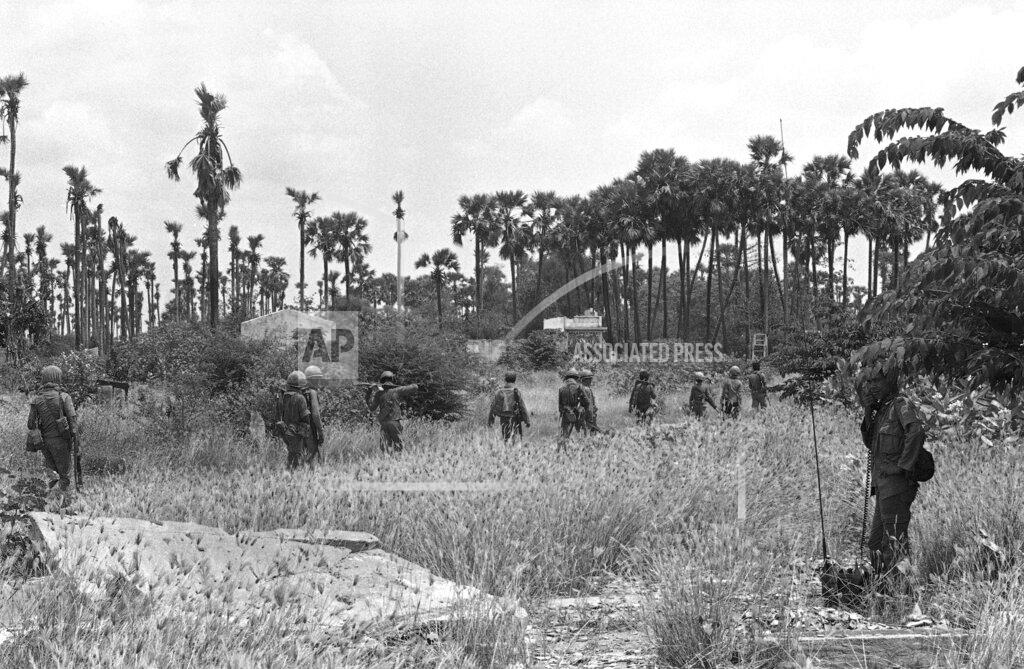
The End approaches in Đà Nẵng.
#
“I met a girl who sang the blues. And I asked her for some happy news. But she just smiled and turned away.”
#
North Vietnamese troops, closing in on the northern city of Đà Nẵng, seized a city only 15 miles away, a Saigon government spokesman said early today. With evidence increasing that large segments of the government’s army were fast disintegrating, the spokesman termed the situation in the Đà Nẵng enclave, Saigon’s last remaining territory in the northern part of the country, “very serious.” He said both the city land its principal airport came under shelling early this morning. But communications with the area were uncertain, and it could not be determined whether the North Vietnamese had already driven closer than Hội An, the nearby city they had just overrun. Hội An, capital of Quảng Nam Province in which Đà Nẵng is situated, was the 13th provisional seat to fall to the Communists.
The 12th, it had been reported only hours earlier, had fallen early yesterday here in the southern part of the country, 93 miles northeast of Saigon. North Vietnamese soldiers, arriving in trucks, took over Bảo Lộc, capital of Lâm Đồng Province. The defenders of the city, a ramshackle community of 49,000 people, were said to have fled. All through yesterday, Đà Nẵng, swollen with half a million refugees or more, was reported in chaos. Efforts to evacuate some of them by air had to be suspended as thousands swarmed over the city’s two airfields.
Government troops were commanded to restore order in 48 hours and to shoot violators at sight. In this chaotic situation, it could not be determined how extensive the shelling reported by the Saigon spokesman was or even who was doing the firing. It appeared possible that Saigon artillery units themselves were in action against other Saigon units. However, the Saigon spokesman was able to confirm that North Vietnamese troops had occupied Hội An, a city 15 miles southeast of Đà Nẵng on Route 1. Among other developments that stirred alarm here in Saigon were the following:
- North Vietnamese troops appeared to be continuing an advance along the central coastal plain that began Thursday. An outpost in Bình Định Province was reported overrun, two district capitals were shelled and many residents of Quy Nhơn, a major port city, were said to be moving southward to Nha Trang.
- A Saigon military spokesman, reporting on action 40 miles north of the capital, said government troops had repulsed a North Vietnamese infantry and tank assault on Chơn Thành, a district capital on the northern boundary of Saigon’s defense perimeter. He said that the Communist attacks there were viewed as the possible start of a much larger campaign to seize the capital.
- South Vietnamese sources estimated that the Saigon the last two weeks. Included were planes, tanks, artillery and armored personnel carriers.
As with the reported capture of Bảo Lộc, 93 miles northeast of Saigon, most towns and military posts have fallen to the Communists with virtually no fighting.
While the evacuation of refugees from Đà Nẵng was suspended yesterday, the United States consul general there, Albert A. Francis, was flown out during the afternoon in a helicopter belonging to Air America, which makes charter flights in Southeast Asia for the United States Government. Searches were being made in the city for Americans who might still be there. So far more than 300 Americans, including about 80 officials, have been evacuated from Đà Nẵng in the last two days.
In Saigon, General Frederick C. Weyand, the Army Chief of Staff, met with President Nguyễn Văn Thiệu yesterday morning, presumably to discuss the deteriorating military situation. General Weyand, the last commander of American forces in Vietnam, is here for three or four days at the request of President Ford. He was accompanied to the presidential palace by Ambassardor Graham A. Martin, who arrived with General Weyand from Washington.
According to United States officials in Saigon, 9,000 to 10,000 refugees were evacuated from Đà Nẵng yesterday aboard the Pioneer Contender, a cargo vessel chartered to the Defense Department. They were to be taken to Cam Ranh Bay on the central coast, site of a former American base. A United States Navy cargo ship and another ship under charter to the Pentagon were headed for Đà Nẵng to help in the evacuation. As the evacuation by air was suspended, a World Airways Boeing 727 jet chartered by the United States Embassy here had to make an emergency take‐off from Đà Nẵng with only a partial load of refugees as others, including families of South Vietnamese Air Force officers, clung to its loading ladder. According to the account of a pilot, some refugees had to be sprayed with Mace to clear a path for the plane.
Intelligence reports on North Vietnamese movements in the Saigon area were said to indicate that a major push on the Capital from the Tây Ninh area to the northwest might begin within days. Communist troops reportedly shelled or attacked outposts in four districts of Tây Ninh Province yesterday and fired 10 rockets into Tây Ninh city. A military spokesman said Saigon troops defending Chơn Thành yesterday had killed 162 Communist soldiers, and knocked out four tanks. These, the spokesman said, were in addition to the nearly 100 Communist soldiers reported killed and eight tanks destroyed in a battle the day before.
The Saigon command reported small, scattered fighting in the Mekong Delta south of the capital. The command said government troops fighting in the center of the country had lost an outpost near the district capital Hoài Nhơn. According to Western officials, the province capital Bảo Lộc was captured yesterday by the North Vietnamese 271B independent regiment, which first made its appearance in South Vietnam last fall. It had been operating recently in Quảng Đức Province, which Saigon troops abandoned in the last week.
The Ford administration was trying to decide how far the United States could and should go in evacuating civilian refugees and possibly troops from the surrounded South Vietnamese port city of Đà Nẵng. Once the United States is involved in a large-scale evacuation, State and Defense Department officials say there is an eventual possibility that President Ford might have to decide whether to send troops to protect the refugees as they are evacuated, and to preserve order.
If American troops are used, even if only for what was described as humanitarian purposes, it is the consensus of officials that the President would have to obtain Congressional permission in the light of legislation prohibiting “the involvement of United States military forces in hostilities.” It was largely because of this Congressional restriction, according to officials, that the Administration devised at least outwardly a civilian sealift and airlift to start getting refugees out of Đà Nẵng.
In the meantime, the United States Embassy in Saigon, using its contingency funds, contracted with Air Vietnam to start flying refugees out of Đà Nẵng. But the State Department said today that after 1,800 were taken out the airlift was temporarily halted because of the large numbers of persons crowding the Đà Nẵng airport and runways. The State Department estimated today that as many as a million refugees have fled into Đà Nẵng before the advancing Communist forces. Robert Anderson, the department spokesman, characterized the situation in the city as difficult, grim and tragic.
“We were loading the refugees in an orderly fashion,” said an airline official, “when the Vietnam Air Force trucks arrived full of their families. Then people started shoving and pushing and failing and clawing and climbing and fighting. There were thousands of them. It was a mob scene and we pulled out.” Charles J. Patterson, a senior vice president of World Airways Inc., described the panic that broke out at the big Đà Nẵng air base yesterday, causing the suspension — at least for a day — of the refugee airlift from the surrounded enclave. About a half million refugees from South Vietnam’s northern provinces now occupied by the North Vietnamese have fled in fear of the fighting and of what the occupiers might do to them and their families.
Pentagon officials acknowledge that, probably, not enough ships and planes could be assembled to remove all the civilian refugees from Đà Nẵng before the city itself comes under attack by North Vietnamese forces. Within the Pentagon, there is considerable doubt that the South Vietnamese Government forces — three divisions, only two regarded as effective — will be able to defend Đà Nẵng against an estimated five North Vietnamese divisions encircling the city on the northern coast.
[Ed: It’s too late to do much of anything for Đà Nẵng.]
The South Vietnamese have lost more than $1 billion in American weapons and equipment over the last two weeks, according to qualified Vietnamese sources. The abandonment of the equipment, including artillery pieces, trucks, tanks and planes, coupled with the rapid retreat of army units is viewed by Vietnamese and Western sources as a stunning and possibly irreversible military and psychological blow for South Vietnam. A senior Western official, who has spent more than a decade in South Vietnam, said today: “These losses are very, very, very considerable. It’s a catastrophic loss.”
Another informed Western source said: “We’ve made no attempt to quantify the loss, but it’s staggering. The equipment has not been saved at all and we’re facing a devastating failure.” An informed Vietnamese said that the armed forces logistics command, which controls the inventory of all military equipment, had made a tentative estimate of at least $1‐billion in equipment losses — virtually all of it left over by the Americans — as a result of the government’s abrupt decision to abandon two‐thirds of the nation and the hasty, panicky exodus of civilians and troops that followed.
These losses are expected to be a key topic of discussion between Gen. Frederick C. Weyand, the Army Chief of Staff, who was sent here by President Ford to assess the deteriorating military situation, and Vietnam officials. General Weyand and Ambassador Graham A. Martin met this morning with President Nguyen Van Thieu for over an hour but there was no information on their discussion. The general is expected to remain here for several days.
American officials ordered the airlift of rice, fuel and ammunition to Phnom Penh suspended again yesterday, but a United States Embassy spokesman said that it would resume today. The spokesman said that a daily evaluation would now be made to determine whether the airlift should proceed on that day. The official said that the security situation had worsened overnight but that there were fewer rockets this morning. The flights were suspended after Communist‐led insurgents began another heavy barrage of rockets and artillery on the military side of the capital’s airfield used by the airlift planes. Nearly 50 rounds struck the field before dusk yesterday.
The insurgents are shelling the field from positions north and northwest of Pochentong Airport, which lies just west of the city. The military situation near those positions continued to deteriorate yesterday and a foreign military analyst said that the insurgents had at least three 105‐mm. artillery emplacements. The artillery is far more accurate than rockets and, if used widely, could conceivably prevent any planes from landing. However, the insurgents have been reluctant to fire their howitzers extensively, for fear of exposing the positions.
The foreign military analyst expressed serious concern over the situation due north of the airport where many new rocket positions have begun to appear. These are east of the town of Tuol Leap, which is firmly in insurgent control. In the last two days, the analyst said, insurgent units have breached government lines at several points, and the government has been able to plug these gaps only with military police and engineering brigades.
Western military sources confirmed that there was a “multibrigade operation” north of the airport, but said that the government lines units were, for the present, holding. There are few government reserve forces anywhere in the country that could be moved to the region around Phnom Penh. Earlier this week, elements in the government military command reportedly considered abandoning two provincial capitals — Svay Rieng and Prey Veng. But, according to two foreign military analysts, the plan was dropped. There are simply not enough good front‐line “intervention” troops in those areas worth bringing up to defend the capital, in the analysts’ view.
If the insurgents can push close enough to the airport to begin firing highly accurate mortars into the military side of the field, mortars that have a range of about two miles, they might render the airfield unusable. There are, of course, other contingency plans to supply the capital by airdrop, and there are also substantial stockpiles of rice, fuel and ammunition. “But will the Government troops fight to the last bullet?” one foreign analyst asked, an swering himself with a shrug.
On other fronts, there was little significant action. government forces continued to bombard enemy positions on the eastern bank of the Mekong River opposite Phnom Penh, but there was no evidence that the insurgents were preparing to give way there. Cambodian university students, meanwhile, demanded that both sides in the fighting to lay down their arms and attend a “peace congress” that they are calling for some future date. At a news conference attended by student leaders and about 1,000 others at the University of Phnom Penh, student leaders also condemned aid from the major powers and said that Cambodians should resolve their own problems.
The hospitals are running out of plasma, the electricity comes on for only about four hours every to days, the telephones rarely work any more and the Pepsi Cola plant says it will soon be out of syrup. One does not have to look far for signs that the fabric of this capital city, once the easiest and most charming place to live in Southeast Asia, is slowly disintegrating. It is a refugee‐packed city of over two million people waiting to be taken over by the other side in the civil war — the Communist‐led insurgents, who encircle Phnom Penh and are trying to squeeze it into submission.
Everyone thinks it is only a matter of time, but this is Asia and time is a patient concept, so it could take months or even go into next year. In the meantime the slide continues, with people trying futilely to lead normal lives as rockets rain randomly on the City and the wounded flow in a steady stream into hospitals so swollen with war victims that a dirty piece of floor is all that Most of them have to lie on.
A lot of people die here avery day, but it is the deaths of children that are the most shocking, even affecting doctors supposedly inured to the constant results of five years of carnage. The other day a 6‐year‐old girl was brought in with a gaping shrapnel wound in her chest. She was bleeding into her abdomen and, already beginning to turn white from loss of blood. “We could have saved her,” a disheartened Western doctor said. “All we needed was steady transfusion. But all we had was one pint of blood to give her. She died in an hour.”
The Soviet Union has ordered the Cambodian Government of President Lon Nol to close its embassy in Moscow and to withdraw the staff, the embassy said today.
Secretary General Waldheim has advised the United States that Prince Norodom Sihanouk has turned down his offers to bring together the warring Cambodian sides and try to restore peace to the country.
The Portuguese Socialist leader, Mário Soares, in an interview published by the French Socialist party publication, has bitterly attacked the Portuguese Communists for declaring “bourgeois democracy” to be outdated in Portugal. In the interview with the weekly L’Unité, Mr. Soares said that his party did not accept the prospect of a people’s republic, as Communist governments in Eastern Europe call themselves, where “state capitalism with a socialist facade” would replace the “monopoly capitalism” of the former rightist regime. “Communist party secretary Alvaro Cunhal recently made a declaration according to which bourgeois democracy, as he put it, is outdated in Portugal,” Mr. Soares said. “Could it be the intention of the Communist party to set up a people’s republic in Portugal? We do not accept this prospect.”
France has been closely watching the shifting power balance in Lisbon and the deteriorating relations between Portuguese Communists and Socialists. In France, too, relations between the two parties, are a key factor in the political situation. French Communists and Socialists were allied during the presidential election campaign last spring. After their joint candidate, François Mitterrand, narrowly lost to Valéry Giscard d’Estaing, the Communists began criticizing the Socialists. They charge the Socialists with secretly considering a moue toward the center and support for the Government.
A top Portuguese Communist party member made an unannounced visit to Moscow earlier this week for talks, the party announced today. Otavio Pato, a key figure in the party’s governing political committee, had talks with Konstantin F. Katushev, who is in Charge of the Kremlin’s relations with foreign Communist parties. The Portuguese Communist party said that Mr. Pato had given an account of the situation in Portugal.
Portugal’s ruling High Council of the Revolution outlawed the extreme left‐wing Maoist party today and decreed stiff penalties for anyone involved in political violence in campaigning for the April 25 election. The council said that the Maoists were banned because of the party’s refusal to change its symbol from a hammer and sickte with a black star on a red background. The council ruled the symbol was too similar to the one used by the official Communist party. It was the first outlawing of a political party under the new Government, although two weeks ago the Maoists were denied the right to run in the election for a constituent assembly. Another far‐left group and the Christian Democratic party were also barred from the election.
A fire in the maternity ward at Kucic Hospital in Rijeka, former Yugoslavia, killed 25 infants. An official statement said that “initial investigation into the cause of the fire, made on the spot, indicates that the fire occurred as a result of faults in the electrical installations.” A hospital source said that oxygen had probably leaked from a tank attached to incubators and had fed the flames.
Two time bombs exploded in busy intersections in Jerusalein today as the city was crowded with Christian pilgrims observing Good Friday and Jews celebrating the second day of Passover. Thirteen persons were injured, none seriously. The bombings, apparently synchronized, occurred five minutes apart in the Jewish sector of the city. A report from Beirut, Lebanon, monitored here said that the Palestine Liberation Organization had assumed responsibility for the attacks. All those injured were in a bus that had halted at traffic light. A passenger was believed to have planted a delayed‐action bomb before leaving the bus. The blast ripped apart the rear end of the vehicle. The second explosion was on Jaffa Road in downtown Jerusalem. Casualties were averted because two policemen, suspicious of a shopping bag with oranges lying on a bench, cleared pedestrians away just before it exploded.
The assassination of King Faisal of Saudi Arabia may have been carefully planned, not an unreasoned act of a lunatic, according to evidence gathered in an official investigation. There were indications that the accused killer, Prince Faisal lbn Musad Abdel Aziz, a nephew of King Faisal, had political aspects and motives. The Prince has a record of mental illness and drug abuse.
Nationalist Yemeni guerrillas released the kidnapped French Ambassador today, exchanging him in Southern Yemen for two guerrillas who had been jailed in France and 19 gold bars worth $100,000, Government officials said.
A Foreign Ministry spokesman said in Bangkok today that Thailand wanted to withdraw from the Southeast Asia Treaty Organization because it served no useful purpose.
Angola’s rival liberation movements agreed today to end the recent fighting between them that killed more than 60 people and wounded 200. The agreement was announced at the end of nightlong talks in the Angolan capital of Luanda between Portuguese officiais and the West African territory’s three liberation movements. Under the accord, the three movements will integrate their militia units with the 25,000‐man Portuguese force stationed in the territory. The situation in Luanda today was reported calm. But an overnight curfew was still in force.
President Ford will announce in a televised speech at 7:30 tomorrow whether he will veto or sign the $24.8 billion tax-cutting bill passed by Congress this week. The White House press secretary said that Mr. Ford would also make “a statement on economic policy.” The President reportedly was having an extremely difficult time making up his mind and has had sharply conflicting advice from his counselors.
Interviews with Americans across the country indicate a widely held belief that taxpayers rebates of $100 to $200, a key provision of the $22.8billion antirecession tax cut bill now on President Ford’s desk, are too small to be meaningful.
Unless they are careful with their withholding, millions of American taxpayers may find that they owe the government money in 1976 because of benefits in the 1975 tax-cut bill.
Environmental and conservation groups charged today that President Ford’s expected nomination of former Governor Stanley K. Hathaway of Wyoming to be Secretary of Interior would place a man “with a pro-industry bias and a poor environmental record” in charge of the nation’s natural resources.
Many of the nation’s banks and savings institutions have money for home mortgage loans again. Mortgage money, which was all but unavailable a few months ago and often cost upwards of 10 percent in annual interest charges when it was available, is now plentiful and is getting cheaper to borrow. This, however, has had little effect on sales of new homes so far.
The Civil Aeronautics Board gave National Airlines the go-ahead for a “no frills” service that will slash many fares 35 percent for passengers willing to forgo meals and liquor, avoid flying on weekends and buy tickets a week in advance. The reduction will become effective April 14 on National, and on four other airlines, which have proposed similar service, if the expected board approval is forthcoming.
The Federal Trade Commission has secretly voted to break off an 18‐month national investigation of abuses in the sale and management of residential condominiums. The action was especially important for consumers who alreadv own condominiums. The commission was widely regarded as their chief, perhaps their only federal remedy for past arrangements that harm them still. Congress and the Department of Housing and Urban Development are considering new laws and regulations to cover future transactions. The commission has power to challenge unfair practices already engaged in. The commission move was sharply criticized on Capitol Hill. A commission spokesman defended it on budgetary grounds and argued that the investigation had appeared to duplicate a study being conducted by the housing department.
The Food and Drug Administration has decided to take no immediate action on a plea from its own experts to prohibit the sale of three aerosol antiperspirants.
A sniper spraying gunfire from the attic bedroom window of his home killed two policemen and wounded two others in Mount Holly, New Jersey, last night before the man was shot by the police and seized in the house, authorities said.
Comparing the racial slaying of a white youth to the Nazi annihilation of Jews in World War II, a circuit judge has sentenced two black men convicted of second‐degree murder to 199 years in prison. “The facts at trial proved that it was a premeditated racial-hatred murder,” Judge Hudson Olliff said yesterday. “The hapless victim was chosen at random, stalked and brutally murdered only because he was defenseless and because he was of a different racial group than his murderers.” Judge Olliff sentenced Brad Evans, 20 years old, and Dwyne Crittendon, 21. They were among four black men convicted in the death of Stephen Orlando, 18, last June. Jacob Dougan, 27, and Elwood C. Barclay, 23, were previously convicted of first‐degree murder. Judge Olliff said he would sentence Mr. Dougan and Mr. Barclay later. A jury has recommended death for Mr. Dougan and life in prison for Mr. Barclay. Under Florida law, the judge is not bound to follow the recommendations.
A Texas state judge denied today a defense motion for an instructed verdict of acquittal in the capital murder trial of Ignacio Cuevas. Will Gray, the defense attorney, contended that the prosecutor had failed to prove beyond a reasonable doubt that inmates had fired first during an attempted escape from the Texas State Prison in which two hostages and two inmates died. Mr. Gray wanted an acquittal on the capital murder charge so that his client could be tried on a simple charge of first degree murder, for which the death penalty is excluded. But the court refused.
The Justice Department sought today to charge officials of all 232 county and municipal jails in Alabama with violating the constitutional rights of prisoners. Through a motion filed at the Federal District Court in Montgomery, Alabama, the department asked to be named as a plaintiff in a case already brought privately by a Federal prisoner against the Houston County jail.
The strongest earthquake in the United States in four years rumbled through a 400‐mile wide area of the Central Rocky Mountains last night. But no serious injuries and only minor property damage were reported. The quake, which struck at about 8:31 PM yesterday, shook skyscrapers in Salt Lake City. It registered 6.3 on the Richter scale and was the strongest quake in the United States since the 1971 quake that claimed 64 lives in California’s San Fernando Valley, the National Earthquake Information Center in Golden, Colorado said.
Born:
Derek Hill, American auto racer (Ferrari Challenge Int, Formula Dodge 1995; Barber Dodge Pro Series 1996; Goodwood Revival 2006), in Santa Monica, California.
Russell Davis, NFL defensive tackle and defensive end (NFL Champions, Super Bowl 42-Giants, 2007; Chicago Bears, Arizona Cardinals, Seattle Seahawks, New York Giants), in Hampton, Virginia.
James Allen, NFL running back (Chicago Bears, Houston Texans), in Wynnewood, Oklahoma.
Omar Brown, NFL defensive back (Atlanta Falcons), in York, Pennsylvania.
Daniel Pope, NFL punter (Kansas City Chiefs, Cincinnati Bengals, New York Jets), in Alpharetta, Georgia.
Todd Doxzon, NFL wide receiver (Miami Dolphins), in Sioux City, Iowa.
Julio Zuleta, Panamanian MLB first baseman, pinch hitter, and outfielder (Chicago Cubs), in Panama City, Panama.
Steve Sparks, MLB pitcher (Pittsburgh Pirates), in Mobile, Alabama.
Richard Kelly, American film writer and director (“Donnie Darko”), in Newport News, Virginia.
Shanna Moakler, American model, beauty queen (Miss USA, 1995), and actress (“Pacific Blue”; “Meet The Barkers”), in Providence, Rhode Island.
Will Cain, American radio and TV journalist (“The Will Cain Show”), in Sherman, Texas.


 History Diaries