Heinrich Himmler authorizes the construction of a concentration camp at Auschwitz near Kraków, Poland. The site is convenient because it has served as an Austrian and later Polish Army barracks and a camp for transient workers. There already are 16 buildings on the site in various states of disrepair. Himmler has a vague idea of housing political prisoners there.
In the Saar and Vosges regions, there are perfunctory artillery duels between German and French forces.
The New York Times editorializes: “PARIS: Thoughtful observers here do not expect any change on the Western Front for a long time to come.”
Robert Ley, long-time boss of the Nazi Labour Front and a close Hitler crony notes today that war “is a blessing, as women love fighters.” His tall, blonde wife, Inge, is a close friend of Hitler, and some wonder just how close.
The Berlin fire department, aided by rain and snow, early today brought under control a fire that raged for two hours in a factory reported to be manufacturing small arms ammunition; but which is described officially as an electrical products plant.
The French government requested the Soviet Union to recall its ambassador to Paris, France. Strained relations between Russia and France appeared early today to have reached the breaking point, with semi-official dispatches from Moscow stating that the Soviet ambassador to France, Jakob Surits, had been “freed from his functions as Soviet ambassador in France.” The dispatches said the French government had declared his presence in Paris no longer was desirable. French officials refused to confirm or deny immediately that the government had formally requested Moscow to recall Surits, who has been in Paris since April, 1937. Newspapers in Paris were urging the government to close the Soviet embassy here and the campaign to break off diplomatic relations with Russia is gaining headway.
The newspapers were prompted by Premier Paul Reynaud’s declaration in the chamber of deputies last Friday that Germany has been “aided by the treason of the Soviets.” Surits, who has stuck to his post despite the rising French feeling against Russia, is expected to leave quickly for Moscow. Informed sources considered it unlikely that the French government would approve the nomination of any Soviet envoy as successor to the recalled ambassador. Paul Nagglar, the French ambassador to Russia, already has left his post, having returned to Paris ostensibly on sick leave. (Sir William Seeds, the British ambassador to Moscow, has been in London on leave for several months. Russia’s envoy to London, Ivan Maisky, still is at his post) Surits’ recall widened the gap between France and Russia that has been growing steadily since the Soviet joined forces with Germany last August in a friendship pact.
The French, replying to the Soviet Invasions of Poland and Finland, have dissolved the Communist party in France, raided Soviet agencies in Paris, and installed close police watch over the Russian embassy. Communist Former Deputies on Trial Forty-four Communist former deputies now are on trial before a military tribunal for action against the interests of the state. The party is banned; several leaders have been deprived of French citizenship and sentenced to prison terms in absentia.
The Supreme War Council is to meet on 28 March, so the British War Council takes up French Prime Minister Paul Reynaud’s proposal that the Allies attack the Soviet oil fields at Baku and Soviet shipping in the Black Sea. The decision is unanimous to oppose this plan and to continue the policy of avoiding direct conflict with the Soviet Union. The true purpose of Reynaud’s proposal is perhaps indicated by the fact that it is leaked to the press, which the British find highly objectionable for such sensitive matters. The British, or at least Winston Churchill, consider this to have been done for domestic political purposes. The British tell General Gamelin and his colleagues of this decision at a preliminary meeting.
An editorial in the Daily Mail notes the massive propaganda head start by the Nazis, led by Dr. Goebbels, in propaganda and urges effective British propaganda in response. While the British, particularly Churchill, have engaged in some very subtle propaganda during occasional speeches, the Nazis have been broadcasting nightly.
Pope Pius XII gave his first public audience today since before Lent and characteristically took the opportunity to speak critically of Russia and Germany.
Russia has protested to Finland because Soviet troops occupying Hanko peninsula, leased from the Finns under terms of the peace treaty, have not been able to obtain electricity, water and food from adjacent Finnish territory. The Finns have not yet answered the Russian demand that such supplies be made available at once. Meanwhile, the Soviets are forced to rely on supplies brought in by the ice-breakers, including coal brought all the way from the Donetsk Basin coal fields.
Finland shifted governmental gears from war to peacetime speed today by setting up a new cabinet devoted to reconstruction of the nation and its future defense. The old cabinet resigned, its work of running the war and making the peace accomplished, and President Kyösti Kallio simultaneously announced formation of the new cabinet. Premier Risto Ryti, who remained as head of the government, called his new cabinet into meeting tonight and mapped out Finland’s reconstruction program, the keynote of which was an expectation of loans from Finland’s friends abroad. He indicated also that the task of alleviating the plight of Finns who have lost their property may become the responsibility of those whose property was untouched. This he described as a “one-for-all” sacrifice.
An agreement was reached today between the Anglo-French commands in the near east and members of a Turkish military mission after conferences in Aleppo, Syria, lasting a week. The Turkish mission, headed by two generals, came to Syria to dis cuss application of military clauses of the tripartite mutual aid agreement between Britain, France, and Turkey. Similar conferences had been held in Turkey but this was the first outside of Turkey. When the conference opened, military circles said that plans for collaboration of the three forces in an emergency were well advanced. Britain and France, especially the latter, have massed strong forces in the near east, the French forces being concentrated in Syria under command of General Maxime Weygand, who in the event of hostilities probably would command all allied forces.
There are air battles across the Maginot Line. The Luftwaffe loses 5-7 Bf 109s according to the RAF.
RAF bombers unsuccessfully attack German shipping in the North Sea. / RAF Coastal Command – A German patrol vessel bombed and sunk in North Sea.
The German U-boat U-22, commanded by Kapitänleutnant Karl-Heinrich Jenisch, sailed from Wilhelmshaven to operate east of the Pentland Firth on 20 March 1940 and two days later was ordered to temporarily patrol off Ryvingen, Norway. The boat sent no messages after leaving port and vanished with all hands. It was reported missing on this day in 1940. Presumably she hit a mine and sank in North Sea. The entire 27 man crew was lost. During its career under Kapitänleutnant Jenisch the U-22 sank one warship and two auxiliary warships and sank six merchant ships for a total of 7,344 tons.
In Norwegian waters, a trawler pulled the Type IIB German U-boat U-21 free from where it had ran aground off Mandal, Vest-Agder, Norway (58°01′N 7°29′E) the day before. The U-boat then entered a Norwegian harbor and was interned at Kristiansand-Sud until 9 April 1940.
The Marine Nationale (French Navy) auxiliary patrol boat AD 381 Blei Mor sank off Dunkerque, Nord after running in a sandbank during a storm.
Convoy OA.118 departs Southend.
Convoy OB.118 departs Liverpool.
Convoy HN.22 with four British, nineteen Norwegian, ten Swedish, three Danish, and four Finnish ships departed Bergen escorted by destroyers HMS Kimberley, HMS Kashmir, HMS Escapade, HMS Zulu, HMS Faulknor, and HMS Tartar. The six ships of the west coast section of the convoy was escorted by Kimberley and Kashmir. After the convoy was dispersed off Cape Wrath, Kimberley and Kashmir arrived at Scapa Flow at 1800/29th. On the morning of 30 March, convoy HN.22 arrived at Methil, escorted by Faulknor, Zulu, Tartar and Escapade.
Convoy ON.23 with six British, eleven Norwegian, four Swedish, two Danish, and two Finnish ships for Norway and one for Aberdeen departed Methil at 1400 escorted by destroyers HMS Javelin, HMS Janus, HMS Juno, and HMS Eclipse and submarine HMS Porpoise. Anti-aircraft cruiser HMS Calcutta departed Sullom Voe on the 29th and provided anti-aircraft support for the convoy. At 0130/29th, destroyers HMS Eskimo, HMS Punjabi, HMS Bedouin departed Kirkwall and joined the convoy with the two ships of the Kirkwall section. Destroyer JANUS was detached for boiler cleaning and repairs. Light cruisers HMS Galatea and HMS Arethusa departed Rosyth on the 28th and provided close cover for the convoy. On the 28th, anti-aircraft cruiser HMS Cairo departed Sullom Voe to assist when German aircraft began to shadow the convoy. On the 31st, convoy ON.23 arrived at Bergen.
Convoy FN.130 departed Southend, escorted by sloops HMS Auckland and HMS Hastings. The convoy arrived in the Tyne on the 29th.
Convoy FS.131 of thirty one ships departed the Tyne escorted by sloop HMS Pelican and destroyer HMS Vivien. The convoy arrived at Southend on the 29th.
The War at Sea, Wednesday, 27 March 1940 (naval-history.net)
Battleships RODNEY, VALIANT, and WARSPITE and destroyers FEARLESS, FORESTER, HUNTER, HASTY, HERO, HOTSPUR, HARDY (D.2), HOSTILE, and HYPERION arrived at Scapa Flow at 1100. Battlecruisers RENOWN and REPULSE and destroyers INGLEFIELD, DELIGHT, DIANA, ILEX, FORTUNE, and BEDOUIN arrived at Scapa Flow at 1100.
From dawn on the 27th to 0900, destroyers SOMALI (D.6), ESKIMO, PUNJABI, FAME, FORESIGHT, and MATABELE swept southbound along the west coast of the Orkneys from Brough Head, then westward along the coast of Scotland to 4-10W before arriving arrived at Scapa Flow at 1600/27th. Destroyers COSSACK, SIKH, NUBIAN, and FOXHOUND remained in the northern area until ordered at 1322 to return to Scapa Flow for shelter from heavy weather. They arrived at 1700.
Armed merchant cruisers SALOPIAN and WORCESTERSHIRE arrived at Greenock from Northern Patrol.
Armed merchant cruiser MALOJA departed Greenock on Northern Patrol.
Heavy cruiser YORK departed Scapa Flow on Northern Patrol.
Armed merchant cruiser PATROCLUS departed Liverpool on Northern Patrol.
Destroyer AFRIDI departed Hartlepool after repairs for Scapa Flow, and arrived at 0845/28th. Flotilla Commander Captain D.4 transferred from destroyer COSSACK back to AFRIDI.
Destroyer ELECTRA arrived at Rosyth from Scapa Flow.
Destroyer GRIFFIN departed Dundee after repair for the Moray Firth Patrol.
Sloop BITTERN departed Leith and arrived at Rosyth after refitting.
Destroyers IVANHOE, IMPULSIVE, FIREDRAKE, and ESK on Moray Firth Patrol proceeded to Invergordon for shelter from heavy weather, arriving at 1930.
Destroyers IMOGEN, ISIS, and HAVOCK arrived at Scapa Flow at 1545 from Plymouth.
Destroyer MOHAWK arrived at Scapa Flow at 1900 after repairs from her collision in the Clyde on the 2nd.
Submarines STERLET and SEAWOLF were reassigned billets in the North Sea after a report of two German K cruisers being at sea.
Convoy HN.22 with four British, nineteen Norwegian, ten Swedish, three Danish, four Finnish ships departed Bergen escorted by destroyers KIMBERLEY, KASHMIR, ESCAPADE, ZULU, FAULKNOR, and TARTAR. The six ships of the west coast section of the convoy was escorted by KIMBERLEY and KASHMIR. After the convoy was dispersed off Cape Wrath, KIMBERLEY and KASHMIR arrived at Scapa Flow at 1800/29th. On the morning of 30 March, convoy HN.22 arrived at Methil, escorted by FAULKNOR, ZULU, TARTAR, and ESCAPADE.
Convoy ON.23 with six British, eleven Norwegian, four Swedish, two Danish, two Finnish ships for Norway and one for Aberdeen departed Methil at 1400 escorted by destroyers JAVELIN (SO), JANUS, JUNO, and ECLIPSE and submarine PORPOISE. Anti-aircraft cruiser CALCUTTA departed Sullom Voe on the 29th and provided anti-aircraft support for the convoy. At 0130/29th, destroyers ESKIMO, PUNJABI, and BEDOUIN (took over as SO) departed Kirkwall and joined the convoy with the two ships of the Kirkwall section. These two steamers in the sailing breakdown from Methil. Destroyer JANUS was detached for boiler cleaning and repairs. Light cruisers GALATEA and ARETHUSA departed Rosyth on the 28th and provided close cover for the convoy. On the 28th, anti-aircraft cruiser CAIRO departed Sullom Voe to assist when German aircraft began to shadow the convoy. On the 31st, convoy ON.23 arrived at Bergen.
Sloop ROCHESTER was damaged in collision with steamer LONGFORD (1913grt), and was repaired at Liverpool, completing on 27 June.
Convoy FN.130 departed Southend, escorted by sloops AUCKLAND and HASTINGS. The convoy arrived in the Tyne on the 29th.
Convoy FS.131 of thirty-one ships departed the Tyne escorted by sloop PELICAN and destroyer VIVIEN. The convoy arrived at Southend on the 29th.
French destroyers FOUDROYANT and BOULONNAIS arrived at Dover with General Gamelin and Amiral Darlan, the heads of the French Military and Naval Missions respectively. After conferences, FOUDROYANT left on the morning of 29 March with Amiral Darlan and his party, and BOULONNAIS that afternoon with General Gamelin and his party.
Light cruisers CERES and COLOMBO departed Colombo for Australia, reached Fremantle on 12 April, and then Singapore on the 31st where both were held for convoy duty from that port.
Tanker TROCAS (7406grt) was disabled off the Italian coast with a broken propeller shaft, and taken in tow by Australian destroyer HMAS STUART which was relieved later in the day by tug RESPOND. The tanker was safely taken to Malta.
French armed trawler VICTORIA and submarines ESPADON and FRESNEL departed Casablanca on the 26th and arrived at Gibraltar. The trawler departed Gibraltar on the 29th to return to Casablanca. FRESNEL carried on escorted by destroyer SIMOUN, arrived at Gibraltar that day and reached Toulon on the 30th. Meanwhile, ESPADON remained at Gibraltar until 4 April for anti-submarine exercises.
Minesweeper HUNTLEY arrived at Suez for duty with the Mediterranean Fleet, and remained until May when she was transferred to the East Indies Command.
In Washington today, President Roosevelt conferred with officials of the Works Progress Administration and the Budget Bureau on relief needs and. appropriations, signed the $1,032,801,095 Treasury-Postoffice Appropriation Bill, and appointed Robert E. Doherty a member of the National Aeronautical Committee.
The Senate considered the resolution to extend the trade treaty program and recessed at 5:14 PM until 11 AM tomorrow. The Foreign Relations Committee approved a resolution for an investigation of foreign propaganda in this country.
The House considered the Labor-Social Security Appropriation Bill and adjourned at 5:08 PM until noon tomorrow. The Military Affairs Committee heard Secretary Woodring and other War Department officials explain the administration’s airplane export policy, a Judiciary Subcommittee approved an amendment to the Hatch bill which would limit national campaign expenses of political parties to $3,000,000 in any one year, and the Ways. and Means Committee heard Representative Patman ask approval of the Chain Store Tax Bill.
Despite cries of “how are you going to pay the bill,” the house today added $67,450,000 to next year’s appropriations for the C.C.C. and the N.Y.A. Subject to final confirmation tomorrow, the supporters ran roughshod over economy forces, adding $50,000,000 to President Roosevelt’s request for $230,000,000 for civilian conservation camps and upping by $17,450,000 his request for $35,000,000 for the national youth administration. Both increases, their sponsors said, would insure continuance of the 1941 N.Y.A. and C.C.C. programs at present levels. Representative Woodrum, Virginia Democrat house economy bloc leader, asserted a “tragic thing” had just occurred. Woodrum shouted: “If we are now going to go ahead pell-mell, and appropriate, then I submit to you that it is honest to decide somewhere how you are going to pay the bill. Are you going to have a tax bill or are you going to raise the debt limit and borrow the money?”
In a sudden reversal of policy, President Roosevelt decided today to let Congress determine for itself the adequacy of a $1,000,000,000 relief appropriation in the next fiscal year without further recommendations from the White House, but with the understanding that it assumed full responsibility for heavy cuts in WPA rolls after July 1. Although the President put relief requirements for the new fiscal year at $1,000,000,000 in his January budget estimate, he said additional funds would be necessary “if conditions fail to meet our hopes.” He added that in the latter event he might submit “revised estimates later in the session.” Since that time, Administration spending advocates have urged that the estimate for relief be increased by $300,000,000 to $500,000,000, to keep WPA rolls at an average level of about 2,000,000 and make unnecessary the dropping of about 500,000 workers, which WPA officials assert would result under a $1,000,000,000 appropriation.
A proposal for an investigation of foreign propaganda disseminated in the United States was approved unanimously today by the Senate Committee on Foreign Relations. It voted to report favorably a resolution offered by Senator Clark of Missouri, suggesting such a study and appropriating $25,000 to conduct it. The resolution was introduced early last Fall, soon after President Roosevelt called Congress in special session to revise the neutrality law with the expressed intent of lifting the embargo on exports of arms, munitions and implements of war to belligerent countries.
The Pittman amendment to require Senate ratification of future reciprocal trade agreements with foreign nations has gained such support that Administration leaders concede it may be adopted.
A limit of $3,000,000 for political expenditures by party national committees was approved unanimously today by a House Judiciary subcommittee as an amendment to the Hatch “clean politics” bill adopted recently by the Senate.
Representatives of the Administration made a public explanation today before the House Military Affairs Committee of its decision to permit Great Britain and France to buy about 2,100 airplanes ordered by the American Army. They apparently won the approbation of the committee for the program.
Maine Democrats joined the Roosevelt third term movement today, pledging their 10 national convention votes to the president should he seek reelection, with National Chairman James A. Farley second choice. The resolution pledging the votes to Roosevelt was carried on a voice vote by the 1,800 delegates to the state convention with comparatively few “nays” registered.
Mayor Maury Maverick of San Antonio, former new deal congressman opened a third term drive in Texas tonight with the declaration that the state’s native son, Vice-President Garner, could not obtain the Democratic presidential nomination if President Roosevelt did not approve.
One English and two Netherlands liners arrived in New York this morning from Europe with passenger lists consisting almost exclusively of German and Austrian refugees. The three ships carried 484 refugees, and a total of 620 passengers.
On the grounds that they are “obscene and indecent,” two motion pictures have been banned by police from showing in Detroit, Michigan. The pictures are “Strange Cargo,” co-starring Clark Gable and Joan Crawford, and “Primrose Path,” with Ginger Rogers as the star.
A dredge was towed to Midway Atoll in the Pacific west of Hawaii to begin work to enlarge the basin and channels between the two main islands.
Yesterday’s attempted revolt was definitely quelled today with the confinement of Javier Paz Campero, Gabriel Gonsalvez, Jose Tamayo and Roberto Jordan Cuellar, Leftist leaders, the first three of whom were defeated in the last elections.
A second Soviet freighter, the Vladimir Mayakovsky, allegedly loaded with metals and bound from the United States west coast to Vladivostok, had been caught in the British blockade net at Hong Kong. A London foreign office spokesman was quick to say that Soviet-British relations had not been strained in any way by the seizure.
Second Battle of Wuyuan: Chinese 8th War Area attacking around Patzepu, Hsishantzu, Hsichiao, and Mankosu. The Japanese retain possession of Wuyuan, but local Chinese forces continue to pressure them. Japanese Army headquarters in Peiping said their forces withdrew from Wuyuan after a month’s occupation on February 20 and that Chinese soldiers had returned to the city, prompting renewed Japanese action, which resulted yesterday in reoccupation of Wuyuan. The Japanese said they lost thirteen dead and seventy wounded while killing 1,500 Chinese. The Chinese reported they were continuing to push to the east beyond Wuyuan and were attacking Japanese reinforcements dispatched from Paotow, western terminus of the railroad to Peiping.
Peter Fraser became the new Prime Minister of New Zealand when Michael Joseph Savage died in office from cancer.
Dow Jones Industrial Average: 147.47 (+1.61)
Born:
Lindy Infante, American football player and coach, in Miami (d. 2015).
Austin Pendleton, American actor (“Short Circuit”; “Simon”; “Hello Again”), in Warren, Ohio.
June Wilkinson, English actress (“Absolutely Glamorous”), in Essex, England, United Kingdom.
Janis Martin, American rockabilly and country singer (“Will You Willyum”; “Drugstore Rock ‘n Roll”), in Sutherlin, Virginia (d. 2007).
Died:
Michael Joseph Savage, 68, 23rd Prime Minister of New Zealand.
Naval Construction:
The U.S. Navy Atlanta-class light cruiser USS San Diego (CL-53) is laid down by the Bethlehem Shipbuilding Corp. (Quincy, Massachusetts, U.S.A.).
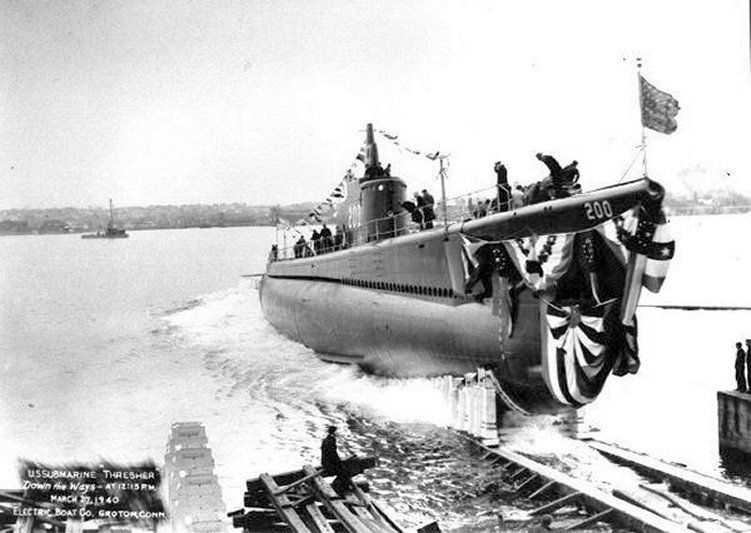
The U.S. Navy Tambor-class submarine USS Thresher (SS-200) is launched by the Electric Boat Co. (Groton, Connecticut, U.S.A.).
The Royal Navy Hunt-class (Type I) escort destroyer HMS Quorn (L 66) is launched by J.S. White & Co. (Cowes, U.K.).
The Royal Navy Dido-class light cruiser HMS Cleopatra (33) is launched by Hawthorn Leslie & Co. (Hebburn-on-Tyne, U.K.).
The Royal Australian Navy Bar-class boom defense vessel HMAS Koala (Z 69) is commissioned.
The Svenska Marinen (Royal Swedish Navy) HSwMS Psilander (18), formerly the Regia Marina Sella-class destroyer Giovanni Nicotera, is commissioned.
The Svenska Marinen (Royal Swedish Navy) HSwMS Puke (19), formerly the Regia Marina Sella-class destroyer Bettino Ricasoli, is commissioned.




 History Diaries